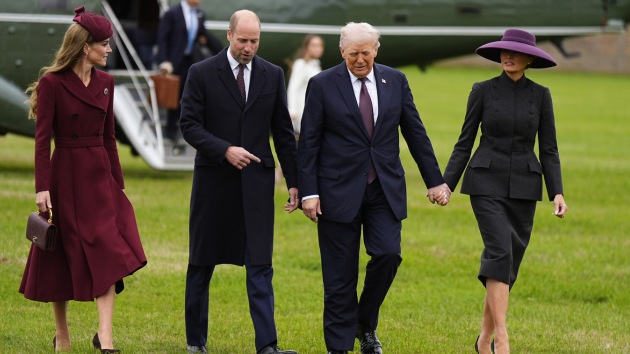
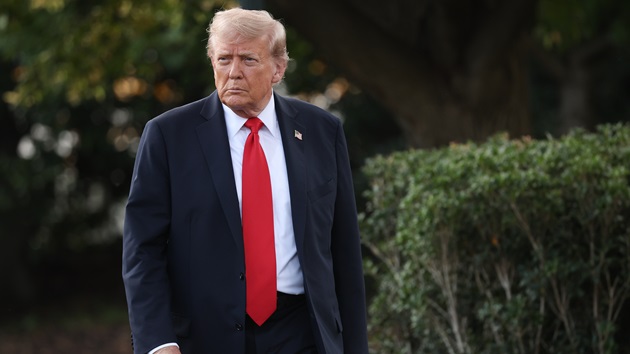
(LONDON) — President Donald Trump kicked off his state visit to the U.K. on Wednesday by traveling to Windsor Castle to meet with King Charles III.
Trump is the first elected political leader in modern times to be hosted for two state visits by a British monarch, having already been hosted by the late Queen Elizabeth II in 2019.
The president and first lady Melania Trump will attend a state banquet with the royal family in Windsor on Wednesday evening.
Trump arrived at Windsor Castle aboard Marine One on Wednesday, having spent the night at Winfield House in central London. He and Melania Trump were greeted in the castle’s Walled Garden by Prince William and his wife, Kate Middleton.
Thursday will see Trump meet with British Prime Minister Keir Starmer at Chequers, the prime minister’s official country residence in Aylesbury. The two men are expected to hold a press conference before Trump begins his journey back to the U.S.
During a background call on Monday with reporters, White House officials said that this visit will highlight what they called the deep ties between the United States and the United Kingdom.
“This historic second state visit is set to highlight and renew the special relationship between the United States and the United Kingdom. At the same time, the visit will recognize and celebrate the upcoming 250th anniversary of the founding of the United States,” a White House official told reporters during a background call previewing the trip.
Trump will be greeted by a joint U.S.-British flypast of F-35 fighter jets. Around 1,300 members of the British armed forces accompanied by 120 horses will be involved in the ceremonial welcome at Windsor Castle.
The guard of honor at Windsor will be the largest ever organized for a state visit to the U.K.
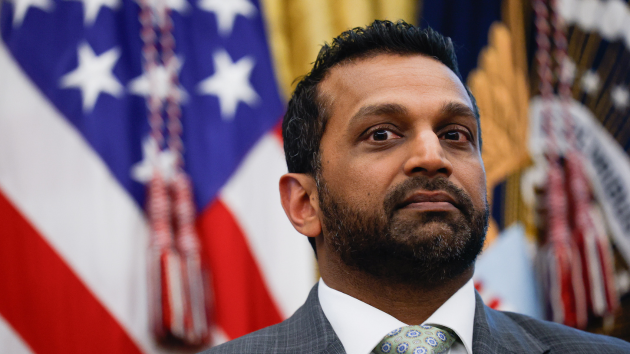
(WASHINGTON) — FBI Director Kash Patel faced questions about the assassination of conservative activist and influencer Charlie Kirk last week — including that other people could be involved — when he appeared before a Senate Judiciary Committee hearing Tuesday.
In his appearance, his first in two days of hearings on Capitol Hill, Patel addressed his handling of the Kirk investigation — something he faced criticism for after he shared on social media at one point that a suspect was in custody, but then had to backtrack an hour and a half later.
Ranking Member Dick Durbin, a Democrat, slammed Patel during his opening remarks on Tuesday, saying Patel sparked “mass confusion” in his posts about Kirk’s killing. Patel stood by his performance, touting the fact that Kirk’s suspected shooter was caught in less than 36 hours.
Patel said he directed authorities to release the photo of the suspect, 22-year-old Tyler Robinson, in the Kirk shooting. Kirk was killed in Utah on Wednesday and Robinson was apprehended after his father recognized him in photographs released by authorities, Utah Gov. Spencer Cox said on Friday. His father told Robinson to turn himself in, with the 22-year-old initially saying no, but later changing his mind, officials said.
Patel contends this only happened because he ordered “against all law enforcement recommendations,” as he said on X on Saturday, the release of video and enhanced photos of the suspect.
“We cannot do our job without the American public and credible reporting in the media,” Patel said. “And that’s why Tyler Robinson is in custody today about to face charges.”
Patel addressed criticism that he has faced for how he handled the investigation on “Fox & Friends” on Monday morning.
“I was telling the world what the FBI was doing as we were doing it. I continue to do it. I challenge anyone out there to find a director who has been more transparent and more willing to work the media with high profile cases or any cases that the FBI [is] handling.”
The online messaging platform, Discord confirmed reports that about two hours before Robinson was taken into custody last week, the alleged shooter posted messages to a small group of friends on the platform that said, “Hey guys, I have bad news for you all … It was me at UVU yesterday. im sorry for all of this.”
Patel addressed the Discord message during the hearing, saying that the FBI is investigating “anyone and everyone involved in that Discord chat” with Robinson. Patel said there are “a lot more” than 20 people linked to Robinson on Discord, “and we’re running them all down. … Every single one.”
“There are a number of individuals that are currently being investigated and interrogated, and a number yet to be investigated and interrogated, specific to that chat room. So we are very much in our ongoing posture of investigation,” Patel said, adding that other people could be involved.
President Donald Trump appears to be standing behind Patel. Asked for his thoughts on Patel’s performance so far Tuesday morning, Trump said he supports Patel and that he has “confidence in everyone in the administration.”
The Epstein investigation
Patel is facing questions on a host of other issues while he has been at the helm of the FBI, including the handling of the Jeffrey Epstein files.
The Trump administration has been dealing with blowback it received from MAGA supporters for its decision to not release more materials related to the investigation into Epstein, the wealthy financier and convicted sex offender who died by suicide in jail in 2019.
Epstein, whose private island estate was in the U.S. Virgin Islands, has long been rumored to have kept a “client list” of celebrities and politicians, which right-wing influencers have baselessly accused authorities of hiding.
The Justice Department and FBI announced in July that they had found no evidence that Epstein kept a client list after several top officials like Patel, before joining the administration, had themselves accused the government of shielding information regarding the case.
Patel squarely blamed former U.S. Attorney and Labor Secretary Alex Acosta, who initially oversaw the Epstein investigation. Acosta resigned amid controversy over his role in a 2008 plea deal with Epstein and defended his decision, saying his goal “was straightforward” and included putting Epstein behind bars.
“I’m here to testify that the original sin in the Epstein case was the way it was initially brought by Mr. Acosta back in 2006. The original case involved a very limited search warrant, or set of search warrants, and didn’t take as much investigatory material it should have seized,” Patel said. “If I were the FBI director, then it wouldn’t have happened.”
Patel testified that Epstein was not an FBI informant as some have claimed.
Patel spars with Democratic senators
Patel and Democratic Sen. Adam Schiff had a tense exchange amid questions about the Epstein investigation, during which Patel called the California senator a “political buffoon.”
Patel called Schiff “the biggest fraud to ever sit in the United States Senate.”
“You are disgrace to this institution and an utter coward,” Patel added.
Schiff hit back as the two yelled over each other: “You can make an internet troll the FBI director, but [he] will always be nothing more than an internet troll.”
Democratic Sen. Cory Booker and Patel engaged in a shouting match over Booker accusing Patel of making the country less safe.
“I believe you have made our country weaker and less safe,” Booker told Patel, before detailing what he perceived as Patel’s failures as the FBI’s leader, including the ouster of several top FBI leaders without explanation.
“That rant of false information does not bring this country together,” Patel shot back at Booker.
The two men shouted over each other until Chair Chuck Grassley intervened and allowed Patel to respond.
Sen. Ted Cruz, who spoke next, quipped: “It used to be that to see theater you had to go to the Kennedy Center, now apparently you need only go to the Senate Judiciary Committee and see our Senate Democrats berating the director the FBI.”
ABC News’ Sarah Beth Hensley contributed to this report.
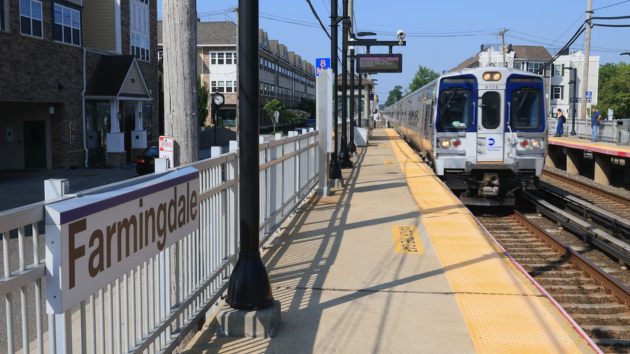
A scenic view of the Farmingdale Long Island Railroad station near by the Bethpage State Park Golf Course on August 11, 2025 in Farmingdale, New York.
(LONG ISLAND, N.Y.) – – President Donald Trump has agreed to establish an emergency board to review the dispute between the Long Island Rail Road and the unions that represent its employees, according to an executive order released by the White House.
A coalition of unions representing about half of Long Island Rail Road employees averted a strike earlier this week by asking President Donald Trump to establish an emergency board, as they seek a pay increase.
Service will continue on the busiest commuter railroad in North America while this emergency board process is underway. A strike could occur next May, however, if a compromise with the MTA isn’t reached.
The news comes after the Brotherhood of Locomotive Engineers and Trainmen announced on Monday that 99.9% of its 529 active LIRR union members voted to authorize a strike.
The coalition of unions, however, agreed to formally request Trump to establish an emergency board to attempt to resolve the issues between the union and the LIRR and come to a new contract, staving off a potential strike that would have begun Thursday.
If BLET does not agree to a new contract by May, however, it could be the first time LIRR employees strike in over 30 years. LIRR unions last went on strike in 1994, but the walkout only lasted for two days before a new contract for LIRR employees was settled.
“These passengers, they’re our friends, our neighbors, our family, and they should be treated much better than we’ve seen over this past week,” said BLET Vice President James Louis. “This is why the five unions decided to be the grown-ups in the room and request President Trump to appoint a presidential emergency board per the Railway Labor Act and allow both sides to present the proposals to the board.”
The strike would potentially affect more than 270,000 daily commuters in New York, as five unions representing 55% of the LIRR workforce are demanding a 16% raise over a four-year period.
New York Governor Kathy Hochul decried the idea of a strike on Monday, stating that it would hurt LIRR employees and passengers.
“A strike would hurt not only the riders who rely on the LIRR, but also many hardworking LIRR employees and their families, who will be left without pay because of unrealistic demands and their union leadership’s refusal to negotiate,” Hochul said in a press release. “There is a fair offer on the table, and I have directed the MTA to be ready to negotiate anytime, anywhere.”
According to the MTA, which runs the LIRR, the unions planning to strike next year have already rejected one deal that offered them a 9.5% wage increase over a three-year period, which would keep LIRR workers as the highest-paid railroad employees in the country. LIRR engineers currently make $160,000 a year on average and top out at $350,000, according to the agency.
LIRR President Rob Free has lambasted the collective bargaining effort by the unions, citing it as a cash grab that would overpay LIRR employees who already earn almost $50 an hour on average, per MTA figures, which is 7% higher than industry norms, he said.
“These five labor organizations, who are amongst the highest paid in the nation, want 6.5% more than everyone else, without any concessions, including outdated work rules, that significantly increase salaries, including providing multiple days’ pay for one day of work,” Free said in a press conference last week.
However, the LIRR unions maintain they are trying to achieve fair wages for their members, as they have been without a pay raise for over three years and run almost 1000 daily trains.
Gil Lang, the General Chairman for the BLET’s LIRR engineers, said the unions are trying to keep pace with the rising cost of living in New York.
“We are only asking for a fair contract — one that provides modest wage gains, or at the very least, maintains real wages,” Lang said. “Our members would not ratify anything short of that.”
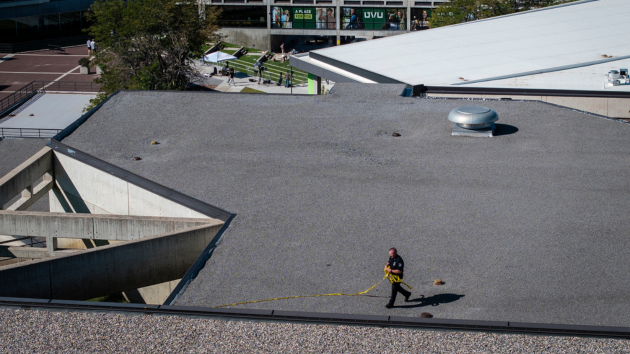
(NEW YORK) — Tyler Robinson, the person accused of assassinating conservative influencer Charlie Kirk during an event at Utah Valley University on Sept. 10, has been formally charged with a slew of offenses, including aggravated murder, with prosecutors announcing the intent to seek the death penalty.
Robinson, 22, has also been charged with felony discharge of a firearm causing serious bodily injury, obstruction of justice, two counts of witness tampering and commission of a violent offense in the presence of a child, Utah County Attorney Jeff Gray announced on Tuesday.
Gray, who described Kirk’s death as “an American tragedy,” said he does not “take this decision lightly” in regard to seeking the death penalty for Robinson. The suspected shooter will continue to be held without bail.
Robinson is also scheduled to make his first court appearance on Tuesday.
Robinson was arrested last week for felony discharge of a firearm, aggravated murder and obstruction of justice, according to probable cause documents and was booked into the Utah County Jail.
Robinson was apprehended after his father recognized him in photographs released by authorities, Utah Gov. Spencer Cox said last week.
“Robinson’s father reported that when his wife showed him the surveillance image of the suspected shooter in the news, he agreed it looked like their son,” according to the charging documents.
His father told Robinson to turn himself in, with the 22-year-old initially saying no, but later changing his mind, officials said previously.
When his father called Robinson, he implied he planned to “take his own life,” with his parents convincing him to meet them at their home, the charging documents said.
“As they discussed the situation, Robinson implied that he was the shooter and stated that he couldn’t go to jail and just wanted to end it,” the charging documents said.
His parents then asked their son why he committed this crime, to which he said “there is too much evil and the guy [Charlie Kirk] spreads too much hate,” according to the charging documents.
The suspect’s parents urged Robinson to speak with a family friend who is a deputy sheriff, who convinced him to turn himself in, charging documents said.
Prosecutors also revealed conversations between the suspect and his roommate in the moments after the shooting.
“I had enough of his hatred. Some hate can’t be negotiated out,” one of the messages read.
Investigators are continuing to assess evidence, including looking at electronic devices the suspect may have had access to, as federal charges could be announced in the coming days, law enforcement officials told ABC News.
A motive has not been revealed by officials, despite Vice President JD Vance saying “left-wing extremism” is “part of the reason” Kirk was killed.
Discord, a group chat messaging platform, confirmed on Monday that Robinson sent messages two hours before he was taken into custody admitting he shot the conservative influencer.
“Hey guys, I have bad news for you all…It was me at UVU yesterday. im sorry for all of this,” one of the messages read.
During a Senate Judiciary Committee hearing on Tuesday, FBI Director Kash Patel said the FBI is investigating “anyone and everyone involved in that Discord chat.”
Patel said there are “a lot more” than 20 people linked to Robinson on Discord and that the FBI is “running them all down.” He added that a “number of individuals” are currently being investigated.
In a press briefing from the Oval Office Monday evening, President Donald Trump said it appeared Robinson became radicalized on the internet.
“Something happened to him over a fairly short period of time. It looks like he was radicalized over the internet, and it’s radicalized on the left. He’s a left,” Trump claimed.
Robinson is alleged to have had an “obsession” with the conservative influencer, based on the alleged shooter’s digital footprint, FBI Co-Deputy Director Dan Bongino said Monday on Fox News.
Bongino said the suspect appeared to have exhibited “multiple warning signs.”
“I believe co-workers stated he had detached himself when the topic of politics came up and walked away,” Bongino said on Fox News’ “America’s Newsroom.”
Bongino said they are looking into whether anyone knew the shooting could happen and didn’t alert authorities, referring to the Discord chats Robinson allegedly had about Kirk.
“Did they … hear it and think it was a joke? That is what we’re trying to find out now,” he told Fox News. “If there is a larger network here, we will get that out to the public as soon as we can.”
(NEW YORK) — Charlie Kirk was a husband and the father of two young kids at the time of his death Sept. 10 at a campus university event in Utah.
Kirk, the founder of the conservative youth activist organization Turning Point USA, was remembered by his wife Erika Kirk in an address to the nation on Sept. 12, her first public message since his killing.
“You have no idea the fire that you have ignited within this wife, the cries of this widow will echo around the world like a battle cry,” Erika Kirk said, adding that she would continue her late husband’s work with Turning Point USA.
“To everyone listening tonight across America, the movement my husband built will not die. It won’t, I refuse to let that happen … All of us will refuse to let that happen,” she said. “No one will ever forget my husband’s name, and I will make sure of it.”
Charlie Kirk, 31, was shot while speaking at Utah Valley University, the first stop this fall for his organization’s “The American Comeback Tour,” which was traveling to multiple college campuses across the country.
President Donald Trump announced Kirk’s death on social media, writing, “The Great, and even Legendary, Charlie Kirk, is dead.”
“No one understood or had the Heart of the Youth in the United States of America better than Charlie. He was loved and admired by ALL, especially me, and now, he is no longer with us,” the president wrote. “Melania and my Sympathies go out to his beautiful wife Erika, and family. Charlie, we love you!”
Together, the Kirks are parents of two children, a son who turned 1 in May and a daughter who turned 3 in August.
“When I got home last night, our daughter just ran into my arms … and she said, ‘Mommy, I missed you.’ I said, ‘I missed you too, baby.’ She goes, ‘Where’s daddy?,'” Erika Kirk said in her Sept. 12 address. “What do you tell a 3-year-old? She’s three. I said, ‘Baby, daddy loves you so much. Don’t you worry. He’s on a work trip with Jesus so he can afford your blueberry budget.'”
Both Charlie Kirk and Erika Kirk shared glimpses of their home life on social media, sharing photos of their children, though not sharing their names or faces.
When Utah Gov. Spencer Cox announced at a Sept. 12 press conference the arrest of a suspect in Charlie Kirk’s fatal shooting, he spoke of the activist’s family.
“I especially want to thank the family of Charlie Kirk — Erika, Charlie’s parents, his children,” Cox said. “I want us to be thinking of them as we bring justice in this case. They will be involved in that justice. We will be working very closely with them as we move through this process as well.”
On Sept. 13, Turning Point USA announced details of a celebration of life ceremony for Kirk. The ceremony is set to be held Sunday, Sept. 21, in Glendale, Arizona, at State Farm Stadium, the NFL stadium in Arizona where the Cardinals play. The venue has a capacity of 63,000, according to the stadium’s website.
Here is more to know about Erika Frantzve Kirk
Erika Kirk is a former Miss Arizona USA and collegiate basketball player who is currently studying for a doctorate in Biblical studies at Liberty University, according to her biography on her website.
She is the founder of Proclaim, a faith-based clothing line, the host of the “Midweek Rise Up” podcast and the founder of two nonprofit organizations, according to her website.
Erika Kirk has also been a frequent presence by her husband’s side at speaking engagements and public appearances.
The couple went on their first date in New York City seven years ago this month, according to a post Erika Kirk shared on Instagram.
“5 years ago today, we sat inside Bills Burgers in NYC deep in conversation and banter over theology, philosophy, and politics and at the end, you paused, looked at me and said, ‘I’m going to date you,'” she wrote in a Sept. 5, 2023, post.
Following Charlie Kirk’s death, Erika Kirk shared a video on Instagram of Charlie Kirk telling the story of how they met to their daughter while sitting at a table at Bill’s Burgers in New York City.
“It started as a job interview … and then I realized momma was beautiful and smart and elegant and Christ-like, and so I said, ‘Forget this job interview. I want to date you.’ I said, ‘I have enough friends,'” Charlie Kirk is seen in the video telling their daughter as she sits on his lap. “And that’s where your journey began.”
Charlie Kirk proposed to Erika Kirk just two years after their first date, in December 2020, and they wed in Arizona on May 8, 2021, according to social media posts she shared at the time.
The couple sat down together for an episode of “The Charlie Kirk Show” in April to talk about marriage and family life.
“Keep your faith, obviously first, and try to identify any fleshy problems that you might be having,” Charlie Kirk said of his advice to young married couples, according to a YouTube video of the podcast.
Erika Kirk added, in part, “You have to continually invest in the confidence in one another, that you’re on the same team. You support each other. You love each other. You’re not going to undercut each other. You’re not going to undercut each other.”
(WASHINGTON) — FBI Director Kash Patel faced questions about the assassination of conservative activist and influencer Charlie Kirk last week — including details about a Discord chat group involving the alleged shooter — when he appeared before a Senate Judiciary Committee hearing Tuesday.
In his appearance, his first in two days of hearings on Capitol Hill, Patel addressed his handling of the Kirk investigation — something he faced criticism for after he shared on social media at one point that a suspect was in custody, but then had to backtrack an hour and a half later.
Ranking Member Dick Durbin, a Democrat, slammed Patel during his opening remarks on Tuesday, saying Patel sparked “mass confusion” in his posts about Kirk’s killing. Patel stood by his performance, touting the fact that Kirk’s suspected shooter was caught in less than 36 hours.
Patel said he directed authorities to release the photo of the suspect, 22-year-old Tyler Robinson, in the Kirk shooting. Kirk was killed in Utah on Wednesday and Robinson was apprehended after his father recognized him in photographs released by authorities, Utah Gov. Spencer Cox said on Friday. His father told Robinson to turn himself in, with the 22-year-old initially saying no, but later changing his mind, officials said.
Patel contends this only happened because he ordered “against all law enforcement recommendations,” as he said on X on Saturday, the release of video and enhanced photos of the suspect.
“We cannot do our job without the American public and credible reporting in the media,” Patel said. “And that’s why Tyler Robinson is in custody today about to face charges.”
Patel addressed criticism that he has faced for how he handled the investigation on “Fox & Friends” on Monday morning.
“I was telling the world what the FBI was doing as we were doing it. I continue to do it. I challenge anyone out there to find a director who has been more transparent and more willing to work the media with high profile cases or any cases that the FBI [is] handling.”
The online messaging platform, Discord confirmed reports that about two hours before Robinson was taken into custody last week, the alleged shooter posted messages to a small group of friends on the platform that said, “Hey guys, I have bad news for you all … It was me at UVU yesterday. im sorry for all of this.”
Patel addressed the Discord message during the hearing, saying that the FBI is investigating “anyone and everyone involved in that Discord chat” with Robinson. Patel said there are “a lot more” than 20 people linked to Robinson on Discord, “and we’re running them all down. … Every single one.”
“There are a number of individuals that are currently being investigated and interrogated, and a number yet to be investigated and interrogated, specific to that chat room. So we are very much in our ongoing posture of investigation,” Patel said, adding that other people could be involved in the shooting.
President Donald Trump appears to be standing behind Patel. Asked for his thoughts on Patel’s performance so far Tuesday morning, Trump said he supports Patel and that he has “confidence in everyone in the administration.”
The Epstein investigation
Patel is facing questions on a host of other issues while he has been at the helm of the FBI, including the handling of the Jeffrey Epstein files.
The Trump administration has been dealing with blowback it received from MAGA supporters for its decision to not release more materials related to the investigation into Epstein, the wealthy financier and convicted sex offender who died by suicide in jail in 2019.
Epstein, whose private island estate was in the U.S. Virgin Islands, has long been rumored to have kept a “client list” of celebrities and politicians, which right-wing influencers have baselessly accused authorities of hiding.
The Justice Department and FBI announced in July that they had found no evidence that Epstein kept a client list after several top officials like Patel, before joining the administration, had themselves accused the government of shielding information regarding the case.
Patel squarely blamed former U.S. Attorney and Labor Secretary Alex Acosta, who initially oversaw the Epstein investigation. Acosta resigned amid controversy over his role in a 2008 plea deal with Epstein and defended his decision, saying his goal “was straightforward” and included putting Epstein behind bars.
“I’m here to testify that the original sin in the Epstein case was the way it was initially brought by Mr. Acosta back in 2006. The original case involved a very limited search warrant, or set of search warrants, and didn’t take as much investigatory material it should have seized,” Patel said. “If I were the FBI director, then it wouldn’t have happened.”
Patel testified that Epstein was not an FBI informant as some have claimed.
Shouting match between Booker, Patel
Democratic Sen. Cory Booker and Patel engaged in a shouting match over Booker accusing Patel of making the country less safe.
“I believe you have made our country weaker and less safe,” Booker told Patel, before detailing what he perceived as Patel’s failures as the FBI’s leader, including the ouster of several top FBI leaders without explanation.
“That rant of false information does not bring this country together,” Patel shot back at Booker.
The two men shouted over each other until Chair Chuck Grassley intervened and allowed Patel to respond.
Sen. Ted Cruz, who spoke next, quipped: “It used to be that to see theater you had to go to the Kennedy Center, now apparently you need only go to the Senate Judiciary Committee and see our Senate Democrats berating the director the FBI.”
ABC News’ Sarah Beth Hensley contributed to this report.
(NEW YORK) — Formal charges are expected to be announced Tuesday against Tyler Robinson, the person accused of assassinating conservative influencer Charlie Kirk during an event at Utah Valley University on Sept. 10.
Utah County Attorney Jeff Gray is set to hold a news conference to announce the charges against Robinson after they are filed in the late morning, according to Utah County officials.
Robinson is also scheduled to make his first court appearance on Tuesday.
Robinson was arrested last week for felony discharge of a firearm, aggravated murder and obstruction of justice, according to probable cause documents and was booked into the Utah County Jail.
Investigators are continuing to assess evidence, including looking at electronic devices the suspect may have had access to, as federal charges could be announced in the coming days, law enforcement officials told ABC News.
A motive has not been revealed by officials, despite Vice President JD Vance saying “left-wing extremism” is “part of the reason” Kirk was killed.
Discord, a group chat messaging platform, confirmed on Monday that Robinson sent messages two hours before he was taken into custody admitting he shot the conservative influencer.
“Hey guys, I have bad news for you all…It was me at UVU yesterday. im sorry for all of this,” one of the messages read.
During a Senate Judiciary Committee hearing on Tuesday, FBI Director Kash Patel said the FBI is investigating “anyone and everyone involved in that Discord chat.”
Patel said there are “a lot more” than 20 people linked to Robinson on Discord and that the FBI is “running them all down.” He added that a “number of individuals” are currently being investigated.
Robinson was apprehended after his father recognized him in photographs released by authorities, Utah Gov. Spencer Cox said last week. His father told Robinson to turn himself in, with the 22-year-old initially saying no, but later changing his mind, officials said.
In a press briefing from the Oval Office Monday evening, President Donald Trump said it appeared Robinson became radicalized on the internet.
“Something happened to him over a fairly short period of time. It looks like he was radicalized over the internet, and it’s radicalized on the left. He’s a left,” Trump claimed.
Robinson is alleged to have had an “obsession” with the conservative influencer, based on the alleged shooter’s digital footprint, FBI Co-Deputy Director Dan Bongino said Monday on Fox News.
Bongino said the suspect appeared to have exhibited “multiple warning signs.”
“I believe co-workers stated he had detached himself when the topic of politics came up and walked away,” Bongino said on Fox News’ “America’s Newsroom.”
Bongino said they are looking into whether anyone knew the shooting could happen and didn’t alert authorities, referring to the Discord chats Robinson allegedly had about Kirk.
“Did they … hear it and think it was a joke? That is what we’re trying to find out now,” he told Fox News. “If there is a larger network here, we will get that out to the public as soon as we can.”
(NEW YORK) — President Donald Trump is seeking $15 billion in damages from The New York Times and Penguin Random House in a defamation lawsuit that alleges the newspaper and publisher engaged in a campaign to damage his reputation ahead of the 2024 election.
Alleging that the Times has become a “leading, and unapologetic, purveyor of falsehoods,” Trump’s attorneys argued that a series of articles about Trump — including a report that Trump’s former chief of staff John Kelly warned the president would rule like a dictator, an article about the making of “The Apprentice,” and a report about the controversy that has followed Trump — amounted to libel.
Filed in the Middle District of Florida, the lawsuit names The New York Times and Times reporters Peter Baker, Russ Buettner, Susanne Craig, and Michael Schmidt as defendants. The lawsuit also names Penguin Random House — the publisher of Craig and Buettner’s book “Lucky Loser: How Donald Trump Squandered His Father’s Fortune and Created the Illusion of Success” — as a defendant.
“Today, the Times is a fullthroated mouthpiece of the Democrat Party. The newspaper’s editorial routine is now one of industrial-scale defamation and libel against political opponents,” the lawsuit claimed.
Trump’s lawyers allege that The New York Times and Penguin Random House sought to not only damage the president’s “hard-earned and world-renowned reputation for business success,” but also hurt his chances of winning the 2024 election.
“President Trump brings this suit to highlight that principle and to clearly state to all Americans exhausted by, and furious at, the decades of journalistic corruption, that the era of unchecked, deliberate defamation by the Times and other legacy media outlets is over,” the lawsuit said.
A New York Times spokesperson said the lawsuit has no merit.
“It lacks any legitimate legal claims and instead is an attempt to stifle and discourage independent reporting,” the Times spokesperson said. “The New York Times will not be deterred by intimidation tactics. We will continue to pursue the facts without fear or favor and stand up for journalists’ First Amendment right to ask questions on behalf of the American people.”
Penguin Random House did not immediately respond to a request for comment from ABC News.
“President Trump’s transcendent ability to defy wrongful conventions has been vividly reflected in his successful undertaking to restore integrity to journalism, and repair the immense damage caused by legacy media outlets such as the Times for the better part of a decade,” the lawsuit said.
In July, Trump filed a $10 billion lawsuit against The Wall Street Journal after the Journal reported that Trump allegedly sent disgraced financier Jeffery Epstein a bawdy letter in 2003 that was included in a book made for Epstein’s 50th birthday, which Trump has denied.
In response to that suit, a spokesperson for Journal owner Dow Jones said, “We have full confidence in the rigor and accuracy of our reporting, and will vigorously defend against any lawsuit.”
Minneapolis Mayor Jacob Frey speaks to the media following a mass shooting at Annunciation Catholic School on August 27, 2025 in Minneapolis, Minnesota. (Stephen Maturen/Getty Images)
(MINNEAPOLIS) — At least 13 people have been wounded, five critically, in two shootings that erupted over a span of 12 hours at homeless encampments in Minneapolis with the city’s mayor saying he wouldn’t be surprised if they are connected.
The shootings on Monday marked the fourth and fifth mass shootings to occur in Minneapolis in the past three weeks, including one on Aug. 27 at Annunciation Catholic School that left two children dead and 21 people injured.
“This is tragic. It’s horrible. It’s unacceptable, and, sadly, it’s not surprising,” Mayor Jacob Frey said at a news conference early Tuesday.
Minneapolis Police Chief Brian O’Hara said the city’s latest mass shooting unfolded Monday night at a notorious homeless encampment in southeast Minneapolis, in which eight people were shot and an estimated 30 shots were fired.
“Here we are yet again in the aftermath of a mass shooting. This is not normal,” O’Hara said.
O’Hara said the shooting at the homeless encampment on South 28th Avenue and East Lake Street occurred around 10 p.m. local time. He said an officer working at a Target store nearby was approached by multiple people “running and telling him that there was gunfire at the encampment.”
“The officer exited the store and heard gunfire coming from the area of the encampment,” O’Hara said.
Upon arrival, officers found five people wounded, including two people, a man and a woman, discovered inside tents suffering from bullet wounds to the head, O’Hara said. He said three other gunshot victims showed up at hospitals on their own.
O’Hara said at least four of the victims had life-threatening gunshot wounds.
The chief said multiple shell casings were recovered from the scene, leading investigators to believe that someone inside the encampment exchanged gunfire with the shooter who targeted the encampment.
O’Hara said that in addition to the shooting, a fire broke out in one of the tents while police were on scene and that that firefighters were called to extinguish the blaze.
No arrests have been announced in the shooting.
O’Hara said detectives are investigating the possibility that the shooting is connected to earlier gunfire at a nearby homeless encampment that left five people injured, including one in life-threatening condition. He said the earlier shooting occurred just after 11 a.m. near the intersection of East Lake Street and Stevens Avenue.
“While the investigation is still very, very preliminary, that is certainly something that we can’t rule out, and, of course, it’s something that we are considering,” O’Hara said.
Asked about the possible connection between the two shootings, Frey added, “We don’t know for sure, but I wouldn’t be surprised.”
Frey said the city has been trying for months to clear the homeless encampment at South 28th Avenue and East Lake Street, the scene of Monday night’s shooting. He said the encampment is on private property and that the city’s attempts to clear it have been met with resistance by the owner of the property.
“These homeless encampments are not safe either for the people that are in them, nor are they safe for the surrounding neighborhood. With this particular one, we’ve been saying this for months. We have been met with resistance for trying to clear this particular encampment,” Frey said.
In addition to the Annunciation Catholic School shooting, in which the suspect, 23-year-old Robin Westman, died by suicide, Minneapolis police investigated an Aug. 26 mass shooting that left one man dead and five other people wounded in southwest Minneapolis.
At the time, O’Hara said the shooter walked up to a group of people standing at the corner of East 29th Street and Clinton Avenue South and unleashed a barrage of at least 30 shots with a high-powered rifle before fleeing.
(WASHINGTON) — FBI Director Kash Patel kicked off two days of questioning on Tuesday from congressional committees about his tenure leading the FBI so far. He’s also facing questions about the assassination of conservative activist and influencer Charlie Kirk last week.
In his appearance before the Senate Judiciary Committee Tuesday, Patel addressed his handling of the Kirk investigation — something he faced criticism for after he shared on social media at one point that a suspect was in custody, but then had to backtrack an hour and a half later.
Ranking Member Dick Durbin, a Democrat, slammed Patel during his opening remarks on Tuesday, saying Patel sparked “mass confusion” in his posts about Kirk’s killing. Patel stood by his performance, touting the fact that Kirk’s suspected shooter was caught in less than 36 hours.
Patel said he directed authorities to release the photo of the suspect, 22-year-old Tyler Robinson, in the Kirk shooting. Kirk was killed in Utah on Wednesday and Robinson was apprehended after his father recognized him in photographs released by authorities, Utah Gov. Spencer Cox said on Friday. His father told Robinson to turn himself in, with the 22-year-old initially saying no, but later changing his mind, officials said.
Patel contends this only happened because he ordered “against all law enforcement recommendations,” as he said on X on Saturday, the release of video and enhanced photos of the suspect.
“We cannot do our job without the American public and credible reporting in the media,” Patel said. “And that’s why Tyler Robinson is in custody today about to face charges.”
Patel addressed criticism that he has faced for how he handled the investigation on “Fox & Friends” on Monday morning.
“I was telling the world what the FBI was doing as we were doing it. I continue to do it. I challenge anyone out there to find a director who has been more transparent and more willing to work the media with high profile cases or any cases that the FBI [is] handling.”
For his part, President Donald Trump is standing behind Patel. Asked for his thoughts on Patel’s performance Tuesday morning, Trump said he supports Patel and that he has “confidence in everyone in the administration.”
Patel is facing questions on a host of other issues while he has been at the helm of the FBI, including the handling of the Jeffrey Epstein files.
The Trump administration has been dealing with blowback it received from MAGA supporters for its decision to not release more materials related to the investigation into Epstein, the wealthy financier and convicted sex offender who died by suicide in jail in 2019.
Epstein, whose private island estate was in the U.S. Virgin Islands, has long been rumored to have kept a “client list” of celebrities and politicians, which right-wing influencers have baselessly accused authorities of hiding.
The Justice Department and FBI announced in July that they had found no evidence that Epstein kept a client list after several top officials like Patel, before joining the administration, had themselves accused the government of shielding information regarding the case.
Patel squarely blamed former U.S. Attorney and Labor Secretary Alex Acosta, who initially oversaw the Epstein investigation. Acosta resigned amid controversy over his role in a 2008 plea deal with Epstein and defended his decision, saying his goal “was straightforward” and included putting Epstein behind bars.
“I’m here to testify that the original sin in the Epstein case was the way it was initially brought by Mr. Acosta back in 2006. The original case involved a very limited search warrant, or set of search warrants, and didn’t take as much investigatory material it should have seized,” Patel said. “If I were the FBI director, then it wouldn’t have happened.”
Patel testified that Epstein was not an FBI informant as some have claimed.