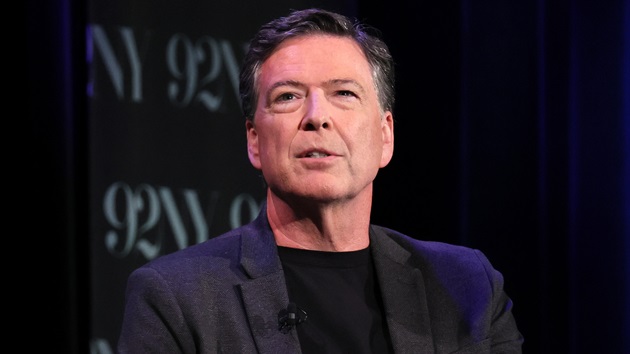
James Comey speaks onstage at 92NY on May 30, 2023 in New York City. (Dia Dipasupil/Getty Images)
(NEW YORK) — A Columbia law professor who is a friend and adviser to former FBI Director James Comey was subpoenaed last week by federal prosecutors in connection with a criminal probe into whether Comey allegedly lied in testimony before Congress, sources familiar with the matter told ABC News.
Daniel Richman has previously acknowledged his role as an intermediary between Comey and reporters in the wake of Comey’s 2017 firing by President Donald Trump during his first term over Trump’s anger with the FBI’s investigation into his 2016 campaign.
Richman met with federal prosecutors in the Eastern District of Virginia on Tuesday, sources familiar with the matter said.
In public statements, Richman has said he shared the content of memos written by Comey about his interactions with Trump with a reporter from the New York Times.
Trump later accused Comey of breaking the law by sharing his memos, arguing they contained classified information, though Richman later told ABC News in a statement that none of the documents had any classification markings.
The subpoena to Richman, according to sources, stems from an investigation into testimony Comey made before Congress in September 2020 about the investigation into Russian interference in the 2016 election.
Comey has repeatedly defended his handling of the early stages of the investigation and denied any decisions were based out of political animus towards Trump.
A previous investigation by the Justice Department’s inspector general faulted Comey for violating FBI policies over his handling of the memos regarding his interactions with President Trump, though the DOJ under Trump’s first administration declined to prosecute him.
An attorney for Richman and an attorney for Comey did not immediately respond to a request for comment from ABC News.
A Justice Department spokesperson also did not immediately respond to a request for comment.
(PITTSBURGH) — A Pennsylvania man was apprehended after he drove his car into a metal gate at the FBI building in Pittsburgh early on Wednesday, a ramming that federal law enforcement officials described as intentional.
Donald Henson, of Penn Hills, allegedly drove at a high rate of speed toward the main entrance gate at about 2:40 a.m., FBI Special Agent in Charge Christopher Giordano said during a press briefing.
The FBI confirmed late Wednesday morning that Henson was apprehended “a short time ago.”
“We look at this as an act of terror against the FBI,” Giordano said earlier on Wednesday. “This was a targeted attack on this building.”
There was “some vulgarity” scrawled on the side of the vehicle, the FBI said. The full details of what was written were not immediately clear, Giordano said, adding there appeared to be a reference to suicide.
Officials said no one was injured in the ramming.
He said the suspect fled the scene and it was believed that he may be dangerous. It was not immediately clear if Henson was armed, the FBI said.
Henson is the registered owner of the vehicle, Giordano said. The FBI compared surveillance video with Henson’s drivers license photo to further identify him, Giordano said, adding that he also had been identified as a former military member. He said Henson may have been experiencing a mental health issue.
After the crash, Henson allegedly exited the car, took an American flag out of the trunk and stuck it on the gate, the FBI said.
Images from the scene captured by ABC News affiliate WTAE appeared to show a white sedan sitting with a door ajar in front of a damaged metal gate near a security booth.
A spokesperson from the Pittsburgh Police Department told ABC News that officers responded to the 3300 block of E. Carson Street for a reported vehicle collision at about 3 a.m. on Wednesday. The vehicle collided with a gate outside of the building, before the driver exited the vehicle and fled the scene, the spokesperson said.
The FBI is leading the ongoing investigation, the police said. The FBI was working with the local U.S. Attorneys Office to draft a complaint against Henson, Giordano said.
Henson had come to the FBI Pittsburgh office within the last few weeks to make a complaint, Giordano said, adding it “didn’t make a whole lot of sense.”
“We contacted him and let him know that there was no federal crime we were able to charge,” he said.
(NEW YORK) — The Atlantic basin may have been quiet going into the peak of hurricane season, but officials are watching a new system that has developed into a tropical storm, which has the possibility of strengthening further.
The National Hurricane Center confirmed on Wednesday that Tropical Storm Gabrielle has formed in the Central Atlantic.
Te tropical storm does not pose a threat to the United States, as of Wednesday. The system should remain over open waters for several days, the NHC said.
The system previously met the criteria to be designated a tropical depression with winds greater than 34 mph on Wednesday.
Although dry air and other unfavorable atmospheric conditions have recently hindered development, the storm is expected to move into a more favorable environment later this week, giving it a better chance to become organized.
The storm will move Northwest and is not expected to hit any of the Leeward Islands or the Caribbean. If it develops further, the storm could be a hurricane in the vicinity of Bermuda.
The storm, which was originally described as a disturbance, was expected to become a tropical depression or tropical storm by the end of the week as it churns northwestward across the central Atlantic Ocean.
The development of a new tropical cyclone would mark the end of a notably quiet period in the Atlantic Basin, a stretch that included the climatological peak of the hurricane season on Sept. 10.
Tropical activity is expected to gradually ramp up over the next few weeks as conditions become more favorable for development, forecasters say.
NOAA’s Climate Prediction Center said the odds of tropical development are increasing across parts of the Atlantic Basin for the second half of September, as large-scale environmental conditions become more favorable.
Tropical weather experts at Colorado State University (CSU) echo these predictions, saying overall atmospheric conditions, including wind patterns, will shift in a manner that supports a notable increase in activity.
While the climatological peak of the Atlantic hurricane season has passed, roughly 60% of tropical activity typically occurs after Sept. 10, on average, according to the National Hurricane Center.
The remainder of September and October will likely be active, David Zierden, the Florida state climatologist and head of the Florida Climate Center at Florida State University, told ABC News last week.
September and October often see some of the busiest activity for hurricanes because sea surface temperatures can be at their highest, Zierden said. Higher temperatures provide “ample fuel” for the formation and intensification of tropical cyclones, he added.
Waters in the Gulf and Caribbean are currently “very warm,” Jennifer Francis, an atmospheric scientist at the Woodwell Climate Research Center, told ABC News last week.
Historically speaking, about two-thirds of all Atlantic hurricane season activity occurs between Aug. 20 and Oct. 10. In August, NOAA predicted above-normal activity for the remainder of the Atlantic hurricane season.
Last year demonstrated that late September and early October can be an active period for tropical development, with multiple threats that may be high-impact and potentially devastating.
Hurricane Helene, which caused devastating flooding in North Carolina, formed on Sept. 24, 2024, while Hurricane Milton, which caused widespread destruction in Florida, formed on Oct. 5, 2024.
ABC News’ Kenton Gewecke and Kyle Reiman contributed to this report.
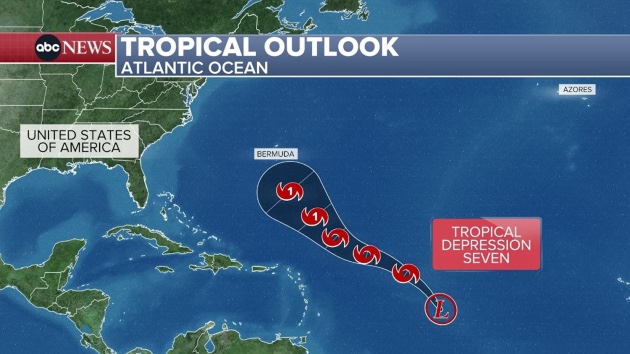
(NEW YORK) — The Atlantic basin may have been quiet going into the peak of hurricane season, but officials are watching a new storm that has developed into a tropical depression, which has the possibility of strengthening further.
The National Hurricane Center confirmed on Wednesday that Tropical Depression Seven has formed in the Central Atlantic.
The system, which is expected to become Tropical Storm Gabrielle in the coming days, met the criteria to be designated a tropical depression with winds greater than 34 mph on Wednesday.
As of Wednesday, the tropical depression does not pose a threat to the United States.
Although dry air and other unfavorable atmospheric conditions have recently hindered development, the storm is expected to move into a more favorable environment later this week, giving it a better chance to become organized.
The depression will move Northwest and is not expected to hit any of the Leeward Islands or the Caribbean. If it develops further, the storm could be a hurricane in the vicinity of Bermuda.
The storm, which was originally described as a disturbance, was expected to become a tropical depression or tropical storm by the end of the week as it churns northwestward across the central Atlantic Ocean.
The development of a new tropical cyclone would mark the end of a notably quiet period in the Atlantic Basin, a stretch that included the climatological peak of the hurricane season on Sept. 10.
Tropical activity is expected to gradually ramp up over the next few weeks as conditions become more favorable for development, forecasters say.
NOAA’s Climate Prediction Center said the odds of tropical development are increasing across parts of the Atlantic Basin for the second half of September, as large-scale environmental conditions become more favorable.
Tropical weather experts at Colorado State University (CSU) echo these predictions, saying overall atmospheric conditions, including wind patterns, will shift in a manner that supports a notable increase in activity.
While the climatological peak of the Atlantic hurricane season has passed, roughly 60% of tropical activity typically occurs after Sept. 10, on average, according to the National Hurricane Center.
The remainder of September and October will likely be active, David Zierden, the Florida state climatologist and head of the Florida Climate Center at Florida State University, told ABC News last week.
September and October often see some of the busiest activity for hurricanes because sea surface temperatures can be at their highest, Zierden said. Higher temperatures provide “ample fuel” for the formation and intensification of tropical cyclones, he added.
Waters in the Gulf and Caribbean are currently “very warm,” Jennifer Francis, an atmospheric scientist at the Woodwell Climate Research Center, told ABC News last week.
Historically speaking, about two-thirds of all Atlantic hurricane season activity occurs between Aug. 20 and Oct. 10. In August, NOAA predicted above-normal activity for the remainder of the Atlantic hurricane season.
Last year demonstrated that late September and early October can be an active period for tropical development, with multiple threats that may be high-impact and potentially devastating.
Hurricane Helene, which caused devastating flooding in North Carolina, formed on Sept. 24, 2024, while Hurricane Milton, which caused widespread destruction in Florida, formed on Oct. 5, 2024.
ABC News’ Kenton Gewecke and Kyle Reiman contributed to this report.
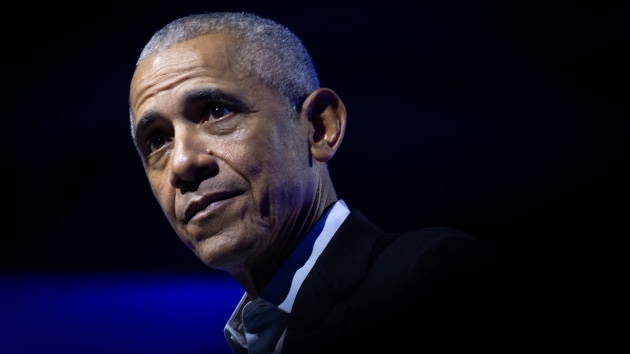
Former President Barack Obama addresses the Obama Foundation’s 2024 Democracy Forum on December 05, 2024 in Chicago, Illinois. The 2024 Democracy Forum focused on “pluralism” and exploring how diverse communities can work together. (Photo by Scott Olson/Getty Images)
(WASHINGTON) — Former President Barack Obama says he finds the murder of Charlie Kirk “horrific” and “a tragedy” and stressed that Americans must be able to disagree, push back against ideas they don’t ascribe to, while respecting the right of others to hold those opinions.
In remarks during a conversation with journalist Steve Scully at the Jefferson Educational Society in Pennsylvania Tuesday night, Obama also acknowledged that the shooting of Democratic Minnesota state legislators Melissa Hortman and John Hoffman were also a tragedy.
“Regardless of where you are on the political spectrum, what happened to Charlie Kirk was horrific and a tragedy,” he said. “What happened … to the state legislators in Minnesota, that is horrific. It is a tragedy. And there are no ifs, ands or buts about it, the central premise of our democratic system is that we have to be able to disagree and have sometimes really contentious debates without resort to violence. And when it happens to some but even if you think they’re, quote, unquote, ‘on the other side of the argument,’ that’s a threat to all of us. And we have to be clear and forthright in condemning them.”
He continued: “And so, look, obviously I didn’t know Charlie Kirk. I was generally aware of some of his ideas. I think those ideas were wrong, but that doesn’t negate the fact that what happened was a tragedy and that I mourn for him and his family.”
Obama also praised Utah GOP Gov. Spencer Cox’s handling of the aftermath of Kirk’s murder.
“I’ve been very impressed with Governor Cox in Utah and how he’s approached some of these issues. I suspect Governor Cox and I disagree on a whole bunch of stuff. He is a Republican, self-professed conservative Republican, but in his response to this tragedy, as well as his history of how he engages with people who are political adversaries, he has shown, I think, that it is possible for us to disagree while abiding by a basic code of how we should engage in public debate.”
Obama also suggested that what he sees as the Trump administration’s desire to target political enemies is part of a larger issue, and stressed that when he served as president, he “wasn’t putting the weight of the United States government behind extremist views.”
“And so, when I hear not just our current president, but his aides, who have a history of calling political opponents ‘vermin’, enemies who need to be ‘targeted,’ that speaks to a broader problem that we have right now and something that we’re going to have to grapple with, all of us. Whether we’re Democrats, Republicans, Independents, we have to recognize that on both sides, undoubtedly, there are people who are extremists and who say things that are contrary to what I believe are America’s core values,” he said.
“But I will say that those extreme views were not in my White House. I wasn’t embracing them. I wasn’t empowering them. I wasn’t putting the weight of the United States government behind extremist views. And that…when we have the weight of the United States government behind extremist views, we’ve got a problem,” said Obama.”
He said that the role of president is to unify — rather than stoke — division, saying, “But my view was that part of the role of the presidency is to constantly remind us of the ties that bind us together.”
“And I’m not alone in that belief,” he continued. “I think George W. Bush believed that. I believe that people who I ran against — I know John McCain believed it. I know Mitt Romney believed it. What I’m describing. Is not a Democratic value or Republican value. It is an American value. And I think at moments like this, when tensions are high, then part of the job of the president is to pull people together.”
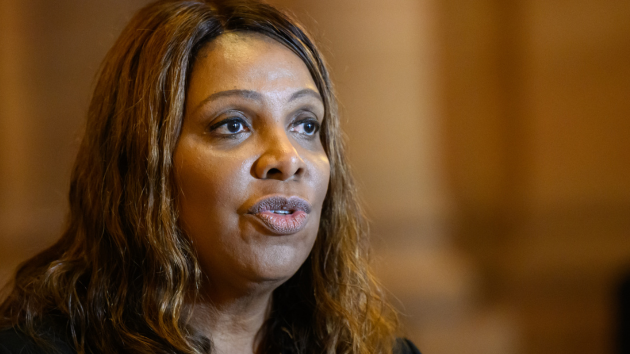
(NEW YORK) — Top Trump administration officials are pressuring federal prosecutors in Virginia to bring charges against New York Attorney General Letitia James for mortgage fraud, despite investigators so far failing to find sufficient evidence supporting such charges, according to sources familiar with the investigation.
After a five-month investigation and interviews with more than a dozen witnesses, federal prosecutors have so far uncovered no clear evidence that James knowingly made false statements to a financial institution to secure favorable terms on a mortgage for her Virginia home, according to multiple sources briefed on the investigation.
Trump himself has pressured the Department of Justice leadership to investigate James more aggressively, and two officials — Ed Martin, the head of the DOJ’s Weaponization Working Group, and Bill Pulte, the director of the Federal Housing Finance Agency — have pushed the U.S. attorney for the Eastern District of Virginia to seek an indictment of James.
When federal prosecutors recently declined to indict James, Pulte encouraged Trump to fire Erik Siebert, the U.S. attorney for the Eastern District of Virginia, and replace him with a prosecutor who would be willing to bring charges against James, sources said.
The move to seek an indictment against one of the president’s political rivals — who successfully brought a civil fraud case against Trump last year and leads multiple lawsuits challenging his administration’s policies — would mark a significant escalation in what the president’s critics have labeled a campaign of political retribution.
Pulte and Martin have argued that James committed mortgage fraud because one of the documents related to a 2023 home purchased by James falsely indicated the property would be her primary residence. However, investigators have so far determined that the document — a limited power of attorney form used by James’ niece to sign documents on her behalf when James closed on the home — was never considered by the loan officers who approved the mortgage, sources said.
Lawyers drafted the document itself for a third-party closing company based on a template that was never corrected, sources said, and every other document in James’ loan file for the mortgage accurately stated that she would not reside at the home.
Prosecutors have not yet been able to produce evidence that James knowingly filled out the power of attorney form incorrectly to influence the bank that issued the mortgage, said sources familiar with the investigation’s findings thus far.
James has denied wrongdoing, and her lawyer Abbe Lowell has criticized the criminal referral as “three pages of stale, threadbare allegations” that he called “the next salvo in President Trump’s revenge tour against Attorney General James.”
“Given the cascade of unsubstantiated allegations coming from the Trump Administration on its ‘mortgage fraud’ crusade against Democrats, it’s no surprise they are having trouble finding an objective and law-abiding prosecutor who would ignore the facts and the evidence to manufacture sham charges,” Lowell said in a statement to ABC News. “As we have repeatedly said, any impartial and non-political inquiry would conclude Attorney General James did not violate any laws managing her properties.”
A White House spokesperson declined to comment when contacted by ABC News. Representatives from the Justice Department and the Federal Housing Finance Agency did not respond to a request for comment.
The contentious investigation comes as Trump, Pulte, and Martin have accused numerous officials of engaging in mortgage fraud, with other investigations targeting Federal Reserve Governor Lisa Cook and Democratic Sen. Adam Schiff, Schiff, allegations both have denied.
Martin is also investigating James regarding a New York home, and federal prosecutors in Albany have issued subpoenas to James in connection with her civil fraud case against Trump and her corruption case against the National Rifle Association, according to multiple sources.
While Martin’s investigation of James’ Virginia properties has failed to yield clear evidence of fraud, sources said, he has taken aggressive steps to publicize the allegations and leapfrogged multiple steps usually taken by prosecutors. Last month, he sent James’ attorney a letter asking that she resign from her role as the New York attorney general, arguing it would “serve the ‘good of the state and nation'” for her to leave office.
“Her resignation from office would give the people of New York and America more peace than proceeding. I would take this as an act of good faith,” Martin wrote.
Days after sending the letter, Martin posed for a New York Post photographer outside James’ Brooklyn home, wearing a Columbo-style trench coat. He later posted a photo from his visit on social media.
As ABC News previously reported, the visit and photo earned him a rebuke from Attorney General Pam Bondi and her deputy, Todd Blanche, who told him the trip was counterproductive and harmful to his investigation, sources said.
“[D]espite the lack of evidence or law, you will take whatever actions you have been directed to take to make good on President Trump’s and Attorney General Bondi’s calls for revenge for that reason alone,” Lowell said in a letter to Martin, a copy of which was reviewed by ABC.
The mortgage investigation has exposed cracks in the DOJ leadership and raised fresh concerns that Trump officials are seeking retribution for the ill-fated prosecutions of the president, sources said.
‘She was the fraudster’ Each of the investigations into James, Cook, and Schiff revolves around two figures in the Trump administration who have since burnished their reputations for aggressively publicizing their claims of mortgage fraud.
Pulte, the director of the Federal Housing Finance Agency and chairman of Fannie Mae and Freddie Mac, has issued the referral letters alleging the officials committed mortgage fraud, while Martin — who holds multiple titles as U.S. Pardon Attorney, Special Attorney for Mortgage Fraud, Associate Deputy Attorney General and Director of the DOJ’s Weaponization working group — has spearheaded the investigations at the Justice Department.
Before taking on his four roles, Martin briefly served as the U.S. attorney for the District of Columbia. He was the first person in recent history to run the pivotal office without any experience as a prosecutor or judge, and his tenure was marked by controversy. He dismissed dozens of prosecutors who worked on cases involving the Jan. 6 Capitol attack, defended the rioters who stormed the Capitol building, and called out potential targets of investigations on social media.
Trump withdrew Martin’s nomination for D.C. U.S. Attorney in May after he lost Senate support and instead opted to place him in the highest echelon of DOJ leadership in four influential roles that did not require confirmation.
Martin has initiated some of his investigations based on criminal referrals by Pulte, a private-equity executive whose family runs the third-largest home construction company in the United States. Pulte built a substantial public profile on social media by using Twitter to share his philanthropic work, though his outspoken presence last year prompted some members of his family to issue a statement distancing themselves from him.
“We additionally believe that some of Bill Pulte’s public communications through social media, public appearances, interviews, self-published articles and more may suggest that he speaks on behalf of the entire Pulte family. To the contrary, Bill Pulte does not represent, nor is he a spokesperson for, all members of the Pulte family, in any capacity,” the family’s charitable foundation said in a statement last year, though it said that the nonprofit “bears no ill will towards Bill Pulte.”
Last year, in a civil case brought by James against Trump and his family business, a New York judge concluded that Trump and his family had committed a decade of business fraud by overstating the value of their properties to get favorable loan terms, fining Trump and his sons nearly half a billion dollars. An appeals court subsequently tossed the financial penalty but upheld the finding that Trump committed fraud.
Pulte, who has publicized his mortgage fraud claims about James since April, has equated the allegations against James to Trump’s civil fraud case.
“I believe this is riddled with mortgage fraud, and frankly, I think that’s why she knew so much about the law in terms of how to go after President Trump,” Pulte told Fox News last month. “She was the fraudster, not President Trump.”
‘Improper political retribution’ The Trump administration’s probe of James began less than a month into the president’s term when newly appointed U.S. Attorney General Pam Bondi announced the creation of a “Weaponization Working Group” headed by Martin. Among the topics the group was created to examine was James’ alleged “federal cooperation … to target President Trump, his family, and his businesses.”
One month after the Senate confirmed Pulte, he issued a criminal referral letter to the Department of Justice in April based on “media reports,” alleging that James “appears to have falsified records in order to meet certain lending requirements and receive favorable loan terms.” The allegations centered on three properties: a home in Virginia that James owns, where her niece resides; James’ Brooklyn townhouse; and her father’s house in Queens, New York.
Pulte accused James of falsifying records to claim she resided in the Virginia home in order to get better loan terms; misrepresenting the number of rooms in her Brooklyn home to meet requirements for a government-backed loan; and falsely claiming to be her father’s wife on a mortgage application in the 1990s.
“Letitia James is one of the most corrupt, shameless individuals ever to hold public office,” Deputy Chief of Staff Stephen Miller told reporters on the day the referral letter was filed. “She is guilty of multiple significant serial criminal violations.”
Later in April, Lowell responded to each of the allegations in a fiery letter that labeled the referral Trump’s “latest act of improper political retribution.”
“U.S. Federal Housing Director William Pulte is the latest administration officer to carry out the all-too-familiar playbook of the President: praise the judicial system and those who serve it when he wins; criticize it when he loses, and attack those — attorneys and judges, alike — who are doing their jobs to protect and uphold the rule of law,” Lowell wrote.
Lowell said that the allegations about James’s homes were “cherry-picked.” Only one document related to the Virginia home — the power of attorney document that was filed so James’ niece could sign documents on her behalf — incorrectly listed the home as her primary residence, he wrote. DOJ investigators would later confirm Lowell’s claim that the POA document was the only document in James’ mortgage file that stated she would live in the home, sources said.
Regarding her Brooklyn home, Lowell argued that Pulte referenced a 24-year-old document to claim the building has five bedrooms, while all other records show it has four bedrooms. The deed for James’ fathers’ home, Lowell wrote, correctly reflects their father-daughter relationship.
“In a predictable pattern here, Director Pulte cites a mistaken May 20, 1983, document Mr. James filled out to cast his baseless allegation while again ignoring the other supporting documentation,” Lowell wrote.
‘Help Wanted’ Since federal prosecutors began looking into James’ Virginia property, they have interviewed or presented to the grand jury 15 witnesses, including insurers, loan officers, underwriters, realtors, and James’ niece.
To bring a case that she made false statements to a bank or federal financial institution, prosecutors would need to prove that James knowingly made a false statement with the intent to influence a bank. Sources tell ABC News that prosecutors have not found evidence to clear that high bar.
A loan underwriter interviewed by investigators said that, in the process of approving the loan, she never looked at or considered the power of attorney document that incorrectly listed the home as James’ primary residence, according to sources.
While Martin is examining whether another property owned by James in Virginia was inconsistently described as both “second home” and an “investment property,” sources said senior DOJ leadership believes Martin would be unable to prove any allegations beyond a reasonable doubt, in part because Fannie Mae guidelines on the issue are too vague.
Despite his investigation failing to yield a viable case, Martin has continued to aggressively pursue the claims with Trump’s backing, sources said. He recently requested 2-3 experienced prosecutors from the U.S. attorney’s office in the Eastern Districts of Virginia and New York to help with the investigations, and he has begun personally recruiting attorneys to join his “Special Attorney Fraud Unit,” said sources.
In a recruiting email titled “Help Wanted,” Martin invited current DOJ lawyers to be “fighters for justice and goodness and the American way,” according to materials reviewed by ABC News. In his pitch, Martin invoked the words of former Attorney General and Justice Robert Jackson — who famously warned that prosecutors going after people they dislike or seek to embarrass is “the greatest danger of abuse of prosecuting power” — when he told prospective team members that “The qualities of a good prosecutor are as elusive and as impossible to define as those that mark a gentleman.”
“In a special way, the SAFU is called to hold bad actors accountable,” Martin wrote. “After all, as New York, Attorney General Leticia [sic] James said, ‘Because no matter how big, rich, or powerful you think you are, no one is above the law.'”
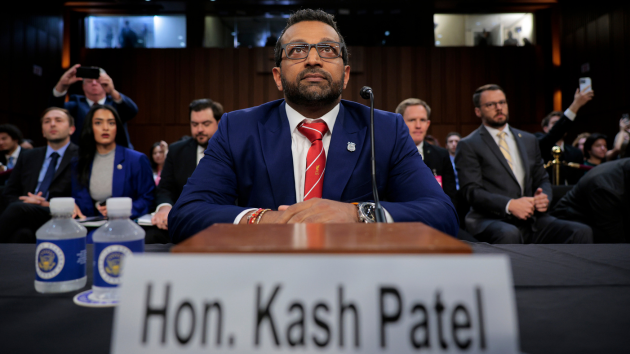
(WASHINGTON) — A day after FBI Director Kash Patel sparred with Democrats on the Senate Judiciary Committee, he is set to answer questions from members of the House Judiciary Committee on Wednesday.
Chair Jim Jordan applauded Patel’s work as the director of the FBI before his appearance.
“The Biden Administration weaponized the FBI. Kash Patel is focused on catching criminals. Such a contrast,” the Ohio Republican wrote on X on Monday.
Ranking member Jamie Raskin said Democrats on the committee will be pushing Patel for answers on the investigation into the Jeffrey Epstein files.
“FBI Director Kash Patel steps before @HouseJudiciary on Wednesday. America wants answers about the ongoing coverup allowing Jeffrey Epstein, Ghislaine Maxwell and their billionaire pals to thwart justice for trafficking victims and accountability for predators,” Raskin wrote in a post on X.
On Tuesday, Patel appeared before the Senate Judiciary Committee, where he feuded with Democratic Sens. Adam Schiff and Cory Booker — at one point calling the California senator a “political buffoon” and an “utter coward.”
In a shouting match with Booker, the New Jersey senator said that Patel was making the country “weaker and less safe.”
Patel fired back that Booker’s comments do “not bring this country together.”
Patel also faced questions about the assassination of conservative activist and influencer Charlie Kirk last week. He said the FBI is investigating if others are involved after the online messaging platform, Discord confirmed reports that before the shooting the alleged shooter, 22-year-old Tyler Robinson, posted messages to a small group of friends on the platform that said, “Hey guys, I have bad news for you all … It was me at UVU yesterday. im sorry for all of this.”
“There are a number of individuals that are currently being investigated and interrogated, and a number yet to be investigated and interrogated, specific to that chat room. So we are very much in our ongoing posture of investigation,” Patel said, adding that other people could be involved.
(NEW YORK) — The Federal Reserve on Wednesday is set to unveil its latest decision on the level of interest rates, hoping to guide the economy through a topsy-turvy stretch of slow hiring and rising inflation.
The high-stakes announcement marks a flashpoint in the monthslong pressure campaign directed at the Fed by President Donald Trump.
In recent weeks, Trump has moved to fire one member of the Fed’s board of governors and secure Senate confirmation for another. Both officials are on track to be among the 12 policymakers who will cast votes on the interest-rate decision, though their status remained uncertain days before the Fed meeting.
The race to reshape the Fed comes after Trump railed for months against the central bank and its Chair Jerome Powell for declining to heed his call for lower interest rates. In July, Powell stressed the importance of political independence, saying it allows central bankers to make “very challenging decisions” based on “data.”
Still, the central bank is widely expected to deliver the policy shift long-sought by Trump, though the size of the rate cut will all but certainly fall short of Trump’s desired outcome.
Powell recently hinted at the possibility of a rate cut, appearing to indicate greater concern for flagging employment growth than for elevated prices. Investors peg the chances of a quarter-point rate cut at about 96% and a half-point cut at nearly 4%, according to the CME FedWatch Tool, a measure of market sentiment.
In a social media post on Monday, Trump reiterated his criticism of Powell, saying the Fed chair “MUST CUT INTEREST RATES, NOW, AND BIGGER THAN HE HAD IN MIND.”
Five meetings and nine months have elapsed since the Fed last adjusted interest rates. The federal funds rate stands between 4.25% and 4.5%, preserving much of a sharp increase imposed in response to a pandemic-era bout of inflation.
In recent months, the economy has suffered a sharp hiring slowdown alongside an uptick of inflation, setting the conditions for what economists call “stagflation.”
The economic conditions have put Fed policymakers in a bind. If the Fed raises interest rates as a means of protecting against tariff-induced inflation, it risks tipping the economy into a downturn. On the other hand, if the Fed lowers rates to stimulate the economy in the face of a hiring slowdown, it threatens to boost spending and worsen inflation.
Last month, Powell said the central bank faces a “challenging situation,” putting pressure on both sides of the Fed’s dual mission to maximize employment and control inflation.
Still, Powell said, the “balance of risks appears to be shifting” in light of a hiring slowdown made clear in a weak jobs report earlier this year that included sharp downward revisions of job gains over recent months.
Trump recently moved to fire board member Lisa Cook, who sued Trump over her attempted ouster, saying the decision violated her legal protections as an employee at the independent federal agency. Trump said he removed Cook over mortgage fraud allegations against her.
Federal law allows the president to remove a member of the Fed board “for cause,” though no president has attempted such a removal in the 112-year history of the central bank.
Last week, a federal judge issued a preliminary injunction requiring the Fed to let Cook continue serving in her role as a governor of the Federal Reserve System as her lawsuit moves through the courts.
Days later, the Trump administration filed a request with an appeals court asking to remove Cook by Monday, before the scheduled vote on interest rates. That day, an appeals court rejected Trump’s bid, clearing the path for Cook to vote at the Fed meeting. Trump may appeal the ruling to the Supreme Court.
Last month, Trump called on Cook to resign on the same day that Bill Pulte, the director of the Federal Housing Finance Agency, posted on X part of an Aug. 15 letter sent to U.S. Attorney General Pam Bondi accusing Cook of falsifying bank documents and property records to acquire more favorable loan terms, “potentially committing mortgage fraud,” the letter stated.
In a statement provided to ABC News at the time, Cook said she learned from the media about Pulte’s letter seeking a criminal referral over the mortgage application, which predated her time with the Federal Reserve.
“I have no intention of being bullied to step down from my position because of some questions raised in a tweet,” Cook said in the statement last week. “I do intend to take any questions about my financial history seriously as a member of the Federal Reserve and so I am gathering the accurate information to answer any legitimate questions and provide the facts.”
The Senate voted 48-47 on Monday to confirm White House economic adviser Stephen Miran’s nomination to serve as a member of the Board of Governors of the Federal Reserve, paving the way for Miran to cast a vote on interest rates.
Miran has vowed to safeguard central bank independence but said earlier this month that he does not plan to resign from his position within the Trump administration. Miran is filling a vacancy created by the early retirement of Fed board member Adrianna Kugler, whose term was set to end in January.
Miran said he plans to take an unpaid leave of absence from his current role. Miran reached the decision after “advice from counsel,” since his term on the Fed board would last four months, Miran said at a Senate hearing this month.
(PITTSBURGH, Pa.) — A Pennsylvania man drove his car into a metal gate at the FBI building in Pittsburgh early on Wednesday, a ramming that federal law enforcement officials described as intentional, saying the man was being sought as a suspect.
Donald Henson, of Penn Hills, allegedly drove at a high rate of speed toward the main entrance gate at about 2:40 a.m., FBI Special Agent in Charge Christopher Giordano said during a press briefing.
“We look at this as an act of terror against the FBI,” Giordano said. “This was a targeted attack on this building. Thankfully no one was hurt, but we are going to exhaust every ability we have under the federal law to find, apprehend and prosecute this subject to the fullest extent.”
There was “some vulgarity” scrawled on the side of the vehicle, the FBI said. The full details of what was written were not immediately clear, Giordano said, adding that there appeared to be a reference to suicide.
He said the suspect fled the scene and it was believed that he may be dangerous. It was not immediately clear if Henson was armed, the FBI said.
Henson is the registered owner of the vehicle, Giordano said. The FBI compared surveillance video with Henson’s drivers license photo to further identify him, Giordano said, adding that he also had been identified as a former military member. He said Henson may have been experiencing a mental health issue.
After the crash, Henson allegedly exited the car, took an American flag out of the trunk and stuck it on the gate, the FBI said.
Images from the scene captured by ABC News affiliate WTAE appeared to show a white sedan sitting with a door ajar in front of a damaged metal gate near a security booth.
A spokesperson from the Pittsburgh Police Department told ABC News that officers responded to the 3300 block of E. Carson Street for a reported vehicle collision at about 3 a.m. on Wednesday. The vehicle collided with a gate outside of the building, before the driver exited the vehicle and fled the scene, the spokesperson said.
The FBI is leading the ongoing investigation, the police said. The FBI was working with the local U.S. Attorneys Office to draft a complaint against Henson, Giordano said.
Henson had come to the FBI Pittsburgh office within the last few weeks to make a complaint, Giordano said, adding it “didn’t make a whole lot of sense.”
“We contacted him and let him know that there was no federal crime we were able to charge,” he said.
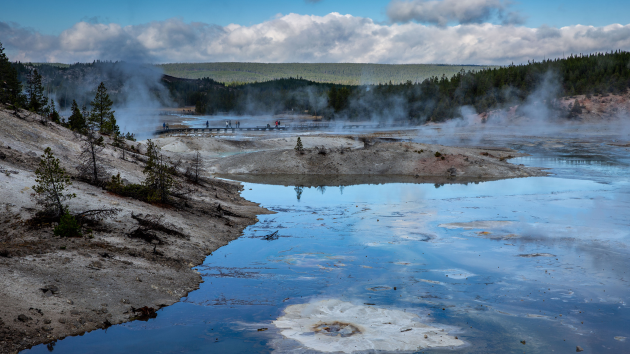
(NEW YORK) — A 29-year-old man is recovering after suffering significant but non-life-threatening injuries to his chest and left arm following a bear attack in Yellowstone National Park, authorities said.
The solo hiker was walking on the Turbid Lake Trail, located northeast of Mary Bay in Yellowstone Lake and approximately 2.5 miles from the Pelican Valley Trailhead in the Pelican Valley Bear Management Area, when he encountered the bear and deployed bear spray against it, according to a statement from the National Park Service.
The hiker told officials he thought the bear was a black bear but, based on the location, size, and behavior of the animal, park officials said it was likely a grizzly bear and that bear management staff will attempt to confirm the species through DNA analysis, if possible.
National Park Service medics responded to the incident and walked out with the hiker who was subsequently taken to the Lake Medical Clinic before being flown to a nearby hospital for treatment.
“The Turbid Lake Trail is closed until further notice,” officials said. “Because this incident was a defensive reaction by the bear during a surprise encounter, the park will not be taking any management action against the bear.”
This is the first incident of a bear injuring a person in Yellowstone in 2025 and the first incident in over four years when, in May 2021, a grizzly bear injured a solo hiker on the Beaver Ponds Trail in Mammoth Hot Springs.
This incident currently remains under investigation.