Officials in Philadelphia are searching for Kada Scott, a 23-year-old woman who has been missing for nearly a week. Philadelphia Police Department
(PHILADELPHIA) — A 23-year-old Philadelphia woman has now been missing for nearly a week, with police saying she was being harassed by an unknown individual before disappearing.
Kada Scott was last seen by her mother on Saturday evening when she was leaving for work at a nearby nursing home, police said.
Scott arrived at work but left “prior to her shift’s completion,” and has not been seen since, John Craig, captain of the Philadelphia Police Department, said during a press conference on Wednesday. It was not clear what time Scott left work, but officials said her shift typically was from 10 p.m. to 6 a.m.
“This is completely out of character,” Craig said during the press conference.
She was reported missing to police on Sunday, with law enforcement saying they have “some concern, more so than usual” regarding her disappearance due to worrying phone calls she was receiving.
“In the days leading up to her disappearance, Ms. Scott related to her family and friends that an unknown individual or person had been harassing her via phone,” Craig said.
Craig said officials have not identified the person who was allegedly harassing Scott, but are continuing to investigate “very thoroughly.”
Police are canvassing the neighborhood for video, interviewing friends and family and looking at Scott’s cellphone data — including taking a “deep dive” of her social media — in their efforts to locate Scott. Officials are also speaking to Scott’s co-workers at the nursing home, Craig said.
“We have no cellphone activity or social media activity, and she has not reached out to family or friends,” Craig said.
Officials were able to recover Scott’s vehicle, which was located in the parking lot of the nursing home where she worked, Craig said.
Scott, who officials described as a “very bright, energetic woman,” is 5 feet, 6 inches tall, weighing 120 pounds and has brown eyes and black hair, police said.
“I just need her to come home and be safe. That’s what I fear — she’s not safe,” Scott’s mother, Kim Matthews, told Philadelphia ABC station WPVI.
Scott’s name has also been entered into the National Crime Information Center database, Craig said.
Anyone who has information on Scott’s whereabouts is urged to call 215-686-3353, police said.
Adva Lavie is wanted for a string of burglaries in which she allegedly targeted older men, posing as a romantic companion on virtual dating platforms and social media, according to officials.
The suspect is described as 5 feet, 7 inches tall and weighing 104 lbs. with brunette hair and hazel eyes. Lavie is believed to drive a black Porsche SUV or white Mercedes-Benz.
She is also known to use the aliases Mia Ventura, Shoshana or Shana, according to officials.
When contacted by ABC News, the Los Angeles County Sheriff’s Department said they had no additional information to provide about the suspect or her alleged crimes.
Officials are asking anyone with information about Lavie or incidents in which she may have been involved to contact the Los Angeles County Sheriff’s Department or Los Angeles Police Department.
Britney Gard is seen in an undated photo released by the Putnam County Sheriff’s Office. Putnam County Sheriff’s Office
(PUTNAM COUNTY, Ind.) — An Indiana woman who was reported missing last week following a “suspicious” fire in her house has been found alive, authorities said.
Britney Gard, 46, last had contact with her family the evening of Sept. 30, according to the Putnam County Sheriff’s Office. She was considered a missing endangered person “due to her unknown whereabouts,” the sheriff’s office said.
Following an extensive investigation, she was found in a wooded area about 2 1/2 miles from her home, the Putnam County Sheriff’s Office said Wednesday evening. She was being cleared by medical staff and no additional details were available, the sheriff’s office said.
Authorities responded to Gard’s home on Oct. 1, following a 911 call for a fire at her home in Bainbridge, located about 40 miles west of Indianapolis, the sheriff’s office said. Smoke was reported coming from the residence around 7:40 p.m., the office said.
Fire crews extinguished the blaze, which investigators believe is “suspicious in nature,” Putnam County Sheriff Jerrod Baugh said in a statement on Friday. The cause of the fire remains under investigation, Baugh said in an update on Wednesday.
No one was found in the fire-damaged home, and attempts by family and friends to contact Gard following the fire have been unsuccessful, the sheriff’s office said. She was not located following a drone-assisted search of the area and searches of a pond on the property following the fire, the sheriff’s office said.
Gard was supposed to attend her daughter’s volleyball game on Oct. 1, but did not show up, her sister, Stephanie Bowen, told Indianapolis ABC affiliate WRTV.
“Her car’s at home, her purse is at home. She’s nowhere to be found, and the house is on fire. It makes no sense,” Bowen told WRTV on Monday.
“I just feel like there’s something here bigger that we don’t know,” she said.
The search continued this week for the mother of two, with dozens of people, including her sisters, looking through cornfields and wooded areas near Gard’s property on Monday, WRTV reported.
Drones were deployed in the area, and conservation officers with the Indiana Department of Natural Resources have been conducting searches of the ponds at the residence and in the surrounding area, the sheriff’s office said Wednesday.
Detectives also worked with the FBI and Indiana State Police, “looking for any leads into the current and past locations of any and all devices that could lead investigators to the location of Britney Gard,” Baugh said Wednesday.
Amid the search, Bowen urged people to be “vigilant” and to check their home security cameras.
“Britney, we love you,” she told WRTV on Monday. “We hope to see you safely return home.”
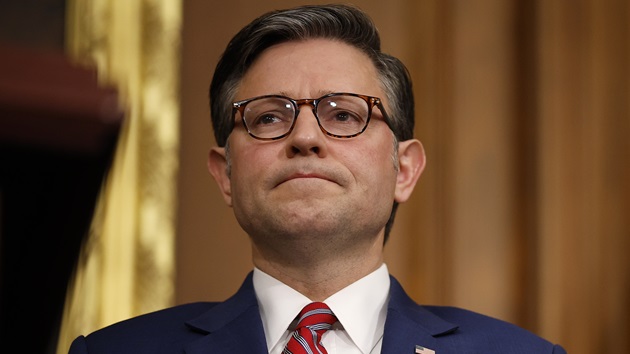
U.S. Speaker of the House Mike Johnson (R-LA) attends a news conference on the government shutdown at the U.S. Capitol on October 08, 2025 in Washington, DC. Kevin Dietsch/Getty Images
(WASHINGTON) — In a rare appearance on C-SPAN on Thursday, House Speaker Mike Johnson heard from one military mom who begged him to bring the House back to session to pass a standalone bill to provide military troops pay during the government shutdown.
The person was identified on the call as “Samantha” — a Republican from Fort Belvoir, Virginia, who said she’s “very disappointed” with the Republican Party over the shutdown.
She said her “kids could die” if her family experiences a lapse in pay on Oct. 15.
If a government shutdown continues into next week and Congress does not pass a measure to pay the troops or reopen the government, that date will mark the first time in recent history when service members missed a paycheck amid a shutdown.
“I think that it is awful, and the audacity of someone who makes six figures a year to do this to military families is insane,” Samantha told Johnson.
She acknowledged feeling “very shaky” over the situation.
“Just want you to hear a little bit about my family. I have two medically fragile children. I have a husband who actively serves this country. He suffers from PTSD from his two tours in Afghanistan,” she said during the call. “If we see a lapse in pay come the 15th, my children do not get to get the medication that’s needed for them to live their life, because we live paycheck to paycheck.”
She pressed Johnson on the standalone bill.
“I’m begging you to pass this legislation. My kids could die,” Samantha said. “We don’t have the credit because of the medical bills that I have to pay regularly. You could stop this, and you could be the one that could say military is getting paid.”
The speaker — a Republican — expressed sympathy for Samantha and her family.
“Samantha, I’m so sorry to hear about your situation,” Johnson said, adding stories like hers is “what keeps me up at night.”
“The reason I’ve been so angry this week, and they’ve been calling me out on media — ‘Johnson’s angry.’ I am angry because of situations just like yours,” the speaker said.
However, when asked at a news conference in the Capitol on Wednesday if he would bring the House back to session and move a bill on the floor to pay military troops if the shutdown drags into next week, Johnson suggested he would not do so.
“We already had that vote. It’s called the [continuing resolution],” Johnson said at the news conference, referring the House GOP stopgap bill to fund the government until Nov. 21. The measure has failed to advance in the Senate.
Johnson also pointed to the continuing resolution while speaking with Samantha, arguing another vote on the floor to pay the troops would also fail in the Senate.
“We had a vote to pay the troops. It was the continuing resolution three weeks ago. Every single Republican but two voted to keep the government open so that your paycheck can flow. Every Democrat in the House, except for one, voted to close it. The Democrats are the ones that are preventing you from getting a check,” Johnson said.
(LONDON) — World leaders on Thursday issued a wave of statements commending Israel and Hamas for agreeing to the first phase of a ceasefire deal, with many also praising U.S. President Donald Trump for his administration’s role in brokering the deal.
“I welcome the news that a deal has been reached on the first stage of President Trump’s peace plan for Gaza,” British Prime Minister Keir Starmer said in a statement. “This is a moment of profound relief that will be felt all around the world, but particularly for the hostages, their families, and for the civilian population of Gaza, who have endured unimaginable suffering over the last two years.”
French President Emmanuel Macron, European Commission President Ursula von der Leyen and U.N. Secretary-General António Guterres issued statements with wording closely matching Starmer’s. Each praised Trump, then also included an appeal to Israel and Hamas to abide by the terms of the agreement.
Those statements and many others like them followed Trump’s announcement on Wednesday evening that the warring parties had “both signed off” on the first phase of a ceasefire plan.
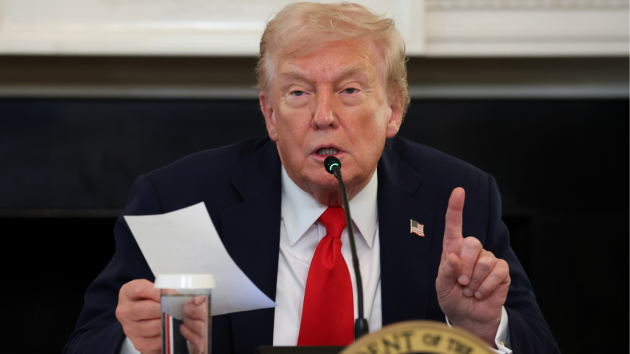
“This means that ALL of the Hostages will be released very soon, and Israel will withdraw their Troops to an agreed upon line as the first steps toward a Strong, Durable, and Everlasting Peace. All Parties will be treated fairly!” Trump said in a statement posted on social media.
The full details of that deal were still coming into focus on Thursday, but the broad outline included a partial withdrawal of Israeli forces from Gaza and the release by Hamas of the remaining hostages, according to Trump. An as-yet unknown number of Palestinian prisoners are also expected to be released from Israeli jails. Nearly 2,000 prisoners are believed to be under discussion for release.
Israeli officials were preparing on Thursday to ratify the deal. The details of the agreed-to deal had not been released as of Thursday morning.
White House Special Envoy to the Middle East Steve Witkoff and Trump’s son-in-law Jared Kushner were in Egypt on Wednesday for the final negotiations. Secretary of State Marco Rubio was in Washington, where he interrupted a White House roundtable to notify Trump that an agreement to the deal was near.
The administration’s efforts drew applause from Trump’s allies in Washington, including House Speaker Mike Johnson, who in a statement hailed it as “a truly historic achievement,” as well as from leaders and aid organisations farther afield.
Israeli President Isaac Herzog said in a statement posted on social media he wanted to thank “all those involved in this vital effort.”
“I wish to extend my deepest thanks to POTUS Donald Trump for his incredible leadership toward securing the release of the hostages, bringing an end to the war, and creating hope for a new reality in the Middle East,” Herzog said. “There is no doubt that he deserves the Nobel Peace Prize for this. Should he visit us in the coming days, he will be received with immense respect, affection, and gratitude by the people of Israel.”
Praise for the deal also came from the Palestinian Authority, which governed the Gaza Strip until a violent 2007 seizure by Hamas, the terror organization that at that time executed or expelled many of the Authority’s civil leaders. The Authority, which currently controls civil operations in parts of the West Bank, said in a statement that President Mahmoud Abbas welcomed the deal, calling it a “prelude to reaching a permanent political solution.”
“He also commended President Trump and all mediators for their significant efforts in reaching the agreement, affirming the State of Palestine’s readiness to work with relevant mediators and international partners to ensure its success, in order to achieve stability and a lasting and just peace in accordance with international law,” the Authority’s statement said.
The statement also said Palestinian “sovereignty over the Gaza Strip belongs to the State of Palestine.” The details of the agreed-to deal had not been released as of Thursday morning.
Guterres, of the U.N., said on social media he welcomed the agreement, praising the “diplomatic efforts” of the United States and the others who moved the deal forward, including Qatar, Egypt and Turkey. He called it a “desperately needed breakthrough.”
“The UN will support the full implementation of the agreement & will scale up the delivery of sustained & principled humanitarian relief, and we will advance recovery & reconstruction efforts in Gaza,” Guterres added.
European Council President Antonio Costa said the deal amounted to a “foundation for a lasting peace, grounded in a two-state solution.”
“Its implementation paves the way for the long-awaited release of all Israeli hostages, a ceasefire in Gaza, and an end to the severe humanitarian crisis on the ground,” Costa said on Thursday.
The Catholic Church’s local patriarchate also issued a statement praising the deal, saying it “welcomes the joy” of the announcement.
“It is good news, and we are very happy. It is a first step, the first phase. Of course, there are many others, and surely there will be other obstacles,” Cardinal Pierbattista Pizzaballa, of the Latin Patriarch of Jerusalem, said in a statement.
He added, “But now we have to rejoice about this important step that will bring a little more trust for the future and also bring new hope, especially to the people, both Israeli and Palestinians.”
(LONDON and TEL AVIV) — Israeli Prime Minister Benjamin Netanyahu will convene his cabinet to discuss the proposed Gaza Strip ceasefire deal on Thursday, with the cabinet and the wider government expected to approve the blueprint to end the two-year-old war.
The cabinet will meet after days of intense negotiations in the Egyptian Red Sea city of Sharm el-Sheikh, where Israeli and Hamas representatives hashed out the final details of a plan based on the 20-point proposal presented by U.S. President Donald Trump last month.
Netanyahu is expected to convene his cabinet meeting at 5 p.m. local time — 10 a.m. ET. The cabinet is expected to approve the deal, after which the proposal will be put to the wider government. A government vote to ratify the deal is then expected at around 6 p.m. local time — 11 a.m. ET.
The cessation of all fighting by the IDF and Hamas will go into effect after the Israel government ratifies the deal, according to an Israeli official.
Trump announced on Wednesday that Israel and Hamas had agreed to the first phase of the deal, in which all remaining hostages — alive and dead — will be released from Gaza in exchange for an as-yet undetermined number of Palestinians being held in Israeli prisons. Nearly 2,000 prisoners are believed to be under discussion for release.
The Israel Defense Forces will also pull back to the so-called “yellow line” in Gaza — a reference to a proposed ceasefire map released by the White House last month showing multiple stages of withdrawal. The full details of the agreed-to deal have not been made public and the exact location of that “line” may have shifted during the negotiations.
A senior Israeli official told ABC News that the 72-hour window for Hamas releasing all hostages will begin after the Israeli government ratifies the deal, which it is expected to do on Thursday.
The 20 hostages thought to still be alive are therefore expected to be released all in one group on Sunday or Monday, the official said.
An Israeli official told ABC News that the IDF will have 24 hours to move to the yellow line once the deal is ratified by the government.
“This means that ALL of the Hostages will be released very soon, and Israel will withdraw their Troops to an agreed upon line as the first steps toward a Strong, Durable, and Everlasting Peace. All Parties will be treated fairly!” Trump said in a post to social media, explaining the first phase of the agreement.
“This is a GREAT Day for the Arab and Muslim World, Israel, all surrounding Nations, and the United States of America, and we thank the mediators from Qatar, Egypt, and Turkey, who worked with us to make this Historic and Unprecedented Event happen,” the post continued.
Key Arab and Muslim said in supportive statements that they would back the White House plan, all pressing Hamas to accept the blueprint that could end more than two years of intense fighting in the Gaza Strip, which has been largely destroyed by Israeli offensives since the war began after Hamas’ surprise terror attack on Israel on Oct. 7, 2023.
Intense strikes across Gaza continued on Thursday, even as the final elements of the deal were hammered out by negotiators in Egypt.
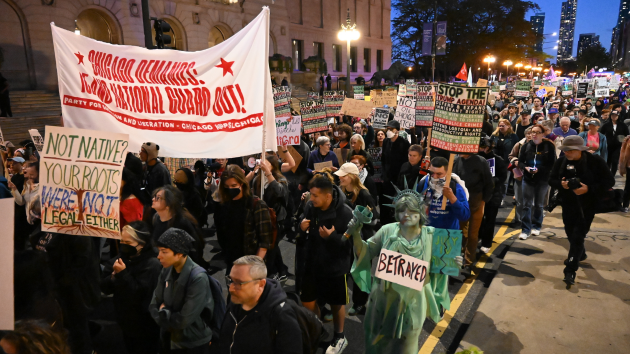
(WASHINGTON) — In two courthouses on opposite sides of the country, Donald Trump’s attempt to send troops into Democratic-led cities will face a critical legal test on Thursday.
The Ninth Circuit Court of Appeals is set to hold oral arguments at noon on whether to lift a lower court’s order blocking the deployment of troops into Portland, while a District Judge in Chicago has a hearing at the same time to consider stopping the deployment of the National Guard in Illinois.
The dueling hearings sets the stage for one of the most high-profile legal battles since President Trump took office, as local governments turn to the courts to stop what some judges have described as blurring of the line between military and civilian rule.
Chicago Ahead of the Chicago hearing, U.S. District Judge April Perry set a midnight deadline for the Trump administration to confirm when National Guard troops are set to arrive in Illinois, where they are set to be deployed and the scope of their activities.
Lawyers for the city of Chicago and state of Illinois have argued that the deployment of National Guardsmen will decrease public safety, exacerbate tensions in the city and infringe on the state’s sovereignty.
“By design, state and local governments operate closer to the people they serve, allowing them to tailor their activities to their communities’ needs. Federalism is not merely an administrative arrangement; it is a structural protection of liberty,” they wrote in a filing. “When the federal government assumes a role traditionally reserved to the States, it blurs the constitutional lines that define who is responsible for public safety.”
Portland Meanwhile, as the Chicago hearing takes place, a three-judge panel on the Ninth Circuit Court of Appeals will hear arguments about whether to lift a lower court’s order blocking the deployment of 200 federalized members of the Oregon National Guard into Portland.
Earlier on Wednesday, the Ninth Circuit issued an administrative stay of that order to preserve the status quo as the lawsuit moves through the court.
Oregon argues that the deployment of troops is “part of a nationwide campaign to assimilate the military into civilian law enforcement” and is based on “inaccurate information” about the conditions in Portland.
“Defendants’ nearly limitless conception [the law] would give the President discretion to repeat this experiment in response to other ordinary, nonviolent acts of civil disobedience across our Nation. The public interest is served by a judicial order preserving the rule of law in the face of unprecedented and unlawful Executive action that threatens grave and irreparable damage to our State and the Nation,” lawyers for the state said in a recent filing.
A federal judge on Sunday expanded her order to bar any state’s National Guard from entering Portland after concluding that the Trump administration was attempting to work around her temporary restraining order by using troops from other states.
That second order has not been formally appealed yet, although the broader issue may arise during the hearing as the Trump administration challenges judicial limits on the president’s authority to deploy the National Guard.
“Congress did not impose these limits on the President’s authority to federalize the Guard, nor did it authorize the federal courts to second-guess the President’s judgment about when and where to call up the Guard to reinforce the regular forces in response to sustained and widespread violent resistance to federal law enforcement,” lawyers for the Trump administration wrote in a filing earlier this week.
In an amicus brief filed on Thursday, a group of former secretaries of the Army and Navy and retired four-star admirals and generals encouraged Judge Perry to express caution about the broader use of the National Guard in domestic operations.
“Domestic deployments that fail to adhere to [Posse Comitatus Act] threaten the Guard’s core national security and disaster relief missions; place deployed personnel in fraught situations for which they lack specific training, thus posing safety concerns for servicemembers and the public alike; and risk inappropriately politicizing the military, creating additional risks to recruitment, retention, morale, and cohesion of the force,” lawyers for the former military leaders wrote.
(SAN FRANSCISCO) — Four people, including two children, have been found dead in a “suspicious” incident inside a San Francisco home, authorities said.
San Francisco police officers responded to a home on the 900 block of Monterey Boulevard at approximately 1:23 p.m. on Thursday to perform a well-being check on a family residing in the home. But when the officers arrived, they discovered four “unresponsive individuals” who were declared dead on scene, according to a statement from the Sam Francisco Police Department.
Police said the deaths appeared to be an isolated incident, reiterating that there is no general threat to the public, but also calling the deaths “suspicious” in nature.
Officers say two of the four people found dead are kids, according to ABC News’ San Francisco station KGO.
Neighbors who live next to the family say that they are heartbroken.
“I was just coming back from school, and I heard it from my mom and I just, you know, my heart dropped,” Teo Brouwers, who lives next door to the home, told KGO.
“I don’t have the words right now. I’m in bit of shock. We are in shock, it’s a tragedy and we’re thinking about the family. We are processing the information right now,” Belinda Hanart, who also lives next door, said to KGO.
“Our bedroom is on their side, and we have two dogs so. There was no noise, nothing, and I think it was the most disturbing part we didn’t hear anything. Nothing,” Hanart continued. “We knew it was a family of four with two girls. The older one was probably 12- to 13-years-old and a dog, and it was a very normal family with normal family routine,” said Hanart.
The names of the dead have not yet been released and police are not saying what they believe happened, but did confirm that crimes were committed inside the home.
Investigators were asked if an attacker or assailant could have been one of the four found dead in the home, according KGO.
“That is a possibility. We’re not confirming any of that at this time but that is a possibility of this incident,” said Officer Robert Rueca of the San Francisco Police Department.
“We heard them more than we saw them and it was just normal family life, like kids in the garden trying to get the dog inside, and having barbecue for summer nights, that’s it. Just like us,” said Hanart.
The San Francisco Office of the Chief Medical Examiner is conducting a parallel investigation and will determine the cause and manner of death.
The San Francisco Police Department Homicide Detail was notified of the suspicious deaths and is leading the ongoing investigation.
(FRANKLIN COUNTY, Pa.) — Two state troopers were wounded in a shooting and the suspect was killed after a car chase ended in an exchange of gunfire in Franklin County, Pennsylvania, on Wednesday.
Both of the troopers were rushed to the hospital. One is in critical condition and the other is in serious condition, according to authorities.
The troopers were responding to a reported retail theft at Dicks Sporting Goods in Chambersburg shortly after 6 p.m., Pennsylvania State Police said in a news release.
The suspects in the theft fled the store, traveling toward nearby Interstate 81 and were pursued by the troopers, who eventually used spike strips to stop the vehicle, according to state police.
When the vehicle came to a stop off the road, two female suspects followed orders and got out of the vehicle to be taken into custody, state police said.
The male suspect, however, began shooting at troopers, authorities said, striking two of them. The troopers fired back, fatally wounding the suspect.
Authorities haven’t released the identities of the troopers who were wounded or the suspected shooter.
State police and the Franklin County District Attorney’s Office are investigating the shooting.
Franklin County, which is located in south-central Pennsylvania, is home to 155,000 residents and its county seat is Chambersburg.
In a statement on social media, Pennsylvania Gov. Josh Shapiro said he was praying for the officers.
“Pennsylvania’s law enforcement officers are the very best of us — running towards danger every day to keep our communities safe,” Shapiro said.
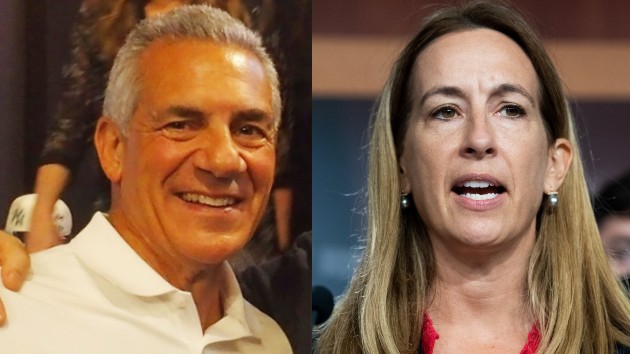
Rep. Mikie Sherrill, D-N.J., conducts a news conference in the U.S. Capitol on the inclusion of solar tax credit legislation in reconciliation on Tuesday, September 28, 2021. (Photo By Tom Williams/CQ-Roll Call, Inc via Getty Images)/Jack Ciattarelli and Matt Servitto attend 2025 Paisan Con at The Williams Center on May 10, 2025 in Rutherford, New Jersey. (Photo by Bobby Bank/Getty Images)
(NEW JERSEY) — New Jersey’s gubernatorial candidates face off in their second debate, hosted by New York City’s WABC-TV and Philadelphia’s WPVI-TV less than a month out from Election Day.
Polling shows Democratic nominee Rep. Mikie Sherrill, a former Navy helicopter pilot, has an edge over Republican former state Assemblyman Jack Ciattarelli. A recent survey from Quinnipiac shows Sherrill leading in a head-to-head matchup, 51%-42%.
This is not Ciattarelli’s first go around — he narrowly lost a bid to unseat Murphy in 2021. But this time, he faces wider margins and is expected to try to dodge Sherrill’s attempts to link Ciattarelli with President Donald Trump on every issue. Trump has endorsed Ciattarelli’s bid.
Outside groups have infused large sums of cash into this race. Democrats, looking to defend control as term-limited Phil Murphy leaves office, are writing fat checks: Greater Garden State, a super PAC supported by the Democratic Governors Association, reserved over $20 million in ads to support Sherrill. And the Democratic National Committee has invested $3 million into the governor’s race, a sum it says is its largest in an off-cycle race in New Jersey.
Republicans have thrown in far less: Restore New Jersey, a Republican Governors Association-backed group, invested $1 million in ads supporting Ciattarelli in September.
New Jersey has not elected the same party three straight terms since 1961, with affordability and taxes central to the race. Trump’s inroads with Jersey voters could be tested in November, as Republicans point to last year’s presidential results as a sign the state has gotten more favorable for the GOP.
Late last month, Sherrill ‘s unredacted military records were released by the National Archives that revealed she did not walk at graduation. In 1994, more than 130 Midshipmen were implicated in a cheating scandal. No documents released or obtained by news outlets have shown that Sherrill was involved in the cheating, but because she did not report her classmates, she was not permitted to walk at graduation.
CBS News, which was the first to report about the release of Sherrill’s unredacted military records, reported that the request came from Ciattarelli ally Nicholas De Gregorio, who was tasked with doing so by political operative Chris Russell.
Sherrill said this was a 30-year-old widely reported incident that does not reflect on her military service and accused the Trump administration of leaking the records in concert with the Ciattarelli campaign and asked for them to stop distributing them as they contained protected personal information.
Sherrill’s campaign communications director Sean Higgins said in a statement: “This disrespects the service of all military veterans, jeopardizes the safety of their records, and shows that Jack Ciattarelli will say or do anything to get elected, no matter the dishonor he brings upon himself — and that should frighten everyone.”
Ciattarelli disagreed.
“For eight years, Mikie Sherrill has built her entire political brand around her time at the Naval Academy and in the Navy, all the while concealing her involvement in the scandal and her punishment. The people of New Jersey deserve complete and total transparency,” the Ciattarelli campaign said in a statement.
Another likely animating issue in the debate will be the impacts of the government shutdown and White House funding freezes in the Garden State. The Hudson Tunnel Project, which White House Office of Management and Budget Director Russell Vought froze funding for on Oct. 1, is meant to expand rail links between New York City and New Jersey.
After the announcement, Sherrill slammed the Trump administration for “attacking” the project and wrote in a post on X that Ciatterelli “said there’s not a single issue where he disagrees with Trump, and he promised to never take them to court.”
Ciatterelli, meanwhile, told NJ Advance Media/NJ.com that the hold “doesn’t stop what’s going on today with regard to the construction. And I think it’s a large negotiation that’s taking place.”
-ABC’s Oren Oppenheim and Aaron Katersky contributed to this report.