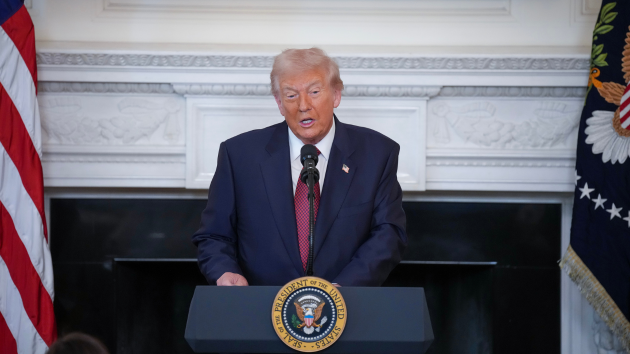
(WASHINGTON) — President Donald Trump issued a sweeping pardon to key figures allegedly involved in the plan to arrange an alternate slate of electors and “expose voting fraud” during the 2020 election, according to U.S. Pardon Attorney Ed Martin.
Trump pardoned high-profile individuals allegedly involved in his attempt to overturn the election, including Rudy Giuliani, Sidney Powell, Boris Epshteyn, John Eastman and Mark Meadows — and 72 other individuals allegedly associated with the effort to challenge the 2020 election results.
The pardon, which Trump appears to have signed on Friday, covers each of the president’s co-defendants who were charged in Georgia for a sweeping scheme to overturn election results.
Four of the pardon recipients pleaded guilty in the Georgia case.
“This proclamation ends a grave national injustice perpetrated upon the American people following the 2020 Presidential Election and continues the process of national reconciliation,” the pardon says.
The pardon language explicitly states that it does not apply to Trump himself. “This pardon does not apply to the president of the United States,” according to the pardon.
(NEW YORK) — For the first time in more than two decades, the Pentagon has begun sending conventional ground forces to Panama to train in the jungle there, returning U.S. soldiers and Marines to a three-week course once called the “Green Hell” because of its similarities to Vietnam.
The training program at Base Aeronaval Cristóbal Colón, formerly known as Fort Sherman, is relatively small in scope but is expected to ramp up over the next year, according to one defense official.
The program began earlier this year and is not intended to prepare troops for a potential mission, including inside Venezuela, the official said.
Still, the military’s interest in jungle warfare in Latin America is noteworthy given Trump’s heightened focus there. Since taking office, Trump has vowed to “take back” the Panama Canal and repeatedly threatened to attack Venezuela because of its alleged role in transiting illegal narcotics.
“If you can train and fight in one of the most difficult and challenging locations in the world, you build a really lethal, effective force,” the defense official said of the rationale behind the new training program.
Alex Plitsas, a former Pentagon official and senior fellow at The Atlantic Council, said the new training course wouldn’t likely play a role in potential operations inside Venezuela. The training effort appears to be more about building Panama’s capacity to handle security threats in the region.
But the move signals a shift in priorities by the Trump administration, he said.
“It’s an expansion of an existing military relationship, but it’s not happening in a vacuum,” Plitsas said. “It’s happening as a broader change in policy. There’s a renewed interest in South America, where the president sees the drug flow to the United States as a national security issue with the intention of potential military action.”
Jungle training hasn’t been a priority for the military since 9/11, when the nation’s focus shifted to counterterrorism operations in the Middle East. The Defense Department in recent years has relied on a smaller Army jungle training center in Hawaii and at a Marine Corps site in Okinawa, Japan.
During the Vietnam War, however, Fort Sherman was considered a prime location where most troops could hone their jungle survival skills before shipping off to war.
Conditions at the Panamanian training site are considered among the harshest in the world, including venomous snakes and several layers of thick, towering vegetation that can make it difficult to operate communications and night-vision equipment or evacuate wounded personnel.
By 1999, the training site shuttered and the last of the U.S. military departed Panama as part of an agreement ceding U.S. control of the Panama Canal.
Shortly after taking office, though, Trump expressed renewed interest in the region, declaring the U.S. would be “reclaiming” the Panama Canal. That effort has since been couched by Pentagon officials as a renewed “partnership” with Panama to prevent Chinese influence over the canal, which the U.S. relies on heavily for shipping.
Trump also has overseen an unprecedented buildup of U.S. troops to the region, deploying 10,000 troops and, more recently, the USS Gerald R. Ford, the world’s largest aircraft carrier. The public display of force appears to be a kind of pressure campaign aimed at forcing out Venezuelan President Nicolás Maduro.
By August, the military had set up the “Combined Jungle Operations Training Course” with Marines and Panamanian forces training as part of a pilot program. A military spokesperson said there have since been 46 graduates of the three-week course: 18 Marines, one Army soldier and 27 personnel from Panama’s National Aeronaval Service, National Border Service and National Police.
According to the Defense official, the Army plans to ramp up training over the next year, eventually sending in platoons of some 40 soldiers at a time to train.
Steve Ganyard, a retired Marine Corps colonel and ABC contributor, said the renewed interest in Panama is likely a practical one, but it also can be used to send a message.
“From a practical perspective, it’s easier to get to Panama than Okinawa. And the jungles of Central and South America have their own unique challenges,” he said. “That said, no doubt a message is being sent to Maduro by conducting combat training in his neighborhood.”
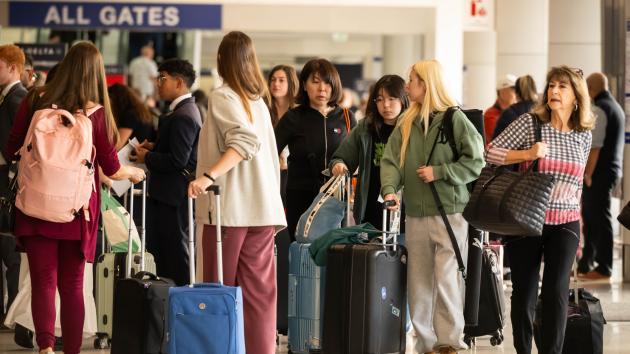
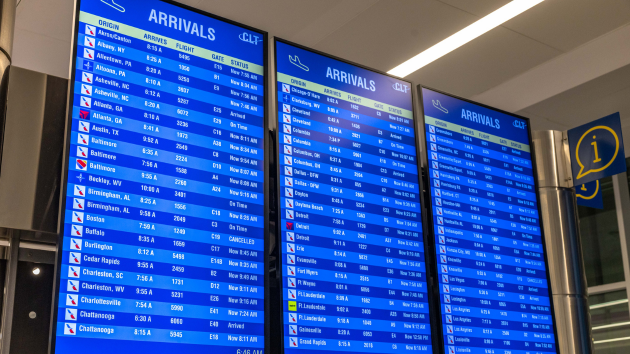
(NEW YORK) — More than 1,500 flights were canceled across the country early on Monday amid the Federal Aviation Administration’s limiting capacity at 40 major U.S. airports.
Another 881 flights were expected to be delayed on Monday, according to FlightAware, an airline traffic tracker, which also logged some 1,509 cancellations for flights within, into or out of the United States.
The travel chaos, which comes amid a record-length shutdown of the federal government, was expected to continue into Tuesday, according to the tracker. At leat 987 flights that had been planned for Tuesday were canceled, FlightAware said.
(WASHINGTON) — President Donald Trump on Sunday claimed that a “dividend of at least $2000 a person” will be paid to all Americans except for “high-income people,” saying the country is now wealthy as a result of his tariff policies.
“People that are against Tariffs are FOOLS! We are now the Richest, Most Respected Country In the World, With Almost No Inflation, and A Record Stock Market Price. 401k’s are Highest EVER,” the president wrote.
“A dividend of at least $2000 a person (not including high income people!) will be paid to everyone,” he added.
In an interview on ABC News’ “This Week” on Sunday, Treasury Secretary Scott Bessent said that he had not spoken with Trump about the proposed dividend.
Calling opponents to tariffs “fools,” Trump claimed “A dividend of at least $2000 a person (not including high income people!) will be paid to everyone.”
“The $2,000 dividend could come in lots of forms, in lots of ways, George,” Bessent told anchor George Stephanopoulos. “You know, it could be just the tax decreases that we are seeing on the president’s agenda — you know, no tax on tips, no tax on overtime, no tax on Social Security, deductibility of auto loans.”
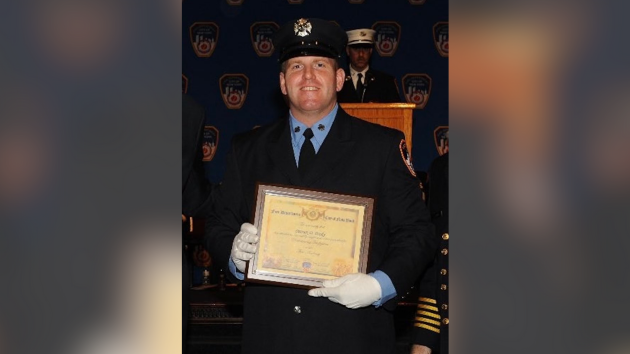
(NEW YORK) — Patrick Brady, a New York City firefighter, had a “medical episode” while battling a five-alarm fire in Brooklyn on Saturday and later died at the hospital, officials said.
Brady, 42, was an 11-year veteran of the department, FDNY Commissioner Robert S. Tucker said in a joint press release with Mayor Eric Adams.
“Firefighter Patrick Brady gave his life protecting the city we all love; there is no sacrifice that is more selfless than the actions that took place this evening,” Adams said in a statement.
Brady had been battling a fire on the roof of 9407 Kings Highway in Brooklyn on Saturday when he had a “medical episode” and went into cardiac arrest, the department said. He was treated on the scene and then rushed to Brookdale hospital, where he later died, officials said.
“A resident of Queens, he is survived by his wife, Kara, and his two brothers, Jimmy and Brian, who are both FDNY Firefighters,” the department said. Other members of his family, including cousins and uncles, are also FDNY Firefighters, according to the department.
“This family is a firefighter family,” Adams said during a somber press conference held at Brookdale hospital in Brooklyn early Sunday morning.
“They’ve been dedicated to protecting the lives of New Yorkers, and we will all cherish Patrick’s memory,” Adams added.
(NEW YORK) — Nationwide flight disruption stretched into Sunday following cancellations or delays to thousands of flights on Saturday, as the Federal Aviation Administration limited capacity at 40 major U.S. airports amid the longest government shutdown in American history.
As of 5:30 a.m. ET on Sunday, more than 1,100 flights were cancelled across the country according to the FlightAware website, as the FAA grappled with sustained staffing issues in air traffic controller towers and centers.
Saturday saw 1,521 flights canceled nationwide and more than 6,400 flights delayed.
Saturday’s figures surpassed those from Friday, when 1,024 flights were cancelled. Since Friday, more than 3,700 flights have been cancelled.
Major disruption was expected to continue through Sunday. As of Saturday night, there were over 40 air traffic control staffing triggers at facilities across the country.
The FAA decided not to cut any international flights as it would be a violation of international agreements with the countries, Transportation Secretary Sean Duffy said in an interview on ABC News Live on Friday.
(WASHINGTON) — Treasury Secretary Scott Bessent said Sunday that there is no formal proposal from the White House to defund the Affordable Care Act and instead send money directly to Americans, despite a social media post from President Donald Trump on Saturday promoting such a plan.
“The president has also come forward with a new proposal overnight, saying it’s time, instead, to do away with Obamacare and said to have the money go directly to the people. Do you have a formal proposal to do that?” ABC News’ “This Week” anchor George Stephanopoulos.
“We don’t have a formal proposal,” Bessent said.
But pressed by Stephanopoulos about whether such a plan would be proposed to the Senate, Bessent said that the administration was not proposing it “right now.”
Bessent also hedged when asked about Trump’s push to end the Senate’s filibuster.
“Is the best way to end the shutdown right now to end the filibuster?” Stephanopolous asked.
“The best way is for five Democratic senators to come across the aisle,” Bessent said.
(NEW YORK) — There is a paragraph on page 22 of the Trump administration’s appeal of a federal judge’s requirement that it make full November SNAP payments that has to be seen to be believed.
The opening sentence asserts that “the district court’s order threatens significant and irreparable harm to the government which outweighs any claimed injury to plaintiffs.”
In plain English, the Justice Department is telling the court that it would hurt the federal government more to comply with a judge’s order requiring full food stamp payments than it would hurt millions of low-income Americans to potentially starve.
Let’s simplify this further: the government is arguing that once the money is spent, it can’t be unspent (and that would be horrible). But the hungry can’t eat tomorrow (and that’s not as bad). That is the contention.
In a 40-page filing to the 1st Circuit Court of Appeals, the administration insisted that being forced to spend money Congress has already appropriated is a graver injury than the hunger and disruption that would follow from withholding it. Friday night, the administration filed a nearly identical emergency stay request with the Supreme Court, and Justice Ketanji Brown Jackson issued a temporary pause that will remain in effect until the circuit court issues a judgment on the matter.
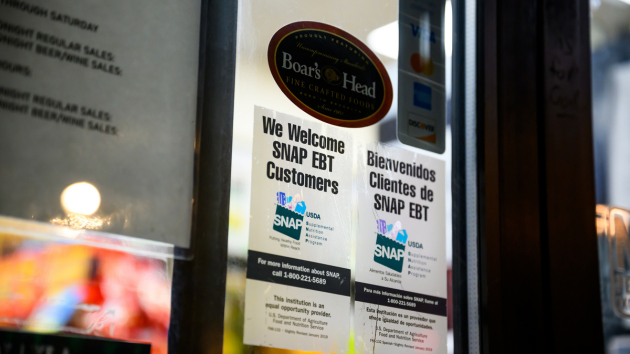
At stake is the Supplemental Nutrition Assistance Program—SNAP—which provides monthly benefits to roughly 42 million Americans. During the ongoing government shutdown, the U.S. Department of Agriculture (USDA) planned to fund only part of the November payments, prompting lawsuits from cities, religious groups, and nonprofits that argued that the administration was flouting its legal obligation to deliver full benefits.
Twice, a Rhode Island federal judge, John J. McConnell Jr., agreed, ordering the government to draw on existing accounts to cover the gap. Twice, the administration appealed, contending that the judiciary had usurped Congress’s spending power by directing the executive branch to find the money.
The Justice Department’s latest emergency filing makes that claim in even starker terms. It asserts that McConnell’s injunction “makes a mockery of the separation of powers” and that there is “no lawful basis” for forcing the USDA “to somehow find $4 billion in the metaphorical couch cushions.” It also warns that by compelling compliance, the court has “thrust the Judiciary into the ongoing shutdown negotiations,” implying that judicial enforcement of basic statutory duties somehow exacerbates the fiscal standoff.
But what makes the filing remarkable is not just its tone—it’s the value judgment embedded in it. Traditionally, when courts decide whether to grant emergency relief, there is a calculus: the courts consider which outcome would cause greater damage, keeping the challenged policy on hold or letting it take effect? Here, the “policy” in question is the administration’s refusal to fully fund SNAP despite having ample reserves.
The Justice Department argues that the “irreparable harm” lies in being required to obey the court order and spend the money. By that logic, the government’s institutional discomfort outweighs the hunger of millions of families, seniors, veterans and children whose grocery money hangs in the balance.
Whether in disputes over public health, environmental regulation, or economic relief, the Trump administration’s lawyers have often equated executive prerogative with public interest—as though what benefits the administration necessarily benefits the nation. In this case, that conflation leads to the extraordinary claim that “the government” suffers greater harm by feeding people than by letting them go hungry.
The administration’s insistence that it “cannot” find the funds also rings hollow. By its own admission, the USDA controls multiple accounts with more than enough money to sustain SNAP for the month—including a $5 billion emergency reserve created by Congress specifically for that purpose. It has already drawn on similar pools of money to protect other nutrition programs from shutdown disruptions. The problem, in other words, is not fiscal incapacity but political choice.
The Justice Department’s appeal thus functions as both legal brief and ideological statement. It asks the courts to privilege administrative convenience over human need.
If that argument succeeds, the precedent would reach far beyond SNAP. It would signal that any time a court orders the government to meet a statutory duty—to pay benefits, deliver services, or enforce protections—the executive may claim “irreparable harm” merely because it prefers not to act. That is not separation of powers; it is the substitution of political preference for law.
Judge McConnell, for his part, put the matter bluntly: “This should never happen in America.” He was referring to the spectacle of a federal government choosing to let its citizens go hungry while pleading poverty amid abundant reserves.
The Justice Department’s legal arguments transform that spectacle into doctrine.
James Sample is an ABC News legal contributor and a constitutional law professor at Hofstra University. The views expressed in this story do not necessarily reflect those of ABC News or The Walt Disney Company.
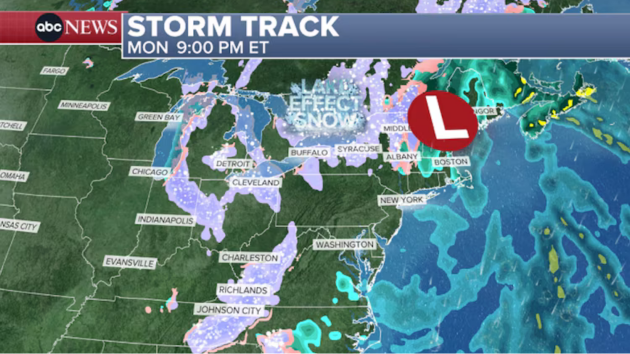
(NEW YORK) — Americans in parts of the Midwest to northern New England could see their first snow of the season early next week due to an arctic blast.
The very warm Great Lakes combined with arctic air will kickstart the lake-effect snow season late this weekend into the new workweek, but this will not be historic snowfall by any measure.
A Winter Storm Watch is in effect for Chicago and South Bend, Indiana, from late Sunday night through Monday afternoon for potentially heavy lake-effect snow. Snow rates exceeding 2 inches per hour, event snow totals up to 6 inches and over 35 mph wind gusts are possible.
While this snow will be very localized and most areas are not expected to see accumulating snow, this combination will likely produce slick and hazardous driving conditions during the morning commute and afternoon on Monday.
Winter Weather Advisories are currently in effect in parts of the Upper Peninsula and northern Wisconsin until Monday afternoon for lake-effect snow bringing between 2 to 5 of total snow and up to 8 inches in localized areas.
By Monday into Tuesday, the first lake-effect snow event will begin to set up in the eastern Great Lakes from Erie to Buffalo and possibly Syracuse.
Some areas off the lakes could see a few inches of snow, but it’s still too soon to know exactly how much will fall and where. Also, reiterating that this will not be historic lake-effect snow by any measure.
The interior Northeast from Appalachia to Pittsburgh up to northern New England could also see its first snow late Monday through Tuesday.
This snow will not stick around for long, as warming temperatures next week will quickly melt any snow that sticks to the ground with this quick blast of arctic air.