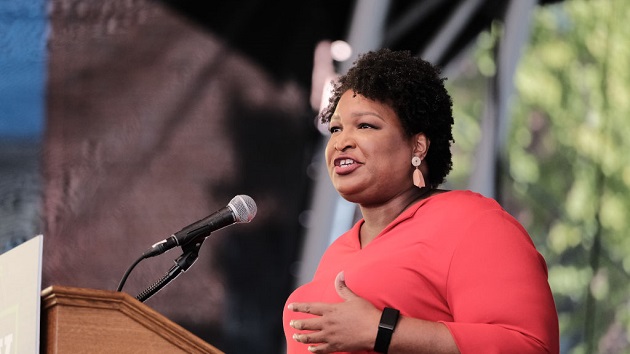
(ATLANTA) — Stacy Abrams will be back on the campaign trail in a second bid for governor of Georgia, setting the stage for a possible rematch with GOP Gov. Brian Kemp whom she lost to in 2018.
Abrams, hoping to become the nation’s first Black chief state executive, made her campaign announcement Wednesday on Twitter.
“I’m running for Governor because opportunity in our state shouldn’t be determined by zip code, background or access to power,” Abrams said in an announcement video.
I’m running for Governor because opportunity in our state shouldn’t be determined by zip code, background or access to power. #gapol
In 2018, she ran a closely-watched race for governor against Kemp, but lost by almost 2 points.
Following the loss, Abrams continued to gain notoriety as she advocated for voting rights legislation. She launched the Fair Fight voter protection organization, which is credited with helping Joe Biden win Georgia in 2020, as well as Raphael Warnock and Jon Ossoff win the state’s two Senate seats.
“We believe in this place and our folks who deserve to be seen and heard and have a voice because in the end, we are one GA.”
Abrams highlighted the work she’s accomplished since leaving the campaign trail in an announcement video that shows Abrams at community events and features various scenes of Georgians at work. I’ve worked to do my part to help families make it through paying off medical debt for 68,000 Georgians expanding access to vaccines, bringing supplies to overwhelmed food banks, lending a hand across our state, especially in rural Georgia,” she said.
Kemp may face a Republican primary challenge.
This is a developing story. Please check back for updates.
(WASHINGTON) — The Biden administration is preparing to implement new travel guidelines that would require proof of a negative COVID-19 test within one day of flying into the U.S., including for vaccinated people, a spokesperson from the Centers for Disease Control and Prevention confirmed.
The expected change comes as the country beefs up surveillance for the omicron variant, the first case of which in the U.S. has been identified in California, the California and San Francisco Departments of Public Health said Wednesday. The CDC said the person traveled from South Africa on Nov. 22.
Omicron has been deemed a “variant of concern” by the World Health Organization and had been detected in over 20 countries as of Tuesday.
“CDC is working to modify the current global testing order for travel as we learn more about the omicron variant; a revised order would shorten the timeline for required testing for all international air travelers to one day before departure to the United States,” CDC spokesperson Kristen Nordlund said Tuesday night. “This strengthens already robust protocols in place for international travel, including requirements for foreign travelers to be fully vaccinated.”
Under the current guidelines, people from other countries who are not fully vaccinated cannot travel to the U.S., while people who are fully vaccinated can as long as they provide proof of a negative COVID-19 test within three days of traveling. For unvaccinated Americans, the guidelines already required proof of a negative test within one day of traveling. The potential new rule would expand that one-day requirement to all vaccinated travelers coming into the U.S. from other countries.
For post-travel recommendations, the CDC also suggests vaccinated travelers get tested three to five days after arriving in the U.S. and that unvaccinated travelers stay home to self-quarantine for a full seven days, even if they test negative during that timeframe.
Earlier on Tuesday, the White House confirmed it was considering updates around testing requirements and said policy discussions were ongoing across the government as more is learned about the omicron variant.
More updates on the country’s response to the variant are expected Thursday.
CDC Director Rochelle Walensky outlined some of the expected changes at the White House COVID-19 briefing on Tuesday morning. She said the CDC is analyzing 80,000 COVID-positive tests per week — or about one in seven tests — looking for the omicron variant. The delta variant continues to account for 99.9% of all tests analyzed, Walensky said.
Asked if she was confident in the CDC’s surveillance system given how many other countries had detected the variant before the U.S., Walensky said the system is “robust.”
The director also said the CDC is working on expanding a surveillance program in the nation’s four busiest international airports, John F. Kennedy International Airport, San Francisco International Airport, Newark Liberty International Airport and Hartsfield-Jackson Atlanta International Airport, which would allow for more COVID-19 tests on international arrivals — though there was no indication that testing would be mandatory for arriving travelers or which arriving planes would be offered the tests.
In the meantime, experts are calling on all Americans to get vaccinated if they haven’t yet and to get boosted if they’re over 18 and were fully vaccinated over six months ago. Of those eligible for a booster, 100 million Americans haven’t gotten one yet, the White House said on Tuesday, while just about 20% of fully vaccinated Americans have, the CDC’s vaccine data shows.
Though the data on how transmissible and severe the omicron variant is will not be available for a few more weeks, as scientists around the globe work to gather it, experts believe it’s unlikely it will completely chip away at the protection from vaccines and boosters, particularly when it comes to hospitalization and death.
“Remember, as with other variants, although partial immune escape may occur, vaccines and particularly boosters give a level of antibody that even with variants like delta, give you a degree of protection, particularly against severe disease,” Dr. Anthony Fauci, chief medical adviser to the White House, said on Tuesday.
On Tuesday, Pfizer BioNTech asked the Food and Drug Administration to consider expanding the booster recommendation to include 16- and 17-year-olds. The agency is expected to review the request in the coming weeks.
Kent Nishimura / Los Angeles Times via Getty Images
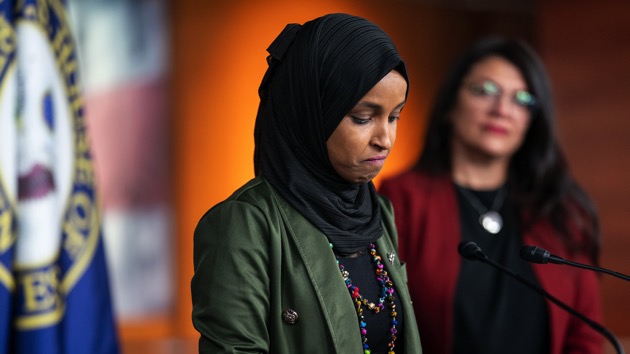
(WASHINGTON) — Democratic Reps. Ilhan Omar, Rashida Tlaib and Andre Carson on Tuesday night forcefully condemned the anti-Muslim remarks made by their colleague, Republican Rep. Lauren Boebert, last week.
Omar, Tlaib, and Carson are the only three Muslims in Congress.
“We may only be three among hundreds serving in Congress, but we are strong advocates that won’t shy away in demanding better for our communities. No one deserves to feel hate or racism solely based on one’s faith. It’s completely unacceptable,” Tlaib said.
A shaken Omar spoke of her difficult experiences as a Muslim American — from the person who told her she would never be elected to Congress for wearing a hijab, to the bigoted reception she received from some Republican members when she was first elected.
“So, when a sitting member of Congress calls a colleague a member of the “jihad squad” and falsifies a story to suggest that I will blow up the Capitol, it is not just attack on me, but on millions of American Muslims across this country,” Omar said of Boebert.
In a video posted to Twitter last week, Boebert referred to Omar as a member of the “Jihad Squad” and claimed that a Capitol Police officer thought she was a terrorist in an encounter in an elevator on Capitol Hill.
She apologized on Twitter Friday “to anyone in the Muslim community I offended,” adding that she had reached out to Omar’s office to speak with her directly, but the phone call did not go well.
Omar hung up on Boebert after the Colorado Republican refused to make a public apology to her, according to a statement from Omar and Boebert’s account of the call.
“We cannot pretend that this hate speech from leading politicians doesn’t have real consequences,” Omar said Tuesday. “The truth is that anti-Muslim hate is on the rise both here at home and around the world.”
Omar said she has received “hundreds” of death threats often triggered by Republican attacks. She held up her phone to the mics and played out a disturbingly graphic voicemail she received just hours after she got off the phone with Boebert on Monday — highlighting the types of threats she receives.
“Condemning this should not be a partisan issue,” Omar said. “This is about our basic humanity and fundamental rights of religious freedom enshrined in our Constitution. Yet, while some members of the Republican Party have condemned this, to date, the Republican Party leadership has done nothing to hold their members accountable.”
Omar said she wants “appropriate action” taken against Boebert but will leave it to leadership to decide what that means. She did not seem keen on the idea of a resolution that would condemn Islamophobia, noting that it’s been done before.
“This kind of hateful rhetoric and actions cannot go without punishment. There has to be accountability,” she said.
A senior Democratic aide confirmed to ABC News that House leadership discussed a possible resolution condemning Islamophobia but didn’t make any decisions during a meeting Tuesday night.
“Rep. Boebert has directed hateful, racist rhetoric against my colleague and friend, Rep. Omar,” Rep. Carson said. “Her verbal abuse was incendiary and hurtful to her and Muslims across the country and the world.”
“This is not about hurt feelings or mean-spirited words. This is about calling out individuals who deliberately incite violence and irresponsibly spread lies and misinformation,” Carson added.
Rep. Jamaal Bowman, who is not Muslim, also stood in solidarity with Omar, Tlaib and Carson during the press conference and called on Boebert to be removed from her committees.
“I’m urging House leadership to hold Lauren Boebert accountable by removing her from her committee assignments, advancing a resolution of condemnation, and taking all other appropriate measures to ensure our message that Islamophobia, anti-Blackness, and xenophobia will not stand is loud and clear,” he said in a statement.
ABC News’ Benjamin Siegel contributed to this report.
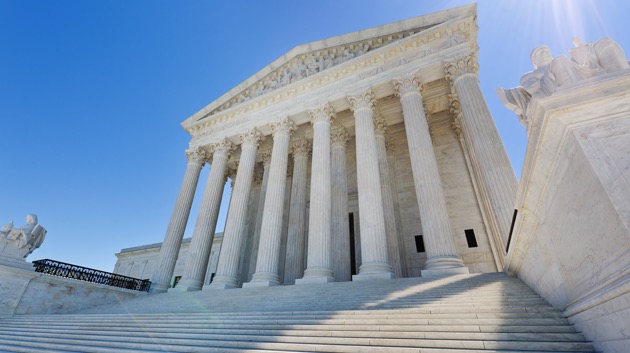
(WASHINGTON) — The U.S. Supreme Court on Wednesday heard historic arguments over a Mississippi law that would ban most abortions after 15 weeks of pregnancy, with conservative justices openly raising the prospect of overturning decades of legal precedent since the Roe v. Wade decision legalizing abortion nationwide.
After almost two hours, the conservative majority appeared headed toward changing 30 years of settled law protecting a woman’s right to end a pregnancy before fetal viability and upholding the Mississippi ban, which legal scholars say could clear the way for stringent new restrictions on abortion in roughly half the country.
“Viability it seems to me has nothing to do with choice,” said Chief Justice John Roberts. “Why is 15 weeks not enough time?”
“That’s not a dramatic departure from viability,” Roberts added of the state law and the line it would draw.
Since the 1973 landmark Roe ruling and the 1992 Planned Parenthood v. Casey case that affirmed the decision, the court has never allowed states to prohibit the termination of pregnancies prior to fetal viability outside the womb, roughly 24 weeks, according to medical experts.
Mississippi argues Roe was wrongly decided and that each state should be allowed to set its own policy.
Scott Stewart, the solicitor general of Mississippi and a former clerk to Justice Clarence Thomas, spoke first, saying that the precedents the Supreme Court set with Roe and Casey in 1992 “damaged the democratic process” and “poisoned the law,” adding, “they’ve choked off compromise.”
“For 50 years they’ve kept this court at the center of a political battle that it can never resolve,” he said.
Justice Sonia Sotomayor questioned whether the court should have taken up the case since the legal right to an abortion based on viability has been a long-standing precedent.
“There has been some difference of opinion with respect to undue burden, but the right of the woman to choose, the right to control her own body has been fairly set since Casey and never challenged. You want us to reject that viability line and adopt something different,” she said. “Thirty (justices) since Casey have reaffirmed the basic viability line. Four have said no to the members of this court, but 15 justices have said yes or varying political backgrounds.”
Referring to comments from a Mississippi lawmaker, she said, “The Senate sponsor said we’re doing it because we have new justices on the Supreme Court,” noting the new makeup of the court with three conservative justice appointed by former President Donald Trump.
“Will this institution survive the stench that this creates in the public perception that the Constitution and its reading are just political acts?” she asked.
Justice Stephen Breyer stressed the importance of stare decisis — the legal principle that courts generally adhere to precedent.
“To overrule under fire in the absence of the most compelling reason to reexamine a watershed decision would subvert the court’s legitimacy beyond any serious question,” Breyer said.
Jackson Women’s Health and its allies say the high court’s protection of a woman’s right to choose the procedure is clear, well-established and should be respected.
But the current court, with a 6-3 conservative majority, is widely considered more sympathetic to abortion rights opponents than any in a generation.
Conservative justices homed in on the current viability standard of roughly 24 weeks, with Justice Samuel Alito describing the line set as “arbitrary.”
As Julie Rikelman of the Center for Reproductive Rights, representing Jackson Women’s Health Organization, the only abortion clinic in Mississippi, argued the impact of pregnancy, Alito responded, “If a woman wants to be free of the burdens of pregnancy, that interest does not disappear the moment the viability line is crossed,” adding, “The fetus has an interest in having a life, and that doesn’t change from the point before viability and after viability.”
When Justice Thomas asked her to identify the constitutional right at issue — whether to abortion, privacy or autonomy, Rikelman replied, “It’s liberty.”
“It’s the textual protection in the 14th Amendment that the state can’t deny someone liberty without the due process of law,” she said.
“Allowing a state to take control of a woman’s body and force her to undergo the physical demands for risks and life-altering consequences pregnancy is a fundamental deprivation for liberty, and once the court recognizes that liberty interest deserves heightened protection, it does need to draw a workable line of viability that logically balances the interests at stake,” Rikelman added.
Justice Brett Kavanaugh asked if the court’s decisions in Roe and Casey were wrong to begin with, how that would counter the stare decisis principle.
“The Constitution is neither pro-life nor pro-choice on abortion. If we think that the prior precedents are seriously wrong, why don’t we return to neutrality? Doesn’t the history of this court’s practice with respect to those cases tells us that the right answer is actually a return to the position of neutrality, and not stick with those precedents in the same way that all those other cases did?”
Later, Kavanaugh asked Solicitor General Elizabeth Prelogar, arguing the Biden administration’s support for abortion providers, “Why should this court be the arbiter rather than Congress?”
“There’ll be different answers in Mississippi in New York, different answers and Alabama than California because they’re two different interests at stake and the people in those states might value those interests somewhat different way,” Kavanaugh said, signaling he might support handing the issue back to the states, despite saying at his confirmation hearings that Roe was “settled law.”
Prelogar replied that it’s not up to states to decide whether to honor fundamental rights.
A former clerk to the late Justice Ruth Bader Ginsburg and Justice Elena Kagan, Prelogar earlier said, “The court has never revoked a right that is so fundamental to so many Americans and so central to their ability to participate fully and equally in society. The court should not overrule the central component of women’s liberty.”
Justice Amy Coney Barrett, who’s personal views on abortion factored large during her confirmation hearing last year, raised doubts about how sweeping the impact would be if the court sides with Mississippi. “Don’t Safe Haven Laws take care of that?” she said, referring to legislation in nearly every state allowing a parent to abandon a newborn baby without fear of prosecution in the event life circumstances make them unable to parent.
Majorities of Americans support the Supreme Court upholding Roe v. Wade and oppose states making it harder for abortion clinics to operate, according to an ABC News/Washington Post poll this month. Three in four Americans, including majorities of Republicans, independents and Democrats, say the decision of whether or not to have an abortion should be left to a woman and her doctor.
But Americans appear more sharply divided on the type of ban at issue in Mississippi. A Marquette University Law School poll this month found 37% favored upholding a 15-week ban, with 32% opposed.
Overshadowing the case is the Supreme Court’s still-pending decision in a separate dispute over Texas’ unprecedented six-week abortion ban, SB8, which has been in effect for nearly three months and dominated national headlines.
The justices gave the Texas law a highly expedited hearing, during which a majority appeared skeptical of its enforcement scheme that encourages citizens to sue anyone who aids or abets an unlawful abortion for the chance at a $10,000 bounty. Many observers assumed the court would quickly move to put the law on hold, but it has not done so.
A decision in the Mississippi and Texas cases are expected by the end of the court’s term in June 2022.
The abortion rights battle at the Supreme Court comes as Republican-led states have enacted more than 100 new abortion restrictions so far this year, according to the Guttmacher Institute, a research organization that supports abortion rights.
Twenty-one states have laws in place that would quickly impose abortion bans in the event the Supreme Court overturns Roe.
Fourteen states plus Washington, D.C., have laws explicitly protecting access to abortion care, according to Guttmacher.
(WASHINGTON) — The U.S. is “deeply concerned by evidence that Russia has made plans for significant aggressive moves against Ukraine,” Secretary of State Antony Blinken said Wednesday.
In the most urgent warning yet, Blinken said the U.S. and its NATO allies would impose a steep cost on Moscow if it attacked its neighbor.
But that cost would be economic and political, with the top U.S. diplomat threatening “a range of high-impact economic measures that we’ve refrained from using in the past.” But he and NATO Secretary General Jens Stoltenberg stopped short of mentioning the use of force to defend Ukraine, which is not a member of the military alliance.
“We don’t know whether President Putin has made the decision to invade. We do know he’s putting in place the capacity to do so in short order,” Blinken said — the clearest statement to date of Western worries of an invasion, as Russia masses approximately 100,000 troops, along with heavy equipment, near Ukraine’s border.
Blinken will meet his Russian counterpart, Foreign Minister Sergei Lavrov, on the sidelines of a summit on European security Thursday, as well as Ukrainian Foreign Minister Dmytro Kuleba.
It will be the latest high-level engagement between the U.S. and Russia amid heightened concern about Russia threatening Ukraine. President Joe Biden deployed his CIA Director Bill Burns to Moscow last month to convey U.S. concerns in person, Blinken said, declining to specify whether he would lay out precisely what those “high-impact” sanctions would be with Lavrov.
Russia has denied it is mounting any attack on Ukraine and instead accused Ukraine, the U.S. and NATO of menacing forces near its borders. Russian President Vladimir Putin said Wednesday his government is seeking guarantees from the West that it not move troops or weapons systems “in close vicinity to the Russian territory,” while Lavrov called the presence of Ukrainian troops “alarming.”
Blinken literally laughed off that latter comment, telling reporters after a two-day NATO summit in Latvia that it was “perplexing,” “profoundly wrong” and “misguided.”
“The idea that Ukraine represents a threat to Russia would be a bad joke if things weren’t so serious,” he added, warning that Russia may “claim provocation for something that they were planning to do all along.”
To that end, Blinken said, Russia has not only massed combat forces, it’s also “intensified disinformation to paint Ukraine as the aggressor” — increasing anti-Ukrainian propaganda by more than tenfold to levels not seen since its 2014 invasion.
Russia’s “plans include efforts to destabilize Ukraine from within, as well as large-scale military operations,” he added — the former, a possible reference to Ukrainian President Volodymyr Zelenskiy’s claim that Russia is behind a potential coup attempt to overthrow his government. The top U.S. diplomat for Europe said last Friday that the U.S. was in touch with Ukrainian authorities “to obtain additional information” and verify Zelenskiy’s statement.
(OXFORD TOWNSHIP, Mich.) — The teenager who allegedly gunned down three classmates and injured eight others took his father’s gun with him to his Michigan high school, officials said.
The suspected gunman, a 15-year-old boy, was taken into custody after the Tuesday afternoon shooting at Oxford High School in Oxford Township. The semiautomatic handgun, a 9mm Sig Sauer pistol, was confiscated, officials said.
Three students ages 14 to 17 were killed and eight others, including a teacher, were injured.
The suspect’s father purchased the weapon on Black Friday and officials are looking into how the family stored its guns and how much access the teen had to them, according to a source briefed on the investigation. The suspect had apparently used the gun prior to the school shooting, the source said.
Detectives are also examining the suspect’s writings and devices, the source said.
It has not yet been announced if the 15-year-old will be charged as an adult.
Out of the eight injured, three were in critical condition Tuesday night: a 15-year-old boy shot in the head; a 14-year-old girl shot in the chest; and a 17-year-old girl shot in the chest, Oakland County Sheriff Mike Bouchard said.
A 14-year-old boy was in serious condition with jaw and head wounds.
Three students were in stable condition: two 17-year-old girls and a 15-year-old boy. The teacher, a 47-year-old woman, was treated and released from the hospital with a graze wound to the shoulder, Bouchard said.
(WASHINGTON) — The U.S. Supreme Court on Wednesday is hearing arguments over a Mississippi law that would ban most abortions after 15 weeks of pregnancy and whether decades of legal precedent since Roe v. Wade should be overturned.
Since the 1973 landmark Roe ruling and a 1992 case that affirmed the decision, the court has never allowed states to prohibit the termination of pregnancies prior to fetal viability outside the womb, roughly 24 weeks.
Mississippi argues Roe was wrongly decided and that each state should be allowed to set its own policy.
The sole abortion clinic in the state, Jackson Women’s Health, and its allies say the high court’s protection of a woman’s right to choose the procedure is clear, well-established and should be respected.
The arguments are being heard by a court with a 6-3 conservative majority widely considered more sympathetic to abortion rights opponents than any in a generation.
Audio of the arguments, beginning at 10 a.m., can be heard live on the court’s website.
Legal scholars say the case is the most significant for abortion rights in 30 years. If the justices uphold the Mississippi law, they would be reversing a key precedent that could clear the way for stringent new restrictions on abortion in roughly half the country.
Majorities of Americans support the Supreme Court upholding Roe v. Wade and oppose states making it harder for abortion clinics to operate, according to an ABC News/Washington Post poll this month. Three in four Americans, including majorities of Republicans, independents and Democrats, say the decision of whether or not to have an abortion should be left to a woman and her doctor.
But Americans appear more sharply divided on the type of ban at issue in Mississippi. A Marquette University Law School poll this month found 37% favored upholding a 15-week ban, with 32% opposed.
Overshadowing the case is the Supreme Court’s still-pending decision in a separate dispute over Texas’ unprecedented six-week abortion ban, SB8, which has been in effect for nearly three months and dominated national headlines.
The justices gave the Texas law a highly expedited hearing, during which a majority appeared skeptical of its enforcement scheme that encourages citizens to sue anyone who aids or abets an unlawful abortion for the chance at a $10,000 bounty. Many observers assumed the court would quickly move to put the law on hold, but it has not done so.
A decision in the Mississippi and Texas cases are expected by the end of the court’s term in June 2022.
The abortion rights battle at the Supreme Court comes as Republican-led states have enacted more than 100 new abortion restrictions so far this year, according to the Guttmacher Institute, a research organization that supports abortion rights.
Twenty-one states have laws in place that would quickly impose abortion bans in the event the Supreme Court overturns Roe.
Fourteen states plus Washington, D.C., have laws explicitly protecting access to abortion care, according to Guttmacher.
(NEW YORK) — As the COVID-19 pandemic has swept the globe, more than 5.2 million people have died from the disease worldwide, including over 780,000 Americans, according to real-time data compiled by Johns Hopkins University’s Center for Systems Science and Engineering.
Just 59.4% of the population in the United States is fully vaccinated against COVID-19, according to data from the Centers for Disease Control and Prevention.
Here’s how the news is developing. All times Eastern:
Dec 01, 8:57 am
South Korea confirms 1st cases of omicron variant
South Korea on Wednesday confirmed its first cases of the omicron variant.
The Korea Disease Control and Prevention Agency said the new variant was initially detected among three people — a couple who arrived from Nigeria on Nov. 24 and their friend who drove them home from the airport. Since then, the variant was found in two other people who also traveled to Nigeria and returned to South Korea on Nov. 23, bringing the total of confirmed cases to five.
Health authorities are conducting genetic sequencing tests on the couple’s child and relatives of the friend who drove them home to determine if they were also infected, according to the Korea Disease Control and Prevention Agency.
In an effort to fend off the omicron variant, which was first identified in southern Africa last week, South Korea has banned foreign short-term travelers from eight southern African nations. South Korean citizens arriving from those countries must quarantine for at least 10 days, regardless of their vaccination status.
South Korea’s daily tally of newly diagnosed COVID-19 infections exceeded 5,000 on Wednesday for the first time since the start of the pandemic. The surge, which officials attributed to the highly contagious delta variant, has pushed COVID-19 hospitalizations and deaths in the country to record highs.
The Korea Disease Control and Prevention Agency said most of the 5,123 new cases were reported in the capital, Seoul, and its surrounding metropolitan region, where officials said earlier that more than 80% of intensive care units designated for COVID-19 patients were already filled.
-ABC News’ Joohee Cho
Dec 01, 8:07 am
Nigeria confirms 1st cases of omicron variant
Nigeria confirmed on Wednesday its first cases of the omicron variant.
The new variant was detected among three people with a recent history of travel to South Africa who tested positive for COVID-19 after arriving in the Nigerian capital, Abuja, according to the Nigeria Center for Disease Control.
“These cases were recent arrivals in the country in the past week,” Dr. Ifedayo Adetifa, director-general of the Nigeria Center for Disease Control, said in a statement Wednesday. “Follow up to ensure isolation, linkage to clinical care, contact tracing and other relevant response activities have commenced. Arrangements are also being made to notify the country where travel originated according to the provisions of the International Health Regulations.”
Following confirmation of the variant on Nigerian soil, the national travel advisory was revised and now requires all inbound travellers to present proof of pre-booked day 2 and day 7 COVID-19 tests as well as a a negative test result that was taken no more than 48 hours before departure. All outbound passengers, regardless of the requirements of the destination countries, are expected to present evidence of full COVID-19 vaccination or a negative test result done no later than 48 hours before departure.
“The NCDC assumes Omicron is widespread globally given the increasing number of countries reporting this variant,” Adetifa said. “Therefore, it is a matter of when, not if, we will identify more cases.”
The cases of omicron in Nigeria are also the first to be confirmed in West Africa.
-ABC News’ James Bwala
Nov 30, 9:41 pm
CDC working to modify international travel testing guidelines
The Centers for Disease Control and Prevention said Tuesday it is working to change its international travel guidelines to require COVID-19 testing one day before departure to the U.S. in light of the omicron variant.
“CDC is working to modify the current Global Testing Order for travel as we learn more about the Omicron variant; a revised order would shorten the timeline for required testing for all international air travelers to one day before departure to the United States,” the CDC said in a statement. “This strengthens already robust protocols in place for international travel, including requirements for foreign travelers to be fully vaccinated.”
The CDC continues to recommend that all travelers get a COVID-19 viral test three to five days after arrival in the U.S. and that unvaccinated travelers quarantine for seven days even if they test negative.
(NEW YORK) — Amid a renewed surge of coronavirus infections and hospitalizations across the country, and concerns surrounding the newly discovered omicron variant, health experts are again pleading with Americans to get vaccinated, and if fully vaccinated and eligible, to get a booster.
“Do not wait. Go get your booster if it’s time for you to do so,” President Joe Biden said earlier this week during an address at the White House. “If you are not vaccinated, now is the time to go get vaccinated and to bring your children to go get vaccinated.”
Although it is still unclear whether the omicron variant is more transmissible, if it causes more serious illness or impacts vaccine effectiveness, the World Health Organization said on Monday that the overall global risk is assessed as “very high,” due to the variant’s mutations.
In light of the global whirlwind of concern, vaccine makers are currently testing the shots’ effectiveness, and announced plans this week to tweak vaccines in order to address the new variant, if deemed necessary, leaving some Americans wondering whether they should rush to get a shot now or wait to see if the vaccines are readjusted.
“I would strongly suggest you get boosted now, and not wait for the next iteration of it, which we might not even need,” Dr. Anthony Fauci, chief medical adviser to the White House, told ABC News’ George Stephanopoulos Monday on “Good Morning America,” adding that he would “not at all” recommend waiting. “We’ll find out reasonably soon whether higher levels of antibody against the original vaccine that we’ve used, whether or not that can spill over in protection against this.”
‘We may not have time to wait’
Many experts have echoed Fauci’s sentiment, urging Americans to get the shots as soon as possible, given all of the uncertainties about omicron.
“We don’t have all the answers we want as of yet. In a few weeks, we will know a lot more,” Dr. Colleen Kelley, an associate professor of medicine in the division of infectious diseases at Emory University School of Medicine, told ABC News.
With prior variants, she said, as long as the levels of antibody were high enough, a variant-specific booster did not seem necessary.
“We hope that this will also be the case with omicron and that high levels of antibodies will maintain some level of protection, but don’t know for sure yet. So, my recommendation is to get boosted now,” Kelley said.
If omicron proves to be as highly transmissible as delta, “we may not have time to wait for the omicron-specific booster to protect people,” Kelley added.
As of Tuesday, there have been no confirmed cases of the omicron variant in the U.S., though experts say the variant is likely already circulating within communities.
“People should not wait for the vaccine to be tweaked to adapt to the new variant as it would be many months until that new vaccine is released. They should get a primary vaccine now or a booster, and then when the updated vaccines are available we may well need additional doses of the vaccine then,” Dr. Camille Kotton, clinical director in the Infectious Diseases Division at Massachusetts General Hospital, told ABC News.
According to the White House, the process of introducing a variant-specific vaccine would take approximately three months, and would include necessary sign off from the Centers for Disease Control and Prevention and the Food and Drug Administration.
“The companies currently estimate that it would take a few months to prototype and manufacture a modified vaccine or booster and that does include, to your question, the time for FDA and CDC to do their evaluation, so the estimate of a few months is all inclusive,” White House COVID coordinator Jeff Zients said Tuesday during a press briefing.
In light of the omicron’s potential threat, CDC Director Rochelle Walensky announced that the agency would be strengthening its recommendation for all adults to get a booster shot six months after their Pfizer or Moderna vaccines or two months after the Johnson & Johnson shot.
“The recent emergence of the Omicron variant further emphasizes the importance of vaccination, boosters, and prevention efforts needed to protect against COVID-19,” Walensky wrote in a statement on Monday.
Additionally, on Tuesday, Pfizer announced it has officially asked the FDA to authorize COVID-19 booster shots for 16- and 17-year-olds.
Vaccines will likely still provide ‘good’ protection against variants
Several experts stressed that even if the vaccines were found to be less effective against the omicron variant, the current vaccines still present “good” protection.
“Even if omicron has some immune evasive properties, boosters are likely to still provide good protection based on some mutational experiments researchers have performed with viruses containing the same mutations as omicron,” Dr. Angela Rasmussen, a virologist at the University of Saskatchewan, told ABC News.
Other experts urge caution, given how little scientists know about omicron.
Although “it is prudent to get your boosters, we have a lot to learn about omicron,” said Dr. Jennifer Lighter, a hospital epidemiologist for NYU Langone Health. If it is indeed more contagious, she said, it could lead to more breakthrough cases, and therefore, boosters would increase antibody levels and convey an extra layer of protection from breakthroughs.
However, Lighter said she does not believe that it would make much difference to get the booster now, or in a few weeks, stressing the fact that the immune response after vaccination is quite broad.
“Your immune response knows that there will be mutations. And the immune response is actually much wider, and not only specific for what someone was vaccinated against,” Lighter told ABC News.
Hence, with vaccination, there is protection against severe disease, and if omicron is indeed more contagious, breakthrough infections will likely “predominantly be mild in most people.”
Data has consistently shown that vaccinated individuals have fared much better than unvaccinated.
Unvaccinated individuals had a 5.8 times greater risk of testing positive for COVID-19 and a 14 times greater risk of dying from it, as compared to vaccinated individuals, according to federal data compiled in September 2021.
At this time, approximately 100 million Americans remain completely unvaccinated, about 80 million of whom are currently over the age of 5, and thus are eligible to get the shot.
“We still have less than 60% of the United States population fully vaccinated. So I think it’s important to first stress that the unvaccinated people will eventually get COVID. It will come to them sooner or later,” warned Lighter.
“We should definitely take this opportunity to protect ourselves, thus protecting our loved ones, our communities, our country and the world,” added Kotton.
ABC News’ Cheyenne Haslett contributed to this report.
(ALBUQUERQUE, N.M.) — Investigators may have found the source of the live bullet fired by actor Alec Baldwin on the Rust set in New Mexico last month that killed cinematographer Halyna Hutchins, according to a new search warrant.
Longtime Hollywood armorer Thell Reed, the father of the film’s armorer, Hannah Gutierrez-Reed, said in a statement to investigators that ammunition once in his possession “may match the ammunition found on the set of Rust,” according to a search warrant issued Tuesday by the Santa Fe County Sheriff’s Office as part of the ongoing investigation.
The new warrant authorized the search of an Albuquerque prop house, PDQ Arm and Prop LLC, owned by Seth Kenney. According to the search warrant affidavit, Kenney told detectives that he was hired to supply Rust with guns, as well as dummy rounds and blanks from a manufacturer identified as Starline Brass.
In his statement, Reed told investigators that he worked with Kenney on another production in August and September, according to the affidavit. During that time, Kenney reportedly asked Reed to bring live ammunition to a training session with actors on a firearms range, “in case they ran out of what was supplied,” according to the affidavit.
Reed told investigators he brought an “ammo can” with 200 to 300 live rounds to the range, according to the affidavit. “This ammunition was not factory made rounds,” the affidavit stated.
After production ended, Reed told investigators that Kenney took the ammo can and remaining ammo back to New Mexico and told Reed to “write it off” when the armorer tried to get it back, according to the affidavit.
Through his attorney, Kenney denied providing live ammunition to the set.
“Mr. Kenney is fully-cooperating with the authorities, as he has been since the tragic incident took place,” Kenney’s attorney, Adam Engelskirchen, told ABC News in a statement. “Neither Mr. Kenney nor PDQ Arm & Prop, LLC provided live ammunition to the Rust production.”
Engelskirchen said the search warrant affidavit “includes material misstatements of fact, particularly with regard to statements ascribed to Mr. Kenney.”
“Reports in other media outlets that Mr. Kenney was part of the crew of Rust or was employed by the production to provide any sort of supervisory services are patently false,” he added.
Albuquerque ABC affiliate KOAT captured footage of the search warrant being served at the facility Tuesday afternoon. It is unclear at this time what, if anything, may have been seized from the business.
Authorities were looking for several items, including live or spent ammunition; all boxes that may hold ammunition with the “Starline brass” logo for “evidence comparison”; documents related to products, equipment and ammunition supplied to Rust; and “any record documented on any media, which establishes and/or tends to establish the state of mind(s), motive(s), action(s) or intention(s) of any person(s) with knowledge or apparent knowledge of a crime(s),” including diaries or videotapes.
Gutierrez-Reed’s attorney, Jason Bowles, called the execution of the latest search warrant “a huge step forward today to unearth the full truth of who put the live rounds on the Rust set.”
“We trust that the FBI will now compare and analyze the ‘live rounds’ seized from the set to evidence seized in the search warrant to conclusively determine where the live rounds came from,” Bowles told ABC News in a statement. ” The questions of who introduced the live rounds onto the set and why are the central questions in the case.”
The fatal shooting occurred on Oct. 21 at the Bonanza Creek Ranch near Santa Fe. Rust director Joel Souza was also wounded in the incident.
The film’s first assistant director handed a Colt .45 revolver to Baldwin while proclaiming “cold gun,” to let the crew know a gun with no live rounds was being used, according to an earlier search warrant affidavit. The assistant director told investigators he did not know there were any rounds in the gun he gave to Baldwin, according to the affidavit.
As the film’s armorer, Gutierrez-Reed was in charge of all weapons on set. Her attorney has stated that Gutierrez-Reed had no idea where the live rounds came from.
Kenney was present on set six days after the shooting to give authorities access to a gun safe on the prop truck, according to the latest search warrant.
Speaking with detectives on Oct. 29, Kenney “advised he may know where the live rounds came from,” according to the search warrant affidavit. “Seth described how a couple years back he received ‘reloaded ammunition’ from a friend” with the Starline Brass logo on it, the affidavit stated.
Investigators initially seized 500 rounds of ammunition from the set — a mix of blanks, dummy rounds and what appeared to be live rounds. Industry experts have said live rounds should never be on set.
No charges have been filed in the case. Santa Fe District Attorney Mary Carmack-Altwies has previously said, “everything is on the table” and any decision to bring charges could take weeks or months.
ABC News’ Vera Drymon and Doug Lantz contributed to this report.