(WASHINGTON) — Five Federal Bureau of Investigation officials “solicited” prostitutes while on an overseas trip, the Department of Justice inspector general said in a two-page report.
Four of the officials “solicited, procured, and accepted commercial sex overseas.”
“The OIG investigation also found that four of those officials lacked candor about their interactions with prostitutes and other misconduct during OIG compelled interviews and compelled polygraph examinations, in violation of FBI policies, and that one of those officials made false statements in an OIG compelled interview and compelled polygraph examination in violation of federal law, when the official denied having engaged in sex acts with a prostitute,” Inspector General Michael Horowitz wrote.
Soliciting a prostitute overseas while working for the FBI is a violation of FBI and DOJ policy.
One FBI official “lacked candor” to the Inspector General “when the official denied observing or placing pills in a package to be delivered to a foreign law enforcement officer and that another of the officials failed to report having been provided such a package.”
The inspector general says there were about 100 white pills that were seen being given to a foreign official.
A sixth FBI official did not report the misconduct in violation of DOJ policy.
The inspector general said of the five who solicited prostitutes two resigned, two retired, and one was removed. The report said three of the individuals also failed to report their interactions with foreign nationals.
There are no details in the report about where the prostitution solicitation occurred or the names of the officials involved.
Allen J. Schaben / Los Angeles Times via Getty Images
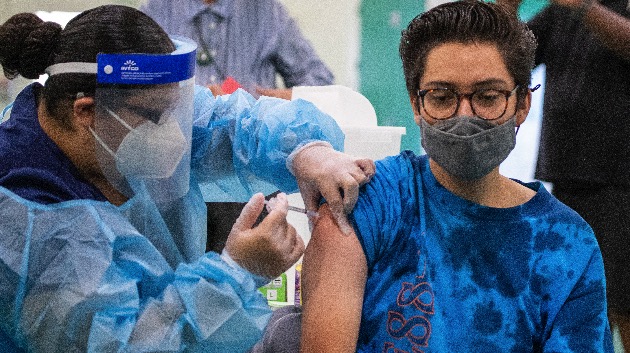
(LOS ANGELES) — The Los Angeles public school district’s board of education has approved delaying enforcement of its COVID-19 vaccine mandate to the fall, as thousands of students at the nation’s second-largest school district remain non-compliant.
Under the mandate, which the board passed in September, all students ages 12 and up were required to be fully vaccinated by Jan. 10, 2022, to be allowed on school campuses for the second semester, unless they had an approved exemption or deadline extension.
Currently, over 87% of eligible students are in compliance with the mandate, Los Angeles Unified Interim Superintendent Megan Reilly said during Tuesday’s board meeting, calling it a “major milestone.”
Some 27,000 students are not in compliance with the mandate, as it’s too late to complete the two-dose vaccine series to be fully vaccinated by the January deadline.
Under Reilly’s proposal, the transfer of non-compliant students to the remote program will be delayed until the beginning of the fall 2022 semester.
“It allows more time for families to get this vaccine,” Reilly said ahead of the board’s vote. “This effort remains a top priority for Los Angeles Unified. We will continue to engage students and families around the importance of vaccines and the deadlines to participate for in-person learning. We will improve vaccination rates for eligible students and we will continue to provide a consistent, stable learning environment and access to vital resources.”
Most board members said they were reluctant to vote in favor of delaying enforcement of the vaccine mandate, though did so to limit disruption to in-person learning in the middle of the school year.
“I will support this because it keeps our promise to the vaccinated students in our district that we would not disrupt their education needlessly,” board member Jackie Goldberg said. “To be clear, we are not moving one inch from the mandate. Not one inch, not a centimeter. We are simply saying you now have more time to do it because we want all of you to be vaccinated and safe. And also we do not want your not being vaccinated to disrupt the education of those who have complied.”
Board president Kelly Gonez said voting in favor of the delay “is not a decision I am happy to make.”
“But like my fellow board members, I am very enthusiastic about our vaccination progress,” she continued. “I believe that this board unequivocally made the right decision in September, and it has made our schools safer, it has made our communities as a whole safer and it has saved lives.”
The vote came a day after a Los Angeles Superior Court judge denied two parent groups’ bid for a preliminary injunction against the student vaccine mandate, according to the Los Angeles Daily News.
The school district had also mandated that staff get both doses of the COVID-19 vaccine by Nov. 15, barring exemptions due to disability or religious belief.
During its meeting Tuesday, board members also approved extending the district’s student and employee vaccination policy to all district-authorized charter schools to maintain a consistent vaccine policy.
The school district is one of the few nationwide that has implemented vaccine mandates. The policies came ahead of California Gov. Gavin Newsom’s announcement in October that the state will require COVID-19 vaccines for all school children ages 12-17 once the Federal Drug Administration grants full approval. The state policy includes personal exemptions, not just religious or medical.
“So there’s plenty of latitude for families to make decisions,” Newsom told Good Morning America last week. “LA is slightly different, and we’re going to obviously have to work through that with that district.”
“You have to work to accommodate, and I have all the confidence in the world the school board will work to accommodate,” he added.
(NEW YORK) — Kroger, one of the largest employers in the U.S. with 500,000 workers, announced that it will pull paid emergency COVID leave for unvaccinated employees.
The grocery chain is also adding a $50 monthly insurance surcharge for salaried associates who are unvaccinated.
The new rules will take effect starting Jan. 1, 2022.
Kroger said this is a necessary step to protect its employees and customers.
“We have been navigating the COVID-19 pandemic for almost two years and in line with our values, the safety of our associates and customers has remained our top priority,” Kroger said in a statement about the policy shift.
The supermarket chain said employees who are fully vaccinated will still be entitled to paid leave and the new policy does not apply to workers with medical or religious accommodations.
Kroger will continue to pay $100 to workers who choose to get vaccinated.
(WASHINGTON) — Late Tuesday night, the House voted to raise the debt ceiling by $2.5 trillion — a move that should stave off the first-ever default.
All Democrats in both the Senate and House voted to raise the debt limit. One Republican, Rep. Adam Kinzinger, from Illinois, joined them.
The Senate cleared the vote earlier Tuesday with zero GOP support.
The bill now heads to President Joe Biden’s desk to be signed into law.
Once signed by the president, the legislation will have prevented a U.S. default that could have halted Social Security and veterans’ payments, hiked interest on mortgages and loans and disrupted the global economy.
The Treasury Department predicted that the U.S. would be unable to pay its bills come Wednesday.
Congressional action was the last step in a months-long process aimed at raising the federal borrowing limit.
In October, Republican and Democratic leadership locked horns over the spending cap. Though both parties acknowledged the necessity of raising the debt limit, Republicans argued that Democrats ought to raise the limit on their own — wrongly claiming they needed to offset the cost of Biden’s yet-to-be passed $1.75 trillion social spending bill.
Democrats, who helped raise the debt limit multiple times under the Trump administration, insisted it be a bipartisan effort since the debt limit had to be raised to cover past spending.
The October dispute ended in the GOP blinking, with Republicans giving Democrats the votes necessary for a short-term raise to the debt limit, but vowing they’d be less cooperative in the winter.
Last week, however, party leaders announced an agreement on a two-step process to raise the debt limit. Republicans ultimately provided 10 votes to permit a one-time rule change altering the number of votes necessary to pass the debt-limit hike and clearing a path for Democrats to pass the legislation without a single GOP backer.
The reached agreement required Democrats to name a specific amount they want to raise the debt limit by. They settled on $2.5 trillion — enough to prevent the government from defaulting through early 2023, Majority Leader Chuck Schumer said Tuesday.
(ATLANTA) — As the delta variant of COVID-19 spread across the United States this summer, the virus appeared to take a particular toll on unvaccinated pregnant people, with deaths dramatically increasing in the summer months.
The number of pregnant people who died of COVID-19 spiked sharply in August and September, with more than two dozen deaths recorded in each of those months, according to data released this week by the U.S. Centers for Disease Control and Prevention (CDC).
More than 40% of the 248 deaths among pregnant people since the start of the pandemic occurred since August, the data shows.
The number of pregnant people who contracted COVID-19 also increased sharply over the summer months, according to CDC data, reaching numbers of cases not seen since before the vaccine was made widely available earlier this year.
Now, as the omicron variant spreads across the U.S., with what is believed to be a high degree of transmissibility, the director of the CDC said she is “very concerned” about those who remain unvaccinated.
“I can tell you, when I hear about a pregnant woman in the community who is not vaccinated, I personally pick up the phone and talk to them,” CDC Director Dr. Rochelle Walensky told ABC News’ chief medical correspondent, Dr. Jennifer Ashton, in a Dec. 8 interview.
“It’s just shocking,” she said of the number of pregnant people who died specifically in August, one month after the delta variant became the predominant variant in the U.S.
Risks to unvaccinated people and the fetus
More than 25,000 pregnant people have been hospitalized since the start of the pandemic, and more than 150,000 cases of COVID-19 have been confirmed in pregnant people, according to the CDC.
Pregnancy is included in the CDC’s list of underlying medical conditions that make a person more likely to experience severe illness from COVID-19.
The virus causes a two-fold risk of admission into intensive care and a 70% increased risk of death for pregnant people, and increases the risk of a stillbirth or delivering preterm, or earlier than 37 weeks, according to the CDC.
COVID-19 is especially dangerous in pregnant people because their immune systems are already less active as they are supporting their growing fetus. For the same reason, their hearts and kidneys are working harder, Dr. Laura Vricella, a maternal fetal medicine physician at Mercy Hospital in St. Louis, told ABC News in August, as her hospital and others experienced a spike in pregnant patients with COVID-19.
Pregnant people must also keep their oxygen levels higher in general to support their fetus, which can be a herculean task to do when COVID-19 is in the body, according to Vricella.
And in addition to pregnant people with COVID-19 being more likely to deliver prematurely, Vricella said her hospital also saw more COVID-positive pregnant patients deliver stillbirths, even with mild COVID cases.
“COVID-19 begins as a respiratory illness, but can affect the entire body and also seems to increase the risk of thrombosis or blood clots,” she said. “We suspect that this decreased oxygen to the fetus may be responsible for the stillbirths that we are seeing, though we need further research.”
Vaccination rate remains low
In September, the CDC issued an “urgent health advisory” calling on pregnant people to prioritize getting vaccinated against the virus.
As of Dec. 4, the most recent data available, the vaccination rate among pregnant people remains below 40%, compared to nearly 61% of the general population, according to the CDC.
The vaccination rate for Black pregnant people, who already face disproportionate health risks in pregnancy and postpartum, is even lower, at just over 20%, CDC data shows.
“This is one where I feel like we have to do more,” Walensky said of the low vaccination rate overall among pregnant people. “We have to do better.”
“The vaccines are safe, they are effective and they are even more important in pregnant women,” she said.
In addition to the CDC, the nation’s two leading health organizations focused on the care of pregnant people — American College of Obstetricians and Gynecologists (ACOG) and the Society for Maternal-Fetal Medicine (SMFM) — have issued guidelines calling on all pregnant people to get vaccinated against COVID-19.
Vaccines shown to be safe
Though pregnant people were not recruited for the initial clinical trials of the COVID-19 vaccines, data over the past several months, since vaccines have been widely available, has shown them to be safe for pregnant people.
In its health advisory urging pregnant people to get vaccinated, the CDC pointed specifically to new data showing the vaccines did not increase the risk of miscarriage. The vaccines are also not believed to have any “significant impact” on fertility.
Both the Pfizer and Moderna vaccines use mRNA technology, which does not enter the nucleus of the cells and doesn’t alter the human DNA. Instead, it sends a genetic instruction manual that prompts cells to create proteins that look like the virus, as a way for the body to learn and develop defenses against future infection.
They are the first mRNA vaccines, which are theoretically safe during pregnancy because they do not contain a live virus.
Vaccine experts interviewed by ABC News said although pregnant women are advised against getting live-attenuated virus vaccines, such as the one for measles, mumps and rubella, because they can pose a theoretical risk of infection to the fetus, the Johnson & Johnson vaccine doesn’t contain live viruses and should be safe. Instead the Johnson and Johnson vaccine uses inactive viruses.
Health experts said that with or without the vaccine, pregnant people need to continue to remain on high alert when it comes to COVID-19 by following safety protocols, including mask wearing, social distancing and hand washing.
(NEW YORK) — As the COVID-19 pandemic has swept the globe, more than 5.3 million people have died from the disease worldwide, including more than 800,000 in the U.S., according to real-time data compiled by Johns Hopkins University’s Center for Systems Science and Engineering.
About 61% of the population in the United States is fully vaccinated against COVID-19, according to data from the Centers for Disease Control and Prevention.
Here’s how the news is developing. All times Eastern:
Dec 15, 6:23 am
Over 67,000 COVID-19 patients hospitalized in US as winter surge intensifies
With winter closing in and COVID-19 cases on the rise, hospitals across the United States are once again facing the pressures of caring for thousands of patients.
More than 67,000 people are currently hospitalized with COVID-19 nationwide, according to federal data.
Rebecca Long, lead nurse in a COVID-19 intensive care unit at Nebraska Medical Center in Omaha, told ABC News that she and her team “literally do not have any ICU beds” available.
“I don’t want anyone else’s family member or loved one to have to be in the position where we say, like, we can’t help you because we don’t have the resources,” Long said. “As health care providers, all we want to do is help people and we can’t because we physically can’t.”
Dr. Kyle McCarty, medical director of emergency services at both HSHS St. Mary’s and HSHS St. Vincent hospitals in Green Bay, Wisconsin, told ABC News that health care workers are feeling burned out after “being asked to do more with less.”
“We’re exhausted by the knowledge that we are the duct tape that is preventing a complete collapse of the health care system,” McCarty said. “There’s a national shortage of hospital staff, which is making it difficult to take care of patients the way that we want it. There aren’t enough inpatient beds for the patients that need to be admitted to the hospital.”
“This is a call for reinforcements, not a warning to stay away, because we don’t want this to be the new normal,” he added. “If we can recruit more health care teammates, it doesn’t have to be.”
-ABC News’ Arielle Mitropoulos
Dec 14, 7:19 pm
US death toll from COVID-19 crosses 800,000
The number of people who have died from COVID-19 in the United States surpassed 800,000 on Tuesday, according to real-time data compiled by Johns Hopkins University’s Center for Systems Science and Engineering.
The figure is greater than the approximately 700,000 Americans who have died from AIDS-related illnesses over the last four decades, and it’s higher than the total number of U.S. troops who have fallen in battle since 1900.
Since last December, when the first COVID-19 vaccines were being administered, an additional 500,000 people in the U.S. have died from the virus.
Of those, some 230,000 have died since April 2021, when U.S. President Joe Biden announced COVID-19 vaccines were widely available to every American over the age of 18.
-ABC News’ Arielle Mitropoulos
Dec 14, 6:59 pm
US sees sevenfold jump in omicron cases over the last week
The U.S. saw a sevenfold increase in the prevalence of the omicron COVID-19 variant over the last week, according to data from the U.S. Centers for Disease Control and Prevention.
Just over two weeks after it was first discovered in the country, the omicron variant is now estimated to account for nearly 3% of all new cases in the U.S., the latest data from the CDC shows.
Last week, omicron accounted for an estimated 0.4% of all new cases, according to the data.
-ABC News’ Arielle Mitropoulos
Dec 14, 2:52 pm
Omicron will ‘for sure’ become dominant strain in US: Fauci
Dr. Anthony Fauci told CNN Tuesday that omicron will “for sure” become the dominant strain in the U.S. given how rapidly it is spreading.
“Omicron is going to be a challenge because it spreads very rapidly,” Fauci said.
Fauci reiterated that omicron so far appears to be less severe, adding, “Whether it is inherently less pathogenic as a virus or whether there is more protection in the community, we’re just going to have to see when it comes in the United States.”
(NEW YORK) — As the COVID-19 pandemic has swept the globe, more than 5.3 million people have died from the disease worldwide, including over 800,000 Americans, according to real-time data compiled by Johns Hopkins University’s Center for Systems Science and Engineering.
About 61% of the population in the United States is fully vaccinated against COVID-19, according to data from the Centers for Disease Control and Prevention.
Here’s how the news is developing. All times Eastern:
Dec 15, 8:09 am
Journalist traveling with Blinken tests positive for COVID-19 in Malaysia
A journalist traveling alongside U.S. Secretary of State Antony Blinken on his visit to Southeast Asia has tested positive for COVID-19 in Malaysia, according to U.S. Department of State spokesperson Ned Price.
Meanwhile, Blinken and his senior staff all tested negative for COVID-19 upon arrival in Kuala Lumpur on Tuesday night. The member of the traveling press pool who tested positive had last tested negative in Indonesia’s capital, their previous stop, on Tuesday.
“The individual who tested positive will remain in isolation,” Price said in a statement Wednesday, “and we will continue to adhere to and go beyond CDC guidance, including with our rigorous testing protocol, for the remaining traveling party.”
Blinken has canceled a scheduled trip to Thailand “out of an abundance of caution” and will return home to the United States, according to Price.
“The Secretary expressed his deep regret to the Foreign Minister that he would not be able to visit Bangkok this week,” Price said. “He explained that, in order to mitigate the risk of the spread of COVID-19 and to prioritize the health and safety of the U.S. traveling party and those they would otherwise come into contact with, the Secretary would be returning to Washington, D.C. out of an abundance of caution.”
“The Secretary extended an invitation for the Foreign Minister to visit Washington, D.C. at the earliest opportunity and noted that he looked forward to traveling to Thailand as soon as possible,” Price added. “They affirmed that they would use the upcoming engagements to further deepen the U.S.-Thai alliance.”
The U.S. Embassy in Malaysia confirmed that the infected individual “was not involved and has not participated in any of Secretary Blinken’s program in Kuala Lumpur.”
“The sole member of the traveling party who tested positive is observing all requirements of the Ministry of Health,” the embassy said in a statement Wednesday. “We confirm all other members of the party tested negative for COVID-19 upon arrival in Malaysia.”
Blinken was in Indonesia on Tuesday, and the U.S. Embassy in Jakarta confirmed that no members of the traveling party tested positive for COVID-19.
All members of the U.S. delegation are required to be vaccinated against COVID-19 and undergo regular testing on trips.
-ABC News’ Conor Finnegan
Dec 15, 6:23 am
Over 67,000 COVID-19 patients hospitalized in US as winter surge intensifies
With winter closing in and COVID-19 cases on the rise, hospitals across the United States are once again facing the pressures of caring for thousands of patients.
More than 67,000 people are currently hospitalized with COVID-19 nationwide, according to federal data.
Rebecca Long, lead nurse in a COVID-19 intensive care unit at Nebraska Medical Center in Omaha, told ABC News that she and her team “literally do not have any ICU beds” available.
“I don’t want anyone else’s family member or loved one to have to be in the position where we say, like, we can’t help you because we don’t have the resources,” Long said. “As health care providers, all we want to do is help people and we can’t because we physically can’t.”
Dr. Kyle McCarty, medical director of emergency services at both HSHS St. Mary’s and HSHS St. Vincent hospitals in Green Bay, Wisconsin, told ABC News that health care workers are feeling burned out after “being asked to do more with less.”
“We’re exhausted by the knowledge that we are the duct tape that is preventing a complete collapse of the health care system,” McCarty said. “There’s a national shortage of hospital staff, which is making it difficult to take care of patients the way that we want it. There aren’t enough inpatient beds for the patients that need to be admitted to the hospital.”
“This is a call for reinforcements, not a warning to stay away, because we don’t want this to be the new normal,” he added. “If we can recruit more health care teammates, it doesn’t have to be.”
-ABC News’ Arielle Mitropoulos
Dec 14, 7:19 pm
US death toll from COVID-19 crosses 800,000
The number of people who have died from COVID-19 in the United States surpassed 800,000 on Tuesday, according to real-time data compiled by Johns Hopkins University’s Center for Systems Science and Engineering.
The figure is greater than the approximately 700,000 Americans who have died from AIDS-related illnesses over the last four decades, and it’s higher than the total number of U.S. troops who have fallen in battle since 1900.
Since last December, when the first COVID-19 vaccines were being administered, an additional 500,000 people in the U.S. have died from the virus.
Of those, some 230,000 have died since April 2021, when U.S. President Joe Biden announced COVID-19 vaccines were widely available to every American over the age of 18.
-ABC News’ Arielle Mitropoulos
Dec 14, 6:59 pm
US sees sevenfold jump in omicron cases over the last week
The U.S. saw a sevenfold increase in the prevalence of the omicron COVID-19 variant over the last week, according to data from the U.S. Centers for Disease Control and Prevention.
Just over two weeks after it was first discovered in the country, the omicron variant is now estimated to account for nearly 3% of all new cases in the U.S., the latest data from the CDC shows.
Last week, omicron accounted for an estimated 0.4% of all new cases, according to the data.
-ABC News’ Arielle Mitropoulos
Dec 14, 2:52 pm
Omicron will ‘for sure’ become dominant strain in US: Fauci
Dr. Anthony Fauci told CNN Tuesday that omicron will “for sure” become the dominant strain in the U.S. given how rapidly it is spreading.
“Omicron is going to be a challenge because it spreads very rapidly,” Fauci said.
Fauci reiterated that omicron so far appears to be less severe, adding, “Whether it is inherently less pathogenic as a virus or whether there is more protection in the community, we’re just going to have to see when it comes in the United States.”
(WASHINGTON) — The House voted Tuesday night to hold former President Donald Trump’s chief of staff, Mark Meadows, in contempt of Congress for defying a subpoena from the House select committee investigating the Jan. 6 Capitol attack to appear for a deposition.
The vote was 222-208, with GOP Reps. Adam Kinzinger of Illinois and Liz Cheney of Wyoming voting with all Democrats.
Meadows is now the first former lawmaker ever held in criminal contempt by Congress — and the first held in contempt since 1832 — when former Rep. Sam Houston was held in contempt for beating a colleague with a cane.
The vote sends the matter to the Justice Department, which will determine whether to bring any charges against Meadows, after previously doing so against Trump ally Steve Bannon.
During debate on the floor Tuesday evening, and earlier in the day, in the House Rules Committee, members of the Jan. 6 select committee released new text messages from the tranche of records Meadows had turned over to the committee.
“I heard Jeff Clark is getting put in on Monday. That’s amazing. It will make a lot of patriots happy, and I’m personally so proud that you are at the tip of the spear, and I could call you a friend,” a text to Meadows from an unknown number read, according to Rep. Adam Schiff, D-Calif.
The new messages further underscored Meadows’s importance to the congressional investigation, as a key figure in Trump’s orbit who personally participated in discussions about challenging the election results and advocated for voter fraud investigations from his perch in the West Wing.
“Mr. Meadows’s testimony will bear on another key question before this committee: Did Donald Trump, through action or inaction, corruptly seek to obstruct or impede Congress’s official proceeding to count electoral votes?” Cheney, the panel’s vice-chair, said Tuesday.
On Jan. 3, Meadows told an unnamed member of Congress that Trump “thinks the legislatures have the power but that the Vp has power too,” according to Rep. Pete Aguilar, D-Calif., who read the message about the counting of the electoral votes on the House floor.
On Nov. 4th, an unnamed member of Congress texted Meadows that Republican-led legislatures should “just send their own electors to Congress” to challenge the official results in key states, and allow the Supreme Court to determine how to award the votes and the winner of the election.
Lawmakers on the panel argued that Meadows, despite his deference to Trump’s alleged claims of executive privilege, was improperly refusing to appear under subpoena to discuss topics referenced in the materials he already shared with Congress or mentioned in his new memoir.
Meadows turned over some 9,000 documents from personal email accounts and a cell phone to the committee, including urgent text messages from Republican lawmakers imploring him to get Trump to something to stop the violence.
But he then reversed course and refused to appear under subpoena to answer questions about the records he provided.
During Monday’s committee meeting, before members voted unanimously to recommend Meadows be held in contempt, Cheney quoted extensively from text messages sent to Meadows during the riot from Fox News hosts, GOP lawmakers and Donald Trump Jr., the former president’s eldest son.
Cheney said the messages left “no doubt” the White House “knew exactly what was happening” at the Capitol during the riot.
“He’s got to condemn [the riot] ASAP,” Trump Jr. told Meadows in a text message, according to Cheney, saying that Trump’s tweet about Capitol Police “is not enough.”
“I’m pushing it hard,” Meadows replied. “I agree.”
“We need an Oval Office address,” Trump Jr. said in a follow up message. “He has to lead now. It has gone too far and gotten out of hand.”
“Please get him on tv,” Fox News host Brian Kilmeade wrote to Meadows. “Destroying everything you have accomplished.”
Rep. Adam Schiff, D-Calif., read aloud from text messages Meadows received from unnamed GOP lawmakers before and after the riot.
“Yesterday was a terrible day,” one wrote. “We tried everything we could in our objection to the 6 states. I’m sorry nothing worked.”
Cheney quoted again from text messages Tuesday morning.
“It is really bad up here on the Hill,” one message read.
In another, an unnamed lawmaker texted Meadows: “Fix this now.”
“We need to question him about emails and texts he has given us without any claims of privilege,” Cheney said.
Commitee Chairman Bennie Thompson, D-Miss., said Tuesday that “only three people” of “over 300” have not cooperated with the committee. He shared that Washington, D.C. Mayor Muriel Bowser is among those scheduled to cooperate and speak to investigators.
“I have no great desire to be here seeking consideration of this contempt referral. Mr. Meadows was a colleague for more than seven years. But that doesn’t excuse his behavior. If anything, his time as a member of the House should make him more aware of the potential consequences of defying a congressional subpoena,” Thompson said.
Republicans for the most part defended Meadows and suggested the committee’s push to hold Meadows in contempt would squander any chance they had to secure his cooperation.
“Today they are destroying executive privilege,” Rep. Jim Jordan, R-Ohio, said on the House floor. “It is a vote to put a good man in prison.”
In a statement Tuesday, Meadows attorney George Terwilliger said his client “never stopped cooperating” with the panel. “What message does that duplicity send to him as well as to others who might be inclined to consider cooperating in good faith to the extent possible?”
Democrats and Republicans aligned with the committee blasted Meadows’ argument, pointing to the fact that he published a memoir detailing conversations with Trump around Jan. 6.
“This is a witness who is refusing to comply with the law,” Rep. Pete Aguilar, D-Calif., said. “But look at his book and you get more information than our committee did.”
Trump ally Steve Bannon was charged with two counts of contempt of Congress for rebuffing the committee’s subpoenas and has pleaded not guilty. That trial is scheduled to begin in July 2022.
(NEW YORK) — Apple’s stock on Tuesday morning was hovering just below the threshold required to reach a market capitalization of $3 trillion, a milestone no publicly traded U.S. company has ever reached.
Shares for the iPhone maker hit an all-time high Monday during intraday trading before opening slightly lower Tuesday at $175.25 per share, roughly 4% shy of the $182.86 required to reach the historic mark.
The tech giant’s stock has gained more than 30% in 2021 and skyrocketed by nearly 500% over the past five years.
Analyst Dan Ives, managing director of equity research at Wedbush Securities, said in a note shared with ABC News that hitting the $3 trillion market cap would be “another watershed moment for Apple as the company continues to prove the doubters wrong with the renaissance of growth story playing out in Cupertino.”
Supply shortages disrupting global iPhone production remain an issue for Apple, according to Ives, but he said he expects these to ease in early 2022.
Despite chip shortages and more, Ives said he’s predicting Apple is on pace to sell “north of 40 million iPhones during the holiday season,” driven in part by strong demand from China.
Rumors of an Apple electric car project also have investors optimistic for the tech giant’s future.
The tech sector has led the U.S. stock market’s rapid growth in recent years and proven resilient to separate shocks to the economy related to the COVID-19 pandemic, especially as tech tools became essential for conducting business and remote schooling.
In August 2020, amid the pandemic, Apple stock soared to make it the first U.S. company to boast a market valuation of $2 trillion.
(LONDON) — A court in Belarus has sentenced the husband of the leader of the country’s pro-democracy movement, Svetlana Tikhanovskaya, to 18 years in prison, convicting him in a closed-door trial widely condemned as revenge for challenging authoritarian leader Alexander Lukashenko.
Sergey Tikhanovsky was jailed on Tuesday along with five other opposition activists who all received lengthy sentences — from 14 to 16 years in maximum security prisons — after they were found guilty of inciting mass unrest and social hatred.
Tikhanovsky, 43, was a popular video blogger who built a following by travelling the country, pointing out problems and criticizing Lukashenko’s rule. Last year, he sought to run against Lukashenko in a presidential election, but authorities blocked Tikhanovsky from the ballot and arrested him, prompting Svetlana to take his place.
She then found herself at the head of the huge protest movement that erupted against Lukashenko following the election in August and briefly seemed close to toppling him. Tikhanovskaya was forced into exile in neighboring Lithuania, and her husband remained behind bars as Lukashenko regained his grip through intense repression.
Tikhanovskaya on Tuesday said her husband’s sentence was Lukashenko’s “personal revenge.”
“The dictator publicly takes revenge on his strongest opponents,” she wrote on Twitter. “While hiding the political prisoners in closed trials, he hopes to continue repressions in silence. But the whole world watches. We won’t stop.”
The verdicts come amid a campaign of relentless repression in Belarus over the past year that has seen many thousands detained and hundreds made political prisoners.
The court also sentenced Artsyom Sakau, who helped on Tikhanovsky’s presidential campaign, and Dmitry Popov, his social media manager, to 16 years in prison. Mikola Statkevich, an opposition activist, received 14 years, and Ihar Losik, a journalist with the U.S.-funded Radio Free Europe/Radio Liberty, was jailed for 15 years.
The verdicts were slammed by European countries and the United States, which demanded Lukashenko’s government immediately release them and other political prisoners.
U.S. Secretary of State Anthony Blinken said in a statement the verdicts were “politically motivated” and further evidence of the Lukashenko regime’s disregard “for the human rights and fundamental freedoms of Belarusians.”
Video released from the court room on Tuesday showed the men in a cage, smiling. As the verdict was read out, Tikhanovsky turned his back on the judge.
Losik’s wife later published a video address castigating the court and challenging Lukashenko to meet with her.
She said her husband already had endured two hunger strikes and had slit his wrists in an attempt to die by suicide. She accused a prison psychologist of encouraging him to make another attempt.
“Let’s meet, and I will tell you what our family has gone through thanks to your underlings,” she said, addressing Lukashenko. “And you try to explain to me why we have gone through, and continue to go through, all these torments.”
“I don’t intend to run and hide abroad,” she added. “Prove to me you’re not a coward. I’m waiting for your invitation.”