
With Julius Jones’ execution date looming, family refuses to give up hope

With Julius Jones’ execution date looming, family refuses to give up hope
Motortion/iStock

(OKLAHOMA) — Julius Jones, who has spent the past 20 years on death row, has never been closer to freedom, despite the fact that last week, his execution date was set for Nov. 18.

The Oklahoma Parole Board voted 3-1 to commute Jones’ sentence to life in prison with the possibility of parole, and now, the final decision on his fate remains in the hands of Oklahoma Gov. Kevin Stitt.

Jones’ mother, Madeline Davis-Jones, told “Nightline” the news is “magical.”

“I’m still in shock, because it’s not over, you know? We still have so much ground [to] cover,” Jones’ sister, Antoinette Jones, said. “I don’t know. I can’t explain it, but it was a good feeling.”

Antoinette Jones said her brother was calm when he heard the parole board’s recommendation, as he knows work still has to be done to secure his freedom.

“He said, ‘I’m good. I’ll be even better when I get out and I can hug y’all and we can start helping change the world,'” Antoinette Jones said. “It was a relief. I could breathe a little bit easier.”

Jones’ sister remains hopeful that he will be freed, and said she can picture justice for her brother.

“Julius being able to feel the sun on his skin, the natural sun on his skin. It looks like him having no chains [on] when he gets to go outside,” she said. “It looks like freedom.”

Julius Jones was 19 years old when he was arrested for the 1999 murder of Oklahoma businessman Paul Howell, and sentenced to death in 2002. What followed were decades of public scrutiny and relentless work from his legal team.

“We think Julius was wrongfully convicted and that Oklahoma is at risk of executing an innocent man,” Jones’ attorney, Amanda Bass, said.

Now 41 years old, Jones has spent most of his life behind bars. Even after so many years, his sister and mother have yet to give up hope.

Before he was in prison, friends and teachers knew Jones as a champion high school basketball player who attended the University of Oklahoma on an academic scholarship.

That all changed in 1999 when Howell, 45, was shot in his family’s driveway after a car-jacking in the wealthy suburb of Edmond, Oklahoma.

Howell’s GMC Suburban went missing and his sister, Megan Tobey, was the only eye-witness.

“Megan Tobey described the shooter as a young black man wearing a red bandana, a white shirt, and a stocking cap or skullcap. She was not able to identify the shooter’s face because it was covered,” Bass told ABC News in 2018.

Two days after Howell was killed, police found his Suburban parked in a grocery store parking lot. They learned later that a man named Ladell King had been offering to sell the car.

King named Chris Jordan and Julius Jones to investigators and said the two men had asked him to help them sell the stolen Suburban.

“Ladell was interviewed by the lead detectives in this case. He told the police that on the night of the crime, a guy named Chris Jordan comes to his apartment. A few minutes later, according to Ladell King, Julius Jones drives up,” attorney Dale Baich told ABC News in 2018.

King accused Jordan of being the driver and claimed that he and Jones were looking for Suburbans to steal, but it was Jones who shot Howell.

“Both Ladell King and Christopher Jordan were directing police’s attention to the home of Julius Jones’ parents as a place that would have incriminating items of evidence,” Bass said.

Investigators found a gun wrapped in a red bandana in the crawl space of Jones’ family home. The next day, Jones was arrested for capital murder.

Jones’ attorneys say the evidence police found could have been planned by Jordan. They say Jordan had stayed at Jones’ house the night after the murder, but Jordan denied those claims during the trial.

In the years since, Jones’ defense team has argued that racial bias and missteps from his then public-defense team played a role.

Jones’ team has submitted files to the parole board that they said proved his innocence, including affidavits and taped video interviews with inmates who had served time in prison with Jordan. They said they allegedly heard Jordan confess to Howell’s murder.

In a statement to ABC News, Jordan’s attorney, Billy Bock, said that “Chris Jordan maintains his position that his role in the death of Paul Howell was as an accomplice to Julius Jones. Mr. Jordan testified truthfully in the jury trial of Mr. Jones and denies ‘confessing’ to anyone.”

Jordan served 15 years in prison before he was released.

In 2020, Jones’ story was thrown back into the spotlight when unlikely legal ally Kim Kardashian drew public attention to his case. Kardashian, who is studying to take California’s bar exam, has been vocal on the issue of the death penalty and prison reform and has campaigned to free a number of men and women who were incarcerated.

“Kim Kardashian, I felt like maybe one of my sorority sisters … she was down to earth,” Davis-Jones said.

Antoinette Jones said Kardashian put in the effort to help her brother.

“She sat down and she broke down my brother’s case. That means that she actually did the work,” Jones said. “She did the work to go back and check certain things, to point out certain things.”

“The fact that she told me that she was able to go see my brother, it was almost like she took a piece of him and brought it to us and then we could feel like he was there with us,” Jones added.

But despite all the efforts, Julius Jones’ execution date is still in place.

His family said they have to just wait to see if Stitt will agree with the parole board’s recommendation and commute Jones’ November death sentence. Three members of the Pardon and Parole board were appointed by the governor, a fact that gives Davis-Jones some hope.

“I’d like for [Stitt] to do the right thing, because the truth will set you free,” Davis-Jones said. “But most of all, being in leadership, I know sometimes it’s hard … to make decisions, [but] you have to try to make the right decisions.”

Copyright © 2021, ABC Audio. All rights reserved.

CDC advisory panel votes to recommend Pfizer boosters for people 65 and older

CDC advisory panel votes to recommend Pfizer boosters for people 65 and older
PeopleImages/iStock

(NEW YORK) —  The Centers for Disease Control and Prevention’s independent advisory panel has unanimously voted to recommend booster doses of Pfizer’s COVID vaccine for people aged 65 and older, along with long-term care facility residents, at least six months after their second dose.

The panel also voted to recommend booster doses for people between the ages of 50 and 64 years old who have underlying medical conditions, at least six months out from their second dose.

This recommendation roughly follows — but is slightly more specific — than authorization Wednesday night from the Food and Drug Administration, greenlighting the third shot for anyone 65 or older, as well as for people as young as 18, if they have a medical condition that puts them at risk of severe COVID-19 or if they work a frontline job that makes it more likely that they would get infected.

The vote also follows weeks of contentious back and forth amongst top health experts over who should get a booster dose and when — and whether it’s still premature to be asking the question. However, advisory panelists ultimately voted to recommend the booster shot, informed by data showing the gradually waning immunity from the vaccine impacting the elderly and high risk groups.

Copyright © 2021, ABC Audio. All rights reserved.

Gabby Petito case shines spotlight on other missing person cases

Gabby Petito case shines spotlight on other missing person cases
Sinicakover/iStock

(NEW YORK) — The national spotlight on Gabby Petito’s disappearance has given families of other missing persons hope that they too can amplify their stories and find loves ones.

Petito made headlines after she went missing on a cross-country road trip with her boyfriend earlier this month. A body found over the weekend near Grand Teton National Park was confirmed to be hers on Tuesday. The coroner said she died by homicide, but the cause of death is pending final autopsy results.

Petito is just one of thousands reported missing each year — the FBI had over 89,000 active missing persons at the end of 2020.

Her case also highlighted racial disparities in coverage of such cases as 45% of missing persons last year were people of color, according to the FBI’s National Crime Information Center.

The Petito case also has become a point of heartbreak for other families, including the sister of Maya Millete, a California mother missing since January.

“I know the circumstances of Gabby’s case are different but it just brought back a lot of pain,” Maricris Droualillet told ABC San Diego affiliate KGTV.

Michael Alcazar, a professor at John Jay College of Criminal Justice and a former New York Police Department detective, told ABC News the Petito case became a national frenzy because she seemed familiar to them.

“I think people see her as someone in their family, perhaps their child or they might see themselves as Gabby, a girlfriend or daughter,” Alcazar said. “I think it’s like a ‘damsel in distress’ syndrome. That’s just the culture in America — we want to protect the females.”

Her case, Alcazar added, showed the “value of social media posts and how it propelled this case nationally,” and how other people may jump on the trend to “put pressure on law enforcement to utilize their manpower to solve these cases that have been going on for months.”

The pressure could prompt police to reprioritize cases or recruit more help, as in Petito’s case, which got FBI assistance.

He pointed to the cracking of the case of a 4-year-old girl who was murdered in 1991. Dubbed Baby Hope for 22 years, she finally was identified as Anjelica Castillo. The case went cold but was reopened in 2013, finally solved through a tip.

“On his 20th anniversary, our Chief Joseph Reznick put up more posters regarding the Baby Hope case,” Alcazar explained. “I think we might have posted it in our Crime Stoppers kit. That’s how we finally were able to identify Baby Hope — somebody 20 years later called in a tip. That was through social media.”

Here’s a snapshot of families pushing forward with their own missing cases, hoping to find a break:

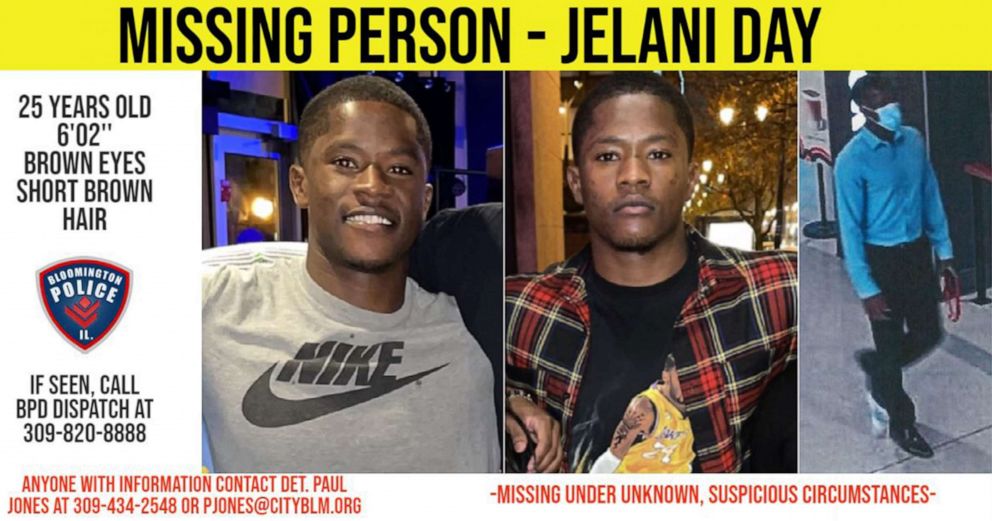
Jelani Day

In Illinois, a search was launched for Jelani Day, a 25-year-old graduate student at Illinois State University last seen on Aug. 24, according to the Bloomington Police Department. A body found near the Illinois River was identified as Day on Thursday after this story was initially published, Bloomington Police announced.

“Currently the cause of death is unknown, pending further investigation, and toxicology testing,” the police said in a statement.

He was reported missing Aug. 25 by his family and an ISU faculty member. He had not shown up to class the past several days before he disappeared, police said in a statement.

A missing persons post seeks Julian Day, a Illinois State University grad student.

Day was captured on surveillance footage entering a retail store called “Beyond/Hello” in Bloomington around 9 a.m. on Aug. 24, wearing a blue Detroit Lions baseball hat, a black T-shirt with a Jimi Hendrix graphic, white and silver shorts, and black shoes with white soles.

Police found his vehicle, a white 2010 Chrysler 300, two days later in a wooded area concealed by trees. Inside, cops found the clothing he was seen wearing in the video footage but no other sign of him.

Bloomington Police said in a Sept. 5 statement that a search team found an unidentified body off the south bank of the Illinois River. The LaSalle County Coroner’s Office initially said the identification process could take a few weeks.

Day’s heartbroken mother, Carmen Bolden Day, pleaded for him to be found.

“I shouldn’t have to beg, I shouldn’t have to plead, I shouldn’t have to feel that there is a racial disparity … I want these people that have their resources to realize this could happen to them,” she said on “Good Morning America.”

Anyone with information about Jelani Day is asked to contact BPD Detective Paul Jones at 309-434-2548 or at Pjones@cityblm.org

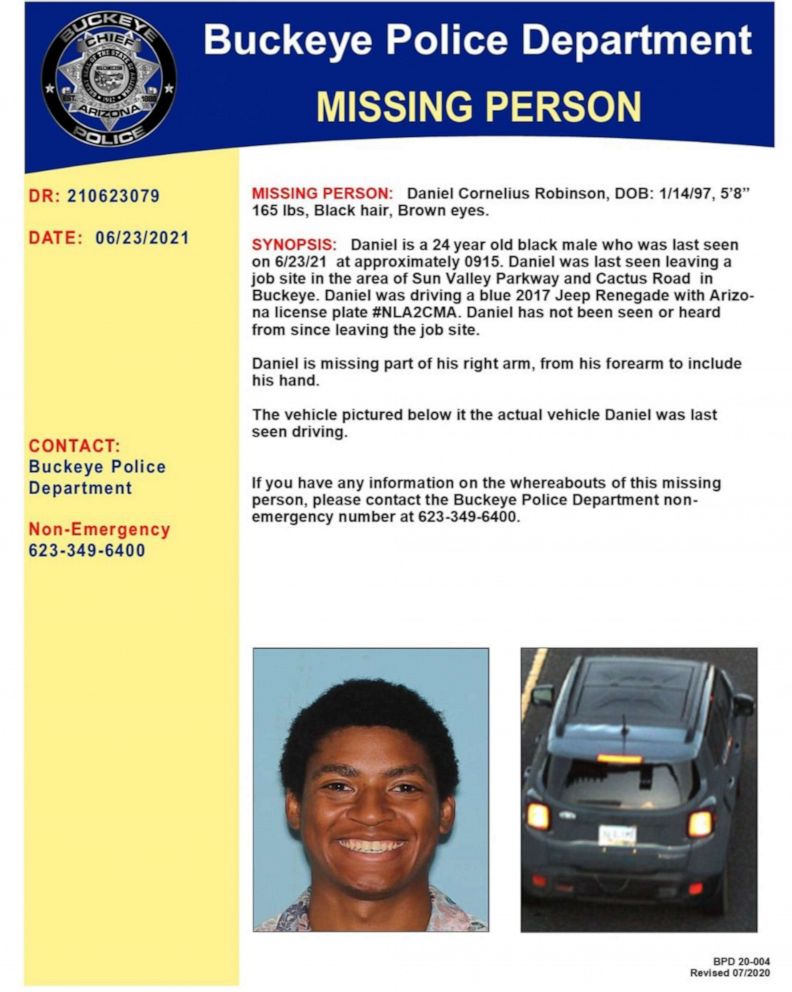
Daniel Robinson

A 24-year-old geologist, Daniel Robinson, went missing outside Buckeye, Arizona, three months ago. The Buckeye Police Department said in an update last week that the search is ongoing.

Robinson was last seen June 23 after leaving a job site near Sun Valley Parkway and Cactus Road, and he didn’t tell anyone where he was going, police said.

His jeep was found turned over in a ravine on July 19, 4 miles from where he was last seen, officials said. The airbags in the car had deployed and initial evidence indicated Daniel was wearing a seatbelt at the time of the accident. Officials found clothes, his cell phone, wallet and keys.

A missing persons post seeks Daniel Robinson, a 24-year-old geologist who disappeared near Buckeye, AZ on June 23.

Later in July, a human skull was found south of where the Jeep was recovered, but it was determined that it didn’t belong to Daniel, police said. No other remains were found.

Investigators have used ATVs, cadaver dogs and a drone and a helicopter to search for Robinson. His family has organized their own searches in the scorching desert.

Robinson’s father, David Robinson, traveled 2,000 miles from South Carolina to Arizona to help search for his son.

“I’m not leaving,” he told ABC Phoenix affiliate KNX. “I’m not leaving until I find my son.”

Anyone with information that can help solve this case is urged to call the Buckeye Police Department non-emergency number at 623-349-6400.

Lauren Cho

Lauren Cho, a 30-year-old from New Jersey also known as “El”, was last seen leaving a residence around 5 p.m. on June 28 in Yucca Valley in California, police said in a statement. She hasn’t been seen or heard from since then.

She had moved to California from New Jersey eight months earlier.

A missing persons poster seeks Lauren Cho who went missing June 28 in Yucca Valley, Calif.

On Tuesday, the Morongo Basic Sheriff’s Station announced that investigators from the Specialized Investigations Division, experts in homicides and suspicious deaths, are assisting in the search effort, investigating leads and working with Cho’s family and friends.

Detectives with the Morongo Basin Station have executed a search warrant in the 8600 block of Benmar Trail, where she was last seen reportedly walking away from the residence, and conducted aerial searches of a remote mountain terrain nearby.

Anyone with information regarding the search for Ms. Cho is urged to contact Detective Edward Hernandez or Sergeant Justin Giles, Specialized Investigations Division, at (909) 387-3589. You may remain anonymous by contacting the We-Tip hotline at 800-78-CRIME (27463) or www.wetip.com.

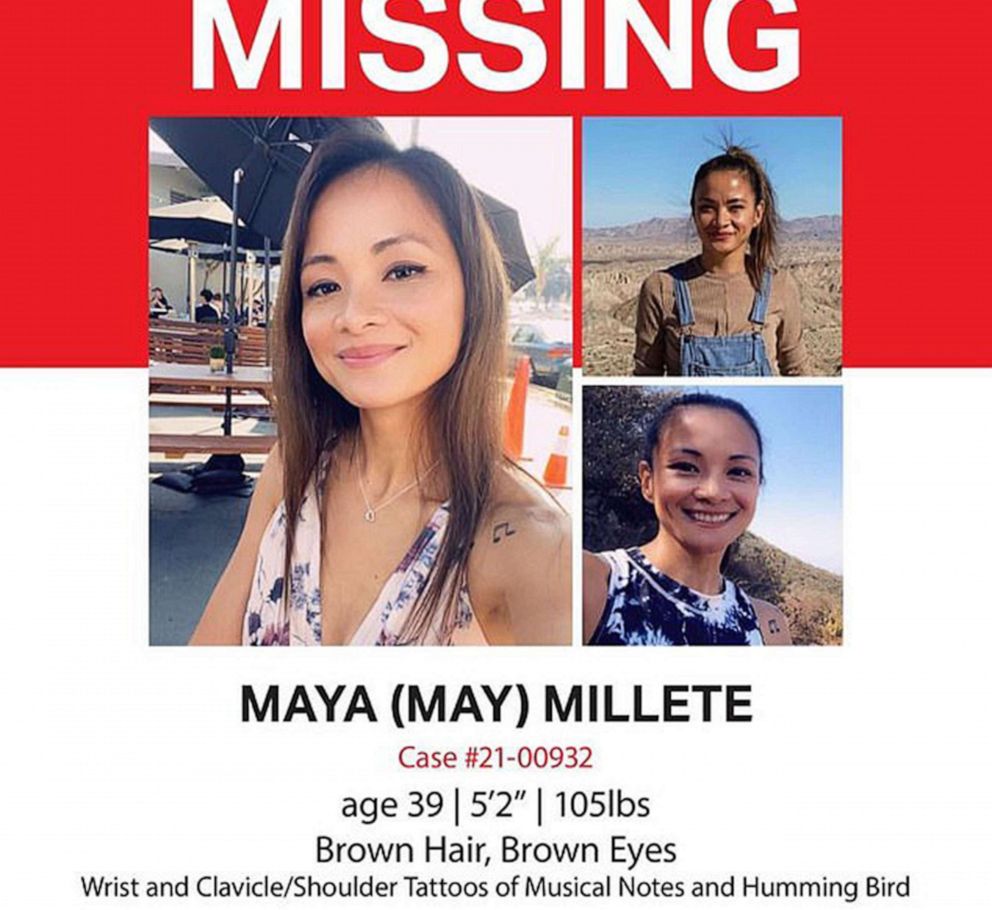
Maya Millete

Meanwhile in California, family members of Maya Millete, a married Chula Vista mother of three, are still searching for her after more than eight months after she was last seen.

Millete, 39, disappeared on Jan. 7 without a trace.

Droualillet, Millete’s sister, said the attention of the Petito case has become a painful reminder of Maya’s unknown whereabouts.

“I know Chula Vista police are working very hard, but the urgency we see in this case is heartbreaking,” Droualillet told KGTV.

A missing persons poster seeks Maya Millete, a mother-of-three who disappeared from Chula Vista California in January.

The Chula Vista Police Department is working with the San Diego County District Attorney’s office, the FBI and the Naval Criminal Investigative Service.

On July 22, Larry Millete, Maya’s husband, was named a person of interest in the case.

The Chula Vista Police Department said its interviewed 79 individuals and written 64 search warrants for residences, vehicles, cell and electric devices, and social media data in the case in a statement published Sept. 9.

Anyone who may have any information regarding May’s disappearance is asked to please contact San Diego County Crime Stoppers at 888-580-8477 or the CVPD at 619-691-5151.

Copyright © 2021, ABC Audio. All rights reserved.
More than a year after George Floyd’s killing, Congress can’t agree on police reform

More than a year after George Floyd’s killing, Congress can’t agree on police reform
drnadig/iStock

(WASHINGTON) — Talks of bipartisan police reform legislation in Congress are officially over as Republicans and Democrats can’t agree on key issues.

Democrats, after more than a year of negotiations, made a final offer, but despite “significant strides,” said Sen. Cory Booker, D-N.J., there weren’t any more concessions to be made.

“I just want to make it clear that this is not an end — the efforts to create substantive policing reform will continue,” Booker told reporters at the Capitol.

“It is a disappointment that we are at this moment,” Booker continued, adding that having participation from nation’s largest police union and the International Association of Chiefs of Police shows that “this is a bigger movement than where we were just a year or two ago.”

Lead Republican negotiator Sen. Tim Scott, R-S.C., said he’s concerned about high crime rates in some cities.

“When you’re talking about making progress in the bill, and your definition of progress is to make it punitive — or take more money away from officers if they don’t do what you want them to do — that’s defunding the police,” Scott told ABC News. “I’m not going to be a part of defunding the police.”

More than a year after the start of a racial reckoning in the United States, the movement to address brutality and racism in policing continues to dominate political discourse.

George Floyd’s death prompts reform

The George Floyd Justice in Policing Act was introduced in June 2020, very soon after Floyd, a Black man, was killed by then-Minneapolis police officer Derek Chauvin during an arrest. Floyd was accused of using a fake $20 bill at a local store.

Chauvin pinned Floyd on the ground, with his knee on the back of Floyd’s neck and upper back until he went unconscious. Videos taken by bystanders sparked a national movement against police brutality and racism, and legislators, including Rep. Karen Bass, D-Calif., and Rep. Sheila Jackson Lee, D-Texas, sought to answer calls for justice and end the current system of policing.

The Justice in Policing Act aimed to establish a national standard for policing practices, collect better data on police use of force and misconduct, ban the use of tactics such as no-knock warrants, and limit qualified immunity, which protects officers against private civil lawsuits.

It passed the House in March on a party-line vote, but the Republican-majority Senate didn’t move it forward. The legislation was reintroduced in 2021.

Senate Republicans also proposed a reform bill in June 2020, but Democrats blocked it, saying it didn’t do enough.

The Justice Act proposed using federal dollars to incentivize police departments to ban controversial practices, like the chokehold that killed Floyd, make lynching a federal hate crime, increase training and enforce the use of body cameras. The effectiveness of no-knock warrants also was to be studied.

Democrats and Republicans agree on ‘framework’

In summer 2021, both sides settled on a shared “framework” from which to pursue legislation.

“After months of working in good faith, we have reached an agreement on a framework addressing the major issues for bipartisan police reform,” Scott, Booker and Bass said in a joint statement. “There is still more work to be done on the final bill, and nothing is agreed to until everything is agreed to. Over the next few weeks we look forward to continuing our work toward getting a finalized proposal across the finish line.”

Many Republicans said they believed the proposed legislation put law enforcement under attack, while most Democrats held firm in holding accountable officers accused of abusing suspects.

Qualified immunity

Both sides still agreed to pursue change, but qualified immunity quickly became a sticking point for Republicans, and it ultimately led to the legislation’s demise.

Qualified immunity protects officers in cases where they’ve been individually accused of violating a person’s civil rights.

Some congressional Republicans said they feared a rise in frivolous lawsuits if qualified immunity were to be eradicated, but officers still would’ve had the same constitutional protections, and civil cases still would’ve been reviewed by courts before moving forward.

Sources told ABC News that Scott would get on board with a proposal if police unions could agree on a plan, but they’ve been very reluctant to do so.

Two police unions, the Fraternal Order of Police and the International Association of Chiefs of Police, were involved in negotiations with legislators. Though they came close to an agreement with Booker, other police unions such as the National Association of Police Organization, spoke out against Booker’s proposals because they weren’t included in earlier discussions.

Now, it’s back to square one. Booker said he and Congressional Democrats will find other pathways to achieving extensive police reform , but those pathways likely won’t include Republican colleagues.

Vice President Kamala Harris, who was in the Senate at the start of these negotiations, denounced Republican efforts to quash reform.

“We learned that Senate Republicans chose to reject even the most modest reforms. Their refusal to act is unconscionable,” Harris said in a statement. “Millions of people marched in the streets to see reform and accountability, not further inaction. Moving forward, we are committed to exploring every available action at the executive level to advance the cause of justice in our nation.”

White House press secretary Jen Psaki said President Joe Biden was disappointed.

“In the coming weeks,” she said, “our team will consult with members of Congress, the law enforcement, civil rights communities and victims families to discuss a path forward, including potential executive actions the president can take to ensure we live up to the American ideal of equality and justice under law.”

Copyright © 2021, ABC Audio. All rights reserved.
Utah city will investigate police response to Gabby Petito, Brian Laundrie dispute

Utah city will investigate police response to Gabby Petito, Brian Laundrie dispute
AlessandroPhoto/iStock

(UTAH) — The city of Moab, Utah, will launch an investigation into the Moab City Police Department’s handling of an incident involving Gabby Petito and Brian Laundrie on Aug. 12.

The city said in a statement that the department’s police officers “have been both praised and criticized for their response and their resolution of the incident involving Ms. Petito and Mr. Laundrie.”

Cops had responded to a call to Grand County Dispatch about a possible domestic dispute between Petito and Laundrie. Body camera footage of that incident was later shared showing Petito visibly distraught.

“At this time, the City of Moab is unaware of any breach of Police Department policy during this incident. However, the City will conduct a formal investigation and, based on the results, will take any next steps that may be appropriate,” the city said in a statement to ABC News.

Moab City Police Chief Bret Edge said, “The police department will identify an unaffiliated law enforcement agency to conduct the formal investigation on our behalf.”

Moab city officials said, “we recognize how the death of Ms. Petito more than two weeks later in Wyoming might lead to speculation, in hindsight, about actions taken during the incident in Moab.”

The city said that the police department “has clear standards for officer conduct during a possible domestic dispute and our officers are trained to follow those standards and protocol.”

An outside party filed a request with the police department asking for a formal investigation into the Aug. 12 incident, Edge said in a statement.

Edge said the department welcomes the investigation and if the probe identifies areas for improvement, “we will take that information to heart, learn from it, and make changes if needed to ensure we are providing the best response and service to our community.”

Body camera images from the Aug. 12 incident show Petito and Laundrie talking to an officer after her 2012 Ford Transit was pulled over by Moab police. In one image, she appears to be crying while sitting in the back of a police vehicle.

The couple told police they were arguing and that Petito had slapped Laundrie, according to the police report. The couple also stated to police that Laundrie did not hit Petito.

In a statement earlier this week, Moab police said that “insufficient evidence existed to justify criminal charges” in that incident.

Petito told police she suffers from severe anxiety and other medical conditions, which were redacted from the police report, and that the couple’s argument had been building for days. Police labeled the incident as a “mental/emotional break” rather than a domestic assault, according to the police report.

The incident took place about two weeks before she last spoke with her family.

Petito, 22, disappeared during a cross-country trip with Laundrie and was reported missing by her parents on Sept. 11 after they hadn’t heard from her in two weeks.

Authorities confirmed Tuesday that a body discovered Sunday in the Bridger-Teton National Forest in Wyoming belonged to Petito.

Now a search is underway for Laundrie, 23, around North Port, Florida. Investigators said he returned to his home on Sept. 1 without Petito but had her 2012 Ford Transit.

He has been named as a “person of interest” in the case. He hasn’t been seen since Tuesday, Sept. 14, police said.

Copyright © 2021, ABC Audio. All rights reserved.

Shooting reported at Kroger grocery store near Memphis: Police

Shooting reported at Kroger grocery store near Memphis: Police
jetcityimage/iStock

(TENNESSEE) — Police are responding to a shooting at a Kroger grocery store near Memphis, Tennessee.

Memphis police said its officers are helping secure the scene in Collierville, about 30 miles from Memphis.

Copyright © 2021, ABC Audio. All rights reserved.
COVID-19 live updates: CDC advisory panel expected to vote on Pfizer booster within hours

COVID-19 live updates: CDC advisory panel expected to vote on Pfizer booster within hours
AlxeyPnferov/iStock

(NEW YORK) — The United States has been facing a COVID-19 surge as the more contagious delta variant continues to spread.

More than 681,000 Americans have died from COVID-19 while over 4.7 million people have died from the disease worldwide, according to real-time data compiled by the Center for Systems Science and Engineering at Johns Hopkins University. The average number of daily deaths in the U.S. has risen about 20% in the last week, according to data from the Centers for Disease Control and Prevention and the U.S. Department of Health and Human Services.

The U.S. is continuing to sink on the list of global vaccination rates, currently ranking No. 45, according to data compiled by The Financial Times. Just 64% of Americans ages 12 and up are fully vaccinated against COVID-19, according to data from the CDC.

Here’s how the news is developing. All times Eastern:

Sep 23, 3:21 pm

More than 26 million Americans potentially eligible for booster next week

Pending the CDC panel’s recommendations and the CDC director’s sign-off, more than 26 million Americans could soon be eligible for a third Pfizer dose. This includes 13.6 million adults 65 and older and 12.8 million adults ages 18 to 64 who completed their primary series at least six months ago. Of those 18 to 64, anyone who is considered “high risk” could be eligible for an additional dose.

To date, more than 220 million Pfizer doses have been administered in the U.S.

Sep 23, 12:40 pm

CDC advisory panel expected to vote on Pfizer booster within hours

The CDC’s independent advisory panel is set to vote around 3 p.m. ET on which Americans are eligible now for a Pfizer booster.

After the vote, CDC director Rochelle Walensky is expected to weigh in with her official endorsement. The CDC is not bound by the panel’s recommendations but usually follows it. State officials may also implement their own criteria.

The FDA granted authorization Wednesday to the following groups: Anyone 65 or older as well as people as young as 18 if they have a medical condition that puts them at risk of severe COVID-19 or if they work a frontline job that makes it more likely that they would get infected. After authorization Wednesday night, the FDA’s acting commissioner Dr. Janet Woodcock said some of the groups that could be classified as front-line workers are health care employees, teachers and grocery store staffers, as well as people in prisons and homeless shelters.

Sep 23, 10:49 am

West Virginia, Montana case rates doubled in last month as Alaska sees record highs

Alaska currently has the country’s highest case rate, followed by West Virginia, Wyoming, Kentucky, Montana and South Carolina, according to federal data.

West Virginia and Montana have seen their case rates double over the last month. In Alaska, case metrics are at record highs, according to federal data.

Hospital admissions are down by about 12.5% in the last week, with improvements in Florida, Mississippi and Louisiana, according to federal data.

Seven states, however, have less than 10% ICU availability: Alabama, Arkansas, Georgia, Idaho, Kentucky, Oklahoma and Texas.

Even highly vaccinated states are experiencing shortages. One central Massachusetts health system, UMass Memorial Health, is running low on critical care beds following the admission of an influx of COVID-19 patients in recent weeks.

Sep 23, 8:21 am
Team USA to require COVID-19 vaccination at future Olympic and Paralympic Games

The U.S. Olympic and Paralympic Committee said it will require every member of its delegation to be vaccinated against COVID-19, starting this year.

According to a new policy posted on Team USA’s website, a COVID-19 vaccine mandate will take effect on Nov. 1 for “all employees, athletes, contractors and others,” unless they obtain a medical or religious exemption prior to accessing U.S. Olympic and Paralympic Committee facilities.

On Dec. 1, that mandate will “extend to all Team USA delegation members or hopefuls for future Games.” Individuals on the long list for the 2022 Winter Olympics in Beijing must submit proof of full COVID-19 vaccination by this date or have received an exemption in order to participate in the upcoming Games, according to the policy, which was dated Sept. 21.

“The health and well-being of our Olympic and Paralympic community continues to be a top priority,” Team USA says on a webpage detailing the new requirement. “This step will increase our ability to create a safe and productive environment for Team USA athletes and staff, and allow us to restore consistency in planning, preparation and optimal service to athletes.”

Sep 23, 6:38 am
COVID-19 hospitalizations reach another all-time high in Iowa for 2021

More people are currently hospitalized with COVID-19 in Iowa than at any other point
this year so far, according to weekly data released by the Iowa Department of Public Health on Wednesday.

The data shows that there are now 638 people hospitalized with the disease statewide, up from 578 last week. Although the figure is nowhere near Iowa’s peak of more than 1,500 in mid-November last year, it’s the highest number of COVID-19 hospitalizations that the Hawkeye State has recorded since December.

Sep 22, 7:48 pm
FDA authorizes Pfizer booster dose for those who are 65 and up, high-risk

The U.S. Food and Drug Administration has authorized a third booster dose of Pfizer’s COVID-19 vaccine for people who are 65 and older or at high risk of severe COVID-19, the agency announced Wednesday.

The dose is authorized to be administered at least six months after the second shot. High-risk recipients must be at least 18 years old.

The announcement comes days after a similar recommendation from FDA advisers.

The U.S. Centers for Disease Control and Prevention’s advisory board is scheduled to vote on booster recommendations Thursday.

Sep 22, 6:04 pm
Florida letting parents choose whether to quarantine asymptomatic, close-contact children

The Florida Department of Health issued an emergency rule Wednesday that lets parents choose whether to quarantine their children if they are deemed a close contact of someone who tested positive for COVID-19.

In such cases, parents can let their children “attend school, school-sponsored activities, or be on school property, without restrictions or disparate treatment, so long as the student remains asymptomatic,” the emergency rule stated.

The move is the state’s latest to empower parents when it comes to coronavirus measures in schools. In July, Gov. Ron DeSantis issued an executive order giving parents the choice of whether to send their kids to school with masks, setting off an intense back-and-forth between the state and districts that mandated masks in the weeks since.

DeSantis touted the new “symptoms-based approach” during a press briefing Wednesday.

“Quarantining healthy students is incredibly damaging to their educational advancement,” he said. “It’s also incredibly disruptive for families all throughout the state of Florida.”

At least one superintendent in Florida has spoken out against the new quarantine rule.

“I find it ironic that the new state rule begins with the phrase ‘Because of an increase in COVID-19 infections, largely due to the spread of the COVID-19 delta variant,'” Carlee Simon, superintendent of Alachua County Public Schools, said in a statement posted to Twitter Wednesday.

“In fact, this rule is likely to promote the spread of COVID-19 by preventing schools from implementing the common-sense masking and quarantine policies recommended by the vast majority of health care professionals, including those here in Alachua County,” she added.

Copyright © 2021, ABC Audio. All rights reserved.

Florida lawmaker introduces abortion bill similar to Texas’ controversial ban

Florida lawmaker introduces abortion bill similar to Texas’ controversial ban
MivPiv/iStock

(FLORIDA) — A state legislator in Florida has introduced an abortion restriction bill similar to a controversial law that took effect in Texas earlier this month.

The new bill, HB 167, introduced Wednesday in the Florida House of Representatives by Rep. Webster Barnaby, would ban most abortions in the state and would allow people to file civil lawsuits against doctors who violate the law.

Specifically, HB 167 would require physicians to test for a “fetal heartbeat” on a pregnant person seeking an abortion.

Under the proposed legislation, a physician may not perform an abortion if there is a “detectable fetal heartbeat.”

The bill also puts the enforcement of the law on private citizens, versus the state, in allowing people to bring lawsuits against physicians. It calls for damages of at least $10,000 per abortion for the physician who performs the procedure and any defendants that “aided or abetted” the procedure.

People would have up to six years after an illegal abortion is performed to file a lawsuit.

The Texas law, Senate Bill 8, bans nearly all abortions after six weeks of pregnancy, specifically once the rhythmic contracting of fetal cardiac tissue can be detected.

Similar to the newly introduced bill in Florida, the Texas law is unusual in that it prohibits the state from enforcing the ban but allows anyone to sue a person they believe is providing an abortion or assisting someone in getting an abortion after six weeks.

People who successfully sue an abortion provider under this law could be awarded at least $10,000.

Texas Gov. Greg Abbott signed the so-called “heartbeat ban” on May 19 and it went into effect on Sept. 1.

Like the Texas law, the Florida legislation does not include exceptions for pregnancies that occur from rape or incest, but makes an exception if a physician believes a “medical emergency” exists.

The bill’s language about “fetal heartbeat” is controversial because many medical experts say that early-stage cardiac activity isn’t a heartbeat.

Cardiac activity is typically first detected five to six weeks into pregnancy, or three to four weeks after the embryo starts developing.

Most of the abortions performed nationwide are after six weeks of pregnancy.

When a person is six weeks pregnant, it typically means the embryo started developing about four weeks prior, based on the formula doctors use to figure out when a person will give birth. People don’t often realize they are pregnant until after the six-week mark.

The U.S. Supreme Court voted 5-4 on Sept. 1 to allow SB8 to take effect on procedural grounds, despite what the majority acknowledged as “serious questions” about constitutionality. The justices did not address those questions.

Texas is one of 13 states that have passed laws banning abortion in the first trimester of pregnancy; legal challenges have so far prevented all from taking effect.

Since Texas’s abortion ban went into effect, lawmakers in 11 states, including Florida, have announced intentions or plans to model legislation after the state’s law, according to NARAL Pro-Choice America.

Florida Gov. Ron DeSantis’ office said the new proposed abortion legislation in his state will be reviewed, according to The Associated Press.

“Governor DeSantis is pro-life. The Governor’s office is aware that the bill was filed today and like all legislation, we will be monitoring it as it moves through the legislative process in the coming months,” DeSantis spokesperson Taryn Fenske said in an email to the AP.

Democratic leaders in Florida have vowed to fight the legislation.

“This bill is dangerous, radical, and unconstitutional. The hypocrisy of this attempt by Governor (Ron) DeSantis and Republicans in the state legislature to take away our rights while at the same time preaching ’my body, my choice’ when it comes to wearing masks is absolutely disgusting,” Agriculture Commissioner Nikki Fried, also a Democratic candidate for governor, said in a statement, according to the AP.

Copyright © 2021, ABC Audio. All rights reserved.

Border Patrol suspends using agents on horseback amid outrage

Border Patrol suspends using agents on horseback amid outrage
Azaliya/iStock

(WASHINGTON) — Amid outrage over images the White House said President Joe Biden found “horrible,” the U.S. Border Patrol has temporarily stopped using agents on horseback against Haitian migrants in Del Rio, Texas, Homeland Security officials said Thursday.

Shortly afterward, White House press secretary Jen Psaki confirmed the decision to end the horse patrols in what critics said was offensively harsh treatment of the migrants.

“We have taken very specific actions as it relates to the horrific photos that we — we’re not going to stand for in this administration,” she told reporters at her daily press briefing.

The agents have been put on administrative leave pending an investigation.

Images of Border Patrol agents using their horses for crowd control on the banks of the Rio Grande have incensed Democratic lawmakers, some of whom drew a connection to white supremacy and slavery.

“Haitian lives are Black lives, and if we truly believe that Black lives matter, then we must reverse course,” Democratic Rep. Ayanna Pressley, D-Mass., said at a news conference Wednesday.

Pressley also called on the Biden administration to “immediately and indefinitely” stop the removal of Haitian nationals back to Haiti. Democrats and immigrant advocates remain concerned that the administration’s rapid removal of migrants from the border has limited their access to humanitarian protections outlined under the law.

Homeland Security official said Thursday the removals would continue.

Law enforcement agencies across the country use mounted patrols on a regular basis to traverse rough terrain, including in remote areas of the border that don’t have paved roads.

While many were disturbed by what appeared to be aggressive behavior by the agents on horseback, Border Patrol agents who spoke to ABC News said their colleagues in the controversial photographs were following procedures. They said it’s common practice for agents on horseback to use “long reins” to control the horse, apparently leading a photojournalist at the scene in Del Rio to describe them as “whips” being used by the agents.

Any use of whips, even on horses, would be out of line with agency policy, Border Patrol Agent and Union Vice President Jon Anfinsen told ABC News.

“These agents are highly trained along with their horses and they were doing exactly what they were trained to do,” Anfinsen said.

About 4,000 migrants remain at the camp and the officials estimated that about two-thirds of the entire group that gathered in Del Rio were families.

Copyright © 2021, ABC Audio. All rights reserved.

EU proposes legislation requiring all mobile devices, including iPhones, use a universal charger

EU proposes legislation requiring all mobile devices, including iPhones, use a universal charger
EkaterinaMesilova/iStock

(EUROPE) — Lawmakers in Europe on Thursday unveiled a proposal to force smartphone makers to adopt a universal, brand-agnostic charging cable in an effort to reduce electronic waste.

The plans call for a USB-C cable to become the universal standard for all smartphones, tablets and other mobile devices. While years of collaborating with the industry on a voluntary approach have brought the number of mobile charger types from 30 to 3 within the last decade, according to a statement from the European Commission, the new legislation would establish a single common charging solution.

Apple, with its proprietary Lightning cables, remains one of the major holdouts to have a unique charger for its devices — though some of its more recent devices do include USB-C charging. The company has previously argued that the proposal would impede innovation.

“Chargers power all our most essential electronic devices,” Thierry Breton, the EU’s internal market commissioner, said in a statement. “With more and more devices, more and more chargers are sold that are not interchangeable or not necessary. We are putting an end to that.”

“With our proposal, European consumers will be able to use a single charger for all their portable electronics — an important step to increase convenience and reduce waste,” Breton added.

Margrethe Vestager, the European Commission’s executive vice president for the digital age, added that consumers have been “frustrated long enough about incompatible chargers piling up in their drawers.”

“We gave industry plenty of time to come up with their own solutions, now time is ripe for legislative action for a common charger,” Vestager said in a statement Thursday. “This is an important win for our consumers and environment and in line with our green and digital ambitions.”

Some 420 million mobile phones and other portable electronic devices were sold in the European Union in 2020, the lawmakers said, and consumers on average own about three mobile chargers but only use two on a regular basis. The group estimates disposed of and unused chargers pile up to some 11,000 metric tons of waste each year.

The Commission also seeks to unbundle the sale of chargers from the sale of electronic devices in order to reduce the environmental footprint associated with the production and disposal of chargers. It also is asking producers to provide clearer information about charging performance, including how much power is required by a device for charging.

The lawmakers estimate that all together the new measures will help consumers in Europe limit the number of new chargers purchased and save nearly $294 million (€250 million) per year on unnecessary charger purchases.

Apple told ABC News that it is continuing to work with the European Commission to understand the full details of the proposal, but argued that the legislation could disrupt a thriving ecosystem, inconvenience users and actually create electronic waste.

“Apple stands for innovation and deeply cares about the customer experience. Some of the most innovative thinking at Apple goes toward building products with recycled and renewable materials,” an Apple spokesperson said in a statement. “We share the European Commission’s commitment to protecting the environment and are already carbon neutral for all of our corporate emissions worldwide, and by 2030 every single Apple device and its usage will be carbon neutral.”

“We remain concerned that strict regulation mandating just one type of connector stifles innovation rather than encouraging it, which in turn will harm consumers in Europe and around the world,” the statement added. “We look forward to continued engagement with stakeholders to help find a solution that protects consumer interest, as well as the industry’s ability to innovate and bring exciting new technology to users.”

The U.S.-headquartered company also noted that the European Commission previously sought to mandate that all smartphones only use USB Micro-B connectors, which would have restricted the advancement to Lightning and USB Type-C chargers.

The proposal will next need to be adopted by the European Parliament and the Council, and the lawmakers have proposed a transition period of two years — which Apple has called concerningly short — from the date of adoption to give the industry time to adapt.

Copyright © 2021, ABC Audio. All rights reserved.