Jabin Botsford/The Washington Post/Bloomberg via Getty Images
(WASHINGTON) — U.S. Capitol Police Officer Eugene Goodman, the man who led rioters up the stairs and away from the Senate chamber on Jan. 6, 2021, broke his yearlong silence Monday when he appeared on the podcast “3 Brothers No Sense.”
“It could have easily been a blood bath,” Goodman says on the show. “So kudos to everyone there that showed a measure of restraint in regards to deadly force, because it could have been bad.”
Goodman’s heroics were caught on camera in what became a viral video that came to light during President Donald Trump’s impeachment trial in the Senate, which revealed Goodman also guided Sen. Mitt Romney back to the Senate chamber, helping him narrowly avoid contact with the rioters.
The officer’s description of the day is one in which he kicked into “go mode” and relied heavily on previous military training to guide him. He said his decision to move up the stairs with the protestors wasn’t entirely by choice because he thought “they would have followed me anyway.”
“Any situation like that you want to de-escalate, but at the same time you wanna survive first,” Goodman says.
He also discusses his newfound fame and explains that he has chosen to stay out of the spotlight to protect his family’s privacy.
“I keep asking myself that question every day like who the hell am I?” Goodman says. “I’m the guy everybody keeps saying saved the Senate… I don’t need no statue, though, that’s one more thing for a bird to prop up and take a dump on.”
Up until Monday, Goodman has avoided media appearances. The podcast interview was conducted by the three hosts, one of whom, Officer Byron Evans, serves as a member of the U.S. Capitol Police.
Earlier this month, “World News Tonight” anchor David Muir sat down with three Capitol Police officers who were at the Capitol on Jan. 6 last year.
ABC News’ Rachel Scott and Allison Pecorin contributed to this report.
(NEW YORK) — Police in New York City have released new video of the suspect wanted for shooting an 11-month-old girl in the face in the Bronx.
A reward has now climbed to $10,000, police said.
The shooting took place at about 6:45 p.m. on Jan. 19 while the baby was in a parked car with her mother outside a grocery store, waiting for the father who was inside the store, police said.
A man chasing another man fired two shots, hitting the baby in the face, police said.
The NYPD said the suspect fled in a gray Nissan.
The baby girl, Catherine, was hospitalized in critical but stable condition and turned 1 days later. Her current condition isn’t clear.
Bronx District Attorney Darcel Clark addressed the gunman in an interview with ABC New York station WABC last week, saying, “you’re not going to get away with it. … We’re going to find you eventually, because we’re not going to stop looking.”
Anyone with information is asked to call 800-577-TIPS.
(BALTIMORE) — The city of Baltimore is in mourning after three firefighters were killed when they responded to a fire and became trapped inside.
Lt. Paul Butrim, firefighter Kelsey Sadler and firefighter Kenny Lacayo died while battling a blaze at a vacant row-home Monday morning.
The house partially collapsed, trapping them inside, along with a fourth firefighter, John McMaster, who survived and is in critical but stable condition.
Lt. Butrim was a 16-year veteran of the department. Sadler spent 15 years with the department and Lacayo was with the department for seven years.
“This is a gut-wrenching tragedy for our city, the Baltimore City Fire Department, and most importantly the families of our firefighters,” Baltimore Mayor Brandon Scott said in a statement. “My heart is with the firefighters, their families, and the entire Baltimore City Fire Department who put the lives and safety of others before their own wellbeing each and every day. I ask that all of Baltimore keep them in our prayers during this extremely difficult time.”
Baltimore Fire Chief Niles Ford said, “From this moment, we will honor those we lost today, for their bravery, their courage, their love for helping others and the respect they had for the Baltimore City Fire Department.”
Maryland Gov. Larry Hogan ordered flags lowered to half-staff.
Law enforcement and sports teams in Baltimore are also offering their condolences.
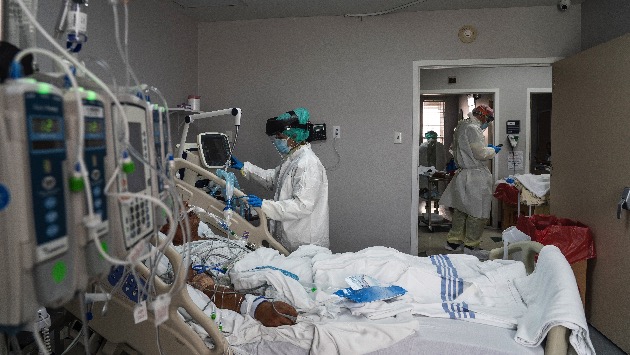
(NEW YORK) — As the COVID-19 pandemic has swept the globe, more than 5.6 million people have died from the disease worldwide, including over 868,000 Americans, according to real-time data compiled by Johns Hopkins University’s Center for Systems Science and Engineering.
About 63.4% of the population in the United States is fully vaccinated against COVID-19, according to data from the Centers for Disease Control and Prevention.
Here’s how the news is developing. All times Eastern:
Jan 25, 4:40 pm
Weekly reported cases set new record at more than 21 million
Over 21 million new weekly cases were reported across the globe — the most recorded since the beginning of the pandemic, according to the World Health Organization.
The U.S. (4,215, 852 new cases — a 24% decrease from the previous week) reported the most, followed by France (2,443,821 new cases — a 21% increase).
The U.S. also recorded 10,795 deaths — the most of any nation.
-ABC News’ Christine Theodorou
Jan 25, 4:25 pm
US hospital admissions drop 8% even as 13 states see surges
Nearly 20,000 Americans with COVID-19 are being admitted to hospitals each day — an 8% drop over the last week, according to federal data.
But 13 states saw COVID-19-related hospital admission rates jump by at least 10%: Alaska, Alabama, Arkansas, Idaho, Kentucky, Nebraska, New Mexico, Oklahoma, Oregon, South Dakota, Utah, West Virginia and Wyoming.
Emergency department visits for diagnosed COVID-19 cases declined nearly 24% over the last two weeks, according to federal data.
While the U.S. case rate is steadily falling — down by 15% in the last week to an average of 664,000 new cases — case rates still remain higher than any other point of the pandemic, according to federal data.
Wisconsin is leading the nation in new cases per capita, followed by Rhode Island, Utah and South Carolina.
-ABC News’ Arielle Mitropoulos
Jan 25, 12:18 pm
Elton John tests positive, Dallas concerts postponed
Elton John has tested positive for COVID-19, forcing him to postpone his concerts on Jan. 25 and Jan. 26 at the American Airlines Center in Dallas, according to a statement from the venue.
“Elton is fully vaccinated and boosted, and is experiencing only mild symptoms,” the statement said. “Fans should hold on to their tickets as they will be honored at the rescheduled dates to be announced soon.”
Jan 25, 12:02 pm
Florida governor vows to ‘fight back’ against FDA’s ‘reckless’ decision
Florida Gov. Ron DeSantis has vowed to “fight back” against the U.S. Food and Drug Administration’s “reckless” decision to limit the use of two monoclonal antibody treatments for COVID-19 that were found to be ineffective against the now-dominant omicron variant.
“This is wrong what they are doing, and we have many people now who are very concerned because they were going to go in and get it today or tomorrow,” DeSantis said during a press conference Tuesday.
While the governor acknowledged that the treatments are less effective against omicron, he claimed that people in Florida have seen their COVID-19 symptoms clear up in the last month after receiving the treatments. DeSantis, however, did not offer data to support that claim.
“We’re going to fight back against this,” he told reporters.
When asked whether he plans to take legal action against the federal government, DeSantis said: “I don’t know. We’re going to see what we can do.”
With omicron accounting for more than 99% of COVID-19 infections nationwide, the FDA on Monday revised its authorizations for two of the main monoclonal antibody treatments that have been widely used across the country — one made by Eli Lilly and the other by Regeneron. The FDA said both treatments are no longer authorized for use in any U.S. state, territory or jurisdiction and should not be used for treatment against COVID-19. In the future, the treatments could still be used to help patients who become sick with other variants, according to the FDA.
Following the FDA’s decision, Florida health officials announced that monoclonal antibody treatment sites would be shut down across the state. More than 2,000 appointments for the treatments were canceled statewide on Tuesday alone, according to the governor’s office.
“Unfortunately, as a result of this abrupt decision made by the federal government, all monoclonal antibody state sites will be closed until further notice,” the Florida Department of Health said in a statement late Monday. “Florida disagrees with the decision that blocks access to any available treatments in absence of clinical evidence. To date, such clinical evidence has not been provided by the United States Food and Drug Administration (FDA).”
-ABC News’ Will McDuffie and Sasha Pezenik
Jan 25, 10:43 am
Kentucky governor’s son tests positive as state’s cases skyrocket
Kentucky Gov. Andy Beshear’s son has tested positive for COVID-19 as cases in the state skyrocket.
“My son is generally asymptomatic, we believe because he is vaccinated and boosted,” Beshear said Monday.
The governor and the rest of his family tested negative on Monday, according to Beshear’s office.
Kentucky reported 81,473 cases for the week ending on Sunday — a record high.
Hospitalizations are also approaching a record high, his office said.
Jan 25, 9:18 am
WHO warns of rising cases of omicron sub-variant
The World Health Organization is sounding the alarm over rising cases of a new omicron sub-variant.
In an updated post to its website on Monday, the WHO said the new sub-variant, called BA.2, is a descendant of omicron, the now-dominant, highly contagious variant of the novel coronavirus. Unlike omicron, BA.2 is currently not considered a “variant of concern.” But because it is spreading in many countries, the WHO is asking governments and scientists across the globe to monitor the situation and study the new sub-variant, as many have already been doing.
As of last Friday, BA.2 had already been detected in at least 40 countries, including the United States. It has already spread quickly in Denmark, where early reports indicate it doesn’t appear to be deadlier than its parent variant. The sub-variant is now also spreading rapidly in the United Kingdom.
While BA.2 is a descendent of omicron, it has slightly different mutations. Omicron has several sub-variants, as does the previously dominant, highly transmissible delta variant.
-ABC News’ Sony Salzman
Jan 25, 6:45 am
Pfizer, BioNTech announce clinical studies for omicron-based vaccine
Pfizer and BioNTech said on Tuesday they have initiated clinical studies to evaluate an omicron-based vaccine for adults.
The trials will evaluate the “safety, tolerability, and immunogenicity” of the omicron-based vaccine for healthy adults between 18 and 55 years old, the companies said. About 1,400 participants will receive one of three combinations of the companies’ current vaccine and the omicron-based vaccine.
“While current research and real-world data show that boosters continue to provide a high level of protection against severe disease and hospitalization with Omicron, we recognize the need to be prepared in the event this protection wanes over time and to potentially help address Omicron and new variants in the future,” said Kathrin U. Jansen, Ph.D., senior vice president and head of vaccine research & development at Pfizer, said in a statement.
The companies said 615 participants will receive a dose of the omicron booster after two doses of the current vaccine. Another 600 participants will receive a dose of the omicron booster after three doses of the current vaccine. The final 205 participants, who have not been vaccinated, will receive three doses of the omicron vaccine.
Pfizer and BioNTech said they expected to have initial findings in the first half of 2022. ABC News has also learned Moderna is expected to start similar human trials of an omicron-specific vaccine within the coming days.
-ABC News’ Eric Strauss
Jan 25, 6:34 am
London police probe Downing Street lockdown parties
London police said Tuesday they are investigating parties that allegedly took place at British Prime Minister Boris Johnon’s official residence and executive office while England was under strict lockdown because of COVID-19.
In a statement before the London Assembly, Metropolitan Police Commissioner Cressida Dick announced the investigation into “a number of events” at 10 Downing Street.
“The fact that we are now investigating does not, of course, mean that fixed penalty notices will necessarily be issued in every instance and to every person involved,” Dick said. “We will not be giving a running commentary on our current investigations.”
Johnson is facing growing anger and calls for his resignation over claims he and his staff flouted COVID-19 restrictions imposed by his government. In the latest allegation, ITV News reported that the prime minister attended a surprise birthday party held for him at his office during the first lockdown in June 2020 and later hosted friends in his apartment upstairs that evening. At that time, people in England were barred from meeting more than one individual outside their household.
A spokesperson for Johnson’s office called the claim “totally untrue,” telling ITV News in a statement that, “in line with the rules at the time, the prime minister hosted a small number of family members outside that evening.”
Earlier this month, Johnson acknowledged for the first time that he went to a garden party at 10 Downing Street during the first lockdown in May 2020. While he didn’t explicitly admit that he had broken any rules, the prime minister apologized and said he had considered the garden party to be a work event to thank his staff for their efforts during the pandemic.
It was unclear which events London’s Metropolitan Police Service is investigating.
Jan 25, 5:42 am
Crisis standards of care activated in southern Idaho
Crisis standards of care have been adopted in much of southern Idaho, as hospitals grapple with a surge in COVID-19 patients.
The Idaho Department of Health and Welfare, citing severe staffing and blood supply shortages, activated crisis standards of care on Monday for the southwest, central and south central public health districts, which encompass 18 counties including the Boise, Nampa and Twin Falls metropolitan areas. Crisis standards of care provide legal and ethical guidelines for how health care providers should allocate scarce, life-saving resources, such as ventilators and intensive care unit beds, during an overwhelming public health emergency.
“The highly contagious Omicron variant has thrown us a curve ball,” Idaho Department of Health and Welfare Director Dave Jeppesen said in a statement Monday. “Once again, the situation in our hospitals and health systems is dire — we don’t have enough resources to adequately treat patients.”
It was the second time amid the coronavirus pandemic that the Idaho Department of Health and Welfare has activated crisis standards of care. Health care rationing was authorized in northern Idaho last September before being extended to the entire state 10 days later. The guidelines were fully deactivated by the end of December.
The latest activation came in response to a request from Saint Alphonsus Health System, which has hospitals in southwestern Idaho as well as eastern Oregon. Jeppesen convened Idaho’s crisis standards of care activation advisory committee last Friday, and the committee recommended that the guidelines be activated statewide. Jeppesen decided to only make the designation for southern Idaho, but said other parts of the state will likely be added if current COVID-19 trends continue.
Jeppesen urged residents to get vaccinated and boosted against COVID-19 and to wear high-quality face masks in public places.
“Omicron is so much more contagious than previous variants, and even though a lower percentage of cases are ending up in the hospital, the record number of cases is still putting strain on our healthcare system,” he said.
Jan 24, 4:05 pm
Pediatric cases sky-high but hospitalizations show decline
More than 1.1 million children tested positive for COVID-19 last week — nearly five times the rate of the peak of last winters’ surge, according to a report from the American Academy of Pediatrics and the Children’s Hospital Association.
A total of 10.6 million children have tested positive since the onset of the pandemic. A fifth of those children — over 2 million kids — tested positive in just the last two weeks, according to the two organizations.
Pediatric cases in the Northeast are seeing a dramatic drop but new cases in the West, South and the Midwest are still surging.
But there is positive news: COVID-19-related hospitalizations among children fell this week for the first time in one month.
More than 28.4 million eligible children remain unvaccinated.
(NEW YORK) — A second NYPD officer has died after being shot at a domestic violence call in Harlem this weekend.
Officer Wilbert Mora, 27, who died Tuesday, is “3 times a hero,” Police Commissioner Keechant Sewell tweeted. “For choosing a life of service. For sacrificing his life to protect others. For giving life even in death through organ donation.”
Mora was shot while responding to a 911 call Friday night from a woman who was in a dispute with her son. She said her son was in a back bedroom, and when the officers approached the bedroom, the door swung open and the suspect fired, police said.
Mora’s partner, officer Jason Rivera, 22, was struck first at the scene and died from his injuries.
A third officer, 27-year-old Sumit Sulan, opened fire on the suspect, LaShawn McNeil.
McNeil, 47, later died from his injuries.
Mora and Rivera are among five NYPD officers who have been shot this month, the commissioner said.
New York City Mayor Eric Adams, a former NYPD captain, on Monday unveiled a new strategy to combat violent crime.
“New Yorkers feel as if a sea of violence is engulfing our city,” Adams said. “But as your mayor, I promise you I will not let this happen. We will not surrender our city to the violent feud. We won’t go back to the bad old days.”
(WASHINGTON) — President Joe Biden said Tuesday there could be some U.S. troop movements in the “nearer term” in Eastern Europe — and that he would consider personally sanctioning Russian President Vladimir Putin if Russia invades Ukraine — a day after 8,500 American forces were put on “heightened alert” in the region.
“If he were to move in with all those forces, it would be the largest invasion since World War II. It would change the world,” Biden told reporters at an unannounced stop at a local business in Washington.
Asked about what would lead him to deploy the troops staging nearby, Biden said that depends on “what Putin does or doesn’t do” but he repeated that American forces would not move into Ukraine.
“I may be moving some of those troops in the nearer term, just because it takes time,” Biden said, adding it’s not to be “provocative” but to reassure NATO allies whom have reasons for concern.
“We have no intention of putting American forces, or NATO forces, in Ukraine. But we — as I said — they’re gonna be serious economic consequences if he [Putin] moves,” Biden added.
Asked whether the risk of an invasion is increasing, decreasing or steady, Biden compared assessing Putin’s intentions to “reading tea leaves.”
“The fact that he continues to build forces along Ukraine’s border from Belarus, all the way around, you’d say, ‘Well that means that he is looking like he’s trying to do something.’ But then you look at what his past behavior is and what everyone is saying on his team, as well as everyone else, as to what is likely to happen. It all comes down to his — his decision-making,” Biden said.
Amid the escalating tensions, Biden had a one hour and 20-minute conference call from the White House on Monday with the leaders of the European Commission, European Council, NATO, France, Germany, Italy, Poland and the United Kingdom, according to the White House, which said they planned to “discuss diplomacy, deterrence and defense efforts” as well as what would constitute potential sanctions against Russia.
The White House said after the call that Biden and European leaders “reiterated their continued concern about the Russian military build-up on Ukraine’s borders” and also discussed “preparations to impose massive consequences and severe economic costs on Russia for such actions as well as to reinforce security on NATO’s eastern flank.”
“We’re all on the same page,” Biden said Tuesday. “You’ve got to make it clear that that there’s no reason for anyone, any member of NATO, to worry whether or not we would, we NATO, would come to their defense.”
(FORT PIERCE INLET, Fla.) — The Coast Guard was combing the waters off eastern Florida Tuesday afternoon, looking for 39 people on a boat that capsized.
The vessel may have been part of a “human smuggling venture,” the Coast Guard said.
The Coast Guard said it had received a report from a good Samaritan who rescued a man clinging to the vessel, roughly 45 miles east of Fort Pierce Inlet, around 8 a.m.
The survivor said he left Bimini, Bahamas, on Saturday night, and that their boat encountered turbulent weather. No one was wearing a life jacket, according to the survivor.
Coast Guard boats and aircraft were searching throughout the morning, and as of 4 p.m. Tuesday, no other survivors had been discovered.
(NEW YORK) — A federal appeals court on Tuesday upheld the conviction of the Mexican drug lord known as El Chapo.
Joaquin Guzman sought to overturn his conviction in Brooklyn federal court on ten grounds. The appellate court concluded “none of these claims has merit.”
Among Guzman’s arguments, the strict conditions of his confinement before trial inhibited his rights to prepare a defense and benefit from the assistance of counsel.
“The District Court did not err in concluding that Guzman was able to assist in his own defense and receive a fair trial, despite the conditions of his pretrial confinement,” the decision from the 2nd US Circuit Court of Appeals said. “The conditions of Guzman’s pretrial confinement, harsh as they were, do not provide a basis for disturbing his conviction.”
“While respecting the Court’s ruling, we’re disappointed that substantial allegations of grave jury misconduct continue to be swept under the rug and left wholly unexamined in a case of historic proportion — all, it appears, because of the defendant’s matchless notoriety,” said Guzman’s attorney, Marc Fernich, in a statement Tuesday.
Guzman was convicted in 2019 of conducting a continuing criminal enterprise, including large-scale narcotics violations and a murder conspiracy, drug trafficking conspiracies, unlawful use of a firearm, and a money laundering conspiracy. He is currently serving a life sentence.
El Chapo was the leader of the Sinaloa Cartel. Under his leadership, the Sinaloa Cartel imported more than a million kilograms of cocaine and hundreds of kilograms of heroin, marijuana, and methamphetamine into the United States. Trial evidence proved the cartel used murder, kidnapping, torture, bribery of officials, and other illegal methods to control territory throughout Mexico and to subdue opposition.
In November, Guzman’s wife, Emma Coronel Aispuro, was sentenced to 36 months in federal prison for conspiring to distribute cocaine, meth, heroin and marijuana for import into the U.S; money-laundering and helping run the Mexican drug cartel in which her husband was the boss.
(NEW YORK) — A new study adds to the growing evidence that COVID-19 vaccines are safe for both pregnant people and people hoping to become pregnant.
The study, which looked at more than 2,000 couples in the United States and Canada, found “no adverse association” between getting vaccinated against COVID-19 and fertility, for both men and women.
On the other hand, men who contract COVID-19 may experience a temporary reduction in fertility. Couples who had a male partner test positive for COVID-19 within 60 days of their partner’s menstrual cycle were 18% less likely to conceive in that cycle, according to the study, published on Jan. 20 in the American Journal of Epidemiology.
“The findings provide reassurance that vaccination for couples seeking pregnancy does not appear to impair fertility,” Dr. Diana Bianchi, director of the National Institute of Health’s Eunice Kennedy Shriver National Institute of Child Health and Human Development, which funded the study, said in a statement. “They also provide information for physicians who counsel patients hoping to conceive.”
The myth that COVID-19 vaccines may negatively impact fertility was one that was spread largely on social media.
More and more research has now shown that not only do the vaccines not affect fertility, they also do not impact pregnancy.
A study released Jan. 4 by the Centers for Disease Control and Prevention (CDC) found no increased risk of preterm or low-weight birth among babies born to pregnant people who got a COVID-19 vaccine shot, compared to babies born to unvaccinated pregnant people.
The study’s researchers at Yale University looked at the health data of more than 40,000 pregnant women and did not identify any safety issues with getting vaccinated while pregnant, no matter which trimester a woman was in when vaccinated, or how many vaccine doses she got during her pregnancy. Researchers noted most of the women included in the analysis were vaccinated in the second or third trimester, and the study didn’t include booster doses.
In a health warning issued in September urging pregnant people to get vaccinated, the CDC said data shows there is also no increased risk for miscarriage linked to receiving a COVID-19 vaccine.
“Miscarriage rates after receiving a COVID-19 vaccine were similar to the expected rate of miscarriage,” the CDC said at the time. “Additionally, previous findings from three safety monitoring systems did not find any safety concerns for pregnant people who were vaccinated late in pregnancy or for their babies.”
In addition, two studies released last summer found Pfizer and Moderna’s COVID-19 vaccines appear to be safe and effective for pregnant people, and were also found to likely offer protection to infants born to a vaccinated person.
In August, the CDC strengthened its recommendation for COVID-19 vaccination during pregnancy, citing new evidence of safety with the vaccines.
The nation’s two leading health organizations focused on the care of pregnant people — American College of Obstetricians and Gynecologists (ACOG) and the Society for Maternal-Fetal Medicine (SMFM) — also issued new guidelines calling on all pregnant people to get vaccinated against COVID-19.
The World Health Organization (WHO) also says pregnant people can be vaccinated against COVID-19.
“Limited data are currently available to assess the safety of COVID-19 vaccines in pregnancy. However, based on what we know about the kinds of vaccines being used, there is no specific reason for concern,” the WHO says on its website. “None of the COVID-19 vaccines authorized to date use live viruses, which are more likely to pose risks during pregnancy.”
Both the Pfizer and Moderna vaccines use mRNA technology, which does not enter the nucleus of the cells and doesn’t alter the human DNA; instead, it sends a genetic instruction manual that prompts cells to create proteins that look like part of the virus as a way for the body to learn and develop defenses against future infection.
They are the first mRNA vaccines, which are theoretically safe during pregnancy, because they do not contain a live virus.
The Johnson & Johnson vaccine uses an inactivated adenovirus vector, Ad26, that cannot replicate. The Ad26 vector carries a piece of DNA with instructions to make the SARS-CoV-2 spike protein that triggers an immune response.
This same type of vaccine has been authorized for Ebola, and has been studied extensively for other illnesses — and for how it affects women who are pregnant or breastfeeding.
The CDC has concluded that pregnant people can receive the Johnson & Johnson one-shot vaccine after reviewing more than 200 pages of data provided by the company and the U.S. Food and Drug Administration (FDA).
Vaccine experts interviewed by ABC News said although pregnant women are advised against getting live-attenuated virus vaccines, such as the one for measles, mumps and rubella, because they can pose a theoretical risk of infection to the fetus, the Johnson & Johnson vaccine doesn’t contain live virus and should be safe.
The COVID-19 virus has also proven to be more dangerous for pregnant people, especially if they are not vaccinated.
According to the CDC, COVID-19 causes a two-fold risk of admission into intensive care and a 70% increased risk of death for pregnant people.
A study led by researchers in Scotland, and published this month in Nature Medicine, found that unvaccinated pregnant people who contracted COVID-19 not only were at risk of more severe illness themselves, but also were more likely to experience pregnancy loss or preterm birth compared to other women.
(SEOUL, South Korea) — North Korea fired a pair of projectiles on Tuesday morning believed to be cruise missiles, a South Korean official told ABC News.
An official with the South Korean Ministry of National Defense said the projectiles were detected by South Korean and U.S. intelligence agencies, which are analyzing the launch. Further details were not immediately available.
North Korea has test-fired missiles at least five times this year. North Korean state media boasted the successful launches of hypersonic missiles on Jan. 5 and Jan. 11, followed by a short-range ballistic missile from a train car on Jan. 14 and another short-range ballistic missile from the Sunan airport in the capital, Pyongyang, on Jan. 17.
The latest launch came just five days after North Korea implied it would withdraw from a self-imposed moratorium on testing nuclear weapons and long-range ballistic missiles, blaming the U.S. for the failed trust between the two countries.
“The hostile policy and military threat by the U.S. have reached a danger line that cannot be overlooked anymore despite our sincere efforts for maintaining the general tide for relaxation of tension in the Korean peninsula since the DPRK-U.S. summit in Singapore,” North Korea’s official Korean Central News Agency reported last Thursday.
Testing cruise missiles does not violate the resolutions the United Nations Security Council imposed on North Korea to curb its nuclear and missile activities, but Seoul-based analysts presumed that Pyongyang’s latest launch was aimed at South Korea and the U.S.
Yang Moo-jin, a professor at the University of North Korean Studies in South Korea’s capital, said the reclusive regime wants “to prove to the outside world that they are capable of bolstering its defense.”
“North Korea aims to enhance its presence in the international community ahead of their most revered anniversaries of the late leader and founder of the country,” Yang told ABC News on Tuesday.
Cha Du-hyeogn, a visiting research fellow at the Asan Institute of Policy Studies in Seoul, said North Korea is purposely launching missiles that will be detected by South Korean and U.S. radars in order to be noticed.
“The continued missile testing is nothing new in North Korea’s viewpoint because Kim Jong Un forewarned during last year multiple times that the regime will keep developing missiles and nuclear weapons for their defense,” Cha told ABC News on Tuesday. “Pyongyang aims to show its citizens that the leader’s words will eventually come true despite the economic difficulties, and also prove to the international community that they are gearing up the military capabilities, enough to become a threat.”
ABC News’ Morgan Winsor contributed to this report.