
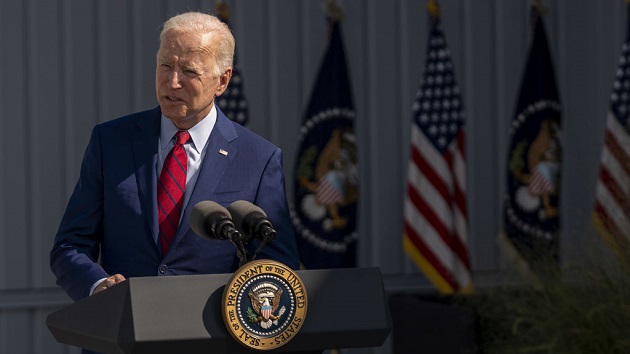
Biden’s new tougher tone on vaccine mandates triggers GOP backlash

Ken Cedeno/UPI/Bloomberg via Getty Images

(NEW YORK) — Taking his toughest tone yet against those Americans still unvaccinated, President Joe Biden has triggered vows of legal challenges from GOP governors representing some of the very states where he’s trying to use mandates to get more people inoculated.

At least 19 Republican governors have lashed back at Biden’s promise to use OSHA to pressure employers with more than 100 employees to mandate COVID-19 vaccines or have workers submit to weekly testing. The Republican governors called the mandate an overreach that will force Americans to choose between their job and the vaccine.

While Biden said on Friday morning, during a visit to local middle school, that all scientists would agree with his new strategy — that using protecting public health as a justification for mandates makes “considerable sense,” his taking a combative tone may come with new political and public health risks and further polarize Americans, fueling the already bitter political divide around the pandemic.

South Dakota GOP Gov. Kristi Noem, a potential 2024 presidential candidate, tweeted to Biden, “see you in court,” while Mississippi GOP Gov. Tate Reeves compared him to a “tyrant,” and South Carolina GOP Gov. Henry McMaster said he’ll “fight them to the gates of hell” to stop the move. House Minority Leader Kevin McCarthy called Biden’s approach “flat-out un-American.”

When ABC News Congressional Correspondent Rachel Scott asked Biden on Friday what his message was to Republicans threatening to challenge his move in court, he responded, “Have at it.”

He continued, “Look, I am so disappointed that particularly some Republican governors have been so cavalier with the health of these kids, so cavalier with the health of their communities. We’re playing for real here — this isn’t a game.”

While Biden has previously said he wouldn’t impose vaccine mandates, he said Friday that vaccine requirements are “nothing new.” However, past vaccines requirements for measles, mumps and rubella, for instance, have historically been implemented at a state and local level — and at times when the country wasn’t already so divided politically

In his address to the nation on Thursday introducing his new six-part approach, a frustrated Biden went after the unvaccinated and elected officials for standing in the way of public health measures and, he said, causing people to die.

“These pandemic politics, as I refer to it, are making people sick, causing unvaccinated people to die. We cannot allow these actions to stand in the way of the large majority of Americans who have done their part and want to get back to life as normal,” Biden said.

“My message to unvaccinated Americans is this: What more is there to wait for? What more do you need to see?” he said. “We’ve been patient, but our patience is wearing thin. And your refusal has cost all of us.”

He called out the governors, many of whom are now criticizing his approach, saying, “if these governors won’t help us beat the pandemic, I’ll use my power as president to get them out of the way.”

He added, “Let me be blunt. My plan also takes on elected officials in states that are undermining you and these life-saving actions. Right now, local school officials are trying to keep children safe in a pandemic while their governor picks a fight with them and even threatens their salaries or their jobs,” he said. He promised his administration would to pay back salaries withheld from those opposing mask bans.

White House press secretary Jen Psaki was asked on Friday what caused Biden and the rest of the administration to change its tune on blaming the unvaccinated for the pandemic — after Psaki said in June that she didn’t want to place blame.

She said Biden on Thursday was “channeling the frustration” of millions who are vaccinated as the pandemic rages, while pointing a finger at Republicans.

“We didn’t anticipate, I will say, that when there was a vaccine approved under a Republican president, that the Republican president took, that there would be such hesitation, opposition vehement opposition in some cases from so many people of his own party in this country,” she said.

While 75% of adults have gotten a shot, per data from the Centers for Disease Control and Prevention, vaccinations have stalled in recent months despite widespread availability as the hospitals across the country face another surge of the virus timed with the start of a new school year.

Biden’s new approach to getting more shots into arms comes as his approval for handling the pandemic has dropped sharply from 62% in June to 52% now.

The latest ABC News/Washington Post poll found also that vaccine hesitancy has subsided in the face of the delta surge, with the share of Americans who are disinclined to get a coronavirus shot now just half what it was last January. Among those unvaccinated adults, about 7 in 10 are skeptical of the vaccines’ safety and effectiveness, 9 in 10 see vaccination as a personal choice rather than a broader responsibility and just 16% have been encouraged by someone close to them to get a shot.

It’s unclear if Biden will break through to that group.

A White House spokesman declined to say whether public polling on why certain people remain unvaccinated informed the decision to institute these new requirements, or otherwise explain how Americans’ attitudes toward COVID-19 vaccines impacted the president’s decision.

The spokesman said the decision to enact the new requirements was “not rooted in any political focus, rather on what’s going to work.”

As some GOP governors say they’re preparing lawsuits, White House COVID-19 Response Coordinator Jeff Zients in defending the mandates on Friday argued that COVID-19 is a “public health issue, not a political issue.”

“We know that vaccination requirements work,” Zients said, pointing to “significant increases in vaccination rates at companies, health care systems, universities, that implement vaccine requirements.”

As Biden did on Thursday, Zients pointed specifically to companies like Fox News — which has provided a platform for vaccine misinformation and has repeatedly railed against Biden’s COVID-19 response — but which is also participating in a version of a vaccination reporting requirement itself.

“The president’s actions will accelerate that number of companies across the board for employers over a hundred, and that includes Fox News, which already has that vaccination requirement in place to keep its own employees safe.”

ABC News’ Ben Gittleson and Sasha Peznik contributed to this report.

Copyright © 2021, ABC Audio. All rights reserved.

‘The Longest Shadow’: 9/11 leads to the militarization of US police departments

Orjan F. Ellingvag/Corbis via Getty Images)

(NEW YORK) — The sky was clear and blue. The gray towers stood, both guarding and welcoming, at the gateway to the nation. Out of nowhere came the impact, the blaze, the smoke — and then the towers were gone. When the dust and flames finally cleared, a new world had emerged.

The death and destruction defined that late summer day and remain seared in the minds of those who lived through Sept. 11, 2001. From the ashes and wreckage rose a new America: a society redefined by its scars and marked by a new wartime reality — a shadow darkened even more in recent days by the resurgence of fundamentalist Islamist rule in the far-off land that hatched the attacks.

Twenty years later — with more than 70 million Americans born since the crucible of the attacks — the legacy of 9/11 remains. From airport security to civilian policing to the most casual parts of daily life, it would be nearly impossible to identify something that remains untouched and unaffected by those terrifying hours in 2001.

This week, ABC News revisits the 9/11 attacks and unwinds their aftermath, taking a deep look at the America born in the wake of destruction. “9/11 Twenty Years Later: The Longest Shadow” is a five-part documentary series narrated by George Stephanopoulos. Episodes will air on ABC News Live each night leading up to the 20th anniversary of the attacks, from Sept. 6-10. The series will be rebroadcast in full following the commemoration ceremonies on Saturday, Sept. 11.

Part 5: A shadow so long, it covers all

The blue light may have been the strangest part.

On the streets of Baltimore, where crime proliferates in the poorest neighborhoods and economic desperation can run thick, the blue cast made it feel like one of those science-fiction movies set in a dark future of robots in control.

“I found it extremely oppressive and dystopian,” said Joanne Cavanaugh Simpson, a contributor to Baltimore magazine and a Pulitzer Center grantee.

The blue lights are meant to be seen. They are security cameras, and police want them to both solve crimes and deter them. In the city famed as the birthplace of America’s national anthem, the lights announce that the people are being watched.

Critics say these neighborhoods coated in blue also represent something else: the failures of an overzealous surveillance state, militarized and armed to the hilt in the years since terrorists attacked the nation on Sept. 11, 2001.

Despite the city’s high-tech efforts to curb crime, Baltimore still suffers from some of the highest homicide rates in the country. The city’s public image — shaped for many by the HBO crime drama “The Wire” — remains tethered to the fraught relationship between the police and the community.

For Baltimore and other major metropolitan areas, ubiquitous surveillance and a tragic cycle of police-involved killings continue to animate the debate over U.S. law enforcement. Many of the most controversial policing practices date to 9/11, when local governments were flooded with a surge of money, technology and new crime-fighting strategies — on top of a new mindset that assigned local cops to the front lines of the Global War on Terror. It was a time when many police departments re-fashioned themselves as paramilitary organizations, as their core mission was recalibrated from performing the traditional role of “protect and serve” to preventing the feared “second wave” of attacks for a terrorized and traumatized nation.

Police departments across the country, eager to avoid the failures that led to 9/11, scrambled to equip officers with the latest in military equipment and technology — much of it made available by a federal government that would spend almost 20 years at war in Afghanistan and Iraq. And the police forces — always eager to hire military veterans — were being staffed by people trained to police populations under occupation, not communities on the home front who get to decide how they want to be governed. Critics charged that racial profiling proliferated in cities like Baltimore, where the blinking blue lights became a symbol of life under a surveillance state.

“Over-policing, the racial tension — it just exponentially grew for local policing,” said Chris Burbank, a former police chief in Salt Lake City, who’s now a vice president at the Center for Policing Equity.

From aerial surveillance in Baltimore to national terrorist watch lists, local police departments experimented with novel approaches to securing their streets in the years following 9/11. A scarred nation largely acquiesced.

Over time, critics of these methods say that the trauma suffered by heavily policed communities — and the toll on residents’ civil liberties — have done more harm than good. As protests erupted across the country in the wake of George Floyd’s death in 2020, the gap between police departments and the citizens they are sworn to protect had never seemed wider.

“This separation between policing and community, I think you have to view 9/11 as gasoline that was poured on that fire,” said Lawrence Grandpre, a Baltimore-based community activist and author.

In the immediate aftermath of 9/11, a wariness of Muslims swept the country. Hate crimes against Muslims skyrocketed. Mosques became inundated with threats.

“Anything that showed that you were an Arab or a Muslim caused everyone to be suspicious of you,” said Sahar Aziz, director of the Center for Security, Race and Rights at Rutgers University Law School.

In response to the terror attacks, police departments in some major cities compiled vast databases of alleged potential terrorists and undertook ambitious surveillance missions targeting Muslim communities.

“You had massive surveillance programs by the NYPD, and the LAPD, and the FBI,” said Aziz. “Muslim student organizations at universities, Muslim-owned businesses, mosques, anywhere where Muslims congregated was systematically surveilled … we were sitting ducks.”

At the time of the attacks, the conversation around law enforcement was trending toward stricter guidelines for equitable policing — including halting some of the most invasive tactics like stop-and-frisk. Years of advocacy and lobbying in Washington culminated in the End Racial Profiling Act — a bill incoming President George W. Bush supported on the campaign trail in 2000.

“And then 2001, 9/11 happened, and it was completely off the table,” Aziz said. “It was a nonstarter.”

Before the 2001 terror attacks, John Farmer was the New Jersey attorney general who led the push to reform a state police culture that had itself acknowledged racial profiling and had vowed to eliminate it. After the attacks, as Farmer served as senior counsel to the 9/11 Commission, he said he had to watch as 9/11 “had the effect of deferring the debate on racial profiling.”

“Suddenly,” Farmer said, “no one wanted to talk about it anymore.”

Over the next decade, as American military forces engaged terrorists abroad, veterans of war returned home to continue their service as police officers. Together, with the influx of weapons of war, police throughout the U.S. began to look more and more like they were deployed on a forward operating military base.

“Police departments all over the country have acquired a pretty significant amount of military-grade weapons and equipment since 9/11,” said Loren Crowe, an Army officer who served two deployments overseas. “My local police department would be well-equipped to go fight in the mountains in Afghanistan.”

It all amounted to a post-9/11 “over-policing” that has had debilitating effects on police-community relations, according to many who have spent their careers in law enforcement.

“At that time there was so much fear in communities because of 9/11,” said Baltimore Police Commissioner Michael Harrison, who experienced the changes as he worked his way up through the ranks in the New Orleans Police Department. “And it became a concept of more police — and do more with more police.”

In Baltimore, where the death of Freddie Gray in 2016 ignited nationwide protests and added new urgency to the debate over post-9/11 policing, the local police department led the charge in advancing novel and controversial police tactics.

Blue-light cameras flooded crime-prone streets. Facial recognition software and phone data collection were employed to fight crime.

Perhaps the most jarring to residents were the so-called “spy planes” deployed to surveil large swaths of the city. Launched in 2016, the nation’s first-ever aerial surveillance experiment was meant to be secret. The manned airplanes’ immense capabilities allowed them to record the outdoor movements of an entire city. An independent audit later found that nearly all of the spy planes’ flights tracked over majority Black communities.

The police department has since suspended the program, and Harrison, the new commissioner, is focused on mending the strained relationship between the police and the community.

“Let’s try to tamper down the militaristic look and mindset, and move away from the warrior model into the guardian model, where we’re guardians of our community, not necessarily warriors of the community,” says Harrison.

Still, wounds run deep.

“Baltimore is one of the cities that is a pioneer in surveilling its own citizens,” said Simpson, who has reported on the city’s surveillance programs for Baltimore magazine. “There’s a lot of desperation to get a handle on the crime … so Baltimore has become a destination for police surveillance technology companies, to try out their wares.”

Grandpre, the community organizer, said this experimentation with electronic surveillance “just exacerbates the notion of a divide between the police force and the community.”

“After 9/11 and with Baltimore’s high crime rate, there’s a notion that anything is acceptable,” Grandpre said.

Now, two decades on, Americans are finally returning to pre-9/11 conversations about policing and what it really means for a nation to govern itself.

“Absolutely there’s bias. Absolutely there’s racism. And we can start to talk about some of these things,” said Burbank.

Supporters of these police programs stress the need to try something new and different. “What we’ve been doing has not been working,” said Joyous Jones, a retired nurse and proponent of police surveillance in Baltimore, who decided to start working for the surveillance company running the planes after the program became public.

“The [American Civil Liberties Union] and all those people that really complain about their civil liberties — I don’t have that because when I walk outside, I have to look and dodge bullets,” Jones said.

Jones is not alone in her support for the programs. “There was public support for it,” Commissioner Harrison said. “There were community surveys that were in high percentage in favor of it … and we looked at all of that.”

But after a year of high-profile police-involved killings and a spike in violent crime in many cities, reformers continue to ask: Are these police practices even working?

“People talk about the dichotomy: Do we want security, or do we want liberty? But some of the experts I spoke with say that’s sort of a false dichotomy,” Simpson said. “Are you getting more security with this technology? Is the crime rate in Baltimore getting better? No.”

“All these technologies have been added, a lot of them since 9/11,” Simpson said. “And what are you losing by deploying all this?”

ABC News’ Sarah Kate Caliguire, Alexandra Myers, Abigail Roberts and Tom Sampson contributed to this report.

Copyright © 2021, ABC Audio. All rights reserved.

Ticket agent who helped Sept. 11 hijackers make flight finds forgiveness

Courtesy Vaughn Allex

(WASHINGTON) — Vaughn Allex will never forget the faces of two of the 9/11 hijackers. He looked them in the eye that morning and asked who packed their luggage.

Allex was an American Airlines ticket agent at Dulles International Airport on Sept. 11, 2001 when two men ran into the terminal — appearing lost — and approached his counter.

Brothers Salem and Nawaf Al-Hazmi arrived late that day, but with two full-fare, first-class passengers standing in front of him, instead of rebooking them, Allex ensured they made flight 77.

Allex has lived with that decision for the last 20 years.

“The check-in was odd. The two that I checked in, two brothers, one was kind of gruff and the other one was standing a couple of paces behind him. And this sounds odd, but this is what caught my attention. He was almost dancing, he was moving from foot to foot and grinning and looking around, and my thought was, here’s somebody that’s never been on an airplane and boy is this guy excited,” Allex recently recalled in an interview at Dulles airport in Virginia.

“And I kind of watched him for a couple of minutes as we went through the whole check. And he was totally unresponsive as far as whatever we asked him to read, to look verbally. He just smiled and danced and was oblivious to what was going on,” he continued. “That’s the image I have, is the two of them standing there and the one just dancing, it was the oddest thing.”

When the pair couldn’t answer basic security check-in questions, Allex marked their tickets for additional security.

There’s more Allex has had to live with — 24 hours before Allex checked-in the brothers, his longtime co-worker and close friend MJ Booth asked for advice on a trip to Las Vegas. She considered flying to Chicago or Dallas to connect to Las Vegas, but Allex encouraged her to take flight 77 instead and connect through Los Angeles.

“I said, first of all, it’s a better flight. It’s a transcontinental flight. You get a meal and a movie and it’s relaxing.” Allex recalls. “She said that sounded good, but that she’d never written a ticket that way and we were just transitioning to electronic tickets. Could I help her? So I wrote her ticket from Dulles to Los Angeles with a connecting flight back to Las Vegas. And then the following day, I saw that she had gotten on the flight on the ticket I’d written.”

Allex left Dulles on Sept. 11 grieving, but had no idea it was about to get so much worse.

“I didn’t know on September 11th, on that night and the morning of September 12th, I was dealing like everybody else was with what happened with losing friends, losing passengers, losing the crew. I knew all of the crew on the flight deck and I knew all of the cabin crew, I’d worked with them for years. What I didn’t know until about mid-morning (Sept. 12) when the FBI was talking to me was that those last two passengers that I checked in were actually two of the hijackers. I had no idea until that moment that I had been involved in it,” Allex said.

On Sept. 12, Allex was summoned to his boss’ office. There, a woman introduced herself as an attorney for American Airlines, adding “I am not your attorney.”

Allex recalls the chill that went through his body. That’s when he says two FBI agents walked in, handing him a passenger manifest.

“I started to run my hand down the list and I saw the names of the two people I checked-in, and in that moment and that instant, that’s when I looked at him and I said, ‘I did it, didn’t I?’ And they said, ‘what did you do?’ And I go, ‘these were the two that I put in,'” Allex said. “I think they, they knew exactly who they were looking for, but they wanted me to come to that conclusion. And once we did, the interview strictly focused on these two individuals. And the rest is history, that the whole transaction came back, I didn’t know all of September 11th until that moment on September 12th — I did not realize that I had checked-in two of the hijackers.”

Guilt tortured Allex for years to come. Twenty years later, there are still some things he’d rather not discuss.

“I blame myself, I thought, you know, if I had done something different, if I’d not let them on, if I just said to the agents, these two guys are late, let them get the next flight. We have one at noon. It’s no big deal,” Allex said.

Over the years, friends and professionals told Allex that he was just doing his job.

“That’s what they tell me, that’s what they tell me, but, what you do, what your — your own mind does is, is crazy sometimes,” Allex said.

His mind continued to play games with him for years. It wouldn’t be until 2004, with the purchase of a book that everything turned around.

“The turning point for me, I had been interviewed by the 9/11 Commission. And it wasn’t until the 9/11 Commission report came out and I bought the book and here is this book with hundreds and hundreds and hundreds of pages, and I’m on page three. I have a little paragraph and a footnote, footnote number 12.”

Allex explained that single footnote — his name next to so many others — is what finally set him free of guilt and the feeling of responsibility years after the attacks.

“That’s when it started to get better. That’s when I went — oh my gosh. There were so many other people involved, there were so many innocent people that just touched on this. And I had just such a small, tiny five-minute part of it. But before that, it was — it was terrible.”

Allex retired from American Airlines in 2008. He now works for TSA.

“I joined the Department of Homeland Security working for the Transportation Security Administration and ever since I’ve been with them, it’s been great. I feel like the work that they do is so important to keep everybody safe. And the fact that I have just such a small little part there, I’m like the happiest person at TSA. And I’ll tell anybody that,” Allex said with a smile.

On Aug. 23, Allex walked with ABC News through the doors he saw the two hijackers run through that fateful morning. As he stood there, recalling the memory of the men responsible for starting the war in Afghanistan, Afghan refugees had just arrived from evacuation flights. They filed past the American Airlines ticket counter and through the very doors that the hijackers walked in 20 years earlier — grateful to start a new life in America.

Copyright © 2021, ABC Audio. All rights reserved.
Appeals court reinstates Gov. Ron DeSantis’ ban on school mask mandates

Marilyn Nieves/iStock

(TALLAHASSEE, Fla.) — In a victory for Florida Gov. Ron DeSantis, an appeals court ruled Friday to keep the state’s ban on student mask mandates in place, at least until it issues a final ruling on the legality of the ban.

The ban on mask requirements — issued by the Florida Department of Health in August after DeSantis directed it to “protect parents’ freedom to choose whether their children wear masks” — had been suspended Wednesday by a judge in Tallahassee. Judge John C. Cooper had ruled that the state could not keep punishing school districts that require masks while the appeals court works toward a final ruling.

Friday’s order overrides Cooper, giving the Florida Board of Education the green light to continue withholding the salaries of school board members in districts that require face coverings for students. The state has imposed that punishment on two districts and has announced investigations into several others.

“Just like last year in the school re-opening litigation, the First District Court of Appeal has reinstated Florida’s ability to protect the freedom for parents to make the best decisions for their children while they make their own ruling on the appeal,” Taryn Fenske, communications director for DeSantis, said in a statement to ABC News. “We look forward to winning the appeal and will continue to fight for parents’ rights.”

DeSantis tweeted, “No surprise here – the 1st DCA has restored the right of parents to make the best decisions for their children. I will continue to fight for parents’ rights.”

Alachua County, one of the districts where school board members’ salaries are being withheld for imposing a mandate, said in a statement that despite Friday’s ruling it will “continue to enforce universal masking in our schools.”

“The decision is disappointing, but we understood from the beginning that the legal battle over masks in schools would take time and not every decision would be favorable,” Alachua County Public Schools Superintendent Carlee Simon said in a statement.

“While Alachua County Public Schools is not part of this particular lawsuit, we certainly support it,” Simon continued. “We are pleased that the plaintiffs plan to continue their fight. In the meantime, our legal challenges are just beginning, and we support the other Florida districts and families who are also taking the state to court over this issue.”

At least 13 school districts, including Florida’s six largest, have implemented mask mandates.

“Upon our review of the trial court’s final judgment and the operative pleadings, we have serious doubts about standing, jurisdiction, and other threshold matters,” Friday’s order states. “These doubts significantly militate against the likelihood of the appellees’ ultimate success in this appeal.”

A lawyer representing the parents who sued the state said Friday’s decision would make students less safe.

“We are disappointed by the ruling of the 1st DCA that reinstates the stay and will be seeking pass through jurisdiction of the Supreme Court of Florida since this matter involves statewide issues. With a stay in place, students, parents and teachers are back in harm’s way,” Charles Gallagher, one of the lawyers representing the group of parents who sued the state over its ban on mask mandates, wrote on Twitter.

Copyright © 2021, ABC Audio. All rights reserved.

COVID-19 live updates: Unvaccinated are 11 times more likely to die: CDC director

Halfpoint/iStock

(NEW YORK) — The United States is facing a COVID-19 surge this summer as the more contagious delta variant spreads.

More than 654,000 Americans have died from COVID-19 while over 4.6 million people have died from the disease worldwide, according to real-time data compiled by the Center for Systems Science and Engineering at Johns Hopkins University.

Just 62.5% of Americans ages 12 and up are fully vaccinated against COVID-19, according to data from the U.S. Centers for Disease Control and Prevention.

Here’s how the news is developing. All times Eastern:

Sep 10, 1:48 pm
Florida governor’s school mask mandate ban is reinstated 

Florida Gov. Ron DeSantis’ school mask mandate ban was reinstated by an appeals court Friday.

This overrules a Tallahassee judge’s decision on Wednesday to lift the stay, preventing the state from enforcing the ban. (The appeals court still needs to rule on the legality of the order, but the reinstatement of the stay means that until then, the state can continue sanctioning school districts.)

DeSantis has struggled to rein in the state’s largest school systems as they implement mask mandates in defiance of state law. At least 13 districts, including Florida’s six largest, have mask requirements in place. The Florida Department of Education has threatened to withhold the salaries of school board members in most of these districts and has begun doing so in at least two cases.

-ABC News’ Will McDuffie

Sep 10, 1:00 pm
CDC studies: Vaccines still dramatically reduce risk of hospitalization, death amid delta 

The unvaccinated “are 10 times more likely to be hospitalized and 11 times more likely to die,” CDC director Rochelle Walensky said at Friday’s White House COVID briefing.

Three new studies from the CDC show vaccines still dramatically reduce the risk of hospitalization and death amid the delta surge. 

A study of U.S. veterans fully vaccinated with Pfizer and Moderna found no real change in vaccine effectiveness against hospitalization pre-delta to post-delta. A second study of all three vaccines across nine states found vaccine effectiveness against hospitalization was 86% for all age groups. A third study of all three vaccines across 13 jurisdictions found vaccines performed roughly equally well protecting against hospitalization and death during the delta surge compared to pre-delta.

Across the studies, vaccines remained 86-87% effective against preventing hospitalizations.

But effectiveness dropped more for people ages 65 and older in recent months compared to before delta, likely due a combination of vaccine effectiveness fading over time and the slight impact of the delta variant on vaccine efficacy.

Vaccines are losing some of their effectiveness when it comes to preventing mild infections among the vaccinated.

-ABC News’ Sony Salzman

Sep 10, 11:28 am
Kentucky deploys more National Guard members to help strained hospitals

In hard-hit Kentucky, over 300 more National Guard members will be sent to help at 21 strained hospitals, Gov. Andy Beshear said.

Kentucky’s positivity rate was above 14% Thursday as the state set new records for hospitalizations and patients on ventilators, the governor said.

-ABC News’ Will Gretsky

Sep 10, 9:54 am
FDA says it won’t cut corners for vaccine for young kids

While awaiting Pfizer trial data for kids ages 5 to 11, the Food and Drug Administration is vowing not to cut corners.

The FDA said, “it’s critical that thorough and robust clinical trials of adequate size are completed to evaluate the safety and the immune response.”

“Children are not small adults — and issues that may be addressed in pediatric vaccine trials can include whether there is a need for different doses or different strength formulations of vaccines already used for adults,” the FDA said.

When the FDA receives a completed emergency use authorization request, “the agency will carefully, thoroughly and independently examine the data to evaluate benefits and risks and be prepared to complete its review as quickly as possible, likely in a matter of weeks rather than months.”

“However, the agency’s ability to review these submissions rapidly will depend in part on the quality and timeliness of the submissions by manufacturers,” the FDA added.

Sep 10, 5:43 am
Milwaukee Public Schools to require COVID-19 vaccination for staff

All employees of Milwaukee Public Schools must provide proof of COVID-19 vaccination by Nov. 1, unless they qualify for a medical or religious exemption, school board members voted unanimously on Thursday night.

The board also decided that staff who qualify for an exemption must take COVID-19 tests twice weekly. Anyone who does not comply with the new vaccine mandate or is not exempt would be placed on unpaid leave and ultimately could lose their job.

Students are not required to get vaccinated, but the board approved monetary incentives of $100 for those who are 12 and older and can provide proof of vaccination by the Nov. 1 deadline.

Sep 09, 7:33 pm
LA school district to mandate vaccine for students

The Los Angeles Unified School District’s Board of Education unanimously voted Thursday to require the COVID-19 vaccine for all eligible students.

All students ages 12 and up will be required to be fully vaccinated by Jan. 10, 2022, unless they have a “medical or other exemption,” said the district, which is the second-largest in the nation with over 600,000 students.

All teachers and staff are already required to be vaccinated by Oct. 15.

“Today’s decision furthers our longstanding commitment to ensure the safety of our students, families, and staff,” Board President Kelly Gonez said in a statement. “The vaccine is the single best way to protect students and schools from COVID-19.”

Copyright © 2021, ABC Audio. All rights reserved.

Woman gives birth to twin sister’s baby she carried after sister battled cancer

ABCNews.com

(NASHVILLE, Tenn.) — When Cathey Stoner gave birth to a baby boy last month, it was a miracle years in the making.

Stoner delivered the child after serving as a surrogate for her twin sister, Sarah Sharp, who could not carry a pregnancy after being diagnosed with choriocarcinoma, a rare and fast-growing cancer that occurs in a woman’s uterus.

The newborn baby, named John Ryder Sharp and born on Aug. 18, is the biological child of Sharp and her husband, Richard.

“Her offering that to me was the biggest act of love that anyone’s ever extended to me or my family,” Sharp, 33, said of her sister carrying her child. “Surrogacy is a beautiful gift that you can give somebody and I will forever be grateful.”

Sharp, who, like her sister, lives in the Nashville area, was diagnosed with choriocarcinoma in 2018, about one year after she gave birth to her now 4-year-old daughter Charlotte.

She underwent seven rounds of chemotherapy in an attempt to beat the cancer while also saving her uterus. She was declared cancer free in December 2018, but by her first checkup, in January, the cancer had returned.

She began a new course of chemotherapy and also underwent a hysterectomy, which successfully removed the cancer but left her without the hope of giving birth to another child.

Just before Sharp underwent the hysterectomy, Stoner told her sister for the second time in her cancer battle that she would carry any future children for her.

“We kind of laughed a little bit again but for me, in the back of my mind, it was something to hold onto,” Sharp told “Good Morning America” in June. “It was something to help me move myself forward mentally. It was hope and grace and the future all in one.”

Once Sharp finished her cancer treatments, she prepared to become a mom again, and turned to her sister for help.

Stoner, mom to a 4-year-old son and a 6-year-old daughter, said she had no hesitation about helping her sister expand her family in any way she could.

“We decided to knock on the doors and see if they opened,” Stoner told “GMA” in June. “There was a lot of waiting, but it went really smooth.”

By the end of 2020, the two sisters, whose story is featured in the new issue of People magazine, were celebrating the news that Stoner was pregnant.

“From the beginning I’ve felt differently in this pregnancy because I know it’s my nephew and not my son, and I have loved every step of the way,” said Stoner, who was the baby’s gestational carrier. “I tell people, ‘I’m just carrying my nephew.'”

“To be able to go to the doctor for such a happy reason is really healing for all of us,” she added, noting that her sister was with her at every doctor’s appointment during the pregnancy.

When Stoner gave birth to her nephew, John Ryder, on Aug. 18, she was supported in the delivery room by Sharp and their two husbands.

“We feel so unbelievably honored to be his parents and raise him,” said Sharp. “A lot of love brought him here.”

Copyright © 2021, ABC Audio. All rights reserved.

Afghanistan updates: 2nd passenger flight from Kabul lands in Doha

christophe_cerisier/iStock

(NEW YORK) — With the U.S. military and diplomatic withdrawal now complete after 20 years in Afghanistan, the Taliban has taken over the country, including the Kabul airport, the site of an often-desperate evacuation effort in past weeks.

But even as the last American troops were flown out to meet President Joe Biden’s Aug. 31 deadline, other Americans who wanted to flee the country were left behind. The Biden administration is now focused on a “diplomatic mission” to help them leave but some hoping to evacuate are still stuck in the country. Meanwhile, the Taliban has announced its new “caretaker” government which includes men with U.S. bounties on their heads — and no women.

Here are the latest developments. All times Eastern:

Sep 10, 12:46 pm
2nd Qatari flight lands in Doha with foreigners on board

A second Qatar Airways flight from Kabul landed in Doha at 7:29 p.m. local time, according to flight data, with an unknown number of foreign nationals on board.

The flight number for the Boeing 777 — QR7277 — was the same as Thursday’s, the first flight out of Kabul since all U.S. personnel withdrew.

Sep 10, 12:23 pm
Kinzinger blasts US evacuation mission as ‘strategic failure’

Rep. Adam Kinzinger, R-Ill., criticized the Biden administration’s handling of evacuations from Kabul as a “strategic failure” on ABC’s “The View” on Friday and expressed deep concern for what will happen in the coming weeks as the Taliban exercises complete control of the country.

“Afghanistan has a constitution. That constitution and that government was overthrown by force by a military coup of the Taliban. I don’t think at any other time we’d look at a military coup by an enemy, in a country of an ally and say, we’re looking forward to finding opportunities to work with them,” Kinzinger said, as the U.S. cooperates with the Taliban to get some 100 remaining Americans out.

“There will be a moment, I fear, when the cell towers come down or the information is locked down, and we see the acceleration of the brutalization of women, of gays, of people that are different than what the Taliban wants them to be,” he added.

Kinzinger argued there is “so much hypocrisy” in the debate on whom to blame for the war ending as it began, under Taliban rule, including on all four presidents preceding Biden, but said the execution of the withdrawal is “what’s broken so many hearts.”

-ABC News’ Joanne Rosa contributed to this report

Sep 10, 11:33 am
2nd passenger plane takes off from Kabul

A second Qatar Airways flight has taken off from the airport in Kabul with an unknown number of Americans on board, a day after the more than 100 foreign nationals left Afghanistan on the first flight out since the U.S. military’s withdrawal.

State Department spokesperson Ned Price confirmed that 39 Americans had been invited on Thursday’s chartered Qatar Airways flight from Kabul and from that group, 10 U.S. citizens and 11 lawful permanent residents, or green card holders, flew out.

Another 43 Canadian citizens, 13 British citizens and others were also aboard.

The Biden administration offered some praise for the Taliban on Thursday for their cooperation as officials try to fly out some 100 Americans without U.S. troops or a State Department presence on the ground.

Sep 10, 8:00 am
US has ‘many means’ to get intelligence in Afghanistan, Mayorkas says

The United States has “many means” of gathering intelligence in Afghanistan despite not having boots on the ground, Homeland Security Secretary Alejandro Mayorkas said Friday.

“We no longer have troops in Afghanistan, but we have other resources to learn information on the ground and we certainly use those resources to the best of our abilities,” Mayorkas told ABC News’ George Stephanopoulos in an interview on “Good Morning America.”

“We are quite creative and quite capable of learning information from coast-to-coast and all over the world,” he added.

Mayorkas noted that the U.S. government is watching the potentially re-emerging terrorist threat in Taliban-controlled Afghanistan “very closely.”

“We watch the threat landscape all over the world,” he added. “We have built an entire architect to protect, to safeguard the American people.”

But the greatest threat to the U.S. homeland is currently domestic terrorism, according to Mayorkas.

“Individuals who are prone to violence by reason of an ideology of hate or false narratives that we see on social media or other online platforms,” he said. “I think it’s a sad thing to see hate emerge, as we have observed it emerge over the last several years.”

With the 20th anniversary of the Sept. 11, 2001 terrorist attacks approaching, Mayorkas said the government is not aware of any “specific credible threats targeting the United States” on the somber date.

“But we are vigilant,” he added. “We watch the information, we learn information; but at this point in time, we don’t know of any threat on the anniversary.”

Sep 09, 3:57 pm
More than 30 Americans invited as passengers on flight from Kabul, some declined

More than 30 U.S. citizens and lawful permanent residents were invited by the U.S. to be passengers on the first chartered flight out of Kabul since the American evacuation mission ended, but not all said yes. Some said no because of medical reasons, extended family members or their desire for more time, among other reasons, according to State Department spokesperson Ned Price.

Price said he could not give an exact number of those who did make Thursday’s flight to Qatar.

Echoing an earlier statement from the National Security Council, Price said he welcomed the Qatari Airways departure from Kabul. He said he hopes and expects more flights will be allowed to continue in the days to come.

Sep 09, 2:16 pm
White House confirms flight with Americans landed in Qatar, calls Taliban cooperation ‘professional’

National Security Council spokesperson Emily Horne has confirmed that U.S. citizens and permanent residents were among the passengers on the first charter flight to leave the airport in Kabul since Qatar took over operations at the airport and that they have safely landed in Qatar.

The statement offered no passenger numbers, so it’s unclear how many U.S. citizens were on board, but it did provide some praise for the Taliban’s cooperation.

“The Taliban have been cooperative in facilitating the departure of American citizens and lawful permanent residents on charter flights from HKIA. They have shown flexibility, and they have been businesslike and professional in our dealings with them in this effort. This is a positive first step,” the statement said.

Copyright © 2021, ABC Audio. All rights reserved.

Biden to GOP governors threatening to sue over vaccine mandates: ‘Have at it’

Ken Cedeno/UPI/Bloomberg via Getty Images

(WASHINGTON) — President Joe Biden and first lady Jill Biden visited a local middle school in Washington on Friday to talk about keeping students safe in classrooms as the raging delta variant has upended the start of the school year — and one day after Biden took his toughest tone yet and announced sweeping new federal requirements for vaccines and testing.

But Biden also offered another lesson to the next generation when asked by ABC News Congressional Correspondent Rachel Scott about Republican governors calling his call for vaccination mandates an “overreach” and threatening to sue the federal government over his new plan.

“Have at it,” Biden said.

“I am so disappointed that particularly some Republican governors have been so cavalier with the health of these kids, so cavalier with the health of their communities,” he said following brief remarks on keeping schools safe.

“One of the lessons I hope our students could unlearn is that politics doesn’t have to be this way,” he said. “They’re growing up in an environment where they see it’s like, like a war, like a bitter feud…It’s not who we are as a nation. And it’s not how we beat every other crisis in our history.”

Reintroducing his six-part strategy to combat the pandemic, Biden focused his remarks at Brookland Middle School on how his approach will help keep schools safe, including requiring that 300,000 educators in federal Head Start programs be vaccinated and using the Defense Production Act to produce nearly 300 million rapid COVID-19 tests for distribution at the schools around the country.

He also called for more governors and school districts to implement vaccine requirements.

“We all know if schools follow the science — like they are here — and implement safety measures like vaccinations testing, masking, then children can be safe in schools safe from COVID-19,” he said.

Biden acknowledged the Food and Drug Administration has not yet approved vaccines for children under 12, leaving a large swath of the population without the choice to be vaccinated. He said while the FDA is working on the science “as safely and as quickly as possible,” the onus is on children aged 12 to 17, and adults, to get the shot to keep schools open.

“The safest thing you can do for your child 12 and over is get them vaccinated,” Biden said, speaking directly to parents.

He reminded that vaccine requirements in schools are “nothing new.”

“You got them vaccinated for all kinds of other things — measles, mumps, rubella — for them to go to school, to be able to play sports, they’ve had to have those vaccinations,” he added. “It is safe, and it’s convenient, and we’ll work to bring the vaccine clinics to our schools as well.”

Praising local vaccine incentives already in play, Biden, seemingly going off script, also offered the students at Brooklyn Middle School a visit to the White House once they’re all vaccinated.

“I’m going to get in trouble with the Secret Service and everybody else. I’m not sure how we’re going to mechanically do it, but I assume the buses can get you to the White House and if we can’t get you all in one room. We’ll be out in the Rose Garden or out in the back there and maybe let you fly the helicopter,” Biden said to laughter. “I’m only joking about that.”

The first lady, who returned to teaching this week and has been an advocate for keeping kids in the classroom, speaking ahead of her husband said it was the responsibility of educators and families to make schools safe for kids.

“We owe them a promise to keep their schools open as safe as possible. We owe them a commitment to follow the science. We owe them unity, so that we can fight the virus, not each other as we move forward,” she said.

In his address to the nation on Thursday, Biden also promised to make up the salary of any teacher or administrator whose pay was withheld for opposing state bans on masks.

Ahead of their remarks, the Bidens visited the classroom 6th-grade science teacher Ms. Michelle Taylor and talked with students, all of whom were masked up.

The visit comes after a record-high 2,396 children were hospitalized with COVID-19 as of Tuesday. In the last week alone, nearly 252,000 children in the U.S. have tested positive for COVID-19, marking the largest increase of pediatric cases in a week since the pandemic began, according to a newly released weekly report from the American Academy of Pediatrics and the Children’s Hospital Association.

ABC News’ Arielle Mitropoulos contributed to this report.

Copyright © 2021, ABC Audio. All rights reserved.

Milwaukee Public Schools offers $100 to students who get vaccinated

Emily Elconin/Bloomberg via Getty Images

(MILWAUKEE) — Milwaukee Public Schools, the largest school district in Wisconsin, will give $100 to students who get the COVID-19 vaccine.

The district’s school board voted unanimously Thursday night to mandate vaccinations for staff by Nov. 1, with exceptions for religious or medical reasons.

The board considered a vaccine mandate for students but ended up unanimously approving a $100 incentive for MPS students 12 and older who provide proof of vaccination by Nov. 1., including those who already got their shots.

The district has about 31,205 students who are eligible for the vaccine, meaning the district could shell out as much as $3.12 million, administrators said during the meeting, the Milwaukee Sentinel Journal reported. Money from the district’s $500 million federal stimulus installment will be used to fund the effort.

The school already has other COVID-19 safety measures in place, such as required face masks, HEPA filtration units and physical distancing.

“The COVID-19 vaccine is one of the most effective strategies to mitigate the spread of the virus,” Superintendent Dr. Keith P. Posley said in a statement. “We owe it to our students, teachers, staff, and community to take all possible steps to ensure safe schools.”
 
The district’s COVID-19 dashboard reports a total of 525 cases among students and staff since July 1, with 115 students testing positive the week of Aug. 30 to Sept. 3.

Over the last 14 days, there have been 448 cases among children under the age of 12 and 406 cases among 12 to 17-year-olds in Milwaukee, according to the city’s dashboard.

Nationwide, pediatric hospitalizations are a rising concern. Pediatric hospital admissions are at one of their highest points of the pandemic, with more than 2,355 children receiving care across the country for confirmed or suspected COVID-19 infections.

Debates over vaccine mandates continue to unfold in school districts across the nation.

On Thursday, the Los Angeles Unified School District became the first large scale system to require eligible students to get the vaccine. All students ages 12 and up will be required to be fully vaccinated by Jan. 10, 2022, unless they have a “medical or other exemption,” the school district said.

President Joe Biden also announced that private businesses with 100 or more employees must require their employees to be vaccinated or undergo weekly testing.

Copyright © 2021, ABC Audio. All rights reserved.

Afghanistan updates: 2nd passenger flight takes off from Kabul

christophe_cerisier/iStock

(NEW YORK) — With the U.S. military and diplomatic withdrawal now complete after 20 years in Afghanistan, the Taliban has taken over the country, including the Kabul airport, the site of an often-desperate evacuation effort in past weeks.

But even as the last American troops were flown out to meet President Joe Biden’s Aug. 31 deadline, other Americans who wanted to flee the country were left behind. The Biden administration is now focused on a “diplomatic mission” to help them leave but some hoping to evacuate are still stuck in the country. Meanwhile, the Taliban has announced its new “caretaker” government which includes men with U.S. bounties on their heads — and no women.

Here are the latest developments. All times Eastern:

Sep 10, 11:33 am
2nd passenger plane takes off from Kabul

A second Qatar Airways flight has taken off from the airport in Kabul with an unknown number of Americans on board, a day after the more than 100 foreign nationals left Afghanistan on the first flight out since the U.S. military’s withdrawal.

State Department spokesperson Ned Price confirmed that 39 Americans had been invited on Thursday’s chartered Qatar Airways flight from Kabul and from that group, 10 U.S. citizens and 11 lawful permanent residents, or green card holders, flew out.

Another 43 Canadian citizens, 13 British citizens and others were also aboard.

The Biden administration offered some praise for the Taliban on Thursday for their cooperation as officials try to fly out some 100 Americans without U.S. troops or a State Department presence on the ground.

Sep 10, 8:00 am
US has ‘many means’ to get intelligence in Afghanistan, Mayorkas says

The United States has “many means” of gathering intelligence in Afghanistan despite not having boots on the ground, Homeland Security Secretary Alejandro Mayorkas said Friday.

“We no longer have troops in Afghanistan, but we have other resources to learn information on the ground and we certainly use those resources to the best of our abilities,” Mayorkas told ABC News’ George Stephanopoulos in an interview on “Good Morning America.”

“We are quite creative and quite capable of learning information from coast-to-coast and all over the world,” he added.

Mayorkas noted that the U.S. government is watching the potentially re-emerging terrorist threat in Taliban-controlled Afghanistan “very closely.”

“We watch the threat landscape all over the world,” he added. “We have built an entire architect to protect, to safeguard the American people.”

But the greatest threat to the U.S. homeland is currently domestic terrorism, according to Mayorkas.

“Individuals who are prone to violence by reason of an ideology of hate or false narratives that we see on social media or other online platforms,” he said. “I think it’s a sad thing to see hate emerge, as we have observed it emerge over the last several years.”

With the 20th anniversary of the Sept. 11, 2001 terrorist attacks approaching, Mayorkas said the government is not aware of any “specific credible threats targeting the United States” on the somber date.

“But we are vigilant,” he added. “We watch the information, we learn information; but at this point in time, we don’t know of any threat on the anniversary.”

Sep 09, 3:57 pm
More than 30 Americans invited as passengers on flight from Kabul, some declined

More than 30 U.S. citizens and lawful permanent residents were invited by the U.S. to be passengers on the first chartered flight out of Kabul since the American evacuation mission ended, but not all said yes. Some said no because of medical reasons, extended family members or their desire for more time, among other reasons, according to State Department spokesperson Ned Price.

Price said he could not give an exact number of those who did make Thursday’s flight to Qatar.

Echoing an earlier statement from the National Security Council, Price said he welcomed the Qatari Airways departure from Kabul. He said he hopes and expects more flights will be allowed to continue in the days to come.

Sep 09, 2:16 pm
White House confirms flight with Americans landed in Qatar, calls Taliban cooperation ‘professional’

National Security Council spokesperson Emily Horne has confirmed that U.S. citizens and permanent residents were among the passengers on the first charter flight to leave the airport in Kabul since Qatar took over operations at the airport and that they have safely landed in Qatar.

The statement offered no passenger numbers, so it’s unclear how many U.S. citizens were on board, but it did provide some praise for the Taliban’s cooperation.

“The Taliban have been cooperative in facilitating the departure of American citizens and lawful permanent residents on charter flights from HKIA. They have shown flexibility, and they have been businesslike and professional in our dealings with them in this effort. This is a positive first step,” the statement said.

Copyright © 2021, ABC Audio. All rights reserved.