(NEW YORK) — Citing what it calls an “unrelenting assault” by greedy lawyers, Johnson & Johnson is hoping to use the bankruptcy process to dispose of 40,000 lawsuits that claim its baby powder products caused cancer.
A J&J subsidiary created to hold the liabilities from the litigation announced last week it was filing for chapter 11 protection.
During Wednesday’s hearing, the first in the case, the judge is expected to hear from J&J why bankruptcy is the best method to resolve the lawsuits and from critics who called the move “an unconscionable abuse of the legal system.”
“There are countless Americans suffering from cancer, or mourning the death of a loved one, because of the toxic baby powder that Johnson & Johnson put on the market that has made it one of the most profitable pharmaceutical corporations in the world. Their conduct and now bankruptcy gimmick is as despicable as it is brazen,” Linda Lipsen, of the American Association for Justice, an advocacy group pushing for change in bankruptcy laws, said in a statement.
The company has denied its signature Johnson’s Baby Powder and other talc-based products contained asbestos and caused cancer, as alleged by tens of thousands of plaintiffs. J&J has spent nearly $1 billion defending itself, according to a court filing.
“Debtor continues to stand behind the safety of its cosmetic talc and does not believe the claims have merit,” J&J said in a court filing. “The unfortunate reality is that this filing is necessitated by an unrelenting assault by the plaintiff trial bar, premised on the false allegations that the Debtor’s 100+ year old talc products contain asbestos and cause cancer.”
The company stopped selling Baby Powder in the United States and Canada in May 2020.
“Johnson’s Baby Powder has been a staple for hundreds of millions of people for over 125 years. If claimants’ allegations were correct that the product causes disease, there should have been long ago an epidemic clearly attributed to the use of the product. That is not the case,” the filing said.
Johnson & Johnson has put $2 billion into a settlement fund to pay the talc claims even though the company said “$2 billion is substantially in excess of any liability the Debtor should have.”
(NEW YORK) — The United States has been facing a COVID-19 surge as the more contagious delta variant continues to spread.
More than 728,000 Americans have died from COVID-19 while over 4.9 million people have died from the disease worldwide, according to real-time data compiled by the Center for Systems Science and Engineering at Johns Hopkins University.
Just 66.8% of Americans ages 12 and up are fully vaccinated against COVID-19, according to data from the CDC.
Here’s how the news is developing. All times Eastern:
Oct 20, 8:23 am
FDA could authorize Moderna, J&J booster shots Wednesday
The FDA could authorize Moderna and Johnson & Johnson booster shots for some populations as soon as Wednesday.
Meanwhile, the CDC independent advisory committee is meeting Wednesday to discuss vaccines in general. The committee is expected to debate Moderna and Johnson & Johnson on Thursday, discussing who boosters should be recommended for and if mixing and matching vaccines should be permitted.
A non-binding vote is expected at the end of Thursday.
The CDC director is expected to make the final recommendations shortly after the vote, which could come as soon as Thursday night or Friday morning.
Oct 20, 8:08 am
NYC to mandate vaccine for municipal workers
New York City Mayor Bill de Blasio on Wednesday announced a COVID-19 vaccine mandate for all municipal workers.
The mandate is expected to include all employees from sanitation workers to office workers and will require some 161,000 workers to have their first dose by Oct. 29.
Municipal employees who do not get vaccinated will be placed on unpaid leave, and their future employment will be resolved in negotiations with individual labor unions.
Correction officers will face a later deadline of Dec. 1.
(NEW YORK) — Reports that China may have tested a new hypersonic weapon have grabbed the world’s attention and divided national security experts about its strategic significance and whether the U.S. was falling behind in a new arms race.
But it also raised basic questions about the new technology, what it all means, and what it is that China may have tested.
“The U.S. does not currently have the ability to even track this weapon, much less defeat it,” said Steve Ganyard, a retired Marine colonel and ABC News contributor.
On Monday, China’s foreign ministry denied a Financial Times report that it had tested a nuclear-capable hypersonic missile and instead claimed that it had conducted a “routine test” of a reusable space vehicle.
The newspaper cited five American officials who said China had launched a long-range rocket that deployed a hypersonic glide vehicle that circled the earth in a low orbit before returning to a target area in China, missing it by two dozen miles. ABC News has not independently confirmed the report.
The development raised the possibility of a new arms race for a concept and technology that few people have even heard of.
The idea is that gliders fitted atop ballistic missiles use the rocket’s force to achieve hypersonic speeds, more than five times the speed of sound, as they glide and maneuver through the atmosphere for longer distances than ballistic missiles.
It is believed that because the gliders travel at lower altitudes than a warhead launched from an ICBM, current early warning systems would have a hard time tracking them as they head toward their targets.
They are also hard to track because the glide vehicles are maneuverable in the atmosphere, unlike ballistic warheads that follow a fixed trajectory, meaning they could weave their way around ground-based interceptor missile systems.
The U.S. has been developing its own hypersonic weapons programs, but both Russia and China have claimed technological advances that they say have made their programs already operational.
But China’s test launch would be a significant step forward because a glider was placed into a low earth orbit and then reentered the atmosphere as it headed towards a target at hypersonic speed.
“What China tested was an orbital bombardment system,” said Jeffrey Lewis, with the James Martin Center for Nonproliferation Studies. “The glider entered orbit and had to be brought back down with a de-orbit burn. It’s not clear how much gliding it actually did.”
Either way, the possibility of a new Chinese glider capability from space is raising concerns, particularly if it is capable of carrying a nuclear warhead and able to evade current missile defense systems.
“It will give the Chinese the ability to conduct a nuclear strike anywhere in the world without warning,” said Ganyard.
“They now have a weapon that we don’t have, we can’t defend against, we can’t even see. So, we are at a strategic disadvantage,” he said. “And it is probably the first time since the end of World War Two, maybe 1945-46, that the U.S. has been at a strategic disadvantage to any other country. We are behind, and the Chinese have the edge.”
Taylor Fravel, the Director of the Security Studies Program at the Massachusetts Institute of Technology, acknowledges that the new Chinese capability “does expose the limits of the U.S. missile defense system” designed to counter ballistic missiles from North Korea and Iran,” but he does not see a new Chinese glide vehicle as destabilizing.
“Given the continued large gap in warhead stockpiles, whereby China possess only a fraction of those of the U.S. this particular test should not upset the U.S.-China nuclear balance or be destabilizing in that way,” he told ABC News.
“However, it underscores China’s determination to strengthen its deterrent, especially as amid the steep decline in U.S.-China relations and long-standing concerns about missile defense,” he added.
A nuclear military power since the 1960s, China is believed to maintain a small stockpile of at least 250 nuclear warheads, as well as a modest launch capability housed in dozens of missile silos.
Meanwhile, the United States has declared a stockpile of 3,750 warheads capable of being deployed by hundreds of land-based and sea-launched missiles and a strategic bomber fleet.
But recent open-sourced satellite images indicate that China is constructing more than 200 additional missile silos, an indication that it may be expanding its nuclear weapons capability.
In an interview with Stars and Stripes Adm. Charles Richard, the head of U.S. Strategic Command, declined to confirm the details of the Financial Times report but said “It almost seems like we can’t go through a month without some new revelation coming about China.”
“I am not surprised at reports like this. I won’t be surprised when another report comes next month,” he said, adding, the “breathtaking expansion of strategic and nuclear capabilities” means “China can now execute any possible nuclear employment strategy.”
(SEOUL, South Korea) — North Korea fired a possible submarine-launched ballistic missile off the East Coast Tuesday morning, according to the neighboring countries South Korea and Japan, marking the eighth missile test-fire this year alone.
“Our military detected a missile launch eastward from a site in the vicinity of Sinpo, South Hamgyong Province around 10:17 a.m.,” South Korea’s Joint Chief of Staff, General Won In-choul, told reporters.
The unidentified ballistic missile allegedly launched from a submarine and flew 370 miles at an altitude of 37 miles, according to South Korea’s military.
“It is likely a new mini-SLBM that North Korea showcased last week at an arms exhibition,” Shin Beom-chul, director of the Center for Diplomacy and Security at the Korea Research Institute for National Strategy, told ABC News.
Another analyst told ABC News that Kim Jong Un is developing submarine-launched ballistic missiles in order to prepare a more survivable nuclear deterrent able to blackmail his neighbors and the United States.
“North Korea cannot politically afford appearing to fall behind in a regional arms race with its southern neighbor,” Leif-Eric Easley, a professor of international studies at Ewha Womans University in Seoul, told ABC News.
Easley said that although the North Korean missile launch timing is largely driven by a technical schedule for when tests are ready and useful, there’s also a political factor.
“Pyongyang is celebrating the ruling party’s founding and looking to boost national morale after harsh pandemic lockdowns. And the Kim regime likely wants to one-up South Korean missile tests, at least in Pyongyang’s propaganda,” Easley said.
The same day, the intelligence chiefs of South Korea, the United States and Japan held a closed-door trilateral meeting in Seoul to discuss the pending issues in the Korean peninsula, such as the security situation, according to South Korea’s National Intelligence.
Meanwhile in Washington, South Korea’s chief nuclear envoy Noh Kyu-duk discussed North Korea’s missile launch over the phone with the U.S. Special Representative for North Korea Policy Sung Kim. Noh happened to be in Washington for the meeting to discuss ways to bring the North back to the negotiating table the day before.
North Korea’s missile launch comes only two weeks after Pyongyang made a conditional peace offer to Seoul on reconnecting the military hotline. For Seoul, it was a symbolic gesture that their relations could see an improvement.
As Pyongyang raised international concern by firing yet another missile just 19 days after the latest missile test, South Korea’s presidential office held a presidential National Security Council right after the missile launch.
“The council members expressed deep regret that North Korea’s launch occurred while active consultations are underway with related countries like the United States to advance the Korean Peninsula peace process,” South Korea’s Unification Ministry said in an official statement.
North Korea’s last test-fire of an SLBM was in October 2019.
(NEW YORK) — New York City Mayor Bill de Blasio on Wednesday was set to announce a COVID-19 vaccine mandate for all municipal workers — a move that is likely to escalate tensions with unions and employees that have been resistant, a source told ABC News.
Nearly 150,000 of the city’s workers — teachers and school staff — had already been required to be vaccinated, but the new announcement took the push for vaccination one step further.
About 71% of employees have already have at least one shot of the vaccine. It’s up to 94% in the 11 city-run hospitals, and 96% in schools, where vaccinations are already mandatory.
But other sectors of the city’s workforce, including the police and fire departments, lag behind.
About 69% of NYPD employees and 60% of FDNY workers are vaccinated and both the fire and police commissioners have endorsed the mandate. The Police Benevolent Association has previously said “vaccine is a medical decision that members must make in consultation with their own health care providers.”
The mandate is expected to include all employees from sanitation workers to office workers and will require some 161,000 workers to have their first dose by the end of the month.
The mayor, who is pondering a run for governor when his term ends at the end of the year, is set to appear on MSNBC to make the announcement.
Municipal employees who do not get vaccinated will be placed on unpaid leave, and their future employment will be resolved in negotiations with individual labor unions.
Correction officers will face a later deadline of Dec. 1.
(WASHINGTON) — Senate Republicans are expected to defeat — for the second time this year — a Democratic measure aimed at enacting sweeping federal election law changes, a move that is certain to increase pressure on the majority to change the chamber’s filibuster rule.
“This bill is a compromise, but a good one. It’s a bill that every Senate Democrat is united behind enthusiastically,” said Senate Majority Leader Chuck Schumer, who worked to get moderate Democrat Joe Manchin behind the proposal known as the Freedom to Vote Act. The legislation is a product of Democrats’ concerns about the wave of stricter new voting laws in red states following the false claims by former President Donald Trump that the 2020 election was stolen.
Manchin, D-W.Va., refused to endorse a more comprehensive reform effort by his caucus in June, saying it lacked bipartisan input and encroached too far on state’s rights to run elections. But after months of trying to corral GOP support, Manchin has found none.
The vote on Wednesday is to start debate on the measure, a move that would require 10 Republicans to vote with all Democrats. But no Republican is expected to support the revised bill.
“There are areas where we could perhaps work together, but the legislation that’s been crafted (by Democrats) is not what I’ll support,” said Sen. Mitt Romney, R-Utah, a consensus-minded Republican whom Manchin approached. “Federalizing election law is something which I think is not a good idea.”
Sen. Angus King, D-Maine, a lead sponsor of the legislation and member of that working group, pleaded with colleagues to support the bill, saying U.S. democracy is “fragile” and at stake in the wake of Trump’s false claims about the 2020 election despite no widespread fraud found in multiple, nonpartisan investigations.
“The problem with this goes well beyond the wave of voter suppression legislation sweeping the country; the deeper problem is the massive and unprecedented erosion of trust in the electoral system itself, the beating heart of our democracy,” said King. “Of all the depredations of Donald Trump, this is by far the worst. In relentlessly pursuing his narrow self-interest, he has grievously wounded democracy itself. And by the way, I mean ‘narrow self-interest’ quite literally; he doesn’t give the slightest damn about any of us — any of you — and will cast any or all of us aside whenever it suits his needs of the moment.”
But Republicans for months have said they see the efforts to counter red state laws as nothing more than “a partisan power grab.”
“The only thing this proposal would have done for the people…would be to help make sure that the outcome of virtually every future election meant that Democrats win and Republicans lose. Thus, Republicans would be relegated to a permanent minority status. That was the goal,” Sen. John Cornyn, R-Texas, charged in a Tuesday floor speech. “If this bill weren’t so dangerous, it would have been laughable.”
King told reporters on a conference call that the only option after the vote fails Wednesday is to alter the Senate’s filibuster rule that requires 60 votes to pass most legislation but also imposes no requirement on the 41 senators who are in opposition other than his or her stated opposition to legislation that is up for a vote.
“I’ve been very, very reluctant on (changing the filibuster), but on the other hand, it strikes me that this is a very special case, because it goes to the very fundamentals of how our democracy works,” King told reporters, adding that the debate among Democrats “can’t go on forever, because as you know redistricting has already started in states…It’s got to happen, I would say, in this calendar year.”
King said Democrats are looking at a number of possible changes, from requiring those supporting a filibuster to appear on the floor and hold the chamber with speeches — the so-called “talking filibuster” — to modifying the rules to end filibusters on motions to start debate — which is what will happen Wednesday — to ending the filibuster altogether.
Changing the filibuster would require all Democrats to be united, but that is not the case currently. Manchin and his fellow moderate, Kyrsten Sinema of Arizona, have steadfastly refused to change the chamber’s rules citing a fear of permanently damaging the institution.
Outside groups pushed back Tuesday and called on Biden to do more.
“The president must get in the game. Say into a microphone, ‘You’ve got to get rid of the filibuster,” said Meagan Hatcher-Mays of the progressive group Indivisible.
“The filibuster is paralyzing the Senate. It’s preventing it from doing the very basics, such as debating bills,” said Adam Jentleson, a one-time deputy chief of staff to former Senate Majority Leader Harry Reid, D-Nev., and founder of the Battle Born Collective, a progressive interest group.
White House press secretary Jen Psaki demurred Tuesday when asked about support for the filibuster.
“It’s a discussion that we would have with leaders and members in Congress,” said Psaki, who added that the White House was focused on the Wednesday vote. “Republicans still have an opportunity to do the right thing to protect people’s fundamental right to vote.”
The Democrats’ new bill still encompasses sweeping election law changes, including voter ID requirements, expanded early voting, making Election Day a national holiday, banning partisan gerrymandering, and implementing election security and campaign finance measures.
Among the provisions dropped or changed since June is the automatic mailing of ballots. Under the new measure, any voter may request a mail-in ballot but they are not sent out automatically. The legislation will continue to allow voter roll purges but requires changes to be “done on the basis of reliable and objective evidence” and prohibits the use of returned mail sent by third parties to remove voters.
The bill would also no longer implement public financing of presidential and congressional elections. Still, there are a number of election security provisions, including mandatory, nationwide use of machines that deliver paper ballots.
(NEW YORK) — “Luma out” and “If I can’t breathe, Luma shouldn’t charge us,” read some of the banners held by hundreds of Puerto Rico’s residents as they marched on a main highway Friday in protest against Luma Energy, the island’s power company.
Puerto Rico has had a long history of instability with its electric system, even prior to the devastation Hurricane Maria wreaked in 2017, which left millions on the island without power for nearly a year.
Still, blackout and brownouts are a part of daily life for Puerto Rico’s citizens, with a recent power outage now affecting thousands.
‘Perfect storm’
The combination of Luma’s late response to failures in the transmission and distribution that have left thousands without power in the last months, and the weak infrastructure of the power plants has made Puerto Rico’s electric service the worst among the U.S.’ states and territories, experts say.
“Most of these power plants should have been decommissioned many years ago. But when you decommission something, you need to have something new,” Puerto Rico’s Electric Power Authority former executive director Ricardo Ramos told ABC News.
ABC News requested a comment from Luma Energy and has yet to receive a response.
PREPA’s gas power plants are over 40 years old. The average lifespan of these power plants is about 20 years, according to one report by National Renewable Energy Laboratory.
Ramos, who says he has worked in the energy industry all his life, told ABC News that the situation with Puerto Rico’s power is the result of a “perfect storm” of failures that perpetuate the island’s electricity woes.
PREPA’s operational hurdles
Problems with electricity have been reported since PREPA was established in 1941, Ramos said.
In the1960’s Puerto Rico began building power plants, but amid the island nation’s industrial revolution plus a then-predicted business boom, those power plants were built larger than the country could manage.
“At that time, bunker type C oil was extremely cheap. So it was chosen to use that fuel in order to have a competitive, let’s say, electricity tariff,” Ramos told ABC News.
More businesses actually began leaving the island, and Puerto Rico ended up with a majority of its larger power plants located in the southern area of the island, while the most electric consumption has been in the north, Ramos said.
That has resulted in a complex geographical situation for the island’s transmission and distribution, now managed by Luma, he said.
Prior to Luma’s takeover on June 1, 2021, the government entity, PREPA, was in charge. Today, the government only owns the system that generates electricity while Luma oversees transmission and management.
Financial Problems
The mix of an expensive system, mismanagement and lack of maintenance drove PREPA into a more dire situation, according to energy financial expert, Tom Sanzillo.
“You can look at it as unfunded maintenance over a long period of time,” Sanzillo told ABC News.
Sanzillo is the director of financial analysis of the Institute of Energy and Economics and Financial Analysis, and is a former New York State comptroller.
“You can look at it as the misuse of the revenues that have come in from the ratepayers over a number of years,” Sanzillo told ABC News.
Both Sanzillo and Ramos say that effective energy projects take time, can be complicated, and must include collaboration between key players from stakeholders to politicians.
“A power system is very hard to work on, decisions have to be made years prior,” Sanzillo added.
In addition, financing energy projects involves a large amount of investment, he said, and that PREPA’s investment came from the bond market and loans.
As the electric utility issued bonds to finance energy projects that typically take over six years to build, the island’s politics got in the way.
“If you’re changing the management every four years, and you already have, let’s say, immediate bonds for a project, and the project doesn’t exist, it can quickly become a mess,” Ramos told ABC News.
“You have a combination of a system and disrepair and political mismanagement at the top of the agency, and you have a recipe for a real problem,” Sanzillo from IEEFA said.
The island filed for bankruptcy in 2016 under Title 3 known as Puerto Rico’s Oversight Management Economic Stability Act.
In 2017, the financial oversight board imposed by Congress filed Title 3 papers for the bankruptcy process of PREPA.
Bankruptcy proceedings are still underway, according to local media reports.
Amid Hurricane Maria’s destruction, the Trump administration designated one of the biggest federal funds with nearly $10 billion for PREPA’s reconstruction. As of today only $7.1 million has been disbursed, according to Puerto Rico’s government.
Sanzillo says using funds for the expansion of a solar system on the island could help change the situation.
“You would have less stress on what is clearly a fragile system,” he added.
(WASHINGTON) — The House select committee investigating the Jan. 6 Capitol riot on Tuesday moved to punish Trump adviser Steve Bannon, recommending the full House hold him in contempt of Congress for refusing to cooperate with a subpoena for records and testimony.
The nine-member panel voted unanimously Tuesday evening to send a report recommending contempt charges to the full House. If approved by the full chamber as soon as this week, the matter would then be referred to the Justice Department to decide whether to pursue criminal charges.
“Our goal is simple: we want Mr. Bannon to answer our questions,” Chairman Bennie Thompson, D-Miss., said in the meeting. “We want him to turn over whatever records he possesses that are relevant to the select committee’s investigation. The issue in front of us today is our ability to do our job.”
The Justice Department has declined to comment on how it might act on a criminal referral for Bannon or others who may be held in contempt.
After President Joe Biden said recently that the Justice Department should prosecute Bannon, White House press secretary Jen Psaki attempted to distance the White House from that action, telling reporters on Monday that Biden “believes it’s an independent decision that should be made by the Department of Justice.”
The matter could take months, if not years, to litigate, and could result in a fine of up to $100,000 and up to one year in prison.
Robert Costello, Bannon’s attorney, told committee members that his client would not cooperate with the probe given Trump’s executive privilege concerns, or without a court order to do so.
“Though the Select Committee welcomes good-faith engagement with witnesses seeking to cooperate with our investigation, we will not allow any witness to defy a lawful subpoena or attempt to run out the clock, and we will swiftly consider advancing a criminal contempt of Congress referral,” Thompson and Vice Chair Liz Cheney, R-Wyo., said in a statement earlier this month.
Thompson said Bannon “stands alone in his complete defiance” of the committee.
“We have reached out to dozens of witnesses. We are taking in thousands of pages of records. We are conducting interviews on a steady basis,” he said.
The committee’s report argues that the committee’s efforts to seek information from Bannon are justified because he “had specific knowledge about the events planned for January 6th before they occurred.”
“Mr. Bannon was a private citizen during the relevant time period and the testimony and documents the Select Committee is demanding do not concern discussion of official government matters with the President and his immediate advisors,” the panel wrote in the report, in response to Trump’s claims of privilege.
Cheney, one of two Republicans on the committee, said that Bannon and Trump’s claims of privilege “suggest that President Trump was personally involved in the planning and execution of January 6th.”
She also warned Republicans that Trump’s continued lies about widespread election fraud are “a prescription for national self-destruction.”
“You know that there is no evidence of widespread election fraud sufficient to overturn the election; you know that the Dominion voting machines were not corrupted by a foreign power. You know those claims are false. Yet President Trump repeats them almost daily,” she said.
“The American people must know what happened. They must know the truth. All of us who are elected officials must do our duty to prevent the dismantling of the rule of law, and to ensure nothing like that dark day in January ever happens again,” Cheney said.
Several other former Trump aides and associates, including former White House chief of staff Mark Meadows and Kashyap Patel, who served as a senior Pentagon official, continue to negotiate with the committee over cooperation after receiving subpoenas.
It’s not clear if Dan Scavino, one of Trump’s longest-serving aides, will cooperate with the panel’s investigation.
On Monday, the former president announced he was suing the committee, as well as the National Archives, to block lawmakers from receiving Trump White House records.
The Biden administration had refuted Trump’s of claim executive privilege, saying that the invocation “is not in the best interests of the United States,” White House counsel Dana Remus wrote in a letter to the National Archives.
As a result, the National Archives notified Trump’s attorney last week that it planned to turn over dozens of records to the committee on Nov. 12, “absent any intervening court order.”
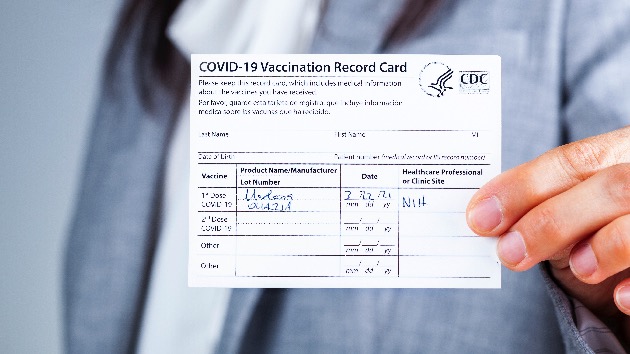
(NEW YORK) — Getting a COVID-19 vaccine isn’t just about protecting yourself, it goes a long way toward protecting your family, according to a new blog post by the director of the National Institutes of Health.
Dr. Francis Collins also noted in his Tuesday post that the data shows adults getting vaccinated helps protect those who can’t get vaccines, especially children.
“This is a chance to love your family — and love your neighbor,” Collins wrote.
Collins reiterated that studies have shown vaccinated individuals are significantly less likely to spread coronavirus to family members within a household. He cited a Swedish study published in JAMA Internal Medicine Journal last week that looked at 1.8 million people from more than 800,000 families “who acquired immunity from either previous COVID-19 infection or full vaccination.”
“The data show,” Collins wrote, “that people without any immunity against COVID-19 were at considerably lower risk of infection and hospitalization when other members of their family had immunity, either from a natural infection or vaccination.”
Specifically, the study found that households with one immune family member had a 45% to 61% lower risk of a COVID-19 infection, and that when a household included two immune family members the risk dropped 75% to 86%. With three or more immune family members, the risk of infection dropped almost 97%.
“These results show quite clearly that vaccines offer protection for individuals who lack immunity, with important implications for finally ending this pandemic,” Collins wrote.
Dr. John Brownstein, an epidemiologist at Boston Children’s Hospital and an ABC News contributor, said Collins’ message is important because there needs to be more emphasis on how getting a vaccination is an altruistic act for the entire community.
“We get a lot of focus on individual risk and side effects, and it takes our eye off the ball for the real reason we can and want the population to get inoculated,” he said.
MORE: COVID-19 vaccine shots for kids under 12 may be available in November: 6 things to know
Brownstein said it’s imperative that every eligible person gets vaccine shots as soon as possible since it may take a while for tens of millions of American children to be fully protected.
“Vaccines create a cocoon that ultimately protects those who aren’t eligible,” he added.
Anyone who needs help scheduling a free vaccine appointment can log onto vaccines.gov.
(WASHINGTON) — Amid a fresh wave of criticism from liberal activists and lawmakers, the White House on Tuesday defended President Joe Biden’s decision to nominate Rahm Emanuel for U.S. ambassador to Japan.
The former congressman and chief of staff to President Barack Obama has faced questions over how, as mayor of Chicago, he handled the fatal police shooting of 17-year-old Laquan McDonald in 2014.
Emanuel faces his Senate confirmation hearing Wednesday, which is also the seventh anniversary of McDonald’s killing — prompting renewed outcry this week.
He’s one of dozens of Biden ambassadorial nominees still stuck in the confirmation process. Biden has seen a single-digit handful of his ambassadorial nominees confirmed by the Senate, leaving key vacancies in foreign capitals and at the highest ranks of the State Department that some analysts warn pose a national security threat.
Republican senators, especially Ted Cruz of Texas and Josh Hawley of Missouri, have put holds on dozens of nominees over Biden’s refusal to sanction the German company behind Russia’s pipeline, Nord Stream 2. But the chair of the Senate Foreign Relations Committee, Sen. Bob Menendez, D-N.J., secured confirmation for 33 nominees on Tuesday, sending them to the Senate floor for a final vote.
White House press secretary Jen Psaki pushed back against new calls for Biden to withdraw Emanuel’s nomination on Tuesday.
“The president nominated Rahm Emanuel to serve as ambassador to Japan because he’s somebody who has a record of public service, both in Congress, serving as a public official in the White House, and certainly also as the mayor of Chicago, and he felt he was somebody who could best represent the United States in Japan,” she told reporters.
No Democratic senators have spoken out against Emanuel’s nomination. Instead, powerful Democratic senators like Dick Durbin, the Senate Majority Whip and a fellow Illinois Democrat, have backed him. Durbin tweeted back in August that Emanuel “has a lifetime of public service preparing him to speak for America. … I will do all I can to help Rahm become America’s voice in Japan.”
Some House Democrats, however, have urged the White House to reverse course, although they do not vote to confirm nominees.
“This nomination is deeply shameful. … That the Biden administration seeks to reward Emanuel with an ambassadorship is an embarrassment and betrayal of the values we seek to uphold both within our nation and around the world. I urge the Senate to vote NO on his confirmation,” Rep. Alexandria Ocasio-Cortez, D-N.Y., said in a statement last month.
This week, Kina Collins, a Democrat running for Congress in Emanuel’s home state of Illinois, has been leading advocacy against him.
“We can’t say Black Lives Matter and plan to build back better by appointing the man who covered up a police murder to a cushy job as an ambassador — a job the man is completely unqualified to hold,” tweeted the community organizer and activist, running again against Democratic lawmaker Danny Davis, who has held the Chicago district’s seat for over two decades.
At issue is the accusation that Emanuel, a longtime Democratic power player, helped cover up the 2014 killing of McDonald, a black teenager shot 16 times by Jason Van Dyke, a white policer officer.
Chicago police had said McDonald ignored warnings and approached the officers, but video, released 13 months later by a judge’s order, showed McDonald veering away from Van Dyke before the officer shot him.
The city reached a settlement with McDonald’s family, and in October 2018, Van Dyke was found guilty of second-degree murder and 16 counts of aggravated battery with a firearm.
Emanuel had said the city could not release the video because of a Justice Department investigation, said he did not see the video until shortly before its release, and has denied any wrongdoing. The video was released in Nov. 2015, seven months after Emanuel won reelection as mayor.
Asked whether Biden and Emanuel have spoken, including about the McDonald case, Psaki told reporters, “I don’t have any record of him speaking with him necessarily through the process. … Obviously, he’s somebody who he was familiar with. He knew his record of long standing prior to the nomination. And the president has made his own comments about that case, which I would point everyone to.”
Emanuel, a former ABC News contributor, was reportedly under consideration for a Cabinet secretary position during the transition last winter, but ultimately, he was not nominated for a role. The White House announced his nomination for ambassador to Japan on Aug. 20 after months of speculation.
To date, only nine Biden ambassador picks have been confirmed by the Senate, with dozens of others held up by Cruz, Hawley, and others over foreign policy disagreements with the White House, especially on Nord Stream 2.
“There have been unprecedented delays, obstruction, holds on qualified individuals from Republicans in the Senate,” Psaki said Monday. “The blame is clear. It is frustrating. It is something that we wish would move forward more quickly.”
After months of battle, however, there was a breakthrough Tuesday, with the Senate Foreign Relations Committee voting to send 33 nominations to the Senate floor for a vote.
“As the United States faces an unprecedented confluence of challenges on the world stage, our security, interests, and ability to advance our values and assert global leadership should not be imperiled by the obstructionism of those infatuated with playing politics with our entire national security infrastructure,” Menendez said Tuesday.
Among those approved by the committee are Cindy McCain, John McCain’s widow, for U.S. envoy to the United Nations agencies in Rome; former Republican Sen. Jeff Flake, an outspoken Trump critic, as ambassador to Turkey; famed pilot Chesley Burnett “Sully” Sullenberger as U.S. envoy to the International Civil Aviation Organization; and former Delaware Democratic Gov. Jack Markell as U.S. envoy to the Organization for Economic Cooperation and Development in Paris.
ABC News’s Sarah Donaldson contributed to this report from the White House.