
Biden administration to launch website for free at-home COVID tests on Wednesday

Biden administration to launch website for free at-home COVID tests on Wednesday
Paul Hennessy/SOPA Images/LightRocket via Getty Images

(WASHINGTON) — The Biden administration will launch a new website on Wednesday that Americans can use to request free at-home rapid COVID tests mailed to their doorsteps, senior White House officials said on Friday.

People will be able to order four tests per household at COVIDTests.gov. They won’t be delivered immediately, though. They will be shipped out 7-12 days after they’re ordered, senior officials said.

That means the first free tests won’t reach Americans until late January or early February, which will be too late to blunt the peak of omicron cases in many parts of the country. Still, the plan will allow Americans to have free tests on-hand in the coming weeks and months.

All that people need to enter on the site to receive a test is a name and an address. The White House will also launch a call line for people who don’t have computer access.

Another 500 million tests will eventually also be available, bringing the total to 1 billion free at-home tests distributed to Americans, but the White House hasn’t announced a timeline for the second batch of tests.

And more immediately, starting Saturday, people will be able to get up to eight tests per month reimbursed through insurance if they go out and purchase them on their own, either online or at stores.

“In the first couple of days, we’re encouraging people to just make sure you keep your receipts as the systems are getting up online,” a senior administration official said on Friday.

The White House is also incentivizing insurers to work with retailers and offer the tests for free up-front for people who show their insurance cards, similar to how prescriptions might be covered at the pharmacy. Those partnerships between insurers and retailers are still in the works.

This is on top of 50 million free at-home tests that have been doled out to community health centers around the country and 20,000 free testing sites.

Taken together, it all signifies a clear effort on behalf of the administration to increase the testing supply after omicron caught the government off guard.

The myriad testing options now in full swing will also likely take the pressure off the website launching on Wednesday, particularly as cases begin to fall in some northeastern areas.

Less demand will give the White House time to finish contracting all 500 million tests.

Currently, the White House only has tens of millions of tests on hand, a senior administration official confirmed Friday.

They’ve secured another 400 million or so that are still being manufactured and delivered.

But senior administration officials said they were confident they would be able to get tests sent out to any American who ordered a test next week within their shipping timeline of 7-12 days.

“We’re confident that with our contracting speed, which is very fast, with the ones we have on hand, and the timeline we’re laying out today, that we can meet all of our timelines and get these to Americans that want them,” a senior administration official said.

The tests will be sent via the U.S. Postal Service as first class mail.

The tests will not necessarily be of use to Americans who were exposed and want to take a test within the first 5 days of exposure, or come down with symptoms and want to test immediately, since they’ll take more than 7-12 days to arrive.

But senior administration officials ran through the host of other testing options Americans can use in those scenarios and defended this program as one “​​designed to ensure that Americans have at-home rapid tests on hand in the weeks and months ahead, as they have a need.”

The officials also said they were “ready” to meet demand on Wednesday and prevent any website crashes, as seen during former President Barack Obama’s launch of Healthcare.gov, which was overseen at the time by the current White House COVID Coordinator Jeff Zients.

“Of course, every website launch poses some risks, we are quite cognizant of that. But we have the best tech teams” across the administration, an official said. “So we’re ready for this and we’re ready for Americans to start ordering their tests on January 19.”

Copyright © 2022, ABC Audio. All rights reserved.
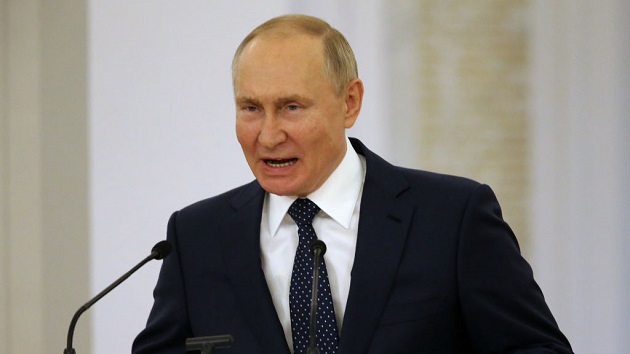
US accuses Russia of ‘fabricating a pretext’ to invade Ukraine

US accuses Russia of ‘fabricating a pretext’ to invade Ukraine
Mikhail Svetlov/Getty Images

(WASHINGTON) — After a week of high-stakes diplomacy, the U.S. on Friday accused Russia of “fabricating a pretext” to invade its neighbor Ukraine.

It’s another sign that the “drumbeats of war” are getting louder, in the words of one U.S. ambassador, after three key meetings this week to defuse tensions raised by Russia massing approximately 100,000 troops on its borders with Ukraine.

But whether Russian President Vladimir Putin will act on a long-held desire to consume Ukraine, or whether his posturing is a bluff to strengthen Moscow’s hand and therefore its influence, is still an open question, according to senior U.S. officials.

A “massive” cyberattack against Ukrainian government sites on Friday sparked new fears that the very kind of sabotage plot that U.S. officials have described could already be underway.

“Russia is laying the groundwork to have the option of fabricating a pretext for invasion, including through sabotage activities and information operations, by accusing Ukraine of preparing an imminent attack against Russian forces in eastern Ukraine,” a U.S. official said Friday.

U.S. intelligence has “information that indicates Russia has already prepositioned a group of operatives to conduct a false-flag operation in eastern Ukraine,” the official added, saying the group was trained in urban warfare and the use of explosives.

The alleged plot would begin several weeks before Russia’s invasion of Ukraine, which he attacked in 2014 by annexing Crimea and fomenting a war in its eastern provinces known as Donbas. That conflict has killed as many as 14,000 people in the last eight years, with artillery and sniper fire still exchanged weekly between Ukrainian government forces and Russian-led separatists.

Not long after, White House press secretary Jen Psaki spelled out the U.S. accusations in public.

“We are concerned that the Russian government is preparing for an invasion in Ukraine that may result in widespread human rights violations and war crimes, should diplomacy fail to meet their objectives,” Psaki told reporters at her daily briefing. “As part of its plans, Russia is laying the groundwork to have the option of fabricating a pretext for invasion, and we’ve seen this before.

She repeated the U.S. official’s assertion that Russian action could occur sometime between the middle of this month and mid-February.

“We have information that indicates Russia has already pre-positioned a group of operatives to conduct a false flag operation in eastern Ukraine,” Psaki continued. “The operatives are trained in urban warfare and in using explosives to carry out acts of sabotage against Russia’s own proxy forces. Our information also indicates that Russian influence actors are already starting to fabricate Ukrainian provocations in state and social media to justify a Russian intervention and sew divisions in Ukraine.”

The Kremlin dismissed the accusations, saying no proof has been presented.

“All these statements still have just the character of hearsay and haven’t been confirmed by anything,” spokesman Dmitry Peskov told the state news agency TASS.

The buildup since last fall of nearly 100,000 Russian forces, with potential plans for as many as 175,000, according to U.S. officials, has heightened fears of a full-scale invasion or new attack. In addition to the troops, Russia has stationed artillery systems and electronic warfare systems, according to U.S. ambassador to the OSCE, Michael Carpenter.

“The drumbeat of war is sounding loud, and the rhetoric has gotten rather shrill,” Carpenter said Thursday after the third and last round of talks with Russia. “We have to prepare for the eventuality that there could be an escalation.”

That rhetoric – accusing Ukraine of abusing human rights and increasing belligerence – has dominated on Russia-language social media, according to the U.S. official. In December, it increased roughly 200 percent to nearly 3,500 posts per day, they said, in order “to justify a Russian intervention and sow divisions in Ukraine.”

That appeared to include a “massive” cyberattack against Ukrainian government sites on Friday. Ukraine’s Foreign Ministry said theirs and other sites were temporarily down, with a message posted on the site by the attackers, address to “Ukrainians!”

“All your information will become public, be afraid and expect the worst. This is for your past, present and future,” it said in part.

Andrei Yermark, a top adviser to Ukrainian President Volodymyr Zelenskiy, said later Friday that approximately 90 percent of sites have been restored and that critical infrastructure was not affected.

No one has claimed responsibility for the attack, and Yermak said the country’s security service was investigating now.

“Of course, we have some thoughts,” he added, saying this kind of attack was “one of the potential parts of the destabilization” that officials have warned about.

With partners like the U.S. and the U.K., “We will be ready to answer to this attack and continue to work with our partners to protect,” he said.

Psaki said President Joe Biden was briefed about the cyberattack against Ukrainian government sites, but held back from naming who might be behind it.

“We don’t have attribution at this time, and I can’t point to any more specifics … I would just note that we will take necessary and proper steps, of course, to defend our allies, support our partners, and support the Ukrainian people, but we’re still assessing that at this point in time,” she said.

ABC News’ Justin Gomez and Patrick Reevell contributed to this report.

Copyright © 2022, ABC Audio. All rights reserved.

GOP candidates focus on school board controversies to bolster campaigns

GOP candidates focus on school board controversies to bolster campaigns
Carlos Bernate/Bloomberg via Getty Images

(WASHINGTON) — With the midterm elections officially taking center stage in national politics, GOP candidates up and down the ballot are taking advantage of nationwide divides over education issues — homing in on controversies over how much power school boards should have to bolster their campaigns.

Parental involvement, curriculum choices, COVID policies and vaccine mandates dominated conversations relating to Virginia’s 2021 gubernatorial race, after Democratic nominee Terry McAuliffe said he didn’t think parents should have a say in what their children are taught at school, which, in part, ultimately delivered a win for Republican Gov.-elect Glenn Youngkin.

The controversy over whether and how to teach about race also helped bring school boards into the national conversation, further seeping the bodies into partisan politics. School boards are now so contentious that some state legislatures are looking to make their normally nonpartisan elections, partisan.

In 2021, Tennessee passed a bill to attach party affiliation to school board candidates, and Arizona, Missouri, Utah and Indiana are among the states flirting with the idea.

School board elections, as with other down-ballot races, often don’t pull hordes of attention from voters. But already in 2022, 20 school board recall efforts have been launched across the country, according to data tracked by the nonpartisan organization Ballotpedia. In 2021, 91 recall efforts were pursued, on average more than twice as many as had been seen in the past.

Like other battlegrounds, school boards have taken center stage in Arizona. GOP candidates for governor there and those hoping to unseat Sen. Mark Kelly in Washington have even started dropping in on school board meetings to shore up support.

School boards were propelled into the spotlight in the state after a document from a Scottsdale school board member listing personal information about parents who had criticized the district was shared by his son, according to the Arizona Republic. Politicians weighed in on the controversy that ensued and, ultimately, efforts to remove the member were successful.

Kari Lake, a former TV anchor, who is running for Arizona governor with backing from former President Donald Trump, and Jim Lamon, a businessman running to unseat Kelly in the Senate, held a joint rally outside the Scottsdale high school in late November ahead of a school board meeting to discuss the parental “dossier.”

Lamon offered to pay legal expenses for parents who chose to pursue lawsuits against the district related to coronavirus policies or other issues.

“These people in that school board meeting about to kick off here, they work for you,” Lamon said outside the Scottsdale meeting, according to the Arizona Republic.

“They work for the parents and the kids, not for themselves. And we don’t work for them. … We’re a peaceful group, we’re great parents here, and we’ll stand tall. And I got your back,” he added.

Lake cut an ad with mothers from the district announcing she would establish the “Arizona Parent Coalition” as governor, which would “serve as an oversight to unruly school boards and the union bosses.”

“When all of us parents rally together, we win. And when we win, we will root out critical race theory,” she said in a campaign video.

Lake is fundraising on the school board controversy as well, with a page on the Republican donation hosting site WinRed dedicated specifically to to it. She’s singled herself out from the GOP field across the state by calling for cameras in all classrooms, which her competitors and sitting GOP Gov. Doug Ducey have spoken out against.

Former GOP Rep. Matt Salmon, who is running for governor, has called on the Arizona School Board Association to distance itself from the national branch. He told ABC News that while he doesn’t think school board issues will necessarily draw single-issue voters, he does think they will engage previously unengaged ones.

“It looks like we’ve awakened the sleeping giant, and it’s not just this, it’s all kinds of government intrusion,” Salmon said. “I think this is part and parcel of a lot of things that people are seeing: that their way of life is not getting better. It’s getting worse.”

Copyright © 2022, ABC Audio. All rights reserved.

Students walk out over COVID-19 in-person learning conditions in schools

Students walk out over COVID-19 in-person learning conditions in schools
Cheney Orr/Bloomberg via Getty Images

(CHICAGO) — Students are walking out of their classes in Boston, Chicago and other cities across the country in protest of in-person learning conditions as COVID-19 rages on.

Public school students in Boston left their classrooms at 10:30 a.m. Friday to demand that local leaders take more initiative in reducing the spread of COVID-19 in schools and implement a two-week period for remote learning.

“We will then stand there for exactly 10 minutes, one minute for every hundred thousand new COVID-19 cases found on the 2nd of January,” according to a post from the student-run Massachusetts COVID Walkout Instagram page.

Following the walk-out, students held a webinar to discuss their fears about the handling of the pandemic in schools. Students at the virtual event recounted their urge to take action and keep their fellow students, teachers and staff safe.

They are demanding a two-week remote learning period, proper Personal Protective Equipment for teachers, adequate technology for remote learning and the cancellation of some standardized testing.

In a statement to ABC News, Boston Public Schools said it “believes deeply in students advocating for what they believe in.”

“We further believe it is critically important that we encourage and support them in expressing their concerns, beliefs and positions to their leaders,” the statement said. “We will continue to listen to our students and families as we navigate this latest surge and the impacts it has on our ability to remain in person and deliver a quality education.”

In spring 2021, Massachusetts officials said remote learning would no longer count toward required learning hours. Any school-wide remote learning days must be made up by students and teachers at the end of the year.

Boston Public Schools has reported 3,483 COVID cases as of Jan. 5, according to the district website.

Students in Chicago also walked out of their classes Friday and chanted demands that schools address COVID-19 safety concerns.

As they walked en masse on the streets and toward the administrative offices of the Chicago Public School district, students yelled, “Si se puede,” or “Yes, we can,” as well as “No more oppression, change is now in session!”

Chicago Public Schools’ Radical Youth Alliance, a student-run advocacy group, also sent a letter of demands to Chicago Mayor Lori Lightfoot, CEO of Chicago Public Schools Pedro Martinez, Chicago Department of Public Health Commissioner Allison Arwady.

The students asked for transparency and accuracy in the school’s COVID-19 data, youth participation in decision-making and accountability for “mistakes.”

“As you consistently prove yourself and your leadership to be incompetent, we as Black and Brown young people are the common denominator of being the most harmed and impacted,” the letter read. “We are tired, exhausted, and frustrated.”

The group also backed the Chicago Teachers Union, which narrowly accepted a new agreement on COVID-19 safety precautions.

Chicago Public Schools had 10,928 cases among its students and staff since the start of the 2021-2022 school year, according to the district website.

In a statement, Chicago Public Schools said it “remains committed to fostering learning environments that allow students to respectfully deliberate issues with evidence and an open mind – and safely participate in civic action.”

According to the CPS website, students are required to wear masks in schools and answer a self-screener symptom questionnaire before school. Testing is optional.

Protests in New York, California and other states have highlighted the growing concerns that school leaders are failing to address COVID-19 and its impact on education and health in schools.

Copyright © 2022, ABC Audio. All rights reserved.

‘Pharma Bro’ Martin Shkreli ordered to pay $64 million for hiking cost of lifesaving drug

‘Pharma Bro’ Martin Shkreli ordered to pay  million for hiking cost of lifesaving drug
Drew Angerer/Getty Images

(NEW YORK) — Martin Shkreli became infamous, and earned the nickname “Pharma Bro,” after he hiked the price of a potentially lifesaving antiparasitic medication in 2015. On Friday, a federal judge ruled he should pay $64 million for his actions.

The judge said Shkreli should pay the financial penalty, equivalent to the profits from his scheme, and receive a lifetime ban from participation in the pharmaceutical industry.

Shkreli earned widespread condemnation in 2015 when he raised the price of Daraprim — an anti-malaria medication often prescribed for HIV patients — by 4,000% and initiated a scheme to block the entry of generic drug competition so that he could reap the profits from Daraprim sales for as long as possible, the judge said.

Through his tight control of the distribution of Daraprim, Shkreli prevented generic drug companies from getting access to the quantity of Daraprim they needed to conduct testing demanded by the Food and Drug Administration. Through exclusive supply agreements, Shkreli also blocked access to the two most important manufacturers of the active pharmaceutical ingredient for Daraprim.

Through these strategies, the judge said, Shkreli delayed the entry of generic competition for at least 18 months. Shkreli and his companies profited over $64 million from this scheme.

“Envy, greed, lust, and hate, don’t just separate, but they obviously motivated Mr. Shkreli and his partner to illegally jack up the price of a life-saving drug as Americans’ lives hung in the balance,” said New York Attorney General Letitia James, whose office sued with several other attorneys general and the Federal Trade Commission.

Shkreli is currently serving a seven-year prison sentence after being convicted of securities fraud in August 2017 related to his work at hedge funds MSMB Capital Management prior to founding Turing Pharmaceuticals. He had called the trial a “witch hunt” and blamed his increase in the cost of Daraprim for making him a target of federal investigators.

In May 2020, Shkreli petitioned for an early release from prison, saying he wanted to research a potential cure for COVID-19. The request was denied.

Copyright © 2022, ABC Audio. All rights reserved.

Wordle takes the internet by storm

Wordle takes the internet by storm
Michael Dobuski/ABC News

(NEW YORK) – The first big viral trend of 2022 is here, and it’s a colorful word game called Wordle.

Players who visit Wordle’s website have six chances to guess a five-letter word, which has been randomly selected from a database. With each try, the game tells you how close your letters are to the “word of the day.” If the letters you pick are in the word but in the wrong order, Wordle highlights them in yellow. If the letters are in the word and placed correctly, they get highlighted in green. Gray-highlighted letters means they don’t appear in the word of the day.

“It’s a good, fun game,” says Gizmodo Executive Editor Andrew Couts. “It only takes a couple of minutes, and it’s something to talk about with your friends.” 

Wordle was created by New York software engineer Josh Wardle this past fall, but Couts says the game really became popular in late December and early January, and now boasts more than three hundred thousand daily players.

“It seemed after the holidays, everybody seemed to be playing this game and sharing it on Twitter, sharing it all over social media,” says Couts, adding that Wordle’s distinct visual style is key to its success. 

“It creates kind of a cool little pattern that the game makes it really easy to share on social media…so you can show people how well you did on the word of the day. And I think that’s one of the big things that has made this game take off.”

While the game’s rules are simple, Couts says there are a few strategies to maximize your chances of Wordle glory.

“Picking words with a bunch of vowels, and picking words with common consonants like S’s or T’s or K’s is a good way to kind of get the word of the day quickly.”

That simplicity cuts both ways – which could open up the game to people who are willing to increase their odds through shadier means.

“It’s also a very simple website and it’s very easy to cheat if you really wanted to,” says Couts. “You can look at the source code of the website, for example, and see the entire list of the words of the day. So you can know them in advance. But that kind of takes all the fun out of it.”

And after all, Couts says, now is just the right time for some innocent, online fun.

“It’s actually a nice thing on the internet for once, so that’s very welcome.”

Hear ABC News Radio’s Michelle Franzen report on the latest viral craze:

Copyright © 2022, ABC Audio. All rights reserved.

Northeast braces for coldest temperatures in years, snow targets South, East Coast

Northeast braces for coldest temperatures in years, snow targets South, East Coast
ABC News

(NEW YORK) — Bundle up: temperatures in the Northeast are plunging to their lowest levels in three years this weekend as snow blasts the South and the East Coast.

Wind chill warnings and advisories are in effect across New England, where it may feel like 35 to 40 degrees below zero Friday night into Saturday morning. In Boston and New York City wind chills could drop to 15 to 20 degrees below zero Friday night.

The snow will first hit the Midwest. By Sunday morning, the icy rain and snow will rip through the South from Atlanta to Raleigh.

This storm has the potential to give Atlanta its first measurable snow in four years on Sunday.

The Southeast could then see heavy rain and thunderstorms Sunday night, causing power outages, coastal flooding and travel disruptions for the Interstate 95 corridor.

The storm then takes aim on the Northeast, where it’ll hit Sunday night and Monday morning.

As of now, the storm tracks more inland in New England and New York state, leaving more of a rain event for the I-95 corridor and the New York City area. But that could still cause travel disruptions for New York City commuters.

ABC News’ Hilda Estevez contributed to this report.

Copyright © 2022, ABC Audio. All rights reserved.

North Korea test-fires missile for third time in 2022 alone

North Korea test-fires missile for third time in 2022 alone
Chung Sung-Jun/Getty Images

(SEOUL, South Korea) — North Korea fired two short-range ballistic missiles toward the East Sea Friday afternoon, three days after the regime claimed a successful launch of a newly developed hypersonic missile.

“South Korean military detected two projectiles believed to be short-range ballistic missiles fired northeast towards the East Sea from Uiju, North Pyonganbuk-do,” South Korea’s Joint Chiefs of Staff told reporters Friday.

Pyongyang has tested its missile capabilities three times this month. On Wednesday, North Korea’s state media, Korean Central News Agency, hyped the test-fire of the claimed hypersonic missile by reporting that North Korean leader Kim Jong-un inspected the launch himself.

North Korea’s show of force took place on the same day the regime expressed discontent over new sanctions implemented by the U.S.

“If the U.S. adopts such a confrontational stance, the DPRK will be forced to take a stronger and certain reaction to it,” a North Korean foreign ministry spokesperson said in a statement.

Cheong Seong-Chang of Seoul-based Sejong Institute said these missile launches were an expression of frustration over U.S. sanctions on the regime’s mass destruction weapons and ballistic missile programs.

“Considering that North Korea has been testing new weapons at dawn or early morning, it’s reasonable to assume that North’s missile test launch this afternoon was improvised to showcase backlash against the U.S. sanctions,” he told ABC News.

Shin Beom Chul, a researcher at the Korea Research Institute for National Strategy, saw the consecutive missile launches as an effort to gain more bargaining chips by North Korea.

“Considering that political dialogue is restricted due to COVID-19 at the moment, it seems North Korea intends to strengthen its nuclear capabilities in the meantime,” Shin told ABC News. “At the same time, this consecutive military provocation has more than one purpose – to neutralize the U.S. efforts with stronger sanctions and also to secure the status of a de facto nuclear powerhouse.”

Copyright © 2022, ABC Audio. All rights reserved.

Why Spanish-language voting ballots are critical for democracy, advocates say

Why Spanish-language voting ballots are critical for democracy, advocates say
EVA MARIE UZCATEGUI/AFP via Getty Images

(NEW YORK) — As the midterm elections approach later this year, some states and jurisdictions have required voting ballots to be made available in other languages besides English.

The Latino population continues to grow in the United States and some counties have mandated that ballots in Spanish are available at polling sites.

However, Spanish and non-English ballots are not required across the nation, though some advocates say that multilingual ballots are critical for democracy.

“We need to have bilingual ballots, bilingual material across the country, it should be a national requirement and a national norm,” said Domingo Garcia, the national president for the League of United Latin American Citizens.

In the 2020 U.S. Census data, the Latino population accounted for over 60 million people. Yet, according to a study conducted by the City University of New York, only 10.6% of Latinos voted in the 2020 elections.

Some advocates believe that one of the reasons behind this lagging voting number is a language barrier.

“When we look at the language barrier, it is voter suppression, right? It is discriminatory against eligible citizens who … have the right to access ballots,” said League of United Latin American Citizens Chief Executive Director Sindy Benavides.

Benavides said the need for ballot materials in Spanish include a need for other voting resources, such as interpreters, bilingual ballot directors and even flyers that can influence voter turnout.

“The requirements are very straightforward. … All election information that is available in English must also be available in the minority language so that all citizens have the opportunity to register and to participate in elections and be able to cast a free and effective ballot,” said Benavides. “We know that language barrier is directly tied to low voter turnout.”

The areas of impact

Across the nation, at least 331 U.S. jurisdictions are required by law to offer language assistance to specific groups. But that number only makes for 4.1% of the 2,920 counties and 5,120 minor civil divisions that constitute the political subdivisions in U.S. Section 203 of the 1965 Voting Rights Act, according to the U.S. Census Bureau.

“In our own backyard, across the entire United States — Ohio, Utah, Maryland, Virginia, Georgia, you name it — we are touching every single state and one fact that is true, is that the Latino community will continue to grow for decades to come,” said Benavides.

According to U.S. Section 203, if over 5% of a township or county’s voting-age citizens are limited in English proficiency they need to be covered by language provisions within the Voting Rights Act, according to the U.S. Census.

Just last month, in the Washington, D.C., area, Prince George’s County in Maryland and Prince William County in Virginia mandated ballots in Spanish to accommodate their significant Latino populations.

But in Georgia, Latino activists have pushed for Spanish-language ballots in Hall County, where 28% of all residents are Hispanic, according to Census data.

“What we’ve heard specifically from the community has been that not having information in Spanish limits their ability to be able to freely and openly participate,” said Jerry Gonzalez, founder and CEO of the Georgia Association of Latino Elected Officials, or GALEO.

“Our community really takes voting very seriously, and they want to be informed and educated about what’s on the ballot,” said Gonzalez. “Sometimes not knowing what’s on the ballot, because they can’t read it in Spanish, makes them hesitant to actually cast a ballot and it prevents people from voting.”

In November 2020, according to a report from GALEO, there were 385,185 Latino voters, representing 4.1% of the total electorate in Georgia. When compared to the 2016 analysis, the Latino electorate in the state grew by 140,995 Latino registered voters, representing a growth rate of 57.7%.

“Our effort is to make sure that we educate our community in both English and Spanish about the importance of their vote and also the importance of these elections and how consequential they are for us moving our community forward,” said Gonzalez.

Hall County, Georgia, Elections Director Lori Wurtz told the Gainesville Times in December that Spanish ballots in the county would not be reevaluated for another five years, however, after that evaluation, she foresees the county qualifying for bilingual ballots. According to the U.S Census, jurisdictions are evaluated every five years using data from the American Community Survey.

“When we are tapped to do this, we’re ready,” Wurtz told the outlet.

Need for change

This week, the Senate will meet to discuss voting rights. However, Gonzalez emphasizes the need to also have “language barrier” as part of the U.S. Voting Rights Act.

This would be a key addition for Puerto Ricans, who have the right to vote in the United States as American citizens. If Puerto Ricans move to one of the 50 states, they are allowed to vote in federal elections, but they might not feel confident to do so with Spanish being the main language spoken on the island.

“It is important for Puerto Ricans to vote in the language that they understand, because there are now more Puerto Ricans living on the mainland,” said Kira Romero-Craft from Latino Justice Puerto Rico Legal Defense Educational Fund.

“If they want to influence Congress to impact the island then Puerto Ricans need to vote,” she told ABC News. “Puerto Rico, to me, is like the perfect example of why we need to care and why we need to engage and vote as if our life depended on it — because it does.”

Although a language barrier continues to be an ongoing issue in some states, advocates are calling on Latinos to go out and take to the polls regardless of current circumstances that may affect them.

“Your vote counts; your voice is your vote. And right now, more than ever, if you want immigration reform, then you got to vote to make sure that you have a congressperson or senator that will represent your points of view,” said Garcia.

Copyright © 2022, ABC Audio. All rights reserved.

Teachers in France strike over COVID-19 health and safety protocols

Teachers in France strike over COVID-19 health and safety protocols
Denis Thaust/SOPA Images/LightRocket via Getty Images

(NEW YORK) — A nationwide strike took place in schools across France on Thursday as teachers and other school staff demonstrated against the government’s management of COVID-19 protocols in schools.

Teachers, other school staff and parents in the country have been complaining for months, saying the health protocols in schools are confusing and continually changing. The government changed the rules twice for schools in the past week.

They argued that they are facing the crisis with inapplicable measures, a growing work overload, teachers not being replaced when sick, no additional resources or staff to alleviate the issues and a lack of transparency from the education minister.

Teachers unions had called for a walkout to denounce the “indescribable mess” in schools as COVID-19 cases have surged and pharmacies have reported shortages of self-test kits since the beginning of the year.

The primary school teachers’ union, SNUipp-FSU, announced an estimated 75% participation rate among their ranks, and the secondary school union, SNES-FSU, said 62% mobilized. However, the Ministry of National Education claimed that 38.5% of primary school teachers and 23.7% of secondary school teachers participated.

“The teachers express their anger at this minister who does not hear them, who does not listen to what’s going on in the field, who does not listen to the distress present in schools and to all the possible dysfunctions, and above all a minister who addresses the press first before addressing the students,” a SNUipp-FSU representative told ABC News. “And so, the teachers are very angry.”

The leading parent association, the FCPE, also joined the movement in support of the teachers, and earlier this week called for a “white day” in schools, urging parents to keep their children at home Thursday.

FCPE co-president Nageate Belahcen said while the COVID-19 protocols look “pretty” on paper, there is “no pedagogical continuity.”

“Nothing is put in place because the means are not there, and there are no substitute teachers,” Belahcen told ABC News, adding that she is also concerned about exams occurring this year. “All this means that the parents are still very, very worried for the future of their children, for the well-being of their children, and above all, we cannot take this situation any longer.”

For weeks now, education professionals have been asking Education Minister Jean-Michel Blanquer for more staff and reinforced measures — including FFP2 masks for the teachers, CO2 sensors and air purifiers for classrooms — to fight against the growing cases of COVID-19.

Blanquer has come under fire multiple times since the beginning of the pandemic due to concerns over the way he has handled the COVID-19 crisis.

“When will you present your resignation, Mr. Minister?” Sylvie Tolmont, a national assembly deputy from Sarthe, asked Tuesday during a government questioning session. This isn’t the first time his resignation has been asked for since he took office in 2017.

In a bid to appease the demonstrators, Prime Minister Jean Castex met with the unions Thursday evening, along with the health and education ministers.

After a discussion that lasted three hours, Blanquer announced he had agreed to some of the unions’ requests, including the distribution of 5 million FFP2 masks to schools, the recruitment of 3,300 contractual substitute teachers and additional non-teaching and administrative staff.

There has been a similar dispute over health and safety in schools in the United States. After five days of canceled classes, the Chicago Teachers Union voted, with 56% in favor, to approve a COVID-19 agreement with Chicago Public Schools that included expanded testing, masks and a plan to shut down schools during outbreaks.

Thursday’s strike was a “historic mobilization” for France, according to SNUipp-FSU, considering the number of strikers, the unity between teachers’ unions and the fact that the FCPE participated as well.

Copyright © 2022, ABC Audio. All rights reserved.