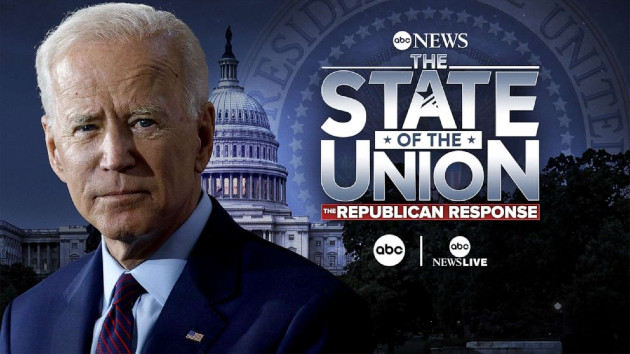
(WASHINGTON) — Masks will no longer be required in the House chamber when President Joe Biden delivers his State of the Union address Tuesday night, a major reversal in the politically controversial policy that reinforces his message that the pandemic is receding and America is getting back to something closer to normal.
On Sunday, the U.S. Capitol’s attending physician lifted a mask mandate for lawmakers inside the House chamber just two days before Biden’s nationally televised prime-time speech.
The new guidance sharply reduces the chances of a potential confrontation with Republican lawmakers who don’t believe masks are necessary and violate their freedom.
“Individuals may choose to mask at any time, but it is no longer a requirement,” Capitol physician Brian Monahan said in a memo shared Sunday, saying masks in the House chamber and elsewhere on the Capitol grounds are now optional after about two years of being required.
All 535 members of Congress are also invited to attend Biden’s address this year due to the relaxed coronavirus measures, a marked difference from last year’s address, when only 200 members showed up due to stringent COVID-19 policies.
The shift in guidance comes just two weeks after the Capitol physician and House sergeant at arms initially warned that attendees must wear a KN95/N95 mask to Biden’s speech and if they refused, they would risk being removed from the chamber or fined.
Republicans have sought for months to reverse House Speaker Nancy Pelosi’s mandate, even going as far as filing a federal lawsuit.
It’s unclear at this point how many Republican lawmakers will actually show up to hear Biden’s address in person, but at least two Republicans have announced they will not attend due to other COVID requirements for attendees, which include getting a COVID test at least one day before the speech.
“I don’t have time to go take a COVID test today. I only take a test if I’m sick,” GOP Sen. Marco Rubio told reporters Monday.
GOP Rep. Chip Roy of Texas tweeted in response to Rubio’s statement late Monday: “Same. I will not attend.”
The move to remove the mask mandate at the Capitol ahead of Biden’s speech highlights the quickly evolving conditions of the pandemic and how eager some Democrats, including the president himself, are about projecting a “return to normalcy.”
Monahan noted in his letter that the “Washington DC region is now in the ‘green level’ or low level in this new CDC schema allowing for reduction in coronavirus prevention measures such as coronavirus testing frequency and indoor mask wear.”
He added that positive COVID-19 test rates at the Capitol are down to 2.7% in the last two weeks, below the current rate for the D.C. Metropolitan area of 4.7%.
Monahan’s announcement came just after the Centers for Disease Control and Prevention also updated its mask guidance late last week, easing its recommendations on masks for most Americans living in communities with “low” or “medium” levels of coronavirus.
This all comes as many governors — many of them Democrats — are also easing up on mask mandates.
On Monday, White House press secretary Jen Psaki denied Biden had any role in masks not being required in the House chamber for his speech.
“The president is very powerful, but he couldn’t make us be in the green zone that we’re in right now in D.C., that’s why we are not required, we’re not going to be required to wear masks starting tomorrow,” she said, referring to D.C. and the White House lifting mask mandates as of March 1.
“For him, it had nothing to do with the timing around the State of the Union,” she added. “He wanted to give the CDC the time to assess and make recommendations that would be clear to the American public about what their recommendations would be for mask wearing moving forward.”
A White House official confirmed to ABC News that masks will no longer be required for fully vaccinated individuals on the White House campus, either, starting Tuesday.
(SACRAMENTO, Calif.) — Four people were killed, including three children, after a gunman opened fire at a church in Sacramento, California.
The shooting took place at The Church in Sacramento in the Arden-Arcade neighborhood, where the suspect opened fire in the main sanctuary area on Monday just after 5 p.m., Sacramento County Sheriff’s Office spokesman Sgt. Rod Grassmann told reporters during a news conference.
Three of the victims were the children of the suspected gunman, Grassmann said. The fourth victim was supervising a court-ordered visit between the man and his children.
All of the victims were dead when first responders arrived. The suspect died by suicide, Grassmann said.
The church’s pastor called 911 around 5:07 p.m. after he heard the gunshots, ABC Sacramento affiliate KXTV reported.
When deputies arrived, they found the body of an adult male, along with his three daughters aged 9, 10 and 13, inside the sanctuary.
The mother had a restraining order against the children’s father. She was not in the building at the time of the shooting.
Investigators have labeled the shooting as a domestic violence incident, Grassmann said.
The sheriff’s office asked residents to stay away from the area near the church due to a large police presence.
Investigators are asking anyone who may have been in the vicinity of Wyda Way to call 911 to provide a witness account.
(NEW YORK) — Hundreds of thousands of Ukrainians are displaced, on the front lines of battle with Russia or awaiting the end of the invasion from their homes after Russia began its attack on Ukraine in the early morning of Feb. 24.
Now, many around the world are left wondering how to help Ukrainians amid the onslaught.
Here are some ways to support the effort:
Razom for Ukraine
The nonprofit is collecting donations for its emergency response project to provide medical supplies, humanitarian aid and support volunteers on the ground.
The group is also partnering with other Ukrainian-targeted organizations like Nova Ukraine, United Help Ukraine, Revived Soldiers Ukraine, Sunflower for Peace and Euromaidan-Warszava, according to its website.
The organization says it will use funds to purchase “tourniquets, bandages, combat gauzes, sterile pads, and satellite phones.” It also says it is arranging “warehouses and points of delivery in Poland and Ukraine.”
Global Giving
The charity organization GlobalGiving has started a Ukraine Crisis Relief Fund which will provide shelter, food, and water to the 500,000 refugees and counting. The money will also be used for health and psychosocial care, as well as education and economic assistance, according to the organization’s website.
“All donations to the Ukraine Crisis Relief Fund will support humanitarian assistance in impacted communities in Ukraine and surrounding regions where Ukrainian refugees have fled,” the fund page reads. “GlobalGiving’s local partners are bringing relief to terrified and displaced communities, and they need resources to continue their life-saving work.”
International Rescue Committee
The International Rescue Committee is collecting financial donations that will go toward supporting resources and aid to displaced families.
The organization specializes in helping refugees around the world who have been forced from their homes. They target communities where people lack vital resources for resettlement and recovery from crises.
They also play a vital role in resettlement efforts in the United States.
Doctors Without Borders
Doctors Without Borders, an organization that provides medical care during humanitarian crises, still has workers in Ukraine despite the ongoing conflict.
Donations to Doctors Without Borders will fund these services as well as mass casualty kits, emergency medicine and preparedness training for local hospitals and more.
“[The] teams in Ukraine are deeply worried about the consequences of the conflict for Ukrainian people and communities,” the website read. “As hostilities continue, ensuring people’s access to health care and medicines will be critical. Our teams are looking into how they can adapt MSF’s activities to respond.”
United Nations High Commissioner for Refugees
The United Nations High Commissioner for Refugees, the refugee agency for the United Nations, is accepting donations to provide health care, legal assistance and on-the-ground supply support to refugees from Ukraine.
“UNHCR has stepped up our operations and capacity in Ukraine and neighbouring countries,” the organization’s website read. “We remain firmly committed to support all affected populations in Ukraine and countries in the region.”
Airbnb
The online rental company Airbnb announced that it will offer free, short-term housing to up to 100,000 refugees fleeing Ukraine via its non-profit initiative Airbnb.org.
The organization urges anyone interested in opening up their homes to refugees to get involved: “We know that Hosts and guests on Airbnb around the world will be eager to stand up and assist this massive effort to help those fleeing Ukraine,” a statement from Airbnb.org read.
“[Airbnb.org] will work closely with governments to best support the specific needs in each country, including by providing longer-term stays,” the statement continued.
(WASHINGTON) — President Joe Biden will deliver the State of the Union address Tuesday night amid the Russian invasion of Ukraine, changing public health guidance around COVID-19 and as the nomination process for his Supreme Court pick gets underway.
Shortly after, Iowa Gov. Kim Reynolds will deliver the GOP response to Biden’s speech.
Coverage will air on Tuesday from 9 p.m. to 11 p.m. ET on ABC. The speech is being broadcast on ABC stations, as well as Hulu, Roku, YouTube TV, Amazon Fire tablets and TV stick, Xumo, Sling TV, Facebook, Twitter, ABCNews.com and the ABC News and ABC mobile apps.
Biden, whose address begins at 9 p.m. ET, is expected to speak on a variety of issues facing the nation, with a specific focus on the economy as inflation soars and supply chain problems create shortages across the country.
ABC News Live will stream from Capitol Hill throughout the day, with live coverage of the State of the Union address beginning at 8 p.m. ET and a roundtable with Houston voters on what they hope to hear from the president’s speech. At 11 p.m. ET, ABC News Live will feature lawmakers from both sides of the aisle reacting to the speeches.
ABC News Digital will have an up-to-the-minute live blog, key takeaways focusing on main themes, an analysis of the speeches’ political implications and full transcripts of and reaction to the remarks.
(NEW YORK) — Russian forces are continuing their attempted push through Ukraine from multiple directions, while Ukrainians, led by President Volodymr Zelenskyy, are putting up “stiff resistance,” according to U.S. officials.
The attack began Feb. 24 as Russian President Vladimir Putin announced a “special military operation.”
Russians moving from Belarus towards Ukraine’s capital, Kyiv, don’t appear to have advanced closer towards the city since coming within about 20 miles, although smaller advanced groups have been fighting gun battles with Ukrainian forces inside the capital since at least Friday.
Russia has been met by sanctions from the U.S., Canada and countries throughout Europe, targeting Russia’s economy and Putin himself.
Here’s how the news is developing Tuesday. All times Eastern:
Mar 01, 4:11 am
Russian bombardment strikes central square in Kharkiv
Russia on Tuesday launched a major bombardment of Ukraine’s second-largest city, Kharkiv, hitting a central square and its civilian administration building.
Video from the scene shows a large projective hitting next to the regional state administration building on Kharkiv’s Freedom Square, causing a huge blast. Aftermath shot on phones from the scene and inside the building, show it shattered with debris strewn around.
Ukraine’s emergency services ministry said at least six people, including one child were injured. It was unclear if anyone was killed.
Kharkiv Mayor Oleg Sinegubov confirmed the strike, calling it a “war crime.”
Monday’s shelling followed a sustained bombardment of civilian areas yesterday and overnight in Kharkiv by Russian heavy artillery, including multiple rocket launchers and an alleged use of cluster munitions.
“What is happening in Kharkiv is a war crime!” Sinegubov wrote on Facebook. “The Russian enemy is shelling whole residential neighborhoods of Kharkiv, where there is no critical infrastructure, no Ukrainian armed forces positions, which the Russians could be targeting.”
Sinegubov accused Russia of conducting the attacks during the day, when civilians were on the street. He said the city’s emergency services are unable to keep up with the number of attacks and injured.
So far at least 11 are dead, with dozens injured, he said.
Russian forces in Kharkiv appear to have shifted tactics to employing heavy artillery indiscriminately against the city, in an apparent effort to bombard and terrorize it into submission.
Sinegubov claimed the Russians were changing tactics because their offensive capabilities on the ground were running out and so they had nothing left but to launch aerial bombardments.
Mar 01, 3:28 am
‘Leave Kyiv urgently today,’ Indian Embassy tells citizens
The Indian Embassy in Kyiv on Tuesday urged Indians still in the capital to “leave Kyiv urgently today.”
“All Indian nationals including students are advised to leave Kyiv urgently today,” the embassy said on Twitter. “Preferably by available trains or through any other means available.”
Mar 01, 2:48 am
’We will fight until the end,’ says Ukrainian parliament member
Solomiia Bobrovska, a member of Ukraine’s parliament, on Monday said Ukrainians would “fight to the end” as they defend Kyiv from a Russian invasion.
“That’s the mood of Ukrainians. We are staying behind altogether, and we do understand that with the total second line staying behind their shoulders. And I think we will fight until the end,” Bobrovska told ABC News’ Linsey Davis.
Mar 01, 12:14 am
Russian troops ‘operational’ near Ukrainian nuclear power plant, agency says
Ukraine said its nuclear power plants are still being operated “safely and securely,” the International Atomic Energy Agency wrote in an update late Monday.
However, IAEA Director General Rafael Mariano Grossi said he “remained gravely concerned about maintaining their safety and security during the current conflict.”
Ukraine’s foreign ministry told the IAEA on Monday that Russian troops are “operational” near a functioning nuclear power plant at Zaporizhzhia, but the troops haven’t entered it so far. Any fighting near nuclear facilities causes alarm, and Ukraine has four sites in total with 15 reactors.
“It is extremely important that the nuclear power plants are not put at risk in any way,” Grossi said in a statement. “An accident involving the nuclear facilities in Ukraine could have severe consequences for public health and the environment.”
The IAEA Board of Governors will hold a meeting Wednesday to discuss the “safety, security and safeguards implications of the situation in Ukraine.”
(NEW YORK) — Russia’s invasion of Ukraine prompted thousands of people to leave the Eastern European country, but should North Carolina native Craig Lang depart Ukraine and return to the United States, he could immediately be taken into custody by federal authorities.
Lang, a 32-year-old U.S. Army veteran-turned-murder suspect who previously moved to Ukraine, is one of two former soldiers accused of killing husband and wife Danny and Deana Lorenzo in southwest Florida nearly four years ago.
FBI investigators say that the Lorenzos, who were also military veterans, were fatally shot in April 2018 in an Estero parking lot after they traveled nearly three hours to respond to an online firearms advertisement.
Sheriff’s deputies found 63 bullet casings at the scene, with bullet holes riddling the Lorenzos’ vehicle.
“She was scared. I know she had to be,” Deana Lorenzo’s sister Angie Crowder told ABC News.
Residents of this Fort Myers suburb were left mystified about the alleged ambush for more than a year until the Department of Justice announced federal charges against Lang and co-defendant Alex Zwiefelhofer in connection with the Lorenzos’ deaths.
Zwiefelhofer was taken into federal custody in Wisconsin in 2019 and has pleaded not guilty.
Lang has yet to appear before a federal judge. He has denied involvement in the Florida murders and has fought extradition back to the United States. Relatives of the Lorenzos, including Crowder, are in anguish.
“We all want answers,” Crowder said. “I would like to see him come back and stand charges.”
Living in plain sight halfway across the world
In the spring of 2021, ABC News traveled roughly 5,000 miles to Ukraine in search of Lang. He was found to be living openly with a Ukrainian wife and child in a Kyiv neighborhood.
Lang, who was previously arrested for brandishing a gun near the home of one of his American ex-wives after he went AWOL, agreed to an on-camera interview with ABC News Investigative Correspondent David Scott. However, Lang refused to answer questions during the interview about the murders in Florida.
“I can’t discuss … anything about Florida [or] pretty much anything about my time in the United States in 2018,” Lang said. “I can’t talk about any of that.”
While the DOJ continues to seek his extradition, Lang told Scott that he is seeking asylum in Ukraine.
“I believe that the United States government intends to prosecute me and other veterans of this conflict here for our service in Ukraine,” he said, arguing that he is a victim of Russian propaganda and American political persecution.
After being discharged by the U.S. Army, he says he first arrived in Ukraine around 2016 and joined far-right militias such as the Azov Battalion and Right Sector. Both groups have been accused of human rights abuses by Amnesty International and have alleged ties to American white power organizations.
Lang denies that he is a right-wing extremist.
“I’m going to say that the amount of, like, neo-Nazis or people with extreme views is very, very minimal, very, very minimal,” he said. “Is there extremism to a small degree? There might be some extremism, yes.”
Small militias, major role
Since Russia’s 2014 invasion of Crimea, to bolster its defenses against those in its eastern regions seeking to separate from Ukraine and join Russia, Ukraine has relied on local militia groups, some of which have been linked to the nation’s far-right political movements by Amnesty International and The Soufan Center.
Such battalions with ties to Ukraine’s far-right fringe political parties may have empowered Russian President Vladimir Putin to spread the false message that “denazification” was the goal of his invasion, despite Ukraine’s elected government having the support of the United States and other Western democracies.
Scott questioned Lang about the far-right ideology reportedly behind the Azov Battalion, but Lang said that he did not think that the group’s membership included anyone with extremist views.
Over an hour into the conversation, after being pressed on racist statements reportedly made by former Azov Battalion commander Andriy Biletsky, Lang ended the interview.
“I’m going to go ahead and leave,” Lang told Scott.
‘A threat to the homeland’
Lang is one of a number of Americans who have reportedly either traveled to Ukraine over the last decade to fight for far-right paramilitary groups or have sought to do so.
The FBI alleged that Jarrett William Smith, an Army veteran who pleaded guilty in 2020 to federal charges of distributing information related to explosives, destructive devices, and weapons of mass destruction, had a “desire to fight in Ukraine” and communicated about his plans with Lang on Facebook.
“It was as if [Smith] wanted to use the Army to get the training that he needed to be successful going overseas, fighting on behalf of this white supremacist organization,” former federal prosecutor Anthony Mattivi said.
Smith is not alleged to have ultimately fought in Ukraine. When asked about Smith, Lang called him an extremist and confirmed that they connected on Facebook, but said that he turned Smith away from his Ukrainian unit.
“I wasn’t going out and recruiting people. I wasn’t saying, ‘Oh, come out and join us,” Lang said. “What was happening is I was simply a point of contact for a lot of foreigners that came into this country, and there’s a lot of good people that came into the country.”
The Soufan Center warned in a 2019 report that Ukraine had already become an attractive stop for far-right extremists.
“Americans have gone to fight as mercenary soldiers in far-right and paramilitary units in Ukraine,” University of Chicago Assistant Professor Kathleen Belew said. “They do pose a threat to the homeland.”
From eastern Ukraine to the East Coast
Lang and Zwiefelhofer are American, but the FBI says that the two alleged murderers initially met in eastern Ukraine more than five years ago while fighting for a far-right militia against Russian-backed separatists.
Federal prosecutors allege that after returning to the United States together, Lang and Zwiefelhofer came up with the plot to rob and kill the Lorenzos in 2018 “to fund their planned travel to Venezuela.”
A superseding indictment also claimed that Zwiefelhofer and Lang conspired with each other to travel to Venezuela and commit murder, kidnapping, and maiming as part of a “military expedition and enterprise” there.
Lang, who said that he has never been to Venezuela, declined to comment on whether he considered the South American nation to be a potential frontline for him.
At some point after the Lorenzos’ deaths, Lang ended up back in Ukraine and said he became an English instructor there, despite being wanted in Florida on federal criminal charges.
Fighters and false claims
While many Americans left Ukraine ahead of the Russian invasion, some groups made recent efforts to encourage others to do the opposite.
In January, an international message board for neo-Nazis urged American followers to join far-right militias to help fight Russian troops and pro-Russian separatists in Ukraine, where local civilian fighters had been prepared to assist the Ukrainian military due to the mobilization of Russian forces.
This effort came a month before Putin falsely claimed that he is looking to rid Ukraine of Nazis and suggested that the country’s far-right has control of its government, using these lies as pretexts for war.
Ukraine’s president is Jewish and, according to the Center for International Security and Cooperation at Stanford University, Russia has had its own extremist militias fighting alongside Russian-based separatists in Ukraine.
One such group was the Russian Imperial Movement, which has reportedly cultivated ties with American neo-Nazis and offered to train white nationalists at the 2017 Unite the Right rally in Charlottesville, Va.
“One important thing to understand about white power and militant right groups is that they are fundamentally opportunistic,” Belew said. “When we have a major … point of tension like we’re seeing in the Ukraine right now, it’s very, very likely that actors will exploit that tension.”
‘I’ll just break out and cry’
With war now underway in Ukraine, it remains unclear when or if Lang will end up being forcibly returned to American soil to face trial in federal court.
Back in Florida, Crowder says she is still grieving the loss of her sister and brother-in-law while hoping that justice will be served.
“I still have my moments and sometimes, I’ll just break out and cry,” Crowder said.
(WASHINGTON) — Days after GOP Reps. Paul Gosar and Marjorie Taylor Greene appeared at an event organized by a white nationalist, Republican party leaders are condemning them for attending.
Senate Minority Leader Mitch McConnell released a statement Monday criticizing white supremacist hate.
“There’s no place in the Republican Party for white supremacists or anti-Semitism,” McConnell said in a statement first reported by Politico.
Republican Leader Kevin McCarthy told reporters Monday afternoon that he found Greene and Gosar’s attendance “unacceptable.”
McCarthy suggested to reporters that he plans to speak with both Gosar and Greene later this week.
“To me, it was appalling and wrong,” McCarthy told reporters. “There’s no place in our party for any of this.”
“The party should not be associated any time any place with somebody who is anti-Semitic…This is unacceptable,” he added.
McCarthy was in Israel last week with a congressional delegation. He told Punchbowl News that the news of Greene and Gosar’s attendance was particularly upsetting because of his recent visit.
Greene and Gosar have both previously been stripped of their committee assignments for their egregious behavior.
McCarthy, however, has previously said he would restore their assignments if Republicans take back the House in November.
McCarthy told CNN and another reporter outside his office that even though Greene claimed not to know who the event organizer was “with that introduction, you should have walked off stage.”
Shortly before introducing Greene, Nick Fuentes, the white nationalist who organized the event, led participants in applause for Russia’s invasion of Ukraine and chanted Russian President Vladimir Putin’s name.
Republican Chairwoman Ronna McDaniel, when asked about Greene’s behavior Monday, also condemned the event but stopped short of condemning her members.
“White supremacy. Neo Nazism, hate speech, and bigotry are disgusting. They have no place or home and our party.”
McDaniel didn’t say whether the party would take any further action against its members, such as censuring them. Instead, she said she “would let the process play out” and see if any members brought any censures forward at a party meeting in August.
The criticism follows recent comments by former President Donald Trump, who continues to praise Putin. During an interview with the conservative radio show “The Clay Travis & Buck Sexton Show” on Tuesday, Trump labeled Putin’s tactics “genius” and “savvy.” Trump ultimately slammed the invasion on Saturday night at the Conservative Political Action Conference but called Putin “smart.”
Greene and Gosar’s appearance at the conference Friday night is now renewing calls for them to be reprimanded by fellow Republicans in Congress.
“In any other world, Greene speaking at a white supremacist conference where attendees have defended Vladimir Putin and praised Adolf Hitler would warrant expulsion from the caucus, to say nothing of her advocacy for violence and consistent anti-Semitism is disgusting,” Democratic National Committee spokesperson Ammar Moussa said.
Greene, however, has doubled down on her appearance.
“I won’t cancel others in the conservative movement, even if I find some of their statements tasteless, misguided or even repulsive at times. I encourage them to seek wisdom, and apologize to those who have been hurt by their words, as I’ve had to do,” she said. “Our faith calls for charity and forgiveness.”
“We’re not going to be deterred by journalists and Washington insiders who fear the name of Our Lord, and relentlessly attack those of us who proclaim His name. We know that Christ is our only judge,” she added.
Over the weekend, in addition to claiming she didn’t know who Fuentes was, Greene said she went to the event to reach his young audience and to discuss “American First” policies.
Last month, Fuentes was subpoenaed by the congressional committee investigating the Jan. 6, 2021, attack on the U.S. Capitol.
(WASHINGTON) — The House select committee investigating the Jan. 6 attack on the U.S. Capitol has spent more than $2 million on its investigation, including $1.64 million between October and December — an indication that the panel’s work is speeding up.
The $1.64 million is roughly four times the $418,000 the panel spent from July to September of 2021, according to spending disclosures. The increased spending is a sign of how much the committee is expanding its work ahead of public hearings and an interim report that’s expected this spring and summer.
Much of the big jump in the committee’s spending comes from an increase in payroll, with the panel reporting $1.2 million in personnel compensation in the final three months of last year compared to just $327,000 from July through September.
The committee hired 12 additional staff members last quarter, bringing the total headcount to 41, up from 29 in September of 2021. The new staffers include investigators and attorneys with experience studying organized crime, terrorism, cryptocurrency, and financial crimes, as well as several former federal prosecutors.
Committee staffers are divided into color-coded teams, with each group focused on a different aspect of the sprawling investigation — from financing and extremist groups to former President Donald Trump’s communication with GOP lawmakers before and on Jan. 6.
The committee also spent more than $300,000 on “other services” in the final three months of last year, as well as a sizable amount on equipment, supplies, rent and utilities.
According to filings, the Jan. 6 committee overall spent just a little more in the fourth quarter than the House Intelligence Committee, which reported spending $1.61 million. But that amount was far less than many other committees, including the House Oversight & Reform Committee, the House Judiciary Committee, and the House Homeland Security Committee, which in the fourth quarter spent $3.6 million, $2.2 million and $2 million, respectively.
To date, the Jan. 6 panel has conducted nearly 600 interviews, issued more than 75 subpoenas, and obtained tens of thousands of official Trump White House and administration records from the National Archives.
They have also sought records from members of the former president’s inner circle, including former New York City Mayor Rudy Giuliani, Trump’s son Eric Trump, and Kimberly Guilfoyle, a campaign fundraiser who is engaged to Trump’s eldest son, Donald Trump Jr.
(WASHINGTON) — As the U.S. and other Western nations considered how to address Russian aggression, the Pentagon and White House said Monday the U.S. saw no need to change the its nuclear alert level despite Russian President Vladimir Putin making a a veiled threat Sunday that he was doing so.
“We are assessing Putin’s directive and at this time we see no reason to change our own alert level,” White House press secretary Jen Psaki said.
“The United States nor NATO has any desire for conflict with Russia, and we think provocative rhetoric like this regarding nuclear weapons is dangerous, adds to the risk of miscalculation, should be avoided, and we’ll not indulge in it,” she said.
Asked by a reporter after a Black History Month event whether Americans should be worried about nuclear was, President Joe Biden quickly responded, “No.”
Psaki also said that the $350 million in aid that Biden approved to be delivered to Ukraine will arrive “within the next couple of days” although that has been complicated by disputed airspace over and near Ukraine. At the same time, she effectively ruled out NATO enforcing a no-fly zone in the area.
Earlier Monday, Biden held a call with allies and partners to coordinate the ongoing response to as Ukraine and Russia held talks on a possible cease-fire in the invasion.
The call included European Commission President Ursula von der Leyen, French President Emmanuel Macron, German Chancellor Olaf Scholz, Japanese Prime Minister Fumio Kishida, NATO Secretary General Jens Stoltenberg, Polish President Andrzej Duda, Romanian President Klaus Iohannis, and UK Prime Minister Boris Johnson.
That call comes as Russian and Ukrainian leaders met for talks for six hours at the Belarusian border on Monday morning.
A Ukrainian spokesman said in a statement afterward that there may be another round of negotiations.
“The Ukrainian and Russian delegations held the first round of talks today, the main purpose of which was to discuss the issues of a cease-fire on the territory of Ukraine and hostilities,” Mikhail Podolyak said.
At the State Department, the U.S. response was skeptical.
“Diplomacy at the barrel of a gun, diplomacy at the turret of a tank – that is not real diplomacy,” spokesperson Ned Price said. Though he said that the U.S., Ukraine, and European allies still believe dialogue is the way forward, he clarified that “diplomacy is highly unlikely to bear fruit – to prove effective – in the midst of not only confrontation, but escalation.” Later, he said, “In order for it to bear fruit, it needed to take place in the context of de-escalation.”
The White House on Monday also laid out more specifics about sanctions announced over the weekend in response to Russia’s invasion of Ukraine.
The sanctions on Russia’s Central Bank prevent the Russian government from access more than $600 billion in reserves in the U.S., or in U.S. dollars in foreign countries. Officials said that from it was evident that Putin planned to use the central bank’s assets to offset the effects of sanctions from Western countries.
A senior White House official said they “represent the most significant actions the U.S. Treasury has taken against an economy of this size, and assets of this size.”
“Today’s announcement that prohibit transactions with the Central Bank of Russia in the national wealth fund will significantly hinder their ability to do that, and inhibit their access to hundreds of billions of dollars in assets from our actions alone, they will not be able to access assets that are either in United States or in US dollars,” officials said.
Beyond sanctions, the U.S., among other nations, is providing material support to Ukraine as it tries to beat back Russian forces. A senior defense official said Monday that the U.S. is continuing “to provide security assistance to Ukraine, and that includes in just the last day or so.”
“We don’t have any indications that that there’s been a blockage or impediment to continued assistance coming from the west to the Ukrainian armed forces,” the senior defense official said. “And as I said, that support continues to flow not just from the United States, but from other nations as well.”
However, the defense official was hesitant to give specifics about the details of U.S. support to Ukrainian forces given so that the support is not “disrupted.”
“I will remain reticent to talk about the methods in which and the ways in which we’re going to look for ways to continue to provide our support precisely because we want to make sure it gets into the hands of Ukrainian armed forces and Ukrainian fighters and we don’t want that to be disrupted,” a senior defense official said.
Pentagon spokesman John Kirby declined to talk about the potential of that aid being disrupted during a press briefing Monday.
“We’re going to continue to provide security assistance to Ukrainian armed forces, and we’re still going to look for ways to do that, in the most effective, efficient way possible,” Kirby said.
ABC News’ Sarah Kolinovsky, Justin Gomez, Matt Seyler, Conor Finnegan, Benjamin Gittleson, Joseph Simoetti and Libby Cathey contributed to this report.
(NEW YORK) — Former President Donald Trump on Monday sought to recast his administration’s role in bolstering Europe’s security, claiming credit for strengthening NATO and arming Ukraine’s military with advanced weaponry.
But critics were quick to point out that Trump, whose “America First” foreign policy slogan often reflected efforts to pull back from allies, frequently undermined NATO and once threatened to withhold military aide from Ukraine — a move that was deemed illegal by a government watchdog and became central to Trump’s first impeachment trial in Congress.
“It was Trump that undermined U.S. national security and froze military assistance to Ukraine,” retired Lt. Col. Alexander Vindman, a former National Security Council official during the Trump administration who testified at the impeachment inquiry, told ABC News on Monday. “It was Trump’s attacks on NATO and support from the far-right that encouraged Putin to believe that NATO was fragile. Trump has blood on his hands.”
Nonetheless, as Russian troops continued to clash with Ukrainian forces Monday, Trump boasted of fortifying Ukraine’s defense capabilities and declared that “there would be no NATO” if not for his efforts.
“I hope everyone is able to remember that it was me, as President of the United States, that got delinquent NATO members to start paying their dues, which amounted to hundreds of billions of dollars,” Trump said in a statement.
“Also, it was me that got Ukraine the very effective anti-tank busters (Javelins) when the previous Administration was sending blankets,” he said. “Let History so note!”
Despite his claims of saving NATO, an alliance of 29 countries on both sides of the Atlantic, the Trump administration oversaw a period of immense strain with allies in Europe. As president, Trump wavered on his commitment to Article 5 of the NATO charter, which stipulates that an attack on one member state amounts to attack on them all.
Mick Mulroy, a former Deputy Assistant Secretary of Defense during the Trump administration and now an ABC News contributor, characterized Article 5 as “what makes NATO the most effective military alliance in history.”
Ties with Europe became so strained during Trump’s presidency that Trump reportedly discussed removing the U.S. from NATO entirely. Two of Trump’s former national security advisers, John Bolton and Gen. John Kelly, have said publicly that Trump expressed an interest in exiting the alliance.
“To the extent President Trump’s rhetoric around NATO helped increase defense spending, it was likely more out of a fear that the U.S. commitment to European security was faltering rather than a positive reinforcement of mutual commitments to the Alliance and Euro-Atlantic security,” said Steven Keil, a fellow at the German Marshall Fund.
Critics also took note of Trump’s invocation of the Javelin, a shoulder-fired precision missile system designed to destroy tanks and other armored vehicles, in his infamous July 2019 phone call with Ukrainian President Volodymyr Zelenskyy.
Trump, in 2018, had approved the $47 million sale of 210 Javelin anti-tank missiles and 37 launchers to Ukraine — the first lethal military assistance provided to Ukraine by the U.S. in its fight against Russian-supported separatists since fighting began in 2014. Zelenskyy told Trump in the 2019 phone call that his government was “almost ready to buy more Javelins from the United States for defense purposes,” according to a readout of the call.
Trump responded: “I would like you to do us a favor though,” and then pressured Zelenskyy to work with U.S. Attorney General William Barr and his personal attorney, Rudy Giuliani, to publicly announce an investigation into then-candidate Joe Biden and his son, Hunter, who had previously served on the board of a Ukrainian oil firm. The Democratic-controlled House of Representatives voted to impeach Trump over the incident, but he was acquitted by the Republican-controlled Senate.
The U.S. Government Accountability Office later found that the Trump administration broke the law in withholding nearly $400 million in congressional appropriations earmarked for Ukraine. The funds were eventually released, and the Trump administration denied any wrongdoing.