
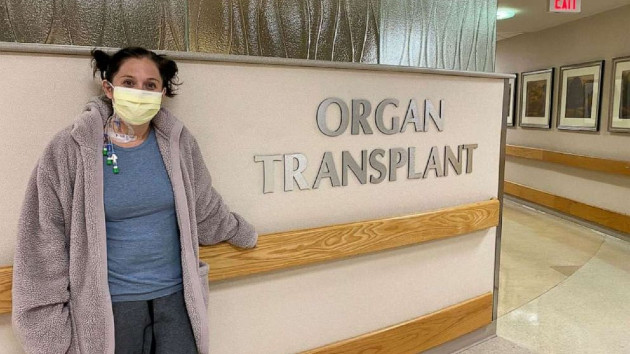
Woman gets stomach transplant after not being able to eat for over 10 years

Woman gets stomach transplant after not being able to eat for over 10 years
Courtesy of Sarah Granados

(NEW YORK) — A North Carolina woman who had been unable to eat solid foods for over a decade due to a rare condition underwent a life-changing multiorgan transplant that gave her a new stomach, pancreas and intestines.

Sarah Granados, a mom of three from Gastonia, North Carolina, waited 444 days for the transplant, which took place in November at Indiana Health University Hospital, more than 500 miles away from her home.

“It gave my kids their mom back. It gave my husband back his wife,” Granados, 36, said of the transplant. “It gave me the chance to dream about things I haven’t dreamt about in years because I was too scared to.”

Granados has faced life-threatening medical complications since 2012, when she underwent what was considered a routine surgery to remove her gallbladder because of a potentially cancerous spot.

Though the surgery did not have complications, Granados said doctors believe she was uniquely affected by it because she has Hypermobile Ehlers-Danlos syndrome, an inherited connective tissue disorder that can cause gastrointestinal dysfunction.

After the surgery, Granados said she was unable to eat solid foods and had to be placed on a feeding tube.

Doctors diagnosed her with severe gastroparesis, a disorder that “slows or stops the movement of food from your stomach to your small intestine,” according to the National Institutes of Health.

After spending six years on a feeding tube, Granados underwent a second surgery, a gastrectomy, in 2018 to remove her stomach and part of her small intestines. Complications from that surgery, she said, sent her into intestinal failure and she was diagnosed with intestinal pseudo-obstruction, a rare condition when the intestines appear blocked, according to the NIH.

Granados, whose youngest child was around 4 years old at the time, was then placed on total parenteral nutrition, a lifesaving measure that delivers nutrients intravenously.

“I ran into complications almost immediately,” said Granados. “It was at that time that [doctors] said, ‘You’re either going to need a transplant or your life expectancy is probably only a few years.”

Doctors determined that Granados needed a transplant of her gastrointestinal system, a rare procedure that only occurs in around 100 patients worldwide each year, according to Dr. Richard Mangus, surgical director of the IU Health intestine transplant program and the doctor who performed Granados’ transplant.

Granados went on the transplant list in 2020, during the coronavirus pandemic, and spent much of the time leading up to the transplant in the hospital.

She was hospitalized in North Carolina in November 2021 when she got the call that a donor had been found with a stomach, pancreas and small and large intestines deemed a “perfect match” for Granados.

“At that point I was having conversations with my family about having my lines actually removed and going into hospice because I was ready to be done,” said Granados. “And not because I don’t love my life, and not because I wouldn’t give anything and everything, but because my body was really, really tired and couldn’t stand the thought of living in a hospital anymore.”

“I essentially had to have a perfect donor to make this this match happen,” she said.

Within 24 hours of getting the call, Granados was transported by plane to Indiana Health University Hospital in Indianapolis.

At the same time, Mangus flew to the location of the deceased donor to oversee the removal of the organs.

Once back in Indianapolis, on Nov. 14, 2021, Mangus oversaw a complex, 10-hour transplant procedure that involved several doctors.

“Usually there are a couple of surgeons taking her organs out, while a couple of surgeons are preparing the organs on a separate table, and then when her organs are out, we go ahead and bring the the new organs and put them into her abdomen,” Mangus explained. “We have to connect the blood vessels … and then we have to connect back to the intestinal tract .. and then distally we have to connect into her large intestine as well.”

Granados said she has thought every day since her transplant about the donor, whom she calls her “angel donor.”

“I can’t change that they had an untimely death, but I truly believe that there are angels that are made to save other people,” she said. “And in my case, the doctors were saying there was a one-in-a-million chance, so I’m very fortunate that I got my one-in-a-million.”

Granados continued, “There’s not an hour that goes by that I’m not very keenly aware that I’m now carrying somebody else. It’s a privilege but it’s also something I take very, very seriously.”

Both Granados and Mangus stressed the importance of organ donation, for which there is a critical need in the United States. More than 106,000 people are currently on the transplant waiting list, and 17 people die each day waiting for an organ transplant, according to U.S. government data.

“They ultimately had to be willing to share five organs with me,” Granados said of her own donor, whose identity she does not know but whose family she said she prays she can one day meet.

“I’m making the choice to honor the beauty of organ donation by talking about it,” she said. “Now every person I walk by, I’m like, ‘You have the potential to save a life or I have the potential to save yours.'”

Granados has had to stay in Indianapolis since November as doctors oversee her recovery. She had a brief visit with her husband and kids, now ages 18, 16 and 14, when the hospital allowed them to visit on Christmas Day.

“We had our first official family meal,” said Granados, who was able to sit and eat with her family for the first time in her kids’ memory. “My oldest daughter couldn’t even hardly eat her food because she was crying because she couldn’t believe that we were having a family dinner.”

In late February, Granados was also allowed to drive to North Carolina to again see her kids, whom she surprised at a local park.

“Getting to surprise them and the look on their faces when they realized it was me might be the best moment of my life,” she said, adding that the visit home gave her “the boost and the strength to go back and continue fighting.”

Granados said she is now on a regimen of 33 prescription medications daily as she fights for her body to continue to accept the transplanted organs.

She said that though her fight is far from over and though there are many hard days in the process, she is for the first time in years allowing herself to dream of a future, which includes swimming with her kids, eating meals with them and fulfilling her dream of opening an animal sanctuary.

“I owe it to my angel donor and to my family to live as best as I possibly can, and I think that means sharing hope and sharing joy wherever I possibly can, so that’s what my goal is,” said Granados. “Like I tell my kids, ‘As long as we have air in our lungs, there’s hope.'”

Copyright © 2022, ABC Audio. All rights reserved.

Jan 6. committee: Trump engaged in ‘criminal conspiracy,’ may have broken laws

Jan 6. committee: Trump engaged in ‘criminal conspiracy,’ may have broken laws
Tasos Katopodis/Getty Images

(WASHINGTON) — The House committee investigating the Jan. 6 Capitol attack said Wednesday it has evidence that former President Donald Trump and some of his associates may have illegally tried to obstruct Congress’ count of electoral votes and “engaged in a criminal conspiracy to defraud the United States” in their efforts to overturn the 2020 election results.

The committee argued in a federal court filing Wednesday that Trump may have committed two crimes as it challenged a bid by former Trump lawyer John Eastman to block investigators from obtaining thousands of pages of emails.

The panel argued that the records should not be protected by attorney-client privilege under the crime fraud exception, given that Eastman’s legal advice may have helped Trump commit multiple crimes.

“The facts we’ve gathered strongly suggest that Dr. Eastman’s emails may show that he helped Donald Trump advance a corrupt scheme to obstruct the counting of electoral college ballots and a conspiracy to impede the transfer of power,” Reps. Bennie Thompson, D-Mississippi, and Liz Cheney, R-Wyoming, the leaders of the panel, said in a statement.

Eastman’s lawyer, Charles Burnham, said in a statement to ABC News that Eastman “has a responsibility to protect client confidences, even at great personal risk and expense.”

“The Select Committee has responded to Dr. Eastman’s efforts to discharge this responsibility by accusing him of criminal conduct,” Burnham said. “Because this is a civil matter, Dr. Eastman will not have the benefit of the Constitutional protections normally afforded to those accused by their government of criminal conduct. Nonetheless, we look forward to responding in due course.”

Representatives for Trump did not respond to requests for comment.

The new filing marks the first time the committee has formally accused Trump of specific criminal activities, by working to disrupt the joint session of Congress on Jan. 6 and by waging a campaign to overturn the results in key states and promote unfounded claims of widespread voter fraud.

“As the courts were overwhelmingly ruling against President Trump’s claims of election misconduct, he and his associates began to plan extra-judicial efforts to overturn the results of the election and prevent the president-elect from assuming office,” the committee wrote in its filing.

“At the heart of these efforts was an aggressive public misinformation campaign to persuade millions of Americans that the election had in fact been stolen. The president and his associates persisted in making ‘stolen election’ claims even after the president’s own appointees at the Department of Justice and the Department of Homeland Security, along with his own campaign staff, had informed the president that his claims were wrong,” it stated.

While lawmakers on the panel cannot formally charge Trump with a crime, they have suggested their investigation would result in a criminal referral to the Justice Department, which would then decide whether to prosecute the former president.

In making their case that Trump and key allies tried to stop the counting of electoral votes and pressure former Vice President Mike Pence “to manipulate the results in his favor,” the committee cited several interviews with senior White House officials and aides to Pence, including his attorney and chief of staff.

“The evidence supports an inference that President Trump, plaintiff and several others entered into an agreement to defraud the United States by interfering with the election certification process, disseminating false information about election fraud, and pressuring state officials to alter state election results and federal officials to assist in that effort,” the committee wrote in the filing.

Eastman was subpoenaed by the committee in January for his role in crafting two legal memos that argued Pence had the authority to overturn the election results on Jan. 6.

He continued making the case for Pence to overturn the results even as pro-Trump rioters clashed with Capitol Police and sent the vice president into hiding on Capitol Hill.

“We are now under siege,” Pence’s counsel Greg Jacob wrote to Eastman, placing blame on him in a Jan. 6 email released by the committee Wednesday.

“The ‘siege’ is because YOU and your boss did not do what was necessary to allow this to be aired in a public way so that the American people can see for themselves what happened,” Eastman replied to Jacob in the middle of the riot.

Later that evening, Eastman again wrote to Jacob, “I implore you to consider one more relatively minor violation [of the Electoral Count Act] and adjourn for 10 days to allow the legislatures to finish their investigations, as well as to allow a full forensic audit of the massive amount of illegal activity that has occurred here,” according to another email released by the committee.

In the court filing, the committee wrote that this email correspondence suggests Eastman “knew what he was proposing would violate the law, but he nonetheless urged the vice president to take those actions.”

Earlier this week, the State Bar of California announced an investigation into whether Eastman violated state ethics laws for attorneys in his work with Trump challenging the 2020 election results.

Exhibits released as part of Wednesday’s court filings also included excerpts of depositions from several key witnesses the committee interviewed over the last few months, including Trump adviser Jason Miller, former Pence Chief of Staff Marc Short, and former Pence national security advisor Keith Kellogg. The interviews show what kinds of conversations took place among key figures within the Trump circle leading up to and on Jan. 6.

According to one exhibit, Miller, a senior advisor to Trump described that, “soon after the election, a campaign data expert told the President ‘in pretty blunt terms’ that he was going to lose.”

But Trump disagreed with the campaign data expert, Miller said, according to the exhibit.

In another exhibit released on Wednesday, then-Acting Deputy Attorney General Richard Donoghue told the Jan. 6 committee that Trump repeatedly pressed the Justice Department to “publicly say that the election is corrupt or suspect or not reliable” even though Donoghue himself had “personally informed” Trump “in very clear terms” that the Justice Department concluded that there’s no evidence to support major allegations of voter fraud.

Another exhibit shows a text message from Ben Williamson, an aide to Trump’s former Chief of Staff Mark Meadow on Jan. 6 warning Meadows: “Would recommend POTUS put out a tweet about respecting the police over at the Capitol — getting a little hairy over there.”

Copyright © 2022, ABC Audio. All rights reserved.

Airbnb hosts opening their hearts — and doors — to refugees fleeing Ukraine

Airbnb hosts opening their hearts — and doors — to refugees fleeing Ukraine
Thiago Prudencio/SOPA Images/LightRocket via Getty Images

(NEW YORK) — The Russian invasion of Ukraine has displaced thousands of people, many of whom are fleeing to nearby Poland and elsewhere. Now Airbnb.org — the non-profit wing of the popular home-sharing company — is stepping up to help.

Airbnb.org’s Open Homes Initiative got its “unofficial” start in 2012, and has since spread all over the world, Joe Gebbia, co-founder and chairman of Airbnb.org tells ABC Audio.

“[W]hen Hurricane Sandy hit…the Eastern seaboard and displaced a lot of people, the next day we get an email from one of our hosts who says, ‘Dear Airbnb, how do I offer my five guest rooms, my Brooklyn loft for free to those displaced by the hurricane?'” Gebbia recalls. “At the time, we had no way to actually facilitate that.” 

“But after a 48-hour engineering marathon [fueled by] Red Bull and pizzas,” Gebbia says, they reconfigured their site and “within about a day or so” had hundreds of rooms available.

“For the last 10 years, we’ve been active in well over 100 countries supporting people fleeing typhoons, wildfires, hurricanes, floods,” he says. “It’s been incredible to see how our host community has to date housed over 100,000 people already all over the world.”

As for Ukraine, Gebbia says, “[S]o many lives have been disrupted with these scenes unfolding of the violence happening there. And I think this will likely produce one of the largest humanitarian crises since likely since World War II.”

Gebbia says the non-profit has offered governments of neighboring countries to help house Ukrainian refugees in hosts’ homes, with the goal of housing up to 100,000 people fleeing Ukraine.

“We’re doing everything we can to use our infrastructure to help, but we need more hosts,” he says.

If you’d like to help, visit Airbnb.org.

Copyright © 2022, ABC Audio. All rights reserved.

House set to vote on help for veterans exposed to ‘burn pits’

House set to vote on help for veterans exposed to ‘burn pits’
Michael Godek/Getty Images

(WASHINGTON) — The push to support military veterans plagued with health issues caused by toxic exposure to burn pits got a significant boost during President Joe Biden’s State of the Union address Tuesday — his support coming just before the House was set to vote Thursday on a bill that would expedite health care and disability payments for millions of veterans.

“I’m calling on Congress: pass a law to make sure veterans devastated by toxic exposures in Iraq and Afghanistan finally get the benefits and comprehensive health care they deserve,” Biden said, calling it part of “a sacred obligation to equip all those we send to war and care for them and their families when they come home.”

Biden lamented the dangers of the toxic smoke from burn pits, which have resulted in enduring health issues for military veterans stationed overseas in Iraq, Afghanistan and Southwest Asia.

The open-air combustion of trash and other waste in burn pits is a common practice of military operations. Common materials incinerated in burn pits included human waste, paint, metal cans, food waste, unexploded ordnance, lubricant products, plastics, rubber, wood and even jet fuel.

Active-duty service members who have been exposed to these toxic chemicals are often plagued with life-threatening diseases and illness.

“And they come home, many of the world’s fittest and best-trained warriors in the world, never the same,” Biden told lawmakers. “Headaches. Numbness. Dizziness. A cancer that would put them in a flag-draped coffin.”

Biden poignantly recalled the memory of his late son, Beau Biden, who died from brain cancer in 2015.

“We don’t know for sure if a burn pit was the cause of his brain cancer, or the diseases of so many of our troops,” Biden said. “But I’m committed to finding out everything we can.”

Approximately 82% of post-9/11 veterans who served in Iraq and Afghanistan reported being exposed to burn pits and/or airborne toxic materials during their service, according to Iraq and Afghanistan Veterans of America, a nonprofit organization.

About half of those exposed believe they have symptoms associated with the exposure, and another 41 percent are unsure if their symptoms are related.

“My eyes burned. It was hard to take a deep breath when I coughed and it made chest hurt and it made me cough,” Katie Purswell, a former veteran and director of health policy at the American Legion, said during a press conference on Capitol Hill Wednesday.

“I choked on the odor from the winds when they would pick up after a while. I started waking up with bloody noses. It was difficult and painful to breathe. After I got home, I had bronchitis for a year. I don’t think my runtime has ever recovered. I just can’t take a deep breath anymore,” she said, describing the symptoms she faced following prolonged exposure to toxic burn pits while stationed overseas.

Purswell was joined by former veterans, advocates, members of Congress, and comedian Jon Stewart at the Capitol Wednesday in support of a bill the House intends to pass Thursday.

Stewart and fellow advocate and 9/11 first responder John Feal have long lobbied Congress for veterans and first responder health care, often challenging lawmakers in emotional testimony — protesting what they believe is inadequate care for the nation’s veterans.

“Last night, they were seen,” Stewart said of the president’s national address. “The president of the United States saw their struggle.”

The group is calling on Congress to pass the bill, Honoring Our PACT Act, that aims to improve health care and benefits for veterans exposed to toxic substances.

The bill would specifically designate 23 respiratory illnesses and cancers as likely linked to toxic exposures related to military burn pits and airborne hazards exposure.

Currently, the Department of Veterans Affairs decides these exposure claims on a case-by-case basis, with the exception of those filed for asthma, rhinitis or sinusitis. The burden of proving one’s illness is related to a burn pit exposure falls on the veteran, leading to delays in health care.

“There is no other toxic exposure legislation in Congress like it in scope or soundness,” Rep. Mark Takano, chairman of the House Veterans’ Affairs Committee, said Wednesday.

The California Democrat authored the legislation that has bipartisan support in the House.

“Without hesitation, our veterans raised their right hand to protect and defend this nation. And many are now sick as a result of that service. We made a pact with these individuals — a pact I’m afraid to say we have not yet honored,” Takano said.

Takano said his bill will address the full gamut of issues affecting toxic exposed-veterans, access to health care and benefits, while also reforming the VA’s “presumptive” decision-making process to provide health care to more than 3.5 million veterans who have been exposed.

The White House on Monday announced that the Department of Veterans Affairs is also making efforts to rework their policies — the VA proposed a rule that would recognize nine new respiratory illnesses as conditions that are presumed linked to a veterans’ military service, which would help fast track them for payouts and medical care.

Dennis McDonough, secretary of Veterans Affairs, alluded to the proposed changes during an interview with ABC News last month.

McDonough, acknowledging the “cumbersome” process veterans must go through to prove their illnesses are linked to exposure to burn pits, told ABC News that the department is working to establish the evidence to suggest even more illnesses are linked to burn pit exposure that he hopes the department will soon recognize.

The Senate Veterans Affairs Committee is undertaking its own effort to address the issue of toxic exposure for veterans as part of a three-step, bipartisan approach. But advocates, including Stewart and Feal, say the Senate’s effort doesn’t go as far in scope.

Some senators, however, are concerned that the House’s version of the bill is too pricey: the House bill calls for nearly $300 billion in spending over 10 years.

House Speaker Nancy Pelosi, standing next to Stewart and Feal during Wednesday’s press conference, defended the price tag.

“Don’t even talk to us about the price,” Pelosi said. “This is a cost of war that we should recognize … it’s going to be worth it. But it’s going to have a big price tag.”

“Because what we are looking at is the value of what this does for our country,” she said.

Sources familiar with the process told ABC News that members of the House and Senate will have to figure out their policy differences and take their respective bills to conference in the coming months to reach a final compromise.

The process could delay passage in the Senate for months to come before it would eventually reach Biden’s desk for his signature.

Stewart and Feal had a stark message for members of the Senate.

“Once this is done, make no mistake, then the battle shifts to the Senate. And as you know, they are excellent at killing things that are necessary. And we cannot allow it to happen,” Stewart said. “And you cannot allow this feeling of unity and hope and finally being seen to dissipate. We need all of your help to put the pressure on to make sure that the comprehensive needs that they have are passed.”

Feal warned Senate Majority Leader Chuck Schumer that he plans to lobby him hard.

“Let Schumer know that we want a bill compatible to the honorable PACT Act. If he does not do that, then I will make his life miserable,” Feal said.

A spokesman to Schumer said in a statement to ABC News: “Leader Schumer believes strongly in this bill and will do everything he can to pass it.”

Copyright © 2022, ABC Audio. All rights reserved.

Old Navy’s new FitsYou jeans adjust to one’s body type

Old Navy’s new FitsYou jeans adjust to one’s body type
Old Navy

(NEW YORK) — It’s no secret that your waist size today might not have the same exact measurements tomorrow, and that’s one reason why one of Old Navy’s latest denim launches is getting a lot of attention.

The brand’s FitsYou jeans feature a unique technology: one pair can fit up to three sizes.

The innovative “one-size-fits-three” technology adjusts to your size by using a unique yarn and fabric construction that enables the jeans to grow with your body as your weight fluctuates.

Falling in line with Old Navy’s commitment to “BODEQUALITY” announced last year, the jeans feature 70% stretch, Lycra-free technology which allows the fabric to expand over your body without feeling compressive.

According to the brand, there’s also a “Never-Quit Shape Retention” feature that works to hold the shape of the jeans over a period of time.

Old Navy’s FitsYou denim styles are available in sizes 00 – 30 and in several different colors. Right now, the brand is offering an extra 30% off when you use code HURRY at checkout.

Copyright © 2022, ABC Audio. All rights reserved.

Rare image of Princess Diana to be displayed in new Kensington Palace exhibit

Rare image of Princess Diana to be displayed in new Kensington Palace exhibit
Yui Mok/PA Images via Getty Images

(LONDON) — Princess Diana was once one of the most photographed women in the world, but one image of the late royal has yet to be seen in public — until now.

In a new royal photography exhibition at Kensington Palace, a rare picture of the Princess of Wales taken by photographer David Bailey will be on display.

The black and white portrait, which was taken by Bailey in 1988, shows Diana reserved, stoic and looking away from the viewer. The portrait was one of several shots during a shoot commissioned by the National Portrait Gallery. This particular photograph was kept by Bailey in his archive and has never been seen in public before.

In the press release for the exhibit, it notes that the princess personally chose Bailey to take the photo after being suggested several other established photographers for the commission.

The never-before-seen photo of Princess Diana will be featured alongside other photos of the royal family for the exhibit titled, “Life Through a Royal Lens,” which will explore the royal family’s relationship with the camera and offer a glimpse of them off-duty.

“Ever since Queen Victoria and Prince Albert first embraced the revolutionary technology of photography, the medium has shaped how the world views the British monarchy,” Claudia Acott Williams, curator at Historic Royal Palaces, said in a statement. “It has allowed the royal family to offer fascinating insights into their life and work, transforming the royal image and creating an unprecedented relationship between crown and subjects.”

“Life Through a Royal Lens” opens March 4.

Copyright © 2022, ABC Audio. All rights reserved.

Russia-Ukraine live updates: Russia claims to have seized eastern Ukrainian city

Russia-Ukraine live updates: Russia claims to have seized eastern Ukrainian city
Aytac Unal/Anadolu Agency via Getty Images

(NEW YORK) — Russian forces are continuing their attempted push through Ukraine from multiple directions, while Ukrainians, led by President Volodymr Zelenskyy, are putting up “stiff resistance,” according to U.S. officials.

The attack began Feb. 24, when Russian President Vladimir Putin announced a “special military operation.”

Russian forces moving from neighboring Belarus toward Ukraine’s capital, Kyiv, don’t appear to have advanced closer to the city since coming within about 20 miles, although smaller advanced groups have been fighting gun battles with Ukrainian forces inside the capital since at least Friday.

Russia has been met by sanctions from the United States, Canada and countries throughout Europe, targeting the Russian economy as well as Putin himself.

Here’s how the news is developing. All times Eastern:

Mar 03, 6:08 am
Ukraine claims to have raised flag over town outside Kyiv

Ukraine claimed Thursday to have raised its flag over the town of Bucha, close to the Ukrainian capital where some of the most intense fighting has been taking place in recent days and where Russia’s push south on Kyiv appears to have stalled.

A video posted on the official Facebook page of the Ukrainian Armed Forces’ ground troops purportedly shows soldiers hoisting the national flag outside Bucha’s town hall. The town is just a few miles north of the edge of Kyiv and about 15 miles from the center of the capital. Fighting is reported to be ongoing nearby and, in the video, an explosion can be heard in the distance as they raise the blue and yellow flag.

Mar 03, 5:34 am
Ukraine requests no-fly zone over Chernobyl

Ukraine is asking the International Atomic Energy Agency (IAEA) to call on NATO to close access to the airspace over the country’s Chernobyl nuclear power plant and the surrounding exclusion zone.

The deserted exclusion zone around the Chernobyl nuclear power plant, where the world’s worst nuclear accident took place in 1986, was seized by Russian forces last week.

A joint appeal to the IAEA was signed Wednesday by Ukrainian Energy Minister Herman Galushchenko, Oleh Korikov, head of the State Nuclear Regulatory Inspectorate of Ukraine, and Petro Kotin, head of Ukraine’s state nuclear energy company Energoatom.

“The fact of the seizure of the world-famous Chernobyl nuclear power plant has all the hallmarks of an act of nuclear terrorism committed against Chernobyl nuclear facilities and its personnel by Russian military units,” they said in the appeal.

Mar 03, 5:06 am
Russia claims to have hit another TV tower in Kyiv

Russia claimed Thursday that its forces have “disabled” another television tower in Ukraine’s capital.

Russian troops fired precision-guided weapons at a TV and radio center in the Lysa Hora region of Kyiv, according to Russian Ministry of Defense spokesman Igor Konashenkov.

“A strike delivered by a long-range precision-guided weapon disabled a reserve TV and radio center in the Lysa Hora area in Kyiv which the Ukrainian Security Service has been using for psychological operations against Russia,” Konashenkov said at a press briefing Thursday. “There are no casualties and there is no damage done to residential buildings.”

There were reports of more explosions in Kyiv on Thursday morning, but Ukrainian officials have yet to confirm that a second TV tower was hit.

A Russian missile struck Kyiv’s main TV tower in the heart of the capital on Tuesday.

Ukrainian Defence Minister Oleksii Reznikov has said that Russia is aiming to cut off a large part of Ukraine from the internet and communications.

Mar 03, 4:37 am
Russia claims to have seized eastern Ukrainian city

Russia claimed Thursday that its forces have seized the eastern Ukrainian city of Balakliya.

Russian troops worked together with Russia-backed separatist forces on the “successful offensive,” according to Russian Ministry of Defense spokesman Igor Konashenkov.

“The city of Balakliya has been freed from nationalist battalions,” Konashenkov said at a press briefing Thursday.

Balakliya is about 55 miles southeast of Kharkiv, Ukraine’s second-largest city, where heavy shelling continued Thursday.

Mar 02, 11:25 pm
US condemns Kremlin’s ‘full assault’ on ‘truth’ in media

The U.S. State Department is condemning Moscow’s attack on the media, saying the Kremlin “is engaged in a full assault on media freedom and the truth, and Moscow’s efforts to mislead and suppress the truth of the brutal invasion are intensifying.”

“The people of Russia did not choose this war. Putin did,” Ned Price, State Department spokesman, said in a statement. “They have a right to know about the death, suffering and destruction being inflicted by their government on the people of Ukraine. The people of Russia also have a right to know about the human costs of this senseless war to their own soldiers.”

The statement comes 24 hours after the Russian government blocked the country’s only two major independent news broadcasters, Dozhd TV and Radio Ekho Moskvy, accusing them of spreading “false information” about Moscow’s invasion of Ukraine.

“Ekho Moskvy has been respected for its even-handed treatment of breaking news since its founding 32 years ago, and, until yesterday, its broadcasts reached some 1.8 million daily listeners throughout Russia and beyond,” the State Department said in a statement Wednesday night. “Dozhd, which has been operating for more than a decade, is similarly known for high-quality reporting.”

Russian state channels, such as RT and Sputnik, are banned from using the word “war” or “invasion” in relation to Russia’s assault on Ukraine. Russian President Vladimir Putin instead has referred to it as a “special military operation.”

The State Department said the Russian Parliament will consider a bill Friday to make “unofficial” reporting on the invasion punishable by up to 15 years in prison.

Copyright © 2022, ABC Audio. All rights reserved.

Eloquii’s brand new bridal collection is coming

Eloquii’s brand new bridal collection is coming
Mint Images/Getty Images

(NEW YORK) — Ahead of wedding season, Eloquii, a plus-size clothing brand, announced its new bridal collection for 2022.

Launching this summer, Eloquii said it is releasing wedding wardrobe pieces in sizes 14-28.

This is the first time the retailer is putting out a dedicated bridal-focused line, and attire for bachelorette parties to bridal showers are included, it said.

In a statement, Eloquii said that it was inspired to create a bridal category as a result of that category being one of the top requests from customers. The company reported in a statement that searches for “white dress” on the brand’s website were one of the top on-site searches in 2021.

There will be a curated assortment of over 50 styles and accessories for all types of wedding events, and prices for dresses starting at $89, the company said.

“Our thoughtfully designed Bridal by ELOQUII collection features exquisite dresses and looks to suit every bride’s taste at an accessible price point,” said Eloquii design director Yesenia Torres. “We were inspired by our customer’s love of elegance, so we incorporated fresh and airy hues, delicate patterns, and luxurious fabrics that make ethereal statements.”

Torres said that the goal of the collection is to provide the ultimate wedding wardrobe of fashion-forward silhouettes that are expertly crafted in design and fit.

Eloquii shared sketches on Instagram of its upcoming line.

“I am SCREAMING. This gives me the opportunity to shine like every straight-sized girl on my pre-wedding events,” one commenter said.

Copyright © 2022, ABC Audio. All rights reserved.

Indiana Senate passes ban on transgender girls playing on girls’ sports teams

Indiana Senate passes ban on transgender girls playing on girls’ sports teams
Getty Images/Stock Photo

(NEW YORK) — An Indiana bill to ban transgender girls from participating in girls sports in K-12 schools passed the state Senate on Tuesday. State legislators voted 32-18 in favor of the bill.

The bill now goes to Indiana Gov. Eric Holcomb’s desk for signature. He has not explicitly said if he will sign it into law.

Holcomb previously stated that he agrees “adamantly that boys should be playing boys’ sports and girls should be playing girls’ sports.” It is unclear whether his definition of “boys” and “girls” is trans-inclusive.

Several organizations have spoken out against the legislation and called for Holcomb’s veto since Tuesday.

“With so much going on at home and abroad, it’s disappointing to see Indiana lawmakers prioritize regulating transgender student-athletes,” Amit Paley, CEO and executive director of The Trevor Project, a nonprofit focused on LGBTQ suicide prevention and crisis intervention, told ABC News. “This will likely become the second anti-trans bill enacted in 2022 and the 11th anti-trans sports ban across the country. While the rationale for these bills is based on myth and misunderstanding, the impacts they’re having are very real.”

Advocates say the bill will have a serious negative effect on transgender students’ mental and physical well-being.

“Trans kids — like all kids — just want to be able to play with their friends. This regressive and damaging legislation hurts transgender youth and doesn’t address any actual problem,” Cathryn Oakley, Human Rights Campaign state legislative director and senior counsel, said in a statement on Tuesday.

“This bill puts already vulnerable youth in more danger, and threatens the health and safety of all children in Indiana,” Sarah Kate Ellis, president and CEO of GLAAD, an anti-LGBTQ defamation organization, said in a statement. “Every child should have the chance to play with their friends and to belong, just as they are, and experience the lifelong benefits that being on a team can offer.”

Jay Brown, senior vice president of programs, research and training at The Human Rights Campaign Foundation, spoke on the stigma and potential consequences that bills like HB 1041 can perpetuate in the organization’s 2021 Epidemic of Violence report.

“When lawmakers discuss bills banning transgender and non-binary youth from accessing medical care, playing school sports or using restrooms, it sends a message that even from an early age transgender and non-binary people are different and unwelcome,” he said.

Authored by Republican Indiana state Rep. Michelle Davis, HB 1041 is one of several anti-trans bills being proposed around the country.

“I want to make sure that all the opportunities are provided for our young females and we protect the fair competition for them so they have all those possibilities,” Davis said at a hearing in January. Davis admitted under questioning during the hearing she could not cite any examples in Indiana of a cisgender student losing a chance to compete to a trans athlete, according to Indianapolis ABC affiliate WRTV.

Another Republican-backed bill, SB 435 or the “Save Girls’ Sports Act,” which similarly calls for a ban on transgender boys and girls participating in high school sports teams that correspond with their gender identity, passed in the Georgia Senate last week. It will have to pass in the House before going to Gov. Brian Kemp, a sponsor of the bill, for review.

ABC News’ Kiara Alfonseca and Tony Morrison contributed to this report.

Copyright © 2022, ABC Audio. All rights reserved.

US documenting Russian strikes on Ukrainian civilians but stopping short of calling them war crimes

US documenting Russian strikes on Ukrainian civilians but stopping short of calling them war crimes
Getty Images/Stock Photo

(WASHINGTON) — Russia is hitting civilian targets in Ukraine, killing innocent people and destroying hospitals, schools and critical infrastructure like running water, electricity and gas, U.S. Secretary of State Antony Blinken alleged Wednesday.

But President Joe Biden and his administration have stopped short of accusing the Kremlin of conducting war crimes in its invasion of Ukraine so far, with the top U.S. diplomat saying instead they are “looking very closely at what’s happening” and “documenting it.”

The U.S. and its NATO allies continue to provide Ukraine with assistance, including anti-aircraft missiles known as Stingers, a senior U.S. official confirmed. But that lethal military aid, overwhelming condemnation at the United Nations and the flight of Western businesses and crippling sanctions, including new ones announced Wednesday, have yet to change Vladimir Putin’s calculus as he seeks to topple Ukraine’s government.

Instead, Russia is increasingly switching to using indiscriminate bombardment to terrorize cities into submission — a tactic Putin’s forces honed previously in Chechnya and Syria and that seems to have secured them their first major Ukrainian city, Kherson.

Kharkiv, Ukraine’s second-largest city, has been pummeled with heavy artillery, rockets and airstrikes, destroying apartment buildings and government offices alike. Another major city, Mariupol, is under ferocious, continual bombardment with rocket barrages and ballistic missile strikes, knocking out the power.

Schools, hospitals and residences; buses, cars and ambulances; and infrastructure like drinking water, electricity, and gas amid Ukraine’s bitter winter have all been hit.

“These aren’t military targets. They are places where civilians work and families live,” Blinken told reporters, adding, “This is shameful.”

But while Biden said Wednesday morning he believed Russia is intentionally targeting civilian infrastructure, Blinken stopped short of that, saying the U.S. is still assessing particular strikes.

“We’re looking very closely at what’s happening in Ukraine right now, including what’s happening to civilians. We’re taking account of it, we’re documenting it, and we want to ensure, among other things, that there’s accountability for it,” he told reporters Wednesday.

The International Criminal Court announced Wednesday it would launch an immediate investigation into possible war crimes in Ukraine after 38 member states, including the United Kingdom and Canada, referred reported atrocities to the ICC.

“Our work in the collection of evidence has now commenced,” ICC Prosecutor Karim A.A. Khan said in a statement. Khan announced Monday that he would request to open a probe, which requires either authorization from a pre-trial ICC chamber or a referral by member states. Ukraine, like Russia and the U.S., is not a member state.

Under the ICC’s founding document, the Rome Statute, “intentionally directing attacks against the civilian population as such or against individual civilians not taking direct part in hostilities” is a violation of international law.

Russia has outright denied that it has struck any civilians or civilian infrastructure.

Amnesty International, among other human rights groups, reported Tuesday that it had documented “the escalation in violations of humanitarian and human rights law, including deaths of civilians resulting from indiscriminate attacks on civilian areas and infrastructure.”

“Strikes on protected objects such as hospitals and schools, the use of indiscriminate weapons such as ballistic missiles, and the use of banned weapons such as cluster bombs may all qualify as war crimes,” the group said.

While Blinken wouldn’t go that far, he compared Russia’s tactics in Ukraine to previous conflicts, where its forces were “absolutely brutal in trying to cow the citizenry of a given country, and that includes at the very least indiscriminate targeting and potentially deliberate targeting as well.”

To fight back, the U.S. provided several hundred anti-aircraft missiles, known as Stingers, to the Ukrainian military Tuesday, a senior U.S. official confirmed to ABC News. The missiles were part of a $350 million package Biden approved late Friday night, bringing total U.S. military aid to approximately $1 billion.

Before Putin launched his war, U.S. aid had been shipped in on regular flights to the capital Kyiv, where the airport has been shut down. Still, the U.S. has been successfully delivering military aid, according to Blinken, who declined to offer details on how.

“We are very actively working — every day, every hour — to provide that assistance,” Blinken said of the U.S. and its NATO allies, adding, “Vitally needed assistance is getting to where it needs to go.”

The U.S. also unveiled new sanctions Wednesday that target Russia’s oil and gas sector, its defense industry and its ally Belarus.

New export controls will bar oil and gas extraction equipment and refining technology, preventing Russian firms “from maintaining and upgrading current projects and, to some degree, from launching new projects,” the White House said.

The State Department is also implementing “full blocking sanctions” on 22 entities in Russia’s defense sector, while the Commerce Department is extending export controls on Russia to include Belarus, to prevent the country from transferring semiconductors and other technology to its powerful neighbor and ally.

ABC News’ Patrick Reevell, Ben Gittleson, and Luis Martinez contributed to this report.
 

Copyright © 2022, ABC Audio. All rights reserved.