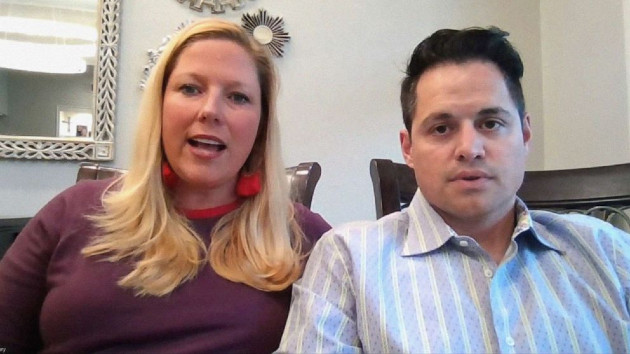
(NEW YORK) — Americans like Chris and Amy Clary are booking Airbnb vacation rentals online in a bid to help Ukrainians directly amid Russian attacks of the Eastern European country.
The Clarys are in Texas but they’ve booked five Airbnbs in Kyiv and outside the capital.
“We wanted to get money into people that are living there. And they’re desperate for funds, obviously for food, maybe to get out of town,” Chris Clary told ABC News’ Good Morning America.
Airbnb said it is “humbled by the inspiring generosity” of people looking to help through the platform.
“Airbnb is temporarily waiving guest and Host fees on bookings in Ukraine at this time,” the San Francisco-based company told GMA in a statement.
The company said on March 2 and 3, it saw more than 61,000 bookings in Ukraine, including more than 34,000 by U.S. guests. It has also set up a website — Airbnb.org — dedicated to helping people in emergencies. There have been over 1.2 million visits to the site already.
“Airbnb allows them to get funds almost immediately and directly to the source,” said Chris Clary. “I believe it’s important because those people need as much assistance as possible and as quickly as possible.”
Added his wife Amy: “I get to chat with the host. You know, find out how they’re doing. Are they OK? And ask questions. And it really makes it like a personal connection to what’s going on in Ukraine and to the Ukrainian people.”
The Clarys said they try to look for Airbnb listings that feature family photos and reviews from past bookings. They also send messages to hosts first with questions before booking.
“When you get the messages back, they are incredibly grateful. It really brings you to tears whenever you read them,” Chris Clary said.
The Clarys say they’ve inspired friends to do the same and hope to keep the momentum going, looking next into booking short-term stays in Poland, which borders Ukraine to the northwest.
Celebrities are also joining the growing number of people looking to help people caught in the Russian and Ukrainian conflict that began on Feb. 24.
Mila Kunis and Ashton Kutcher launched an online fundraiser called “Stand With Ukraine” to help Ukrainians. In a video message introducing the campaign, Kunis said she was born in Ukraine and emigrated to the U.S. in 1991 with her family and has “never been more proud to be a Ukrainian.”
Blake Lively and Ryan Reynolds have also announced they would match donations up to $1 million for the nonprofit UNHCR, the U.N. refugee agency.
Bethenny Frankel, the former reality TV star, has also used her BStrong initiative to get aid to Ukraine and neighboring countries like Poland, Hungary and Romania.
Former Dancing With the Stars choreographer Maksim Chmerkovskiy, who recently escaped Ukraine amid the escalating conflict, said he’s also working to help people in the region with his wife, dancer Peta Murgatroyd. They said they’ve started an Amazon store where people can buy items for people in need.
(NEW YORK) — As war in Ukraine rages on, several peace talks and increasing economic sanctions against Russia have failed thus far to stop the aggression.
Ukrainians have withstood days of airstrikes and shelling across multiple cities since the invasion began on Feb. 24. The better-equipped Russian military has shown no signs of de-escalation and has claimed to have taken control of several areas of Ukraine, though it has also been slowed by Ukrainian resistance.
How far Russian President Vladimir Putin will go, how much longer Ukrainian forces can hold out and what exactly it would take to end the conflict are key questions in the war.
“No one has a crystal ball, and it is very difficult to predict outcomes of conflict,” said retired Gen. Robert Abrams, an ABC News contributor and the former commander of U.S. forces in Korea.
Amid “unprecedented” sanctions against Russia and the stronger-than-expected Ukrainian resistance, “what appears to be happening is Putin is becoming even more resolved,” Abrams said. He pointed to threatening comments Putin made Saturday about Ukraine’s statehood, which “in plain speak means Russia is intent to invade, occupy and make Ukraine part of Russia, and erase the name Ukraine and replace it with Russia. That’s new. And that is an indication that it will be difficult to judge how far Putin will go.”
Role of international aid
When asked at a Thursday news conference by ABC News senior foreign correspondent Ian Pannell how long Ukraine can hold out against the Russian advance, Ukrainian President Volodymyr Zelenskyy said, “I don’t know.”
One key factor in Ukraine’s fight is the level of support from the international community, including NATO, the European Union and the United Nations, Abrams said.
The United States has provided hundreds of millions of dollars in military aid to Ukraine, and millions more in lethal aid has been sent by NATO and several EU countries.
“I think there are many other things that we can do to support the Ukrainian military and the Ukrainian people,” like arms, ammunition, enhanced communications and food, Abrams said. “It’s going to require continuous and predictable resupply into Ukraine to be able to give them the means necessary to defend themselves.”
During a Zoom call Saturday with more than 300 U.S. lawmakers, Zelenskyy pleaded for more air support, including drones and planes, Rep. Mike Quigley, D-Ill., a co-chair of the Congressional Ukrainian Caucus, told ABC News Live. Quigley said the president also repeated his call for a no-fly zone over Ukraine — something experts have argued could very quickly escalate into a “World War III”-type scenario.
“To those who are advocating for a no-fly zone, we just need to all ask the question, are we prepared for the consequence — basically starting World War III?” Abrams said. “I don’t think we are, I don’t think it’s worth the risk of that sort of level of conflict, because that’s what is coming. President Putin has made it clear that anybody that intervenes militarily will be treated as an enemy. That’s not a bluff.”
“And he is prepared to escalate this conflict as high as anybody wants to go,” he continued.
Morale on both sides
Another key factor in the outcome of the conflict is how long Ukrainians can “maintain their will,” Abrams said.
“How much are they willing to sacrifice for their country?” he said. “It is crystal clear that they have been galvanized, that the country has been galvanized, the Ukrainian people are fighting for their country and for their way of life. … What will that look like on day 60? Day 120? That is difficult to predict.”
President Joe Biden remarked during his State of the Union last week that the Ukrainians’ “fearlessness, their courage, their determination, literally inspires the world.”
Zelenskyy has been a key part of maintaining morale, Abrams said.
“He has been masterful in leading his country in this conflict,” Abrams said. “He is sharing the same hardships, he is communicating with his people. He’s constantly communicating with the international community.”
That connection can help Ukraine prevail, he said, though “we’re in for some very, very difficult, tough days and tough images, for those of us outside looking in.”
Meanwhile, Russia’s military, though superior, has been dogged by logistical challenges, including food and fuel shortages, and a “lack of cohesion and discipline,” which could work in Ukraine’s favor, Abrams said.
“I think that’s the bigger picture that people really need to understand about the dynamics and what makes soldiers fight with the ferocity and intensity that we would expect to see,” he said. “It boils down to, do you believe in what you’re fighting for? And in this case, I think what we’re seeing is not necessarily extensive effects of lack of food or fuel — that certainly does have a role to play — but I don’t think the Russian military believes in what they’re fighting for.”
A possible off-ramp
The “Russian playbook” indicates that its military will continue to bomb and shell Ukrainian cities and “choke them out,” according to Abrams — pointing to Aleppo, Syria, and Grozny, Chechnya, as examples — in order to take over and instate its own puppet government.
The international community, in particular NATO members, has been closely watching the conflict in hopes of preventing it from escalating beyond Ukraine’s borders as well.
A senior White House official told ABC News the administration has been discussing efforts to make sure Putin is not completely boxed in with no way out but to fight.
Abrams said he thinks there is a chance for a potential “off-ramp” for Russia, “but it will require compromise.”
That could look like Putin getting at least one of his demands met, such as Ukraine recognizing the two breakaway regions in the Donbas region as separate states, a guarantee of neutrality in Ukraine or a commitment that Ukraine never joins NATO.
“History tells us to end these wars, there’s always going to have to be compromise, because I don’t think we’re going to find either side giving unconditional surrender. That’s the other alternative, and I think that’s highly, highly unlikely,” Abrams said.
Though much remains unclear at this time, two things are certain, Abrams said.
“I think we can be certain that the vast majority of the cities in Ukraine are likely to be decimated and destroyed,” he said. “I say that because the Ukrainian resistance, their armed forces and their people, has been so strong, so capable, and it has come as a complete surprise to the Russian military … and as a result, the Russian military has already basically taken the gloves off and they’re using what we call dumb bombs — non-precision-guided munitions, rockets and artillery — in suburban areas and housing areas, destroying civilian infrastructure.”
Additionally, the conflict is going to displace millions of people, he said. So far, over 1.5 million people have fled Ukraine, and the United Nations has predicted that 10 million Ukrainians ultimately could be displaced by the war.
“There’s nothing good coming out of this war,” Abrams said. “The stories of the courage and heroism and just the grit, the real grit of the Ukrainian people — it’s inspiring. But their country is slowly being destroyed, one village at a time.”
(NEW YORK) — Russian forces are continuing their attempted push through Ukraine from multiple directions, while Ukrainians, led by President Volodymyr Zelenskyy, are putting up “stiff resistance,” according to U.S. officials.
The attack began Feb. 24, when Russian President Vladimir Putin announced a “special military operation.”
Russian forces moving from neighboring Belarus toward Ukraine’s capital, Kyiv, don’t appear to have advanced closer to the city since coming within about 20 miles, although smaller advanced groups have been fighting gun battles with Ukrainian forces inside the capital since at least Friday.
Russia has been met by sanctions from the United States, Canada and countries throughout Europe, targeting the Russian economy as well as Putin himself.
Here’s how the news is developing. All times Eastern:
Mar 07, 7:42 am
Ukrainian foreign minister again calls for NATO no-fly zone
Ukrainian Minister of Foreign Affairs Dmytro Kuleba on Monday called for NATO to enforce a no-fly zone over Ukraine, saying Russian planes were targeting civilians.
“The Russian Air Force dominates in the skies and continues bombing our cities and killing many civilians,” Kuleba told George Stephanopoulos on Good Morning America.
U.S. and NATO officials have rejected calls from Ukrainian officials to impose a no-fly zone, saying doing so could provoke Russia, perhaps pulling other European countries and NATO members into the conflict. The U.S. and NATO have offered other military aid, including a possible deal to send aircraft to Ukraine.
“We believe that the rejection of the idea of the no-fly zone is based in the lack of confidence in the strength of NATO as an alliance,” Kuleba said. “Because the military might of NATO is incomparably bigger compared to Russia. So why would Russia dare to shoot down a NATO plane, knowing it is doomed, eventually doomed, if a war with NATO begins.”
Kuleba over the weekend had urged the international community to help in the struggle against “Russian barbarians.” He posted a photo on Twitter on Sunday of an unexploded bomb, which he said landed on a residential building in Chernihiv.
Mar 07, 5:50 am
Ukraine casts doubt on Russian pledge for civilian pathways
Ukrainian officials said Russia’s proposal on Monday to open “humanitarian corridors” for cities in Ukraine is not a genuine offer because it offers to evacuate civilians only to Belarus and Russia.
Iryna Vereshchuk, a Ukrainian vice prime minister, in a televised briefing called that “unacceptable” and said Ukraine had demanded instead that civilians be allowed to evacuate to other parts of Ukraine.
Russia’s Defense Ministry had said it would open a corridor from towns and villages north of Kyiv, where heavy fighting is taking place, but that would allow people to travel to the Belarusian city of Gomel and then be flown to Russia. Russia also offered corridors near the besieged northeastern and eastern cities of Kharkiv, Sumy and Mariupol, but that would also only allow people to leave over the border to Russia.
“This is an unacceptable option of humanitarian corridors. Our people from outskirts of Kyiv won’t go to Belarus and then to Russia,” Vereshchuk said.
She said that Ukraine wants civilians north of Kyiv to be permitted to leave to the capital and for those from Kharkiv to be allowed to western cities by train, and from Mariupol north to the central city of Zaporizhzhia.
“We delivered our proposal on how the corridors should be organized,” Vereshchuk said, later adding, “Humanitarian aid is prepared for a number of towns in the east and south. We ask Russia to confirm these corridors and provide ceasefire.”
Russia has repeatedly violated its own ceasefire since offering humanitarian corridors for Mariupol and another eastern town Volnovakha, including shelling evacuation points in Mariupol according to officials there. The Red Cross, which is trying to organize the evacuations, has said the agreements currently are too vague and without clear understandings for routes out.
Russia said Monday’s offer for the corridors was made following a lengthy phone conversation between French President Emmanuel Macron and Russian President Vladimir Putin on Sunday.
Vereshchuk said Russia was trying to exploit Macron’s name for a disingenuous offer of corridors.
“I hope president Macron understands that his name and good intentions are manipulated by Russia,” she said.
-ABC News’ Patrick Reevell
Mar 07, 3:43 am
Refugee arrivals to Poland top 1 million, guard says
More than 1 million people fleeing Ukraine have arrived in Poland since the Russian invasion began on Feb. 24, the Polish Border Guard said on Monday.
A record 142,000 people arrived on Sunday, the guard said on Twitter. On Monday, about 42,000 people had crossed the border before 7 a.m. local time.
As of Sunday, more than 1.5 million people had fled the war in Ukraine, marking the “fastest growing refugee crises in Europe since World War II,” according to Filippo Grandi, the U.N. high commissioner for refugees.
Mar 07, 2:43 am
With attacks on TV towers, Russia seeks to isolate Ukrainians, UK says
Russian forces have attacked Ukrainian communications infrastructure to “reduce Ukrainian citizens’ access to reliable news and information,” the U.K. Ministry of Defence said on Monday.
“Russia reportedly struck a TV tower in Kharkiv yesterday, suspending broadcasting output,” the Ministry’s update said.
Russian forces on March 1 struck a TV tower in Kyiv, the capital.
Mar 07, 2:18 am
Russia says cease-fire will allow evacuations from 4 cities
Russia declared a cease-fire starting Monday morning, opening humanitarian corridors for the evacuation of civilians from Kyiv, Mariupol, Kharkiv and Sumy, the Russian interagency humanitarian response staff in Ukraine said.
“Taking into account the disastrous humanitarian situation and its severe deterioration in the cities of Kyiv, Kharkiv, Sumy, and Mariupol, and also at French President Emmanuel Macron’s personal request to Russian President Vladimir Putin, the Russian Armed Forces are declaring a ceasefire and opening humanitarian corridors for reasons of humanity starting 10:00 a.m. on March 7, 2022,” the staff said.
Ukrainian officials in Mariupol said Russia broke planned cease-fires on Saturday and Sunday.
Vlad Karkov/SOPA Images/LightRocket via Getty Images
(NEW YORK) — In light of Russia’s unprovoked invasion of Ukraine, many major American and Western companies have decided to drop their presence in the region.
In the last two weeks, movie studios Warner Brothers, Sony Pictures and Disney, the parent company of ABC News, have dropped future movie releases in Russia. Ikea shut down all Russian stores and production operations. Microsoft and Apple have ceased all sales, including game consoles and phones, in the country as well.
On Saturday, Visa and Mastercard announced they would stop Russian operations.
That list is expected to grow as the conflict continues and consumers look for companies to take a stand on the invasion, business experts told ABC News.
“Companies have found it difficult to stay out of [current events],” Erik Gordon, an assistant professor at the University of Michigan’s Ross School of Business, told ABC News. “That doesn’t work anymore. If you don’t take a stand one way or another the conclusion is you’re either amoral or taken a bad stand.”
Gordon and other business experts said that there is also the economic calculus involved in the companies’ decisions to pull out of Russia as its declining economy makes the country a poor investment. Nonetheless, the experts said this is likely to pose a turning point in nearly 30 years of Western business in Russia.
Gordon said it’s unlikely that any of the Western business pauses will make an impact on Russian President Vladimir Putin’s war in Ukraine, compared to the economic sanctions levied by the U.S. and European nations. The Russian government, however, will likely retaliate against Western-based products and services with boycotts and blocks as the conflict continues.
On Friday, the country said it would ban Facebook and Twitter.
“I don’t think the Russian business will be a hospitable place for Western business for a very long time,” he said.
Shon Hiatt, an associate professor of management and organization at the University of Southern California, told ABC News that a similar situation took place during World War II when American companies stopped shipping their goods to Germany. Corporations lost millions of dollars in revenue during the 1940s, but Hiatt said the increased globalization of today’s economy means that American companies won’t take as much of a hit by halting their Russian operations.
“This isn’t the divestment like we’re seeing with BP or the other oil companies,” Hiatt said. “This is a small drop in the bucket for these companies compared to other markets.”
He noted, as an example, that the Russian market represents roughly 3% of worldwide sales for the movie industry.
Hiatt said the next couple of months will be interesting to watch within the business community. Depending on how long the conflict goes on and if Russia succeeds in its invasion, corporations around the world will have to make a major decision barring any government action, he said.
“Most companies believe this is a small strategic pause,” he said. “They may believe that in a few months, things might go back to normal. It’s still a changing situation.”
(NEW YORK) — Jessica Parker, 40, didn’t transition until she was in her 30s.
She suppressed her identity in her conservative, central Texas town out of fear of rejection or violence. But as more and more LGBTQ people came into her life, she finally felt safe enough to come out, identifying publicly as a woman.
“I feel more myself than ever,” Parker told ABC News in an interview. “I’ve been happier than ever. It’s been a struggle, certainly, but it’s been great and I have a good trans community now.”
Her “chosen family” — the close circle of LGBTQ friends and allies she has cultivated — understands the beauty and power of the LGBTQ community and they’ve become a lifeline for her.
When facing rejection from family members or feeling lost about the challenges faced by the LGBTQ community, that’s where a chosen family steps in. Local activist groups, LGBTQ alliances or clubs, or dedicated spaces like queer bars are often the birthplaces of many chosen families.
As anti-LGBTQ policies and legislation proliferate across the country, finding such a community has become a vital tool. For many queer people, a chosen family can be a means for survival.
“That’s what’s beautiful about the trans community,” said D. Ojeda, a senior national organizer at trans advocacy organization National Center for Transgender Equality. Their pronouns are they/them and they identify as nonbinary.
“What makes us so resilient is that we tend to really be resourceful in making sure that our communities get what they need, even if external forces don’t protect us.”
Increase in anti-LGBTQ legislation
2021 was a record-breaking year for anti-LGBTQ legislation, according to the Human Rights Campaign. Legislatures in 2022 are moving full steam ahead with these ongoing efforts — including bills or governmental directives in Florida, Texas, Alabama, Indiana, and more that target these groups.
Recent bills and laws range from attempting to ban some trans children from sports; to banning trans people from the bathroom corresponding with their gender; to banning curricula featuring LGBTQ subjects in some classrooms.
The trans community has taken its safety into its own hands in many cases. Ojeda says trans activists have been dispatched to barbershops and hair salons, health clinics and other service locations to assess a businesses’ acceptance of trans people.
When someone needs a jumpstart on their car, or when someone needs moral support during a health care procedure — a chosen family will ensure that someone will be there to lend a helping hand.
They say it’s because other LGBTQ people often understand the collective struggles, queer joy and nuances of the community in a way only they may understand.
“We’re always looking out for each other,” Ojeda said. “Even when outside forces want to make sure that we don’t exist — that’s going to be an impossible thing to do. Because our community is resilient. We definitely have this strong, unified force. This is our chosen family.
Building a strong network
It’s why Parker, Ojeda and Ricardo Martinez, CEO of LGBTQ advocacy group Equality Texas, encourage LGBTQ youth to find or build a strong moral support system that understands the challenges of being part of the community.
A chosen family can save lives, they say.
According to the National Alliance on Mental Illness (NAMI), LGBTQ community members are at a higher risk for experiencing mental health conditions, including depression, anxiety disorders and suicidal ideations.
Transgender individuals, in particular, are at risk — they are almost four times as likely as cisgender people to experience a mental health condition and suicide, NAMI reports.
The organization also found that discrimination, prejudice, denial of civil and human rights and family rejection are oft the source behind this disparity.
“I’ve made a tremendous amount of friends [in the LGBTQ community], which brings me a tremendous amount of joy. But also heartbreak, right?” Martinez said, referring to the onslaught of anti-LGBTQ legislation and sentiment.
However, he said the heartbreak is short-lived.
He added, “Regardless of what powers are trying to attack us, I know that I can pull back on many of the families that I’ve met, who affirm the identity of their children, folks who I’ve met on the ground who are incredible advocates that have tremendous power not only in their words but in their actions.”
(NEW YORK) — Sen. Marco Rubio, vice chair of the Senate Select Committee on Intelligence, said imposing a no-fly zone over Ukraine amid Russia’s unprovoked invasion could lead to the “beginning of World War III.”
“I think people need to understand what a no-fly zone means … it’s not some rule you pass that everybody has to oblige by,” Rubio, R-Fla., told ABC “This Week” anchor George Stephanopoulos on Sunday. “It’s the willingness to shoot down the aircrafts of the Russian Federation, which is basically the beginning of World War III.”
In a Zoom call with U.S. lawmakers that Rubio participated in Saturday, Ukraine President Volodymyr Zelenskyy reiterated his request for the West to implement a no-fly zone over his country. But if that can’t be done, Zelenskyy asked for planes instead, several members of Congress said after the call.
Stephanopoulos asked Rubio about a potential deal with Poland to supply aircraft, which Secretary of State Antony Blinken said the U.S. is “actively looking at.”
“How about this provision of fighter jets? We would provide the fighter jets to Poland, other Eastern European nations, they would send the jets they now have to Ukraine, do you support that?” Stephanopoulos pressed.
“I do. If that can be done, that would be great,” Rubio answered. “I do have concerns about a couple of things. And that is sort of, you know, can they actually fly them given the amount of anti-aircraft capability that the Russians possess and continue to have deployed in the region? … But generally speaking, it’s something I’d be supportive of.”
Bipartisan support to ban Russian oil imports continues to grow among U.S. lawmakers, but the White House has yet to back it.
“The president has resisted banning Russian oil imports, of course, that would send gas prices soaring even more here in this country. Do you support that?” Stephanopoulos asked.
“I do and I don’t think — you know, I think that’s something that you can construct a plan to phase that in pretty rapidly,” Rubio said. “And you could use reserves for the purposes of buffering that. But we have more than enough ability in this country to produce enough oil to make up for the percentage that we buy from Russia.”
Rubio said the Biden administration’s unwillingness to stop importing barrels of Russian oil each day is simply “an admission that this guy, that this killer, that this butcher, Vladimir Putin, has leverage over us.”
“Why would we want that leverage to continue,” Rubio asked. “Why would we have someone like him to have the power to raise gas prices on Americans which is basically if he cuts us off, what would happen in the reserve?”
“So I think we have enough that we should produce more American oil and buy less Russian oil or none, actually, none at all,” he added.
When asked whether it was “responsible” for Republican Sen. Lindsey Graham of South Carolina to suggest in a tweet that someone should assassinate Russian President Vladimir Putin and “take this guy out,” Rubio did not condemn the comments, as others, like Republican Sen. Ted Cruz of Texas, did.
“Well, look, people are watching what’s happening in Ukraine and what this man is doing to these people, what this monster is doing to human beings, and they’re very angry about it,” Rubio said, adding that “at the end of the day I do think Vladimir Putin is going to face some problems internally in Russia.”
“How the Russians seek to take care of it is up to them,” Rubio continued. “I’m not sure he was calling for a U.S. action in that regard. I think what he was basically trying to say, at least my reading of it is, I wish someone would take this guy out and remove him from power one way or the other. I think the whole world wishes that.”
(NEW YORK) — The U.S. Ambassador to the United Nations Linda Thomas-Greenfield is standing by the White House and NATO allies’ opposition to implementing a no-fly zone over Ukraine.
“President Biden has been very, very clear that American troops will not be put on the ground or in the air to escalate this war and make this an American war against — against the Russians,” she told ABC “This Week” anchor George Stephanopoulos. “But we’ve also been very clear that we will support Ukraine in every other way possible.”
Thomas-Greenfield said the U.S. will continue to support Ukrainian President Volodymyr Zelenskyy “in every other way possible” after Zelenskyy angrily denounced NATO’s refusal to impose a no-fly zone and blamed the West for “all the people who will die from this day.”
In a Zoom briefing with members of Congress on Saturday, Zelenskyy said if a no-fly zone couldn’t be implemented, Ukraine needs fighter jets to defend itself against Russia’s invasion. The White House told ABC News the administration is working with Poland to transfer Soviet-era jets from that country and looking into possibly repaying Poland for them.
Asked by Stephanopoulos, “Is that on the table, is that going to happen?” Thomas-Greenfield said the U.S. is in “close consultations” with the Polish government and NATO allies.
“We have not in any way opposed the Polish government providing these — these jets to — to Ukraine and we’re working, as you noted, to see how we can backfill for them.”
Pressure is growing from Democrats and Republicans for the White House to impose tougher sanctions on the Kremlin, including a ban on oil imports from Russia, but Thomas-Greenfield reiterated the White House’s hesitation to do so.
“The president has been clear with President Putin that the consequences of his actions in Ukraine will be felt and it will be felt by the Russians. At the same time, we’re trying our best to minimize the impact on our own country, on our own energy security, as well as the energy security around the world.”
She said Biden remains in discussions with NATO partners and his closest advisors on how to address energy issues while adding that sanctions imposed by the U.S. and allies have already had an impact on the Russian economy.
“The ruble is worth less than a penny right now. The Russian Central Bank is — is not being — not functioning completely, the stock market has been closed. So the sanctions are having the impact and Putin is feeling the results of those sanctions.”
Biden said last week it was still “too early” to determine if Russia has committed war crimes in Ukraine, even after the targeting of civilian areas and a nuclear power plant. When Stephanopoulos pressed her on evidence of shelled kindergartens, orphanages and hospitals, asking, “Isn’t that a war crime?” Thomas-Greenfield said, “any attack on civilians is a war crime.”
“We’re working with partners to collect and provide information on this so that we could investigate this and have it ready in the event that war crimes are brought before this government.”
When asked by Stephanopoulos “what kind of incentives can the United States and the West offer” Putin to move forward with a negotiated peace treaty, Thomas-Greenfield said a return to negotiations is “still on the table.”
“Putin has made the decision that he wants to continue with confrontation, with escalation with attacks on civilians and to move forward with this war that Russia is feeling as much as anyone. We’re seeing that hundreds of Russian troops are being killed every day. Russians are demonstrating in the streets against this. So clearly President Putin is feeling the consequences of his actions, but I can’t explain why he’s — he has continued to move forward in the aggressive way that he’s continuing to do in Ukraine.”
(NEW YORK) — Though threatened by the Kremlin for decades, for former Ukrainian President Victor Yushchenko, the Russian invasion of his country, he says, is a tragedy that Ukrainians didn’t envision becoming reality.
The 68-year-old told ABC’s “Nightline” the situation has united his people in a way that caught Russian forces off guard.
“Russia has never in its history encountered such determination, such a high democratic spirit and spirit for freedom,” Yushchenko told ABC News in a video interview from an undisclosed location in Ukraine. “In terms of spirit, [of] understand[ing], a totalitarian Russia cannot defeat Ukraine.”
Yushchenko, who served as the country’s president from 2005 to 2010, said Ukraine has developed a democracy for the last 20 years despite internal bickering.
“Putin is in an absolute, extreme isolation and that is why, every day, his reputation as the Russian president declines and his political beliefs, including nuclear inclinations, are devaluing fast,” he said.
By comparison, Ukrainian President Volodymyr Zelenskyy has worked hard to consolidate the Ukrainian nation, Yushchenko said.
“He’s doing very important work. It’s possible,” he added, “that we’ve not been this united in 30 years. Tragedy and pain can unite.”
Zelenskyy has continually released televised updates as Russian forces continue to launch missile attacks and advance on the ground into the country. Zelenskyy has said he is Russia’s number one target in this war, his family, the second.
Yushchenko is no stranger to threats against his own life. He survived a dioxin poisoning in 2004 when he ran against a Kremlin-favored candidate for the presidency.
Yushchenko’s face was memorably heavily disfigured for years and some Ukrainian officials alleged that the Russian government was involved. The Kremlin has never officially responded to those allegations.
Yushchenko said his country is appreciative of the steps taken by the U.S. and Western allies to help the Ukrainian people, including sanctions and aid, but he reiterated calls for a no-fly zone.
The former president said “the Achilles’ heel of the Ukrainian defense” is strategic Russian airstrikes.
“When we’re talking about what Ukrainian soldiers want to have on the war field, any soldier’s first sentence would be ‘close airspace over Ukraine,'” he said.
ABC News’ Mary Marsh and Karin Weinberg contributed to this report.
(NEW YORK) — Recently, an update to the national COVID-19 strategy was released, designed to manage the virus so most Americans can return to daily life without disruption.
The country is moving to a new phase in which the COVID-19 threat changes from “pandemic” to “endemic.” That means the virus will likely continue to circulate within the population, but at low rates or seasonally.
The updated strategy should fill us with optimism. But we should couple that with a healthy dose of caution.
“As we move toward a COVID-controlled life, it’ll be ever-important to assess for real-time changes in the virus and its community impact because we know just how unpredictable this virus can be,” said Dr. Atul Nakhasi, an internist at the Martin Luther King Jr. Outpatient Center in Los Angeles.
How can we know if it’s safe to unmask and resume our normal activities? What signals should we look for to determine if we need to resume social distancing? Below are five indicators that may provide us with answers.
1. Case numbers:
In Los Angeles County, where Nakhasi practices, public health officials have developed an alert system designed to signal the risk level of the virus. If the number of new cases stays below 200 per 100,000 people, then the risk level remains low.
Though vaccination plays a key role in keeping case numbers low, it’s not the only way to get there. Most people who become infected with COVID-19 develop some level of immunity to the virus. Widespread infections combined with vaccinations have led one group of scientists to determine that 73% of Americans are, at least for now, immune to omicron, the dominant variant. They say that percentage could increase to 80% by mid-March.
2. Hospitalizations:
If we see hospitalizations continue to decrease and remain stable, that will suggest endemicity. The CDC has pivoted away from case numbers to focus on hospitalizations. That’s because, even if the overall reported number of cases stay low, an increase in hospitalizations could indicate that the virus has mutated and the risk of infection may be increasing rapidly.
“A new phase of the pandemic requires a recalibration of metrics that directly highlight true population impact,” said ABC News contributor and Chief Innovation Officer at Boston Childrens Hospital John Brownstein, P.h.D.
“While cases have uncoupled from severe illness, hospitalization numbers will continue to be a robust indicator that public health can rely on,” he added. “Though not the most timely (measure), hospital capacity will continue to reflect risk levels in communities and help guide decisions on mitigation efforts.”
3. Death rates:
According to Jodie Guest, an epidemiologist at Emory University, one measure of the severity of the virus is death rates. If we see fewer than 100 COVID-19 deaths a day nationwide, according to Guest, the virus has reached the endemic phase. Of course, we will need to keep an eye on variants and particular regions of the country where community spread may be different.
4. Wastewater samples:
Yeah, it’s gross, but the wastewater that flows through our sewer systems can tell us a lot about diseases that might be circulating in the community. In fact, data from the CDC’s National Wastewater Surveillance System showed that 70% of wastewater facilities found that virus levels had decreased compared to two weeks ago — another sign COVID-19 cases are on the decline.
Wastewater samples are especially important because people shed the virus when they are in the early stages of infection. That means we can identify rising infection rates even before people begin to show symptoms.
Dr. Ted Smith, an associate professor of environmental medicine at the University of Louisville School of Medicine, said that “wastewater concentrations are dropping in North America.” Though he cautions that infection rates typically drop in the spring and summer, “the genomics is supportive of a tamped situation.”
5. Outbreak clusters:
If we’ve learned anything at all about COVID-19, it’s that it’s highly contagious. That means public health officials need to be able to identify clusters of outbreaks in schools and workplaces, which likely portend rising levels of disease.
One big caveat:
As we move into the endemic phase of the virus, many people will be tempted to think COVID is a thing of the past. If only it were so. For one thing, every community is different. Vermont’s vaccination rate is around 80%, while Alabama’s is closer to 50%. Residents of these two states are facing two very different scenarios in the months ahead.
Likewise, even in cities like Los Angeles, Nakhasi warned that “it’s really important for us to recognize the disproportionate impact this virus has had on our under-resourced and vulnerable communities and prioritize their health, well-being, and life as we prepare for the next surge.”
Also, just because fewer of us are getting sick, doesn’t mean we shouldn’t take smart precautions like washing our hands and continuing to get booster shots when recommended.
“We are in an endemic phase when cases, hospitalizations, and deaths have reached a steady state,” said Dr. Megan Ranney, a practicing physician and dean at Brown University’s School of Public Health. “Remember, though, that ‘endemic’ is not the same as ‘not dangerous.'”
Dr. Jay Bhatt is an internist, instructor at UIC School of Public Health and an ABC News contributor.
(NEW YORK) — As many states relax COVID-19 protocols, birthing practices continue to be impacted by the virus nearly two years after the World Health Organization declared it a global pandemic.
Kyaira White is set to give birth for a second time during the pandemic, with her baby due in late spring.
“I was hoping things would be over,” White, of Ellenwood, Georgia, told ABC News. “I’m just not looking forward to having to have a C-section and have your mask on.”
As a first-time mom, White didn’t know what to expect when she gave birth to her son last year.
“Everything was so new to me,” she said.
Weeks after recovering from COVID-19, she tested positive for the virus upon admission on what she said turned out to be a faulty batch of rapid tests. She said she wasn’t able to see her son in the neonatal intensive care unit for several days until it was sorted out.
“The hospital kind of was just giving me the runaround because they knew I didn’t know anything,” she said.
Much has been learned about the virus in the past two years, particularly around the risk of infection for newborns following delivery, allowing medical associations to update their guidance. However, COVID-19 continues to complicate families’ plans, oftentimes limiting who can be at the hospital and, if a parent tests positive before the delivery, restricting visits to NICUs.
Some hospitals also may still lag on standards of care when it comes to keeping otherwise healthy COVID-positive mothers and their newborns together, which can help foster bonding and breastfeeding, by instead separating them, according to Dr. Lori Feldman-Winter, a professor of pediatrics at the Cooper Medical School of Rowan University and the chair of the American Academy of Pediatrics’ Section on Breastfeeding.
“We understand how to care for mothers and babies during the pandemic, even when mothers present with positive PCRs for COVID,” Feldman-Winter told ABC News. For instance, immediate skin-to-skin contact was something “we weren’t sure about early in the pandemic,” but which the AAP currently recommends, she said.
Varying practices across hospitals means pregnant women should be prepared to advocate for themselves, and that hospitals might need to improve their care practices, according to Feldman-Winter.
“It is shocking, actually, how long it takes to get policies from the AAP into practice,” she said.
Where the latest guidance stands
AAP’s clinical guidance on care for infants born to a mother with a confirmed or suspected case of COVID-19 has remained largely unchanged since May 2021. The organization says that mothers and infants can room-in safely, as long as the mother is well enough.
“The evidence to date suggests that the risk of the newborn acquiring infection during the birth hospitalization is low when precautions are consistently taken to protect newborns from maternal infectious respiratory secretions,” the AAP said.
The Centers for Disease Control and Prevention also note that the latest evidence “suggests that the chance of a newborn getting COVID-19 from their birth parent is low, especially when the parent takes steps (such as wearing a mask and washing hands) to prevent spread before and during care of the newborn.” It advises birth parents to talk to their health care provider about the the “risks and benefits” of rooming-in and shares precautions to take in the hospital. “Having your newborn stay in the room with you has the benefit of making breastfeeding easier, and it helps with parent-newborn bonding,” it says.
The American College of Obstetricians and Gynecologists also advises that COVID-positive mothers and their infants “should ideally room-in according to usual facility policy,” due to the benefits of early and close contact, including “increased success with breastfeeding, facilitation of mother-infant bonding, and promotion of family-centered care.”
“Decision-making around rooming-in or separation should be free of any coercion, and facilities should implement policies that protect an individual’s informed decision,” it says.
The guidance deviates when an infant is in the NICU, where there typically is separation following a positive test, Gail Bagwell, president of the National Association of Neonatal Nurses, told ABC News.
“We cannot risk having moms in the NICU that are COVID-positive because the other babies are immunocompromised,” Bagwell said. “That said, our goal is to not separate moms from their babies. It’s a balancing act between the trauma that the baby could experience from not being with its mother to keeping every other child in that NICU safe.”
In practice
Early on in the pandemic, when much wasn’t known about the virus, COVID-positive mothers would often be separated from their newborns in the hospital. That started to shift in summer 2020 with updated CDC guidance that emphasized the mother’s autonomy in the decision, according to Dr. Melissa Bartick, an assistant professor of medicine at Harvard Medical School who studies breastfeeding.
“Unfortunately, a lot of hospitals had this separation policy, and they never changed that policy,” explained Bartick, who said she continues to hear reports of COVID-positive mothers and their infants being separated.
How long hospitals require COVID-positive parents to isolate before being able to visit the NICU may also vary from 10 to 14 days, Bagwell said.
It’s difficult to assess nationally what hospitals’ policies are currently when it comes to COVID-positive mothers due to a lack of tracking. The CDC’s national survey of Maternity Practices in Infant Nutrition and Care does look at room-in policies, though the 2020 survey did not address COVID-19 specifically, Feldman-Winter said.
“It would be useful to have a survey of exactly what hospitals are doing now with respect to infected mothers and infants, and … if they are separating, why they’re still separating,” Bartick said. “That would be useful to know because that should not be a standard of care right now.”
Hospital policies may be impacted by COVID-19 transmission in the area, their interpretations of CDC guidance and their risk tolerance, Bagwell said.
“Some people have lower tolerance for risk and other people have a higher tolerance for risk,” she said.
Whether a hospital is designated as a baby-friendly facility, meaning it has practices that optimize mother-baby bonding, could also impact room-in policies, according to Becky Mannel, clinical assistant professor at the University of Oklahoma Health Sciences Center and director of the Oklahoma Breastfeeding Resource Center.
“Most hospitals, especially if they were hospitals who were really already trying to follow best practice and keep moms and babies together … I would think that most hospitals are back to doing that,” she said. “We still have hospitals that didn’t have that as routine practice, so it’d be really easy for them to use COVID as an excuse to continue doing what they want to do.”
New moms may also be put in a tough spot trying to decide what to do if they test positive for COVID-19, Mannel said.
“If they’re actually not giving you really all of the current recommendations, have you made an informed choice at a time that you’re extremely vulnerable?” she said.
Kimarie Bugg, president of the Atlanta-based breastfeeding advocacy group Reaching Our Sisters Everywhere, said some moms may be able to advocate for themselves, while others might not have enough information.
“They say, ‘OK, fine, I’ll do whatever you say,'” she told ABC News. “It’s inconsistent.”
With her second baby due later this spring, White is optimistic she will have a smoother experience. She hopes she’ll be able to have her mother, in addition to her husband, with her for support — unlike last year, when she was only able to have one support person.
“Some things are definitely changing, but since COVID it’s been really different and painful. People aren’t even able to get into the hospital at all,” Bugg said. “So many grandmothers I know are sitting in the parking lot while their daughter’s in the hospital because they cannot go in.”
Where guidance goes from here
As more is learned about the virus, that could continue to impact guidance and policies, Bagwell said.
“It depends on what we find out,” she said. “As we learn more about this disease, as it goes from the very pandemic type of state that we’re in now to more endemic, like seasonal flu, I would predict that things would again change more.”
For instance, she said, during certain times of year NICU visitors are limited to just parents due to the flu.
The designs of NICUs — often open bays with multiple infants in the same area — also could have an impact on protocols. Even before COVID-19, there was a push for more family centered care in NICUs, such as private rooms with beds, Bagwell said.
“The newer NICUs that are being built are incorporating more of the single-patient room design into their NICU design,” Bagwell said. “Parents are caregivers and they’re the ones that take the babies home, so we want them there 24/7 if possible.”
The behavior of future variants could also impact guidance, Feldman-Winter said.
“It’s always ‘to be continued,'” she said. “That’s why we call the guidance ‘interim guidance,’ which we look at monthly, really, to see if we need to update or reaffirm.”