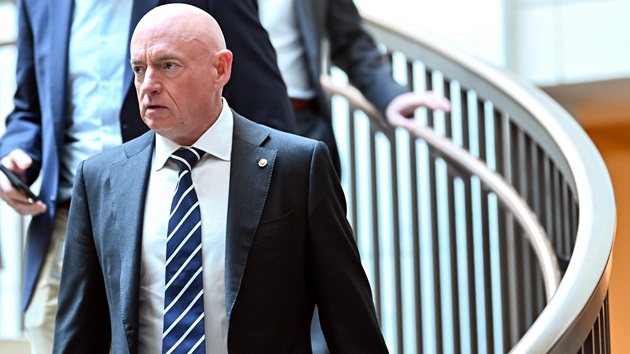
(NEW YORK) — Former President Joe Biden is now receiving radiation therapy for his prostate cancer, a spokesperson for the former president confirmed to ABC News.
“As part of a treatment plan for prostate cancer, President Biden is currently undergoing radiation therapy and hormone treatment,” the spokesperson said in a statement.
The former president’s office announced his prostate cancer diagnosis in May, noting that while it was an aggressive form, “the cancer appears to be hormone-sensitive which allows for effective management.”
“It’s all a matter of taking a pill, one particular pill, for the next six weeks and then another one,” the 82-year-old said in May.
“Well, the prognosis is good. You know, we’re working on everything. It’s moving along. So I feel good,” he added.
Back in May, the former president’s office said his diagnosis was “characterized by a Gleason score of 9 (Grade Group 5) with metastasis to the bone.”
A Gleason score of 9 indicates a high-grade, aggressive form of prostate cancer. It further indicates that the cancer cells look very different from normal prostate cells and are likely to grow and spread rapidly.
This places the cancer in the Grade Group 5, the highest-risk category, which is associated with a greater likelihood of metastasis and a more challenging prognosis. Yet despite the cancer’s aggressiveness, its hormone-sensitive nature offers a viable treatment pathway, according to the National Cancer Institute.
Prostate cancer is the most common cancer and the second-leading cause of cancer death among men in the U.S., according to the National Institutes of Health.
An estimated 313,780 new cases of prostate cancer will be diagnosed this year, representing 15.4% of all new cancer cases, according to the NIH. The five-year survival rate from prostate cancer is roughly 98%, the NIH says.
Prostate cancer usually grows very slowly. While finding and treating it before symptoms occur may not improve men’s health or help them live longer, it is generally a more treatable type of cancer, even when it has spread.
The news of Biden’s radiation therapy comes after he had Mohs surgery — a common procedure to treat skin cancer — in September, a Biden spokesperson said.
Biden’s health had been under scrutiny since before he dropped out of the presidential race in 2024, giving way to then-Vice President Kamala Harris to top the Democratic presidential ticket.
Prior to the announcement of his prostate cancer diagnosis, Biden and former first lady Dr. Jill Biden appeared on ABC’s “The View,” where they both pushed back against the slate of new books from reporters claiming that Biden was dealing with cognitive decline at the end of his presidency.
(NEW YORK) — The federal charge that makes accused killer Luigi Mangione eligible for the death penalty must be dismissed because it does not meet the legal threshold, his defense attorneys argued in a new court filing.
Mangione has pleaded not guilty to federal charges that accuse him of shooting and killing United Healthcare CEO Brian Thompson in December of 2024.
Federal prosecutors allege Mangione stalked Thompson in Manhattan, where the executive was due to attend an investor conference at the New York Hilton Midtown. Mangione allegedly waited for Thompson to pass by and then shot him at close range.
“It is clear that, in its generic form, this crime can be committed without the use, attempted use, or threatened use of physical force against the person or property of another,” the defense said in the filing.
The defense also argued that evidence recovered from the backpack Mangione was carrying when he was arrested at a Pennsylvania McDonald’s should be suppressed.
“Altoona law enforcement failed to follow fundamental Fourth Amendment case law (and basic police procedure) by failing to obtain a search warrant before searching through Mr. Mangione’s backpack and the closed containers within the backpack,” the defense said.
Prosecutors have previously defended the police handling of the arrest and search, which resulted in the recovery of the alleged murder weapon and writings that investigators said helped explain a motive.
Mangione is accused of shooting and killing Thompson with a 9mm handgun equipped with a silencer on a Midtown Manhattan street on Dec. 4, 2024.
After a several-day manhunt, Mangione was captured in Altoona, Pennsylvania, where police found a backpack that investigators said contained the alleged murder weapon, a fake ID and a red notebook he used as a diary.
“I finally feel confident about what I will do,” one entry said, according to authorities. “The target is insurance. It checks every box.”
A federal grand jury charged Mangione in April with two counts of stalking, firearms offense and murder through the use of a firearm, a charge that makes him eligible for the death penalty, if convicted.
Mangione has pleaded not guilty to state charges in New York and Pennsylvania as well as the federal charges. The simultaneous prosecutions put him in what his attorneys have called an “untenable situation” and they’ve asked Judge Gregory Carro to dismiss the state case, or at least put it on hold.
Mangione is also being ordered to appear in a Pennsylvania courtroom regarding those state charges. While he is currently being held in the Metropolitan Detention Center in Brooklyn, the Blair County District Attorney’s Office in Pennsylvania wants the accused killer to appear in court for a pretrial motion hearing scheduled for Nov. 7.
In Pennsylvania, Mangione has pleaded not guilty to charges of forgery, possession of an instrument of a crime and giving a false ID to an officer.
In September, a New York judge dismissed two murder charges related to acts of terrorism, including the most severe charge, first-degree murder. The judge said the evidence presented to the grand jury was insufficient to support the terrorism charge.
Mangione is due back in federal court in December.
(NEW YORK) — One of the most potent greenhouse gas emissions has been discovered seeping out of cracks of the Antarctic seafloor, researchers announced.
Methane has been measured escaping from crevices in the seabed at a high rate as the region warms at unprecedented rates, according to a paper published in Nature Communications.
A large reservoir of methane lies beneath sea floors around the world, which can escape through fissures in the sea floor, according to the paper.
The invisible gas can be seen in streams of bubbles originating on the seafloor of Antarctica’s Ross Sea — located on the northern coast of the continent — said the researchers, describing the mechanism as “seemingly widespread” throughout the region, rather than a “rare phenomenon.”
Numerous seafloor seeps of fluid and gas were identified in the shallow coastal environment of the Northern Victoria Land and McMurdo Sound — both located in the Ross Sea — with shipboard water column acoustic surveys and Remotely Operated Vehicle surveys.
One of the most concerning greenhouse gases, methane, has been described as a “super pollutant” by the U.S. Environmental Protection Agency. It is responsible for about a third of current anthropogenic global warming and is 25 times more potent for global warming than carbon dioxide, according to the agency.
Oceans and coastlines contain the highest uncertainties of methane release, according to researchers.
“There is a continued gap between the measured increase in atmospheric methane and the total emissions predicted from currently known methane sources,” the authors wrote.
The methane leaks appear to occur in areas of the ocean that experience seepage of fluids rich in hydrocarbons, according to the paper.
Past research in the Arctic has identified tens of thousands of methane seeps — many of them linked to climate change impacts and the degradation of cryospheric caps, such as glacial ice, permafrost and gas hydrates, the authors said.
Reducing the weight of ice sheets and glaciers in the Arctic has been found to decrease hydrostatic pressure on subglacial hydrate reservoirs, which can then enhance subglacial flux and methane discharge on the coast, according to the paper.
Greenhouse gases stored in subsea permafrost reservoirs in ice-free regions of the Antarctic are similarly vulnerable to climate change.
However, the role of methane emissions in Antarctica has not yet been fully determined, requiring more study in the future, the researchers said.
“The increasing climate impacts in the Antarctic, including the widespread reduction in ice mass highlights the importance of understanding the current and future dynamics of fluid and gas release from the significant reservoirs predicted in the region,” the scientists wrote.
(WASHINGTON) — As the federal government shutdown enters its tenth day, one major health care issue has continued to be a sticking point: insurance subsidies.
The Affordable Care Act (ACA) subsidies, or premium tax credits, help lower or eliminate the out-of-pocket cost of monthly premiums for those who purchase insurance through the health insurance marketplace.
Eligibility for the subsidies can include factors such as household income and geographic location.
The subsidies were part of the original Affordable Care Act passed during the Obama administration and were enhanced during the COVID-19 pandemic to increase the amount of financial assistance to those who were already eligible and to expand eligibility to more people. They are set to expire at the end of the year.
Republicans have said the expansions from the pandemic era went too far and have tried to persuade Democrats to fund a temporary spending bill that doesn’t address the expiring ACA subsidies, with promises of discussing ways to continue the subsidies later.
House Speaker Mike Johnson, R-La., referred to the Dec. 31 deadline to extend subsidies as being far away.
“That’s a Dec. 31 issue,” he said during a news conference earlier this week. “There are lots of conversations and deliberations and discussions right now, even bipartisan amongst members about necessary changes that would have to be made, pretty dramatic changes to even have that considered on the floor. But look, I’m not going to forecast the outcome of that.”
However, Democrats say that with open enrollment for ACA plans beginning Nov. 1, the subsidies not being approved could be detrimental for millions of American families.
“The Democrats have said that their position on getting out of the shutdown period is that they would want to both extend and make permanent these enhanced marketplace premium tax credits,” Melinda Buntin, a professor at Johns Hopkins Bloomberg School of Public Health and Johns Hopkins Carey Business School, told ABC News.
“The thing at the very top of the list is these subsidies because they are so salient and they will directly affect the pocketbooks of so many millions of Americans,” Buntin said.
Buntin said that if open enrollment begins and these subsidies are not approved and loaded into the enrollment systems, people are likely to see their premiums go up.
Estimates from the Congressional Budget Office suggest that, without an extension, gross benchmark premiums could increase by 4.3% in 2026 and by 7.7% in 2027 for those on marketplace plans.
A KFF analysis last month found that people who buy insurance from the marketplace, and receive financial assistance, would see their premiums rise by about 114% on average, from $888 in 2025 to $1,904 in 2026.
There is broad support for the tax credits. A recent KFF poll, which was fielded just before the government shut down on Oct. 1, found that 78% of Americans support extending the enhanced tax credits, including more than half of Republicans and of “Make America Great Again” supporters.
House Minority Leader Hakeem Jeffries expressed on Thursday the need to extend tax credits, stating, “[U]nless we extend the Affordable Care Act tax credits, tens of millions of Americans are about to experience dramatically increased premiums, co-pays and deductibles by thousands of dollars per year.”
Buntin says this could affect many Americans, but particularly those who live in states where Medicaid was not expanded and buying insurance on the marketplace is their only option.
Naomi Zewde, a fellow at the UCLA Center for Health Policy Research and assistant professor of health policy and management at the UCLA Fielding School of Public Health, told ABC News that working low-income families and adults will be affected if the ACA subsidies are not approved.
“Mainly those who don’t get insurance through their job, who make too much for Medicaid but not enough to pay [about] $600-plus per month for a plan with a two-to-three-thousand-dollar deductible,” she said.
However, James Blumstein, university distinguished professor of constitutional law and health law and policy at Vanderbilt University School of Law, told ABC News that even if the subsidies lapse and the Nov. 1 deadline arrives, a deal could be worked out to retroactively fix the issue.
He added that he believes congressional Democrats and Republicans could also come up with a deal that saves the ACA subsidies but doesn’t keep the full expansions that were offered during the pandemic.
“I think the leverage for the Democrats will diminish,” he said. “Republicans have passed a continuing resolution so that this issue is going to come back up five or six weeks again.”
Blumstein continued, “Democrats will have leverage again in five or six weeks and I think that whether this goes into the period of new enrollment or not, that can all be fixed in the deal. In other words, if the time lapses that can be overcome by the subsidies coming a little bit later.”
Earlier this week, President Donald Trump indicated that he was negotiating with Democrats on health care policy and that he was open to making a deal on health care subsidies in an attempt to reopen the government.
“We have a negotiation going on with the Democrats that could lead to good things, and I’m talking about good things with regard to health care,” Trump told reporters in the Oval Office.
“If we made the right deal, I’d make a deal. Sure,” Trump said in reference to making a deal to approve ACA subsidies.
In a statement, Senate Minority Leader Chuck Schumer denied that the White House was negotiating with Democrats.
Trump later walked back his willingness to make a deal, writing on social media that he would work with Democrats as long as the government is reopened first.
Democratic leaders have said they are not willing to vote to reopen the government unless Republicans negotiate on health care demands, while Republicans have signaled unwillingness to negotiate on health care policy unless the government is reopened — an effective stalemate.
“Republicans are saying that we should have what is referred to as a clean bill, just continue the government operations as they were, without extending these subsidies, and then once we’ve got that, then we can come back and we can talk about things like extending the subsidies,” Buntin said. “Democrats are seen so far unwilling to agree to that, which I think represents a sort of breakdown in normal process.”
She continued, “Democrats are seeing a political opening, because there are so many millions of people who depend on these subsidies to be able to afford health insurance, and there’s nothing like a deadline to use to get something you want.”
A spokesperson for the Department of Health and Human Services told ABC News in a statement earlier this week that Democrats are to blame for the shutdown.
“Senate Democrats are choosing to keep the government shut down, putting major health programs at risk. They should do the right thing and vote to reopen the government,” the statement read.
(NEW YORK) — Elon Musk, the founder and CEO of SpaceX, has called “rapidly reusable, reliable rockets” the key to humans becoming a multiplanetary society. And when it comes to his company’s Falcon 9, SpaceX has shown that a rocket can do all those things.
The Falcon 9 has now completed 542 missions, 497 landings and 464 reflights, according to the SpaceX website.
But to reach the Moon and Mars and establish settlements on both, SpaceX will need its larger, more complex and significantly more powerful Starship and its Super Heavy booster to reach Falcon 9’s level of reliability and reusability.
Soon, SpaceX will have the chance to show that Starship’s successful August flight, the first to complete all its primary mission goals, was no fluke.
Barring a delay due to bad weather or mechanical issues, the stainless steel Starship and Super Heavy booster will conduct its 11th flight test on Monday, Oct. 13, at 7:15 p.m. ET, from the company’s Starbase in South Texas. A mission the company hopes will build on the much-needed success of its previous test. SpaceX will be operating Starship autonomously and there will be no astronauts aboard during the flight.
In late August, Starship and its Super Heavy booster successfully reached space on a suborbital trajectory at a near-orbital velocity, deploying a series of Starlink simulators before returning to Earth with such navigational precision that the reentry was captured on a camera attached to a remote buoy in the middle of the Indian Ocean.
“I would give [flight test 10] an A-plus. That was an A-plus performance. The only thing that was a little bit off was that there was some damage in the aft skirt compartment of Starship during the flight, but most of the mission objectives were achieved,” said Olivier de Weck, the Apollo Program Professor of Astronautics and Engineering Systems at MIT and editor-in-chief of the “Journal of Spacecraft and Rockets.” “I don’t think this could have gone much better,” he added.
But now, de Weck says SpaceX needs to demonstrate that it can build on its August success and move the program forward with new mission objectives.
“I think the next step is to actually land the Starship, still not go into orbit and stay over multiple orbits, but actually land and recover the actual Starship,” said de Weck. “Recovery of the Starship, an upright landing, with retro propulsion on a fixed platform, that’s the next step.”
SpaceX is not planning an upright, fixed platform landing for the upcoming 11th flight test. Like the previous mission, the Starship will splash down in the Indian Ocean. The Super Heavy first stage booster, with its 24 Raptor engines, which SpaceX said was previously used during flight test eight, is also scheduled to splash down in the ocean. In several previous missions, it returned to the launch site and was caught by the tower’s mechanical “chopstick” arms.
The development of Starship hasn’t come easily for SpaceX, with several high-profile setbacks along the way. However, despite an explosion on the launch pad during a pre-flight engine test and several explosions and mechanical failures during previous test flights, Musk has long maintained that learning from failures is an integral part of SpaceX’s engineering process.
“I’m not surprised where the program is. It’s moving forward through the usual SpaceX iterative development model, and not surprisingly, it’s behind SpaceX’s ambitious schedule projections,” said Greg Autry, associate provost for space commercialization and strategy at the University of Central Florida. “But that wouldn’t make it any different than almost everything else that they’ve done in the past, other than that the scale of this is so large,” he added.
Autry is President Donald Trump’s nominee to be the chief financial officer of NASA.
Autry says he’s confident that SpaceX is headed in the right direction and said that Elon Musk and his companies tend to prove their critics wrong in the long run, delivering results even if it takes longer than anticipated.
“About ten years ago, Elon Musk promised me I was going to have a self-driving car shortly, and a lot of people said that was completely crazy. It wasn’t shortly, but I now have a self-driving car. I literally get in my car, push the button, and fifty miles later, I arrive at work. It is amazing. He delivers eventually,” Autry said.
Experts say that making the next generation of U.S.-designed and built rockets and spacecraft work is critical to achieving NASA’s goals of not only returning to the Moon but building a permanent lunar settlement and doing it before the Chinese.
During a late September ceremony at the Johnson Space Center announcing the new class of NASA astronauts, Acting NASA Administrator and Secretary of Transportation Sean Duffy spoke about the competition for space dominance.
“Now some are challenging our leadership in space, say, like the Chinese, and I’ll just tell you this, I’ll be damned if the Chinese beat NASA or beat America back to the Moon,” said Duffy. “We are going to win. We love challenges. We love competition, and we are going to win the second space race back to the Moon,” he added.
Autry, who first wrote about a new space race with China back in 2010, says China is determined to reach the Moon and dominate low-Earth orbit, but he believes the global competition will push American efforts forward.
“There are very credible people saying that they’re about to eclipse us in the next five years. I think that’s great for the prospect of competition that spurs us to work harder and take our role more seriously, and frankly to put funding into programs that we badly, badly need to fund,” said Autry.
Autry says that today’s space race should be compared to the “Age of Exploration” in the 15th and 16th centuries. He points out that while China had “an ambitious sailing-exploration program” in the early 1400s, European countries overtook the Chinese when the Europeans accelerated their global exploration efforts later in the century, at a time when China was pulling back.
“We are at that same moment in time right now. The countries that aggressively pursue going to the Moon and using the assets of space will dominate human history for the next several hundred years,” Autry said.
Autry believes that the billions of dollars being spent by companies like SpaceX and the federal government to support space exploration, return to the Moon and potentially get to Mars is money well spent.
“The countries that choose to take advantage of space resources will be wealthy, prosperous and happier than the countries that don’t. We have plenty of history to show that,” Autry said.
Autry says you just have to look at the first space program to see the benefits of this kind of investment.
“We would not have the computing environment, AI, the internet, solar power, fuel cells, and a variety of technologies at the level they are now if we had not made those investments that drove so much effort into engineering development and STEM education. It created the boom we’ve experienced since the second half of the 20th century,” he added.
Workers describe the housing the Bangladesh government is building for thousands of Rohingya refugees. ABC
(WASHINGTON) — The Trump administration is asserting that it has secured substantial financial commitments for the Rohingya refugees living in Bangladesh from partner nations as reports claim that U.S. foreign aid cutbacks have worsened the crisis facing the persecuted group, according to a State Department document obtained exclusively by ABC News.
Per the document, the State Department says it has secured $64.6 million in aid commitments from partner countries in September alone, marking what it calls “a significant development in the Trump administration’s effort to encourage burden sharing with other nations to address humanitarian crises across the globe.”
State Department data indicates that 11 countries, including the U.K., Bangladesh, Japan, Qatar, Australia, Thailand, South Korea, and the Netherlands, have increased their aid to the Rohingya people by more than 10% under the Trump administration in 2025 compared to the last year of the Biden administration, the document states.
The level of influence the Trump administration had over the uptick in aid from these foreign governments is not clear.
The Trump administration also pledged more funding to support Rohingya refugees in September, committing $60 million to the cause in addition to $73 in new assistance announced in March.
In 2024, the final year of the Biden administration, the U.S. contributed just over $300 million to the Rohingya, over 50% of total support for that year, records show.
“The Trump administration has continuously called on nations around the world to join the United States in offering humanitarian assistance to vulnerable populations like Rohingya refugees,” a senior State Department official said. “The media narrative that the obligation to provide aid falls solely on the Trump Administration is tired and ignores the reality that many other countries, including regional actors, have repeatedly failed to step up.”
The State Department’s push to ramp up foreign aid for the Rohingya comes as the AP has published a report asserting that Rohingya children have died in a camp located in Myanmar because of the Trump administration’s USAID cuts. (Notably, the report covers impact to Rohingya children in Myanmar; the Trump administration’s fundraising efforts have focused on supporting Rohingya refugees in Bangladesh.)
“Let me be absolutely clear: the Associated Press’ claim that children are dying because of recalibrated U.S. foreign assistance levels is completely false and downright irresponsible,” State Department spokesperson Tommy Pigott said in a statement.
Benny Johnson, a political commentator and podcast host, during a press briefing in the James S. Brady Press Briefing Room at the White House in Washington, D.C. on Tuesday, Aug. 12, 2025. Eric Lee/For The Washington Post via Getty Images
(TAMPA, Fla.) — Attorney General Pam Bondi announced Friday the arrest of a man who allegedly sent a letter with death threats targeting right-wing podcaster Benny Johnson in the days after the assassination of Charlie Kirk.
Bondi held a news conference in Tampa, Florida, to make the announcement.
“Benny is a well-known media personality carrying a message very similar to Charlie’s, grounded largely in faith and love of country,” Bondi said during a news conference in Tampa, Florida.
Kirk, 31, the founder of the conservative youth activist organization Turning Point USA, was killed on Sept. 10 during a campus event at Utah Valley University (UVU) in Orem, about 39 miles south of Salt Lake City.
“Just days after Charlie’s assassination, Benny received a letter at his home, where he and Kate are raising their beautiful, beautiful young family. The author of this letter made it very clear that he hated Benny, because of his views and he wanted him dead. This was a coward hiding behind a keyboard who thought he could get away with this,” Bondi said during the press conference Friday.
Bondi said authorities arrested George Isbell Jr. in connection with the threatening letter, which she described as “horrific” in nature.
He was arrested on Oct. 7 in San Diego, California.
Isbell was charged federally with mailing a threatening communication, according to the DOJ.
“We cannot allow this political violence to continue any longer,” Bondi said. “This arrest will serve as a reminder to many: Do not do this. We will find you.”
U.S. Attorney for the Middle District of Florida Greg Kehoe further detailed Isbell’s letter to Johnson, saying he threatened Johnson’s “extermination” and that he “should be strangled by an American flag” and “hoped somebody blows his head off.”
If convicted, Isbell faces a maximum penalty of five years in prison, according to the DOJ.
“The FBI and our partners will not tolerate threats of violence like the kind allegedly made by the defendant about a media personality,” FBI Director Kash Patel said in a DOJ press release on the arrest. “We will continue to investigate, pursue, and find those responsible for this conduct and ensure such criminals are held to full account in our justice system.”
Isbell has not yet entered a plea in the case, and contact information for his attorney was not available as of Friday afternoon.
Stock image of police lights. Douglas Sacha/Getty Images
(KATY, Texas) — A Marine Corps veteran was arrested after allegedly threatening to open fire on a Texas high school and zoo after leading police on a high-speed chase, officials said.
Joshua Finney, 38, is accused of sending Facebook messages to relative threatening to shoot up Morton Ranch High School in Katy, Texas, and the Houston Zoo. The relative said he also sent pictures posing with guns, according to authorities.
Law enforcement confronted Finney on Tuesday, when he took police on a high-speed car chase in Katy, according to investigators. One magistrate told ABC News affiliate ABC 13 that Finney “evaded for eight miles at speeds of 110 miles per hour, driving on the shoulder, weaving through lanes, driving the wrong way head-on at two patrol vehicles and innocent motorists.”
When Finney was stopped, police said they found a loaded gun in his car with 39 rounds of ammunition. Law enforcement also has a video of Finney driving by Morton Ranch High School, according to police.
At his first probable cause court appearance Wednesday, Finney did not appear as he being held in a mental health unit, according to the magistrate.
Finney has been charged with harassment, evading police and illegally possessing a weapon due to a lengthy and violent previous criminal history, according to police.
The investigation is ongoing, police said, and Finney’s bond was raised to $10 million on Thursday.
Crosses dedicated to the 21 victims of the 2022 mass shooting at Robb Elementary are placed in front of the school. (Photo by Aaron E. Martinez/The Austin American-Statesman via Getty Images)
(UVALDE, Texas) — Three and a half years after the mass shooting at Robb Elementary School in Uvalde, Texas, the community honored the 21 victims killed in the tragedy at the “bittersweet” opening of a new school.
“Today, as we open the doors of this beautiful elementary school, we do so with reverence for the precious lives lost and with resolute confidence in the legacy we will build within it,” Ashley Chohlis, the superintendent for the Uvalde Consolidated Independent School District, said during the ribbon-cutting ceremony on Friday.
The new school, Legacy Elementary School, a two-story campus totaling 116,000 square feet, opened on Friday, with classes beginning on Oct. 20. The new school is not located on the Robb Elementary property, which remains closed off with no immediate plans to demolish it.
The campus features a “large oak tree with two large branches” along with 19 “smaller branches,” paying tribute to the two teachers and 19 children who were killed in the May 2022 rampage.
At the start of the emotional ribbon-cutting ceremony on Friday, Chohlis asked for those in attendance to pause for 21 seconds of silence in honor of the victims of the shooting.
“The path to this ribbon cutting has been long and deeply emotional in the wake of unimaginable tragedy. Texans from across the state and here in Uvalde, with sorrow gripping their hearts, vowed to do something, anything they could to offer their deep sympathy, love and support. During the darkest of times, many people came together. From their love, this beautiful building stands proudly,” Chohlis said.
The school, which was built using $60 million in “donations, grants and community support,” will teach third, fourth and fifth graders, school officials said.
Jesse Rizo, the uncle of one of the victims who was killed in the shooting, said the opening of this campus is a “bittersweet” and “heart-wrenching moment.”
Laura Perez, the Uvalde CISC school board president, said the school “stands a testament” to the memory of the victims.
“This school is not about forgetting but remembering with dignity, rebuilding with courage and choosing to believe in the future even when the past still hurts,” Perez said on Friday.
The campus, which includes 36 classrooms, can house up to 800 students, according to a press release from Uvalde CISD Moving Forward Foundation, an organization that was created in the wake of the tragedy.
The opening of the school comes days after a trial date was set for one of the two senior police officers charged in connection with the failures on the day of the shooting, the judge overseeing the case told ABC News.
Former Uvalde school district police chief Pete Arredondo, who was the on-site commander at Robb Elementary School on the day of the shooting, and former school officer Adrian Gonzales, were charged in June 2024 with multiple counts of child endangerment and abandonment.
On the day of the shooting, law enforcement waited some 77 minutes at the scene before breaching a classroom and killing the gunman.
Gonzales’ trial is set to begin on Jan. 5, with Arredondo’s case remaining on hold pending the outcome of ongoing litigation between the Uvalde District Attorney’s Office and U.S. Customs and Border Protection.
ABC News’ Josh Margolin contributed to this report.
U.S. Speaker of the House Mike Johnson (R-LA) speaks during a news conference on the government shutdown at the U.S. Capitol on October 09, 2025 in Washington, DC. Kevin Dietsch/Getty Images
(WASHINGTON) — As the government shutdown plows forward with no end in sight, many civilian federal workers are feeling the impact as they receive only a partial paycheck on Friday, the 10th day of the impasse.
For many federal workers, the partial paycheck is the last payment they will receive until the shutdown ends.
“You’ve got millions of American families who will now have to figure out how to make their mortgage, how to cover their rent, pay the car note and keep food on the table — because Democrats, Chuck Schumer, his colleagues in the Senate are here playing games,” House Speaker Mike Johnson said during a Friday morning press conference.
House Minority Leader Hakeem Jeffries fired back in his own Friday morning press conference saying Republicans are “not serious about reopening the government” and that Democrats are open to having meetings to discuss off-ramps. He urged Republicans to work with Democrats to “pay our federal employees and at the same time address the Republican health care crisis.”
On Thursday night, the Senate again failed to pass the clean seven-week funding bill. Following the seventh failed vote, senators left town for the weekend — ensuring the shutdown lasts for at least two weeks with the next chance to vote to fund the government on Oct. 14.
House Republican leaders on Friday canceled votes for all of next week.
The latest failed Senate vote guarantees that some 2 million military service members will miss their paycheck on Wednesday, Oct. 15 and won’t be paid until the government reopens.
The last time service members went without pay was in 2018 when the Coast Guard went without money in a shutdown under President Donald Trump’s administration. Other troops haven’t gone without pay in decades, although private financial institutions are offering zero percent loans.
Johnson said that Trump is “working on ways” to ensure the military troops get paid during the shutdown but did not provide specifics.
“The executive branch, the president is working on ways that he may have as well to ensure that troops are paid,” Johnson said Friday morning. “The Republican party stands for paying the troops; the Democrats are the ones that are demonstrating over and over and over – now eight times – that they don’t want troops to be paid. This could not be any simpler than it is – look at the record.”
Pressed by ABC News on the worsening effects of the government shutdown and the millions of federal employees and soldiers going without pay, Jeffries was firm, saying Democrats will not buckle without health care concessions from Republicans.
“Republicans have the House, the Senate, and the presidency. They decided to shut the government down. Republicans in the House have decided to remain on vacation,” Jeffries said.
The shutdown already appears to be impacting many military families, with some lined up at food pantries around the country.
On Thursday, a military mom called into Johnson’s appearance on CSPAN and begged him to bring the House back to session to pass a standalone bill to provide military troops pay during the shutdown, saying her “kids could die” if her family experiences a lapse in pay on Oct. 15.
The National Military Family Association estimates that one in five military and veteran families are experiencing some level of food insecurity. Also, 25% of military families report having less than $500 in savings, the association found in its most recent report.
The next vote on clean House-passed funding bill in the Senate will be Tuesday at 5:30 p.m. ET — which will be Day 14 of the shutdown.