E. Jean Carroll arrives for her civil defamation trial against President Donald Trump at Manhattan Federal Court on January 25, 2024 in New York City. (Michael M. Santiago/Getty Images)
(NEW YORK) — A federal appeals court in New York on Wednesday rejected President Donald Trump’s request to rehear his challenges to the writer E. Jean Carroll’s successful defamation and sex assault claims.
Carroll successfully argued during a nine-day trial in 2023 that Trump sexually abused her in a Bergdorf Goodman dressing room in the 1990s and defamed her in 2022 with comments he made after he left office.
The jury awarded Carroll $5 million in damages.
Trump, who has denied all wrongdoing, tried unsuccessfully to substitute the United States as a defendant and to raise a claim of presidential immunity. In its decision Wednesday, the 2nd U.S. Circuit Court of Appeals said both arguments were raised too late.
“The fact of the matter is that no other defendant would be permitted to move to substitute the United States in his place, fifteen months after trial and the entry of judgment against him,” Judge Denny Chin wrote. “The Court appropriately declined to convene en banc to revisit this issue.”
A separate jury in a subsequent trial awarded Carroll $83 million in damages.
U.S. Supreme Court building on Wednesday, March 18, 2026. (Bill Clark/CQ-Roll Call, Inc via Getty Images)
(WASHINGTON) — The Supreme Court on Wednesday struck down Louisiana’s 2022 congressional map as an unconstitutional racial gerrymander and dealt a blow to Section 2 of the Voting Rights Act, landmark legislation that has long prohibited election practices that have the effect of diluting the influence of racial minority voters.
In a 6-3 decision, the Supreme Court’s conservative majority effectively raised the bar for challenges to election maps that limit the equal opportunity of minority voters to elect candidates of their choosing, even if lawmakers did not have deliberate intent to discriminate.
Justice Samuel Alito authored the opinion, which said that states only violate the Voting Rights Act when “evidence supports a strong inference that the State intentionally drew its districts to afford minority voters less opportunity because of their race.”
This is a developing story. Please check back for updates.
Pam Bondi testifies before the Senate Judiciary Committee in the Hart Senate Office Building on Capitol Hill on October 07, 2025 in Washington, DC. (Win Mcnamee/Getty Images)
(WASHINGTON) — After a top Democrat introduced a resolution to hold former Attorney General Pam Bondi in civil contempt, a GOP spokesperson for the House Oversight Committee said Bondi will appear on May 29 for a deposition as part of the panel’s Jeffrey Epstein investigation.
Rep. Robert Garcia, the committee’s top Democrat, on Wednesday morning introduced a resolution to hold Bondi in civil contempt for failing to comply with a subpoena.
“Just a few minutes ago, we filed official contempt charges against Pam Bondi,” Garcia announced to reporters at the Capitol.
Moments later, a House Oversight Committee spokesperson said that “former Attorney General Pam Bondi is appearing on May 29. We will have more details to share later.”
Garcia applauded the news as he spoke to reporters.
“Clearly, we’re being effective, because it’s interesting how only when we take action and when we actually have to force Republicans to do anything, to call subpoenas, to get in front of our committee that they actually ever do anything,” he said.
“So, I am so glad that Chairman [James] Comer is scared of this group back here, and then we’ll continue to push every single time,” Garcia continued. “So, that’s great to hear. If that’s the truth. I’m glad he told him he made that announcement today.”
Bondi had been expected to testify behind closed doors on April 14 pursuant to the committee’s bipartisan subpoena. But after she was removed from her role by President Donald Trump, the Justice Department said the subpoena no longer obligated her testimony in the Epstein matter.
Bondi’s handling of the Epstein documents and the Justice Department’s compliance with the Epstein Transparency Act was a point of bipartisan criticism, and stoked frustration within the Trump administration.
Garcia’s civil contempt effort, if successful, would elevate the matter to a federal court where a judge would be tasked with deciding whether Bondi is legally obligated to comply with the subpoena.
According to the Congressional Research Service, civil contempt allows Congress to “seek a civil judgment from a federal court declaring that the individual in question is legally obligated to comply with the congressional subpoena.”
In January, the GOP-controlled House Oversight Committee voted to hold former President Bill Clinton and Hillary Clinton in criminal contempt. The Clintons ultimately agreed to testify, and Republicans dropped the contempt effort.
Comer has depositions scheduled with several other witnesses in the probe through June, prolonging the committee’s Epstein investigation into the summer.
U.S. Secretary of War Pete Hegseth speaks during a news conference at the Pentagon on March 2, 2026 in Arlington, Virginia. (Photo by Alex Wong/Getty Images)
(NEW YORK) — Defense Secretary Pete Hegseth is on Capitol Hill Wednesday for what is formally billed as a routine hearing on the Pentagon’s budget request.
But the appearance — the first before Congress for Hegseth since the war in Iran began in February — lands just two days before a 60-day deadline to wind down hostilities.
It also comes amid intensifying questions on the Hill about how quickly the Pentagon is depleting weapons stockpiles, and as lawmakers continue to scrutinize Hegseth’s unusual spate of firings of senior defense officials without a public explanation.
Questions over civilian casualties in the Iran war, as well as whether the U.S. was properly prepared for retaliatory strikes, and broader questions over the strategic rationale for the conflict, are likely to be a key part of committee members on both sides of the aisle questioning of Hegseth, multiple congressional aides explained.
This week marks Hegseth’s first return to Capitol Hill in nearly a year — with testimony Wednesday before the House Armed Services Committee and Thursday on the Senate side — and his first exposure to sustained scrutiny since the war with Iran began. He is joined by Gen. Dan Caine, the chairman of the joint chiefs of staff at both hearings.
While Hegseth has appeared before the press since the conflict began in late February, he has largely limited engagement to reporters viewed as sympathetic to the administration.
At the center of this week’s hearings is the administration’s request for $1.5 trillion in defense spending, the largest amount in the Pentagon’s history and a jump of 50% over current levels, which would mark the largest single-year increase in a generation.
The proposal would triple spending on drones and related technologies to more than $74 billion, while directing over $30 billion toward munitions procurement. But that budget request was developed months ago: not account for spending in the war with Iran.
“The overlap, you’ll see, is the request for munitions, which is something we always need,” Jules Hurst III, acting undersecretary of defense and the Pentagon’s comptroller, told reporters last week. “We always need to increase our magazine depth. But outside of that, there aren’t any operational costs in here from Iran.” Hurst is set to join Hegseth and Caine at the Senate hearing on Thursday.
That means the Pentagon may require additional funding to cover the cost of the vast quantities of munitions being expended as U.S. forces have struck more than 13,000 targets in Iran since February, along with other significant war-related expenses.
Defense experts have long raised concerns about stockpile constraints even before the war with Iran, with some estimates of a potential conflict with China suggesting the United States could exhaust long-range missile inventories within the first few weeks of fighting.
In less than two months of exchanging fire with Iran, the U.S. has used roughly half of certain missiles and other munitions, according to an analysis published last week by the Center for Strategic and International Studies (CSIS).
Retired Col. Mark Cancian, a senior adviser at CSIS and an author of the report, said Operation Epic Fury “does create a window of vulnerability” for a period of as many as four years – the time it would take to replenish stocks.
“The United States has enough munitions to fight this war if it stubs up again,” Cancian said. “But the risk is in a future war with China, where inventory levels are far below where war planners would like them to be.”
Pentagon officials have maintained the U.S. has enough ammo to fight Iran. Though rearming the force with new munitions can take years, with some missiles requiring one to two years to build, reflecting an inherent limit on how many complex munitions the defense industry can produce each year, spurring much of the interest in huge investments in relatively cheap, easier-to-produce drones, which the Pentagon continues to surge into the Middle East.
Hegseth is also likely to face questions on his unprecedented firing or sidelining of two dozen senior military officials, particularly during a time of war, where he recently fired Gen. Randy George, who was the Army’s top officer and John Phelan, the Navy secretary.
Hegseth has also fired numerous lower-profile generals, without explanation, including Maj. Gen. William Green Jr., who was the chief of the Army Chaplain Corps, a collection of clergy from different faiths within the service. He has also blocked the promotion of four colonels to brigadier general, two of whom are women and two are Black, according to two U.S. officials, who both described a secretary of defense intervening in promotions as unprecedented.
Meanwhile, Democrats have failed in their multiple attempts to rein in President Donald Trump’s authority to wage war in Iran without Capitol Hill’s approval.
The 1973 War Powers Resolution gives the president latitude to conduct military strikes for a 60-day window, which closes Friday. The law allows for a one-time 30-day extension for the president to act without the consent of lawmakers, though it is unclear whether Trump intends to do so or whether Republicans will take into account the ceasefire in a way that relieves any deadline pressure.
Kevin Warsh, President Donald Trump’s nominee for Chair of the Federal Reserve, testifies during his Senate Committee on Banking, Housing, and Urban Affairs confirmation hearing, April 21, 2026 in Washington. (Andrew Harnik/Getty Images)
(WASHINGTON) — A Senate committee on Wednesday voted to advance Fed chair nominee Kevin Warsh, clearing a key hurdle in his path to replace Fed Chair Jerome Powell before his term ends next month. Warsh’s nomination will move to a confirmation vote on the floor of the upper chamber.
The Senate Banking Committee voted 13-11 to approve the nomination on a party-line vote, with Republicans supporting the nomination and Democrats opposing it.
The vote comes days after the Department of Justice moved to drop its criminal probe into Powell. Before that, Warsh had faced a bipartisan stonewall in the Senate Banking Committee over the probe.
Sen. Thom Tillis, R-N.C., who previously vowed to oppose Warsh’s nomination on account of the investigation, said he would flip his vote after the investigation was set aside. Tillis voted to approve the nomination on Wednesday.
The probe into Powell focuses on alleged false testimony to Congress about an office renovation. Powell, who was appointed by Trump in 2017, has rebuked the investigation as a politically motivated effort to influence interest-rate policy.
Powell’s term as Fed chair ends on May 15, but he said last month he would stay in the position until Warsh is confirmed.
Warsh, a former Fed official, is currently a fellow at a conservative think tank called the Hoover Institution, which is based at Stanford University.
At testimony before the Senate Banking Committee last week, Democrats sharply criticized Warsh, saying the independence of the Fed would be at risk if Warsh were to take policy cues from Trump.
In his opening remarks, Warsh voiced support for the independence of the Fed in its role setting interest rates. He used the term “monetary policy” to describe the central bank’s task of adjusting benchmark borrowing costs.
“Monetary policy independence is essential. Monetary policymakers must act in the nation’s interest,” Warsh said.
Still, Warsh defended the right of public officials, including presidents, to voice their views on interest-rate policy, saying such comments do not infringe on Fed independence.
“Central bankers must be strong enough to listen to a diversity of views from all corners,” Warsh said.
Sen. Elizabeth Warren, D-Mass., the top Democrat on the committee, responded directly to Warsh’s defense of a president’s right to criticize the Fed, saying the federal investigation of Powell amounts to a pressure campaign that extends beyond public criticism of Fed policies.
“You said it’s perfectly fine for elected officials to state their views on interest rates. But that’s not what Donald Trump is doing,” Warren said, addressing Warsh.
Republicans, including Sen. Tim Scott, R-S.C., the chairman of the Senate Banking Committee, praised Warsh, saying the Fed nominee would focus central bank policy on economic stewardship. During the tenure of President Joe Biden, Scott claimed, the Fed shifted some of its attention to the implications of issues like climate change.
“An independent Federal Reserve is essential to achieving its mission. That independence must be protected,” Scott said.
During his term as a Fed governor in the late 2000s and early 2010s, Warsh gained a reputation as an interest-rate “hawk,” meaning he generally preferred higher interest rates as a means of ensuring low and stable inflation.
In recent months, however, Warsh has voiced support for lower interest rates, rebuking the Fed’s concern about inflation risk posed by a flurry of new tariffs issued last year.
The Senate committee vote came hours before the Fed is set to announce its latest decision on the level of interest rates. The central bank is widely expected to hold interest rates steady.
ames Comey speaks onstage at 92NY on May 30, 2023 in New York City. (Photo by Dia Dipasupil/Getty Images)
(WASHINGTON) — Former FBI Director James Comey is expected to self-surrender today in the Eastern District of Virginia, sources familiar with the matter told ABC News.
A federal grand jury in North Carolina on Tuesday indicted Comey over a controversial Instagram post from last year that President Donald Trump and members of his administration claimed was a threat against the president.
The new indictment centers on a controversy that erupted nearly a year ago when Comey, in a since-deleted Instagram post, shared a picture showing the numbers “86 47” written in seashells on the beach with the caption “Cool shell formation on my beach walk.” Citing the slang meaning of “86” as to “nix” or “get rid” of something, allies of the president allege that the post was a veiled threat against Trump, who is the 47th president.
As outlined in the short, three-page indictment, Comey faces one charge of threats against the president and successors, and one charge of transmitting a threat in interstate commerce.
Prosecutors in the indictment say the post constitutes a threat that any “reasonable recipient who is familiar with the circumstances would interpret as a serious expression of an intent to do harm to the President of the United States.”
Prosecutors will likely face a high legal bar to prove that the Instagram post constituted a “true threat,” which the Supreme Court in 2023 found required showing an individual understood their message would be perceived as threatening. With the phrase “86 47” increasingly adopted by protesters of the Trump administration, the case could carry sweeping implications for the First Amendment.
Comey was indicted last year on unrelated charges for allegedly lying to Congress and obstruction related to his testimony before the U.S. Senate Judiciary Committee in 2020. Comey’s lawyers moved to dismiss the indictment, arguing the case was politically motivated and that the grand jury never saw the charges in their entirety, and the case was ultimately dismissed over issues with the legitimacy of the prosecutor who brought the case.
“I know that Donald Trump will probably come after me again, and my attitude is going to be the same,” Comey said in a video posted to social media after the previous indictment was thrown out in November. “I’m innocent. I am not afraid, and I believe in an independent federal judiciary — the gift from our founders that protects us from a would-be tyrant.”
The new indictment comes as the Department of Justice in recent weeks has ramped up investigations of some of Trump’s perceived political foes under Acting Attorney General Todd Blanche, who is heading up the Justice Department following Trump’s ouster of Pam Bondi.
“Nothing has changed with me,” Comey posted online Tuesday in response to the indictment, echoing what he said after the previous indictment was thrown out last year. “I’m still innocent, I’m still not afraid and I still believe in the independent federal judiciary so let’s go.”
“But it’s really important that all of us remember this is not who we are as a country, this is not how the Department of Justice is supposed to be and the good news is we get closer every day to restoring those values,” he added. “Keep the faith.”
This is a developing news story. Please check back for updates.
(LONDON) — Two people were injured in a stabbing incident allegedly targeting “Jewish members of the public” in London, after which at least one suspect was arrested, a charity group and local leaders said on Wednesday.
The incident took place at 11:16 a.m. local time in London on Wednesday morning when officers responded to the Golders Green neighborhood in Northwest London following reports of people stabbed in Highfield Avenue.
“The suspect also attempted to stab police officers, and was tasered before being arrested,” a statement from the Metropolitan Police said. “No officers were injured.”
“One male was seen running along Golders Green Road armed with a knife and attempting to stab Jewish members of the public,” Shomrim NW London, a charity that operates an emergency response team in the area, said on social media.
Two men — one in his 70s and one in his 30s — were treated at the scene for stab wounds before being taken to hospital where they are both listed in stable condition.
“A 45-year-old man was arrested on suspicion of attempted murder,” the Metropolitan Police said. “He was taken into custody, where he remains. We are working to establish his nationality and background.”
Specialist officers from Counter Terrorism Policing are now leading the investigation and working with the Metropolitan Police to establish the full circumstances and any links to terrorism, officials said.
“Whilst I must stress this investigation is at an early stage, we are working quickly to understand exactly what happened,” Head of Counter Terrorism Policing Laurence Taylor said. “Thank you to those who were in the area at the time and supported the response to this terrible incident.”
Mayor Sadiq Khan of London also confirmed the police made an arrest following the “appalling attack on two Jewish Londoners in Golders Green.”
“London’s Jewish community have been the target of a series of shocking antisemitic attacks,” Khan said in a statement. “There must be absolutely no place for antisemitism in society. The Met have stepped up high visibility patrols in the area.”
Sarah Sackman, a member of Parliament who represents the area, said she was aware of the “serious stabbing” in Golders Green, also adding that a suspect had been arrested.
“The attacks on British Jews are an attack on Britain itself,” she said in a statement posted on social media. “It is unconscionable that jews are being targeted in this way.”
Prime Minister Keir Starmer, who was addressing questions in the House of Commons on Wednesday, said it was “deeply concerning to everyone in this House.” He added that a police investigation was underway.
Wednesday’s alleged stabbing was at least the third violent incident reported in the Golders Green area — which is well-known for its sizable Jewish community — in recent weeks.
In late March, four ambulances belonging to the Jewish community ambulance service, Hatzalah, were firebombed in a suspected antisemitic attack, according to the Met Police.
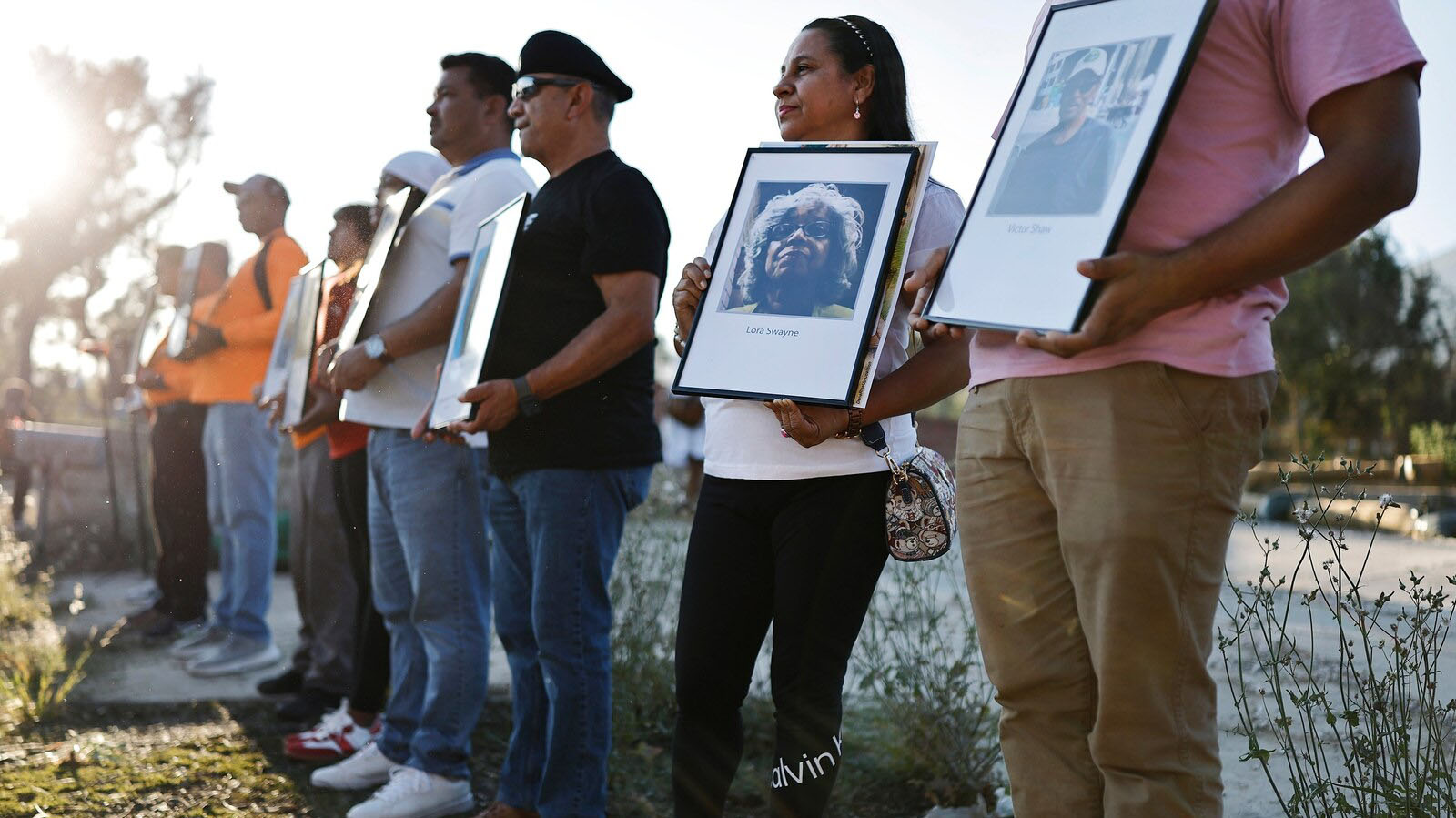
And on Tuesday, an arson attack was reported on a memorial wall in Golders Green which is dedicated to thousands of protesters killed in an Iranian government crackdown on nationwide protests in January, police said.
The wall is located close to a local Jewish center, although police said the Tuesday alleged attack was “not being treated as a terrorist incident and officers are keeping an open mind about the motive behind the attack.”
ABC News’ Joe Simonetti and Zoe Magee contributed to this report.
U.S. Secretary of War Pete Hegseth speaks during a news conference at the Pentagon on March 2, 2026 in Arlington, Virginia. (Photo by Alex Wong/Getty Images)
(NEW YORK) — Defense Secretary Pete Hegseth heads to Capitol Hill Wednesday for what is formally billed as a routine hearing on the Pentagon’s budget request.
But the appearance — the first before Congress for Hegseth since the war in Iran began in February — lands just two days before a 60-day deadline to wind down hostilities.
It also comes amid intensifying questions on the Hill about how quickly the Pentagon is depleting weapons stockpiles, and as lawmakers continue to scrutinize Hegseth’s unusual spate of firings of senior defense officials without a public explanation.
Questions over civilian casualties in the Iran war, as well as whether the U.S. was properly prepared for retaliatory strikes, and broader questions over the strategic rationale for the conflict, are likely to be a key part of committee members on both sides of the aisle questioning of Hegseth, multiple congressional aides explained.
This week marks Hegseth’s first return to Capitol Hill in nearly a year — with testimony Wednesday before the House Armed Services Committee and Thursday on the Senate side — and his first exposure to sustained scrutiny since the war with Iran began. He’ll be joined by Gen. Dan Caine, the chairman of the joint chiefs of staff at both hearings.
While Hegseth has appeared before the press since the conflict began in late February, he has largely limited engagement to reporters viewed as sympathetic to the administration.
At the center of this week’s hearings is the administration’s request for $1.5 trillion in defense spending, the largest amount in the Pentagon’s history and a jump of 50% over current levels, which would mark the largest single-year increase in a generation.
The proposal would triple spending on drones and related technologies to more than $74 billion, while directing over $30 billion toward munitions procurement. But that budget request was developed months ago: not account for spending in the war with Iran.
“The overlap, you’ll see, is the request for munitions, which is something we always need,” Jules Hurst III, acting undersecretary of defense and the Pentagon’s comptroller, told reporters last week. “We always need to increase our magazine depth. But outside of that, there aren’t any operational costs in here from Iran.” Hurst is set to join Hegseth and Caine at the Senate hearing on Thursday.
That means the Pentagon may require additional funding to cover the cost of the vast quantities of munitions being expended as U.S. forces have struck more than 13,000 targets in Iran since February, along with other significant war-related expenses.
Defense experts have long raised concerns about stockpile constraints even before the war with Iran, with some estimates of a potential conflict with China suggesting the United States could exhaust long-range missile inventories within the first few weeks of fighting.
In less than two months of exchanging fire with Iran, the U.S. has used roughly half of certain missiles and other munitions, according to an analysis published last week by the Center for Strategic and International Studies (CSIS).
Retired Col. Mark Cancian, a senior adviser at CSIS and an author of the report, said Operation Epic Fury “does create a window of vulnerability” for a period of as many as four years – the time it would take to replenish stocks.
“The United States has enough munitions to fight this war if it stubs up again,” Cancian said. “But the risk is in a future war with China, where inventory levels are far below where war planners would like them to be.”
Pentagon officials have maintained the U.S. has enough ammo to fight Iran. Though rearming the force with new munitions can take years, with some missiles requiring one to two years to build, reflecting an inherent limit on how many complex munitions the defense industry can produce each year, spurring much of the interest in huge investments in relatively cheap, easier-to-produce drones, which the Pentagon continues to surge into the Middle East.
Hegseth is also likely to face questions on his unprecedented firing or sidelining of two dozen senior military officials, particularly during a time of war, where he recently fired Gen. Randy George, who was the Army’s top officer and John Phelan, the Navy secretary.
Hegseth has also fired numerous lower-profile generals, without explanation, including Maj. Gen. William Green Jr., who was the chief of the Army Chaplain Corps, a collection of clergy from different faiths within the service. He has also blocked the promotion of four colonels to brigadier general, two of whom are women and two are Black, according to two U.S. officials, who both described a secretary of defense intervening in promotions as unprecedented.
Meanwhile, Democrats have failed in their multiple attempts to rein in President Donald Trump’s authority to wage war in Iran without Capitol Hill’s approval.
The 1973 War Powers Resolution gives the president latitude to conduct military strikes for a 60-day window, which closes Friday. The law allows for a one-time 30-day extension for the president to act without the consent of lawmakers, though it is unclear whether Trump intends to do so or whether Republicans will take into account the ceasefire in a way that relieves any deadline pressure.
Federal Reserve Chair Jerome Powell speaks during a press conference following the Federal Open Markets Committee meeting at the Federal Reserve on December 10, 2025 in Washington, DC. (Photo by Chip Somodevilla/Getty Images)
(NEW YORK) — The Federal Reserve on Wednesday will issue its latest announcement on interest rates as gasoline prices in the U.S. reach their highest level in four years. The move marks what may be the central bank’s final decision on borrowing costs under the leadership of Fed Chair Jerome Powell.
The policy announcement is set to arrive at an uneasy moment for the central bank. The Iran war set off a rapid acceleration of price increases, posing a challenge for policymakers bedeviled by elevated inflation and sluggish hiring.
Investors overwhelmingly expect the Fed to leave rates unchanged on Wednesday, according to the CME FedWatch Tool, a measure of market sentiment.
A standoff between the White House and Congress, meanwhile, has cast doubt over succession plans for Powell as his term comes to a close next month.
President Donald Trump’s nominee to lead the Fed, Kevin Warsh, has faced a bipartisan stonewall in the Senate Banking Committee over a federal criminal investigation into Powell.
The Department of Justice moved to drop the probe last week, paving the way for Warsh to advance in a committee vote. If his nomination advances, Warsh would face a confirmation vote on the Senate floor.
The investigation into Powell focuses on alleged false testimony to Congress about an office renovation. Powell, who was appointed by Trump in 2017, has rebuked the probe as a politically motivated effort to influence interest-rate policy.
Powell’s term as Fed chair ends on May 15, but he said last month he would stay in the position until Warsh is confirmed.
Even after his successor is confirmed, Powell could remain on the Fed’s 12-member policymaking board until 2028, retaining a role in the central bank’s interest-rate policy. Powell has not indicated whether he intends to remain on the board.
Elevated price increases have coincided with a slowdown of economic growth, threatening to intensify an economic double-whammy known as “stagflation,” which poses difficulty for the Fed.
If the Fed opts to lower borrowing costs, it could spur growth but risk higher inflation. On the other hand, the choice to raise interest rates may slow price increases but raises the likelihood of a cooldown in economic performance.
The Fed held interest rates steady last month at its first meeting since the U.S.-Israeli war with Iran drove up gasoline prices and risked a wider bout of inflation.
The central bank’s move marked the second consecutive time it has opted to maintain interest rates at current levels since the outset of 2026. Before that, the Fed cut interest rates a quarter-point three straight times.
Warsh, a former Fed official, is currently a fellow at a conservative think tank called the Hoover Institution, which is based at Stanford University.
During his term as a Fed governor in the late 2000s and early 2010s, Warsh gained a reputation as an interest-rate “hawk,” meaning he generally preferred higher interest rates as a means of ensuring low and stable inflation.
In recent months, however, Warsh has voiced support for lower interest rates, rebuking the Fed’s concern about inflation risk posed by a flurry of new tariffs issued last year.
Markets peg a roughly 80% chance of interest rates holding steady for the remainder of this year, according to the CME FedWatch Tool.
President Donald Trump speaks in the Oval Office after signing an Executive Order April 18, 2026 in Washington, DC. (Photo by Tasos Katopodis/Getty Images)
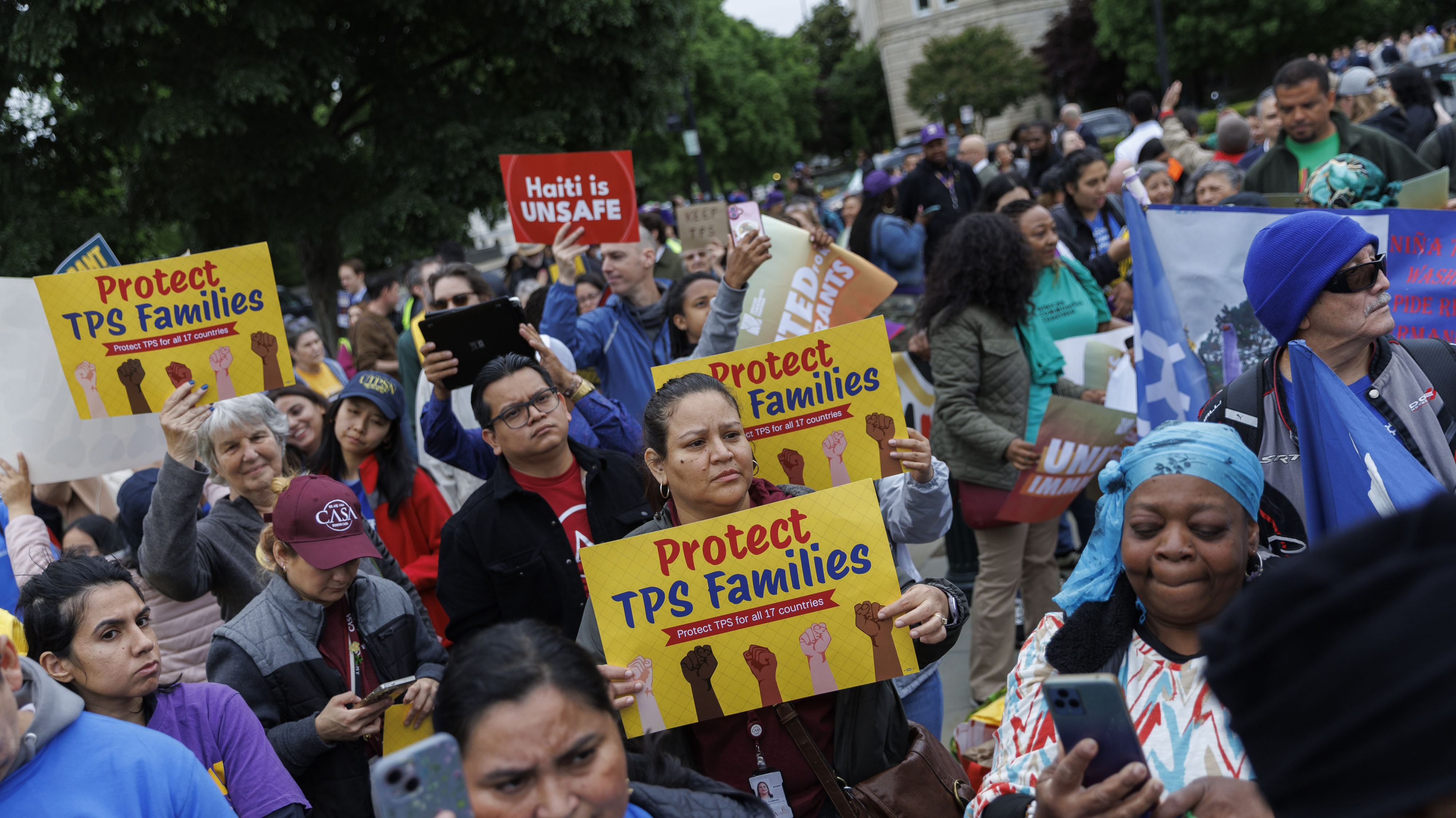
(NEW YORK) — The Supreme Court on Wednesday is considering whether the Trump administration unlawfully ordered hundreds of thousands of immigrants living in the U.S. from Haiti and Syria to return home, abruptly cancelling their legal status out of alleged racial animus and without proper consideration of risks to their safety and the nation’s economy.
The outcome in the pair of cases being argued before the court will directly affect the futures of roughly 350,000 Haitian nationals and about 6,000 Syrians.
The Trump administration contends in court documents that the immigrants were never intended to be permanent residents and that cancellation of their temporary status is “critically important to the national security and public safety of the United States.”
Those immigrants were granted Temporary Protected Status (TPS) under separate government declarations first issued more than a decade ago and later renewed multiple times, most recently by the Biden administration.
TPS status, established by the Immigration and Nationality Act, provides work authorization and protection from deportation – as long as the Homeland Security Secretary certifies that a foreign country is unsafe because of armed conflict, natural disaster, or “extraordinary and temporary conditions.”
Haiti experienced a devastating earthquake in 2010 and has since been hit by subsequent natural disasters, political unrest following a presidential assassination, and waves of rampant gang violence.
Syria devolved into civil war around 2011 and has been considered by the U.S. government a hotbed of terrorism and extremism for nearly two decades. A major earthquake in 2023 plunged the country into a deeper economic and humanitarian crisis.
“There is no functioning healthcare system for the disabled and elderly to return to, no reliable housing infrastructure, no legal framework that can guarantee anyone’s safety,” said Syrian TPS-holder and health care worker Adam, a pseudonym used to protect his identity.
Then-DHS Secretary Kristi Noem, in separate acts last year, moved to terminate TPS status for Haiti and Syria by certifying that, in her estimation, conditions on the ground in those countries were sufficiently safe for immigrants to return.
Those decisions were blocked by lower courts, which concluded that Noem did not follow proper procedures for cancelling TPS and may have also unlawfully discriminated against the immigrants on the basis of race.
The Supreme Court is now reviewing those findings.
“If the government is correct, then they can terminate TPS without conducting any country conditions review at all,” said Ahilan Arulanantham, a UCLA law professor and co-director of the Center for Immigration Law and Policy. “The statute requires, in our view, that there be consultation with the State Department.”
Immigrant advocates and some American business groups, particularly in the healthcare and senior caregiving sectors, say TPS holders play an indispensable role in the nation’s labor force and contribute billions of dollars in tax revenue to state and federal governments.
Immigrants make up 28% of the U.S. long-term care workforce – nearly double their share of the entire labor force, according to the Kaiser Family Foundation.
More than 113,000 Haitian TPS holders work in Florida alone, which is home to a high proportion of America’s seniors, according to the Florida Immigrant Coalition.
“The effects of [DHS’s] hasty TPS terminations are too serious to ignore,” a senior living community and ageing services provider jointly wrote the Court in an amicus brief. “The government has largely failed to address the impact that stripping thousands of caregivers of work authorization will have on elderly and medically vulnerable adults in U.S. communities.”
The Trump administration contends that courts have no authority to second-guess the DHS determinations on whether countries should qualify for TPS or not. They note that Congress, in creating the special status, put a time limit on it of 18-months, subject to extension.
“Congress, in short, prescribed substantive and procedural guardrails to keep TPS designations temporary,” U.S. Solicitor General John Sauer wrote the Court in a brief, “but left further accountability to the political process, not federal courts.”
Sauer also disputed claims that the TPS cancellations rested on racial animus, calling it a “legal and factual nonstarter.”
The cases are the latest high court test of President Trump’s bold assertion of executive authority in his second term. The justices are already preparing to rule on his authority to redefine birthright citizenship, fire members of independent agencies, and remove a member of the Federal Reserve.
The Supreme Court last year handed the Trump administration a temporary win when it allowed them to terminate TPS for 350,000 Venezuelan nationals as litigation continues.
TPS status for Haitians and Syrians remains in place for now, but many immigrant advocates worry that if the Court allows the Trump administration to cancel the status, protections for immigrants of other countries may also end. The Department of Homeland Security has attempted to end protections for at least 11 countries since President Trump took office.
The Court is expected to hand down a decision by the end of June.