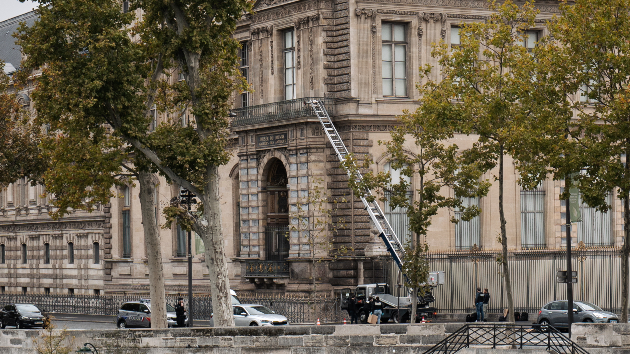
(PARIS) — The Paris public prosecutor reported on Wednesday that investigators are making “major progress” in solving the brazen Oct. 19 Louvre Museum heist and said two suspects in custody will be charged with “organized robbery.”
During a news conference on Wednesday, Laure Beccuau, the Paris Public Prosecutor, released new information about the two suspects arrested last weekend, but said the stolen jewels remain missing.
Beccuau said that if the suspects are convicted, they’ll face a sentence of up to 15 years in prison and heavy fines.
A 96-hour deadline for charging or releasing the suspects was set to expire on Wednesday. Both suspects are from the Paris suburb of Seine-Saint-Denis, authorities previously said.
Beccuau also said in her press conference that the two suspects arrested on Saturday “partially admitted their involvement in the events to investigators.”
A massive manhunt continued on Wednesday for at least two other suspects in the robbery. Beccuau said she has not ruled out the possibility that more perpetrators were involved in the heist, but added that, at this stage, evidence has not suggested any additional accomplices.
Beccuau said trace DNA recovered from a scooter used in the heist and a window at the Louvre helped investigators identify the suspects, whose names have not been released.
One man was arrested about 8 p.m. local time on Saturday at Paris’ Charles de Gaulle Airport as he was about to leave the country without a return ticket, Beccuau said. She said the suspect has lived in France since 2010 and had been convicted of a previous robbery.
Beccuau said the second suspect is a taxi driver who was arrested at 8:40 p.m. on Saturday near his home. She said the suspect’s DNA was found on one of the windows at the Louvre.
Beccuau said the suspect had been previously convicted of “aggravated robberies” in 2008 and 2014.
Investigators previously told ABC News that the second suspect was arrested as he was about to travel to Mali, but on Wednesday, Beccuau said the man had no intention of leaving the country.
ABC News’ Tom Soufi Burridge and Joseph Simonetti contributed to this report.
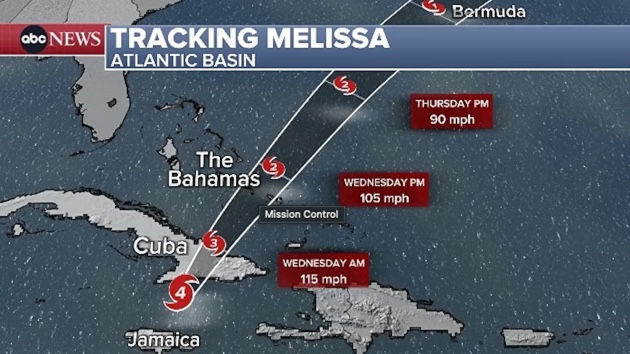
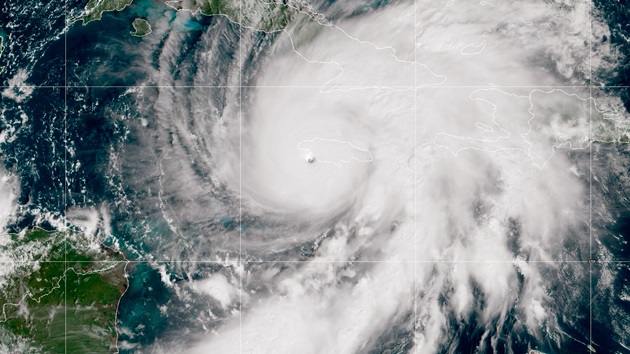
(NEW YORK) — Hurricane Melissa made landfall in Jamaica as a Category 5 hurricane — one of the most powerful hurricane landfalls on record in the Atlantic basin — and is now continuing its path of destruction through the Caribbean.
Melissa tore through Jamaica on Tuesday with 185 mph winds, making the storm the strongest hurricane on record to make landfall on the island. The previous record was set by Category 4 Hurricane Gilbert in 1988.
Rain totals in Jamaica could be up to 2 feet, with up to 30 inches in higher elevations. Jamaica’s prime minister has declared the country a disaster area.
Early Wednesday morning, Melissa made landfall in Cuba with 120 mph winds. Cuba faced a storm surge of up to 12 feet and could be inundated with 25 inches of rain in higher elevations.
Now, Melissa is heading toward the Bahamas as a Category 2 storm.
In the southeastern Bahamas, 5 to 10 inches of rain is expected and a storm surge of 5 to 8 feet is possible.
The storm is then expected to pass closely to Bermuda on Thursday night.
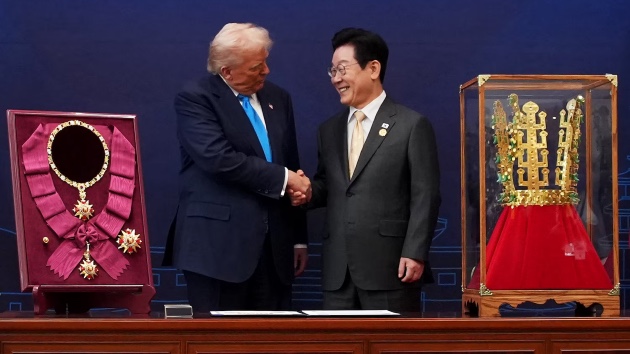
President Donald Trump is presented with the Grand Order of Mugunghwa and the Silla gold crown by South Korean President Lee Jae Myung at the Gyeongju National Museum, October 29, 2025 in Gyeongju, South Korea. (Andrew Harnik/Getty Images)
(GYEONGIU, South Korea) – South Korea announced on Wednesday that it has reached an agreement on details of the trade deal with the U.S., following a bilateral meeting between President Donald Trump and President Lee Jae Myung, as well as months of negotiations.
President Lee’s chief of staff said the tariffs the U.S. imposes on automobile exports will be lowered to 15% from 25%. The framework deal from July lowered the reciprocal rate to 15% and that will be maintained.
Back in July, South Korea pledged to invest $350 billion into the U.S. Lee’s chief of staff said a $200 billion investment will be made in installments of up to $20 billion cash payments each year. Another $150 billion will be invested in the U.S. shipbuilding industry.
This now puts the auto tariffs South Korea will pay in line with those on Japan.
The White House has not responded to request for comment about the tariffs, but released a fact-sheet with more details of the trade deal.
It includes a commitment from Korean Air to purchase 103 new Boeing aircraft for $36.2 billion, a move that is expected to support up to 135,000 jobs in the U.S. The Republican of Korea Air Force will invest $2.3 billion to develop its aircraft with an American technology company.
Plus, the White House said it has secured key investments that solidify the United States as a global energy leader, including South Korean purchases of American liquid natural gas and a $3 billion investment in U.S. power-grid infrastructure.
Earlier on Wednesday, the South Korean president greeted Trump with flattery and gifts, including a replica of the ancient gold crown from the Silla dynasty. Their meeting was held in Gyeongju, South Korea, which was the capital of the ancient Silla Kingdom.
Trump was also awarded with the Grand Order of Mugunghwa, South Korea’s highest honor. Trump is the first U.S. president to receive the honor.
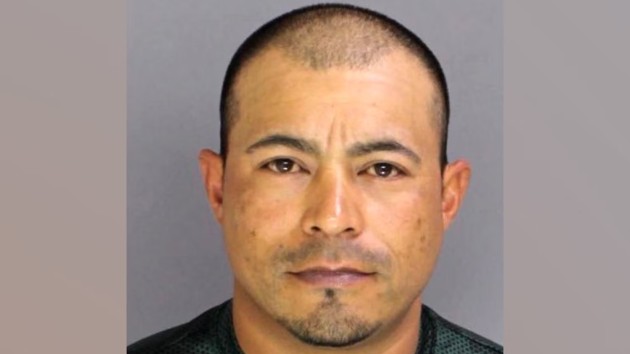
Officials in Pennsylvania are searching for Jairo Eliazar Ramirez-Lima, a man with “multiple active arrest warrants, including federal ICE detainers” who escaped police custody while handcuffed, according to the East Pikeland Township Police Department. (East Pikeland Township Police Department)
(NEW YORK) — A man in Pennsylvania with multiple warrants, including federal Immigration and Customs Enforcement detainers, is at large after he escaped police custody while still wearing handcuffs, according to the East Pikeland Township Police Department.
Jairo Eliazar Ramirez-Lima, 41, escaped from police custody on Saturday at approximately 6:59 a.m. while being transported from a local hospital following an arrest for driving under the influence, police said in a statement on Saturday.
Despite being handcuffed, Ramirez-Lima “fled on foot from the hospital grounds” and has not been seen since, police confirmed to ABC News on Wednesday.
Ramirez-Lima, who “should be considered dangerous,” was last seen wearing a black sweatshirt, white or light gray sweatpants and black sneakers, police said.
While police said there is “no known active threat to the public,” they added Ramirez-Lima has “multiple active arrest warrants, including federal ICE detainers and has a history of violence and weapons offenses.”
In addition to the DUI and escape charges, Ramirez-Lima was also charged with false identification to a law enforcement officer, tampering with public records, driving without a license, disregard to a traffic lane and careless driving, according to court documents obtained by ABC News.
He also has a protection-from-abuse order against him in Maryland, according to Philadelphia ABC station WPVI.
The suspect’s escape remains under investigation and police said additional information will be released as it becomes available.
Anyone with information on Ramirez-Lima’s whereabouts should contact the East Pikeland Township Police Department at 610-935-0606 or call 911, officials said.
In this handout satellite image provided by the National Oceanic and Atmospheric Administration (NOAA), Hurricane Melissa churns through the Caribbean Sea, captured at 15:20Z on October 28, 2025. NOAA via Getty Images
(NEW YORK) — At first light on Wednesday, the coastal communities of southwestern Jamaica bore the devastation of being in the direct path of Hurricane Melissa, as images emerging from the area show numerous homes destroyed, vehicles overturned, power lines down and trees uprooted.
One of the hardest-hit areas appeared to be the town of Black River, where many homes and businesses were left in ruins by the powerful Category 5 hurricane that made landfall on Wednesday. Twisted sheets of metal and busted concrete lay in ruins in the streets of the village, as first responders were seen in the footage weaving through downed power lines in search of survivors.
Jamaican Prime Minister Andrew Holness said his nation was “ravaged” by the hurricane’s 175 mph winds and torrential rain.
“I know many, especially those in the worst-affected parishes, are feeling disheartened,” Holness said in a social media post. “Your homes may have been damaged or destroyed, and your communities and towns no longer look the same.”
This is a developing story. Please check back for updates.
(WASHINGTON) — Two federal prosecutors were informed Wednesday that they will be put on leave after filing a legal brief that described the Jan. 6, 2021, attack on the U.S. Capitol as being carried out by “thousands of people comprising a mob of rioters,” sources familiar with their removals told ABC News.
The two prosecutors, Carlos Valdivia and Samuel White, were locked out of their government devices and informed Wednesday morning they will be placed on leave, just hours after they filed a sentencing memorandum in the case of Taylor Taranto, the sources said.
Taranto was pardoned by President Donald Trump over his involvement in the Jan. 6 attack on the Capitol but faced a separate conviction for firearms and threat charges related to a June 2023 arrest near the home of former President Barack Obama where he was found in possession of two guns and hundreds of rounds of ammunition, as well as a machete.
A day before Taranto’s arrest, he claimed he would use a car bomb to drive into the National Institute of Standards and Technology.
In their sentencing memorandum, Valdivia and White used only two sentences to detail Taranto’s involvement in the Jan. 6 attack.
“On January 6, 2021, thousands of people comprising a mob of rioters attacked the U.S. Capitol while a joint session of Congress met to certify the results of the 2020 presidential election,” the memorandum said. “Taranto was accused of participating in the riot in Washington, D.C., by entering the U.S. Capitol Building. After the riot, Taranto returned to his home in the State of Washington, where he promoted conspiracy theories about the events of January 6, 2021.”
It’s unclear if Valdivia or White were given a reason for their suspensions, though the moves come following months of turmoil in the Washington, D.C., U.S. attorney’s office where multiple career prosecutors faced removals or demotions related to their involvement in prosecuting the more than 1,500 defendants charged in connection with the Capitol attack.
A Justice Department spokesperson did not immediately respond to a request for comment from ABC News.
It’s also not immediately clear how Valdivia and White’s suspensions could impact Taranto’s case or whether the Justice Department plans to alter its recommendation that he serve 27 months in prison related to his firearms and threats conviction.
Taranto is currently set to be sentenced Thursday by U.S. District Judge Carl Nichols.
(WASHINGTON) — President Donald Trump appeared to acknowledge Wednesday that he cannot run for a third term, after previously declining to rule out the possibility.
“I have my highest poll numbers that I’ve ever had, and, you know, based on what I read, I guess I’m not allowed to run. So, we’ll see what happens,” Trump told reporters aboard Air Force One en route to Gyeongju, South Korea.
“I would say that if you read it, it’s pretty clear. I’m not allowed to run. It’s too bad, but we have a lot of great people,” he added.
House Speaker Mike Johnson said Tuesday that he does not “see the path” for Trump to seek a third term.
“It’s been a great run, but I think the president knows, and he and I have talked about, the constrictions of the Constitution, as much as so many of the American people lament that,” Johnson said during a news conference on Capitol Hill.
Trump sidestepped questions about Johnson’s comments, instead touting his strong polling numbers.
“I don’t want to even talk about that because, you know, the sad thing is, I have my highest numbers that I’ve ever had,” Trump continued.
Trump has repeatedly raised the prospect of serving a third term, despite being barred from doing so by the Constitution. The 22nd Amendment explicitly states that no person shall be elected president more than twice.
On Monday, Trump said he would “love to do it” when asked about a potential 2028 bid but Johnson, on Tuesday, said he doesn’t see a way forward when it comes to amending the Constitution.
“I don’t see a way to amend the Constitution because it takes about 10 years to do that,” Johnson, a constitutional lawyer, said. “As you all know, to allow all the states to ratify what two-thirds of the House and three-fourths of the states would approve. So I don’t, I don’t see the path for that, but I can tell you that we are not going to take our foot off the gas pedal.”
On Monday, Trump appeared to rule out the prospect of running on the 2028 Republican ticket as vice president.
“Yeah, I’d be allowed to do that,” Trump said. “I guess I think it’s too cute. Yeah, I would rule that out because it’s too cute. I think the people wouldn’t like that. It’s too cute. It’s not — it wouldn’t be right.”
(NEW YORK) — President Donald Trump arrived in South Korea, the third stop on his Asia tour that will culminate in a high-stakes meeting with Chinese President Xi Jinping on Thursday.
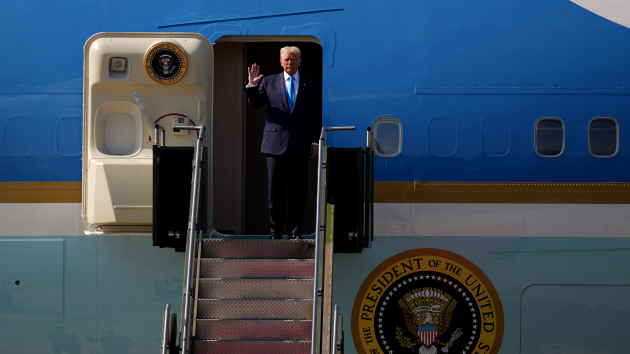
Trump touched down in Busan, South Korea, descending down Air Force One onto a red carpet flanked with Korean soldiers.
Trump greeted H.E. Hyun Cho, the foreign minister of the Republic of Korea, and a 21-gun salute followed. The band played a rendition of YMCA after the gun salute.
Trump then headed to the coastal city of Gyeongju for remarks at the Asia-Pacific Economic Cooperation (APEC) summit.
There, the president addressed several key aspects of his Asia trip, including his upcoming meeting with Xi. Trump expressed his hope for a “grand deal” between Washington and Beijing.
“I think we’re going to have a deal,” Trump said. “I think it’ll be a good deal for for both. And that’s really a great result.”
An agreement, Trump continued, would be beneficial for the broader region and “better than fighting and going through all sorts of problems, and, you know, no reason for it.”
Trump also lauded bilateral ties between the U.S. and South Korea, praising South Korean President Lee Jae Myung as “a terrific person.”
“The Republic of Korea is a cherished American friend and a close ally, and as we can see in this beautiful city, it’s truly one of the most remarkable nations anywhere on Earth,” Trump said.
Later, at an APEC leaders’ working dinner, Trump said the bilateral meetings were “tremendous” and produced a “pretty much finalized” trade deal with South Korea.
The president used his APEC address to tout his domestic and foreign economic strategies.
Trump said the tax cuts within the Big Beautiful Bill were a “tremendous success” for the return of manufacturing to America, and described himself as a president that “cuts through the red tape and excuses.”
Trump also celebrated Nvidia and TSMC for creating the first Blackwell AI Chip in the U.S. which he says is a chip “10 years advanced.”
The president claimed that his administration had secured upwards of $22 trillion in foreign investments coming into the U.S.
Trump said the figure included some $10 billion in investment by Japanese auto giant Toyota to build new car plants in “six or seven” states.
The president said the U.S. and South Korea would partner on ship building, referring to the Hanwha Group’s acquisition of the Philly Shipyard.
Trump added that his use of tariffs was “strengthening our alliances” and “also bringing peace to the world.”
“The only [deal] I didn’t do is Russia-Ukraine,” the president added. “But that’ll get done too. That’ll get done. I thought that was going to be an easy one because of my relationship with [Russian] President [Vladimir] Putin. He turned out to be a little different. But I think it’ll get done.”
Trump-Xi meeting on the horizon Trump’s most anticipated meeting on the three-country tour is with China’s Xi on Thursday, with a goal to end a month-long trade war between the world’s two largest economies.
Trump and Xi are set to meet on the sidelines of the Asia-Pacific Economic Cooperation Summit in Busan, South Korea, according to the White House. It will be their first face-to-face meeting since Trump’s return to office.
China’s state-run Xinhua news agency, citing a Chinese Foreign Ministry spokesperson, also reported on Wednesday that the meeting will occur in Busan on Thursday.
Trump expressed optimism on striking a deal with Xi, telling reporters on Air Force One that he thinks there will be a “successful transaction.”
“We’re going to have a great talk. I have a lot of respect for President Xi. I like him a lot. He likes me a lot,” Trump said as he flew to Japan. On Wednesday, the president said he expected the meeting with Xi to last for three or four hours.
Treasury Secretary Scott Bessent, on ABC’s “This Week” on Sunday, said the administration reached a “substantial framework” in tariff negotiations with Chinese counterparts ahead of Thursday.
“The president had given me maximum leverage when he threatened 100% tariffs if the Chinese imposed their rare earth global export controls, so I think we have averted that,” Bessent said, adding that the levies on Chinese goods would be avoided if the deal holds.
Bessent didn’t provide specifics on the framework, but suggested American soybean farmers would be happy. Farmers have been caught in the administration’s global tariff fight, particularly with China importing more soybeans than any other country, but currently buying none from the U.S.
“I believe, when the announcement of the deal with China is made public, that our soybean farmers will feel very good about what’s going on, both for this season and the coming seasons, for several years,” Bessent said.
Will Trump meet with Kim Jong Un? While in Asia, Trump has faced questions on whether he will try to meet with North Korea’s Kim Jong Un. The two men met three times during Trump’s first term, and Trump was the first sitting U.S. president to step into North Korea.
“I’d love to meet with him if he’d like to meet. I got along great with Kim Jong Un. I liked him. He liked me. If he wants to meet, I’ll be in South Korea,” Trump said on Air Force One.
Trump even said he was open to possibly extending his trip, which is set to wrap on Thursday.
“I think the answer would be yeah. I would do that, sure,” Trump told reporters when asked if he’d stay in Asia longer to make such a meeting happen.
In Japan, Trump and Prime Minister Sanae Takaichi had a photo spray with families of people who “were abducted by North Korea,” according to a White House official. There were about 20 people there, many holding photos of their loved ones taken by North Korea. Trump said he recognized some of the families from his visits during his first term.
Trump was then asked by a reporter whether he plans to discuss the abducted people with the North Korean leader, but Trump said that he has not yet spoken to Kim.
“We’re going to see what’s going on. We have not done anything. We’ve been so busy. We really haven’t, but we’ll be discussing it,” Trump said.
Trump talks trade with Japan’s new prime minister — first woman to serve in role
Trump visited with Japan’s Emperor Naruhito on Monday after landing in Tokyo. On Tuesday, Trump met with Japan’s new Prime Minister Sanae Takaichi.
Takaichi, a conservative, is the country’s first woman to serve as prime minister. Trump congratulated her on her election victory earlier this month, calling it “incredible news” for Japan. Takaichi is a protege of the late Shinzo Abe, with whom Trump developed a close diplomatic relationship during his first term.
Trump and Takaichi talked trade, with Japan’s previous leadership having agreed to a $550 billion investment in the U.S. in exchange for a 15% tariff rate, as well as security.
“Now both Japan and the United States have developed the greatest alliance in the world, and together with you, Japan is ready to contribute towards peace and stability,” Takaichi said during the meeting.
The prime minister noted that Japan will gift the U.S. with 250 cherry blossom trees to Washington, D.C., in honor of America’s 250th anniversary in 2026. White House press secretary Karoline Leavitt told reporters that during their bilateral meeting, Takaichi told the president that she nominated him for the Nobel Peace Prize and presented the papers to him.
The leaders also held a signing ceremony for an implementation of the trade deal that the nations struck. The agreement they signed “confirmed their strong commitment to implementing this GREAT DEAL,” the agreement read. Later, the White House released a fact-sheet detailing some of the investments.
Trump and Takaichi also signed the framework for an agreement to “support the supply of raw and processed critical minerals and rare earths crucial to the domestic industries of the United States and Japan.” The agreement comes as Trump has been working to shore up rare earths deals with nations after China slapped strict export controls on the key minerals causing trade tensions between the U.S. and China.
At a dinner with business leaders in Tokyo, Trump said Japan is opening its market up more to US goods and discussed some of the joint ventures the U.S. is taking part in with Japan, including shipbuilding, semiconductors and critical minerals.
(WASHINGTON) — The Federal Reserve on Wednesday will set the level of its benchmark interest rate, adjusting a major policy lever for the first time since a government shutdown sharply restricted the release of gold-standard federal data about the economy.
In a rare exception, the U.S. government issued an inflation report last week showing a continued acceleration of price increases, which may complicate the Fed’s effort to revive a flagging labor market.
In recent months, inflation has picked up while hiring has slowed, posing a risk of an economic double-whammy known as “stagflation.”
The economic conditions have put the Federal Reserve in a bind. If the Fed raises interest rates as a means of protecting against tariff-induced inflation, it risks tipping the economy into a downturn. On the other hand, if the Fed lowers rates to stimulate the economy in the face of a hiring slowdown, it threatens to boost spending and worsen inflation.
Last month, the Fed cut its benchmark interest rate a quarter of a percentage point, opting for its first interest rate cut this year in an effort to revive the labor market. The federal funds rate stands between 4% and 4.25%, preserving much of a sharp increase imposed in response to a pandemic-era bout of inflation.
Policymakers are widely expected to make an additional quarter-point cut on Wednesday, according to CME FedWatch Tool, a measure of market sentiment.
“It’s a challenging situation when our goals are in tension like this,” Powell said last month, but he added that the balance of risks had shifted toward greater concern over sluggish hiring.
The posture delivers a policy shift long-sought by President Donald Trump, though the size of the anticipated rate cut will all but certainly fall short of Trump’s desired outcome.
Last month, the Federal Open Market Committee (FOMC), a policymaking body at the Fed, projected two additional quarter-point rate cuts over the remainder of the year. By contrast, Trump has called for rate cuts totaling as much as 3 percentage points.
Trump has carried out a pressure campaign at the Fed with little precedent.
In recent months, Trump moved to fire one member of the Fed’s board of governors and secure Senate confirmation for another. Both officials were among the 12 policymakers who cast votes on last month’s interest-rate decision, though their status remained uncertain days before the Fed meeting. They both stand poised to cast votes again on Wednesday.
Stephen Miran, a top White House economic advisor who joined the Fed last month, cast the lone vote in favor of a larger half-point rate cut.
Trump attempted to fire board member Lisa Cook, who sued Trump over her attempted ouster, saying the decision violated her legal protections as an employee at the independent federal agency. Trump said he removed Cook over mortgage fraud allegations against her.
Federal law allows the president to remove a member of the Fed board “for cause,” though no president has attempted such a removal in the 112-year history of the central bank.
Last month, a federal judge issued a preliminary injunction requiring the Fed to let Cook continue serving in her role as a governor of the Federal Reserve System as her lawsuit moves through the courts.
(NEW YORK) — Hurricane Melissa made landfall on Jamaica early Tuesday afternoon as a Category 5 storm, with maximum sustained winds of 185 mph — the most powerful hurricane to strike the Caribbean island nation and one of the strongest on record in the Atlantic Basin.
The storm is anticipated to bring catastrophic winds, rain, flooding and storm surge to Jamaica, where residents and tourists are sheltering in place.
But the island is no stranger to dealing with destructive storms. Several hurricanes over the past several decades have struck Jamaica, causing fatalities and billions of dollars of damage.
Hurricane Beryl: July 3, 2024 Hurricane Beryl — the first hurricane of the 2024 Atlantic hurricane season — battered Jamaica when it passed just south of the island as a Category 4 storm.
Beryl slammed the island with up with 130 mph winds, between 8 inches and 12 inches of rainfall and a storm surge that sent ocean water rushing into coastal areas, according to the National Hurricane Center (NHC). The storm ripped roofs off of buildings and sent several feet of floodwater onto roadways in low-lying areas.
At least four people died in Jamaica as a result of the storm, three due to freshwater flooding and one due to rain, while more than 1,000 people were evacuated to shelters, according to officials.
In the aftermath of the storm, about 60% of the island was without electricity, and 20% of the population lacked access to clean water due to the storm’s impact on the piped water network, according to a situation report by the United Nations Office for the Coordination of Humanitarian Affairs. Healthcare on the island was also compromised, with 82 healthcare facilities reporting major damage. Minor damage was reported at the Norman Manley International Airport in Kingston.
Beryl’s damage was especially extensive in rural parts of Jamaica, where debris from destroyed homes littered the landscape and banana and coconut farms were severely damaged, according to the United Nations. An estimated 45,000 farmers were impacted, with $15.9 million in damage done to farming infrastructure that led to food shortages, according to the report.
The storm tallied about $995 million in damage to infrastructure, homes and in lost revenue, according to the National Hurricane Center. Beryl caused also caused a 1.1% drop in Jamaica’s GDP, according to the U.K.’s Centre for Disaster Protection.
Beryl was the strongest storm to hit Jamaica since Hurricane Dean in 2007, Rhea Pierre, disaster manager for the International Federation of Red Cross and Red Crescent Societies, said in the aftermath.
Hurricane Dean: Aug. 20, 2007 Hurricane Dean passed just south of Jamaica on Aug. 20, 2007, bringing powerful winds, heavy rains and storm surge to the region.
The storm was so strong that there are “few authoritative observations” for its passage over Jamaica because many of the instruments did not survive the storm, according to the NHC.
The weather station tower at the Norman Manley International Airport in Kingston was blown over the day before the storm passed the island, and numerous rain gouges were either blown over or washed away.
The highest rainfall report was 13.5 inches in Manchester Parish in West-Central Jamaica, according to the NHC.
The NHC estimates that Dean was a Category 3 hurricane when it impacted Jamaica, with maximum sustained winds of 111-129 mph, per the Saffir-Simpson scale. The most severe impacts were reported in the southeastern parishes of Clarendon, St. Catherine, Kingston and St. Andrew. About two-thirds of the homes that were completely destroyed or required major repairs were located in those parishes.
Agriculture was also significantly impacted, particularly the banana crops, according to the NHC.
Six people died in Jamaica as a result of Hurricane Dean, according to the University of West Indies.
The storm caused damage in all 13 of the island’s parishes, according to USAID. More than 3,120 homes were damaged, while a significant portion of the island’s farmland was also affected, with about 40% of the sugarcane crop, 75% of coffee trees and 100% of the banana crop impacted.
Hurricane Gilbert: Sept. 12, 1988
Before Melissa, Hurricane Gilbert was the strongest tropical cyclone on record to make landfall on Jamaica.
The massive storm made landfall on the island’s east coast near Kingston around 1 p.m. on Sept. 12, 1988, as a Category 4 hurricane with maximum sustained winds of 130 mph, according to the National Weather Service.
The eye of the hurricane traversed the entire island, with its winds weakening only to 125 mph by the time is exited Jamaica’s western coast several hours later. The storm triggered a massive storm surge, mudslides and heavy rains that caused inland flash flooding, according to the NWS.
At least 45 deaths were attributed to Gilbert, according to the National Oceanic and Atmospheric Administration.
The eye of the hurricane traversed the entire island, with its winds weakening only to 125 mph by the time is exited Jamaica’s western coast several hours later. The storm triggered a massive storm surge, mudslides and heavy rains that caused inland flash flooding, according to the NWS.
At least 45 deaths were attributed to Gilbert, according to the National Oceanic and Atmospheric Administration.
Gilbert damaged 40% of Jamaica’s agricultural fields and 95% of the island’s medical facilities, according to Hurricanes: Science and Society. Two of Jamaica’s hospitals were completely destroyed, while only two of those remaining escaped with minimal damage. In addition, about 50% of the island’s water supply was destroyed, including storage and distribution facilities.
More than 100,000 homes were destroyed or damaged, as were hundreds of miles of roads and highways, The New York Times reported at the time.
The destruction amounted to an estimated $4 billion in damages to crops, buildings, roads, homes and other infrastructure, according to Hurricanes: Science and Society.
Jamaica Prime Minister Edward P. G. Seaga described Hurricane Gilbert at the time as “the worst disaster in our modern history.”
Hurricane Charlie: Aug. 17, 1951 The center of Hurricane Charlie skirted the southern coast of Jamaica on the night of Aug. 17, 1951, before it made landfall early the next morning as a strong Category 3 storm, bringing destructive winds to the entirety of the island, according to the NHC. The strongest winds at Kingston were measured at 110 mph.
Heavy rainfall that lingered after the hurricane passed caused landslides across the island, according to the University of West Indies.
Charlie was the deadliest storm of the 20th century to impact Jamaica, resulting in more than 150 deaths on the island, according to the NHC. About 2,000 people were homeless in the storm’s aftermath.
The hurricane caused about $50 million in property and crop damage to the island, according to the NHC. Banana farms, coconut plantations and citrus groves perished in the storm.
Considerable damage was also done to shipping in the Kingston Harbor, with five large vessels pushed ashore, according to the University of West Indies.