Stock image of police lights. Douglas Sacha/Getty Images
(SPARTANBURG, S.C.) — A former sheriff of Spartanburg, South Carolina, is expected to plead guilty Thursday morning to stealing money from his own police force and taking illicit drugs.
Chuck Wright previously signed a plea deal admitting to three criminal counts of conspiracy to commit theft concerning programs receiving federal funds, conspiracy to commit wire fraud and obtaining controlled substances through misrepresentation, according to court documents reviewed by ABC News.
Wright has been accused of stealing money from a benevolent fund intended for his officers facing financial difficulties and pocketed cash he said he would use to send an officer to Washington, D.C., to honor a deputy killed in the line of service, according to federal filings.
Attorneys for Wright did not immediately respond to ABC News’ requests for comment.
Two other former Spartanburg County Sheriff’s Office employees pleaded guilty to charges associated with Wright.
Amos Durham, a former chaplain of the force, helped Wright steal more than $28,000 from the sheriff’s department, and Lawson Watson was paid by Wright as a deputy for four years for work he never did — totaling more than $200,000, investigators said in court documents against Durham and Watson.
Wright resigned earlier this year after working as a police officer for more than 20 years. Suspicion began to rise against him after a local paper discovered he had spent over $53,000 over six years on frivolous purchases that included dinners, fancy hotels, and subscriptions that included a keto diet program, according to the Post and Courier.
An excavator sits on the rubble after the East Wing of the White House was demolished on October 28, 2025 in Washington, DC. Alex Wong/Getty Images
(WASHINGTON) — Days after the abrupt demolition of the East Wing of the White House, critics are questioning whether the Trump administration and contractors involved in razing the historic structure adhered to federal health and safety standards, including those governing the handling of hazardous materials like asbestos, a dangerous and potentially deadly substance widely used during the period of the East Wing’s original construction.
On Thursday, Sen. Edward Markey, D-Mass., penned a letter to executives at the firm responsible for the demolition seeking evidence that the company complied with regulations dictating the safe removal of asbestos and lead — or if, instead, they “cut corners” and “gambled with people’s health.”
“The demolition of a structure of the age and historic national significance of the East Wing demands the highest possible standards of care, not the lowest bid and a blind eye toward regulation,” Markey wrote to leaders of ACECO, a Maryland-based demolition contractor.
The senator’s overture comes days after the nation’s largest asbestos victims’ organization raised alarms about whether the White House may have deviated from accepted practices for handling these materials.
“Federal law requires comprehensive asbestos inspection, notification, and abatement before any demolition,” wrote the Asbestos Disease Awareness Organization (ADAO) last week. “No publicly available information demonstrates that these statutory obligations have been fulfilled.”
A White House official would not say whether asbestos was found in the East Wing, but told ABC News that “a very extensive abatement and remediation assessment was followed, complying with all applicable federal standards.”
The official said that “any hazardous material abatement was done in September,” prior to the demolition earlier this month.
But Linda Reinstein, the president of ADAO, said she has seen no public evidence to suggest that an assessment or abatement took place. Federal standards require rigorous inspections to be done prior to demolition, and those inspections are then documented with a certification. If asbestos is found, workers on site would be observed wearing protective equipment, like hazmat suits.
“I am deeply concerned for White House staff and others working in or near the East Wing demolition site,” Reinstein said. “It remains unclear what measures have been taken to ensure the safe removal of deadly asbestos and other hazardous materials.”
Asbestos is a naturally occurring mineral that was commonly used in mid-century structures for fireproofing and insulation, before its deadly health risks were fully known. Invisible asbestos fibers can become airborne whenever materials containing asbestos are disturbed during demolition, renovation, or even routine maintenance.
Doctors warn that there is no safe level of asbestos exposure, and that even short, unprotected demolition work can damage the lungs and increase the risk of developing mesothelioma, a cancer of the lining of the lungs. According to the Environmental Protection Agency, exposure to asbestos fibers can cause scarring in the lungs and increases the risk of mesothelioma and lung cancer.
Dr. Raja Flores, a top lung doctor, said it can take years after inhaling the fibers for symptoms to arise.
The progressive lung disease and cancer that can occur after asbestos exposure “makes you weak, you feel short of breath, feel like you’re drowning and all these symptoms develop over a long period of time,” Flores said. “It is a prolonged and agonizing torture.”
“You wouldn’t catch me in there — not without a mask” and “not without precautions,” Flores said, referring to the White House complex during demolition.
Although White House officials would not say whether asbestos existed in the building, some experts suggest that its age and the era of its construction mean that it likely had the presence of the fiber. Originally completed in 1800, the building underwent major renovations in the 1940s and 50s, at the peak of asbestos use in buildings.
Last week, Treasury Secretary Scott Bessent defended President Donald Trump’s decision to demolish the East Wing, citing in part his assumption that “parts of the East Wing could have been asbestos, could have been mold.”
The demolition of the East Wing has been unpopular with most Americans, according to new polling released Thursday morning.
A 56% majority of Americans oppose the Trump administration tearing down the East Wing of the White House as part of the construction of a 90,000-square-foot ballroom paid for by $300 million in private donations, including 45% who “strongly” oppose it, according to an ABC News/Washington Post/Ipsos poll conducted using Ipsos’ KnowledgePanel.
President Trump said in July that the ballroom project would not interfere with the existing White House structure. But last week, as crews began to raze the East Wing, an official said the “entirety of the East Wing will be modernized.”
By Thursday, satellite images from Planet Labs PBC showed the East Wing reduced to rubble.
The White House has required at least some of the construction workers tasked with demolishing the East Wing to sign nondisclosure agreements barring them from discussing their work, according to sources familiar with the project.
A White House official told ABC News that requiring workers to sign NDAs is “standard” practice, given aspects of the project deal with the operational security of the White House.
Bob Sussman, who was the deputy EPA administrator under President Bill Clinton and a senior EPA policy counsel under President Barack Obama, said “the speed with which all this happened and the reasons why it happened so quickly should have raised many questions.”
Some environmental and health experts are warning about potential risks to the public if demolition debris that may contain asbestos is being moved off White House grounds without the appropriate safety measures.
“I am concerned that wherever they move this debris, the population in that area is going to be at risk for 20 to 30 years,” Dr. Flores said.
Markey’s letter seeks details from ACECO on the timeline of the demolition, the process it followed, what permits were sought, and whether any incidents were reported, and asks ACECO to respond by Nov. 12.
ABC News’ Jared Kofsky contributed to this report.
Margaryta Galych/Suspilne Ukraine/JSC “UA:PBC”/Global Images Ukraine via Getty Images
(LONDON) — Russia bombarded Ukrainian cities with 705 missiles and drones overnight into Thursday, according to Ukraine’s air force, with Ukrainian President Volodymyr Zelenskyy reporting strikes on civilian targets and energy infrastructure all across the country.
Russia launched 653 drones and 52 missiles of various types in its attack, Ukraine’s air force said. Of those, 592 drones and 31 missiles were shot down or otherwise suppressed, the air force said. Sixteen missiles and 63 drones impacted across 20 locations, the air force said.
Wednesday night’s attack was the second-largest Russian drone and missile barrage of the full-scale invasion to date, according to Ukrainian air force data analyzed by ABC News.
Only the bombardment of the night of Sept. 6 to 7 — in which Russia launched a combined total of 823 drones and missiles into Ukraine — was larger.
Zelenskyy said attacks were reported in the capital Kyiv and at least nine other Ukrainian regions, stretching from frontline areas in the southeast of the country to the border with Poland in the west.
“It was a complex, combined strike,” Zelenskyy said in a post to social media. At least two people were killed in a strike on a residential building in the southern city of Zaporizhzhia, with “tens of people” injured, the president said.
“There have also been many vile strikes on energy facilities and civilian life across the regions,” Zelenskyy wrote. “All the necessary services are deployed on the sites. All efforts should be made to restore power and water supply as swiftly as possible wherever it’s been disrupted.”
“Russia continues its terrorist war against life itself, and it’s crucial that every such vile attack on civilians boomerangs back on Russia with concrete consequences — sanctions and real pressure,” Zelenskyy continued.
“We count on America, Europe, and the G7 countries not to ignore this,” he wrote. “New steps are needed to increase pressure — on Russia’s oil and gas industry, its financial system and through secondary sanctions on those who bankroll this war.”
Russia’s Defense Ministry, meanwhile, said its forces shot down at least 173 Ukrainian drones overnight into Thursday. Nine were downed over the Moscow region, including six that were “heading to Moscow,” the ministry said.
(NEW YORK) — Sean “Diddy” Combs is asking a federal appeals court to expedite his appeal of his conviction on two prostitution-related charges, arguing he could finish his prison sentence before his appeal is heard on a normal timetable.
Combs is appealing his conviction and his more than four-year sentence.
“An expedited briefing and argument schedule is critical to ensure that Mr. Combs’s appeal of his sentence does not become moot while the appeal is pending,” defense attorney Alexandra Shapiro said in a new filing.
She said Combs has already served approximately 14 months of his 50-month sentence, and it is unclear how much additional time he will ultimately serve due to his potential eligibility for reductions.
Earlier this week, the Bureau of Prisons posted what the agency believes to be Combs’ release date from the Metropolitan Detention Center in Brooklyn, which is set for May 8, 2028 — although it can change.
Combs was convicted of two counts of transportation for the purposes of prostitution after an eight-week trial in July. The jury acquitted Combs of more serious sex trafficking and racketeering charges he faced.
In his appeal, Combs plans to argue to the 2nd U.S. Circuit Court of Appeals that prosecutors misapplied the law.
“Sean’s appeal will challenge the unfair use of the Mann Act, an infamous statute with a sordid history, to prosecute him for sex with consenting adults,” Shapiro said.
He has said his counts of conviction should not apply because he had no financial motive for transporting male escorts. Instead he said he wanted to watch them have sex with his girlfriends.
(WASHINGTON) — Most Americans oppose the demolition of the White House’s East Wing to make way for President Donald Trump’s ballroom, according to an ABC News/Washington Post/Ipsos poll conducted using Ipsos’ KnowledgePanel.
A 56% majority of Americans oppose the Trump administration tearing down the East Wing of the White House as part of the construction of a 90,000-square-foot ballroom paid for by $300 million in private donations, including 45% who “strongly” oppose it, the poll finds.
Just 28% of Americans support it, with 15% strongly supporting the East Wing being torn down for a ballroom, the poll found. Another 16% say they are not sure.
Support breaks down by party lines, with a 62% majority of Republicans in support and 88% of Democrats opposed. A 61% majority of independents oppose the East Wing tear town and ballroom, with nearly half opposing it strongly, according to the poll.
Opinions are much stronger among Democrats: 78% of Democrats strongly oppose the teardown and ballroom, a much smaller 35% of Republicans strongly support it.
A majority of liberals (76%) and about half of moderates (51%) strongly oppose the East Wing teardown and ballroom, while just about a third of conservatives (34%) support it strongly.
Strong support peaks among strong Trump approvers, with 58% saying they strongly support the teardown of the East Wing and ballroom. Among those who somewhat approve of Trump, just 11% strongly support the plan.
Among strong Trump disapprovers, 82% strongly oppose tearing down the East Wing and building a ballroom, while a much smaller 37% of those who somewhat disapprove of the president strongly oppose the plan.
Just about four in 10 conservative Republicans (42%) say they are strongly in favor of the plan. Conversely, 82% of liberal Democrats and 73% of moderate and conservative Democrats oppose it strongly.
Methodology: This ABC News/Washington Post/Ipsos poll was conducted online via the probability-based Ipsos KnowledgePanel® Oct. 24-28, 2025, in English and Spanish, among a random national sample of 2,725 U.S. adults and has a margin of error of plus or minus 1.9 percentage points, including the design effect. Error margins are larger for subgroups. The partisan divisions are 28% Democrats, 31% Republicans and 41% independents or something else.
See more details on ABC News’ survey methodology here.
(LONDON) — President Donald Trump touted an “amazing” meeting with Chinese President Xi Jinping in South Korea, saying the two leaders reached agreements to reduce tariffs on Chinese imports, delay Chinese restrictions on its rare earth mineral exports and secure Chinese purchases of American soybeans and other farm products.
Still, key topics — including Chinese designs on Taiwan and a potential deal to keep TikTok operating in the U.S. — were not addressed, according to the post-meeting remarks from Trump and official Chinese readouts.
Speaking to reporters aboard Air Force One following the meeting with Xi, which lasted about 1 hour and 45 minutes, Trump said the 20% tariffs on China related to fentanyl were being reduced to 10%, bringing the total amount of duties imposed on Chinese imports from 57% to 47%.
Trump said he agreed to reduce the tariff rate because China had agreed to “work very hard to stop the flow” of fentanyl.
Trump said the U.S. had reached a one-year agreement with China ensuring Beijing would not impose dramatic restrictions on rare earth minerals — materials key for producing computer chips that are needed for everything including smartphones, AI systems and defense technology.
China’s Ministry of Commerce confirmed the temporary suspension of those restrictions in an official readout. Trump said he believes the one-year deal will be “routinely” extended.
Meanwhile, Trump also said Xi had “authorized China to begin the purchase of massive amounts of Soybeans, Sorghum, and other Farm products.”
“We have a deal now,” Trump told reporters. “Every year we’ll renegotiate the deal, but I think the deal will go on for a long time, long beyond the year. We’ll negotiate at the end of the year. But all of the rare earth has been settled, and that’s for the world.”
The president said the meeting touched on most key bilateral issues. “A lot of decisions were made,” Trump said. “There wasn’t too, too much left out there.”
Overall, Trump said the meeting with Xi in South Korea was “amazing,” and on a scale of 1 to 10 gave it a 12. “He’s a great leader, great leader of a very powerful, very strong country, China, and we, what can I say? We have — it was an outstanding group of decisions, I think that was made,” Trump said.
The two leaders agreed that Trump will visit China in April, the president said, with Xi then visiting the U.S. “sometime after that.”
The Chinese Ministry of Commerce released a statement following the meeting saying that Beijing “looks forward to working with the United States to do a good job in implementation and inject more certainty and stability into Sino-U.S. economic and trade cooperation and the world economy.”
Leaders talk soybeans, but not Taiwan Trump said China would begin purchasing U.S. soybeans “immediately” as part of the new deal. The Chinese pause on purchasing Americans soybeans had been a major part of the ongoing trade war and had deeply affected American farmers.
“We’re in agreement on so many elements, large amounts, tremendous amounts of the soybeans and other farm products are going to be purchased immediately, starting immediately,” Trump told reporters after the meeting.
In a later social media post, Trump said Xi “authorized China to begin the purchase of massive amounts of Soybeans, Sorghum, and other Farm products.”
Trump also said that he discussed computer chips with Xi, claiming China said they would speak with U.S. chipmaker Nvidia and some others about purchasing products from America.
Trump said the two men did not discuss Nvidia’s high-end Blackwell artificial intelligence chip during the talks.
In his post to social media after the meeting, Trump said China also agreed to “begin the process of purchasing American Energy. In fact, a very large scale transaction may take place concerning the purchase of Oil and Gas from the Great State of Alaska.”
Trump did not address a potential deal to keep TikTok running in the U.S. China’s Commerce Ministry said it is committed to “properly resolving issues related to TikTok.” The statement did not say a deal had been finalized.
The thorny issue of Taiwan did not come up, Trump told reporters aboard Air Force One.
Russia’s war in Ukraine was discussed at length, the president added, with Trump saying he and Xi agreed to work together to get the war “finished.”
“Ukraine came up very strongly,” Trump said. “We talked about it for a long time, and we’re both going to work together to see if we can get something done.”
“We agree the sides are, you know, locked in fighting, and sometimes you have to let him fight, I guess, crazy, but he’s going to help us, and we’re going to work together on Ukraine. Not a lot more we can do,” Trump said.
Trump said that he didn’t broach China’s continued purchases of oil from Russia.
“He’s been buying oil from Russia for a long time. It takes care of a big part of China,” Trump said. “But we didn’t really discuss the oil. We discussed working together to see if we could get that war finished. You know, it doesn’t affect China. It doesn’t affect us.”
The president said his pre-meeting announcement on the planned resumption of U.S. nuclear testing was not aimed at China. Rather, he said, it “had to do with others.”
“They seem to all be nuclear testing,” he said. “We have more nuclear weapons than anybody. We don’t do testing. We’ve halted it years, many years ago. But with others doing testing, I think it’s appropriate that we’d … also testing.”
When pressed, Trump would not say who the “others” were. The U.S. and Russia, he added, have the most nuclear warheads, with China able to “catch up within four or five years.”
“I’d like to see a denuclearization,” Trump said. “I think de-escalation would be — they would call denuclearization — would be a tremendous thing, and it’s something we are actually talking to Russia about that and China would be added to that, if we do something.”
(NEW YORK) — Tens of thousands of children and families could be affected by dozens of Head Start programs potentially closing if the federal government shutdown extends past Nov. 1.
About 134 programs across 41 states and Puerto Rico will see their operational funding cease on Saturday, affecting nearly 65,000 kids, or 10% of all Head Start children, according to the National Head Start Association (NHSA).
Florida, Georgia, Missouri and Ohio may see the most impacts, potentially affecting more than 24,000 children and more than 7,500 staff members, NHSA data shows.
Head Start is a federal program run by the U.S. Department of Health and Human Services that provides early childhood education, health, nutrition and family support services to low-income children and families.
Programs shutting down could mean that children under age 6 could lose access to preschool education, health services and referrals. Families could lose access to affordable childcare that allows parents to work, attend school or undergo job training.
“We are concerned that the longer a government shutdown runs, the more likely it is that Head Start programs might be faced with potential closures and having deep impacts on children and families that we serve,” Tommy Sheridan, deputy director of NHSA, told ABC News. “The longer the shutdown goes, the more that number will increase and, at the end of the day, children and families should never be put at risk because of political gridlock. However, that’s exactly what’s happening right now.”
Programs struggle to find funding Sheridan said not all of the 134 programs affected will close in November. Some are reaching out to state and local leaders and some are asking private organizations for funding, which may cover costs for a short period of time.
He said there are 1,600 programs across the U.S. so, while a majority of Head Start programs will not be affected after Nov. 1, it is still a substantial number that will either be struggling to remain open or may have to close.
An HHS spokesperson told ABC News that Democrats are to blame for the government shutdown and that, when the shuthown is over, the HHS’ Office of Head Start will work to expedite grant awards.
Central Kentucky Community Action Council Head Start and Early Head Start (CKCAC), which serves 400 children in nine centers across six counties, will lose access to an $8 million federal grant on Nov. 1, Bryan Conover, executive director of CKCAC, told ABC News.
Although CKCAC’s Head Start policy council affirmed unanimously to allow the group to pursue a line of credit for about $1 million with a local bank, it will only allow operations to be maintained until Nov. 21.
“All 400 of those families could be put in a situation where, if we have to close our doors, they’re going to choose whether or not to take care of their kids or work,” Conover said. “And so there really is multiple ripples of pain that ceasing operations would cause, and we’re hoping beyond hope that this shutdown ends very soon, that we don’t have to go through those painful conversations.”
Conover said if the shutdown extends past Nov. 21, “it’s going to make for some very unfortunate Thanksgiving situations.”
“If we get to Nov. 22 and we don’t have funding available, and we have to close our doors and SNAP may not be in place yet, we’re going to have vulnerable families missing out on nutrition for their kids, let alone education, let alone therapy, let alone the other supports they need to be able to be kindergarten-ready and let alone the impacts on the families who are going to have to make choices to potentially work or stay home to provide child care,” he continued.
The Ohio Head Start Association said seven providers serving more than 3,700 kids are at risk of closing because their federal funds will be exhausted on Nov. 1. The association said closures could force 940 staff members out of work.
“Every day the shutdown continues, Ohio children and families are paying the price,” said Julie Stone, executive director of the OHSA said in a statement. “Head Start is not a political issue — it’s a lifeline. Congress must act now to restore funding, keep classrooms open, and protect the stability of families, the staff who serve them, and communities.”
Closures could affect childhood development Dr. Lindsey Burghardt, chief science officer at the Center on the Developing Child at Harvard University, said there could be negative effects on development from Head Start programs ending so suddenly.
She said these services help support children’s healthy physical and mental development through education, nutrition, having consistently available and responsible caregivers and having safe and clean places to play and learn.
Head Start programs may be the only way by which children receive nutritious meals, get health screenings or receive early intervention for developmental delays and special education.
“When you disrupt it, especially when you destabilize these services suddenly, I think you have the potential to disrupt healthy brain development, to derail the healthy development of all these other organ systems,” Burghardt told ABC News.
“And that’s important, because it can disrupt mental and physical health in childhood, but actually, really importantly, can disrupt health and well-being across those children’s life spans and have really long-lasting developmental implications,” she added.
Burghardt said the longer or larger disruption to these services, the more potential to negatively impact a child that could span throughout adolescence and decades later, when they’re an adult.
This can include poor academic and cognitive function as well as greater behavioral problems, Burghardt said.
The NHSA said research has shown Head Start programs have short-term and long-term impact, including less chronic absenteeism in middle school, improved high school graduation rates, increased higher education enrollment and completion and a decreased reliance on public assistance.
Sheridan said families, including parents and caregivers, may also feel negative impacts from Head Start programs shutting down.
“Families that are eligible for Head Start often work multiple jobs,” he said. “They might be in college or community college or a technical college or are in job training programs. … So the families that are in Head Start, they’re doing everything that they can to try to better their situation and their child’s situation. They count on Head Start to be there so that they can navigate whatever they need to in order to be able to provide for their families.”
Sheridan went on, “Without Head Start, many parents will have no affordable child care option. They may be forced to leave their jobs. They may … reduce the hours that they might be working, not attend class, different things like that, horrible decisions that families do not want to have to make … and it’s going to be incredibly destabilizing and challenging.”
(NEW YORK) — Last week, Joel Camas, a 16-year-old living in the Bronx, New York, showed up for a routine immigration check-in at a federal building in the city, hoping he would be able to return to class at his high school later that morning.
But when Camas appeared at the immigration office accompanied by his lawyers, his attorneys say he was immediately detained and taken into custody, despite telling officials that he has Special Immigrant Juvenile Status — a federal pathway to legal residency for undocumented minors who have allegedly been abused, neglected, or abandoned.
The detention of the 16-year-old, who was granted SIJS status due to the conditions in Ecuador and because his father abandoned him, occurred one month after his mother, who was issued an order of removal in 2024, self-deported to Ecuador, the country they both fled almost three years ago due to gang violence.
Camas’ detention has raised alarm among immigration attorneys about the Trump administration’s rollback of protections for SIJS recipients and their risk for deportation to their home countries.
In June, the administration announced a policy change that eliminated the automatic consideration of deferred action and work permits for those with approved SIJS status who are awaiting an available green card visa. The move, according to immigration attorneys, has resulted in the detention and possible deportation of young immigrants who were granted protections by immigration judges.
The government has defended the changes made to the SIJS program by alleging they are addressing “significant national security and public safety concerns” stemming from alleged abuses within the program.
In Camas’ case, a federal judge on Tuesday issued a temporary restraining order blocking his removal, shortly after the Department of Homeland Security said that Camas “will be reunited with his family” in Ecuador.
“One of the findings that a judge needs to make is that it’s in the best interest for this young person to remain in the U.S.,” said Beth Baltimore, the attorney representing Joel. “I’ve never seen young people targeted in this way.”
Similarly, Carlos Guerra Leon, an 18-year-old from Spring Valley, New York, was stopped and detained by Immigration and Customs Enforcement in August while on his way to work.
According to Guerra Leon’s attorney, Sarah Decker, he was detained without a warrant by officers and told he had a final order of removal, despite having SIJS status and being granted deferred action through 2026.
Guerra Leon was transported to Jackson Parish Detention Center in Louisiana, where he remains in detention. His attorneys have a pending lawsuit alleging that his detention is unlawful and that his arrest was in violation of his Fourth Amendment rights.
In a statement to ABC News, DHS Assistant Secretary Tricia McLaughlin said that Guerra Leon chose to remain in the U.S. despite a removal order “in violation of the [country’s] immigration laws.”
McLaughlin did not address Guerra Leon’s SIJS status.
“He had just graduated from high school this past June,” Decker said of Guerra Leon. “He was diligent and a well-respected worker at a local car wash, and community members have described him as an extremely hardworking, kind, and responsible young person who was dedicated to building a career in a special trade and finishing his education.”
(LONDON) — Five more suspects have been arrested in connection to the the Oct. 19 jewel heist at the Louvre museum in Paris, according to Paris Prosecutor Laure Beccuau.
The arrests took place on Wednesday in the Seine-Saint-Denis region in the suburbs of Paris though French authorities have not yet named any of the suspects.
Beccuau, who was speaking on French radio station RTL, said that the stolen jewelry has still not been found but that police believe one of the suspects arrested in yesterday’s raid could be a major person of interest due to his DNA being found at the scene of the crime.
French police told ABC News that one of the suspects was already identified and had been under surveillance for a few days already.
The fresh arrests bring to seven the total number of people detained related to the heist. Two other people — both men in their 30s and from the Paris suburb of Seine-Saint-Denis — were arrested last weekend, French National Police confirmed to ABC News.
Investigators said they matched trace DNA evidence recovered from a helmet left at the scene of the crime to one of the suspects, enabling police to put the alleged thief under phone and physical surveillance.
One suspect was arrested at 10 p.m. on Saturday at Paris’ Charles de Gaulle Airport while trying to board a plane bound for Algeria, according to police.
Investigators previously told ABC News that the second suspect was arrested as he was about to travel to Mali, but on Wednesday, Beccuau said the man had no intention of leaving the country.
One of the suspects has dual citizenship in France and Mali, and the other is a dual citizen of France and Algeria, investigators said, adding that both were already known to police from past burglary cases.
Investigators say they’re still determining whether a source inside the Louvre may have had a role in the theft.
“They knew exactly where they were going. It looks like something very organized and very professional,” French Culture Minister Rachida Dati told ABC News last week.
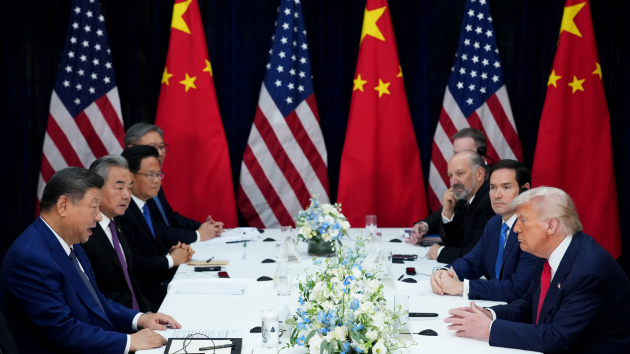
(NEW YORK) — President Donald Trump and Chinese President Xi Jinping met for their first face-to-face talks in six years with hopes of ending a monthslong trade war — a meeting that came shortly after Trump said the U.S. would “immediately” begin testing nuclear weapons, which it has not done in more than 30 years.
The meeting at an air base in Busan, South Korea, lasted roughly 1 hour and 45 minutes. Leading up to the meeting, Trump said it could last three to four hours.
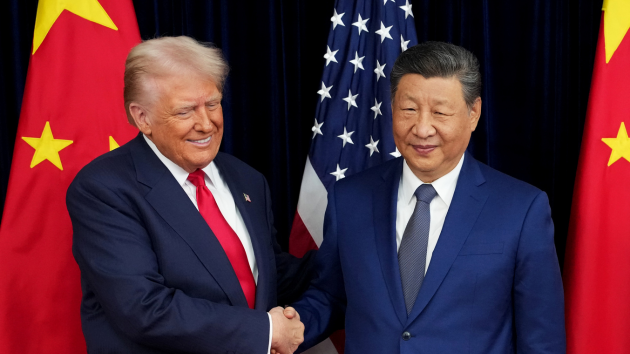
The two leaders appeared to be in good spirits leaving the meeting, exchanging a brief word and shaking hands. Trump is now headed back to Washington.
There was no immediate readout of high-profile talks.
The two shared a handshake for the cameras ahead of the meeting and, in brief remarks, projected optimism about the U.S.-China relationship.
“I think we’ve already agreed to a lot of things, and we’ll agree to some more right now, but President Xi is a great leader of a great country, and I think we’re going to have a fantastic relationship for a long period of time,” Trump said.
Xi said, since Trump’s reelection, the two leaders have spoken three times on the phone.
“Given our different national conditions, we do not always see eye-to-eye with each other, and it is normal for the two leading economies of the world to have frictions now and then,” Xi said through an interpreter.
But he said the relationship between the two countries remained “stable on the whole.”
About an hour before the meeting was set to start, Trump posted on his social media platform, touting U.S. nuclear capacity and saying he had ordered the Pentagon to resume nuclear testing on an “equal basis” to other countries’ testing programs, which will begin “immediately.”
The U.S. has “observed a voluntary moratorium on nuclear explosive testing since 1992,” according to the Congressional Research Service, though it has maintained the ability to resume the tests.
“The United States has more Nuclear Weapons than any other country,” Trump said in the post, adding “Russia is second, and China is a distant third, but will be even within 5 years.”
The post went on to say, “Because of other countries testing programs, I have instructed the Department of War to start testing our Nuclear Weapons on an equal basis. That process will begin immediately.”
After negotiations in Malaysia earlier this week, Treasury Secretary Scott Bessent said U.S. and Chinese officials agreed to a framework around trade talks. But ultimately, it’s up to the two leaders to finalize the deal.
Even if truces are made and deadlines extended, experts say any breakthrough will only offer temporary relief: short-term adjustments rather than structural change to one of the world’s most consequential relationships.
What’s on the table in talks Weeks ago, China announced it would dramatically expand restrictions on rare earth minerals — materials key for producing computer chips that are needed for everything including smartphones, AI systems and defense technology. The new rules mean that foreign firms must get Chinese government approval to export products that have even trace amounts of certain rare earths that originate from China.
Bessent said China has agreed to delay its restrictions by one year. But that’s not a lot of time, certainly not enough build viable alternatives to China.
And experts say restrictions on rare earths are part of Beijing’s long-term plans. While they can delay these controls, it still gives Beijing powerful leverage for years to come.
The rare earth export restrictions are part of a “broader shift in China’s approach to economic diplomacy,” said Neil Thomas, a fellow at the Asia Society Policy Institute’s Center for China Analysis.
“It’s been studying the U.S. export control regime and absorbing the lessons of just how powerful a diplomatic tool can be. … Beijing wants Washington to reduce its own export controls on China,” Thomas said.
Tariffs are also to be a main topic of the talks.
In response to China’s rare earth controls, Trump threatened to impose additional 100% tariffs on China. Bessent says that threat is now off the table.
But Nov. 10 is another deadline: That’s when the 90-day truce on the sky-high tariffs on each country expires. Bessent says he expects an extension, but even with this truce, tariffs on goods from both countries remain in the double digits.
Trump imposed 20% tariffs on China earlier this year over claims that China has failed to crack down on exporting chemicals used to make fentanyl. Trump said he expects to lower those fentanyl tariffs. The flow of fentanyl precursor chemicals has been a longstanding challenge between the U.S. and China.
Bessent said the deal with China also addresses the concerns from American soybean farmers. China has turned to Argentina for soybeans during the trade war, a shift that has deepened financial pressure on U.S. farmers.
Bloomberg and Reuters report that China has purchased a few soybean cargoes — its first purchases from this year’s U.S. harvest. ABC News has reached out to the White House and Treasury Department for comment. While this could be temporary relief, the long-term trend is that China has been steadily reducing its reliance on the U.S.
Plus, the TikTok deal to keep the hugely popular app operating in the United States could be finalized during their meeting. Bessent said on Sunday his “remit was to get the Chinese to agree to approve the transaction” and he believes “we successfully accomplished that” during their negotiations in Malaysia.
The White House announced last month the deal would create a joint venture majority owned by U.S. investors, with Oracle overseeing the algorithm.
Some experts say President Xi is angling for President Trump to signal a shift in U.S. support for Taiwan, the democratically governed island that Beijing claims as its own.
Trump played down the issue, telling reporters he doesn’t know if they’ll even mention Taiwan, which relies on the U.S. for political and military backing.
Also on the foreign policy front, Trump wants Xi to use his sway over Russian President Vladimir Putin to help end the war in Ukraine and to stop buying Russian energy.