
Man pleads guilty to raping Ohio girl who ended up traveling across state lines for abortion

Man pleads guilty to raping Ohio girl who ended up traveling across state lines for abortion
LordHenriVoton/Getty Images

(OHIO) — An Ohio man pleaded guilty to raping a then-9-year-old girl who later sought an out-of-state abortion in a case that became a flashpoint in the national abortion rights debate after Roe v. Wade was overturned.

Gerson Fuentes, 28, was sentenced to life in prison on Wednesday after pleading guilty to two counts of rape of a child under 10. He has the possibility of parole after 25 years, Franklin County Judge Julie Lynch said.

Fuentes was arrested last year after the victim identified him as the assailant, according to the complaint. He reportedly confessed to the rape when detectives brought him to police headquarters for a saliva test, the complaint said.

Fuentes initially pleaded not guilty to the crime and a trial was scheduled to begin Wednesday when he appeared in court and changed his plea. Fuentes will be registered as a sex offender for life and will be on supervised release for five years if released.

Lynch said in court that the girl’s family agreed to the jointly recommended sentence of life in prison with the possibility of parole after a minimum of 25 years.

“This is a hard pill for this court to swallow, to take this joint recommendation,” Lynch said. “If that family hadn’t begged me to take this joint recommendation, this would never have happened.”

Defense attorney Zachary Olah told reporters in court that Fuentes was “anxious to get it resolved.”

“We’re pleased that we could get it resolved,” Olah said. “We’re happy that we were able to get it done today for everybody involved.”

ABC News did not immediately receive a comment from the Franklin County Prosecuting Attorney’s Office on the plea deal.

Fuentes was the live-in boyfriend of the mother at the time of the assault and was identified through DNA, prosecutors said in court Wednesday. He admitted to having sex with the girl two times while living with her in the Columbus home, prosecutors said.

Authorities said the victim was raped in mid-May 2022 and traveled to Indianapolis in neighboring Indiana the following month to undergo a medical abortion at the age of 10.

A ban on abortion about six weeks into pregnancy had recently gone into effect in Ohio, following the U.S. Supreme Court’s decision overturning Roe. The so-called heartbeat law has no exceptions in the case of rape or incest.

The case drew national attention following an Indianapolis Star report that included comments from the Indianapolis obstetrician-gynecologist who performed the abortion, Dr. Caitlin Bernard.

Indiana Attorney General Todd Rokita, a Republican who opposes abortion, sought to suspend Bernard’s license, claiming that she violated federal and state law relating to patient privacy and reporting child abuse, sparking a yearlong dispute.

In May, the Indiana Medical Licensing Board decided to reprimand and fine Bernard $3,000 after ruling that she violated patient privacy laws by talking to a newspaper reporter about providing the abortion. The board refused to suspend Bernard’s license and dismissed Rokita’s allegations that Bernard violated state law by not reporting the child abuse to Indiana authorities.

In her testimony before the board, Bernard heavily criticized Ohio and Indiana politicians for politicizing the case.

“I think that if the Attorney General, Todd Rokita, had not chosen to make this his political stunt we would not be here today,” Bernard said. “I don’t think that anyone would have been looking into this story as any different than any other interview that I have ever given if it was not politicized the way that it was by public figures in our state and in Ohio.”

Abortion rights groups are now seeking to enshrine abortion rights in Ohio’s constitution. Ohioans United for Reproductive Rights said Wednesday they delivered more than 700,000 petition signatures — nearly double the amount needed — in a step toward placing a measure protecting abortion rights on the state’s November ballot. The signatures are now under review.

Currently, abortions are legal in Ohio through 22 weeks, according to the Guttmacher Institute. The “heartbeat bill” that bans abortions after cardiac activity can be detected — roughly six weeks into pregnancy — remains blocked as legal challenges play out.

ABC News’ Jeremy Edwards and Nadine El-Bawab contributed to this report.

Copyright © 2023, ABC Audio. All rights reserved.

Gov. Ron DeSantis’ push for ‘civics’ education: What does it look like?

Gov. Ron DeSantis’ push for ‘civics’ education: What does it look like?
Tony Anderson/Getty Images

(FLORIDA) — Florida Gov. Ron DeSantis recently said that if elected president in 2024 he would push for civics education about the founding principles of the United States to celebrate the country’s upcoming 250th anniversary.

DeSantis’ announcement, which he made during an interview with the Washington Examiner, comes amid the yearslong overhaul that DeSantis and state legislators have put Florida’s K-12 education system through, with civics taking center stage.

Florida’s America-focused education requirements
DeSantis signed several policies into law in 2021 that set off a wave of new educational requirements about the country and its founding.

One law, House Bill 5, requires implementation of “patriotic programs,” which includes teaching students about accepting “responsibility for preserving and defending the blessings of liberty inherited from prior generations and secured by the United States Constitution.”

It also requires “comparative discussion of political ideologies such as communism and totalitarianism, that conflict with the principles of freedom and democracy essential to the founding principles of the United States.”

The “Portraits in Patriotism Act” within the law would create a curated oral history resource that includes “first-person accounts of victims of other nations’ governing philosophies who can compare those philosophies with those of the United States.”

Another law, House Bill 233, requires that colleges and universities be reviewed for “intellectual freedom” and “viewpoint diversity.”

Meanwhile, the state Department of Education has revised, removed or rejected other lessons based on the requirements of the so-called “Stop WOKE Act” and other legislation.

The law restricts lessons and training related to race and diversity in schools, though the law has been blocked in court from impacting colleges and universities.

This law is supplemented by the Parental Rights in Education law, which restricts curriculum or programs related to gender identity or sexual orientation, as well as Senate Bill 266, which bars state or federal funding from being used for programs or campus activities related to diversity, equity and inclusion or social activism in higher education.

The effects of these laws restricting classroom content have already been seen. DeSantis’ administration rejected an advanced placement African American history course, saying it is “inexplicably contrary to Florida law and significantly lacks educational value” in a statement to ABC News.

Lessons on the civil rights movement and Black history also have been changed. For example, discussion of Black social justice movements in the 2000s, including the anti-police brutality Black Lives Matter movement, have been removed from classroom materials.

What is civics education?
Civics education in the U.S., according to the National Center for Education Statistics, refers to the knowledge and skills in “democratic citizenship, government, and American constitutional democracy.” Surveys on American civics knowledge often focus on whether respondents can name presidential candidates, the branches of government, what the Constitution does, and more.

According to the 2022 Annenberg Public Policy Center survey, less than half of respondents — 47% — could name all three branches of government. One in four respondents said they couldn’t name any of the First Amendment freedoms.

Over half of respondents — 51% — wrongfully believe that Facebook must let all Americans express themselves freely on its platform under the First Amendment.

However, some educators and lawmakers say civics in education should play a larger role than being able to recite information about the government.

They argue it should teach students about how to be an active and knowledgeable member of one’s community, according to CivXNow, a bipartisan coalition of academics advocating for civics education expansion.

The group argues that civics education is about an understanding of the methods involved in civil discourse and civil engagement, such as protest, debate, voting, volunteering and more.

The National Education Association — the nation’s largest labor union which represents public school teachers, professors, institution staff members — argues that civics education should incorporate discussions about current political or social issues, as well as promote programs that allow students to apply lessons from the classroom into community service.

Copyright © 2023, ABC Audio. All rights reserved.

LA County sheriff investigating after bodycam video shows deputy throwing Black woman to the ground

LA County sheriff investigating after bodycam video shows deputy throwing Black woman to the ground
Los Angeles County Sheriff’s Department

(LOS ANGELES) — The Los Angeles County Sheriff’s Department is investigating a June 24 incident outside a WinCo Foods grocery store in Lancaster, California, where a sheriff’s deputy slammed a woman to the ground during a confrontation about an alleged robbery in progress.

The LASD said in a statement on Monday that they are releasing the body camera footage of the incident “in the interest of transparency” with the community.

“The Los Angeles County Sheriff’s Department has opened an investigation into this incident. While the Department does not make statements related to ongoing investigations, Sheriff Luna has made it clear that he expects Department personnel to treat all members of the public with dignity and respect, and that personnel who do not uphold our training standards will be held accountable,” the statement said.

According to the LASD, two deputies responded to the scene after a report of an in-progress robbery at the WinCo Foods store at the 700 block of West Avenue K-4 in Lancaster.

“Upon arrival, deputies approached a man and a woman, matching the description given by store security personnel in calls placed to 911,” the LASD said. “As deputies attempted to detain the individuals described by store security personnel, the encounter escalated into a use of force incident that was captured by a community member with a cell phone camera. The video is disturbing.”

The body camera video shows the two deputies approaching a man and a woman, who are both Black, outside the grocery store before the situation escalated.

“Why am I under arrest … for what?” the man asked.

“You are not under arrest, you are being detained,” the first deputy responded.

The other sheriff’s deputy is then seen approaching the woman, who appeared to be recording the deputies’ interaction with the man.

“You can’t touch me! You can’t touch me,” the woman said in the video.

“Get down on the ground. Get on the ground. Stop. Stop or you’re going to get punched in the face,” the sheriff’s deputy responded.

“STOP. If you touch me, you’re going to get sued,” the woman said.

The woman called out that she can’t breathe as the deputy appeared to place his knee near her neck.

“I can’t breathe,” she says at one point, followed by, “you threw me down to the ground.”

The deputy then appeared to pepper spray the woman.

The man can be heard telling deputies that the woman has cancer.

“She got cancer, man,” he said and then asked the woman to “relax” and “cooperate” with deputies.

The identities of the man and the woman, who were detained by police at the scene, have not been released by the sheriff’s office and ABC News’ attempts to independently verify their identities have not been successful.

The identities of the two sheriff’s deputies involved in the incident have also not been released, but Tom Yu, an attorney representing the deputies, told ABC affiliate in Los Angeles, KABC, that the deputies were responding to a robbery in progress and were attempting to detain the man and woman, who was recording the interaction.

“She was recording, but she’s involved in this robbery investigation so deputies have to pat her down; make sure she’s not armed, make sure she has no weapons, make sure people are safe,” Yu told KABC. “She failed to do that and then she begins to fight with deputies, so my client, as he’s trained, takes her down to the ground. It’s the safest way and the most tactful way to handcuff a suspect.”

ABC News reached out to Yu for further comment. WinCo Foods did not immediately respond to ABC News’ request for comment.

The LASD said both deputies involved were reassigned from field duty pending an administrative review, which will determine “if the force used was reasonable, necessary, appropriate, and proportional to the level of actions described.”

Amid outrage following the release of the video, community members and advocates are set to hold a protest outside the WinCo grocery store in Lancaster on Wednesday evening organized by Cancel the Contract Antelope Valley – an advocate group that is calling on the city of Lancaster to cancel its contract with the Los Angeles County Sheriff’s Department and invest those funds into communities of color.

“As Black residents of this community we are tired of living in fear of the police,” co-founder of Cancel the Contract Waunette Cullors said in a statement.

ABC News’ Alex Stone contributed to this report.

Copyright © 2023, ABC Audio. All rights reserved.

Israel withdraws forces after 2-day operation that left 12 Palestinians, 1 Israeli dead

Israel withdraws forces after 2-day operation that left 12 Palestinians, 1 Israeli dead
Alexandre Morin-Laprise/Getty Images

(JENIN, West Bank) — Israel withdrew its forces from the Jenin refugee camp just after midnight Wednesday, ending the largest military operation it’s conducted in the occupied West Bank in nearly twenty years.

The Israeli operation — which included drone airstrikes, hundreds of special forces and tanks — lasted 48 hours, leaving fatalities and scenes of earthquake-like destruction. The Palestinian Health Ministry says 12 Palestinians were killed, and 141 injured, 20 in critical condition. The Israeli Defense Forces reported one soldier was killed.

Israeli officials have defended the deadly incursion as a counterterrorism operation. Col. Richard Hecht, a spokesman for the Israeli Defense Forces, told ABC News the aim was, “to dismantle terrorist infrastructure in the area and break the mentality of the camp as a ‘safe haven’ for terrorist operatives.”

The Jenin refugee camp is a stronghold for Palestinian militant groups, from the established Palestinian Islamic Jihad to new splinter groups like The Lions Den, Israeli and U.S. officials say. Over the last year, dozens of militants who’ve carried out deadly shootings, stabbings or car ramming attacks against Israeli civilians have hailed or taken shelter in the densely populated camp, according to Israeli and Palestinian security officials.

In a speech at the U.S. Embassy’s July 4th celebration in Jerusalem, Israeli Prime Minister Benjamin Netanyahu called militants in the Jenin refugee camp, “the most legitimate target on the planet: people who want to annihilate our country.”

Netanyahu thanked the U.S. for supporting the operation. The Biden administration said it supported Israel’s right to defend itself.

Despite repeated pleas from Jerusalem and Washington, the Palestinian Authority has been unable, or unwilling, to send its own security forces into Jenin to root out militant activity. The camp is under President Mahmoud Abbas’s jurisdiction, but the deeply unpopular leader has lost much of his ability to govern, including on the security front, his critics say.

Abbas’s spokesperson Abu Rudneih denounced the Israeli operation as a “new war crime,” with the president promptly cutting off security ties with Israel, a step that will likely be temporary. In a sign of his embattled leadership, mourners heckled Abbas on Wednesday when he showed up at the funerals for the Palestinian victims. “You have no place here in the camp,” some shouted, “shame on you!”

Meanwhile, Israeli officials are hailing the operation a success. Defense Minister Yoav Gallant said in a statement, “we have intercepted weapon production lines and confiscated thousands of explosive devices. We have demolished dozens of weapon manufacturing sites, hideouts and labs for the production of explosive devices.”

The IDF says it detained over 100 suspected Palestinian militants, arresting over 30. Of the 12 Palestinians killed, Hecht tells ABC News, “no non-combatants were killed during the counterterrorism activity in the Jenin camp. The IDF is not fighting against the Palestinian people – only against terrorist operatives.”

Activists inside the camp claim several of the 12 Palestinians killed were civilians.

Visiting an IDF command center near Jenin Tuesday, Netanyahu praised the Jenin operation and indicated it was the start of a new counterterrorism strategy.

“I can say that our extensive operation in Jenin is not a one-off,” Netanyahu said, adding “we will eradicate terrorism wherever we see it.”

The Israeli leader indicated the IDF may replace its nightly arrest raids in Jenin with less frequent, but longer sweeps of the area lasting a few days at a time.

But even as Israeli leaders praised the operation for striking a “severe blow” to Jenin militants, new Palestinian attacks undercut those claims and raised the specter that the deadly Israeli raid may only intensify the violence.

On Tuesday, the second day of the Jenin operation, a Palestinian attacker drove his car into pedestrians waiting at a bus stop in Tel Aviv, Israeli police said. After the impact, the attacker crawled out of his car window, wielding a knife, and stabbed two civilians before being shot dead by an armed civilian. Eight Israelis were wounded, three in serious condition, according to Israeli police.

The assailant was a Palestinian from a village near Hebron with no criminal record, according to Israeli authorities.

The Islamic militant group Hamas swiftly praised the attack, calling it the “first response to the Jenin Operation.”

Early Wednesday, after the Israeli Army withdrew from the Jenin refugee camp, militants in Gaza fired a volley of 5 rockets on the Israeli city of Sderot, according to the IDF. All were shot down by Israel’s Iron Dome system and no one was reported injured, the IDF said.

Israel’s defense forces responded with airstrikes on what it called a Hamas rocket manufacturing site.

The residents of the camp, home to 18,000 Palestinians, expressed anger and shock at the level of destruction wrought by the IDF. Thousands who fled the violence returned home Wednesday to a neighborhood turned upside down.

Abed Al Salam Al Hayga, a social activist in the camp, told ABC News, “the level of destruction of the infrastructure is beyond imagination, the Israeli Army destroyed the streets of the camp with bulldozers and digging the water pipes network and electricity. The camp is now without electricity and water and no cars can be used in the camp.”

Clips posted on social media show streets in rubble, damaged apartments, blown out storefronts and crushed cars.

The NGO Doctors Without Borders says the destruction has hampered their efforts to deliver medical care to the dozens wounded.

The IDF did not immediately address this claim, but it said in a previous statement that all the injured were able to receive assistance.

ABC News’ Nasser Atta contributed to this report.

Copyright © 2023, ABC Audio. All rights reserved.

Biden’s Plan B on student loan forgiveness relies on Higher Education Act: What to know

Biden’s Plan B on student loan forgiveness relies on Higher Education Act: What to know
Peter Dazeley/Getty Images

(WASHINGTON, D.C.) — President Joe Biden is launching another effort to forgive at least some federal student loan debt after the Supreme Court last week struck down his initial proposal to wipe away as much as $20,000 for borrowers.

The White House’s new approach is based on the Higher Education Act (HEA) of 1965, which provides government-backed student loans and grants the U.S. Education Department the ability to “compromise, waive or release loans.”

Further details will be revealed during a rulemaking process: Implementing any changes will take multiple steps over months, the National Economic Council’s deputy director, Bharat Ramamurti, told reporters on Friday.

It’s unclear if any debt cancellation offered through HEA would be of a similar scope and scale as Biden’s first program, which the White House said covered 43 million borrowers — with 20 million expected to see their student loans entirely erased.

Conservatives had sharply criticized that loan forgiveness as a misuse of tax dollars and an excessive and unconstitutional “scam,” with some saying it didn’t address underlying cost problems in education.

Ramamurti said on Friday that “even a typical rulemaking process can take some amount of time. You have to do a proposal, it has to receive comments, it has to be finalized and so on.”

A negotiated rulemaking process is “even more complicated,” Ramamurti said, and will involve public hearings. The Education Department will hold one virtually on July 18.

“One of the things about the rulemaking process is that we can’t actually prejudge its outcome. Part of how we do this process is how we initiate it, we put a proposal on the table, we work with stakeholders to get their input. That ends up shaping the scope of the proposal. … You’ll hear more about that as we get to each state to the process going forward,” Ramamurti said.

The initial debt cancellation plan the Supreme Court rejected 6-3 as presidential overreach was based on the post-9/11 Higher Education Relief Opportunities For Students (HEROES) Act, which enabled the education secretary to “waive or modify any statutory or regulatory provision” and was later altered to include people affected by “a war or other military operation or national emergency.” The White House argued the COVID-19 pandemic qualified as such an emergency.

However, progressive Democratic lawmakers like Sen. Elizabeth Warren of Massachusetts and Rep. Alexandria Ocasio-Cortez of New York repeatedly called on the Biden administration to use the HEA rather than the HEROES Act in pursuing debt forgiveness.

Regardless of how much student loan debt Biden intends to cancel under his backup plan and whether there is an income cap for those whose debts get wiped away, his proposal is likely to face legal challenges, too — sparking questions over how big the White House will go and whether a Supreme Court that already overturned his first plan would be more amenable to an alternate strategy.

“My view is that the HEA’s settlement authorities are potentially quite broad, and so using them to forgive a lot of student debt is entirely legally defensible,” said Luke Herrine, an assistant law professor at the University of Alabama. “This would be their broadest use ever — many experts think it’s entirely justified, but the viability question is more a question of whether the administration can either convince a hostile court or avoid that court.”

“I expect the administration is likely seeing the previously enacted plan as a ceiling, so the most they’d do is just try to do the same thing again,” said Herrine, who also was a legal director of The Debt Collective, a debtors’ union. “But that’s not because of built-in limits to the statutory authority in question — it’s a combination of what they think is fair, politically viable and relatively likely to win in a skeptical court.”

Activists hope that Biden will go broader the second time around, noting that the HEA is not tied to a national emergency the way the HEROES Act was, suggesting the scope of the debt forgiven can now be larger.

“I think that the administration liked the idea that they were tying relief to the pandemic, they were saying very clearly to the public, ‘This is a onetime thing. Don’t worry, we’re not getting too out of hand with this debt relief stuff.’ But you know, both are totally legal, legitimate authorities. And in fact, the HEROES Act was sort of tailor-made for what we were in, which is a national emergency,” said Debt Collective co-founder Astra Taylor.

“So, I understand in a sense why they used it. But the Higher Education Act is broader, and the Debt Collective’s position has always been that it should be used to cancel all student debt,” she added. “Legally, they can wipe out every penny.”

Taylor also urged the administration to move swiftly, given that the White House has made a commitment to wiping out some debt.

“It would show that the Biden administration is serious. Sixteen million people got notifications from the federal government saying their applications were approved, 25-odd million people applied. People changed the course of their financial lives thinking, ‘Hey, the government has communicated with me this is something I can plan around.’ So, I think speed is really important on a practical level to honor that commitment,” she said.

Others, however, expressed caution at such a broad proposal, insisting that using the HEA could pass muster with the Supreme Court but with limits.

“Will this new Plan B, will it really be about the administration just waiving as much student loan debt as possible? Or will it be about it really looking at individual files or individual schools that have engaged in fraud or whatever it may be and setting income thresholds and debt relief thresholds that really are achieving the goals of the statute? If so, I think that survives,” said Derek Black, a professor at the University of South Carolina’s School of Law.

“I think the cost of higher education is astronomical, and I think a lot of people are making a lot of money off loans. But is it the case that all people making less than $120,000 are struggling to pay their student loans? That’s a tough case to make,” Black said. “The more nuanced it gets, the more survivable it is, whereas the prior iteration was not that case-specific. It wasn’t that nuanced to individual circumstances.”

Still, despite confidence from experts and activists that some debt forgiveness is legal under the HEA, it’s unclear how the court would rule on the issue a second time around.

“This court is deeply skeptical of broad interpretations of administrative authorities, of actions that improve the prospects of their political opponents and of legal interpretations that involve fiscal decisions that make working class folks’ lives better — let alone all three combined,” Herrine said. “So that’s a steep hill to climb.”

ABC News’ Anne Flaherty, Justin Gomez and Cheyenne Haslett contributed to this report.

Copyright © 2023, ABC Audio. All rights reserved.

1 in 4 Americans hadn’t contracted COVID by the end of 2022, CDC estimates

1 in 4 Americans hadn’t contracted COVID by the end of 2022, CDC estimates
DuKai photographer/Getty Images

(NEW YORK) — By the end of 2022, about one in four American adults and older teenagers still hadn’t contracted COVID-19, according to new federal data.

The Centers for Disease Control and Prevention has been tracking seroprevalence — antibodies in the blood — by collecting samples nationwide from blood donors between January and December 2022

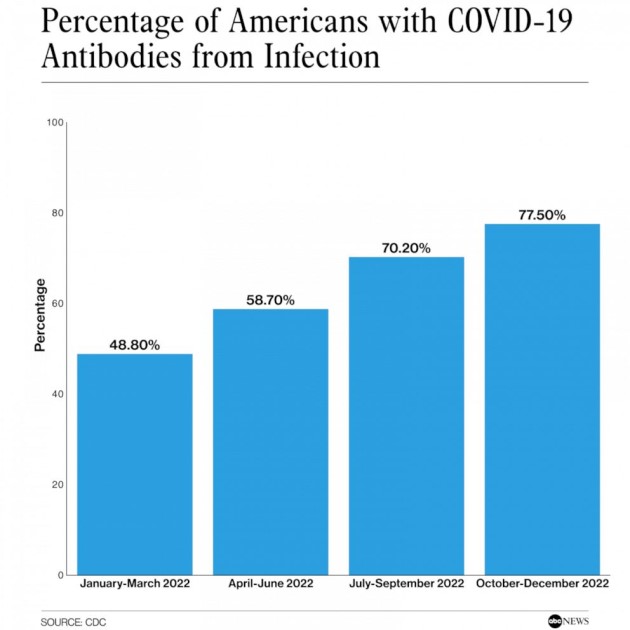
The data suggests 77.5% of those aged 16 and older had antibodies from COVID-19 infection by the time 2022 ended, according to the agency’s final estimates, which is up from the 48.8% estimate at the beginning of the year.

Meanwhile, when including people who had antibodies either from infection, by getting vaccinated or from a combination of the two, the CDC estimated that’s about 96.7% of the population.

When it came to age groups, seniors aged 65 and older had the lowest estimated percentage of people with antibodies from prior infection at 56.5% and teens and young adults aged 16 to 29 had the highest percentage at 87.1%.

CDC

Only 47 states and the District of Columbia had seroprevalence data, which showed Vermont had the lowest percentage of estimated residents with infection-induced antibodies at 64.4% and Iowa had the highest at 90.6%.

There were no major differences between men and women with 79.3% and 75.7%, respectively, estimated to have antibodies from infection.

Among racial/ethnic groups, Asian Americans had the lowest estimated percentage of infection-induced antibodies at 66.1% and Hispanic Americans had the highest percentage at 80.6%.

“Despite the fact that the various COVID variants are so very contagious, isn’t it remarkable that, by the end of last year, only three-quarters — plus a little bit — of our population had had an infection and that may be a little but surprising,” Dr. William Schaffner, a professor of preventive medicine and infectious diseases at Vanderbilt University Medical Center, told ABC News.

Experts said there are a few reasons why Americans may have yet to contract COVID-19 including living being more diligent about mitigation measures such as mask-wearing and living in a more rural area.

“We have a large rural population in the United States, and it may be that this virus has not reached everyone who lives in a more sparsely populated part of the country,” Schaffner said. “Obviously, if you live in big cities where you encounter people, there are going to be many more opportunities for transmission.”

Experts added it’s also a reminder of the importance of vaccination and that it’s not too late to get a shot for those who have yet to do so.

In April, the CDC and Food and Drug Administration simplified the vaccine schedule to recommend everyone aged 6 and older receive an updated bivalent COVID-19 vaccine, regardless of whether they previously completed their monovalent primary series.

Additionally, the FDA’s vaccine advisory committee recommended in June that vaccine manufacturers update their COVID booster shots to target XBB.1.5, which is the most common strain in the U.S.

Dr. Peter Chin-Hong, an infectious diseases specialist at the University of California, San Francisco, told ABC News the simplified schedule is especially important as we approach fall and colder weather, when cases typically tend to rise.

“It’s not too late to still be open-minded about protection, particularly since one in four is not a small number,” he said. “Many people have already been exposed naturally but we know that [antibodies] will wane over time, and it’s probably a good idea to get at least one recent shot…Simplification is the name of the game.”

Copyright © 2023, ABC Audio. All rights reserved.
CDC says 1 in 4 Americans hadn’t had COVID by end of 2022

1 in 4 Americans hadn’t contracted COVID by the end of 2022, CDC estimates
DuKai photographer/Getty Images

(NEW YORK) — By the end of 2022, about one in four American adults and older teenagers still hadn’t contracted COVID-19, according to new federal data.

The Centers for Disease Control and Prevention has been tracking seroprevalence — antibodies in the blood — by collecting samples nationwide from blood donors between January and December 2022

The data suggests 77.5% of those aged 16 and older had antibodies from COVID-19 infection by the time 2022 ended, according to the agency’s final estimates, which is up from the 48.8% estimate at the beginning of the year.

Meanwhile, when including people who had antibodies either from infection, by getting vaccinated or from a combination of the two, the CDC estimated that’s about 96.7% of the population.

When it came to age groups, seniors aged 65 and older had the lowest estimated percentage of people with antibodies from prior infection at 56.5% and teens and young adults aged 16 to 29 had the highest percentage at 87.1%.

CDC

Only 47 states and the District of Columbia had seroprevalence data, which showed Vermont had the lowest percentage of estimated residents with infection-induced antibodies at 64.4% and Iowa had the highest at 90.6%.

There were no major differences between men and women with 79.3% and 75.7%, respectively, estimated to have antibodies from infection.

Among racial/ethnic groups, Asian Americans had the lowest estimated percentage of infection-induced antibodies at 66.1% and Hispanic Americans had the highest percentage at 80.6%.

“Despite the fact that the various COVID variants are so very contagious, isn’t it remarkable that, by the end of last year, only three-quarters — plus a little bit — of our population had had an infection and that may be a little but surprising,” Dr. William Schaffner, a professor of preventive medicine and infectious diseases at Vanderbilt University Medical Center, told ABC News.

Experts said there are a few reasons why Americans may have yet to contract COVID-19 including living being more diligent about mitigation measures such as mask-wearing and living in a more rural area.

“We have a large rural population in the United States, and it may be that this virus has not reached everyone who lives in a more sparsely populated part of the country,” Schaffner said. “Obviously, if you live in big cities where you encounter people, there are going to be many more opportunities for transmission.”

Experts added it’s also a reminder of the importance of vaccination and that it’s not too late to get a shot for those who have yet to do so.

In April, the CDC and Food and Drug Administration simplified the vaccine schedule to recommend everyone aged 6 and older receive an updated bivalent COVID-19 vaccine, regardless of whether they previously completed their monovalent primary series.

Additionally, the FDA’s vaccine advisory committee recommended in June that vaccine manufacturers update their COVID booster shots to target XBB.1.5, which is the most common strain in the U.S.

Dr. Peter Chin-Hong, an infectious diseases specialist at the University of California, San Francisco, told ABC News the simplified schedule is especially important as we approach fall and colder weather, when cases typically tend to rise.

“It’s not too late to still be open-minded about protection, particularly since one in four is not a small number,” he said. “Many people have already been exposed naturally but we know that [antibodies] will wane over time, and it’s probably a good idea to get at least one recent shot…Simplification is the name of the game.”

Copyright © 2023, ABC Audio. All rights reserved.

5 shark bites reported on Long Island as officials deploy surveillance drones

5 shark bites reported on Long Island as officials deploy surveillance drones
Maremagnum/Getty Images

(NEW YORK) — Police responded to three reports of possible shark bites in separate locations around the same time on the Fourth of July off the South Shore of Long Island, New York, a day after two similar incidents were reported, authorities said.

At 1:50 p.m., police responded to a report of an injured beachgoer at Quogue Village Beach in the town of Southampton, according to the Quogue Village Police Department.

In that incident, a 47-year-old man was swimming in chest-deep water when he was bitten on his right knee. Although a shark was not physically observed, the bite was from a larger marine animal, police said. The man suffered severe lacerations and was taken by ambulance to Peconic Bay Medical Center to be treated for non-life-threatening injuries.

Police have notified all surrounding beaches of the marine life activity and are encouraging patrons to stay out of the water until the situation can be further assessed.

In the second incident, a 49-year-old man was bitten on the hand around 1:55 p.m. while swimming in the ocean off Fire Island, according to the Suffolk County Police Marine Bureau, who responded to the incident. The victim was brought to South Shore University Hospital in Bay Shore for treatment of a non-life-threatening laceration.

A third incident, also off Fire Island, took place at about 4:25 p.m. on Tuesday, the Suffolk County Police Marine Bureau said on Wednesday. An adult woman was bit on the upper thigh just west of Cherry Grove and was treated for non-life-threatening injuries at South Shore University Hospital.

Two more apparent shark bites were reported at beaches on Long Island’s South Shore on Monday, WABC reported – one at Robert Moses State Park and another at Kismet Beach.

New York Gov. Kathy Hochul’s office is deploying drones across beaches to try and prevent encounters after a rise in shark attacks last year, when there were six shark attacks off beaches on Long Island in the span of three weeks.

Robert Moses State Park had a delayed opening for swimming Tuesday after state parks officials spotted about 50 sand sharks during their morning drone survey, WABC reported.

In Florida last week, a shark bit a fisherman who was washing his hands off the side of a boat in Everglades National Park. In another incident in Cocoa Beach, a 12-year-old girl received 50 stitches after a shark bit her on the leg.

Copyright © 2023, ABC Audio. All rights reserved.

Supreme Court shows surprising restraint in chaotic year of crises: ANALYSIS

Supreme Court shows surprising restraint in chaotic year of crises: ANALYSIS
Bloomberg Creative/Getty Images

(WASHINGTON, D.C.) — It’s a conservative Supreme Court that has acted with confidence and conviction, but one that seems increasingly aware of its image problem.

Since the addition of the three justices nominated by President Donald Trump, the court’s six-justice conservative supermajority has set into motion the most significant changes in American law and society in a generation — overruling Roe v. Wade; expanding concealed carry gun rights; bolstering free speech and advancing religious liberty.

The biggest and most controversial decisions of this year effectively ended 45 years of affirmative action in higher education; struck down President Biden’s $400 billion student debt forgiveness plan; and, carved out an exception to anti-discrimination laws for opponents of same-sex marriage.

The major rulings were predictably praised by Republicans and condemned by Democrats. A majority of Americans say they believe the justices have ruled mainly on the basis of politics, not the law, according to a new ABC News/Ipsos poll.

But while the headline-grabbing decisions and ideological divisions may define it, the nation’s highest court was significantly less divided in 2023 than it has been in recent years. In several cases where conservatives could have made big gains, the court showed surprising restraint.

Of the 58 opinions the court issued since October 2022, more than half were unanimous or near-unanimous, either 9-0 or 8-1. More than 9 out of 10 cases had one of the court’s liberal justices in the majority.

The justices forcefully rejected the independent state legislature theory for election law, embraced by Trump and his allies; rebuffed Texas’ challenge to the Biden administration’s immigration and deportation plan; upheld Section 2 of the Voting Rights Act, preserving protection against race discrimination in redistricting; and upheld the landmark Indian Child Welfare Act, celebrated by Native American tribes.

Perhaps most remarkable, only five cases were decided by a 6-3 ideological split — conservatives versus liberals. That’s down from 14 last term and the lowest number of straight ideological split decisions in the past six years, according to Adam Feldman at Empirical SCOTUS.

Many of these outcomes appear to reflect the extraordinary influence and strategy of Chief Justice John Roberts, who was pushed aside as a central power broker during the Trump years, but still wields significant power.

One year ago, Justice Clarence Thomas appeared to be emerging as the dominant influence on the court, joined by Justices Samuel Alito and Neil Gorsuch in a project to push ahead on a maximalist approach to the law.

But this term, the tables appeared to turn, many veteran court watchers say.

Chief Justice Roberts and Justice Brett Kavanaugh were the most common alignments of any pairing of justices in the decisions this term, according to Feldman. Kavanaugh was in the majority 96% of the time, Roberts 95% of the time.

Both Roberts and Kavanaugh have signaled publicly and in their writings a desire for a more incremental approach to the law – one that has an eye on bolstering legitimacy of the court as an institution in the public eye.

Near-record low public approval, compounded by growing concern over ethics and impartiality, has fed bipartisan debate about the state of the court and what steps may need to be taken from the outside to improve its credibility.

While the justices frequently insist that they do not decide cases based on public opinion, they are also not blind to it.

And through it all, the nine justices have shown surprising cohesion. In the midst of a partisan firestorm over alleged ethics lapses by two conservative justices — Thomas and Alito — the entire court released a signed public statement attesting to its ethical practices and unanimously rebuffing Democrat-led efforts to legislate “reform.”

One potential wild card at the center of it all was the court’s newest member, Justice Ketanji Brown Jackson. The nation’s first black woman justice publicly showed outsized engagement and impact from the start: She spoke during oral arguments more than any other new justice in history — and more than any justice sitting during this period, according to Feldman. Her influence behind the scenes will take years to come into focus.

Where does it all go from here?

The justices will take the summer to cool off — and hope the public disaffection with them does as well. Meantime, they have filled their docket with another list of blockbuster cases for the fall: on gun rights, social media censorship, government regulation and voting rights that will give them plenty to chew on heading into an election year.

Copyright © 2023, ABC Audio. All rights reserved.

Search underway for hiker missing in Yosemite National Park since Sunday

Search underway for hiker missing in Yosemite National Park since Sunday
Yosemite National Park

(NEW YORK) — Officials are searching for a hiker who went missing over the holiday weekend at California’s Yosemite National Park.

Hayden Klemenok was last seen backpacking with a group at Upper Chilnualna Fall on July 2. He entered the Chilnualna Creek near the trail junction at around 2 p.m. local time, according to park officials.

Officials said Klemenok was last seen wearing a tan brimmed hat, white sunglasses, red T-shirt, blue swimming trunks and white Adidas shoes.

Klemenok’s whereabouts are currently unknown, according to park officials.

Park officials ask anyone who may have seen Klemenok or hiked off the trail in the area of Upper Chilnualna Fall on or after July 2 to get in touch with officials.

“Simply knowing where you went and when you were there may help us focus the search, whether you saw anyone or not,” park officials said in a statement.

Yosemite National Park Dispatch can be contacted at 209-379-1992.

Copyright © 2023, ABC Audio. All rights reserved.