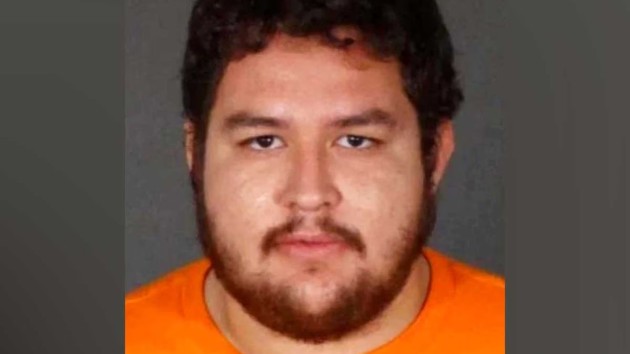
The FBI is offering a reward of up to $1,000,000 for information leading to the arrest of Omar Alexander Cardenas. (FBI)
(WASHINGTON) — The FBI is now offering $1 million for information leading to the arrest of one of its “Top Ten Most Wanted Fugitives.”
Omar Alexander Cardenas is wanted by local and federal authorities for a 2019 murder in Los Angeles.
Cardenas is accused of firing several rounds at the victim, Jabali Dumas, at a barber shop on Aug. 15, 2019, according to the FBI. Dumas was struck in the head and died, authorities said.
Cardenas has “known gang affiliations,” and the shooting is believed to have been gang-related, according to Los Angeles Police Chief Jim McDonnell.
A local arrest warrant was issued for Cardenas in April 2020 after he was charged with murder, the FBI said. He is believed to have possibly fled to Mexico and has also been federally charged with unlawful flight to avoid prosecution, according to the FBI.
The FBI initially offered a $100,000 reward for information on Cardenas’ whereabouts when he was added to its “Top Ten Most Wanted Fugitives” list in 2022. The reward, which subsequently increased to $250,000, has now surged to $1 million, the FBI announced on Tuesday.
McDonnell called the new reward a “critical step forward” in the case.
“We believe that someone knows Omar Cardenas’ whereabouts, and we’re urging anyone with information to please come forward,” the chief said during a press briefing on Tuesday. “Our mission is clear — to locate and apprehend Cardenas and bring justice for the Dumas family.”
Akil Davis, the assistant director in charge of the FBI Los Angeles field office, said the U.S.’ relationship with the government of Mexico “has never been stronger,” pointing to the recent apprehension in Mexico of another “Most Wanted” fugitive — former Olympic snowboarder turned alleged drug kingpin Ryan Wedding.
Davis shared a message directed at Cardenas.
“Mexico is not safe for you. Mr. Cardenas, if that’s where you’re hiding,” Davis said during the briefing. “I have full faith in this task force that they will bring you to justice.”
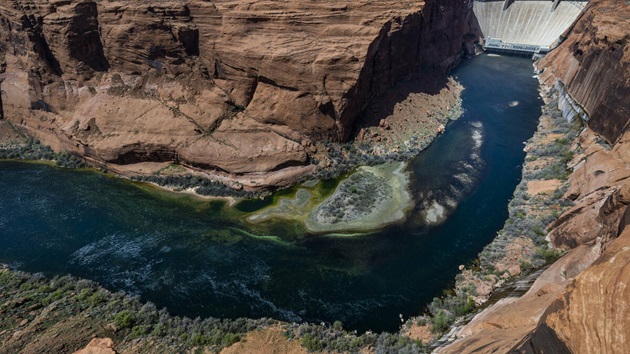
The Colorado River flows below the Glen Canyon Dam on Tuesday, April 18, 2023, in Page, Arizona. (L.E. Baskow/Las Vegas Review-Journal/Tribune News Service via Getty Images)
(NEW YORK) — Cold and snowy conditions dominated the winter season in the Northeast with much of the region experiencing its coldest winter in a decade or more, and several cities seeing their biggest snowfall in years. However, if you live in other parts of the country, this winter was very different.
Meteorological winter — December to February — was unseasonably warm across much of the contiguous U.S., ranking as the second-warmest winter on record since 1895, behind the 2023-24 season, according to a new report from the National Oceanic and Atmospheric Administration (NOAA).
While the Northeast faced persistent blasts of bitter cold and snow, exceptional winter warmth in the West nearly pushed the nation to a new all-time high for the season.
Nine states finished off with their warmest winter on record: Arizona, Colorado, New Mexico, Nevada, Texas, Oklahoma, Oregon, Utah and Wyoming. Dozens of cities in the West and Plains saw a top 5 warmest winter with cities such as Albuquerque, Phoenix, Las Vegas, and Salt Lake City seeing their all-time warmest.
Dallas, Texas, recorded 16 days with high temperatures of at least 80°F, the highest seasonal total on record.
For much of the country, winter was not only exceptionally warm, but exceptionally dry, ranking as the driest winter in 45 years across the Lower 48. Much of the western United States entered the season already grappling with drought, and persistent warmth fueled the worst snow drought in decades across parts of the Rockies as more precipitation fell as rain instead of snow.
Drought on its own already stresses water supplies, agriculture, and ecosystems. But when winter fails to deliver significant mountain snow, those impacts can intensify, according to NOAA.
A persistent snow drought can trigger a cascade of hydrologic changes. Low snowpack and early snowmelt can affect vegetation, reduce surface and subsurface water storage and alter streamflow, all of which directly impact water management and planning across the West.
Snowmelt supplies a large share of the region’s water used by communities, agriculture, and ecosystems. In some states, up to about 75 percent of water supplies can come from melting snow, according to the USGS.
The Colorado River provides water for more than 40 million people and fuels hydropower resources in seven states: California, Arizona, Nevada, Colorado, New Mexico, Utah and Wyoming, according to the Bureau of Reclamation.
Widespread, persistent drier-than-average conditions also impacted parts of the Heartland and Southeast, bringing drought expansion and intensification during the winter months. Multiple states, including Arkansas, Missouri, Illinois and Nebraska, experienced one of their driest winters on record.
According to the latest U.S. Drought Monitor reportreleased on March 5, more than half of the contiguous U.S. is experiencing drought conditions, an increase of about 10% from the beginning of February.
Florida is enduring its worst drought in 25 years, according to the National Integrated Drought Information System, with a heightened risk of wildfires this spring as conditions worsen across the state.
All of Florida is currently experiencing some level of drought, with more than 70% of the state facing an extreme drought level 3 of 4, U.S. Drought Monitor data shows.
“We expect the drought to continue or even worsen in the next couple of months, as we are in the heart of peninsular Florida’s dry season that usually lasts until mid-May,” Florida State Climatologist David Zierden told ABC News. “Then the summer convective rains kick in and provide some relief.”
The National Interagency Fire Center says Florida faces an above-average risk of significant wildland fires throughout meteorological spring, which began on March 1. Dozens of counties across the state have issued burn bans due to the ongoing drought and elevated wildfire risk.
The worsening conditions are raising concerns beyond wildfires, including impacts to water supplies and agriculture.
“Four of the five Water Management districts have either voluntary or mandatory water restrictions limiting outdoor irrigation,” Zierden added. “Range and pasture for cattle is the agricultural commodity that is hit hardest right now.”
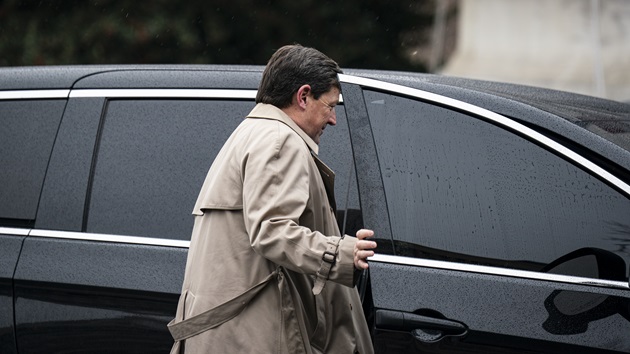
Ed Martin, former Interim U.S. Attorney for the District of Columbia, departs following a meeting at the White House on January 9, 2026 in Washington, DC. (Al Drago/Getty Images)
(WASHINGTON) — The Washington, D.C., Bar has initiated disciplinary proceedings against Justice Department pardon attorney Ed Martin over allegations he improperly threatened to withhold federal funding from Georgetown University’s law school and then attempted to sideline an investigation into his conduct, according to a petition.
This is a developing story. Check back for updates.
(NEW YORK) — A 2.3 magnitude earthquake struck about half a mile west of Sleepy Hollow, New York, on Tuesday morning, the U.S. Geological Survey confirmed.
The earthquake struck at 10:18 a.m. ET.
This is a developing story. Please check back for updates.
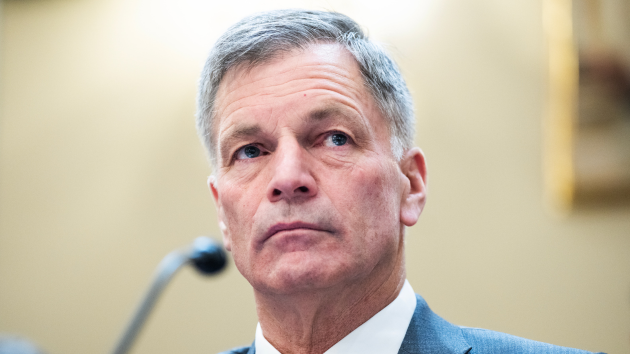
Wyoming Gov. Mark Gordon testifies during the House Natural Resources Committee hearing on Thursday, June 15, 2023. (Tom Williams/CQ-Roll Call, Inc via Getty Images)
(NEW YORK) — Wyoming Gov. Mark Gordon signed a bill into law on Monday banning abortion in the state after a “fetal heartbeat” has been detected.
HB 126, or the Human Heartbeat Act, prohibits abortion once cardiac activity is identified, which is around six weeks of pregnancy, before many women know they’re pregnant.
If cardiac activity is detected, an abortion can only be performed in the case of a medical emergency, meaning if the life of the mother is in danger or if continuing the pregnancy would cause serious or irreversible impairment of a major bodily function, according to the bill.
The bill does not include exceptions for pregnancies as a result of rape or incest.
Any person who intentionally or knowingly violates the act will be charged with a felony punishable by up to five years in prison, a fine of up to $10,000, or both, according to the bill.
“Today I signed the Human Heartbeat Act into law, reaffirming my view that life is sacred. I resoundingly share the determination to defend the lives of unborn children and support the intentions behind the Human Heartbeat Act,” Gordon wrote in a post on X on Monday.
Previously, abortion was allowed in Wyoming until fetal viability, which occurs between 24 and 26 weeks of gestation.
Wyoming is now the fifth state at least to have a “heartbeat ban” following bans enacted in Florida, Georgia, Iowa and South Carolina.
“This ban is an attack on Wyomingites’ constitutional freedom to make their own health care decisions, and it puts the health and well-being of our communities at risk,” Julie Burkhart, president of Wellspring Health Access, Wyoming’s only abortion clinic, said in a statement.
“Every day that this law is in effect means people in our state will face even greater barriers to abortion care — and some may be denied this care altogether,” the statement continued. “With so many across Wyoming already struggling to access reproductive health care, restrictive policies like these take us further in the wrong direction.”
Burkhart said Wellspring Health Access is prepared to challenge the ban in court and will continue to work with regional and national partners to help patients access the care they need.
Gordon wrote in the post on X that he was concerned the bill was “well-intentioned” but would lead to a “fragile legal effort with significant risk of ending in the courts rather than in lasting, durable policy.”
Gordon suggested that voters should decide on the issue and that a question be placed on a ballot asking if an abortion ban should be cemented in the state constitution.
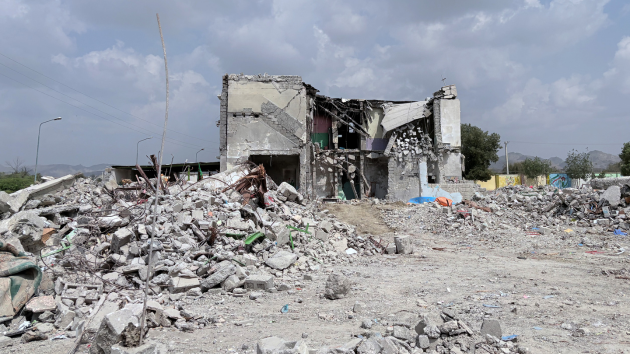
A view of the debris of a school, where many students and teachers lost their lives on the first day of the wave of attacks launched by the United States and Israel against Iran on March 5, 2026. (Photo by Stringer/Anadolu via Getty Images)
(NEW YORK) — President Donald Trump said on Monday he doesn’t “know enough” about the strike on an Iranian elementary school that Iran says killed at least 168 people, including dozens of children, but that he was “willing to live” with the findings of a U.S. investigation into the incident.
A newly surfaced video appears to show a U.S.-made missile, a Tomahawk, hitting a building in Iran adjacent to the girls’ school, experts told ABC News.
Trump suggested Monday it could have been a Tomahawk fired by Iran.
“I will say that the Tomahawk, which is one of the most powerful weapons around, is used by, you know, it’s sold and used by other countries, you know that,” Trump said. “And whether it’s Iran, who also has some Tomahawks, they wish they had more, but, whether it’s Iran or somebody else, the fact that a Tomahawk — a Tomahawk is very generic, it’s sold to other countries. But that’s being investigated right now.”
The U.S. makes and sells Tomahawks to its closest allies, including the U.K. and Australia. But it has never sold the technology to Iran or other adversaries. While other countries like Russia use cruise missiles, only the U.S. makes Tomahawks, as the missile experts say appears to be seen in the video of the school strike.
Israel has already said it wasn’t operating in the area of the school bombing.
The president faced questions Monday on the Feb. 28 incident during a news conference at Trump National Doral Miami, including his comment over the weekend that Iran was behind it.
“Based on what I’ve seen, that was done by Iran,” Trump told reporters on Air Force One on Saturday. Defense Secretary Pete Hegseth, standing just behind the president on the plane, said the matter was under investigation and that “only side that targets civilians is Iran.”
But pressed on those remarks, Trump said on Monday, “I just don’t know enough about it.”
“I think it’s something that I was told is under investigation. But Tomahawks are –are used by others, as you know. Numerous other nations have Tomahawks. They buy them from us,” Trump said.
“But I will certainly, whatever the report shows, I’m willing to live with that report,” the president continued.
The U.S. military was striking targets in the country last Saturday in an area where an elementary school was hit and dozens of children were killed, two people familiar with the initial findings previously told ABC News.
An analysis of satellite imagery by ABC News suggests the Shajareh Tayyebeh school in Minab was near an Iranian Revolutionary Guard Corps compound but had been separated from it more than decade ago.
Iranian Foreign Minister Abbas Araghchi, on NBC’s “Meet the Press” on Sunday, rejected Trump’s claim that Iran was behind the hit on the girls’ elementary school.
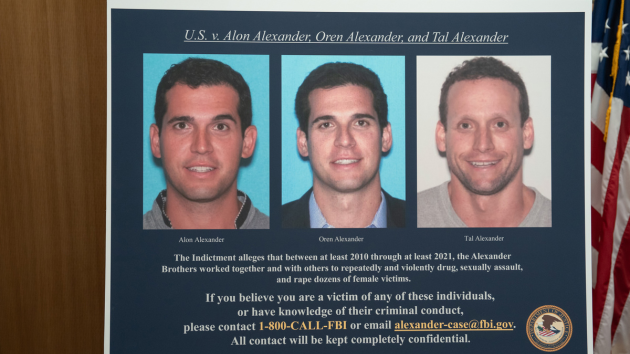
A poster of celebrity real estate agents Tal and Oren Alexander along with their brother Alon (Barry Williams/New York Daily News/Tribune News Service via Getty Images)
(NEW YORK) — A jury has found the Alexander brothers guilty on all counts in their federal sex trafficking trial in New York City.
Jury deliberations began Thursday for the former real estate titans, Oren and Alon Alexander, 38-year-old twins, along with their brother, Tal Alexander, 39, who have denied sexually assaulting anyone or running a sex trafficking conspiracy, as prosecutors have charged. They pleaded not guilty.
Throughout the five-week trial, 11 women testified that they were sexually assaulted by one or more of the brothers. At least eight of the women claimed they were drugged by one of the Alexanders.
“These are chilling, reprehensible, and unacceptable acts,” U.S. Attorney Jay Clayton, whose office prosecuted the case, said in a statement following the verdict. “We commend the victims for their courage in coming forward and testifying at the trial. They bravely overcame the pain of reliving the abuses inflicted upon them and, as a result, prevented others from becoming victims.”
A spokesperson for the Alexander family called the verdict “deeply disappointing.”
“We believe there are substantial problems with the evidence and the way this case was presented,” the spokesperson, Juda S. Engelmayer, said in a statement. “The legal process does not end here. We will continue fighting every day until justice is done and the three brothers regain their freedom.”
An attorney for one of the brothers also vowed to keep fighting.
“There are a lot of avenues open to us. We’re not gonna stop,” Marc Agnifilo, who represented Oren Alexander, said outside court on Monday. “We believe in our client’s innocence and we’re not gonna stop fighting until we prevail. And we believe that we will one day prevail.”
The brothers’ federal sentencing has been set for Aug. 6.
Oren and Tal Alexander gained notoriety in New York’s luxury real estate market through their company, Alexander Group, and have been under federal investigation alongside Alon since late 2024.
They have been accused of luring women to nightclubs and parties, then drugging and sexually assaulting them.
In his closing statement, federal prosecutor Andrew Jones said there is “crushing evidence” that the brothers “masqueraded as party boys when really they were predators” who committed an “array of federal sex offenses.”
Jones recounted the graphic accounts of the alleged victims and said the wealthy brothers had a “playbook” luring women with exclusive parties, yachts and luxury travel so they could assault them.
“Once they had their victims where they wanted them, the defendants assaulted them using force, using drugs, or using both,” Jones said.
Then, the brothers allegedly bragged about their exploits in blog posts with titles like “It’s not rape if… you use her tears as lube” and “It’s not rape if… she secretly wants it.”
Jones told the jury the allegations are corroborated “by the sheer number of other victims who testified here — women who never met each other, who have each led different lives, in different professions, sometimes in different cities. But they had one horrific thing in common — they were each raped by these men. And they described near identical experiences of their assaults.”
During closing arguments, defense attorney Howard Srebnick conceded the brothers could be “obnoxious” and their conduct “inappropriate,” but he told the jury, “Nobody was being assaulted, nobody had been trafficked.”
Srebnick urged jurors to reject the government’s case against his client, Alon Alexander, insisting prosecutors failed to meet their burden of proof.
In her closing argument, Deanna Paul said the brothers “are not mobsters,” though sometimes they acted like “entitled a——-.”
A defense attorney for Tal Alexander, Paul argued that prosecutors have asked the jury to “connect dots that really aren’t there.”
In his summations, Agnifilo suggested to the jury that the victims in this case were dissatisfied with their encounters with the Alexanders, which motivated them to testify in this trial.
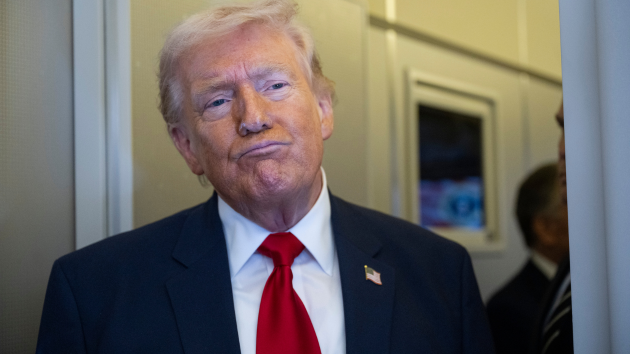
President Donald Trump speaks to members of the media traveling on Air Force One while heading to Miami on March 7, 2026. President Trump and other members of the government attended the dignified transfer of six soldiers from the 103rd Sustainment Command who were killed in action by an Iranian drone strike on March 1 in Port of Shuaiba, Kuwait, during Operation Epic Fury. (Photo by Roberto Schmidt/Getty Images)
(WASHINGTON) — Ten days into the U.S. war with Iran, Americans are starting to feel the economic fallout as oil and gas prices soar.
Gas prices skyrocketed to a national average of $3.47 on Monday, up nearly 50 cents from last week, according to data from AAA. Plus, oil prices on Monday surpassed $100 a barrel for the first time since Russia’s invasion of Ukraine in 2022 before falling lower later in the day.
President Donald Trump has dismissed the higher cost, telling ABC News Chief White House Correspondent Mary Bruce it’s “a little glitch.”
“I think it’s fine. It’s a little glitch. We had to take this detour,” Trump told ABC’s Bruce in an interview on Sunday before going on to tout the U.S. military campaign against Tehran.
In a social media post on Sunday night, Trump argued: “Short term oil prices, which will drop rapidly when the destruction of the Iran nuclear threat is over, is a very small price to pay for U.S.A., and World, Safety and Peace.”
Yet the cost of living remains one of the biggest issues heading into the 2026 midterms, where Trump and Republicans are seeking to maintain narrow majorities in Congress.
A poll released by NBC News on Sunday found Trump received his lowest ratings in the poll on his handling of inflation and the cost of living as 36% of registered voters approve and 62% disapprove.
On Iran, the NBC poll found a majority of registered voters (54%) disapproved of Trump’s handling of the matter.
Trump, on the 2024 campaign trail, vowed to bring gas down below $2 a gallon. During the first year of his second term, Trump routinely pointed to the drop in prices at the pump, including in his State of the Union address last month.
“Gasoline, which reached a peak of over $6 a gallon in some states under my predecessor and was, quite honestly, a disaster, is now below $2.30 a gallon in most states, and in some places $1.99 a gallon,” Trump said in his speech on Feb. 24.
Now, gas prices are closing in on $3.50 a gallon and are expected to continue to keep rising the longer the Middle East conflict lasts.
Patrick De Haan, a petroleum analyst at GasBuddy, told ABC News Live that Americans are currently experiencing “sticker shock.”
“Gas stations are seeing their costs go up in real time again today, as oil markets are jumping, and that’s going to be in another round of price increases over the course of this week, prices could jump another 15 to 35 cents a gallon for gasoline over the next three days, as long as nothing changes,” De Haan said. “And it’s going to be worse for the price of diesel, which could jump 35 to 50 cents a gallon, that would put it close to nearly a $5 a gallon national average.”
Some Democrats are seizing on the price jump to criticize Trump and the administration for the handling of the war.
Senate Minority Leader Chuck Schumer, a New York Democrat, has called for President Trump to tap into the Strategic Petroleum Reserve (SPR) to alleviate the financial burden for Americans.
“American families are suffering from higher prices as the effects of Trump’s reckless war become pain at the gas pump and beyond as high gas prices trickle down making everything more expensive,” Schumer said in a statement on Sunday. “They cannot afford to simply wait and hope prices come down. The President has a solution right here at home, and he should use it.”
“Trump promised a Golden Age in America. Meanwhile. Republicans are crashing the economy, gas prices are out of control and the extremists are spending billions dropping bombs in the Middle East. You deserve better,” House Minority Leader Hakeem Jeffries, also a New York Democrat, wrote on X on Monday.
Trump was asked over the weekend if he would use the SPR to bring some relief, but declined to say, instead criticizing former President Joe Biden’s use of the reserve. Biden released oil from the SPR several times over the course of 2022 as prices increased due to Russia’s war on Ukraine.
“I filled it up and he brought it down to the lowest level it’s ever been. We will start at the appropriate time, which is basically a gut instinct, we will start filling up,” Trump told reporters on Air Force One on Saturday.
“Biden used them so that he could get some extra votes in the election,” Trump added.
Analysts previously told ABC News that the SPR is a “valuable resource” for the administration to bring some relief to Americans and assuage market fears, but likely wouldn’t be enough oil in the long term to make up for the 20 million barrels of oil currently being prevented from passing through the Strait of Hormuz every day.
Trump told Fox News’s Brian Kilmeade in an interview on Sunday night that ships holding at the Strait of Hormuz need to “show some guts” and push through the channel.
Several war-risk insurers have canceled their coverage for vessels amid the widening conflict. Trump said the U.S. government was going to provide some risk insurance and guarantees, and if necessary the U.S. Navy would escort tankers through the strait.
Like Trump, several Republicans are contending that higher gas prices will be temporary.
“The prices will come back down as soon as we get out of Iran, as soon as we finish turning them into fish food, which will be pretty soon,” Republican Sen. John Kennedy said on Fox News on Sunday.
How long the Iran war will last remains an open question. President Trump initially estimated four to five weeks for the U.S., though he later said the timeline would be whatever it takes.
On Sunday, Trump told ABC’s Bruce: “I don’t know. I never predict. All I can say is we are ahead of schedule both in terms of lethality and in terms of time.”
GasBuddy’s De Haan told ABC News Live that the longer the conflict lasts, the more time it will take to see oil and gas prices to get back to their previous levels
“Every day the situation continues, it could add another several weeks to the recovery time,” De Haan said.
ABC News’ Isabella Murray, Nicholas Kerr, Soo Youn and Max Zahn contributed to this report.
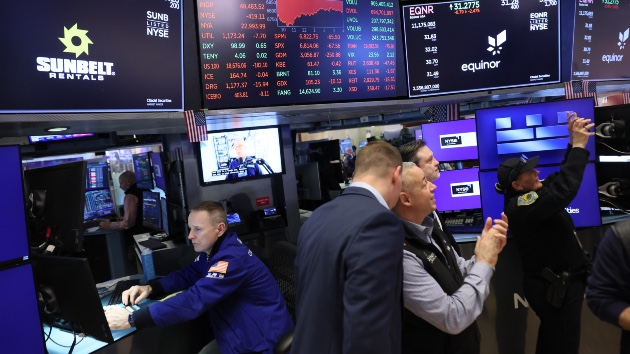
Traders work on the floor of the New York Stock Exchange. (Photo by Michael M. Santiago/Getty Images)
(NEW YORK) — Stocks closed higher on Monday, recovering from sharp losses earlier in the day as markets whipsawed in response to developments in the U.S.-Israeli war with Iran.
The dramatic reversal on Wall Street came after U.S. oil prices turned lower on Monday afternoon. Crude prices settled at about $85 per barrel, unwinding a surge hours earlier that had reached as high as nearly $120 a barrel.
The Dow Jones Industrial Average closed up 230 points, or 0.4%, while the S&P 500 jumped 0.8%. The tech-heavy Nasdaq increased 1.3%.
The Dow had fallen as much as 750 points on Monday morning, before reversing those losses in the afternoon.
Oil prices fell into the red and stocks raced into the green after comments made by President Donald Trump to a CBS reporter, who posted on X that the president had said “the war is very complete, pretty much.”
Crude markets began to calm on Monday morning amid a meeting of the Group of Seven (G7) finance ministers about a possible coordinated release from their respective strategic petroleum reserves.
The G7 announced on Monday its decision to forego a release of reserve oil at this time, but traders appeared to view the group as willing to take such action.
Still, indexes fell worldwide on Monday as the jump in oil prices rippled through global markets. Tokyo’s Nikkei 225 index plunged 5.2%, while pan-European STOXX 600 index slipped 0.6%.
U.S. crude oil prices hovered at about $85 per barrel on Monday afternoon, which marked a roughly 6% decline from a day earlier. Since a month ago, however, oil prices have soared 34%.
In a social media post on Sunday night, President Donald Trump downplayed the rise in oil prices.
“Short term oil prices, which will drop rapidly when the destruction of the Iran nuclear threat is over, is a very small price to pay for U.S.A., and World, Safety and Peace. ONLY FOOLS WOULD THINK DIFFERENTLY!” Trump said.
Soon after the war with Iran began on Feb. 28, U.S.-Israeli forces killed Supreme Leader Ayatollah Ali Khamenei in Tehran. His son Mojtaba Khamenei was chosen on Sunday to succeed him.
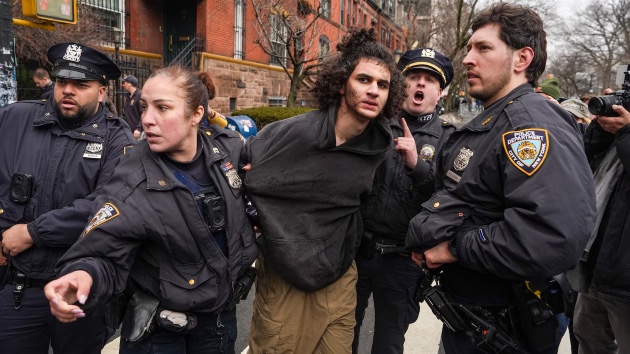
A man is arrested after throwing a hand-made smoke grenade at a protest near Gracie Mansion, on March 7, 2026, in New York. (Ryan Murphy/Getty Images)
(NEW YORK) — Two improvised explosive devices brought to a counterprotest outside Gracie Mansion in New York City Saturday are being investigated as “an act of ISIS-inspired terrorism,” and the two suspects arrested in connection with the incident are facing federal terrorism charges, New York Police Commissioner Jessica Tisch said Monday.
According to a federal criminal complaint released Monday, both suspects openly pledged allegiance to ISIS while in the presence of police, and one suspect allegedly told officers they “wanted to carry out an attack bigger than the Boston Marathon bombing,” which the suspect noted “caused only ‘three deaths.’”
The explosive devices contained the volatile substance triacetone triperoxide, known as TATP, and were made to “injure, maim or worse,” Tisch said of Saturday’s incident.
“These were not hoax devices or smoke bombs. They were improvised explosive devices,” Tisch said during a news conference outside the Gracie Mansion mayor’s residence with New York City Mayor Zohran Mandami, the city’s first Muslim mayor.
One of the devices was ignited and deployed at protesters in a crosswalk on East End Avenue and East 87 Street, and the other device was detonated close by, Tisch said.
Tisch said a third suspected IED was found in the car of the two suspects, a black 2010 Honda with New Jersey license plates, parked on the Upper East Side of Manhattan near Gracie Mansion, prompting an immediate evacuation of homes in the area. She said the device did not test positive for explosives.
All of the devices are being sent to the FBI lab in Quantico, Virginia, for additional testing, Tisch said.
Two Pennsylvania men who are in custody are charged in a five-count federal complaint with attempting to provide material support and resources to ISIS, use of a weapon of mass destruction, transportation of explosive materials, interstate transportation and receipt of explosives, and unlawful possession of destructive devices.
The suspects were identified as Emir Balat of Langhorne, Pennsylvania, and Ibrahim Kayumi of Newton, Pennsylvania, according to Tisch and the federal complaint.
The suspects were ordered to be held without bail after they made their initial appearances, both in shackles, in Manhattan federal court on Monday afternoon. They did not enter a plea to the charges.
“They’re suspected of coming here to commit an act of terrorism,” Mamdani said Monday. “Let me say this plainly: Anyone who comes to New York City to bring violence to our streets will be held accountable in accordance with the law.”
The explosives were deployed at an anti-Muslim protest outside Gracie Mansion that was organized by far-right, anti-immigrant provocateur Jack Lang, officials said. The event was called “Stop the Islamic Takeover of New York City.”
The anti-Muslim protest drew counterprotesters who called their response “Run Nazis Out of New York City,” according to the criminal complaint.
“FBI’s Joint Terrorism Task Force is investigating the matter with our partners at NYPD as well as the U.S. Attorney’s Office for the Southern District of New York,” the FBI said in a statement Sunday.
Balat and Kayumi are suspected of attending the event as part of the counterprotest to the anti-Muslim demonstration, authorities said Monday.
Neither Mamdani nor his wife, Rama Duwaji, were in Gracie Mansion when the incident occurred, the mayor said Monday.
Immediately following his arrest, Kayumi was asked by someone in the surrounding crowd why he allegedly attempted to bomb the protest, according to the complaint.
“Kayumi responded in part and as captured on NYPD body-worn camera footage, ‘ISIS,'” the complaint states.
Balat waived his Miranda rights to remain silent following his arrest, according to the complaint, and allegedly provided a written statement in which he “pledge[d] [] allegience [sic] to the Islamic State,” the complaint states.
Balat also allegedly told police that “they wanted to carry out an attack bigger than the Boston Marathon bombing, which Balat noted caused only ‘three deaths,'” according to the complaint.
The April 15, 2013, Boston Marathon bombing also left more than 500 people injured.
Kayumi, whom the complaint said also waived his Miranda rights, allegedly “stated, in substance and in part, that he was affiliated with ISIS; watched ISIS propaganda on his phone; and was partly inspired to carry out his actions that day by ISIS,” according to the complaint.
“Anti-Muslim bigotry is nothing new to me, nor is it anything new for the one million or so Muslim New Yorkers who know this city as our home,” Mamdani said at Monday’s news conference.
“While I found this protest appalling. I will not waver in my belief that it should be allowed to happen. Ours is a free society, where the right to peaceful protest is sacred. It does not only belong to those we agree with. It belongs to everyone,” Mandani added.
Many of the counterprotesters on Saturday confronted the “display of bigotry,” the mayor said. He also praised NYPD officers who swiftly responded to the incident and arrested the suspects, saying they were “faced with a chaotic situation that quickly could have become far more dangerous.”
The mayor specifically cited the “courageous and selfless” acts of two NYPD officers, Assistant Chief Aaron Edwards and Sgt. Luis Navarro, who attended Monday’s news conference. Mamdani said the officers “ran towards the danger so that others could run safely.”
Tisch said the last incident in New York City in which an IED was deployed occurred in December 2017, when Akayed Ullah detonated a homemade bomb he had strapped to his torso in a pedestrian underpass connecting the Port Authority Bus Terminal to the Time Square subway station.
Ullah, a permanent resident of Bangladesh who was living in Brooklyn at the time, was the only person injured in the act, which federal prosecutors said was committed on behalf of ISIS of Iraq. Ullah was convicted in April 2021 by a federal jury on all six counts of the indictment and was sentenced to life in prison.