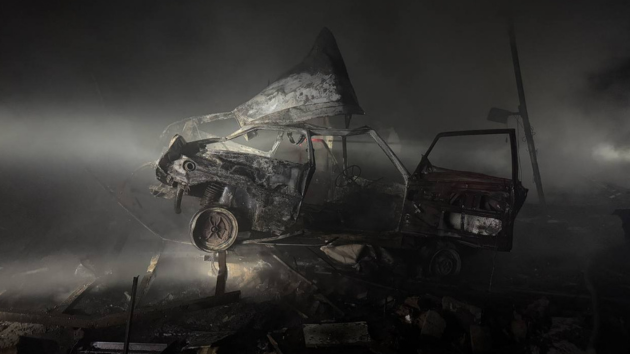
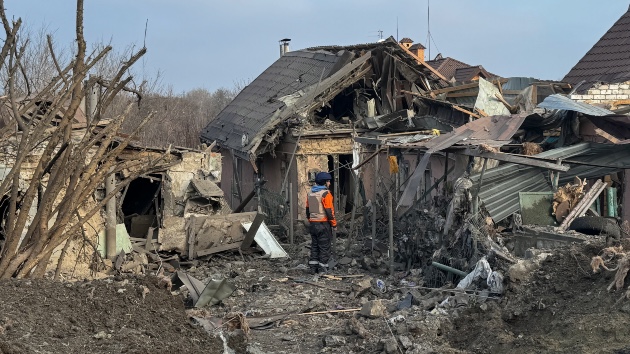
A view of destroyed residential building as search and rescue and firefighting efforts continue after Russian forces carried out airstrikes on the city of Zaporizhzhia in Ukraine on December 24, 2025. (State Emergency Service of Ukraine / Handout/Anadolu via Getty Images)
(LONDON) — At least seven people were killed and 39 injured in Ukraine after Russia and Ukraine exchanged hundreds of long-range drone strikes Wednesday night into Thursday morning, according to Ukrainian officials.
Russia launched 131 drones into Ukraine overnight, the air force in Kyiv said, of which 106 were shot down or suppressed. Twenty-two drones impacted across 15 locations, the air force said.
As of Thursday morning, local Ukrainian officials and the air force warned that Russian drones were still in the air.
“Unfortunately, even on Christmas Eve and during Christmas night, the Russian army did not stop its brutal strikes against Ukraine, targeting our energy system and our people. There are brownouts in many of our cities and villages,” Ukrainian President Volodymyr Zelenskyy said in a post on X.
“Today, during the daytime, Russian troops are once again striking the cities of our east, and in Chernihiv, aid was being provided at the very moment of our conversation with the Patriarch to people wounded by a Russian drone that struck an ordinary residential building,” Zelenskyy added.
Odesa Gov. Oleh Kiper said in a Telegram post that Russia targeted the southern region’s “port and industrial infrastructure,” damaging industrial facilities and killing at least one person. Two other people were injured, Kiper said.
Ukraine’s State Emergency Service (SES) said on Telegram on Thursday that at least one person was also killed and 14 people injured by a series of Russian attacks in the northeastern Kharkiv region over the previous 24 hours.
The SES said that a Russian drone hit a high-rise residential building in Chernihiv, while several energy infrastructure targets in the city were also attacked.
Chernihiv Gov. Viacheslav Chaus said two people were killed by Russian drone attacks in the city. Two more people were injured, Chaus said.
Ukrenergo — Ukraine’s state-owned electricity operator — said on Telegram that Russian attacks had caused power outages in the Chernihiv, Sumy, Kharkiv, Dnipropetrovsk and Odesa regions. All regions of Ukraine will see power consumption restriction measures enforced throughout Thursday, it added.
Zelenskyy vowed to continue countering Russian aggression “in every way possible,” in a post on X.
Ukraine’s Deputy Prime Minister Oleksiy Kuleba wrote on Telegram, “Even during the Christmas holidays, Russia continues to launch targeted attacks on Ukrainian logistics, ports and critical infrastructure.”
Russia’s Defense Ministry, meanwhile, said its forces shot down at least 141 drones overnight, nine of which were destroyed over the Moscow region.
Moscow Mayor Sergey Sobyanin said in posts to Telegram that emergency services were working at the sites of fallen debris.
In the western Bryansk region, which borders Ukraine, Gov. Aleksandr Bogomaz said one person was hospitalized after being injured by shrapnel from a drone attack, with an apartment building also destroyed.
In Krasnodar Krai in southern Russia, local officials said the port of Temryuk came under attack, with two tanks holding petroleum products catching fire.
Russia’s federal air transport agency, Rosaviatsiya, said temporary flight restrictions were introduced at airports in Krasnodar and Yaroslavl during the latest attacks.
Wednesday night’s strikes followed multiple waves of Ukrainian attack drones launched into Russia on Tuesday night and throughout Wednesday, according to the Defense Ministry.
Through Wednesday, the ministry said its forces shot down at least 387 Ukrainian drones — the largest number reported by the ministry in a 24 hour period of the war to date — including more than a dozen over the Moscow region.
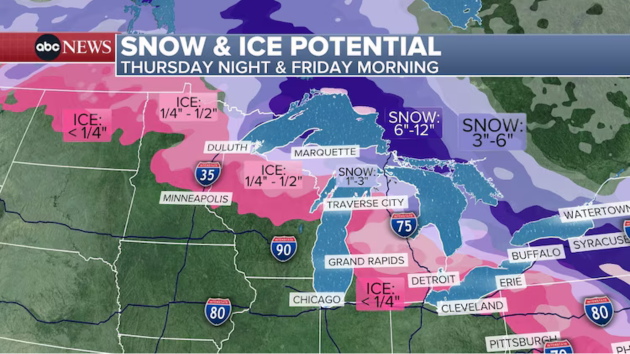
(NEW YORK) — A major winter storm is expected to bring ice and snow to the upper Midwest on Thursday, with the system moving through the lower Northeast on Friday and ending by Saturday morning.
Freezing rain is forecast to move through northern Minneapolis and Wisconsin on Thursday evening. The rain is expected to reach Michigan on Friday morning, moving into western and central Pennsylvania later in the morning.
Most of the freezing rain and ice accumulation is expected in central and western Pennsylvania.
Snow flurries could begin as early as noon on Thursday in New York City, though most of the forecast snow is expected to fall after 4 p.m.
Snowfall is expected to continue through Thursday night in New York City, upstate New York, New Jersey, eastern Pennsylvania, Connecticut, Rhode Island and Massachusetts — though Boston is not expected to see significant snow.
Much of the heavy to moderate snowfall is expected to end by 4 a.m. on Sunday. Snowfall is forecast to end entirely by Saturday morning between 8 a.m. and 11 a.m.
New York City, northern New Jersey, the southern Hudson Valley and western Pennsylvania are expected to see the most snow accumulation, with more than half a foot possible. Some areas could see up to 8 or 9 inches of snow.
Ice accumulation could reach more than a quarter of an inch in central Pennsylvania, such as in Johnstown and Clarion. Drivers along the I-80 and I-70 have been advised to use extreme caution. Power outages are also possible with high levels of icing.
Up to 0.2 inches of ice accumulation is possible for areas of northeastern West Virginia and through central and northwestern Pennsylvania, plus up through much of Michigan, including Detroit. Driving is expected to be difficult on untreated surfaces.
Washington, D.C., and Baltimore may also see some ice accumulation on Friday and into Friday night.
Across the upper Midwest, ice accumulation of around 0.2 inches is possible from northern Minnesota through northern Wisconsin and Michigan.
A view of destroyed residential building as search and rescue and firefighting efforts continue after Russian forces carried out airstrikes on the city of Zaporizhzhia in Ukraine on December 24, 2025. (State Emergency Service of Ukraine / Handout/Anadolu via Getty Images)
(LONDON) — Russia and Ukraine exchanged hundreds of long-range drone strikes from Wednesday night through into Thursday morning.
Russia launched 131 drones into Ukraine overnight, the air force in Kyiv said, of which 106 were shot down or suppressed. Twenty-two drones impacted across 15 locations, the air force said.
As of Thursday morning, local Ukrainian officials and the air force warned that Russian drones were still in the air.
Odesa Gov. Oleh Kiper said in a Telegram post that Russia targeted the southern region’s “port and industrial infrastructure,” damaging industrial facilities and killing at least one person. Two other people were injured, Kiper said.
Ukraine’s State Emergency Service (SES) said on Telegram on Thursday that at least one person was also killed and 14 people injured by a series of Russian attacks in the northeastern Kharkiv region over the previous 24 hours.
The SES said that a Russian drone hit a high-rise residential building in Chernihiv, while several energy infrastructure targets in the city were also attacked.
Chernihiv Gov. Viacheslav Chaus said two people were killed by Russian drone attacks in the city. Two more people were injured, Chaus said.
Ukrenergo — Ukraine’s state-owned electricity operator — said on Telegram that Russian attacks had caused power outages in the Chernihiv, Sumy, Kharkiv, Dnipropetrovsk and Odesa regions. All regions of Ukraine will see power consumption restriction measures enforced throughout Thursday, it added.
Ukraine’s Deputy Prime Minister Oleksiy Kuleba wrote on Telegram, “Even during the Christmas holidays, Russia continues to launch targeted attacks on Ukrainian logistics, ports and critical infrastructure.”
Russia’s Defense Ministry, meanwhile, said its forces shot down at least 141 drones overnight, nine of which were destroyed over the Moscow region.
Moscow Mayor Sergey Sobyanin said in posts to Telegram that emergency services were working at the sites of fallen debris.
In the western Bryansk region, which borders Ukraine, Gov. Aleksandr Bogomaz said one person was hospitalized after being injured by shrapnel from a drone attack, with an apartment building also destroyed.
In Krasnodar Krai in southern Russia, local officials said the port of Temryuk came under attack, with two tanks holding petroleum products catching fire.
Russia’s federal air transport agency, Rosaviatsiya, said temporary flight restrictions were introduced at airports in Krasnodar and Yaroslavl during the latest attacks.
Wednesday night’s strikes followed multiple waves of Ukrainian attack drones launched into Russia on Tuesday night and throughout Wednesday, according to the Defense Ministry.
Through Wednesday, the ministry said its forces shot down at least 387 Ukrainian drones — the largest number reported by the ministry in a 24 hour period of the war to date — including more than a dozen over the Moscow region.
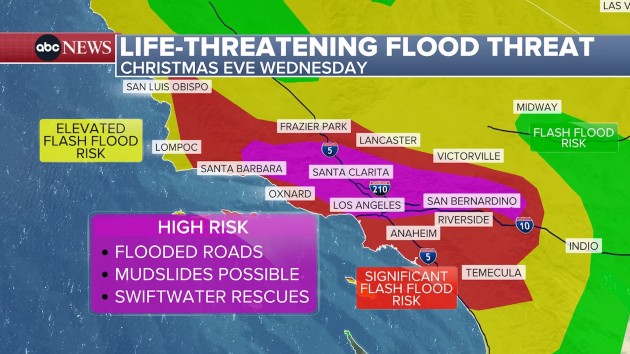
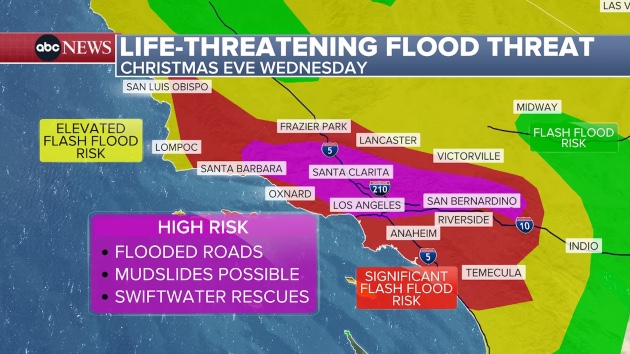
(LOS ANGELES) — More than 41 million Americans across California, southern Nevada and northwest Arizona are under flood watches on Wednesday amid a rare, high risk for excessive rainfall and flooding.
This includes major metros like Los Angeles, San Francisco, Sacramento, California, San Diego and Las Vegas.
A “High Risk for excessive rainfall” is in place for Los Angeles, including I-10 from San Bernardino to Santa Monica and areas north like Highway 101 to Thousand Oaks, I-5 to Burbank, Santa Clarita, and up to Pyramid Lake and all of I-210. Travel on these roads is not recommended as they may become flooded, officials said. Low-lying neighborhoods in these areas could also become flooded, forecasts show.
Being under a “High Risk” designation is rare. This risk is only issued about 4% of days, accounting for one-third of all flood-related fatalities and 80% of all flood-related damages, according to the NWS.
Potential flooding impacts include the threat of significant and widespread urban roadway flooding, a high risk of major rock/mudslides, and rapid rises in creeks, streams and rivers which will likely lead to swift water rescues.
The recent burn scars will be at risk of possibly damaging debris flows. These flooding impacts will likely lead to significant travel delays and road closures during the busy holiday travel period.
Winds are forecast to gust 40 to 50 mph across the area, potentially leading to power outages on Wednesday, according to forecasts. Thunderstorms are also possible.
The heaviest rain is expected on Wednesday morning and afternoon. Rainfall rates of 1 inch per hour or greater are expected.
By 6 p.m. or 7 p.m. PT, the rain will be coming to a brief end before more rain arrives overnight.
Additional rounds of rain are expected on Thursday and Friday, and the flood threat along with mudslides and landslide risks will continue each day as well.
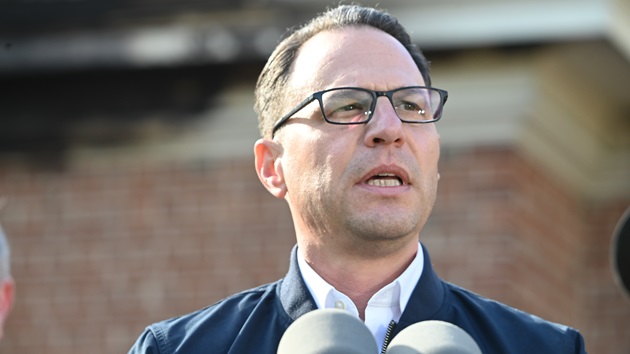
Pennsylvania Governor Josh Shapiro speaks during a press conference outside of the Governor’s Mansion on April 13, 2025. Kyle Mazza/Anadolu via Getty Images
The “catastrophic” incident — possibly caused by a gas leak — unfolded Tuesday afternoon at the Silver Lake Nursing Home in Bristol, which is about 25 miles northeast of Philadelphia.
Of the 20 people hurt, 19 are still hospitalized on Wednesday, including one in critical condition, Bristol Township Police Chief CJ Winik said on Wednesday.
Bristol Township Fire Marshal Kevin Dippolito said parts of the first floor collapsed into the basement, trapping people inside.
All employees and all 120 residents of the facility have been accounted for, the police chief said.
Winick praised the “heroism” of the first responders, who he said ran into the building, despite the strong smell of gas, and evacuated residents, including some who couldn’t walk or talk.
“This could’ve been a much more serious catastrophe,” he said at a news conference on Wednesday. “The actions of everybody involved help preserve life.”
The cause of the incident remains under investigation, Dippolito said on Wednesday. Pennsylvania Gov. Josh Shapiro said on Tuesday that the preliminary belief was that a gas leak was responsible, and Dippolito said the source of the leak was in the facility’s basement.
Direct Source Seafood LLC, Bellevue, WA, is recalling approximately 83,800 bags of frozen raw shrimp, imported from Indonesia, sold under the Market 32 and Waterfront Bistro brands. FDA
(NEW YORK) — The FDA has announced a recall of frozen raw shrimp due to potential exposure to the radioactive isotope cesium-137.
The FDA says about 83,800 bags of frozen raw shrimp imported from Indonesia are being recalled after the products may have been prepared, packed, or held under conditions that could have exposed them to very low levels of cesium-137.
The recall affects shrimp distributed by Direct Source Seafood LLC and sold under the Market 32 and Waterfront Bistro brands. The shrimp was sold at Price Chopper, Jewel-Osco, Albertsons, Safeway, Lucky, and other supermarkets across multiple states including Connecticut, Massachusetts, New Hampshire, New York, Pennsylvania, Vermont, Colorado, Iowa, Idaho, Illinois, Indiana, Montana, North Dakota, Nevada, Oregon, Utah, and Wyoming, according to the recall notice.
The affected products were sold after late June and early July 2025, the notice said.
The FDA has warned consumers who have purchased affected shrimp not to consume the product and to dispose of it or return it to the place of purchase for a full refund.
“At this time, no product that has tested positive or alerted for Cesium-137 (Cs-137) has entered the U.S. marketplace,” the recall notice stated, also noting that no illnesses have been reported to date.
The recalled products include the following frozen raw shrimp:
Market 32 Frozen Raw Shrimp UPC 0 41735 01358 3 Best by dates: 04/22/27, 04/23/27, 04/24/27, 04/26/27, or 04/27/27
Waterfront Bistro Frozen Raw Shrimp UPC 021130 13224-9 Best by dates: APR 25, 2027 or APR 26, 2027
A rescuer stands amid rubble in the yard of house after Russian shelling on December 19, 2025 in Zaporizhzhia, Ukraine. As a result of the shelling, private houses were partially destroyed, a garage cooperative, cars, and residential buildings located near the hit sites were damaged. (Photo by Polina Moroz/Suspilne Ukraine/JSC “UA:PBC”/Global Images Ukraine via Getty Images)
(LONDON) — Russia’s offensive campaign in eastern and southern Ukraine has been grinding on throughout 2025, with much of the fighting of the last 12 months focused on devastated cities in the eastern Donetsk and northeastern Kharkiv regions.
But in September, Russian forces began a relatively rapid advance in the farmlands to the east of Zaporizhzhia, advancing up to six miles in places — according to Ukrainian military officials — as territorial defense units that had been holding the area for two years crumbled under sudden and intense offensive pressure applied by Moscow’s forces.
Russia’s unexpected breakthrough in Zaporizhzhia represented a rare instance of battlefield mobility in a war that has become characterized by labored attritional warfare, in which mechanized troop concentrations and supporting armored vehicles quickly become easy prey for the flocks of drones incessantly swarming above the front lines.
Among the Ukrainian units deployed to stem the Russian advance was the 225th Separate Assault Regiment, which had previously been fighting to repel Russian forces along the shared border in the northeastern Sumy Oblast.
“The situation there remains complicated, and we are trying to stabilize it,” Maj. Oleh Shyriaiev of the 225th regiment told ABC News by phone from close to the front. “It is a mistake to consider that it is 100% stabilized,” he added.
Representatives of the combatants are currently engaged in U.S.-sponsored shuttle diplomacy that the White House hopes will secure an end to Europe’s largest conflict since World War II and a war that U.S. President Donald Trump vowed to end within 24 hours of his return to the Oval Office.
Russian officials have repeatedly framed their slow battlefield gains as evidence of Moscow’s “inevitable” victory, in the words of Deputy Foreign Minister Sergey Ryabkov during a recent interview with ABC News.
That interpretation is hotly disputed by Kyiv and its European allies, but the Kremlin nonetheless seeks to use its gradual seizure of new territory as leverage in the ongoing talks. “The space for freedom of decision-making narrows as territories are lost,” Kremlin spokesperson Dmitry Peskov said in November.
In foxholes, trenches and treelines along the contact line, Shyriaiev said his unit is focused on their day-to-day survival.
“I personally am skeptical about any kind of peace negotiations,” he said. “Even if some kind of a peace agreement is signed, Russia will not stop existing, and it will not stop being our enemy.”
Any deal, he suggested, “will just give time for Russia to regroup. And what happens next? We need to expect a new attack. No guarantees that Russia can give can be considered true guarantees.”
The focus of the Russian offensive in Zaporizhzhia is now in the area of Huliaipole, a small city which before the war was home to around 20,000 people. Only around 150 civilians remain in the devastated city, the head of its military administration told Ukrainian media earlier this month.
In the fields around the city, Ukrainian officials say they have largely stalled Russia’s forward momentum. Shyriaiev said his unit needed time to adapt to the new battlefield and wear down the attackers.
“We had to go out and create a blocking line, fulfil missions and create favorable conditions for further success,” he explained. “At the moment, everything we are doing is focused on stabilizing the front line and blocking the enemy.”
Ukrainian forces in the area are facing Russian units replenished with new recruits and new equipment, Shyriaiev said.
“The enemy has strengthened its UAV component and thanks to that, they are holding under control the access areas to the line of contact — or at least they are trying to hold it under control,” he said.
“The enemy has had some success because their units have been reconstituted according to the most cutting edge experience that they have,” Shyriaiev said. “They have been trained with the latest updates, they have all the ‘lessons learned'” by their predecessors, he added.
Those newly arrived troops are trying to use the wintry weather and resulting “dense fog” to their advantage, Shyriaiev said.
“When there are normal visibility conditions, we can see everything and control everything,” he said. “However, when there is fog around, the enemy is trying to take advantage of this and to infiltrate the space between our positions.”
For the Ukrainians, too, the weather offers opportunities, Shyriaiev said. “When visibility is good, it means that badly hidden or badly masked positions are an open target and the troops that are deployed there can be wounded or destroyed.”
Moscow’s ‘glacial’ advance
Russian President Vladimir Putin has given little indication that he intends to ease the frontline pressure on Kyiv’s troops, despite the recent fresh impetus given to U.S.-brokered peace negotiations.
At his annual end-of-year press conference on Friday, Putin said peace was only possible on the basis of “principles” he outlined in a speech last year, in which he made some of his most hardline demands — Ukraine’s permanent exclusion from NATO and Kyiv’s withdrawal from all of the territory Russia claims in eastern and southeastern Ukraine.
Putin again claimed that military momentum was with Moscow’s forces, saying its troops were “advancing on all fronts.”
Putin’s bombast does not align with battlefield realities, according to Ukrainian officials and independent analysts.
The U.S.-based Institute for the Study of War think tank said this month that Russian forces have seized 0.77% of Ukraine’s territory — some 1,802 square miles — over the past year, while sustaining disproportionately high casualties. The area captured is roughly equivalent to that of Anchorage, Alaska.
Ukraine’s military estimates that Russia has sustained around 1.2 million casualties since February 2022. President Volodymyr Zelenskyy said this month that around 30,000 Russian troops are being killed each month.
Russia does not release details about its casualties, making it difficult to independently confirm that figure. Ukrainian estimates of Russian casualties have broadly chimed with estimates from U.S. and European intelligence agencies since 2022.
Ukraine likewise does not regularly disclose its casualty figures. Zelenskyy said in February 2025 that more than 46,000 Ukrainians have been killed and 380,000 wounded since 2022.
Peter Dickinson, the editor of the Atlantic Council think tank’s UkraineAlert service, wrote in December that while Moscow’s troops hold “the overall initiative,” its attacking units are “grinding forward at glacial pace while suffering catastrophic losses.”
Also this month, Zelenskyy visited the Kharkiv frontline city of Kupyansk, posting videos of himself in the center of the city as proof that Russia’s recent claim to have captured it was false. The visit, Dickinson said, “underscored the fact that Russian victory is anything but inevitable.”
But Putin appears committed to a relentless push, regardless of its slow pace and high cost. Ukrainian Commander-in-Chief Gen. Oleksandr Syrskyi said in a post to Facebook last week that Russia has amassed 710,000 troops along the front for its offensive operations.
“Despite the substantial losses, the Russian army is not giving up on continuing offensive operations, although it has not achieved significant operational success,” Syrskyi said.
Shyriaiev said that although his unit is “well-staffed” and motivated, the difference in manpower and resources is obvious at the front. The Russians, he said, “are focusing on mass in everything.”
Shyriaiev’s unit faces “massive amounts of infantry” attacking from “early morning and until late at night,” he said. “They conduct mechanized assaults on all kinds of vehicles — regular cars, motorbikes, buggies. It could also be proper military equipment, proper military armored vehicles.”
“They are leaving no stone unturned,” he continued. “The ratio of the size of our army and our resources and their resources is, of course, something unfavorable towards us. They have more resources. This is why they do achieve some successes, but that happens at a very high price.”
(NEW YORK) — This year is expected to be the busiest on record for holiday travel, but rough weather in the West and the East may make getting to and from your Christmas destination even harder.
More than 41 million people across nearly all of California — including Los Angeles, San Francisco, Sacramento and San Diego — as well as parts of Nevada and Arizona are under a flood watch on Christmas Eve.
A rare alert for “high risk for excessive rainfall” is in place Wednesday for Los Angeles and the surrounding area, so those traveling on Christmas Eve and Christmas Day should be extremely careful on the roads. Road flooding, rockslides, mudslides and water rescues are possible.
The pounding rain is now underway in Southern California and will continue until around 6 p.m. local time Wednesday.
With rainfall rates possibly topping 1 inch per hour, higher elevations surrounding LA can expected 4 to 6 inches of rain on Wednesday alone.
Winds gusts will reach 40 to 50 mph on Wednesday, potentially causing power outages. Thunderstorms are also possible, as well as brief tornadoes along the California coast.
The rain will take a break Wednesday evening before picking back up overnight.
More rounds of rain will hit on Christmas Day and Friday, prolonging the threat of flooding, mudslides and landslides.
By Friday, rain totals could reach 4 to 7 inches along Southern California’s coasts and valleys, and 6 to 14 inches is possible in the foothills and mountains.
Meanwhile, a new storm is forecast to hit the Northeast on Friday morning.
The storm will bring ice to Michigan, Ohio and then Pennsylvania, potentially causing travel chaos and leaving widespread power outages. Ice accumulation could reach up to half an inch in some areas, which makes driving home after Christmas extremely dangerous.
Further east, the storm will bring snow. Six to 12 inches is possible in western New York, northeastern Pennsylvania and parts of New Jersey.
This storm is also forecast to bring the biggest snowfall of the season to New York City. The snow will fall in New York from Friday night to Saturday morning and could reach 3 to 6 inches.
Expect treacherous commutes on Friday on Interstate-80, I-70, I-90 and I-95.
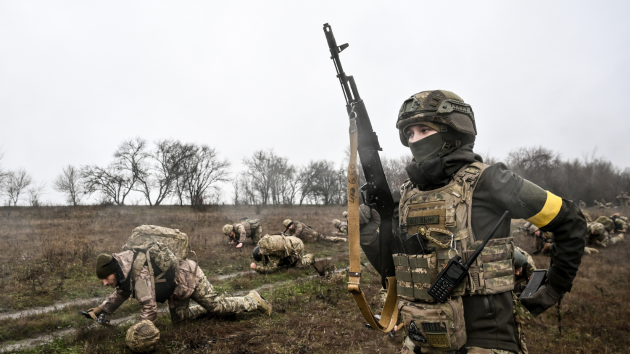
Recruits crawl a designated distance with combat gear under the supervision of instructors during the zero day of basic combined arms training with the 65th Separate Mechanized Brigade at an improvised training ground in Ukraine, on December 12, 2025 (Dmytro Smolienko/Ukrinform) (Ukrinform/NurPhoto via Getty Images)
(LONDON) — Ukrainian President Volodymyr Zelenskyy said on Tuesday that he believes the U.S. “wants to reach a final agreement,” to end the war in Ukraine, with Kyiv offering its full backing for a peace deal.
“We sense that America wants to reach a final agreement, and from our side, there is full cooperation,” Zelenskyy said. “Ukraine has never been, and will never be, an obstacle to peace.”
Ukraine and Russia continued their nightly exchange of long-range drones overnight into Wednesday. Russia’s Defense Ministry said on Wednesday that its forces downed at least 195 Ukrainian drones, including five over Moscow region of which two were “flying toward” the capital.
Russia’s federal air transport agency, Rosaviatsiya, said flight restrictions were introduced at two of Moscow’s four international airports — Domodedovo and Vnukovo — during the attacks. Restrictions were also put in place at airports in Volgograd, Yaroslavl, Orenburg, Ufa and Orsk, Rosaviatsiya said.
Ukraine’s air force, meanwhile, said Russia launched 116 drones into the country overnight, of which 60 were shot down or suppressed. Forty-eight drones impacted across 19 locations, the air force said.
On Tuesday night, Zelenskyy said Ukrainian repair crews were working to restore power after a major Russian drone and missile strike on Monday night. “Throughout the day, repair crews have been working at energy facilities — putting in maximum effort to ensure that Ukrainians have electricity for Christmas,” Zelenskyy said.
“Of course, the Russians are trying to ruin this holiday, this sacred day, as well. No surprise there,” Zelenskyy added.
At a briefing in Kyiv with journalists on Tuesday, Zelenskyy revealed details of the 20-point peace plan negotiated with the U.S. which is now being reviewed by Moscow.
Zelenskyy told reporters that said all sides were “much closer” to finalizing the documents. Kyiv expects to receive a response from Moscow on Wednesday, Zelenskyy added.
The proposed framework includes security guarantees from the U.S., NATO and European partners, though territorial questions remain unresolved. Under the draft plan, Ukraine would hold a presidential election as soon as possible after any deal is signed.
Zelenskyy said the deal would see Article-5-style security guarantees kick in if Russia attacks the country again, even without Ukrainian NATO membership. Zelenskyy again stressed that Kyiv rejected any ban on joining the alliance — a key Russian demand.
Kremlin spokesperson Dmitry Peskov said on Wednesday that Russian President Vladimir Putin has been briefed on recent U.S. contacts.
“We now intend to formulate our future position based on the information received by the head of state and continue our contacts in the very near future through the existing channels that are currently operational,” Peskov said, as quoted by the state-run Tass news agency.
Russian Deputy Foreign Minister Sergei Ryabkov, meanwhile, said Moscow and Washington have “significant similarities” in their positions on a possible settlement.
(GAZA and LONDON) — As Palestinian Christians prepare for their first Christmas without the constant threat of bombardment and attacks after two years of war in Gaza, rare scenes of color, glitter and light can be spotted in a city that is mostly covered with rubble and collapsed buildings.
With the fragile ceasefire broadly holding more than two months since the first phase went into effect, the small remaining Palestinian Christian community in Gaza hopes for long-lasting peace as they practice holiday traditions like putting up Christmas trees and baking pastries.
“This year, Christmas is not just a religious ritual but celebrating a new beginning that we all work towards, which is the beginning of peace and stability in the region,” Mousa Ayyad, coordinator of Princess Basma, a Christian center in Gaza, told ABC News last week while standing by a Christmas tree decorated with ornaments and lights.
The center is located inside Al-Ahli Hospital, the only Christian hospital in Gaza, and provides vital rehabilitation for children.
“You must prepare the atmosphere for the children, and continue to welcome happiness into your home, even if you aren’t at your home and you are displaced,” Ayyad said.
Over 80% of all structures in the Gaza Strip have been damaged as of Oct. 11, according to a United Nations assessment.
The Holy Family Church, the only Catholic church in the Gaza Strip, remains standing, though has signs of damage.
Since the war broke out between Israel and Hamas, the terrorist group that launched a surprise attack on Israel on Oct. 7, 2023, almost half of the Christian population in Gaza has left the strip and at least 23 Palestinian Christians have been killed, according to the Holy Family Church. About 500 people in the community are still in Gaza, with the majority of those currently sheltering in the church, according to the Holy Family Church.
Cardinal Pierbattista Pizzaballa, the Latin Patriarch of Jerusalem, led his first prayer in Gaza following the ceasefire during Mass at the Holy Family Church on Sunday, in what he called a “new phase.”
Amid modest decorations and damaged walls, Pizzaballa led the first communion for several children and baptized a baby, continuing a pastoral tradition he has upheld during each Christmastime visit to Gaza.
Pizzaballa said during a press conference on Sunday that he has witnessed “a desire for a new life” in Gaza, but that “all the problems are still on the table: housing, schools, hospitals, the condition of life and poverty are catastrophic.”
“At the same time, we saw that the resilience of these people is what, at the end, will prevail,” he said, describing Palestinians’ steadfastness as a lesson to the world.
George Messaqo, an 11-year-old displaced Christian who attended the Mass, told ABC News that he feels “very happy” this Christmas, though his joy was tinged with longing.
“Before the war, Christmas was more beautiful,” he said. “There were more people, all our relatives and loved ones, and the atmosphere was warmer.”
George said his aunt was killed during the war and other family members now live abroad.
“We only communicate through video calls,” he said. “I wish to see our friends, relatives and loved ones again, and to live in peace.”