
Indiana governor declares statewide disaster emergency as Midwest floodwaters rise

Indiana governor declares statewide disaster emergency as Midwest floodwaters rise
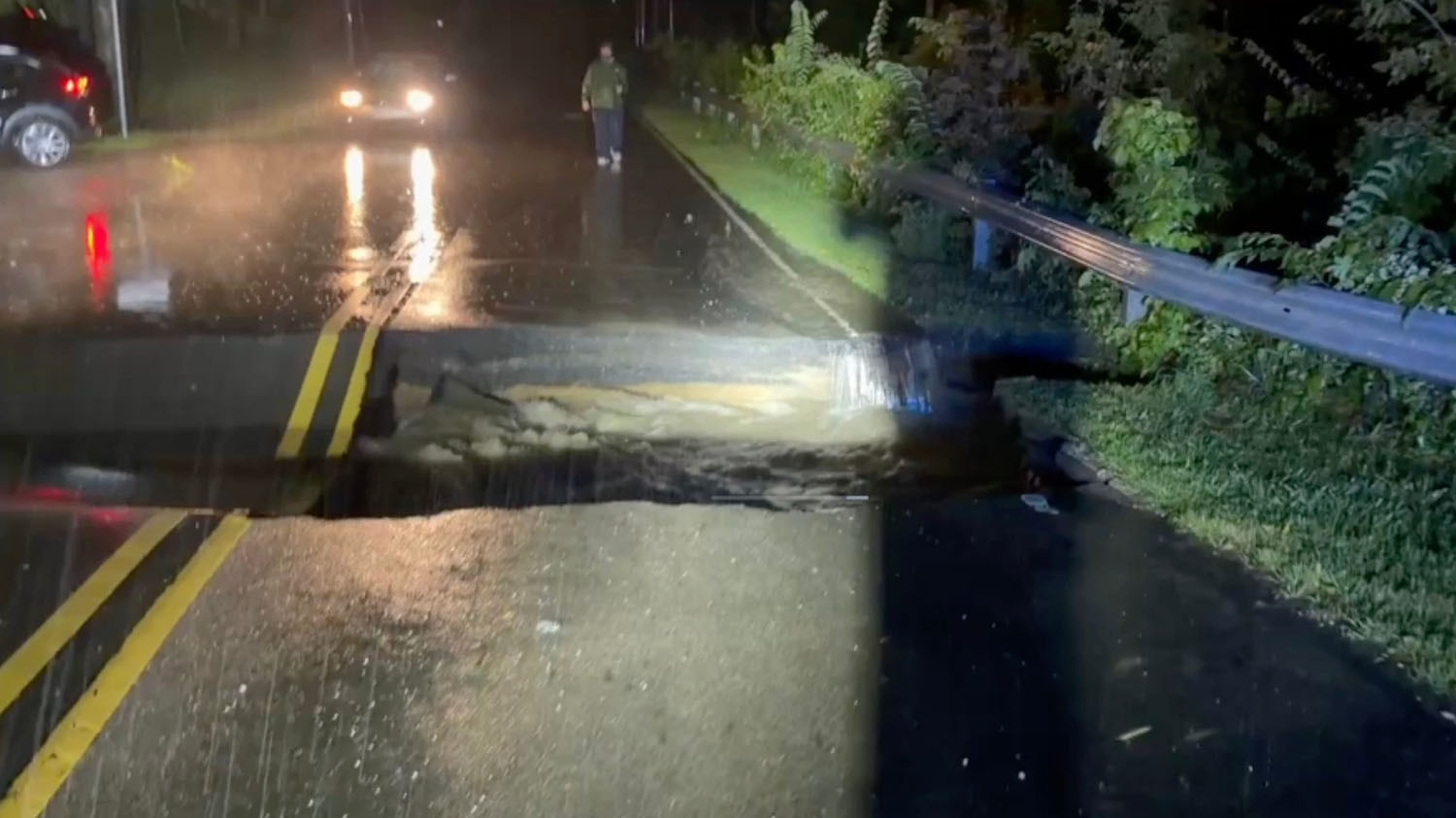
Flash flooding in Henry County, Indiana, caused this street to collapse, Aug. 12, 2026. (Henry County Sheriff’s Office)

(NEW YORK) — Amid floodwaters already up to the roofs of some homes and turning the streets of multiple cities into rushing rivers, Midwest residents are bracing for more severe storms on Thursday.

“When I looked out my window, I saw my fence floating past my window,” Karlie Frey, a resident of hard-hit Cambridge City, Indiana, told ABC Indianapolis affiliate station WRTV.

After being evacuated from her home on Wednesday via a rescue boat, Frey, who has lived in Cambridge City since 2009, said, “I’ve never seen it get this bad.”

Indiana, which recorded three storm-related deaths this week, was in the path of more severe storms expected to pound the Midwest on Thursday.

Indiana Gov. Mike Braun declared a statewide disaster emergency on Thursday.

“Hoosiers’ safety is my top priority. Our state response is fully mobilized, resources are moving where they’re needed, and we will continue working around the clock to support every impacted community,” Braun said in a social media post on Thursday.

Braun is expected to meet with first responders in Cambridge City and survey the damage there to “ensure state resources are available to support the response and recovery efforts,” the governor’s office said in a statement.

Meanwhile, rescue operations resumed on Thursday for one person in Delaware County, Indiana, who was among four people who reportedly went into the Mississinewa River on Wednesday during significant flooding, authorities said. Three others were rescued from the river on Wednesday night, officials noted.

Flood watches also remained in effect in Iowa, Kentucky and North Carolina, where showers and storms are possible on Thursday, keeping the threat of more flooding in place.

Like in recent days, storms expected from Des Moines, Iowa, to Lexington, Kentucky, and Knoxville, Tennessee, have the potential to train, or remain stationary, over the same areas, and could produce rainfall rates of 1 to 2 inches per hour.

The National Weather Service’s Storm Prediction Center said severe isolated storms on Thursday are expected to occur across Iowa and Illinois, including the cities of Des Moines, Cedar Rapids, Springfield and Peoria.

The storms are expected to be accompanied by damaging winds, large hail and possible tornadoes.

Dangerous heat will also be a factor from the Midwest and Plains to the Southeast, all the way down to South Florida. More than 100 million people in over 15 states are under heat alerts on Thursday as a heat dome remains parked over the country’s Mid-South region.

Extreme heat warnings are in effect for Wichita, Kansas City, St. Louis and Paducah, Kentucky. Heat indices, which include humidity, will make it feel 111 in St. Louis and 110 in Kansas City.

Meanwhile, authorities are continuing to assess the damage from storms, floods, and at least five tornadoes, including three in southwest Chicago suburbs, that devastated the Midwest over the past two days.

Images from flooded areas of Cambridge City and elsewhere in Henry County showed floodwaters up to the roofs of some homes and many flooded streets impassable.

In an interview with ABC’s “Good Morning America,” Cambridge City Town Council President Jim McLane described the flood in his small town of 1,700 people as “pretty devastating.”

McLane said he has lived in the area for 60 years and had never seen flooding “anything remotely compared to this.” He said flood waters rose “several feet higher than most people have seen it here before.”

McLane described a seven-to-eight-block area of flooded homes in Cambridge City, and said dozens of people had to be rescued by boat.

Henry County Sheriff John Sproles said more than 50 people were rescued on Wednesday from a flooded apartment complex in Henry County.

Henry County officials are also investigating a possible tornado that moved through New Castle, Indiana, on Wednesday, toppling trees and ripping the roof off a commercial building.

Sproles said he is concerned about additional rainfall hitting the area.

“Any more rain is really going to put us into much more significant problems,” he said.

Eric Stiles, who owns a plumbing company in Indiana, posted a video this week of damage caused by severe storms that hit Munster, Indiana, on Tuesday. The footage showed a line of massive trees uprooted in one residential neighborhood.

“It’s like driving through a war zone,” Stiles said in the video.

Copyright © 2026, ABC Audio. All rights reserved.
Potentially historic El Nino takes shape, with far-reaching US and global impacts expected

Potentially historic El Nino takes shape, with far-reaching US and global impacts expected
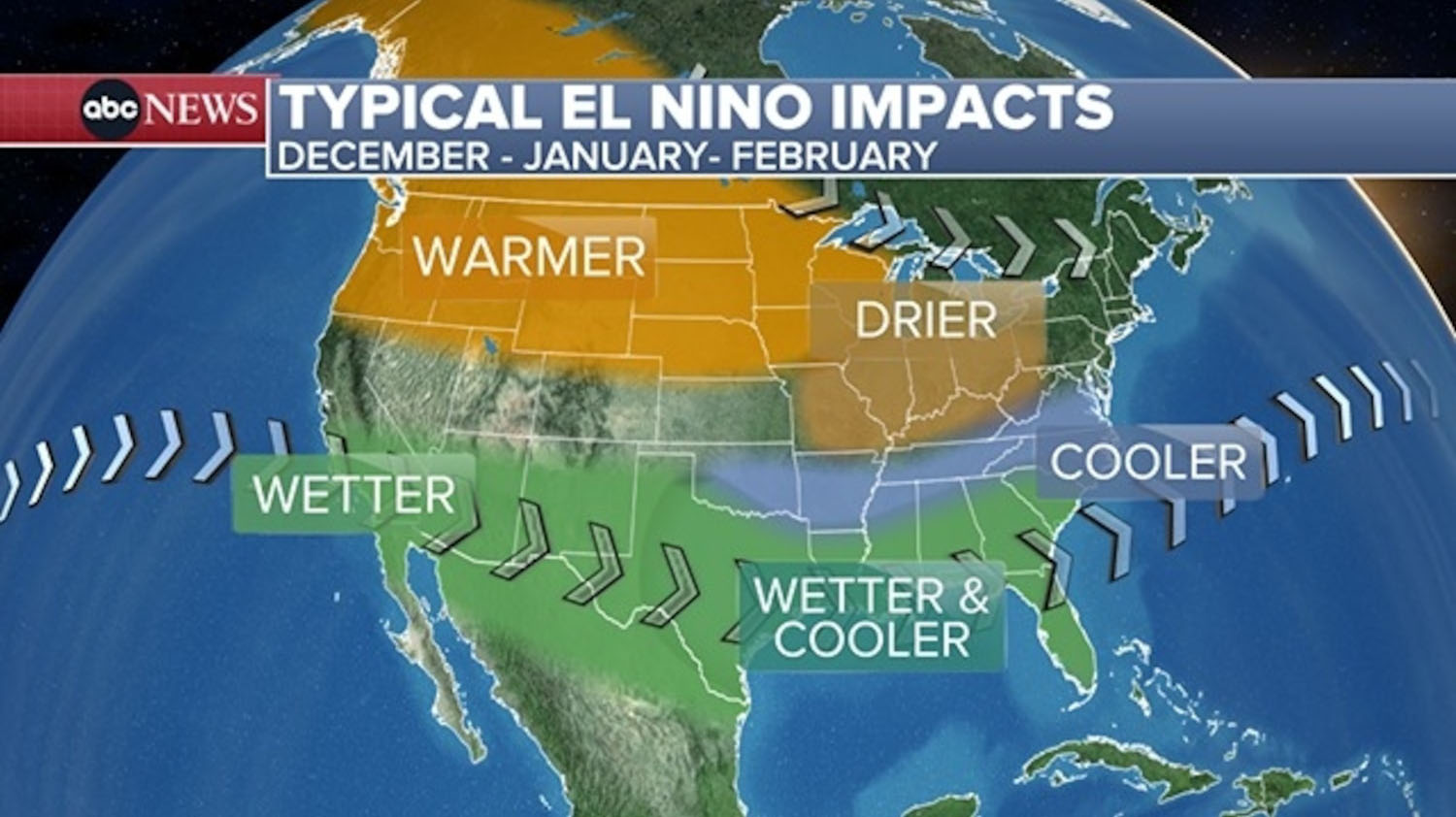
Typical El Nino impacts in winter months. (ABC News)

(NEW YORK) — El Nino conditions continue to intensify and are likely to be very strong, resulting in a potentially historic event in the coming months that could significantly influence our weather, the hurricane season and global temperatures, according to the latest forecast from the National Oceanic and Atmospheric Administration (NOAA).

The agency is now highly confident there will be a very strong El Nino during the upcoming Northern Hemisphere fall and winter seasons.

NOAA’s latest forecast says that between October and December, there is a 69% chance of a historic event that would exceed the strength of all previous El Nino events on record, dating back to 1950. The current event ranks as the second strongest on record for this time of the year, behind 1997.

“Our team has become more confident in the possibility of a very strong El Nino by the end of this year,” Michelle L’Heureux, a physical scientist at NOAA’s Climate Prediction Center, told ABC News.

“There is a greater than 90% chance of a ‘very strong’ El Nino, which is the highest chance to date, and expresses our confidence in the growth and development of a potentially historic El Nino event,” L’Heureux added.

NOAA noted that with an event of this magnitude, while the chances of experiencing impacts consistent with El Nino are greater, they are not guaranteed.

El Nino refers to the warmer-than-average phase of the El Nino–Southern Oscillation (ENSO), a natural cycle where sea surface temperatures across the central and eastern equatorial Pacific Ocean rise and fall. The cooler-than-average phase is called La Nina, while near-average conditions are known as ENSO-neutral.

NOAA ranks the strength of El Nino events by measuring the sea surface temperature departure from average (anomaly) across this region, classifying events as weak, moderate, strong or very strong.

While adjectives such as “super” and “extreme” are popular ways of describing the strength of an El Nino event on social media, NOAA and the WMO classify the strength as weak to moderate, strong and very strong. The WMO noted in a recent statement that “the term [[super]] is not part of standardized operational classifications.”

Typical El Nino impacts across the United States

Impacts from El Nino, similar to La Nina, tend to be most consistent and pronounced from late autumn through early spring following the event’s onset, NOAA said. There is usually a delay between the onset of the event and many of the associated effects.

Experts caution that the impacts on weather patterns are nuanced. Each season is different, and typical El Nino conditions don’t always materialize.

“The data is very clear that we can be more confident in certain impacts occurring during strong and very strong El Nino, but it is really important to emphasize that even if this ends up being a historic El Nino, there will be impacts in some locations that do not align with the expected El Nino impact,” L’Heureux added. “This is why our seasonal forecasts are expressed in terms of probabilities.”

Northeast: Typically, during El Nino, warmer-than-average temperatures are favored across the northern half of the United States during the winter months. However, its influence is less pronounced in the Northeast, compared to the Upper Midwest and Northwest.

El Nino typically increases the odds of above-average snowfall in the mid-Atlantic and coastal areas of the Northeast as storms often move up the coast. Farther inland, drier-than-average conditions and less snow are more likely.

South: Near- to below-average temperatures are favored along the southern tier of the U.S., especially from Texas to the Southeast.

For precipitation, wetter-than-average conditions are typically observed along the southern tier of the U.S., including parts of the Gulf Coast and Southeast. Below-average precipitation is frequently observed across parts of the south-central Mississippi Valley.

Midwest: Warmer-than-average temperatures are favored from the northern Plains into the Great Lakes. Drier-than-average conditions are frequently observed across parts of the Ohio Valley and Great Lakes regions.

El Nino typically increases the odds of above-average snowfall in the south-central Plains, with below-average snowfall favored in the northern Plains and Great Lakes regions.

West: During the winter months, warmer-than-average temperatures are likely across much of the Northwest. For precipitation, wetter-than-average conditions are typically observed across southern California and much of the Southwest, with below-average precipitation frequently observed across parts of the northern Rockies.

El Nino typically increases the odds of above-average snowfall in the southern Rockies, with below-average snowfall favored in the northern Rockies.

Meanwhile, above-average tropical activity in the eastern Pacific increases the likelihood of indirect impacts to the southwestern United States, such as sending more rain to the region and more frequent flash flood concerns.

Alaska: El Nino impacts in Alaska tend to be more pronounced than across much of the contiguous United States, with the strongest effects typically occurring during the winter and spring months. During winter, warmer- and drier-than-average conditions are more likely, with less snowfall and reduced snowpack.

Above average temperatures often persist into spring, while precipitation trends closer to average. However, warmer conditions typically mean more precipitation falls as rain rather than snow, prolonging snow deficits.

Hawaii: Rainfall is typically above average across Hawaii the year an El Nino event develops before conditions become drier during the winter months and remain dry well into the following year. The shift toward drier weather can increase the likelihood of drought and elevate the risk of wildfires.

Meanwhile, above-average tropical activity in the eastern Pacific increases the risk of impacts from tropical systems across the Hawaiian Islands.

How El Nino influences hurricane season activity

While El Nino is only one of several key factors that influence tropical activity, forecasts now indicate it will be a strong event through the peak of the hurricane season, making it the primary driver of activity in both the Atlantic and eastern Pacific in the coming months.

El Nino conditions often suppress tropical activity during the Atlantic hurricane season by producing unfavorable atmospheric winds. In the Eastern Pacific, the opposite occurs, with favorable conditions supporting above-average hurricane season activity.

Other factors, such as sea surface temperatures, also play an important role in tropical cyclone development and strength. Unseasonably warm ocean waters can partially offset the effects of unfavorable atmospheric winds, according to forecasters.

Global temperature records will likely be challenged

2024 ranked as the planet’s warmest year on record, following the last El Nino event, which emerged in mid-2023 and persisted through spring 2024, according to NOAA. However, the return of El Nino means global temperature records will likely be challenged again in the near future, especially since a very strong event is unfolding.

Record highs in global average temperature often occur during El Nino years, combined with the long-term global warming trend driven primarily by human-caused greenhouse gas emissions.

“Warmer ocean temperatures associated with El Nino, together with its tendency to favor warmer conditions in many areas, often contribute to warmer than normal global annual temperatures,” Jon Gottschalck, chief of the Operational Prediction Branch at NOAA’s Climate Prediction Center said.

According to the latest outlook from NOAA’s National Centers for Environmental Information, it’s virtually certain that 2026 will rank among the five warmest years on record, with a 99.9% chance.

However, the probability of it becoming the warmest year currently stands at less than 1%. These odds will likely rise significantly for 2027, based on the latest forecasts.

There is usually a delay between the onset of El Nino and its peak impact on global temperatures, NOAA says. As with the most recent event, its greatest influence often occurs in the months after it peaks, which can keep global temperatures elevated into the following year.

Copyright © 2026, ABC Audio. All rights reserved.

Potentially historic El Nino takes shape, with far-reaching US and global impacts expected

Potentially historic El Nino takes shape, with far-reaching US and global impacts expected
Typical El Nino impacts in winter months. (ABC News)

(NEW YORK) — El Nino conditions continue to intensify and are likely to be very strong, resulting in a potentially historic event in the coming months that could significantly influence our weather, the hurricane season and global temperatures, according to the latest forecast from the National Oceanic and Atmospheric Administration (NOAA).

The agency is now highly confident there will be a very strong El Nino during the upcoming Northern Hemisphere fall and winter seasons.

NOAA’s latest forecast says that between October and December, there is a 69% chance of a historic event that would exceed the strength of all previous El Nino events on record, dating back to 1950. The current event ranks as the second strongest on record for this time of the year, behind 1997.

“Our team has become more confident in the possibility of a very strong El Nino by the end of this year,” Michelle L’Heureux, a physical scientist at NOAA’s Climate Prediction Center, told ABC News.

“There is a greater than 90% chance of a ‘very strong’ El Nino, which is the highest chance to date, and expresses our confidence in the growth and development of a potentially historic El Nino event,” L’Heureux added.

NOAA noted that with an event of this magnitude, while the chances of experiencing impacts consistent with El Nino are greater, they are not guaranteed.

El Nino refers to the warmer-than-average phase of the El Nino–Southern Oscillation (ENSO), a natural cycle where sea surface temperatures across the central and eastern equatorial Pacific Ocean rise and fall. The cooler-than-average phase is called La Nina, while near-average conditions are known as ENSO-neutral.

NOAA ranks the strength of El Nino events by measuring the sea surface temperature departure from average (anomaly) across this region, classifying events as weak, moderate, strong or very strong.

While adjectives such as “super” and “extreme” are popular ways of describing the strength of an El Nino event on social media, NOAA and the WMO classify the strength as weak to moderate, strong and very strong. The WMO noted in a recent statement that “the term [[super]] is not part of standardized operational classifications.”

Typical El Nino impacts across the United States

Impacts from El Nino, similar to La Nina, tend to be most consistent and pronounced from late autumn through early spring following the event’s onset, NOAA said. There is usually a delay between the onset of the event and many of the associated effects.

Experts caution that the impacts on weather patterns are nuanced. Each season is different, and typical El Nino conditions don’t always materialize.

“The data is very clear that we can be more confident in certain impacts occurring during strong and very strong El Nino, but it is really important to emphasize that even if this ends up being a historic El Nino, there will be impacts in some locations that do not align with the expected El Nino impact,” L’Heureux added. “This is why our seasonal forecasts are expressed in terms of probabilities.”

Northeast: Typically, during El Nino, warmer-than-average temperatures are favored across the northern half of the United States during the winter months. However, its influence is less pronounced in the Northeast, compared to the Upper Midwest and Northwest.

El Nino typically increases the odds of above-average snowfall in the mid-Atlantic and coastal areas of the Northeast as storms often move up the coast. Farther inland, drier-than-average conditions and less snow are more likely.

South: Near- to below-average temperatures are favored along the southern tier of the U.S., especially from Texas to the Southeast.

For precipitation, wetter-than-average conditions are typically observed along the southern tier of the U.S., including parts of the Gulf Coast and Southeast. Below-average precipitation is frequently observed across parts of the south-central Mississippi Valley.

Midwest: Warmer-than-average temperatures are favored from the northern Plains into the Great Lakes. Drier-than-average conditions are frequently observed across parts of the Ohio Valley and Great Lakes regions.

El Nino typically increases the odds of above-average snowfall in the south-central Plains, with below-average snowfall favored in the northern Plains and Great Lakes regions.

West: During the winter months, warmer-than-average temperatures are likely across much of the Northwest. For precipitation, wetter-than-average conditions are typically observed across southern California and much of the Southwest, with below-average precipitation frequently observed across parts of the northern Rockies.

El Nino typically increases the odds of above-average snowfall in the southern Rockies, with below-average snowfall favored in the northern Rockies.

Meanwhile, above-average tropical activity in the eastern Pacific increases the likelihood of indirect impacts to the southwestern United States, such as sending more rain to the region and more frequent flash flood concerns.

Alaska: El Nino impacts in Alaska tend to be more pronounced than across much of the contiguous United States, with the strongest effects typically occurring during the winter and spring months. During winter, warmer- and drier-than-average conditions are more likely, with less snowfall and reduced snowpack.

Above average temperatures often persist into spring, while precipitation trends closer to average. However, warmer conditions typically mean more precipitation falls as rain rather than snow, prolonging snow deficits.

Hawaii: Rainfall is typically above average across Hawaii the year an El Nino event develops before conditions become drier during the winter months and remain dry well into the following year. The shift toward drier weather can increase the likelihood of drought and elevate the risk of wildfires.

Meanwhile, above-average tropical activity in the eastern Pacific increases the risk of impacts from tropical systems across the Hawaiian Islands.

How El Nino influences hurricane season activity

While El Nino is only one of several key factors that influence tropical activity, forecasts now indicate it will be a strong event through the peak of the hurricane season, making it the primary driver of activity in both the Atlantic and eastern Pacific in the coming months.

El Nino conditions often suppress tropical activity during the Atlantic hurricane season by producing unfavorable atmospheric winds. In the Eastern Pacific, the opposite occurs, with favorable conditions supporting above-average hurricane season activity.

Other factors, such as sea surface temperatures, also play an important role in tropical cyclone development and strength. Unseasonably warm ocean waters can partially offset the effects of unfavorable atmospheric winds, according to forecasters.

Global temperature records will likely be challenged

2024 ranked as the planet’s warmest year on record, following the last El Nino event, which emerged in mid-2023 and persisted through spring 2024, according to NOAA. However, the return of El Nino means global temperature records will likely be challenged again in the near future, especially since a very strong event is unfolding.

Record highs in global average temperature often occur during El Nino years, combined with the long-term global warming trend driven primarily by human-caused greenhouse gas emissions.

“Warmer ocean temperatures associated with El Nino, together with its tendency to favor warmer conditions in many areas, often contribute to warmer than normal global annual temperatures,” Jon Gottschalck, chief of the Operational Prediction Branch at NOAA’s Climate Prediction Center said.

According to the latest outlook from NOAA’s National Centers for Environmental Information, it’s virtually certain that 2026 will rank among the five warmest years on record, with a 99.9% chance.

However, the probability of it becoming the warmest year currently stands at less than 1%. These odds will likely rise significantly for 2027, based on the latest forecasts.

There is usually a delay between the onset of El Nino and its peak impact on global temperatures, NOAA says. As with the most recent event, its greatest influence often occurs in the months after it peaks, which can keep global temperatures elevated into the following year.

Copyright © 2026, ABC Audio. All rights reserved.

Luigi Mangione: Guilty plea expected to be announced Friday in federal case, sources say

Luigi Mangione: Guilty plea expected to be announced Friday in federal case, sources say
Luigi Mangione attends a pretrial appearance at Manhattan Criminal Court on Aug. 11, 2026, in New York City. (David Dee Delgado-Pool/Getty Images)

(NEW YORK) — It’s expected that a guilty plea will be announced in connection with the federal prosecution of Luigi Mangione during a conference scheduled for federal court Friday, sources familiar with the matter told ABC News.

The sources caution that plans for the guilty plea are not final at this point and will not be official until announced at the hearing, which is set for 11 a.m. Friday. The situation is fluid and Mangione could conceivably decide against pleading guilty between now and Friday.

Neither the prosecution nor defense teams are commenting on the situation.

Mangione is accused of gunning down UnitedHealthcare CEO Brian Thompson on Dec. 4, 2024, in Midtown Manhattan, and he was captured in Pennsylvania after a five-day manhunt. Manhattan District Attorney Alvin Bragg announced that Mangione was indicted on first degree murder charges on Dec. 17, 2024, and federal prosecutors announced separate charges of stalking and murder on Dec. 19, 2024.  

Mangione pleaded not guilty in the separate state and federal cases.

The charges in both cases have narrowed over the last year. U.S. District Judge Margaret Garnett in January threw out the federal murder and firearm charges, which would have made the death penalty an option if convicted. Judge Gregory Carro last September dismissed the first-degree murder and terrorism charges in the state case.

In the state case, Judge Gregory Carro last September dismissed the first-degree murder and terrorism charges. In the state case, Mangione is still charged with murder in the second-degree, criminal possession of a forged instrument in the second-degree, and multiple counts of criminal possession of a weapon in the second-degree, third-degree and fourth-degree.

Mangione is scheduled to stand trial in the state case beginning Sept. 8. His federal trial was set for Jan. 5.


Copyright © 2026, ABC Audio. All rights reserved.

Luigi Mangione: Guilty plea expected to be announced Friday in federal case, sources say

Luigi Mangione: Guilty plea expected to be announced Friday in federal case, sources say
Luigi Mangione attends a pretrial appearance at Manhattan Criminal Court on Aug. 11, 2026, in New York City. (David Dee Delgado-Pool/Getty Images)

(NEW YORK) — It’s expected that a guilty plea will be announced in connection with the federal prosecution of Luigi Mangione during a conference scheduled for federal court Friday, sources familiar with the matter told ABC News.

The sources caution that plans for the guilty plea are not final at this point and will not be official until announced at the hearing, which is set for 11 a.m. Friday. The situation is fluid and Mangione could conceivably decide against pleading guilty between now and Friday.

Neither the prosecution nor defense teams are commenting on the situation.

Mangione is accused of gunning down UnitedHealthcare CEO Brian Thompson on Dec. 4, 2024, in Midtown Manhattan, and he was captured in Pennsylvania after a five-day manhunt. Manhattan District Attorney Alvin Bragg announced that Mangione was indicted on first degree murder charges on Dec. 17, 2024, and federal prosecutors announced separate charges of stalking and murder on Dec. 19, 2024.  

Mangione pleaded not guilty in the separate state and federal cases.

The charges in both cases have narrowed over the last year. U.S. District Judge Margaret Garnett in January threw out the federal murder and firearm charges, which would have made the death penalty an option if convicted. Judge Gregory Carro last September dismissed the first-degree murder and terrorism charges in the state case.

In the state case, Judge Gregory Carro last September dismissed the first-degree murder and terrorism charges. In the state case, Mangione is still charged with murder in the second-degree, criminal possession of a forged instrument in the second-degree, and multiple counts of criminal possession of a weapon in the second-degree, third-degree and fourth-degree.

Mangione is scheduled to stand trial in the state case beginning Sept. 8. His federal trial was set for Jan. 5.


Copyright © 2026, ABC Audio. All rights reserved.

Judge to press DOJ to explain Epstein files redactions, withheld materials related to Trump

Judge to press DOJ to explain Epstein files redactions, withheld materials related to Trump
A survivor of Jeffrey Epstein holds a copy of files on July 29, 2026, in Washington, D.C. The Epstein survivors attempted to meet with Sen. Cornyn and Attorney General nominee Tod Blanch over the Department of Justice’s handling of the Epstein files. (Kevin Dietsch/Getty Images)

(WASHINGTON) — A federal judge on Thursday is set to press lawyers with the Department of Justice to explain why some materials from the Epstein files were withheld from the public. 

U.S. District Judge Emmet Sullivan scheduled the hearing in a lawsuit filed by an independent journalist who sued over what she alleged were improper redactions and withheld materials from the files on Jeffrey Epstein, the late convicted sex offender.

In June, Sullivan concluded that the redactions and withheld materials violated the Epstein Files Transparency Act. He ordered the DOJ to either turn over the materials or explain why the materials needed to be withheld.  

“The Attorney General has conceded that he is in violation of the Act,” Sullivan wrote in his ruling

In recent weeks, the DOJ has sought to justify the redactions, rather than turn over the materials. Unsatisfied with some of those reasons, Judge Sullivan set Thursday’s hearing to press DOJ lawyers about the release of the Epstein files. 

Specifically, the judge said the DOJ has not provided documentation to prove that redactions were made to some files because “[lawyers for] victims or potential victims … have contacted the government and requested that the persons be treated as victims.”

He also raised concerns that the DOJ withheld handwritten notes from an interview with a woman who made unsubstantiated allegations against President Donald Trump, who has denied any wrongdoing. 

The DOJ has argued that the handwritten notes are “substantially similar to” the FBI reports of the interviews that were publicly released, and that the notes risk exposing victim information. However, Sullivan noted the Epstein Files Transparency Act does not have an exception for “substantially similar” or duplicative documents, and that the DOJ has released similar versions of other documents.

“The Defendant shall be prepared to explain why the handwritten notes cannot be redacted manually, or why the redactions cannot be accomplished in another way,” Sullivan wrote. 

The DOJ has argued that all the redactions were lawful and asked to delay the case for two months. 

“The Department has not knowingly violated, nor has it ever acknowledged violating, the EFTA as it continues working to comply with statutory requirements,” DOJ lawyers argued in a court filing. 

Copyright © 2026, ABC Audio. All rights reserved.
Powerball player in Illinois wins $1 billion jackpot

Powerball player in Illinois wins  billion jackpot
Powerball player in Illinois wins $1 billion jackpot
Powerball lottery tickets (Photo by Brandon Bell/Getty Images)

A Powerball ticket sold in Illinois matched all six numbers in Wednesday night’s drawing, winning an estimated $1.04 billion jackpot, according to the lottery organization.

The winning numbers were 4, 26, 66, 67, 69 and red Powerball 9.

It’s the largest Powerball jackpot so far this year, and the eight-largest Powerball jackpot in the game’s history.

The winner can top for the annuitized prize paid out over 29 years or a lump cash payment of $450.5 million. Both prizes are before taxes.

Wednesday’s drawing was the 44th consecutive drawing since the last jackpot win on May 2.

Last year, there were two Powerball jackpots that hit more than $1 billion, including $1.8 billion jackpot won on Christmas Eve that was the biggest U.S. lottery prize ever.

A $1.787 billion Powerball jackpot won in September 2025 by two tickets in Missouri and Texas was the third-largest prize in U.S. lottery history.

This is a developing story. Please check back for updates.

Copyright © 2026, ABC Audio. All rights reserved.
Nick Reiner indicted on charges alleging he murdered parents Rob and Michele Reiner

Nick Reiner indicted on charges alleging he murdered parents Rob and Michele Reiner
Nick Reiner appears during his arraignment in Los Angeles County Superior Court on Feb. 23, 2026, in Los Angeles. (Chris Torres/Pool/Getty Images)

(NEW YORK) — Nick Reiner has been indicted on charges alleging he murdered his parents, renowned director Rob Reiner and his wife Michele Reiner, by means of lying in wait, prosecutors announced Wednesday.

The indictment, which was returned on July 20 and unsealed Wednesday, charges Reiner with two counts of murder with the special circumstance allegations of multiple murders and murder by means of lying in wait, according to the Los Angeles County District Attorney’s Office. Reiner also faces a special allegation that he used a dangerous and deadly weapon, a knife, the office said.

Nick Reiner, 32, pleaded not guilty to the indictment on Wednesday. He remains held on no bond and is next scheduled to appear in court for a pretrial hearing on Sept. 15.

Rob Reiner and Michele Reiner were found stabbed to death in their Brentwood home on Dec. 14, 2025. The night before their deaths, Nick Reiner — who had been living on his parents’ property at the time — got into an argument with Rob Reiner at a holiday party and was seen acting strangely, sources told ABC News in December.

Nick Reiner was arrested and initially charged with two counts of murder with the special circumstance allegation of multiple murders, as well as faced a special allegation that he used a dangerous and deadly weapon.

The indictment, which added a special allegation of lying in wait, means the case will no longer have a preliminary hearing that had been scheduled to occur in the coming weeks.

“This was a profound betrayal by someone who was loved and trusted by the very people he is accused of killing,” Los Angeles County District Attorney Nathan Hochman said in a statement. “The indictment unsealed today also adds a special circumstance allegation that the defendant committed the murders by means of lying in wait. We hope that by having a grand jury return an indictment in this case it will bring us one step closer to a trial and achieving justice.”

If convicted as charged, Reiner faces death or life in state prison without the possibility of parole. The district attorney’s office said it has not yet made a decision on whether to seek the death penalty.

This is a developing story. Please check back for updates.

Copyright © 2026, ABC Audio. All rights reserved.

Blanche, newly confirmed as AG, says ‘Anti-Weaponization Fund’ still dead

Blanche, newly confirmed as AG, says ‘Anti-Weaponization Fund’ still dead
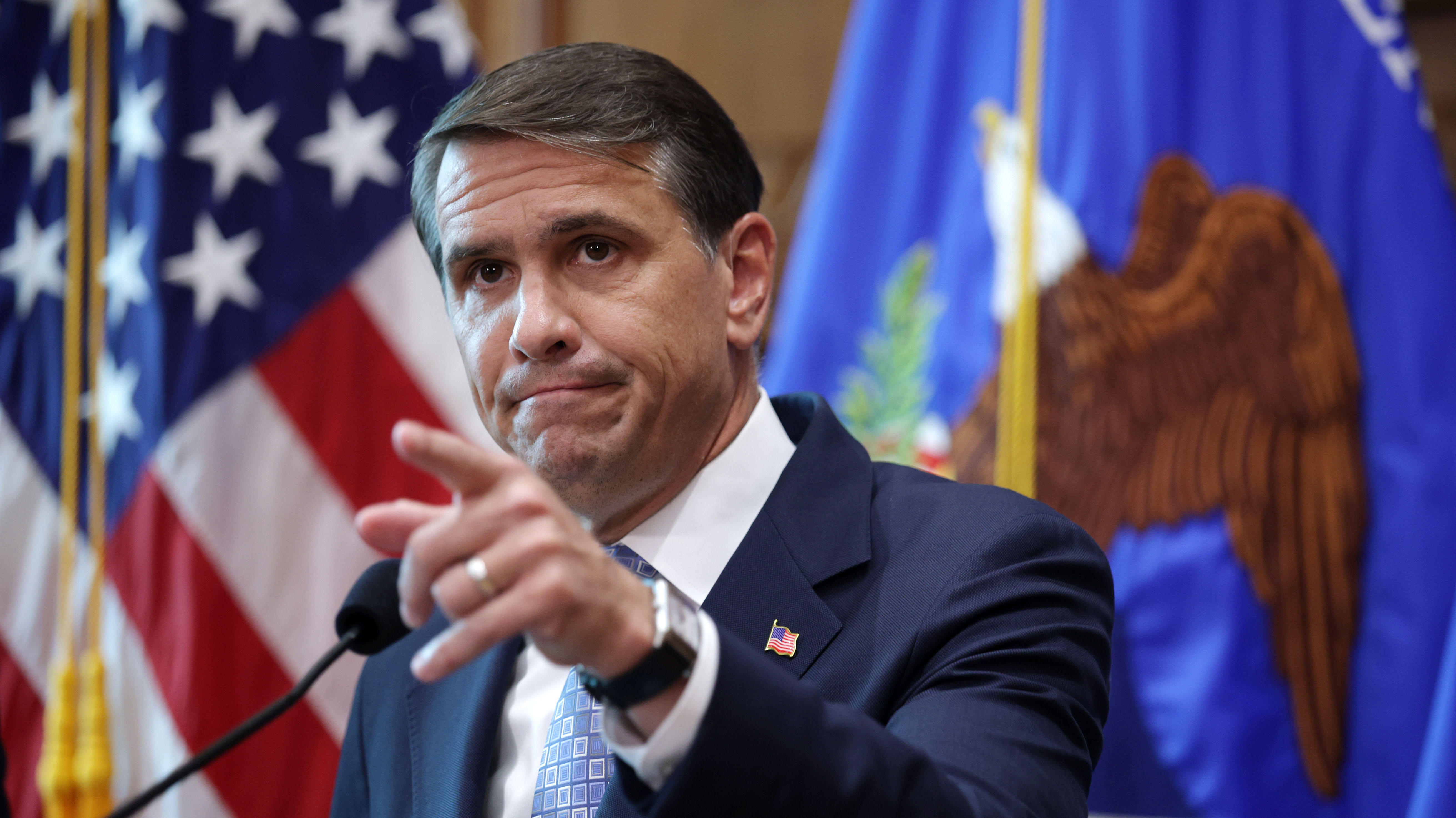
U.S. Attorney General Todd Blanche speaks during a news conference on Aug. 12, 2026, in Washington, D.C. (Alex Wong/Getty Images)

(WASHINGTON) — In his first news conference since his narrow confirmation as attorney general, Todd Blanche reiterated Wednesday that the Justice Department’s “Anti-Weaponization Fund” will not be revived — but suggested there could be other ways of compensating so-called “victims” of “weaponization.”

Blanche’s comments, during a press conference on an unrelated criminal fraud matter, came after President Donald Trump told reporters in the Oval Office earlier this week that the Anti-Weaponization Fund’s future would be Blanche’s to decide. 

The $1.776 billion fund was announced in May by the Justice Department to compensate those who allege they were wrongly targeted under the Biden administration. Blanche affirmed in a written order prior to his confirmation as attorney general that the fund was dead, under pressure from two Republican senators whose support for his nomination hinged on whether he would make such a declaration. 

“I keep on saying this over and over again, but I’m happy to say it one more time,” Blanche said at Wednesday’s press conference in response to a question from ABC News. “I have testified under oath that it’s dead. I have testified in front of the House where I wasn’t under oath where I said it was dead. I have answered questions after my hearing where I said that it was dead, I have rescinded the order that that set up the weaponization fund, which means that it does not exist.”

“I’m not sure how I can further say that the anti-weaponization fund doesn’t exist, or we use the word ‘dead,'” he added. “But if anybody has any ideas, we also have said under oath that if Congress would like to make it a law, that we would support that, as would the White House.”

At the same time, Blanche suggested the department would entertain other means to pay out so-called “victims” of “weaponization” under the Biden administration, as President Trump has repeatedly said he wants.

“The president feels very strongly, as do I, that there were people who were victims of a Department of Justice that was absolutely weaponized, and he feels very strongly that that he would want to — to make them whole, as do I, but it will not be through the Anti-Weaponization Fund,” Blanche said.

The fund was proposed in exchange for Trump agreeing to drop his $10 billion lawsuit against the IRS as well as two civil claims for $230 million related to the Russia collusion investigation he faced during his first term in office and the 2022 search of his Mar-a-Lago estate — sparking accusations by critics of self-dealing and a bipartisan uproar over the possible use of taxpayer money to pay rioters who attacked the U.S. Capitol on Jan. 6, 2021.

Copyright © 2026, ABC Audio. All rights reserved.

Inflation eases slightly: How price increases break down

Inflation eases slightly: How price increases break down
A person pumps gas at a Chevron gas station on Aug. 7, 2026, in Austin, Texas. (Brandon Bell/Getty Images)

(NEW YORK) — Inflation eased slightly in July but price increases stayed above the pace recorded before a surge in fuel prices set off by the Iran war. The reading matched economists’ expectations.

Prices rose 3.4% in July compared to a year earlier, marking a slight cooldown from an annual inflation rate of 3.5% in the prior month, federal government data released on Wednesday morning showed.

Inflation stands more than a percentage point higher than the Federal Reserve’s target rate of 2%.

In July, prices rose for medical care, airline fares, communication, education and recreation, the U.S. Bureau of Labor Statistics said.

The prices of meat and milk each climbed more than 5% over the year ending in July, clocking in well above the overall inflation rate.

Egg prices, by contrast, plummeted more than 25% over the previous year, indicating continued recovery from a shortage caused by an outbreak of bird flu.

Energy prices, meanwhile, climbed nearly 15% over the year ending in July. Shelter prices — made up primarily of monthly rents and an equivalent cost assigned to home owners — jumped 3.2% over that period, registering slightly below the overall inflation rate.

The reading arrived days after government data showed unexpected job losses last month, suggesting strain on the economy as a months-long bout of elevated price hikes weighed on shoppers.

The Iran war drove up gasoline prices and catapulted inflation to a three-year high in May. A preliminary peace agreement in June offered up some relief, but a burst of on-again, off-again fighting over ensuing weeks caused crude prices to climb.

Global oil prices stood at about $89 a gallon on Wednesday morning, keeping them well above pre-war levels.

The national average price of a gallon of gas registered at $4.03 on Wednesday, AAA data showed, marking a 35% rise since the outbreak of war in late February.

A prolonged bout of elevated inflation has raised the chances of an interest rate hike, futures markets show. Investors peg the odds of a quarter-point rate hike next month at nearly 50%, according to the CME Group’s FedWatch Tool, a measure of market sentiment.

The odds of a rate increase have ticked lower since last week, however, when a lackluster jobs report showed the labor market had shifted into reverse.

The U.S. lost 23,000 jobs in July, according to the federal government’s monthly jobs report, which marked a decline from 57,000 jobs added in June.

The unemployment rate fell slightly from 4.2% in June to 4.1% in July. Unemployment remains low by historical standards.

A government report issued last week showed a steeper slowdown in gross domestic product than expected over three months ending in June, indicating softness in the underlying economy over the early months of the war.

The Fed could raise interest rates in an effort to cool off prices, but the move risks an economic slowdown that may pinch hiring.

Fed Chair Kevin Warsh, who took the helm of the central bank this summer, has repeatedly vowed to dial back inflation.

“The committee remains resolute — you’ve heard this before — that we will deliver price stability,” Warsh told reporters in Washington, D.C., last month.

Copyright © 2026, ABC Audio. All rights reserved.