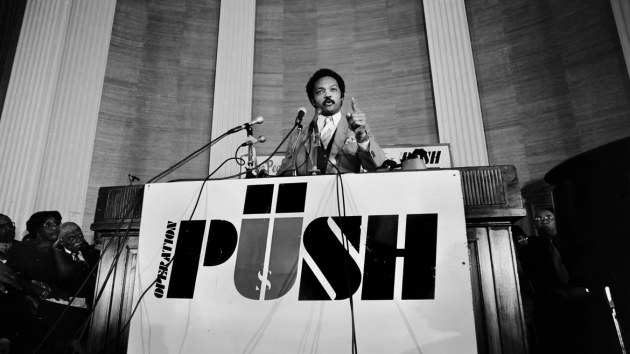
American religious & Civil Rights leader and politician Reverend Jesse Jackson points as he speaks from a lectern at the headquarters of Operation PUSH (People United to Save Humanity), Chicago, Illinois, July 17, 1981. (Photo by Antonio Dickey/Getty Images)
(NEW YORK) — Three former American presidents and a former vice president are set to honor the late Rev. Jesse Jackson at a memorial service in Chicago on Friday morning – a “Celebration of Hope” that is being held by the family of the pioneering civil rights leader, who died on Feb. 17 at the age of 86.
Former Presidents Bill Clinton, Barack Obama and Joe Biden and former Vice President Kamala Harris are expected to deliver remarks at the homegoing services on Friday, according to the Jackson family. Former Secretary of State Hillary Clinton and former first lady Jill Biden are also expected to attend the services, the family said.
ABC News reached out to representatives for Clinton, Obama, Biden and Harris for further comment.
“Jesse Jackson, Sr. marched beside Martin Luther King, Jr. for civil rights for all people. He traveled the world fighting economic and gender inequity. Until his last days, he fought for better healthcare, education, and peace in Chicago, Illinois, the United States, and beyond,” the Jackson family said in a statement on Wednesday. “I hope everyone who joins us to honor his legacy will also continue to champion these causes. That would be the best possible tribute and celebration they could offer.”
Friday’s public homegoing service will take place at the House of Hope event center. A private service will take place on Saturday morning in Chicago.
The services come after thousands paid their respects to Jackson as he lay in honor at the headquarters of the Rainbow PUSH Coalition in Chicago last week. He was also honored in his birth state of South Carolina on Monday, where he laid in state at the state house in Columbia.
“Jesse Jackson, Sr. changed the United States — and the world,” the Jackson family said in a statement. “We are deeply honored to know there are people from every walk of life who want to join us to pay their respects.”
Other scheduled speakers at the service on Friday include Chicago Mayor Brandon Johnson, Illinois Gov. J.B. Pritzker, Rep. Maxine Waters, D-Ill., and Chicago Cubs owner Tom Ricketts. Singer and actress Jennifer Hudson and gospel legends Bebe Winans and Pastor Marvin Winans are also expected to perform on Friday. Stevie Wonder is set to perform at the private service on Saturday.
Jackson died after experiencing health issues over the past several years, including a battle with Parkinson’s disease and progressive supranuclear palsy (PSP), a rare neurological disorder.
Jackson’s children honored their father’s legacy at a press conference last month, reflecting on his 1984 and 1988 presidential runs and how he dedicated his career to advancing economic justice and building political power for Black Americans.
Jackson’s son, Jesse Jackson, Jr., called for unity in the Feb. 18 press conference ahead of his father’s funeral services.
“Do not bring your politics out of respect to Rev. Jesse Jackson and the life that he lived to these home going services,” he said. “Come respectful and come to say thank you, but these homegoing services are welcome to all Democrat, Republican, liberal and conservative, right wing, left wing, because his life is broad enough to cover the full spectrum of what it means to be an American.”
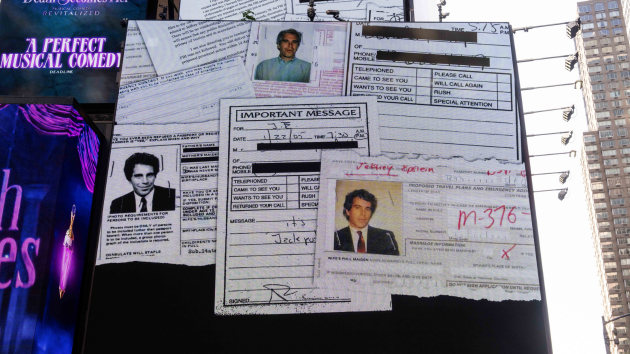
A billboard in Times Square calls for the release of the Epstein Files on July 23, 2025 in New York City. (Photo by Adam Gray/Getty Images)
(WASHINGTON) — The Department of Justice on Thursday released three previously withheld FBI interview reports from 2019 related to a woman who made uncorroborated allegations that she was abused by Donald Trump in the 1980s, when she was a minor.
In a statement on social media, the Department of Justice said the interview summaries — known as FBI 302 reports — were initially withheld from the January release of millions of pages of DOJ documents related to Jeffrey Epstein because they were believed to be duplicative of other documents.
“What we found through extensive review is that a published 302 — additionally disclosed in a published spreadsheet — had subsequent 302s that were coded as ‘duplicative.’ After this was brought to our attention, we reviewed the entire batch with the similar coding and discovered 15 documents were incorrectly coded as duplicative,” the DOJ account said.
The statement did not appear to explain why, beyond possible human error, the records were marked as duplicative. As of Thursday evening, the DOJ database still does not include the handwritten notes from the interviews themselves.
According to the reports, the FBI interviewed the woman four times between July and October 2019. During each of the interviews with the woman, whose identity is redacted, she made allegations of abuse against Epstein.
In her second interview with federal investigators, she claimed that Epstein once took her to either New York or New Jersey where he introduced to Trump when she was between the ages of 13 and 15 years old. According to the report, she claimed Trump abused her during that trip.
In the fourth interview in October 2019, the woman declined to provide additional details about the alleged interaction with Trump when asked by agents, according to the summary of that interview.
Her statements to the federal agents allege that the incident with Trump took place in the early-to-mid 1980s — a period when Epstein and Trump did not appear to be in contact.
Trump has denied any wrongdoing related to his relationship with Epstein or any knowledge of Epstein’s criminal activity.
In her initial interview with the FBI, the woman claims she was sexually abused by Epstein after being hired for what she thought was a babysitting job, but she said there were no children present. Similar abuse occurred, she said, on several more occasions, according to the summary of the first report, which was released by the DOJ in January.
The witness said multiple alleged incidents with Epstein took place in South Carolina, a location not known to have been frequented by Epstein. The timing of the allegations would place them two decades before law enforcement in Florida began investigating Epstein for sexual exploitation of minors.
Before the additional records were released Thursday, Congressional Democrats had accused the Justice Department of illegally withholding the documents to protect the president.
“It is unconscionable, it is illegal, and [Attorney General] Pam Bondi and the president need to answer where those files are,” California Democrat Robert Garcia, D-Calif. said last week.
In a statement in January, the Department of Justice said that some investigative files in the massive tranche released would include unsubstantiated claims about Trump.
“Some of the documents contain untrue and sensationalist claims against President Trump that were submitted to the FBI right before the 2020 election. To be clear, the claims are unfounded and false, and if they have a shred of credibility, they certainly would have been weaponized against President Trump already,” the statement said.
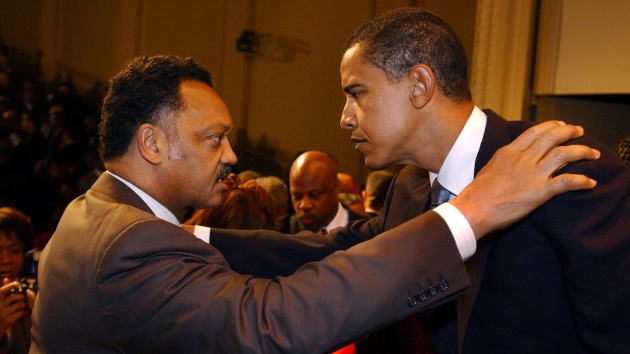
Rev. Jesse Jackson has a word with Sen. Barrack Obama, after a Congressional Black Caucus ceremony at the Library of Congress, in which members where sworn into the CBC for the109th Congress, Jan. 4, 2005. (Tom Williams/CQ-Roll Call via Getty Images)
(CHICAGO) — Three former American presidents and a former vice president are set to honor the late Rev. Jesse Jackson at a memorial service in Chicago on Friday morning – a “Celebration of Hope” that is being held by the family of the pioneering civil rights leader, who died on Feb. 17 at the age of 86.
Former Presidents Bill Clinton, Barack Obama and Joe Biden and former Vice President Kamala Harris are expected to deliver remarks at the homegoing services on Friday, according to the Jackson family. Former Secretary of State Hillary Clinton and former first lady Jill Biden are also expected to attend the services, the family said.
ABC News reached out to representatives for Clinton, Obama, Biden and Harris for further comment.
“Jesse Jackson, Sr. marched beside Martin Luther King, Jr. for civil rights for all people. He traveled the world fighting economic and gender inequity. Until his last days, he fought for better healthcare, education, and peace in Chicago, Illinois, the United States, and beyond,” the Jackson family said in a statement on Wednesday. “I hope everyone who joins us to honor his legacy will also continue to champion these causes. That would be the best possible tribute and celebration they could offer.”
Friday’s public homegoing service will take place at the House of Hope event center. A private service will take place on Saturday morning in Chicago.
The services come after thousands paid their respects to Jackson as he lay in honor at the headquarters of the Rainbow PUSH Coalition in Chicago last week. He was also honored in his birth state of South Carolina on Monday, where he laid in state at the state house in Columbia.
“Jesse Jackson, Sr. changed the United States — and the world,” the Jackson family said in a statement. “We are deeply honored to know there are people from every walk of life who want to join us to pay their respects.”
Other scheduled speakers at the service on Friday include Chicago Mayor Brandon Johnson, Illinois Gov. J.B. Pritzker, Rep. Maxine Waters, D-Ill., and Chicago Cubs owner Tom Ricketts. Singer and actress Jennifer Hudson and gospel legends Bebe Winans and Pastor Marvin Winans are also expected to perform on Friday. Stevie Wonder is set to perform at the private service on Saturday.
Jackson died after experiencing health issues over the past several years, including a battle with Parkinson’s disease and progressive supranuclear palsy (PSP), a rare neurological disorder.
Jackson’s children honored their father’s legacy at a press conference last month, reflecting on his 1984 and 1988 presidential runs and how he dedicated his career to advancing economic justice and building political power for Black Americans.
Jackson’s son, Jesse Jackson, Jr., called for unity in the Feb. 18 press conference ahead of his father’s funeral services.
“Do not bring your politics out of respect to Rev. Jesse Jackson and the life that he lived to these home going services,” he said. “Come respectful and come to say thank you, but these homegoing services are welcome to all Democrat, Republican, liberal and conservative, right wing, left wing, because his life is broad enough to cover the full spectrum of what it means to be an American.”
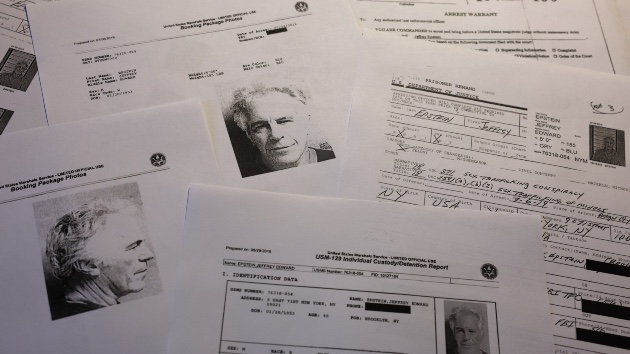
Printed documents available at Epstein Library on the U.S. Department of Justice website are seen in this illustration photo taken in Krakow, Poland on February 6, 2026. (Photo by Jakub Porzycki/NurPhoto via Getty Images)
(NEW YORK) — The Department of Justice on Thursday released three previously withheld FBI interview reports from 2019 related to a woman who made uncorroborated allegations that she was abused by Donald Trump in the 1980s, when she was a minor.
In a statement on social media, the Department of Justice said the interview summaries — known as FBI 302 reports — were initially withheld from the January release of millions of pages of DOJ documents related to Jeffrey Epstein because they were believed to be duplicative of other documents.
“What we found through extensive review is that a published 302 — additionally disclosed in a published spreadsheet — had subsequent 302s that were coded as ‘duplicative.’ After this was brought to our attention, we reviewed the entire batch with the similar coding and discovered 15 documents were incorrectly coded as duplicative,” the DOJ account said.
The statement did not appear to explain why, beyond possible human error, the records were marked as duplicative. As of Thursday evening, the DOJ database still does not include the handwritten notes from the interviews themselves.
According to the reports, the FBI interviewed the woman four times between July and October 2019. During each of the interviews with the woman, whose identity is redacted, she made allegations of abuse against Epstein.
In her second interview with federal investigators, she claimed that Epstein once took her to either New York or New Jersey where he introduced to Trump when she was between the ages of 13 and 15 years old. According to the report, she claimed Trump abused her during that trip.
In the fourth interview in October 2019, the woman declined to provide additional details about the alleged interaction with Trump when asked by agents, according to the summary of that interview.
Her statements to the federal agents allege that the incident with Trump took place in the early-to-mid 1980s — a period when Epstein and Trump did not appear to be in contact.
Trump has denied any wrongdoing related to his relationship with Epstein or any knowledge of Epstein’s criminal activity.
In her initial interview with the FBI, the woman claims she was sexually abused by Epstein after being hired for what she thought was a babysitting job, but she said there were no children present. Similar abuse occurred, she said, on several more occasions, according to the summary of the first report, which was released by the DOJ in January.
The witness said multiple alleged incidents with Epstein took place in South Carolina, a location not known to have been frequented by Epstein. The timing of the allegations would place them two decades before law enforcement in Florida began investigating Epstein for sexual exploitation of minors.
Before the additional records were released Thursday, Congressional Democrats had accused the Justice Department of illegally withholding the documents to protect the president.
“It is unconscionable, it is illegal, and [Attorney General] Pam Bondi and the president need to answer where those files are,” California Democrat Robert Garcia, D-Calif. said last week.
In a statement in January, the Department of Justice said that some investigative files in the massive tranche released would include unsubstantiated claims about Trump.
“Some of the documents contain untrue and sensationalist claims against President Trump that were submitted to the FBI right before the 2020 election. To be clear, the claims are unfounded and false, and if they have a shred of credibility, they certainly would have been weaponized against President Trump already,” the statement said.
(CLEVELAND) — A 28-year-old woman has been arrested days after the bodies of two girls were found in suitcases in a field in Cleveland, police announced Thursday.
The Cleveland Division of Police did not say what charges the suspect was arrested on in connection with the suspected homicides, noting that the woman is expected to be formally charged later Thursday. Her name will be released at that point, police said.
Detectives began investigating the deaths on Monday, following the “horrific” discovery, according to Cleveland Police Chief Dorothy Todd.
An individual spotted one of the bodies inside a suitcase while walking a dog in a residential neighborhood on Monday evening and reported it to police, according to Todd.
Responding officers located a second body in another suitcase nearby, Todd said. Both suitcases were in a shallow grave in a field near a school, she said.
One of the girls is suspected to have been between the ages of 8 1/2 and 13, and the second between 10 1/2 and 14, Todd said. They have been determined to be half-siblings, the Cuyahoga County Medical Examiner’s Office said Wednesday.
It was unclear how long the girls had been at the location, just that “it was some time,” and that there were no clear indicators of the cause of death, Todd told reporters Tuesday.
“This is a traumatic event for our officers, for the community,” Todd said.
The cause and manner of death have not yet been determined, and the medical examiner’s office is continuing to work to officially identify the children, police said Thursday.
The investigation led detectives to execute a search warrant at a residence located within a block of the field on Wednesday, where they “recovered substantial evidence related to the case,” the Cleveland Division of Police said.
A person of interest was detained on Wednesday, with Cleveland Police Sgt. Wilfredo Diaz telling reporters it was a “significant break” in the case.
Todd said in a statement Thursday that “careful and methodical work” in the case “allowed our detectives to develop the evidence needed to make quick identification of a person of interest, ultimately resulting in an arrest.”
A child located inside the searched home has been taken into custody by the county’s Department of Children and Family Services, police said. The child appeared to be in good health, police said.
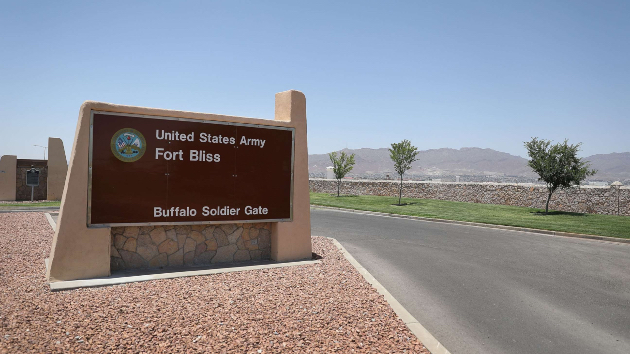
In this June 25, 2018, file photo, an entrance to Fort Bliss is shown, in Fort Bliss, Texas. (Joe Raedle/Getty Images, FILE)
(El PASO, Texas) — The contract for an Immigration and Customs Enforcement tent facility in El Paso, Texas, is under review, the Department of Homeland Security confirmed in a statement.
Camp East Montana, a detention center on the grounds of Fort Bliss, was opened in August by the Trump administration. The facility has faced criticism from immigrant advocates following the deaths of three detainees and a current measles outbreak.
“ICE is always looking at ways to improve our detention facilities to ensure we are providing the best care to illegal aliens in our custody,” Deputy Assistant Secretary Lauren Bis said in a statement. “The contract for Camp East Montana was inherited from the Department of War. DHS undergoes rigorous audits and inspections of our facilities to ensure they are meeting our high standards.”
“DHS is reviewing this facility and contract,” Bis added. “No decisions have been made related to contract extension, termination, or award.”
Last year, Acquisition Logistics LLC, a Virginia-based company, was awarded $1.2 billion to build the 5,000 bed, short-term detention facility with an estimated date of completion of Sept. 30, 2027, according to a Department of Defense notice.
Acquisition Logistics did not immediately respond to ABC News’ request for comment.
While DHS has not provided a reason for the review, a current measles outbreak has renewed calls from legal advocates who say detainees are not getting proper medical care.
DHS confirmed to ABC News that there are currently 14 active measles cases at the facility. In a statement, Bis claimed medical staff were quarantining all detainees that may have come into contact with those infected.
“This is the best healthcare than many aliens have received in their entire lives,” Bis claimed, contradicting repeated claims of medical neglect and abuse at the facility made by the ACLU in December and by attorneys with clients being detained there.
Crystal Sandoval, an accredited representative with Las Americas Advocacy Center, who attempted to meet with a potential client on Tuesday, says she was denied entry into the facility because of the outbreak. Sandoval says she was the first person who was granted access into the facility in August 2025 and has been sounding the alarm about what she calls widespread medical neglect.
“I’ve had people be like, ‘I want to be deported because I’m not getting my diabetic medication and if I continue like that, I’m going to have a diabetic coma,'” she told ABC News.
Lawmakers have also increasingly called on DHS to provide more transparency about who they’re contracting with it, and to shut down the facility.
“For months, we have sounded the alarm on the horrific conditions at this facility—from the tragic and preventable deaths of three individuals to the current measles outbreak that has put hundreds at risk,” said Rep. Pramila Jayapal, D-Wash., on Wednesday. “This $1.2 billion contract was awarded to a company with zero experience in detention management, and the results were as predictable as they were disastrous.”
(TORREY, Utah) — A suspect in a triple murder investigation was taken into custody Thursday morning after investigators tracked him in one of the victim’s vehicles, according to the Utah Department of Public Safety.
Three women were found murdered on Wednesday in two locations.
The suspect — 22-year-old Ivan Miller from Blakesburg, Iowa — is believed to have had no prior relationships with the victims or prior ties to the area, Utah Highway Patrol Lt. Cameron Roden said at a press conference Thursday.
The victims in this case are not related and investigators are still looking into the suspect’s criminal background, according to Roden.
Two of the victims were found dead on a hiking trail and a third victim was found dead at a Wayne County residence during the investigation, according to Utah DPS.
The husbands of two of the victims found their bodies on a trailhead near State Route 12 in Torrey, Utah, and reported it to the dispatch center on Wednesday evening, according to Roden.
Investigators then found a suspicious vehicle near the trailhead and tracked it to a residence in Lyman, Utah. Investigators found evidence that led them to the body of the third victim on Wednesday — who was the registered owner of the vehicle — according to Roden.
The identities of the victims have not been publicly released. Investigators believe the ages of the victims are in the 30s, 60s and 80s.
Investigators tracked the vehicle the suspect tried to escape in through southern Utah into northern Arizona and eventually Colorado. Colorado law enforcement then located the vehicle abandoned in Pagosa Springs and took the individual into custody shortly after, according to Utah DPS.
Investigators were searching for a 2022 white Subaru Outback in connection with at least one of the murders, according to Utah DPS. This vehicle belonged to one of the victims found on the trailhead, Roden said.
A representative with the FBI Salt Lake City field office told ABC News Salt Lake City affiliate KTVX they are aware of the investigation and are “prepared to assist our law enforcement partners, if requested.”
Multiple counties were on high alert as officials searched for the suspect. All residents were advised to take extra precautions, including keeping lights on and locking all doors, but now investigators said they have no outstanding suspects and there is no ongoing threat to the public.
Schools in the Wayne County School District are closed on Thursday and Friday, according to the Wayne County School District.
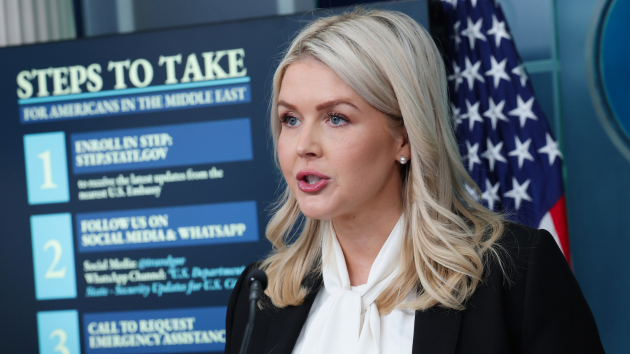
White House Press Secretary Karoline Leavitt displays steps for U.S. citizens in the Middle East to take following U.S. strikes on Iran as she speaks during a news briefing in the James S. Brady Press Briefing Room of the White House on March 04, 2026 in Washington, DC. (Kevin Dietsch/Getty Images)
(NEW YORK) — The State Department announced on Wednesday that a charter flight for American citizens stuck in the Middle East was en route to the United States — days after the war with Iran left thousands of American travelers stranded as combat operations led to the closure of airspace around the region.
The department said the flight is “part of our ongoing efforts to assist Americans return home” and said additional flights will be departing from the United Arab Emirates, Qatar, Saudi Arabia and Israel.
The move comes as hundreds of thousands of Americans stranded across the Middle East are trying to leave the region, faced with canceled flights and other travel disruptions.
Chris Elliott, a pastor from Lexington, North Carolina, told ABC News that he and his family were stranded while visiting sites in Jerusalem. He said they ended up in a bomb shelter as sirens sounded and incoming missiles were intercepted.
“We want Americans to be on American soil right now,” Elliott said.
Eliott’s daughter, Riley, said it’s been frustrating and frightening to be forced to shelter in place since the joint U.S.-Israel attacks on Iran began on Saturday.
“The scariest for me was trying to go to bed at night and then being woken up by the sounds of sirens,” Riley Elliott told ABC News.
The U.S. State Department issued an advisory on Monday, three days into the military operation, urging Americans to immediately leave 14 countries in the region via commercial flights, but stranded U.S. citizens have said that’s become extremely difficult, given the significant disruptions to air travel.
The Trump administration is facing some criticism for apparently not having a plan in place to get American citizens out of harm’s way ahead of the joint operation.
Responding to a question on Tuesday from ABC News about why so many Americans became stuck in the Middle East absent any advance warning of the attack on Iran, President Donald Trump said, “Well, because it happened all very quickly.”
White House press secretary Karoline Leavitt said during a Wednesday press briefing that the U.S. did communicate the danger of traveling to the region.
“There was many signs, put out by the State Department,” Leavitt said. “The secretary of state issued level four travel advisories dating back to January for many of these countries in the region,” adding that they were “advising extreme caution and do not travel alerts to Americans in the region.”
However, a review of travel advisories issued by the State Department indicates that prior to the start of the conflict, of the the 14 countries American travelers were later urged to depart, eight of them were only listed at a Level 1 or Level 2 — meaning to exercise normal precautions or increased caution.
Leavitt also claimed that since the start of the U.S.-Israeli attack on Iran, over 17,500 Americans “have safely returned home from the Middle East, with over 8,500 American citizens returning home to the United States just yesterday alone.”
Multiple U.S. embassies in the region, including some that have been attacked, have said they are unable to help citizens trying to leave.
“Our embassies and our diplomatic facilities are under direct attack from a terroristic regime,” Secretary of State Marco Rubio told reporters on Tuesday in Washington.
Asked if there were plans in place to evacuate Americans before the attack took place, Rubio said, “That’s the plan we’re trying to carry out.”
“The problem is, or the challenge we are facing, is airspace closures,” Rubio said, adding that some airports were closed after being hit in strikes. “So, that’s a challenge, but rest assured, we are confident that we are going to be able to assist every American.”
Odies Turner, a private chef from South Carolina, told ABC News that he’s been stuck in his hotel in Doha, Qatar, since the military operation began. He said the unexpected experience of being in a war has left him “frustrated, anxious” and feeling helpless.
“How do you expect us to leave a country where the airspace is closed? People are really stranded here,” Turner said in a self-video recorded on Tuesday. “I really don’t know what to do. I’ve reached out to the embassy, consulate and airlines. There’s no information on when I will get back home. It’s a mess.”
American Lisa Butler said the military conflict left her and her family, who were part of a large travel group, stranded in Abu Dhabi before they were evacuated to Dubai.
“We were standing … outside of this beautiful mosque, looking up in the sky and seeing these missiles that have been intercepted,” Butler told ABC News about how she and her family learned while in Abu Dhabi that they were vulnerable to a major military conflict breaking out in the region.
Oliver Sims, an American from Texas, told ABC News that he has been stuck in Qatar.
“I was just a few minutes ago, listening to some explosions that are going off above my head,” Sims said. “And, you know, I know that officials have said use commercial means, but there are really no commercial means here for us to use. So it’s really difficult to try and figure out a way out.”
Asked to describe conditions in Qatar, Sims said that he has been awakened at night by “extremely loud explosions” that shook the windows of his hotel room.
“I looked out my window and I saw a bunch of debris that was raining down outside of my hotel window,” Sims said. “And it’s very jarring, too, because it’s not just how loud it is, just how it actually physically shakes you. The rumbling is really, really just as violent.”
An F/A-18E Super Hornet, attached to Strike Fighter Squadron 151, prepares to make an arrested landing on the flight deck of Nimitz-class aircraft carrier USS Abraham Lincoln in support of Operation Epic Fury, March 2, 2026. (U.S. Navy)
President Donald Trump’s special envoy Steve Witkoff revealed in an interview this week that Iranian negotiators told him in the lead-up to the U.S.-Israeli military operation in Iran that they had enough enriched uranium to “make 11 nuclear bombs.”
But since the major combat operations were launched on Saturday with the intent of crushing Iran’s nuclear ambitions, the administration has yet to publicly produce any concrete evidence on the whereabouts of the nuclear material or who is in control of it. The Israel Defense Forces claimed that at least 40 top military commanders were killed in the opening strikes of the conflict.
In an interview on Fox News, Witkoff told host Sean Hannity that as soon as he and Trump’s son-in-law, Jared Kushner, sat down with the Iranian negotiators for denuclearization talks last month, their counterparts spoke of their stockpile of enriched uranium.
“Jared and I opened up with the Iranian negotiators telling us they had the inalienable right to enrich all the nuclear fuel they possessed,” Witkoff said. “We, of course, responded that the president feels we have the inalienable right to stop you in your tracks.”
Witkoff claimed the Iranian negotiators openly shared details about their supply of nuclear material.
“In that first meeting, both the Iranian negotiators said to us directly with, you know, no shame, that they controlled 460 kilograms of 60% [enriched uranium] and they’re aware that that could make 11 nuclear bombs,” Witkoff said.
Witkoff said the 60% enriched uranium can be brought to weapons-grade in about a week and that the 20% enriched uranium can be brought to weapons-grade in three to four weeks.
“They manufacture their own centrifuges to enrich this material,” Witkoff said. “So, there’s almost no stopping them. They have an endless supply of it.”
The statement appears to contradict what the Pentagon said last summer about Iran’s ability to develop weapons-grade uranium following U.S. strikes on its nuclear facilities.
In July 2025, Sean Parnell, the Pentagon’s chief spokesperson, said at a news conference that that the strikes on Iran’s nuclear facilities in June set back Iran’s capability to develop a nuclear weapon by “closer to two years.”
“It’s not just … enriched uranium or centrifuges or things like that. We destroyed the components that they would need to build a bomb,” Parnell said at the time.
But on Tuesday, that assessment fell to the wayside as the administration defended the U.S. military operation by insisting Iran posed an imminent threat to Americans. A senior administration official told reporters in a briefing that among the factors in the operation was that Iran had the ability to rebuild those components destroyed in the bombing, including its own centrifuges.
The official said a lot of the enriched uranium remained mostly in Isfahan with some still at Natanz and Fordo.
“It can be a long and cumbersome process in extracting it and covering it up,” the official said. “I think the first question is, where is it? The second question is, how do we get to it, and how do we get physical control? And then after that, it would be a decision of the president and department, the Department of War, CIA, as to whether we wanted to physically transport it or dilute it on premises.”
Iran has stated numerous times that it doesn’t want nuclear weapons, but believes it has the right to use nuclear power for civilian purpose. It had also been part of a nuclear deal with the U.S., which Trump withdrew from during his first term.
Iranian Foreign Minister Abbas Araghchi told ABC’s “This Week” anchor George Stephanopoulos on Sunday that the attack on his country was “unprovoked and unwarranted.” He said Iran was negotiating with the United States in good faith prior to the attacks.
“A deal was at our reach, and we left Geneva happily with the understanding that we can reach a deal next time we meet,” Araghchi said.
In their two public briefings on “Operation Epic Fury” in Iran, Secretary of Defense Pete Hegseth and Gen. Dan Caine, chairman of the Joint Chiefs of Staff, did not address what has become of Iran’s nuclear material since the widespread military strikes began on Saturday.
In several speeches since the attacks commenced, Trump has also not been specific about the status of Iran’s nuclear material.
Hegseth, Caine, CIA Director John Ratcliffe and Secretary of State Marco Rubio conducted a closed-door briefing with members of the U.S. Senate and House on the Iran operation on Tuesday afternoon.
In a letter sent on Monday to the administration’s briefers, five top House Democrats — including Rep. Gregory Meeks of New York, ranking member of the House Foreign Affairs Committee, and Rep. Adam Smith, ranking member of the House Armed Services Committee — asked for information on nuclear security in Iran.
“Who currently controls Iran’s nuclear facilities and materials, and what safeguards are in place to prevent diversion or proliferation, or complete loss of control?” the Democratic lawmakers asked in their letter.
But following the briefing, Meeks said the briefers offered few answers.
“Here we are again without answers. Here we are again without complete transparency,” Meeks said. “Here we are again trying to go around Congress.”
Pramila Jayapal, D-Wash., said the briefers provided “no additional” information on the imminent threat that prompted the military operation, adding, “There’s nothing that we got that you don’t have.”
House Speaker Mike Johnson, R-La., challenged any suggestion that the Trump administration was unclear during their briefing with House members about their objectives in Iran.
“This is really a very simple matter. It’s about the building of ballistic missiles. That’s what Iran was engaged in, and they were doing it at a speed and in a scale that was exceeding the ability of our regional allies to respond appropriately,” Johnson said. “This created an imminent and serious threat. It also gave them cover to continue with their nuclear ambitions.”
Johnson added, “As you know, we tried very hard to negotiate with them about that nuclear enrichment of uranium … and the buildup of their missiles was so important and so serious that the President of the United States, this president, thought that it was a great enough threat that we needed to act.”
The International Atomic Energy Agency (IAEA), the United Nations’ nuclear watchdog, said in a social media post on Tuesday that, based on the latest available satellite imagery, it “can now confirm some recent damage to entrance buildings of Iran’s underground Natanz Fuel Enrichment Plant [FEP].”
“No radiological consequence expected and no additional impact detected at FEP itself, which was severely damaged in the June conflict,” the IAEA said in the post.
In June 2025, the U.S. and Israeli militaries launched “Operation Midnight Hammer,” targeting three of Iran’s nuclear facilities — Natanz, Fordo and Isfahan — with “bunker-buster” bombs, according to the White House.
At the time, Trump said the operation “completely and totally obliterated” Iran’s key uranium enrichment sites.
In a speech on Monday at the White House, Trump said that after “Operation Midnight Hammer,” Iran attempted to rebuild its nuclear facilities in another location, “because they were unable to use the ones we so powerfully blew up.”
“In addition, the regime’s conventional ballistic missile program was growing rapidly and dramatically, and this posed a very clear, colossal threat to America and our forces stationed overseas,” Trump said. “The purpose of this fast-growing missile program was to shield their nuclear weapon development and make it extraordinarily difficult for anyone to stop them from making these highly forbidden, by us, nuclear weapons.”
The Institute for Science and International Security said in a statement on Tuesday that its analysis of satellite imagery indicates the Natanz nuclear complex, Iran’s main uranium enrichment site, was struck twice during Saturday’s joint U.S.-Israeli attack.
Neither the Trump administration nor the Israeli government have confirmed the alleged strikes on the Natanz complex.
Meanwhile, Israel targeted a compound near Tehran linked to the regime’s nuclear weapons “capabilities,” the Israel Defense Forces (IDF) said in statement Tuesday.
After the U.S. targeted Iran’s nuclear facilities last year, Israel, which participated in the operation under the code-name “Rising Lion,” continued to track scientists connected to the Iran’s nuclear weapons program “and located their new location at this site in a manner that enabled a precise strike on the covert underground compound,” the statement said.
“The strike removes a key component in the Iranian regime’s capability to develop nuclear weapons and joins a series of strikes conducted during Operation ‘Rising Lion’ that were essential to eliminate the Iranian nuclear threat,” the IDF said.
-ABC News’ Mary Kekatos and Jordana Miller contributed to this report.
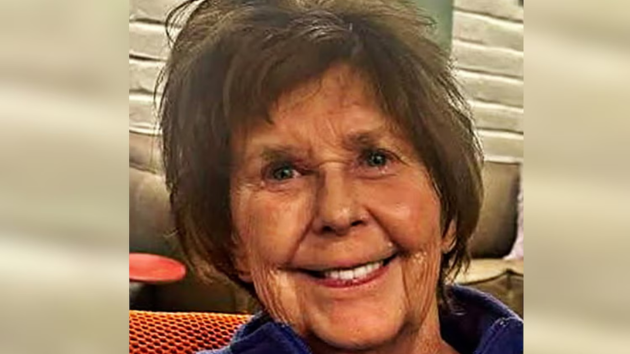
This image provided by the FBI Feb. 5, 2026, shows a missing person Nancy Guthrie. (FBI)
(ARIZONA) — As the search for Nancy Guthrie continues into its second month, one lead that hasn’t panned out for investigators is the glove recovered about 2 miles from Guthrie’s home.
The DNA on that glove traced back to a person who works at a nearby restaurant and “has nothing to do with the case,” according to Pima County Sheriff Chris Nanos.
“We feel the love and prayers from our neighbors, from the Tucson community and from around the country,” Savannah Guthrie wrote on Instagram this week. “please don’t stop praying and hoping with us.bring her home.”
Anyone with information is urged to call 911, the FBI at 1-800-CALL-FBI, or the Pima County Sheriff’s Department at 520-351-4900.