ChatGPT opened on a computer screen is displayed on Sept. 24, 2026, in Melbourne, Australia. (Asanka Ratnayake/Getty Images)
(NEW YORK) — Nearly two dozen states are calling on Congress to regulate artificial intelligence, warning that unchecked development could put Americans and the country at risk.
The attorneys general of 23 states, along with the District of Columbia and American Samoa, signed a letter to congressional leaders Thursday demanding “comprehensive federal regulation and safety protocols” for AI.
“Recent developments show that unchecked AI endangers Americans and could soon threaten our financial system, critical infrastructure, and national security,” the letter said. “Although we are working to hold frontier AI labs accountable under existing state laws, federal oversight is urgently needed to prevent future disasters.”
The attorneys general cited recent incidents involving AI, including reports involving Hugging Face, as evidence of what they described as the risks of AI systems operating beyond their intended safeguards.
The states called for federal oversight of AI model safety testing, international cooperation to pace AI advancement and leaders empowered to make safer decisions “unburdened by profit maximization,” according to the letter.
“In recent weeks, alarming reports of AI agents breaking containment have shocked the nation,” New York Attorney General Letitia James said. “My colleagues and I are calling on Congress to act swiftly to establish a regulatory framework for AI development to ensure this does not continue.”
The letter comes as states and the federal government continue to debate how AI should be regulated, including the appropriate balance between federal oversight and state authority.
In addition to New York, the attorneys general of Arizona, California, Colorado, Connecticut, Delaware, Hawaii, Illinois, Maine, Maryland, Massachusetts, Michigan, Minnesota, Nevada, New Jersey, New Mexico, North Carolina, Oklahoma, Oregon, Rhode Island, Vermont, Virginia, Washington and Wisconsin signed the letter, along with the District of Columbia and American Samoa.
Raw meat cuts on display. (Getty Images stock photo)
(NEW YORK) — More than 167,000 pounds of beef, pork and goat meat are being recalled nationwide after being produced without required federal inspection, according to the U.S. Department of Agriculture’s Food Safety and Inspection Service.
Star Meat Delivery Inc., based in Lucama, North Carolina, is recalling approximately 167,639 pounds of meat that was distributed to restaurants and retailers nationwide, USDA announced on Tuesday.
The meat was produced on various dates before Sept. 22 and sent to a distributor in Georgia before being distributed to restaurants and retailers across the country.
The USDA said it discovered the problem during a routine check. The recalled products had USDA inspection marks with the establishment number “EST. 1363,” but officials said that number is not approved for federal inspection.
No illnesses or injuries linked to the recalled meat have been reported, according to the agency.
What meat is being recalled?
The recall covers a wide range of raw beef, pork and goat products, including sliced ribeye, beef chuck, oxtail, beef short ribs, ground pork, pork chorizo, pork chops, pork ribs, pork feet, pork Boston butt and goat meat.
The products were vacuum-sealed and packed in cardboard boxes before being sent to A&D Foods, a distributor in Georgia.
Identifying the recalled meat may be difficult for some shoppers. The USDA said stores may have repackaged the meat and added their own price and safe-handling labels, meaning products in consumers’ refrigerators or freezers may not have the original packaging.
The agency said more products and labels could be added to the recall as officials continue to gather information.
A full list of recalled products and labels is available on the USDA’s website.
What should consumers do?
The USDA said it is concerned that some of the recalled meat could still be in consumers’ refrigerators and freezers or at restaurants and stores.
Consumers should not eat the recalled meat, and restaurants and retailers should not serve or sell it. The products should be thrown away or returned to the place where they were purchased.
Food that is produced without federal inspection may contain undeclared allergens, harmful bacteria or other contaminants that could pose a health risk, according to the USDA.
Anyone concerned about an illness or injury should contact a health care provider.
ABC News has reached out to Star Meat Delivery Inc. and A&D Foods for comment but did not hear back immediately.
Sign and banner for Ole Miss. (Getty Images stock photo/Melissa Kopka)
(NEW YORK) — Local officials are looking for answers after two Ole Miss students were found dead in separate incidents in Oxford, Mississippi, this week, police said.
Despite “packaged Kratom” being found during both investigations into the students’ deaths, officials asked students not to speculate as the police conduct their probe.
A cause of death hasn’t immediately been determined, according to the school. The victims’ identities have not been released.
“Out of an abundance of caution, we encourage everyone to avoid kratom and any other medication or substance that was not prescribed to you or obtained from a trusted, regulated source,” the Oxford Police Department said in a statement on Tuesday.
The police said that packaged kratom “sold from a retail store” was found during their investigations into the two deaths. Kratom is sold in convenience stores, gas stations and online, and linked to a growing number of overdoses.
Kratom products contain chemicals that can increase alertness, physical energy and talkativeness. At higher doses, users may experience sedating effects.
The FDA has warned that kratom and especially concentrated 7-OH products can carry risks including dependence, addiction, and serious adverse effects.
Advocates have called on the Food and Drug Administration for stricter regulations on the products and bans.
Oxford police said they are still trying to see if the drug was a factor in the students’ deaths as their probes continue.
“We do not have confirmed information indicating that kratom or any other substance was a contributing factor in either death,” they said in a statement.
“Local, state and federal partners are working collaboratively to gather the facts and provide answers as quickly and responsibly as possible,” the police added.
The police noted that Narcan, which may be able to reverse the life-threatening effects of an overdose of Kratom and other substances, is available on the campus.
Dr. Shawnboda Mead, the vice chancellor for student affairs at Ole Miss, said in a statement Tuesday that the school expressed its condolences and remorse to the family members of the deceased students.
“We encourage our community not to speculate about the circumstances or repeat information that has not been officially confirmed,” she said.
The federal student aid website on March 30, 2026. (Jenna Watson/Mirror Indy/CatchLight via Getty Images)
(NEW YORK) — The Department of Education is launching the Free Application for Federal Student Aid (FAFSA) earlier than ever before — a change it says will help families navigate the rising cost of college amid affordability concerns.
The department’s early rollout is welcome news for the millions of American families eager to receive financial aid for the 2027-2028 school year.
The critical resource is used to help applicants achieve funding for higher education and department officials are touting the FAFSA as its simplest version ever.
“We’ve simplified it,” Department of Education Under Secretary for Higher Education Nicholas Kent said ahead of the launch in an exclusive interview with ABC News. “Instead of it taking hours or even days to fill out, it takes 15 minutes on average,” he said.
The form goes live on studentaid.gov this morning. The major changes include clearer, less complicated language that removes “confusing jargon,” and a family friendly form that allows students to invite a contributor via text or email, according to the department.
In a statement, Secretary of Education Linda McMahon told ABC News that the new form was redesigned with students and families in mind.
Kent urged families to complete the improved form because it bolsters resources for low and middle income households worried about the cost of college.
“We don’t want students leaving money on the table,” Kent told ABC News. “There’s a lot of money out there in higher education. We want students to take advantage of it. And it starts with filling out the FAFSA form.”
This is the second year in a row the agency has launched its FAFSA form before Oct. 1, which is the mandated rollout deadline set by the FAFSA Simplification Act of 2020.
Last year, the FAFSA form rolled out on Sept. 24.
During the final weeks of President Donald Trump’s first term, Congress passed the FAFSA Simplification Act of 2020. This law overhauled the program and expanded access to federal aid, including federal Pell Grants, which are used specifically for low-income borrowers.
Kent stressed that the Trump administration is prioritizing policies that students and families deserve when deciding their futures.
“There are a few things that the Department of Education is really responsible for doing: One of them is getting the FAFSA form up and running,” Kent said.
“We want students and families to be able to access this form, complete it easily, and get the financial aid that they need to get on with their lives,” he added.
The announcement comes after a severely delayed FAFSA launch under Biden in 2023 and on the heels of the Trump administration’s attempts to overhaul other aspects of higher education.
The administration also made a major shakeup to the federal student loan system this summer — issuing fewer repayment plans and borrowing limits — affecting millions of people. Critics contend that some Americans — especially lower-income borrowers — will face higher monthly payments from the new student loan caps.
The department argued that its loan limits from the Working Families Tax Cuts Act have curbed excessive borrowing, forcing institutions to evaluate their costs and lower them in some cases.
Meanwhile, higher education experts contend that reforming college access crosses political lines and the efforts to simplify the FAFSA have been “incremental” for more than a decade.
Kyla Hurns, a higher education policy analyst at The Education Trust, called FAFSA the “gateway” to postsecondary education but she worries that changing the system doesn’t fully tackle college costs.
“While it’s super important to fix the FAFSA as a form, it only truly can achieve its goal of allowing every American to choose the pathway that works best for them if Pell Grant keeps up with inflation,” Hurns said.
She concluded that affordability is still families’ prime concern.
“FAFSA allows us to talk about the conversation to maybe fund a portion of [college], but it’s not funding all of the kids’ education anymore,” Hurns told ABC News.
“That’s still something that is a problem that states across the country are grappling with, that families are grappling with, that students are grappling with, and I think that’s determining their decisions.”
Flowers and candles are seen at an intersection near an ICE-related shooting on Sept. 21, 2026, in Austin, Texas. A U.S. Immigration and Customs Enforcement officer shot and wounded 28-year-old Wilber Rafael Garces Perez, a Venezuelan national who was working as a DoorDash delivery driver, Sunday afternoon in North Austin. (Brandon Bell/Getty Images)
(NEW YORK) — Wilber Rafael Garces Perez, the 28-year-old Venezuelan who was shot by an Immigration and Customs Enforcement officer in Austin, Texas, on Sunday, has been released from the hospital and is back in federal custody, according to his attorney.
Garces Perez’s attorney, Kate Lincoln-Goldfinch, said in a social media post on Tuesday that her client was transferred back to a federal detention facility in Pearsall, Texas, after being treated at a hospital.
Lincoln-Goldfinch said that she spoke with Garces Perez by video Tuesday morning and he told her that since returning to the detention facility, Garces Perez has only been “receiving Tylenol and ibuprofen for pain.” He also said he has had his communication privileges revoked, allegedly in retaliation for speaking to reporters by phone during a news conference on Monday, according to Lincoln-Goldfinch.
“Wilber tells me that after he spoke publicly, guards at the Pearsall detention center forcibly took the tablet from his hands, revoked his communication privileges, and moved him out of the infirmary into an isolated room with a flat bed that cannot be adjusted like a medical bed,” she said in a post.
Lincoln-Goldfinch said Garces Perez was transferred to a hospital Monday night after he was unable to move his arms, after which doctors determined that Garces Perez’s clavicle was fractured and that he had experienced significant swelling, Lincoln-Goldfinch said.
She said Garces Perez received morphine while at the hospital. She also said she is calling on the detention facility to reinstate his communication privileges.
President Donald Trump looks on as New York Mayor Zohran Mamdani speaks to reporters following their meeting at Gracie Mansion on September 21, 2026, in New York City. (Photo by Spencer Platt/Getty Images)
(WASHINGTON) — The Supreme Court has given the Trump administration a green light to use a federal citizenship database to verify voters ahead of the midterm elections.
In a 6-3 opinion, the Supreme Court, for now, lifted a lower court order that blocked the Department of Homeland Security from expanding a 40-year-old immigration database — known as the Systematic Alien Verification for Entitlements system — to help states screen voter records for noncitizens.
The immediate impact of the ruling is unclear, since states are prohibited by law from purging their voter rolls within 90 days of Election Day.
“The District Court’s order thus inhibits the Federal Government’s efforts to assist state and local agencies in the proper administration of the midterm elections. Under these circumstances, the equities weigh in favor of a stay,” the majority wrote.
President Donald Trump has characterized noncitizen voting as a pressing threat to free and fair elections, but audits of voter rolls have suggested that voting by noncitizens is exceedingly rare.
This is a developing story. Please check back for updates.
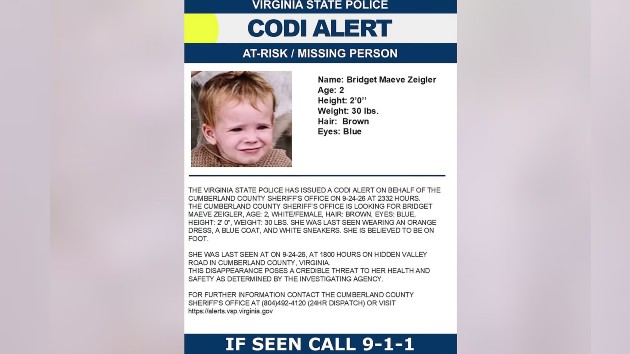
Bridget Maeve Zeigler, 2, went missing in Cumberland County, Va. on Thursday, Sept. 24. (Virginia State Police)
(NEW YORK) — A 2-year-old girl went missing Thursday evening in Southwest Virginia, setting off a search by police and help from the local school district, according to officials.
The child, Bridget Maeve Zeigler, is described as a white female with short brown hair and blue eyes, and is about 2 feet tall and 30 pounds, according to a Virginia State Police alert.
Zeigler was last seen at 6 p.m. on Thursday in Cumberland County, Virginia in an area that appears to be heavily forested, according to police.
Zeigler was last seen wearing an orange dress, blue coat and white tennis shoes, according to the alert.
Police said the child is believed to be on foot.
Virginia State Police issued a CODI alert at approximately 11:30 p.m. Thursday on behalf of the Cumberland County Sheriff’s Office.
Cumberland County Public Schools also issued an alert, encouraging community members to contact authorities with any information regarding Zeigler’s whereabouts.
Anyone with knowledge of the child’s location or disappearance is directed to reach out to the Cumberland County Sheriff’s Office at (804) 492-4120.
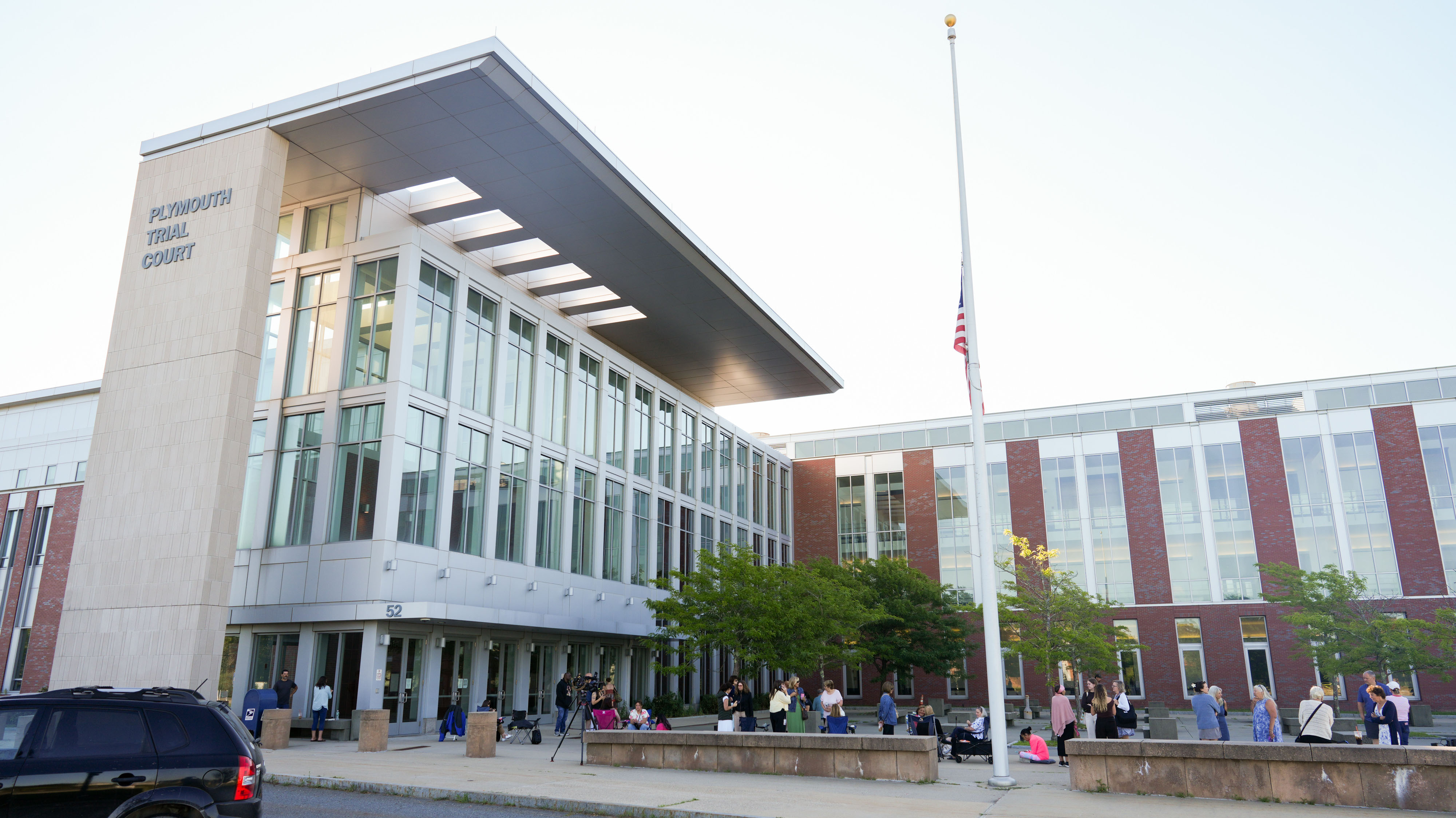
Plymouth Superior Court during Lindsay Clancy’s murder trial on Aug. 26, 2026,in Plymouth, Massachusetts. (Mel Musto/Getty Image
(NEW YORK) — The man identified as the lone holdout juror in the Lindsay Clancy trial is speaking out, saying he “didn’t have any doubts” during the jury’s seven days of deliberations.
“I didn’t have any doubts. As I tried to explain different possible theories during deliberation, I kept getting cut off as if I had doubts based on the evidence presented,” Michael Péguy Desronvil said in a statement shared to ABC News by his attorney on Friday. “Based on all the physical evidence, key witnesses, and what the prosecution presented, I thought it was enough proof that she (Clancy) knew exactly what she was doing and planned.”
Clancy pleaded not guilty to three murder charges for the deaths of her 5-year-old daughter Cora, 3-year-old son Dawson and infant son Callan, who were strangled at the family’s home in Duxbury, a Boston suburb, on Jan. 24, 2023.
Her five-week trial ended in a mistrial on Sept. 4, after jurors failed to reach a unanimous verdict.
This is a developing story. Please check back for updates.
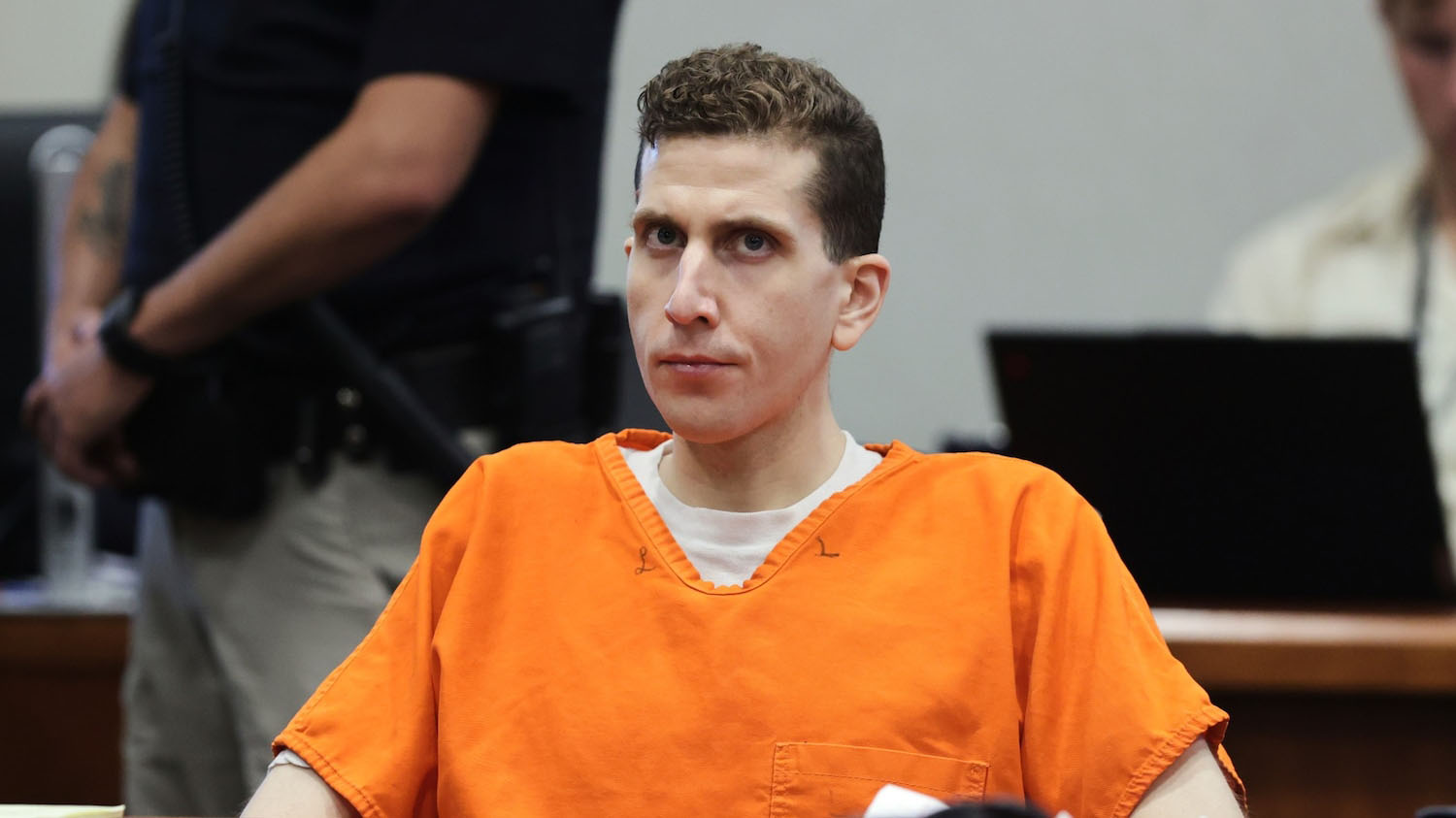
In this July 23, 2025, file photo, Bryan Kohberger appears at the Ada County Courthouse for his sentencing hearing in Boise, Idaho. (Kyle Green, Pool via Getty Images, FILE)
(NEW YORK) — The family of Bryan Kohberger is supporting his efforts to challenge his 2025 conviction, saying in a statement exclusive to ABC News, “Our full support of Bryan’s decision to pursue post-conviction relief does not come from a place of disregard.”
Kohberger, who is currently serving four consecutive life sentences for killing four college students in Idaho, said in his petition that the circumstances of his plea deal are now suspect because, among other things, he was “convinced to falsely confess” to a crime he says he did not commit.
“My actual innocence is my truth, and the plea, hinged on by false promises and blatant disinformation, MUST be withdrawn,” he said in a statement to the New York Times last month.
Kohberger’s family told ABC News that they did not want their support of their son “to compound the unimaginable grief the families have borne so courageously.”
“Rather, it comes from our family’s need to see that the complete and unvarnished truth is told. Like everyone, we seek answers to all the questions that have been raised, which can only be addressed through a proper trial, as opposed to an improper plea,” the Kohberger family said.
“As a family, we continue to carry the victims, their families, and the entire Moscow community in our hearts and daily prayer,” they added. “We continue to love and support Bryan and we continue to respect the memory of those lost. We seek to find justice and a conclusive resolution through the legal process.”
This month, Bryan Kohberger also requested a new judge to oversee the process, saying comments made by Judge Steven Hippler during his sentencing showed bias. Hippler said he could identify nothing redeeming about Kohberger because his conduct had buried anything “good or intrinsically human,” and he called him “the worst of the worst.” Kohberger’s motion also asks for his case to be moved back to Latah County, where the killings took place.
A hearing regarding his request for a new judge and location is scheduled for Oct. 15. A hearing to address his motion for post-conviction relief is set for June 17, 2027.
Last year, Kohberger, a former doctoral student in criminal justice, admitted he killed four college students in an off-campus house in Moscow, Idaho, on Nov. 13 2022. In addition to the life sentences, he received 10 years in prison for a burglary charge. The case received international media attention. Kohberger never explained or gave a motive for the killings.
By filing that brief handwritten petition, Kohberger is putting himself in the category of many criminal defendants before him, who have argued after the fact that their guilty pleas were coerced.
“It is not impossible but not common to have a plea deal returned after a conviction is final,” said Andrea Lewis Hartung, director of Northwestern University’s Center on Wrongful Convictions.
“People accept guilty pleas for all kinds of reasons, not necessarily because they were guilty,” she said. Oftentimes, she said, it is because they “don’t want to take the chance of having such a harsh punishment or were offered lesser charges.”
“A lot of consideration is ‘what is the worst case scenario that will happen if you lose.’ Whereas if you take a plea, you’ll have a guaranteed result or at least guarantee that you won’t have as harsh of a punishment,” she said.
Under Idaho law, first-degree murder is a crime that can be punished by death or life imprisonment. Prosecutors made it clear early in pre-trial hearings that they intended to seek capital punishment.
Plea deals are often attractive for attorneys to avoid trial. In fact, in any given year, 98% of criminal cases in federal courts end with a plea bargain, according to the American Bar Association. Yet according to the National Registry of Exonerations, about 28% of all exonerated people across the United States since 2014 pled guilty to crimes they did not commit. Likewise, the Innocence Project shows that about 12 percent of known DNA exoneration cases involved an innocent person who pled guilty.
Kohberger’s court-appointed lawyers, led by Coeur d’Alene-based attorney Ann Taylor, spent more than two years challenging evidence during pre-trial hearings. Despite Kohberger’s insistence that he was not guilty throughout the process, his plea deal was announced shortly before his trial was scheduled to begin.
In his new petition, Kohberger claims his lawyers pressured him into the deal with false promises. He said his court-assigned defense team failed to disclose or review exculpatory evidence during discussions and, despite his insistence that he was innocent, he said his attorneys told him that it was legally okay to submit a false guilty plea.
Kohberger “took the plea because he was frightened out of his mind,” Dr. Brent Turvey, a forensic criminologist hired by Kohberger’s legal team to analyze the crime scene, told ABC News. “His lawyers told him it’s okay to lie to the court. His family was used to induce him to take the plea. He didn’t know the strength of his own case.”
Turvey said Kohberger and his family were not given enough knowledge of the case the defense team had built before he pleaded guilty. Turvey explained his report, provided to the defense lawyers, included more evidence that supports Kohberger’s innocence.
Had he had the chance to testify for Kohberger, Turvey said he would have told a jury he was troubled by how investigators documented evidence in the house where the victims were found. He said police did not properly handle the knife sheath after they found it – so much so it should have been ruled inadmissible at trial. Turvey also said, “the hair evidence points to someone else” because FBI analysis “excluded Kohberger.”
He also said video and cell tower data that was used to place Kohberger in the vicinity of the murder scene around the time the killings occurred “has no value or meaning.”
“College students drive around all the time. That’s normal behavior,” Turvey said. “What’s really interesting is turning off the cell phone; it is riddled throughout his cell phone behavior. He’ll turn it off and drive around. Why? He’s a college student who doesn’t want to be bothered. You ignore the behavior of real people.”
Ann Taylor did not respond to ABC News’ request for comment.
Jason Goldman, one of Kohberger’s new defense attorneys, said plea deals can be thrown out “by bringing evidence to support the notion that you were coerced into accepting a plea through false promises, misrepresentations, or through undue duress.”
“Oftentimes, these very psychological methods could have been employed by an individual’s own counsel, justifying a court’s decision to allow a person to withdraw their plea,” he told ABC News.
“Many individuals take a plea deal even when they are otherwise innocent or believe the evidence against them is weak. Sadly, it becomes less about facts, guilt, or innocence and more about a business decision and being risk-averse,” he said.
Idaho Attorney General Raúl Labrador released a statement following Kohberger’s petition, saying only that he had sympathy for victim families “who have already endured unimaginable loss” and who now “must face today’s deeply painful news.”
“My office stands ready to do whatever is necessary to ensure justice is fully carried out,” he said.
Danone USA is voluntarily recalling So Delicious Dairy Free Salted Caramel Cluster Non-Dairy Frozen Dessert pints because of the potential presence of small stones and other hard objects. (FDA)
(NEW YORK) — It might be time to check your freezer. Danone USA is voluntarily recalling one of its popular frozen dessert offerings due to what the company said is the potential presence of foreign objects.
The food company announced this week that it is recalling pints of So Delicious Dairy Free® Salted Caramel Cluster Frozen Dessert “out of an abundance of caution” because they may be contaminated with “small stones and other hard objects, within the cashew inclusions.”
Danone USA said it had received complaints from customers and notified the Food and Drug Administration of the recall.
Recalled frozen desserts bear the UPC number of 744473476138 and have best-by expiry dates on and before April 3, 2028.
Customers are being advised not to eat any recalled frozen desserts and to throw them away. Those affected by the recall can request a refund or a coupon for a replacement product from the So Delicious Dairy Free® Consumer Care Line at 1-833-367-8975, available Monday through Friday from 9 a.m. to 6 p.m. ET, or through the So Delicious website.
Other So Delicious frozen desserts and products are not impacted by the recall, the company said on its website.
“We know this is not the quality you expect from us,” the brand shared on its website. “So Delicious Dairy Free® is working swiftly with retail partners to remove the impacted product from shelves. In the meantime, we have identified and corrected this issue and will soon be able to bring the product back to market safely.”
Danone USA said recalled frozen desserts were distributed to retailers nationwide and that it is working with stores to remove recalled products.
ABC News has reached out to Danone USA for additional comment.