A plane heading to Jamaica to help with storm relief crashed in a waterway in a community in Coral Springs, Florida, Nov. 10, 2025. (Obtained by ABC News)
(CORAL SPRINGS, Fla.) — Two people died when a small plane heading to Jamaica for Hurricane Melissa relief efforts plunged into a waterway in a Coral Springs, Florida, neighborhood, according to local officials.
The Beech B100 went down at about 10:19 a.m. on Monday behind some homes, according to the National Transportation Safety Board and the Coral Springs Fire Department.
No one on the ground was injured and no houses were hit, fire officials said.
The plane went down about five minutes after takeoff from Fort Lauderdale Executive Airport and was heading to Sangster International Airport in Montego Bay, Jamaica, for relief efforts, according to Fort Lauderdale city officials.
Jamaica is working to rebuild after the massive destruction caused by Hurricane Melissa. The storm made landfall on the island on Oct. 28 as a Category 5 hurricane, one of the most powerful landfalls on record in the Atlantic basin.
There were more than 30 deaths in Jamaica from Melissa and 100,000 housing structures were damaged, according to the United Nations.
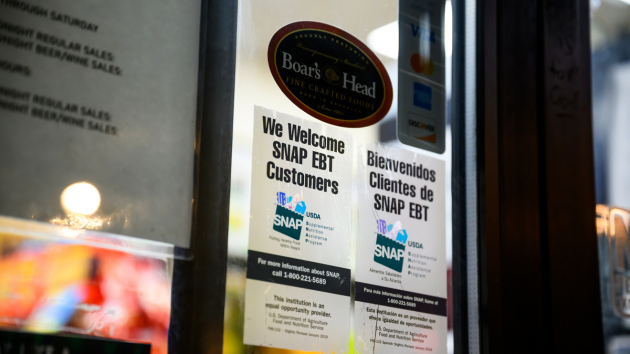
Supplemental Nutritional Assistance Program (SNAP) signage at a grocery store in Dorchester, Massachusetts, US, on Monday, Nov. 3, 2025. Mel Musto/Bloomberg via Getty Images
(WASHINGTON) — A federal judge said Monday that she will continue to block the Trump administration from enforcing a memo directing states to “undo” the issuance of full SNAP benefits.
The administration is currently seeking to “undo” hundreds of millions of dollars in SNAP benefits that went out after the U.S. Department of Agriculture, which operates the Supplemental Nutrition Assistance Program, told states Friday afternoon that it was “working towards implementing November 2025 full benefit issuances” to comply with a court order.
During a tense hearing Monday afternoon, U.S. District Judge Indira Talwani rebuked the Trump administration for “trying to play vindictive games” with states that sent benefits to SNAP recipients.
“It would seem to me that if the agency is trying to comply with the law and with the executive branch’s preferences on policies, a piece of that wouldn’t be trying to play vindictive games with the states. That’s not part of it,” said Talwani, who said she planned to issue a written ruling later Monday.
The USDA sent out its initial guidance after U.S. District Judge McConnell on Thursday ordered the Trump administration to fully fund SNAP by Friday — but on Saturday the USDA told states that they must “immediately undo any steps taken to issue full SNAP benefits for November 2025.”
Twenty states said they had already begun the process of issuing full November benefits.
“What you have right now is confusion of the agency’s own making,” Judge Talwani said.
The Trump administration, meanwhile, asked the Supreme Court Monday to stay the order requiring full payment of November SNAP benefits in order to allow Congress to finalize an end to the ongoing government shutdown without judicial interference.
“The irreparable harms of allowing district courts to inject themselves into the shutdown and decide how to triage limited funds are grave enough to warrant a stay,” wrote Solicitor General John Sauer.
Justice Ketanji Brown Jackson, who paused the order late Friday night, is expected to revisit it Tuesday.
Sauer, in an earlier filing, told the court that if the government reopens, its request would become moot — but in the meantime, the administration is making clear that it still wants the justices to allow it to make an only a partial payment of SNAP benefits for the month.
The administration asked the Supreme Court on Friday for an emergency stay of a ruling by U.S. District Judge John McConnell ordering the administration to fully fund SNAP for the month of November, saying it would partially fund SNAP with approximately $4.5 billion but that it needed the remaining funds to support WIC programs that feed children.
Justice Jackson granted the stay, pending a decision on the administration’s appeal to the 1st U.S. Circuit Court of Appeals.
Late Sunday, the circuit court denied the administration’s appeal, rejecting the administration’s argument that harm suffered by the government by complying with the order would outweigh the harm suffered by the millions of Americans who rely on the food assistance program.
“These immediate, predictable, and unchallenged harms facing forty-two million Americans who rely on SNAP benefits — including fourteen million children — weigh heavily against a stay,” wrote Judge Julie Rikelman.
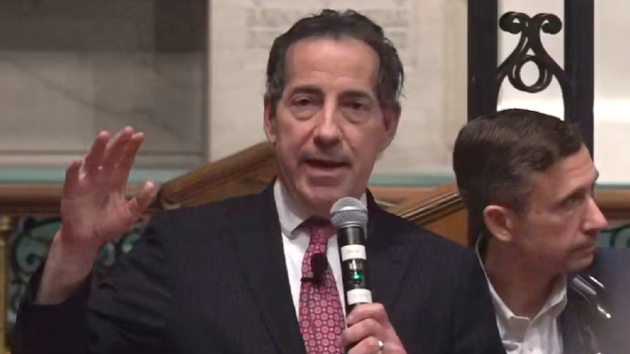
Rep. Jamie Raskin (D-MD) addresses the crowd at a Democratic “People’s Town Hall” in Bethlehem, PA on March 20, 2025. (ABC News)
(NEW YORK) — Rep. Jamie Raskin sent a sharply worded six-page letter to President Donald Trump on Sunday following new information his committee received from a whistleblower alleging that Ghislaine Maxwell is preparing a “commutation application” for the Trump administration and receiving preferential treatment while incarcerated.
Raskin, the top Democrat on the House Judiciary Committee, accused the Trump administration of allowing “a corrupt misuse of law-enforcement resources” and demanded that Deputy U.S. Attorney General Todd Blanche testify before the Judiciary Committee immediately to “answer for this corrupt misuse of law enforcement resources and potential exchange of favors for false testimony exonerating you and other Epstein accomplices.”
White House spokeswoman Abigail Jackson said in a statement about Raskin’s letter: “The White House does not comment on potential clemency requests. As President Trump has stated, pardoning Ghislaine Maxwell is not something he has thought about.”
Asked in July about a possible pardon for Maxwell, Trump said no one had approached him, though he reiterated his power to grant one.
The Justice Department has not responded to ABC News’ request for comment.
Democratic Rep. Robert Garcia, the ranking member on the House Oversight Committee who has led the minority on the panel’s Epstein investigation — released a statement on Monday calling on House Speaker Mike Johnson and Trump to “publicly oppose a commutation or pardon by President Trump” after the Judiciary Committee Democrats released their whistleblower information.
Johnson has resisted calls to swear in Democratic Rep.-elect Adelita Grijalva, who won a special election in September to succeed her father Rep. Raul Grijalva, who died in March, and said he would after the House reconvenes following the Senate passing a government funding bill.
The speaker sent the House home after it passed the funding resolution four days before Grijalva’s election.
The speaker has denied that his decision is related to her intent to become the 218th signature on a discharge petition forcing a vote to release the Department of Justice’s full Epstein file.
“This is a White House cover-up, and Speaker Johnson is now complicit. Seat Adelita Grijalva, and release the Epstein files, now,” Garcia said.
Raskin’s letter is a follow-up to an August 12 letter he and other Democrats sent to the Department of Justice and the Bureau of Prisons about Maxwell’s transfer to Federal Prison Camp Bryan, a minimum-security facility that he said was an “apparent flagrant violation of BOP policies, including one that explicitly prohibits the placement of sex offenders in such facilities.”
Maxwell is serving a 20-year prison sentence for child sex trafficking and other offenses in connection with Jeffrey Epstein, the former financier and convicted sex offender who died by suicide in jail in 2019.
FCI Tallahassee in Florida, where Maxwell had been held, is a “low security” prison for men and women, while FPC Bryan is a “minimum security” camp just for women.
The transfer followed Maxwell’s two-day meeting in July with Blanche in Tallahassee, where her attorney said the two discussed “about 100 names” associated with Epstein, after the Trump administration promised to release additional information about the deceased sex offender.
Supplemental Nutritional Assistance Program (SNAP) signage at a grocery store in Dorchester, Massachusetts, US, on Monday, Nov. 3, 2025. Mel Musto/Bloomberg via Getty Images
(WASHINGTON) — Amid efforts to end the ongoing government shutdown, the Trump administration has informed the Supreme Court that it intends to continue seeking a stay of a lower court’s order requiring full payment of November SNAP benefits.
That order remains on hold following a late-Friday night administrative action by Justice Ketanji Brown Jackson.
Solicitor General John Sauer told the court that if the government reopens, its request would become moot — but in the meantime, the administration is making clear that it still wants the justices to allow it to make an only a partial payment of SNAP benefits for the month.
The administration is currently seeking to “undo” hundreds of millions of dollars in SNAP benefits that went out after the U.S. Department of Agriculture, which operates SNAP, told states Friday afternoon that it was “working towards implementing November 2025 full benefit issuances” to comply with a court order.
The administration asked the Supreme Court on Friday for an emergency stay of a ruling by U.S. District Judge John McConnell ordering the administration to fully fund the Supplemental Nutrition Assistance Program for the month of November, saying it would partially fund SNAP with approximately $4.5 billion but that it needed the remaining funds to support WIC programs that feed children.
Justice Jackson granted the stay, pending a decision on the administration’s appeal to the 1st U.S. Circuit Court of Appeals.
Late Sunday, the circuit court denied the administration’s appeal, rejecting the administration’s argument that harm suffered by the government by complying with the order would outweigh the harm suffered by the millions of Americans who rely on the food assistance program.
“These immediate, predictable, and unchallenged harms facing forty-two million Americans who rely on SNAP benefits — including fourteen million children — weigh heavily against a stay,” wrote Judge Julie Rikelman.
On Saturday the USDA told states that they must “immediately undo any steps taken to issue full SNAP benefits for November 2025” but 20 states said they had already begun the process of issuing full November benefits.
A federal judge in Boston has set an emergency hearing for Monday afternoon to consider the legality of the administration’s guidance that states “undo” SNAP benefits.
A group of state attorneys general argue that it would be nearly impossible — as well as unfair and illegal — to unwind hundreds of millions in SNAP benefits after they have already been issued.
“In the span of less than a week, USDA has circulated multiple formal guidance documents, each inconsistent with the prior one, forcing the Plaintiffs into a continual state of whiplash,” they argued in a court filing.
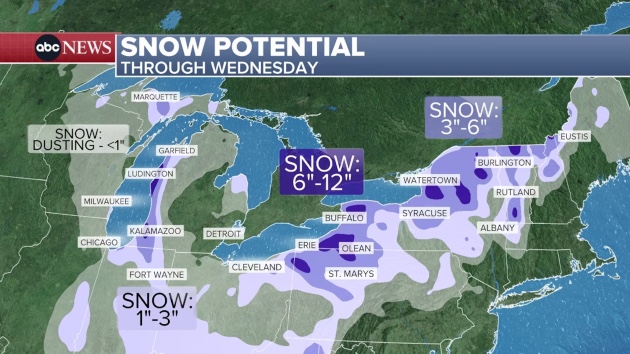
(NEW YORK) — The first snow of the season struck the Midwest this weekend, and more snow is on the way for the North in the next few days while freeze warnings hit the South.
The snow forecast
Very heavy snow — at rates of 2 inches per hour — fell overnight in Valparaiso, Indiana, with more than 9 inches of snow reported as of early Monday.
South Bend, Indiana, has reported more than 8 inches of snow, while more than 1 foot of snow has fallen in some parts of Michigan and Wisconsin.
Chicagoans are waking up to 1 to 2 inches of snow, with another brief round of light snow expected Monday morning.
This lake effect snow event will continue along eastern and southern Lake Michigan through Monday afternoon. Some areas along the eastern side of Lake Michigan could get more than 6 inches of snow on Monday.
One to 2 inches of snow is possible in Indianapolis, and even Louisville, Kentucky, could get up to 1 inch of snow.
In the Smoky Mountains, places like Gatlinburg, Tennessee, could see up to 8 inches of snow, and higher elevations could get up to 15 inches of snow and strong wind gusts.
Further east, areas downwind of Lake Erie and Lake Ontario will see major lake effect snow on Monday night.
The deep freeze forecast
Parts of the South are waking up to their coldest weather of the season on Monday, with temperatures dropping below freezing in Texas, Oklahoma and Arkansas.
Dozens of daily record low temperatures are possible across the Southeast on Tuesday morning. The temperature is forecast to plunge to 28 degrees in Wilmington, North Carolina; 31 degrees in Savannah, Georgia; 30 degrees in Mobile, Alabama; and 26 degrees in Montgomery, Alabama. Even Miami is forecast to drop to 48 degrees.
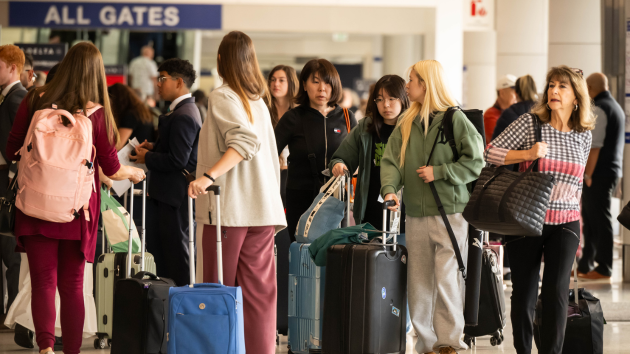
(NEW YORK) — More than 1,500 flights were canceled across the country early on Monday amid the Federal Aviation Administration’s limiting capacity at 40 major U.S. airports.
Another 881 flights were expected to be delayed on Monday, according to FlightAware, an airline traffic tracker, which also logged some 1,509 cancellations for flights within, into or out of the United States.
The travel chaos, which comes amid a record-length shutdown of the federal government, was expected to continue into Tuesday, according to the tracker. At leat 987 flights that had been planned for Tuesday were canceled, FlightAware said.
(NEW YORK) — Patrick Brady, a New York City firefighter, had a “medical episode” while battling a five-alarm fire in Brooklyn on Saturday and later died at the hospital, officials said.
Brady, 42, was an 11-year veteran of the department, FDNY Commissioner Robert S. Tucker said in a joint press release with Mayor Eric Adams.
“Firefighter Patrick Brady gave his life protecting the city we all love; there is no sacrifice that is more selfless than the actions that took place this evening,” Adams said in a statement.
Brady had been battling a fire on the roof of 9407 Kings Highway in Brooklyn on Saturday when he had a “medical episode” and went into cardiac arrest, the department said. He was treated on the scene and then rushed to Brookdale hospital, where he later died, officials said.
“A resident of Queens, he is survived by his wife, Kara, and his two brothers, Jimmy and Brian, who are both FDNY Firefighters,” the department said. Other members of his family, including cousins and uncles, are also FDNY Firefighters, according to the department.
“This family is a firefighter family,” Adams said during a somber press conference held at Brookdale hospital in Brooklyn early Sunday morning.
“They’ve been dedicated to protecting the lives of New Yorkers, and we will all cherish Patrick’s memory,” Adams added.
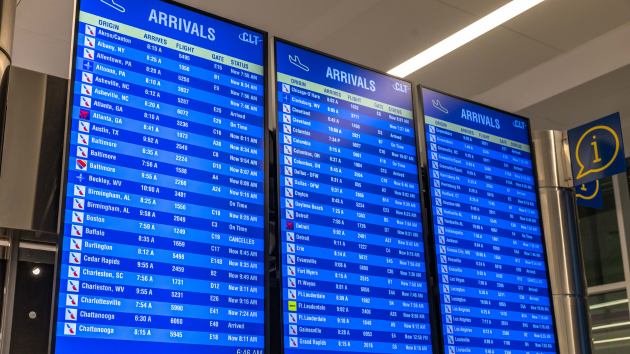
(NEW YORK) — Nationwide flight disruption stretched into Sunday following cancellations or delays to thousands of flights on Saturday, as the Federal Aviation Administration limited capacity at 40 major U.S. airports amid the longest government shutdown in American history.
As of 5:30 a.m. ET on Sunday, more than 1,100 flights were cancelled across the country according to the FlightAware website, as the FAA grappled with sustained staffing issues in air traffic controller towers and centers.
Saturday saw 1,521 flights canceled nationwide and more than 6,400 flights delayed.
Saturday’s figures surpassed those from Friday, when 1,024 flights were cancelled. Since Friday, more than 3,700 flights have been cancelled.
Major disruption was expected to continue through Sunday. As of Saturday night, there were over 40 air traffic control staffing triggers at facilities across the country.
The FAA decided not to cut any international flights as it would be a violation of international agreements with the countries, Transportation Secretary Sean Duffy said in an interview on ABC News Live on Friday.
(NEW YORK) — There is a paragraph on page 22 of the Trump administration’s appeal of a federal judge’s requirement that it make full November SNAP payments that has to be seen to be believed.
The opening sentence asserts that “the district court’s order threatens significant and irreparable harm to the government which outweighs any claimed injury to plaintiffs.”
In plain English, the Justice Department is telling the court that it would hurt the federal government more to comply with a judge’s order requiring full food stamp payments than it would hurt millions of low-income Americans to potentially starve.
Let’s simplify this further: the government is arguing that once the money is spent, it can’t be unspent (and that would be horrible). But the hungry can’t eat tomorrow (and that’s not as bad). That is the contention.
In a 40-page filing to the 1st Circuit Court of Appeals, the administration insisted that being forced to spend money Congress has already appropriated is a graver injury than the hunger and disruption that would follow from withholding it. Friday night, the administration filed a nearly identical emergency stay request with the Supreme Court, and Justice Ketanji Brown Jackson issued a temporary pause that will remain in effect until the circuit court issues a judgment on the matter.
At stake is the Supplemental Nutrition Assistance Program—SNAP—which provides monthly benefits to roughly 42 million Americans. During the ongoing government shutdown, the U.S. Department of Agriculture (USDA) planned to fund only part of the November payments, prompting lawsuits from cities, religious groups, and nonprofits that argued that the administration was flouting its legal obligation to deliver full benefits.
Twice, a Rhode Island federal judge, John J. McConnell Jr., agreed, ordering the government to draw on existing accounts to cover the gap. Twice, the administration appealed, contending that the judiciary had usurped Congress’s spending power by directing the executive branch to find the money.
The Justice Department’s latest emergency filing makes that claim in even starker terms. It asserts that McConnell’s injunction “makes a mockery of the separation of powers” and that there is “no lawful basis” for forcing the USDA “to somehow find $4 billion in the metaphorical couch cushions.” It also warns that by compelling compliance, the court has “thrust the Judiciary into the ongoing shutdown negotiations,” implying that judicial enforcement of basic statutory duties somehow exacerbates the fiscal standoff.
But what makes the filing remarkable is not just its tone—it’s the value judgment embedded in it. Traditionally, when courts decide whether to grant emergency relief, there is a calculus: the courts consider which outcome would cause greater damage, keeping the challenged policy on hold or letting it take effect? Here, the “policy” in question is the administration’s refusal to fully fund SNAP despite having ample reserves.
The Justice Department argues that the “irreparable harm” lies in being required to obey the court order and spend the money. By that logic, the government’s institutional discomfort outweighs the hunger of millions of families, seniors, veterans and children whose grocery money hangs in the balance.
Whether in disputes over public health, environmental regulation, or economic relief, the Trump administration’s lawyers have often equated executive prerogative with public interest—as though what benefits the administration necessarily benefits the nation. In this case, that conflation leads to the extraordinary claim that “the government” suffers greater harm by feeding people than by letting them go hungry.
The administration’s insistence that it “cannot” find the funds also rings hollow. By its own admission, the USDA controls multiple accounts with more than enough money to sustain SNAP for the month—including a $5 billion emergency reserve created by Congress specifically for that purpose. It has already drawn on similar pools of money to protect other nutrition programs from shutdown disruptions. The problem, in other words, is not fiscal incapacity but political choice.
The Justice Department’s appeal thus functions as both legal brief and ideological statement. It asks the courts to privilege administrative convenience over human need.
If that argument succeeds, the precedent would reach far beyond SNAP. It would signal that any time a court orders the government to meet a statutory duty—to pay benefits, deliver services, or enforce protections—the executive may claim “irreparable harm” merely because it prefers not to act. That is not separation of powers; it is the substitution of political preference for law.
Judge McConnell, for his part, put the matter bluntly: “This should never happen in America.” He was referring to the spectacle of a federal government choosing to let its citizens go hungry while pleading poverty amid abundant reserves.
The Justice Department’s legal arguments transform that spectacle into doctrine.
James Sample is an ABC News legal contributor and a constitutional law professor at Hofstra University. The views expressed in this story do not necessarily reflect those of ABC News or The Walt Disney Company.