
Jobs report shows US unexpectedly lost jobs in February

Jobs report shows US unexpectedly lost jobs in February
Job applicant with resume (Narisara Nami/Getty Images)

(NEW YORK) — The U.S. economy lost jobs in February, marking a major reversal of fortunes for the labor market and nearly erasing all of the job gains delivered a month earlier, government data on Friday showed. The reading came in well below economists’ expectations.

The U.S. lost 92,000 jobs in February, according to the report from the U.S. Bureau of Labor Statistics (BLS), which marked a significant dropoff from 130,000 jobs added in the previous month.

The unemployment rate ticked up from 4.3% in January to 4.4% in February, the BLS said. Unemployment remains low by historical standards.

The new jobs report arrived as markets roil and gasoline prices surge in response to the war with Iran. The Middle East conflict cast fresh uncertainty over the economic outlook.

A hiring cooldown last year prompted interest rate cuts at the Federal Reserve and concern among some observers about the nation’s economic prospects. The U.S. added an average of about 15,000 jobs per month in 2025, U.S. Bureau of Labor Statistics data showed.

Sluggish hiring has coincided with elevated inflation, threatening a period of “stagflation.”

Those economic headwinds helped set the conditions before the outbreak of war with Iran, which spiked oil prices and risked price increases for a host of diesel-fuel transported goods.

The Dow Jones Industrial Average plunged 785 points on Thursday as U.S. crude prices rose to their highest level since June.

Still, the overall economic picture remains mixed.

A government report in February on gross domestic product (GDP) showed the economy grew at a tepid annualized pace of 1.4% over the final three months of 2025. That reading indicated a dramatic cooldown from the strong annualized growth of 4.4% recorded in the previous quarter, U.S. Commerce Department data showed.

Price increases, meanwhile, have softened. In January, inflation fell to 2.4%, its lowest level in nine months. It remains slightly higher than the Federal Reserve’s target rate of 2%.

The Iran war threatens to slow U.S. economic growth since oil-driven price increases could weigh on consumers and businesses, analysts previously told ABC News.

The potential combination of higher inflation and slower growth could also pose a challenge for the Fed, putting pressure on both sides of its dual mandate to manage prices and maintain maximum employment.

If the Fed opts to lower borrowing costs, it could spur growth but risk higher inflation. On the other hand, the choice to raise interest rates may slow price increases but risks a cooldown of economic performance.

The central bank held interest rates steady at its most recent meeting in January, ending a string of three consecutive quarter-point rate cuts. Policymakers will make their next interest-rate decision on March 18.

Copyright © 2026, ABC Audio. All rights reserved.
Investors send stocks tumbling, Dow plunges 900 points

Investors send stocks tumbling, Dow plunges 900 points
Traders work on the floor of the New York Stock Exchange during morning trading on February 24, 2026 in New York City. (Michael M. Santiago/Getty Images)

(NEW YORK) — The Dow Jones Industrial Average plunged 900 points on Thursday as the war with Iran escalated and oil prices continued to climb.

The Dow fell 908 points, or 1.8%, while S&P 500 dropped 1%. The tech-heavy Nasdaq declined 0.9%.

This is a developing story. Please check back for updates.

Copyright © 2026, ABC Audio. All rights reserved.
Dow falls 1,000 points as Iran War escalates

Dow falls 1,000 points as Iran War escalates
Photo of Wall Street (Matteo Colombo/Getty Images)

(NEW YORK) — The Dow Jones Industrial Average plunged more than 1,000 points in early trading on Tuesday as the ongoing U.S.-Israeli war with Iran prompted a major selloff.

The Dow fell 1,075 points, or 2.2%, while the S&P 500 dropped 2%. The tech-heavy Nasdaq plummeted 2%.

Investor reaction on Tuesday sharply departed from the muted response a day earlier, when the major indexes closed essentially flat.

Oil prices, meanwhile, spiked for the second consecutive day as traders feared a prolonged blockade of the Strait of Hormuz, a trading route that facilitates the transport of about one-fifth of global oil supply.

The national average price of gasoline in the U.S. soared about 11 cents overnight to $3.11, AAA said on Tuesday.

President Donald Trump announced “major combat operations” against Iran on Saturday, with daytime strikes in the joint U.S.-Israel attack targeting military and government sites, officials said.

On Sunday, Iranian state television confirmed that Ayatollah Ali Khamenei was among those killed by airstrikes in Tehran.

Iran is responding to the U.S.-Israeli operation with missile and drone attacks targeting Israel, regional U.S. bases and Gulf nations. American diplomatic facilities have also been attacked.

U.S. Treasury yields ticked higher on Tuesday, suggesting possible concern about economic instability and inflation stemming from the Iran War.

Since bonds pay a given investor a fixed amount each year, the specter of inflation risks higher prices that would eat away at those annual payouts.

In turn, bonds often become less attractive in response to economic turmoil. When demand falls, bond yields rise.

ABC News’ Jon Haworth, Jack Moore, Nadine El-Bawab, David Brennan, Kevin Shalvey, Meredith Deliso and Leah Sarnoff contributed to this report.

Copyright © 2026, ABC Audio. All rights reserved.
Stocks slide after Iran attack

Stocks slide after Iran attack
An ATACM long-range missile is fired towards Iran from an undisclosed location, Feb. 28, 2026. (U.S. Central Command)

(NEW YORK) — Stocks slid on Monday morning in the first trading session after the U.S.-Israeli attack on Iran over the weekend.

The Dow Jones Industrial Average fell 280 points, or 0.5%, while the S&P 500 dropped 0.5%. The tech-heavy Nasdaq declined 0.5%.

The strikes early Saturday morning prompted Iranian drone attacks and missile fire targeting U.S. military bases and Gulf countries. Tit-for-tat strikes rapidly widened into a regional war.

Four U.S. service members have been killed in action, U.S. Central Command said on Monday. At least 555 people have been killed in the U.S.-Israeli strikes on Iran, the Iranian Red Crescent Society said.

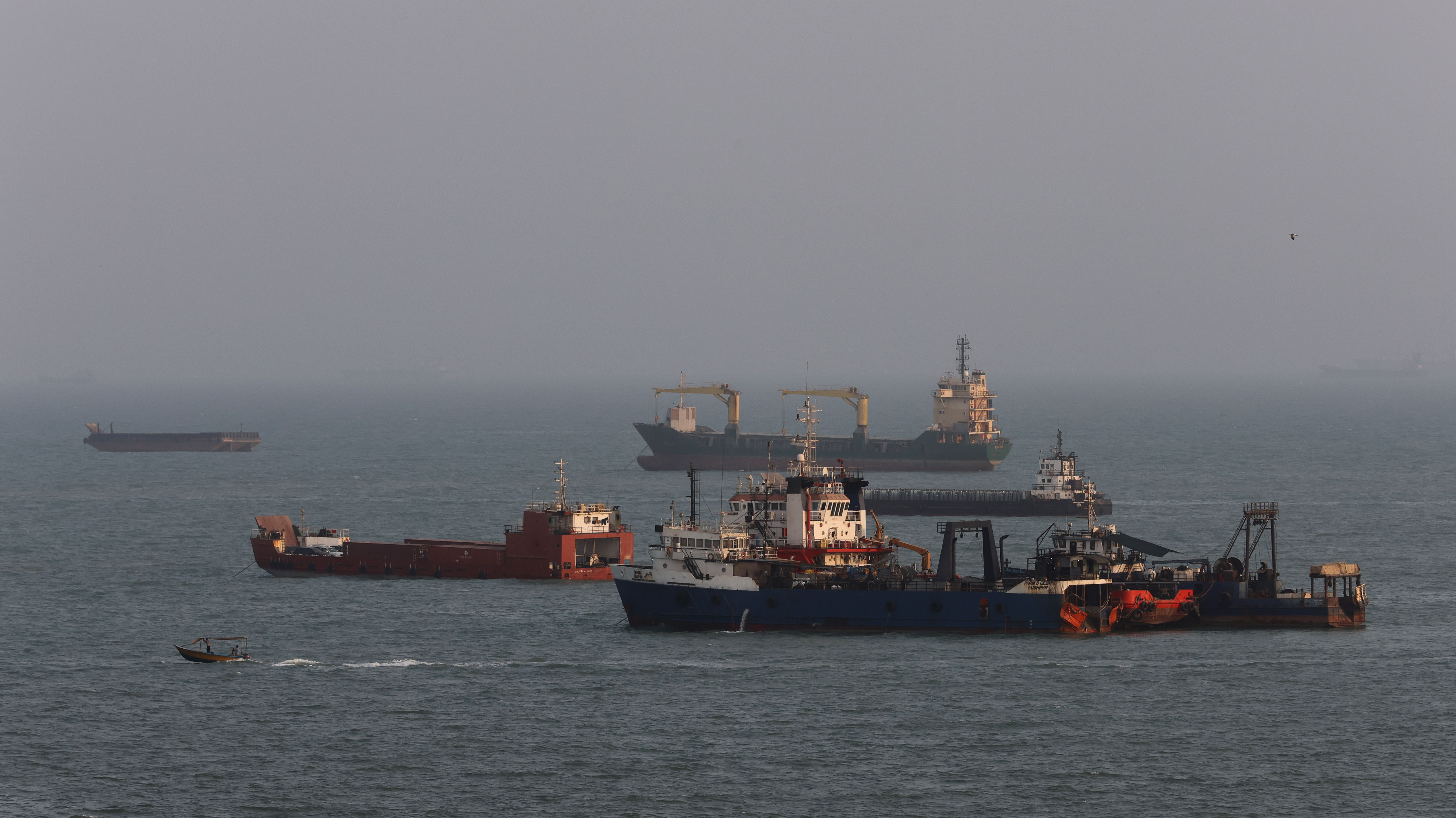
Oil prices spiked on Monday amid fears of a prolonged disruption of the Strait of Hormuz, a trading route that facilitates the transport of about one-fifth of global oil supply. Iran asserts control over the passage of tankers through the strait.

Brent crude prices soared more than 7%, threatening to push up prices for auto fuel and hike transport costs for other goods.

An array of global stock exchanges suffered marked losses on Monday.

In Europe, the pan-continental STOXX 600 index tumbled 1.6%. Tokyo’s Nikkei 225 index slipped 1.3%, while South Korea’s KOSPI dropped 1%.

Angelo Kourkafas, a senior global strategist for investment strategy at Edward Jones, on Monday acknowledged the volatility in markets but downplayed the long-term risk.

“While the situation remains dynamic, both historical patterns and market fundamentals offer some reassurance,” Kourkafas said in a statement to ABC News. “Geopolitical flare ups can create short term volatility, but recent episodes have produced limited and short lived market impacts.”

The CBOE Volatility Index (VIX), a measure of anticipated market volatility, climbed more than 7% on Monday.

President Donald Trump announced “major combat operations” against Iran on Saturday, with daytime strikes in the joint U.S.-Israel attack targeting military and government sites, officials said.

On Sunday, Iranian state television confirmed that Ayatollah Ali Khamenei was among those killed by airstrikes in Tehran on Saturday.

Iran is responding to the U.S.-Israeli operation with missile and drone attacks targeting Israel, regional U.S. bases and Gulf nations.

Israel is also intensifying its long-running strike campaign in Lebanon following fresh attacks by the Iranian-aligned Hezbollah militia.

In remarks on Monday, Iranian and American officials signaled expectations of an extended conflict.

The secretary of Iran’s Supreme National Security Council, Ali Larijani, said that Iran is prepared for a long war.

“Iran, unlike the United States, has prepared itself for a long war,” Larijani wrote in a post on X on Monday. He added that Iranian armed forces “have not engaged in any attacks except in defense.”

Gen. Dan Caine, the chairman of the Joint Chiefs of Staff, did not specify a timeline, but said, “This is not a single overnight operation. The military objectives … will take some time to achieve.”

Copyright © 2026, ABC Audio. All rights reserved.

US and Israeli strikes on Iran could rattle oil markets

US and Israeli strikes on Iran could rattle oil markets
A plume of smoke rises after an explosion on February 28, 2026 in Tehran, Iran. (Photo by Majid Saeedi/Getty Images)

(NEW YORK) — The U.S. and Israel’s large-scale strikes on Iran Saturday are expected to rattle oil markets when trading resumes Sunday evening, with analysts anticipating an immediate price reaction and impact on gas prices.

The central concern isn’t just Iran’s oil production, but its influence over the Strait of Hormuz, one of the world’s most important checkpoints for oil.

According to the U.S. Energy Information Administration, roughly 20% of the world’s oil passes through the strait, making Iran’s threats to close the waterway a significant risk. The U.S. is trying to control for this situation by vowing to “annihilate” Iran’s navy. 

Saudi Arabia and the United Arab Emirates have limited infrastructure in place that can bypass the Strait of Hormuz, which has the potential to mitigate any transit disruptions, but not offset them entirely.

While Iran has never followed through on these threats in the past, the perception of risk is still enough to move markets.

GasBuddy’s Patrick DeHaan expects crude oil to jump 5-10% as markets reopen, pushing oil above $70 a barrel.

While this would be much less dramatic than the response to the start of the Russia-Ukraine war in 2022, which drove prices above $100 a barrel, it would still move the average price of gas to above $3 a gallon for the first time this year.

DeHaan noted that gasoline and diesel prices in the U.S will not skyrocket overnight, and the actual impact will depend on the intensity and duration of the conflict.

Copyright © 2026, ABC Audio. All rights reserved.
US mortgage rates drop below 6% for the 1st time in nearly 4 years

US mortgage rates drop below 6% for the 1st time in nearly 4 years
In an aerial view, two-story single family homes line the streets of neighborhood on January 13, 2026 in Thousand Oaks, California. (Kevin Carter/Getty Images)

(NEW YORK) — The rate on a 30-year fixed mortgage dropped below 6% for the first time in nearly four years, according to new data from Freddie Mac.

Rates have been hovering around 6% this year and averaged 6.76% last February.

“For the first time in three and a half years, the 30-year fixed-rate mortgage dropped into the 5% range, falling even lower than last week’s milestone,” Sam Khater, Freddie Mac’s chief economist, said in a statement. “This rate, combined with the improving availability of homes for sale, is meaningful and will drive more potential buyers into the market for spring homebuying season.”

This is a developing story. Please check back for updates.

Copyright © 2026, ABC Audio. All rights reserved.
What do the remaining tariffs mean for prices? Experts explain

What do the remaining tariffs mean for prices? Experts explain
US President Donald Trump speaks during a press conference at the White House, Washington, D.C., US on February 20, 2026. Kyle Mazza/Anadolu via Getty Images

(NEW YORK) — President Donald Trump rushed to enact new tariffs and vowed to preserve others after a recent Supreme Court ruling knocked out most of his levies.

Businesses and consumers now face a different set of tariffs, which amount to taxes paid by importers for goods shipped into the U.S. Oftentimes, importers pass along tariff-related costs to consumers, raising retail prices.

The nation’s overall tariff rate has dropped, meaning some products have gained relief from tariff-related price pressures, some analysts told ABC News. But levies remain in place for nearly all imported goods, including duties as high as 50%, hiking costs for some companies and shoppers, they added.

“In general, we’ve seen tariffs pushing up on prices. That won’t go away,” Jason Miller, a professor of supply chain management at Michigan State University, told ABC News.

The high court ruled on Friday that the International Emergency Economic Powers Act (IEPPA) does not authorize Trump to impose levies, nullifying 70% of Trump’s tariffs after they collected more than $140 billion through December, the Yale Budget Lab found.

During his State of the Union speech on Tuesday, Trump criticized the Supreme Court decision, describing at as a “very unfortunate ruling,” and asserting that he retains the ability to impose tariffs under “fully approved and tested alternative legal statutes.”

In a social media post on Monday, Trump affirmed what he said was his authority to issue tariffs, saying he does not need to consult Congress before erecting new trade levies.

Trump also reiterated his commitment to his policy approach, warning other countries that they may face a “much higher Tariff, and worse.”

A 10% global tariff took effect on Tuesday, marking the first duty enacted by Trump since the high court’s decision. Trump issued the levy under Section 122 of the Trade Act of 1974, which allows the president to hike tariffs for 150 days as means of addressing “large and serious” balance-of-payments deficits, or disparities between a country’s total payments in transactions with other nations and its total earnings. In order to extend the Section 122 tariffs beyond 150 days, Trump would need to secure congressional approval.

Senate Minority Leader Chuck Schumer, D-N.Y., said this week that Democrats would oppose an extension of Section 122 tariffs, which could deny Trump the 60 votes necessary to overcome a potential Senate filibuster.

Trump has vowed to hike the Section 122 tariff to 15%. As of Tuesday, however, the president had not issued an order formalizing that increase.

A 15% Section 122 tariff would result in price increases amounting to $800 in additional costs for an average U.S. household over the next 150 days, the Yale Budget Lab projected.

“That’s hundreds of dollars that you’re going to be paying as a result of these tariffs,” Raymond Robertson, professor for trade, economics and public policy at Texas A&M University, told ABC News.

Robertson noted the ultimate cost impact may be slightly lower than projected as consumers shift away from products that display noticeable tariff-induced price hikes. But, he added, tariff-impacted products will be all but impossible for shoppers to avoid.

“These tariffs are hitting across the board,” Robertson said.

The Trump administration also plans to maintain sector-specific tariffs imposed under Section 232 of the Trade Expansion Act of 1962 and conclude pending investigations that could authorize additional levies, U.S. Trade Representative Jamieson Greer said in a statement on Friday.

That statute permits the White House to levy tariffs on products of importance to national security. Under the law, the White House must await the result of an investigation undertaken by the Commerce Department before imposing a tariff.

Under Section 232, for instance, steel and aluminum face a 50% tariff, putting upward pressure on prices for tableware, motorcycles, canned goods and assorted children’s products, analysts previously told ABC News.

A 50% tariff also applies to some copper products, while 25% tariffs remain for cars and auto parts. Those levies exclude a host of goods compliant with the United States-Mexico-Canada Agreement, or USMCA, a free trade agreement.

To be sure, some products will experience a reduction of tariffs in the aftermath of the Supreme Court decision. Products from China, Brazil, Vietnam and India will likely gain notable tariff relief, since those nations faced significant tariffs under the legal authority that was struck down by the Supreme Court, Miller said.

Electronics and clothing are among the products that could benefit from softer tariffs.

If the Supreme Court had opted to uphold tariffs issued under IEPPA, the nation’s effective tariff rate would have remained at 16%, the Yale Budget Lab said. Taking into account Section 122 tariffs, the effective tariff rate now stands at 13.7%, the group said.

“The good news for consumers is there’s an overall decrease in tariff rates,” Miller said. “What creates a challenge is we don’t know exactly what the new landscape will look like.”

Copyright © 2026, ABC Audio. All rights reserved.
Trump’s 10% global tariff takes effect

Trump’s 10% global tariff takes effect
President Donald Trump speaks during a press conference in the Brady Press Briefing Room of the White House in Washington, February 20, 2026. (Aaron Schwartz/Getty Images)

(NEW YORK) — A 10% global tariff took effect on Tuesday, marking the first duty enacted by President Donald Trump after a recent Supreme Court decision invalidated most of his levies.

Within hours of the high court’s ruling on Friday, Trump signed an executive order imposing a 10% tariff on nearly all imports for up to 150 days. The directive called for enforcement of the duty to begin at 12:01 a.m. ET on Tuesday, Feb. 24.

Soon after signing the order, Trump vowed to hike the global tariff to 15%. As of Tuesday, however, the president had not issued an executive order formalizing that increase.

Stocks ticked higher Tuesday morning, recovering some of the losses suffered a day earlier in the first trading session since Trump announced the tariff increase.

Trump enacted the 10% tariff under Section 122 of the Trade Act of 1974, which allows the White House to address “large and serious” balance-of-payments deficits, or disparities between a country’s total payments in transactions with other nations and its total earnings.

Under the measure, the president can also impose levies to “prevent an imminent and significant depreciation of the dollar.”

The Section 122 tariffs will result in price increases amounting to $800 in additional costs for an average U.S. household over the next 150 days, the Yale Budget Lab projected. In order to extend the across-the-board 15% tariff beyond that time window, Trump would need to secure Congressional approval.

Senate Minority Leader Chuck Schumer, D-N.Y., said Monday that Democrats would oppose an extension of Section 122 tariffs, which could deny Trump the 60 votes necessary to overcome a potential Senate filibuster.

In a social media post on Monday, Trump affirmed what he said was his authority to issue tariffs, saying he does not need to consult Congress before erecting new trade levies.

Trump also reiterated his commitment to his policy approach, warning other countries that they may face a “much higher Tariff, and worse.”

The high court ruled in their February 20 decision that the International Emergency Economic Powers Act (IEPPA) does not authorize Trump to impose levies, nullifying a major swathe of tariffs issued by the president on April 2 of last year, which he dubbed “Liberation Day,” and a host of other measures.

If the Supreme Court had opted to uphold tariffs issued under IEPPA, the nation’s effective tariff rate would have remained at 16%, the Yale Budget Lab said. Taking into account the Section 122 tariffs, the effective tariff rate now stands at 13.7%, the group said.

Copyright © 2026, ABC Audio. All rights reserved.
Stocks tick lower after Trump ratchets up tariffs

Stocks tick lower after Trump ratchets up tariffs
Photo of Wall Street (Matteo Colombo/Getty Images)

(NEW YORK) — Stocks slid on Monday morning in the first trading session since President Donald Trump announced a new 15% tariff on most imported goods, intensifying his effort to impose levies that were struck down by the Supreme Court.

The Dow Jones Industrial Average fell 90 points, or 0.1%, while the S&P 500 dropped 0.1%. The tech-heavy Nasdaq declined 0.1%.

Cryptocurrency prices tumbled in early trading on Monday. The price of bitcoin fell nearly 2%, putting it at about $66,075.

Gold prices jumped to their highest level in three weeks as investors sought the safe-heaven asset amid heightened uncertainty.

In a social media post on Monday, Trump reiterated his criticism of the Supreme Court.

The Supreme Court, Trump said, “accidentally and unwittingly gave me, as President of the United States, far more powers and strength than I had prior.”

Trump retains the power to levy a 15% tariff for up to 150 days under the Trade Act of 1974, which allows the president to address trade disparities with other countries.

Hours after the Supreme Court ruling on Friday, Trump said he would sign an executive order enacting a new 10% “global tariff,” invoking authority under Section 122. On Saturday, Trump escalated the tariff to 15%.

This is a developing story. Please check back for updates.

Copyright © 2026, ABC Audio. All rights reserved.
US economy slowed more than expected at end of 2025

US economy slowed more than expected at end of 2025
Woman shopping (lechatnoir/Getty Images)

(NEW YORK) — The U.S. economy slowed more than expected over the final months of 2025, federal government data on Friday showed.

The economy grew at an annualized rate of 1.4% in the fourth quarter in the government’s initial estimate, marking a cooldown from blistering-hot 4.4% growth recorded in the previous quarter.

The slowdown at the end of last year stemmed in part from a decline in the pace of consumer spending, the U.S. Commerce Department said.

The GDP report marks the latest distress signal for U.S. shoppers, who account for about two-thirds of the nation’s economic activity.

Retail sales data last week showed flat performance in December, suggesting possible weakness for shoppers during the holiday season. Meanwhile, credit card debt levels have climbed and consumer sentiment has remained glum.

The fresh reading of gross domestic product on Friday provided a key measure of the country’s economic health as policymakers continued to grapple with an ongoing bout of elevated inflation and sluggish hiring.

Inflation cooled in January, dropping price increases to their lowest level in nine months. While the pullback defied fears of a tariff-induced rise in overall costs, inflation continued to hover above the Federal Reserve’s target rate of 2%.

Meanwhile, a recent jobs report showed stronger-than-expected hiring in January, even though an updated estimate released at the same time indicated a near-paralysis of the labor market last year.

A boost in consumer spending helped propel the surge in GDP over three months ending in September, the U.S. Commerce Department previously said.

Over the past year, hiring has slowed dramatically while inflation has remained elevated, risking an economic double-whammy known as “stagflation.” Those conditions have put the Federal Reserve in a difficult position.

The central bank must balance a dual mandate to keep inflation under control and maximize employment. To address pressure on both of its goals, the Fed primarily holds a single tool: interest rates.

The strain on both sides of the Fed’s mandate presents a “challenging situation” for the central bank, Fed Chair Jerome Powell said in December.

The Fed held interest rates steady at its most recent meeting in January, ending a string of three consecutive quarter-point rate cuts.

Futures markets expect two quarter-point interest rate cuts this year, forecasting the first in June and a second in the fall, according to the CME FedWatch Tool, a measure of market sentiment.

Copyright © 2026, ABC Audio. All rights reserved.