(NEW YORK) — Who will win the Mega Millions jackpot in Friday night’s drawing? That’s the billion-dollar question.
For only the third time in the 20-year history of the American lottery game, the big prize has reached the billion-dollar mark. The jackpot has grown to an estimated $1.1 billion — a cash value of $648.2 million — after no ticket matched all six numbers drawn Tuesday night, according to a press release from Mega Millions.
If won, it will be the second-largest jackpot in Mega Millions history, behind only the record $1.537 billion won in South Carolina on Oct. 23, 2018 — the world’s largest lottery prize ever won on a single ticket.
Friday night’s Mega Millions drawing will mark the 30th in this jackpot run, which began on April 19.
In the 29 drawings since the Mega Millions jackpot was last won in Tennessee on April 15, there have been over 28.1 million winning tickets at all prize levels, including 42 worth $1 million or more in 17 states across the country. Four Mega Millions jackpots have been won so far this year — in California, New York, Minnesota and Tennessee.
Mega Millions jackpots start at $20 million and grow based on game sales and interest rates. Despite a surge in ticket sales, the odds of winning the big prize remain the same — 1 in 303 million.
Mega Millions tickets are $2 and can be purchased in 45 U.S. states, Washington, D.C., and the U.S. Virgin Islands. Drawings are conducted at 11 p.m. ET every Tuesday and Friday at the studios of Atlanta ABC affiliate WSB-TV, supervised by the Georgia Lottery.
Winners can either take the money as an immediate cash lump sum or in 30 annual payments over 29 years.
(JOLIET, Ill.) — Employees at a Joliet, Illinois, Amazon warehouse have filed a complaint with the Equal Employment Opportunity Commission against the company, alleging corporate abuse, racial discrimination, and retaliation.
According to the complaint filed Tuesday, a group of Black employees at the MDW2 Fulfillment Center said that Confederate imagery on coworkers’ clothing, racist death threats written in bathroom stalls, and a lack of security and accountability have contributed to a racially hostile work environment since late 2021. Institutional abuse and women’s rights attorney Tamara Holder said her clients are now not only seeking change in the workplace to appropriately address and resolve these issues, but monetary damages for emotional duress caused by stressful working conditions.
“We don’t know what that amount comes to at this point. But I can tell you that after working in a climate where it’s racially hostile, people are experiencing extreme emotional distress,” she told ABC News. “Our message to Amazon is that their behavior after our cases come to light is only increasing our damages because people are becoming more afraid rather than less.”
As the case receives more attention, Holder said that employees are hesitant to speak out any more about these claims for fear of further retaliation from the MDW2 Fulfillment Center management, causing concern for the future of this case and her clients’ livelihoods.
“They are allegedly telling their employees that if they speak out, they will be fired because they signed an agreement to remain silent,” Holder told ABC News.
Holder says former MDW2 employee Tori Davis was the first to make contact with her about the warehouse’s work environment. Davis, who was fired earlier this month after raising the alarm about her concerns, told ABC affiliate WLS that the death threats were dismissed by Amazon.
“They were trying to sweep it under the rug,” Davis said. “The way that this situation was handled, it was strange.”
A spokesperson for Amazon, Richard Rocha, issued a statement to ABC News.
“Amazon works hard to protect our employees from any form of discrimination and to provide an environment where employees feel safe. Hate or racism have no place in our society and are certainly not tolerated by Amazon,” the statement read.
The MDW2 Fulfillment Center did not respond to ABC News’ request for comment.
Holder said she plans to do everything in her power to see the complaint through and ensure that her clients’ voices are heard.
“I think that they had an opportunity here to make it better. And instead they’re taking a very, very different aggressive stance to make it worse,” she said. “They are not too big for me and they are not too big for the people that I represent…We are not going away.”
(NEW YORK) — The Mega Millions jackpot has risen to over a billion dollars. With Americans across the country rushing to secure tickets for the chance to win big, it’s likely someone will hear their ticket numbers announced Friday night.
But, for those lucky winners who become millionaires overnight, what comes next?
While buying a mansion, going on a dream vacation or taking an extended shopping spree may seem like the most logical first move after winning the lottery, there are actually a few steps someone has to take to claim and obtain their prize.
Keep it quiet
The first step experts suggest for winners is harder than you may think — keep your mouth shut.
Experts say that keeping as little people in the know about your big win is key.
Walt Blenner, an attorney who’s worked extensively with lottery winners, said the more relatives and friends you tell, the more likely the news will get out.
Especially for big wins, like a Mega Millions jackpot, safety is priority, Blenner said. He suggests that winners get out of town, just far enough to be under the radar.
“You don’t need to rent a dacha in Siberia – my last big winner rented a modest house under an assumed name just a few dozen miles away from where he lived for one month,” Blenner told ABC News. “Putting distance between the lottery winner and familiar surroundings is best.”
Kurt Panouses, a seasoned “lottery lawyer” from Florida, told ABC News that many of his big-winner clients are grateful they kept their winnings private, so they could live their lives without safety concerns, or awkward questions from friends and family who could view the winner as a money source.
Get professional advice
After ensuring your safety, experts say it’s imperative to get advice from qualified and experienced professionals.
While not all professionals use the same strategies, finding one that suits you can ensure that you make the best decision after scoring a winning ticket.
“You’re talking about the most important financial decision that they and their family is ever going to make,” said Panouses, who is also a certified public accountant or CPA.
Blenner believes in bringing in a team of professionals for specific needs. He said his primary job is to line a winner up with a financial team, including a wealth manager, tax attorney and a CPA. He also helps the client redeem their ticket, which is a process in itself.
Ultimately, finding professional guidance is key for a lottery winner as they navigate the many steps to becoming a millionaire.
Using trusts and LLCs
It’s common for lottery winners to set up a trust or a limited liability company, LLC, to claim their winnings from.
For some states, this means that you can claim your prize without using your real name, instead using the name of your LLC.
Depending on a state’s rules, you may have to jump through hoops to keep your identity safe.
Panouses said that when helping winners in Michigan, he had to create a club to claim the winning prize. Panouses came as a representative of that club to claim the winnings for his clients that had joined this “club” and their identities remained safe.
Trusts and LLCs can be used for one or more people, Panouses said, and ultimately make a safer process in claiming your prize.
Seeking professional assistance allows you to therefore establish a trust or LLC to use in this process.
Decide if you want to share
While winners are encouraged to stay quiet about their jackpot, experts say it’s better to decide before you claim if you are going to share your prize.
This is because any sums given after someone claims their prize will have a certain gift tax on it, which will end up costing the winner more money.
Experts say to figure out who you would be sharing the winnings with, and establish the percentages of who gets what. Everyone who is going to be claiming a piece of the prize can be joined together in a trust or LLC that is used to claim the money.
This way, no additional taxes will be added if you were planning on sharing the money.
Sharing the claim like this, experts say, also allows the main winner to save on the initial taxes, as everyone involved in the claim will take on parts of the income tax.
Cash or annuity?
Another decision lottery winners will be faced with is the decision to accept the cash lump sum or to take the winnings through annuity.
A cash lump sum means accepting the entire payment all at once, while annuity means accepting a series of payments over time.
It’s more common for winners to take the lump sum, Blenner said, because it provides them with the freedom to invest as they wish with maximum available funds up front.
Annuity may be a simpler option for those not familiar with organizing wealth, as a lump sum leaves you with a large, immediate sum that can be very overwhelming, Blenner said.
Panouses said the decision depends on who you are, where you are and what you are going to do with the money.
For young people, or someone more inexperienced with finances, annuity is a much safer route, Panouses said.
However, due to the high rates of inflation right now, annuity may be a better option for others, too, because of the impact on taxes. Essentially, the initial taxes taken out of a lump sum payment will be greater right now due to inflation.
Taking annuity means that some of your future earnings may not be so heavily taxed and you’ll keep more of the original prize.
But, if you live in a high-tax state or city, you could then risk losing more each year on taxes as you receive the new income.
If you will be taking on the full prize by yourself, your experience with finances and your projected tax costs are essential starting points to deciding if a lump sum or annuity payment is right for you.
(WASHINGTON) — The U.S. economy shrank 0.9% in the second quarter of this year, the Commerce Department reported Thursday morning, marking the second quarter in a row that the nation’s gross domestic product (GDP) has declined.
The economy contracted 1.6% in the first quarter of 2022.
According to the Commerce Department, the decline in GDP “reflected decreases in private inventory investment, residential fixed investment, federal government spending, state and local government spending, and nonresidential fixed investment that were partly offset by increases in exports and personal consumption expenditures (PCE).”
The latest contraction in GDP this year has raised fears of a recession.
As ABC News’ Economics Correspondent Rebecca Jarvis notes, “That makes it two back-to-back quarters of economic activity declining here in the United States — and that is considered on Wall Street a strong signal that we either are in a recession, or will be soon.”
(NEW YORK) — New grants, technology enhancements and partnerships are helping grocers and shoppers who rely on the Supplemental Nutrition Assistance Program (SNAP) to get more access to more places for online grocery shopping.
The U.S. Department of Agriculture (USDA) opened applications earlier this month for grants to an organization that will provide technology and systems support for new retailers to offer SNAP online shopping.
The recipient of the $5 million SNAP EBT Modernization Technical Assistance Center grant funded by the American Rescue Plan, will be announced this fall and go toward creating a more diverse set of grocery stores beyond the larger chains with established online shopping programs.
Stacy Dean, the agency’s deputy undersecretary for food, nutrition and consumer services, called online grocery shopping “a vital resource that improves access and convenience for all, including low-income families.” She added that this grant has the potential to “improve customer service for SNAP participants, especially those that face barriers in traveling to a physical store.”
In more recent efforts to bolster support and expansion for EBT-SNAP payment integration, Instacart announced a new partnership with Albertsons to add more online grocery shopping benefits, including delivery and pickup, to give more families access to affordable food.
The company said it will add 10 new states to the SNAP payment integration, which will now include 49 states plus Washington, D.C., to serve nearly 30 million people experiencing food insecurity.
Delivery and pickup fees will be waived on the first three EBT SNAP orders for each customer with a valid EBT card associated with their Instacart account, according to a representative for the company. Standard rates apply after the first three orders.
Just over three million households using SNAP shopped online in May 2022, which was a substantial increase from the nearly 35,000 households in March 2020. The USDA said this was due in large part to its expansion of the pilot program at the onset of the COVID pandemic, which added nearly 130 retailers in two years.
“At Instacart, our goal is to continue unlocking access to nutritious food for those who need it most. We’ve long advocated to expand online EBT SNAP acceptance, and we’re proud to bring this critical service to people,” Sarah Mastrorocco, vice president of access to food and nutrition, said in a statement. “Our partners offer a broad selection of fresh food and pantry staples, and with this expansion, we’re giving more families access to nourishment, paired with the convenience of same-day delivery and pickup.”
SNAP is accepted for online grocery shopping with Meijer, Price Chopper/Market 32, Tops Friendly Markets and Albertsons, which includes Pavilions, Safeway and Vons.
With these expansions, the brand said it now powers EBT SNAP payments for over 60 retailers that span more than 8,000 stores.
The combined efforts to modernize the SNAP program are set to help more Americans who participate to have the same shopping access as food-secure families. The USDA is currently developing a pilot program that will allow SNAP consumers to use their phones to purchase groceries at checkout and will soon seek states to participate in the pilot.
As a whole, the USDA Food and Nutrition Service (FNS) leverages 15 nutrition assistance programs to ensure that children, low-income individuals and families have opportunities for a better future through equitable access to safe, healthy and nutritious food while building a more resilient food system.
(NEW YORK) — A TikTok account with more than 17 million followers has sparked a discussion about children’s privacy and safety online.
The mom behind the popular TikTok shares photos and videos featuring her 3-year-old daughter, whom she calls Wren Eleanor and whom the account is named after.
Over the past month, other parents on the social media app have started raising their concerns about the account and about the potential dangers of sharing videos and photos of young children online.
Some users have pointed out, for example, that certain photos of Wren Eleanor have been saved tens of thousands of times. Other users have highlighted inappropriate comments on some posts using hashtags like #savewren.
In response, some parents have said that they are taking their own children’s photos off social media.
“I just deleted all photos of my son on social media I can’t take that chance,” one TikTok user wrote.
“Just removed videos of my own child. This is so sad,” wrote another.
Wren Eleanor’s mom has now disabled comments on her posts. She did not immediately reply to ABC News’ request for comment.
Sarah Adams, a TikTok user from Vancouver, British Columbia, said she has been aware of the account for the past year, since joining the app.
She told ABC News she believes the mom’s account is in the spotlight now because of its large following.
“I think this is the start of a conversation, a much larger and broader conversation about accounts like this,” she said. “This is being used as an example for the larger conversation about our children and social media and the exploitation of them.”
“It’s not just one account,” she added. “This is a big problem that we have on social media right now.”
Adams, a stay-at-home mom of two kids under 4, said she started her own TikTok account after becoming a parent and seeing how many people put their children on social media.
She said she started posting videos of herself on TikTok to see if other parents noticed the same things she had, and were as concerned as she was.
“I felt like I’m a stranger and I shouldn’t have had access to all that information about other people’s kids,” said Adams, who said she does not post photos of her own children online. “I just wanted to see if anyone else out there felt the same, like does anyone else think this is reaching worrisome new heights and things are getting a little out of control?”
Adams said what concerns her most are social media accounts run by parents that primarily feature their children.
“It’s different for parents who occasionally include their child in their content versus a child being their content,” she said. “No baby, no toddler, no child under the age of 13 should have a social media account that’s dedicated to them.”
A TikTok spokesperson told ABC News they cannot comment on a specific account.
The spokesperson said there are many features built into the app to help protect users’ safety, particularly kids, including the Family Pairing features that gives parents and caregivers control over content settings on their child’s app. The app also allows users to control their own account settings, like limiting who can comment on videos and turning off the ability for other users to download their videos.
In addition, according to the spokesperson, the app removes content that “depicts or promotes physical abuse, neglect, endangerment, or psychological disparagement of minors,” as outlined in TikTok’s Community Guidelines.
Takeaways for parents
Jasmine Hood Miller, director of community content and engagement for Common Sense Media, a nonprofit organization focused on media safety for families, said parents should remember that every photo posted online creates a digital footprint for their child.
“That’s basically an electronic paper trail that doesn’t go away for your kids,” Hood Miller told ABC News. “So it’s something to really, really think about even as early as when you have a newborn and you’re so excited and you want to share.”
“As a parent, you need to stop and think before you kind of jump on that bandwagon,” she added.
Hood Miller said posting on social media has become so “normalized” in today’s world that parents may not always think about what it could mean for their child both in the present and long term, citing risks such as loss of privacy and safety.
“When you put something out there, you don’t have any control over it. You lose control over those photos,” she said. “Anyone can easily copy the photo, tag it and save it and use it for things that you are not intending and maybe not even thinking of.”
Here are five tips for parents from Hood Miller herself:
1. Stop and think before posting: “Have that critical thinking before posting. That’s what we teach our kids, our students. We’re telling them, ‘Think about your digital footprint because it may impact you when you’re going to apply for college or a job,’ and so we have to do the same thing as parents. Someday your preschooler is going to grow up and they may not want documentation of their potty training online for their friends to find,” said Hood Miller.
2. Turn off your phone’s GPS for pics: “We recommend that you turn off your phone’s GPS when you take those photos so that there’s no geotagging where people can find your location,” she said.
3. Add privacy settings wherever possible: “Limit the audience of the posts. If you have a private account, you know the people who are following you, like friends and family,” said Hood Miller, adding that parents can also use nicknames for their children on social media instead of their birth names.
4. Use photo-sharing sites instead of social media: “Something like Google Photos requires users to log in to see the photos so that way you can keep it more contained,” she said. “There are a few different options that still gives families the ability to share, especially with relatives who maybe don’t live nearby, and watch little ones grow.”
5. Talk to your kids early and often about social media: “You can have those conversations as early as possible,” said Hood Miller, noting that kids today are automatically born into a world of social media. “They’re not afraid to tell you what they like and what they don’t like, what they want and what they don’t want, so you can start asking them.”
“But ultimately, as a parent, you want to have their best interests in mind and try to make the right decisions to be proactive and protective,” she added.
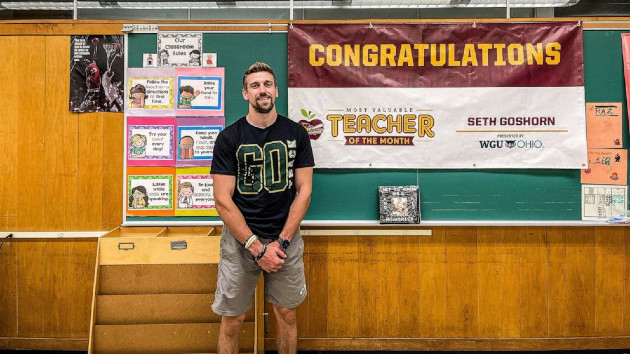
(NEW YORK) — A former teacher in northeast Ohio is opening up about why he walked away from years of teaching to go work at Walmart.
Seth Goshorn decided to share his personal story through TikTok, posting a short clip of him holding up and displaying Walmart’s signature blue uniform in the same way athletes hold up their team jersey on draft day.
The 28-year-old’s post, just 6 seconds long with a caption that read “Leaving teaching after 6 years to go be a manager at Walmart and make more not using my degree,” quickly went viral. It has now been viewed more than 810,000 times in the last week.
Goshorn told ABC News’ Good Morning America he left education after careful consideration and doing his research, tapping his family members who also work at the retailer for their input. In the end, he said he made the switch, even though he “absolutely” loved teaching, for more growth and a higher salary, especially since he hopes to start a family with his fiancée in the near future.
“My biggest thing was the opportunity,” he said. “You don’t have to go and get another degree or more initials or letters in front of your name to move up.”
“The compensation,” he added. “It was a lot better than I think people are used to and what people would expect.”
As a stocking 2 coach at a Walmart store in Massillon, Ohio, Goshorn said he makes about $55,000 a year before bonuses, a figure Walmart corroborated to GMA.
It was an upward move for him after working for five-and-a-half years in education, first as a reading tutor in a lower-paying school district and then as a second-grade teacher in a district he described as a “middle [to] upper” paying district. He said when he was teaching with Plain Local Schools in Ohio’s Stark County last year, he was earning $43,000 a year. The district confirmed to GMA that their elementary teacher salaries range from $43,896 to $83,766.
Goshorn said he hoped to shine a light on how he felt hard-working teachers and his former colleagues are underappreciated, in the wake of a national teacher shortage and amid high burnout among educators since the COVID pandemic.
“There’s a misconception that we only work six or nine months out [of] a year,” he said, explaining that often, teachers spend many extra hours outside the classroom to draw up lesson plans, grade assignments and so forth.
“Think about how good our teachers can be if they could focus on just teaching and not have to work a second job on the weekends, or I know some that would work at Starbucks after their shifts,” he said, adding that he also coached two sports and worked summer school sessions while holding down his teaching position. “They chose to be a teacher because they’re passionate about it. They didn’t choose to have to work a second job that comes along with it. And that’s the thing that I would have loved to see go away.”
But although he’s giving up full-time teaching, for now, he said he plans on keeping and renewing his teaching license and doesn’t discourage others to pursue the same path he was once on.
“If that’s what you’re passionate about, absolutely,” Goshorn told GMA. “Just make sure going into it, figure out what the [return] is on your investment and make sure that it makes sense for you.”
“I absolutely don’t want this to be that I’m just trying to discourage anybody from becoming a teacher. That’s not the case. I just want my teacher friends to be paid as they should be,” he added.
(WASHINGTON) — Leading gun manufacturing executives testified Wednesday before a House panel investigating the role of the firearms industry in the nation’s high rates of gun violence, maintaining under sharp questioning from Democrats that American citizens — not firearms — cause mass shootings.
The hearing, helmed by House Oversight Committee Chairwoman Carolyn Maloney, a New York Democrat, featured two CEOs and other gun industry members ahead of the consideration of legislation that would restrict the sale of semiautomatic weapons, which are often used in large-scale killings.
Many gun rights supporters and Republicans oppose such a move as unconstitutional.
Over the span of nearly six hours, House Democrats probed the manufacturers on their marketing tactics to children and adults, with lawmakers asking if they would implement additional safety features on their firearms and seeking, the lawmakers said, to better understand the features of the military-style weapons.
“I hope the American people are paying attention today. It is clear that gun-makers are not going to change unless Congress forces them to finally put people over profits,” Maloney said.
Gun companies have seen revenues of more than $1 billion over the last 10 years, according to a new report from Democrats on the House Oversight Committee on the five major gun manufacturers’ sales and marketing of AR-15-style rifles.
The two CEOs who spoke Wednesday, Marty Daniel of Daniel Defense and Christopher Killoy of Sturm, Ruger & Company, Inc., both pushed back when asked if they felt they had responsibility for recent mass shootings, such as those in Uvalde, Texas; Highland Park, Illinois; and Buffalo, New York, among others, given that the weapons their companies make are often used in such massacres.
“I believe that these murders are a local problem that have to be solved locally,” Daniel said. “These acts are committed by murderers. The murderers are responsible.”
“I don’t consider what my company produces to be ‘weapons of war,'” Killoy said.
Some of the Uvalde and Buffalo victims’ relatives sat in the chamber during the hearing. The parents of 10-year-old Alexandria Rubio, one of the students slain in Uvalde, propped up their daughter’s photo in the room.
Republicans on the committee defended the manufacturers, agreeing that “criminals” are responsible mass shootings rather than guns or weapons manufacturers.
Some lawmakers, like South Carolina Rep. Nancy Mace, called the hearings “political theater.”
Rep. Jody Hice, a Georgia Republican, and Tennessee Republican James Comer, the committee’s ranking member, said the hearing was a part of a “disturbing trend in this committee of going after both private citizens and the constitutional rights of American citizens.”
“I want to know when are you, Chairwoman Maloney, going to apologize to the American citizens for not dealing with the real issues and showing responsibility and accountability?” Hice asked — trying to redirect the focus to what he said was a more important issue.
“When are we gonna have hearings in this committee, holding people responsible in cities, municipalities, states and right here in our own Congress, for being soft on crime? When are we going to have hearings to do away with the ridiculous, outrageous policies of defunding the police?” he said.
Daniel, of Daniel Defense, said that he was at the hearing voluntarily but was “concerned” that the implied purpose of the hearing was to vilify and blame rifles for recent deadly shootings.
Two months ago, the Uvalde gunman used a Daniel Defense weapon to kill 19 students and two teachers at an elementary school.
“Many Americans, myself included, have witnessed an erosion of personal responsibility in our country and in our culture. Mass shootings are all but unheard of just a few decades ago,” Daniel said. “So what changed? Not the firearms … I believe our nation’s response needs to focus not on the type of gun but on the type of persons who are likely to commit mass shootings.”
During his testimony, Daniel said he wanted to reduce violent crime. He said that the hearing focused on a weapon, the AK-15, that is responsible for less than 4% of homicides.
Killoy began his testimony by discussing his corporation’s safety practices, then defended the right to gun possession despite the push by some in Congress for further restrictions and reforms.
“We firmly believe it’s wrong to deprive citizens of their constitutional right because of the criminal acts of wicked people. The firearm, any firearm, can be used for good or evil,” Killoy said. “The differences in the intent of the individual possessing it, which we respectfully submit can be the focus of any investigation into the root causes of criminal violence involving firearms.”
Rep. Ro Khanna, D-Calif., asked Killoy if he would track crimes committed with his company’s firearms as part of a new human rights assessment.
“Congressman, respectfully, that’s not our job. We’re not law enforcement. We don’t have the resources or capability to track injuries or fatalities.” Killoy said.
Ryan Busse, a senior adviser at the Giffords Law Center and a former gun-industry professional, testified that he had seen the industry evolve over time, becoming more emboldened in their marketing and sales of weapons.
“Sadly for me, there is no place in the industry for anyone who believes in moderation or responsible regulation,” he said.
When questioned on how exactly an AR-15 differs from other guns, Busse said AR-15s were “designed to be an offensive weapon of war for troops in battle, to charge into places like buildings and battlefields to take as many lives as possible as fast as they possibly can.”
Maloney spoke with ABC News on Tuesday about the context of the hearing. She said it should be a “wakeup call” for Congress to act on gun reform “to hold these gun manufacturers accountable for the deadly weapons that they’re manufacturing that are killing innocent Americans.”
“Most industries have a responsibility for their products. We have liability on our cars. Every time there’s a car wreck, we study it. We should do the same thing with guns. We should have liability on guns. They’re far more dangerous than cars,” Maloney told “GMA3.”
Maloney told ABC News that a representative for a third gun manufacturer, President Mark P. Smith of Smith & Wesson Brands, Inc., was invited to the hearing, but did not attend. Smith’s company made the weapons used by the shooters in Highland Park and in Parkland, Florida, among others.
“I would say, ‘We have invited three manufacturers — CEOs — [and] two have accepted,'” Maloney said.
“One is dodging us and not responding to our requests for documents,” she contended. “And we intend to hold them accountable eventually in some form.”
Maloney opened the hearing Wednesday by announcing her intent to issue a subpoena for documents from Smith & Wesson “so that we can finally get answers about why this company is selling assault weapons to mass murderers, answers we were hoping to get at today’s hearing.”
The company did not respond to ABC News’ request for comment.
The oversight committee previously sent letters to Smith & Wesson, Daniel Defense and Sturm, Ruger & Company, Inc., among others, on May 26, following the mass shootings in Buffalo and Uvalde.
The letters sought further information on the companies’ sale and marketing of AR-15-style semiautomatic rifles and similar firearms, “including revenue and profit information, internal data on deaths or injuries caused by firearms they manufacture, and marketing and promotional materials.”
On July 7, following the Fourth of July shooting in Highland Park, Maloney sent additional letters to the CEOs of the three top gun manufacturers, requesting their appearance at Wednesday’s hearing.
Maloney’s request for the hearing with gun executives came ahead of the committee’s June 8 hearing with Uvalde and Buffalo survivors and victims’ relatives.
President Joe Biden a month ago signed into law a bipartisan gun safety package, which did not include the weapons ban he sought. House Democrats are pushing for more reforms.
Maloney told ABC News that she believed the additional legislation “will make America safer for our citizens.”
At the hearing, Rep. Alexandria Ocasio Cortez, D-N.Y., pressed the gun manufacturers on several advertisements tied to their weapons with what appear to be acknowledgment of white supremacist groups. She asked both Daniel Defense and Sturm, Ruger & Company if they would condemn the practice of marketing to far-right extremist groups.
Both CEOs said they were unaware of her specific instances, but “we do not tolerate racism or white supremacy,” Killoy said.
Busse, the former industry professional, said he would push back on the idea that gun laws don’t work — citing Uvalde and Buffalo, both cases in which the shooters waited until they were 18 years old to lawfully purchase their guns.
In the wake of those killings, Democrats renewed calls to raise the minimum age to buy assault-style weapons.
“The fact is that the laws impact the way people purchase and use guns and we need to as a responsible society and you as a governing body need to take that into account,” Busse said.
In closing remarks, Comer, the ranking Republican, thanked the manufacturers for continuing to do business in the U.S. and he called for better security at our schools, mental health support and police funding.
Maloney, in her remarks, apologized to the families of gun violence victims.
ABC News’ Lalee Ibssa and Benjamin Siegel contributed to this report.
(WASHINGTON) — The Federal Reserve significantly raised its benchmark interest rate on Wednesday, the latest in a series of hikes meant to tackle sky-high price increases last seen more than four decades ago.
But rate hikes at the Fed risk widespread financial pain. An increase to the benchmark interest rate raises borrowing costs for consumers and businesses, which in theory should slash inflation by slowing the economy and eating away at demand.
That means borrowers will face higher costs for everything from car loans to credit card debt to mortgages. More alarmingly, the approach risks tipping the economy into a recession.
These significant risks, however, come along with potential financial benefits, experts told ABC News. First, the hike in borrowing costs directly benefits savers, who stand to gain from an uptick in the interest yielded by accounts held at banks, they said.
Plus, the effort to bring down inflation holds financial promise, since lower prices would relieve economic hardship and enhance spending power, especially for low- and middle-income households, they added.
“When interest rates rise and money becomes more scarce, people can receive payments for the money they keep on hand at a bank,” James Cox, a financial advisor and managing partner of Virginia-based Harris Financial Group, told ABC News.
“Many Americans will like to have interest on their savings for the first time in many years,” he added.
The series of rate hikes so far this year has spurred an increase in interest rates for savings accounts at banks, Greg McBride, the chief financial analyst at the research firm Bankrate, told ABC News. The top-yielding savings accounts at the beginning of the year maxed out at 0.55% — now they stand above 2%, he said.
“They’re still climbing,” he added. “Another big rate hike from the Fed this week — that only sustains the upward momentum.”
Online banks and small banks, especially, have raised interest rates on savings accounts as they try to win over customers, McBride said. He contrasted those banks with the larger brick-and-mortar players, which feel less pressure to raise interest rates in this environment because of their strong market position.
“Online banks are among the most competitive out there,” he said. “That’s where we see banks leapfrogging each other as they continually raise their payouts.”
To be sure, the interest rates on savings accounts that hover around 2% still fall far short of the inflation rate, which as of June stood at 9.1%. That means that the increasingly strong returns on savings accounts continue to be heavily devalued by skyrocketing price increases, the experts said.
In theory, however, as interest rates rise, inflation should come down and savings accounts should yield better returns, improving their prospects as a financial option, they added.
“Much of the benefit is illusory at a time when inflation is running north of 9%,” McBride said. “But savings accounts are on the rise.”
U.S. adults on average hold $62,000 in personal savings, according to a study released by Northwestern Mutual in May. The savings grant many individuals a sizable cushion and potential for taking advantage of rising interest rates on savings accounts.
But high prices have already taken a toll on savings. The average savings have fallen 15% since last year, when they stood at $73,000, Northwestern Mutual found.
In addition to prompting higher yields on savings accounts, Fed rate hikes should eventually deliver lower prices, which will improve the financial outlook of Americans straining under the weight of high costs, the experts said.
In the meantime, rate hikes could cause substantial financial harm, they added. As the central bank slows down the economy and chokes demand, it could bring layoffs that put millions of people out of work and force households to draw down whatever savings they had set aside.
While rate hikes at the Fed address the upward pressure that consumer and business demand places on prices, the hikes do not affect the supply shortages behind some of the cost increases, which owe to COVID disruptions and the Russia-Ukraine war. This dynamic could limit the effect of rate hikes and prolong the downturn.
Highlighting the limitations of rate hikes, Sen. Elizabeth Warren (D-MA) in a Wall Street Journal op-ed on Sunday called them “largely ineffective against many of the underlying causes of this inflationary spike.”
But the risk of entrenched inflation outweighs the costs of short-term financial pain, said Cox, the managing partner of Harris Financial Group.
“It’s either raise rate hikes very fast to bring down the rate of inflation, or inflation becomes anchored in the economy and all of your personal savings get eaten away by it,” he said.
“Unfortunately, it’s not without pain,” he added. “But it’s far less painful to take your medicine upfront than to let the disease take hold.”
(NEW YORK) — Instagram CEO Adam Mosseri doubled down on recent changes to the app Tuesday, despite backlash from scores of users, including Kylie Jenner and Kim Kardashian – two of Instagram’s most prominent users.
In a video posted to social media Tuesday morning, Mosseri said the company is “experimenting with a lot of different changes to the app, and so we’re hearing a lot of complaints from all of you.”
On Monday, Jenner, who has 361 million Instagram followers, and Kardashian, with 326 million Instagram followers, shared a post from photographer “@Illumitati” urging the platform to stop “trying to be tiktok,” and to “Make Instagram Instagram Again.”
“History shows that when a Kardashian or a Jenner talks about your platform, you should probably listen,” Jack Appleby, author of Morning Brew’s “Future Social” newsletter, told ABC Audio.
The complaints come as the company – launched in 2010 as primarily a photo-sharing app – continues to push new types of posts to the app’s main feed, including Reels videos from recommended creators. Reels, introduced in 2020, mimics TikTok’s app, presenting users with a vertical scrolling feed of videos. Appleby said Reels are often from accounts recommended by Instagram – not from accounts users themselves follow – and this changes the app’s “value proposition.”
“It was a friend-to-friend network. Now it is a – I am seeing content from people I did not elect to follow, and that effects how users view the platform,” he said.
Instagram may have good reason to worry about what the stars of “Keeping Up With The Kardashians” have to say. In 2018, Kylie Jenner tweeted that she was no longer using Snapchat — sending shares of the app plunging 7% and erasing over $1 billion of value, Bloomberg reported at the time.
Instagram’s parent company, Meta, which also owns Facebook and WhatsApp, is set to report quarterly earnings on Wednesday after the closing bell.
Despite the backlash, Mosseri said his company remains committed to video content.
“I got to be honest, I do believe that more and more of Instagram is going to become video over time,” Mosseri said in the video.
“If you look at what people share on Instagram, that’s shifting more and more to video over time. If you look at what people like and consume and view on Instagram, that’s also shifting more and more to video over time – even when we stop changing anything. So we’re going to have to lean into that shift.”
“The reality is that Instagram is going to be able to make more money based on more video content than static or photo content,” said Appleby. “It’s really that simple.”
Whether that explanation will be enough to change Instagrammers’ feelings about the new features remains to be seen.
“I just want to see cute pictures of my friends,” the original post shared by Jenner and Kardashian goes on to read. “Sincerely, everyone.”