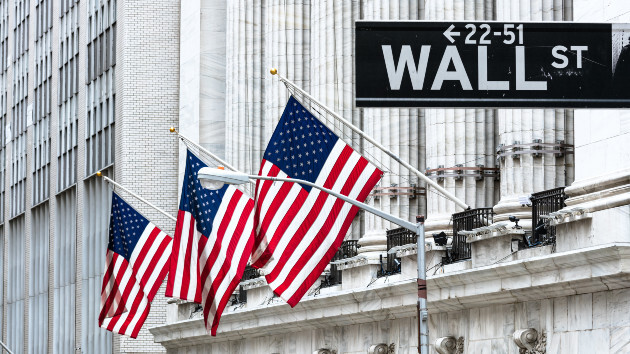
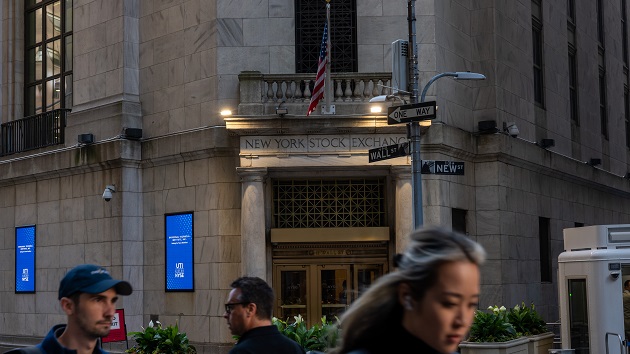
(NEW YORK) — Stocks closed higher on Thursday after a panel of federal judges blocked President Donald Trump from slapping some of his far-reaching tariffs on China and other major U.S. trading partners.
A federal appeals court moved to temporarily reinstate the tariffs on Thursday afternoon, however, leaving the ultimate fate of the policy uncertain.
The Dow Jones Industrial Average closed up 117 points, or 0.2%, while the S&P 500 increased 0.4%. The tech-heavy Nasdaq climbed 0.3%
The ruling from the U.S. Court of International Trade late Wednesday marked a major blow for Trump’s tariff policy, invalidating levies on dozens of countries unveiled in a Rose Garden ceremony that Trump had dubbed “Liberation Day.”
Less than a day later, an appeals court opted to revive the policy on administrative grounds, affording the judges additional time to weigh the case.
A set of tariffs focused on Mexico and Canada over their alleged role in the fentanyl trade would also fall victim to the U.S. Court of International Trade’s ruling, if it ends up being upheld. The decision would also invalidate a 10% tariff imposed on goods from nearly all countries.
The Trump administration appealed the ruling within minutes on Wednesday night.
The ruling centered on Trump’s unprecedented invocation of the International Economic Emergency Powers Act as a legal justification for tariffs.
The 1977 law allows the president to stop all transactions with a foreign adversary that poses a threat, including the use of tools like sanctions and trade embargoes. But the measure does not explicitly permit tariffs, putting Trump in untested legal territory.
The ruling Wednesday afforded the Trump administration as many as 10 days to halt the tariffs.
Even before the court’s decision, Trump had rolled back some of the levies at issue.
A trade agreement between the U.S. and China earlier this month slashed tit-for-tat tariffs between the world’s two largest economies and triggered a surge in the stock market. Within days, Wall Street firms softened their forecasts of a recession.
The U.S.-China accord came weeks after the White House paused the reciprocal tariffs. Trump eased duties on some goods from Mexico and Canada.
The ruling did not impact sector-specific tariffs used under separate legal statutes, including levies targeting autos, steel and aluminum.
(NEW YORK) — Stocks were mixed on Thursday after a panel of federal judges blocked President Donald Trump from slapping some of his far-reaching tariffs on China and other major U.S. trading partners.
The Dow Jones Industrial Average fell 25 points, or 0.06%, while the S&P 500 increased 0.3%. The tech-heavy Nasdaq climbed 0.6%
The ruling from the U.S. Court of International Trade late Wednesday marked a major blow for Trump’s tariff policy, invalidating levies on dozens of countries unveiled in a Rose Garden ceremony that Trump had dubbed “Liberation Day.”
Trump later paused those so-called “reciprocal tariffs” for 90 days, embarking on trade negotiations with the target nations that remain ongoing.
A separate set of tariffs focused on Mexico and Canada over their alleged role in the fentanyl trade fell victim to the court’s decision. The ruling also invalidated a 10% tariff imposed on goods from nearly all countries.
The Trump administration appealed the ruling within minutes, leaving the ultimate fate of the tariffs unclear.
The ruling centered on Trump’s unprecedented invocation of the International Economic Emergency Powers Act as a legal justification for tariffs.
The 1977 law allows the president to stop all transactions with a foreign adversary that poses a threat, including the use of tools like sanctions and trade embargoes. But the measure does not explicitly permit tariffs, putting Trump in untested legal territory.
The ruling afforded the Trump administration as many as 10 days to halt the tariffs.
Even before the court’s decision, Trump had rolled back some of the levies at issue.
A trade agreement between the U.S. and China earlier this month slashed tit-for-tat tariffs between the world’s two largest economies and triggered a surge in the stock market. Within days, Wall Street firms softened their forecasts of a recession.
The U.S.-China accord came weeks after the White House paused the reciprocal tariffs. Trump eased duties on some goods from Mexico and Canada.
The ruling did not impact sector-specific tariffs used under separate legal statutes, including levies targeting autos, steel and aluminum.
(NEW YORK) — Stocks surged at the open of trading on Thursday after a panel of federal judges blocked President Donald Trump from slapping some of his far-reaching tariffs on China and other major U.S. trading partners.
The Dow Jones Industrial Average jumped 55 points, or 0.1%, while the S&P 500 increased 0.8%. The tech-heavy Nasdaq climbed 1.4%
The ruling from the U.S. Court of International Trade late Wednesday marked a major blow for Trump’s tariff policy, invalidating levies on dozens of countries unveiled in a Rose Garden ceremony that Trump had dubbed “Liberation Day.”
Trump later paused those so-called “reciprocal tariffs” for 90 days, embarking on trade negotiations with the target nations that remain ongoing.
A separate set of tariffs focused on Mexico and Canada over their alleged role in the fentanyl trade also fell victim to the court’s ruling.
The Trump administration appealed the ruling within minutes, leaving the ultimate fate of the tariffs unclear.
The ruling centered on Trump’s unprecedented invocation of the International Economic Emergency Powers Act as a legal justification for tariffs.
The 1977 law allows the president to stop all transactions with a foreign adversary that poses a threat, including the use of tools like sanctions and trade embargoes. But the measure does not explicitly permit tariffs, putting Trump in untested legal territory.
The ruling afforded the Trump administration as many as 10 days to halt the tariffs.
Even before the court’s decision, Trump had rolled back some of the levies at issue.
A trade agreement between the U.S. and China earlier this month slashed tit-for-tat tariffs between the world’s two largest economies and triggered a surge in the stock market. Within days, Wall Street firms softened their forecasts of a recession.
The U.S.-China accord came weeks after the White House paused the reciprocal tariffs. Trump eased duties on some goods from Mexico and Canada.
The ruling did not impact sector-specific tariffs used under separate legal statutes, including levies targeting autos, steel and aluminum.
(NEW YORK) — Macy’s slashed its full-year profit forecast on Wednesday, attributing the downbeat expectations in part to tariffs imposed by President Donald Trump.
The New York-based retail chain is the latest major company to warn of ill effects from the levies, including Target, Walmart and Nike.
Macy’s downgraded its expectations for adjusted earnings per share from a range of $2.05 to $2.25, instead saying the metric is likely to register between $1.60 to $2.00.
In addition to tariffs, Macy’s faulted flagging consumer spending and heightened competition.
The earnings release arrives more than a year after the company embarked on a three-year plan to improve its balance sheet by closing its low-performing stores and optimizing its e-commerce service.
The nationwide retailer said last year that it plans to close about 150 stores by 2027.
Macy’s brought in $4.6 billion in revenue over a recent three-month period, exceeding the company’s expectations, according to the earnings release.
“We continued to execute against our Bold New Chapter strategy during the quarter, scaling key initiatives that improved our customer experience and contributed to stronger than expected performance across all three of our nameplates,” CEO Tony Spring said in a statement on Wednesday.
The tariff escalation in recent weeks poses a challenge for Macy’s, however.
Trump earlier this month slapped 30% tariffs on China, a key source of apparel imports for the retail chain. The levies mark a deescalation from a previous 145% levy on China, but the tariffs remain well above levels prior to Trump’s second term.
Roughly 20% of Macy’s merchandise originates in China, Spring told CNBC.
The tariffs helped propel a monthslong stretch of souring consumer sentiment, which also threatens the bottom line of sellers like Macy’s.
However, a Conference Board survey released on Tuesday showed a brightening of consumer attitudes in May, suggesting that consumer appetites had rebounded as Trump rolled back some tariffs.
(NEW YORK) — The GENIUS Act, a cryptocurrency regulation bill making its way through the Senate, has thrust a little-known type of digital asset into the spotlight.
The industry-backed measure establishes rules targeting stablecoins, a form of cryptocurrency pegged to the value of another asset, often the U.S. dollar.
If enacted, the bill could allow such crypto coins to become a mainstream tool for digital payments and investments, proponents say. Critics warn that wider adoption of stablecoins may endanger consumers and the broader economy.
Here’s what to know about crypto coins and how they could impact your finances:
What are stablecoins?
Stablecoins are a type of digital currency backed by another form of currency, like the U.S. dollar or a commodity like gold.
Typically, the issuer of a stablecoin holds at least one unit of reserve currency for every stablecoin. A stablecoin pegged to the U.S. dollar, for instance, is backed by a reserve of dollars that matches the number of coins.
Stablecoins are designed to be less volatile than other forms of cryptocurrency, which experience large price swings in part because digital assets lack inherent value.
Cryptocurrencies – including popular coins like bitcoin and ether – can be highly sensitive to news developments or investor behavior. In turn, such digital currencies pose difficulty for individuals trying to conduct a purchase or sale using digital assets.
“Most crypto assets have nothing behind them – they’re literally annotations on a database or spreadsheet,” Hilary Allen, a law professor at American University who examines stablecoin policy, told ABC News. “Stablecoins have reserve assets linked to the annotations in the database.”
As their name suggests, stablecoins “evolved as a way of keeping a more stable price for crypto assets,” Allen said.
What do stablecoins mean for your finances?
For now, stablecoins function primarily as a tool for crypto investors, but wider adoption could pave the way for their use as a form of digital payment in everyday purchases, some experts said.
Stablecoins offer crypto investors a place to store their profits without converting the gains into fiat currency.
Once a crypto trader finds a new digital asset deemed worthy of investment, the stablecoins can be used to acquire that target cryptocurrency. When the trader wants out of the new investment, he or she can cash out for more stablecoins.
In other words, Allen said, stablecoins amount to a “cash-management tool.”
Some stablecoins offer annual yields for investors, meaning the digital assets also function as liquid assets with stable upside akin to money-market mutual funds, some experts said.
In theory, both dollar-pegged stablecoins and money-market funds can be exchanged for a dollar at any time. That flexibility allows asset holders to earn small gains while retaining the capacity to sell off the asset at any time.
A potential integration of stablecoins into conventional finance could allow them to be used in a manner similar to app- or debit card-based payments, some experts said.
“You wouldn’t need to physically transfer bills,” said Steven Schwarz, a law professor at Duke University who studies stablecoins, who noted the crypto coins could have particular value for cross-border transactions.
“The holy grail would be to find a so-called ‘global stablecoin’ – one that everyone will accept internationally,” Schwarz said.
What are the risks posed by stablecoins?
Critics warn that stablecoins enable illicit transactions, lack consumer safeguards, and pose a threat to the wider financial system.
The fundamental consumer risk in holding a stablecoin stems from the possibility that an issuer will squander the reserve assets used to back the crypto tokens, some experts said.
“The risk is that you may go to the issuer of the stablecoin and say, ‘Please redeem my stablecoin for the underlying reference assets,'” Schwarz said. “And the issuer may be unable to redeem the stablecoin.”
“The issuer may be in bankruptcy or failed to provide the assets in the first place,” Schwarz added.
Wider adoption of stablecoins may coincide with participation by non-bank firms, which may result in assets that lack the protection of federal deposit insurance and the anti-fraud stipulations allowing users to redeem funds spent wrongfully or mistakenly, some experts said.
On a broad scale, such risky practices could pose a risk to the financial system, since asset holders could demand repayment from issuers unable to cover the reimbursements.
Such a scenario could trigger a government bailout or other public policy solution at the expense of taxpayers, Arthur Wilmarth, a law professor at George Washington University, told ABC News.
“These issuers could be in trouble during a crisis,” Wilmarth said. “It may require a massive bailout.”
Stablecoins, meanwhile, account for about 3 of every 5 illicit cryptocurrency transactions, blockchain data firm Chainalysis found in January.
“They’re used for money laundering and sanctions evasion – that type of thing,” Allen said.
Some critics say the risks posed by stablecoins are exemplified by conflict-of-interest concerns raised by President Donald Trump’s dealings in the crypto tokens.
In March, Trump-backed crypto firm World Liberty Financial issued a stablecoin USD1. An Abu Dhabi-based investment firm earlier this month used the stablecoin to make a $2 billion investment in crypto exchange Binance, putting Trump’s company in a position to profit from the deal. Trump has denied any wrongdoing.
(NEW YORK) — Consumer confidence improved more than expected in May, ending a monthslong stretch of worsening consumer attitudes as President Donald Trump’s tariffs set off company warnings about price increases even after the president eased his policy.
The reading of brightened consumer sentiment snapped five consecutive months of decline, which had brought the Conference Board gauge to its lowest level since the COVID-19 pandemic.
The rebound in consumer confidence took hold across all age and income demographics, the Conference Board said.
A trade agreement between the U.S. and China earlier this month slashed tit-for-tat tariffs between the world’s two largest economies and triggered a surge in the stock market. Within days, Wall Street firms softened their forecasts of a recession.
The U.S.-China accord marked the latest softening of Trump’s levies, coming weeks after the White House paused far-reaching “reciprocal tariffs” on dozens of countries. Trump also eased sector-specific tariffs targeting autos, and rolled back duties on some goods from Mexico and Canada.
An array of tariffs remain in place, however, including an across-the-board 10% levy that applies to imports from nearly all countries. Additional tariffs have hit auto parts, as well as steel and aluminum.
Consumers face the highest overall average effective tariff rate since 1934, the Yale Budget Lab found this month.
A growing set of major retailers have warned of possible tariff-driven price hikes, including Nike, Target, Walmart and Best Buy.
Walmart CEO Doug McMillan last week said tariffs risk prices increases for a wide range of goods that includes food, toys and electronics.
“The merchandise that we import comes from all over the world,” McMillon said. “All of the tariffs create cost pressure for us.”
Consumer spending, which accounts for about two-thirds of U.S. economic activity, could weaken if shopper sentiment sours. In theory, a slowdown of spending could hammer some businesses, prompting layoffs that in turn further shrink consumer appetite.
Despite ongoing market swings, key measures of the economy remain fairly strong.
The unemployment rate stands at a historically low level and job growth remains robust, though it has slowed from previous highs. In recent months, inflation has cooled, reaching its lowest level since 2021.
Buying a Tesla has become a bit more complicated in the past year.
The company’s Model Y and Model 3 continue to be the best-selling electric vehicles in the U.S., accounting for more than 40% of all EVs sold last year, according to Cox Automotive data. But Tesla’s stronghold on the EV market is slipping.
The U.S. electric automaker has seen its popularity dip in recent months, with insiders attributing the decline to more competition and Elon Musk’s political views.
Reports of Tesla owners selling their vehicles, violent demonstrations at Tesla showrooms and anti-Musk rallies across the globe have convinced some consumers to search for an alternative. The good news is that legacy automakers and electric startups are quickly answering that demand, unveiling new models that offer performance, styling and impressive range.
If you’re searching for an EV, here are some suggestions that could meet your driving needs.
Model 3
Jason Cammisa, host of Hagerty’s “ICON” series, said motorists have “legitimate” concerns about Tesla: “Buying one is making a political statement,” he told ABC News. But the Model 3 is also “the best consumer product in the world,” he argued.
“It’s the best car in the world, period, full stop, not up for discussion,” he said. “You won’t find a better car on planet earth, not at that price and combination of attributes.”
He added, “The thing about Tesla is that is spans so many different price points and socioeconomic situations … you have value shoppers looking at Model 3s as well as billionaires.”
Cammisa, however, has plenty of praise for several Model 3 competitors, including the Hyundai Ioniq 5 ($42,400), the Kia EV6 ($42,900) and Genesis GV60 ($52,350).
“The Hyundai products tend to hit all the marks well — the packaging is good and the UX (user experience) works well enough,” he noted. “The Ioniq 5 N is the enthusiast choice — it has drift modes and you get Lamborghini levels of performance in that car.”
Cammisa said he reviews and ranks EVs on factors that may not have been top priorities for motorists in the past.
“The biggest differentiators in the market now are not things like powertrains and suspension tuning. The consumer experience is the real differentiator now,” he said.
Patrick George, editor-in-chief of InsideEVs, said he’s heard from many Tesla owners who are ready “to move on” from their cars.
“They’re done with Tesla because of Elon,” he told ABC News. “Getting rid of Teslas are a real thing.”
He and his staff have compiled a list of non-Teslas to chose from, which includes the EV6 and Ford Mustang Mach-E.
George noted that the BMW i4 and i5 were superb replacements: “I was massively impressed with how those drive,” he said.
Model Y
Jared Rosenholtz, editor at large for CarBuzz, has two favorite Model Y replacements: the Chevy Equinox ($33,600) and Porsche Macan Electric ($77,295).
“The Equinox EV is a fantastic little vehicle with a nice interior and more than 300 miles of range,” he told ABC News. “With incentives, the price will come in under $30,000.”
The pricier Macan EV “drives just as well as the gas version,” according to Rosenholtz, who is also a fan of the Audi Q6 e-tron ($63,800), which is similar in size and power.
Camissa, too, was impressed with the Macan, saying it had “the best stereo I ever heard in a car.”
“The Macan EV is the total package,” he said.
Rosenholtz also recommended the new Volvo EX30 ($46,195), a smallish yet mighty crossover that packs 422 hp and sprints from 0-60 mph in 3.4 seconds.
“The EX30 is super adorable and the quickest Volvo ever made,” he said.
Model S
Cammisa, Rosenholtz and George all agreed that the Lucid Air, a handsome electric sedan that can travel at least 420 miles on a single charge, was without question a top competitor to the S, or any sedan on the market.
“It has unbelievably fast charging and drives amazing,” said Rosenholtz. “And you can get a Lucid for $10,000 less than the cheapest Model S.”
The Air, which is available in four trims, has a starting price of $69,900. Owners can “fill up” their Air with 200 miles of charge in about 12 minutes if they opt for the Wunderbox battery charger, according to the company.
Cammisa raved about the Air Sapphire ($250,000), which is priced like a Bentley and performs like a supercar: 0-60 mph in 1.89 seconds.
“It’s the best-handling sedan ever made in the history of the world,” he said. “The Lucid Gravity is even better — if you want a minivan looking SUV. Dynamically that thing is unbelievable and the packaging is unbelievable. I send people to Lucids all the time.”
In addition to the Lucid Air, George listed the Porsche Taycan ($100,300) and Hyundai Ioniq 6 ($37,850) as two great options, depending on one’s budget.
“The Ioniq 6 is outstanding on range,” he pointed out. “The Taycan is the OG Model S competitor — it’s more like a sports car with really fast charging.”
Model X
Americans love their big, three-row SUVs and plenty of Model X challengers have hit the market in recent months. George said Tesla owners are increasingly turning to startup Rivian, which makes the fashionable R1S ute ($75,900).
“We’ve seen a lot of Model X owners move to Rivian. It’s the closest to Tesla in so many areas — software updates, range and performance,” George said. “Everyone who has gotten a Rivian has so far adored it. It’s one of my favorite trucks.”
Added Cammisa: “The R1S is the EV that Range Rover owners want.”
Cammisa still prefers the Lucid Gravity ($79,900), which is available to order now on the Lucid site.
“It does have the proportions of a minivan but the engineers have crafted the perfect commuter vehicle,” he said. “This thing has everything you need but the question will be: is this what people want?”
George also pointed to the Polestar 3 ($67,500), a sleek and haute SUV that can be configured in all-wheel drive or rear-wheel drive. The 3’s long range dual motor model makes 489 horsepower and 620 lb.-ft. of torque and its dual chamber active air suspension improves the handling and ride quality by adapting to sensor input 500 times a second.
“The Polestar 3 is very Tesla-esque,” said George. “It’s got great tech, outstanding performance and great styling.”
Honda’s Prologue ($47,400), the company’s first electric SUV, has already been a hit with consumers since it launched last year. The interior is spacious, the optional panoramic roof adds brightness to the cabin and designers included high-quality materials and large buttons and knobs. Honda has partnered with General Motors on battery development and technology, so there are many similarities with the Chevy Blazer EV.
“The Prologue is a great gateway to EVs,” said George, who noted how “normal” the Prologue drove compared to more aggressive regenerative braking systems. Plus, “it has buttons if you don’t want a car that’s all screens and minimalist.”
(WASHINGTON) — President Donald Trump has disrupted global trade and roiled markets in an effort to bring manufacturing jobs back to the U.S. Some of his top tech allies, however, have backed ventures that replace human workers with robots.
Elon Musk, a top donor and adviser to Trump, has touted humanoid robots as a future growth area for electric-carmaker Tesla. “You can produce any product,” Musk said of the robots’ potential capacity during a February interview with Dubai’s World Governments Summit.
Amazon founder Jeff Bezos, who Trump last month called “terrific,” has invested in several advanced robotics firms.
Bezos last year poured funds into Figure, a humanoid robot company that says its initial rollout will focus on manufacturers and warehouses, among other business applications. “We believe humanoids will revolutionize a variety of industries,” the company says on its website.
Nvidia CEO Jensen Huang and OpenAI CEO Sam Altman – both of whom joined Trump on his recent trip to the Middle East – helmed their respective companies as each invested in Figure. OpenAI ended its partnership with Figure last year.
“Trump is talking about bringing back the jobs, and he’s not understanding the tension between that goal and automation, which the tech bros have enthusiasm for,” Harry Holzer, a professor of public policy at Georgetown University and a former chief economist at the U.S. Department of Labor, told ABC News. “There’s a fundamental conflict between those goals.”
Musk did not immediately respond to ABC News’ request for comment made through Musk-owned firm SpaceX. Neither Bezos, Huang nor Altman responded to ABC News’ request.
Speaking at a conference in April, Huang said the onset of artificial intelligence would fuel “new types of factories,” which in turn would create jobs in construction and steelmaking, as well as in trades such as plumbing and electricity.
Even more, Huang said, AI is set to trigger a surge in productivity at companies that adopt the new technology, allowing them to add employees as the firms increase output and revenue.
“New jobs will be created, some jobs will be lost, every job will be changed,” Huang said. “Remember, it’s not AI that’s going to take your job. It’s not AI that’s going to destroy your company. It’s the company and the person who uses AI that’s going to take your job. And so that’s something to internalize.”
Even after a rollback of some levies, consumers face the highest overall average effective tariff rate since 1934, the Yale Budget Lab found earlier this month.
A key reason for the tariffs, White House officials say: Reshoring factories and rejuvenating employment in the manufacturing industry.
Commerce Secretary Howard Lutnick said this month in an interview with Fox News that Trump’s vision for ushering in a “golden age” for America involved enticing manufacturers to open factories and build in the United States.
“We’re going to have huge jobs in manufacturing. You’ve heard the president talk about trillions and trillions of factories being built in America,” he said in the interview on May 11.
In response to ABC News’ request for comment, White House Spokesperson Kush Desai said “the importance of President Trump’s push to reinvigorate American industry goes beyond creating good-paying jobs for everyday Americans.”
“Supply chain shocks of critical pharmaceuticals, medical equipment, and semiconductors during the COVID era prove that America cannot rely on foreign imports. The Trump administration remains committed to reshoring manufacturing that’s critical to our national and economic security with a multifaceted approach of tariffs, tax cuts, rapid deregulation, and domestic energy production,” Desai added.
The share of U.S. workers in manufacturing has plummeted for decades. Roughly 8% of U.S. workers currently hold positions in manufacturing, which marks a steep decline from about a quarter of all employees as recently as 1970.
Researchers attribute such decline to overlapping trends, including the offshoring of manufacturing to low-wage markets overseas and the adoption of labor-saving technology throughout the sector.
Long before current advances, automation significantly increased productivity in U.S. factories, meaning the same number of workers could produce many more goods, researchers at Ball State University found in 2015. As a result, they said, manufacturing employment stagnated for decades even as output climbed.
“Automation is something we’ve seen for a long time,” Philipp Kircher, a professor of industrial and labor relations at Cornell University, told ABC News.
Some of Trump’s tech allies have backed firms that seek to further automate manufacturing, touting a new wave of artificial-intelligence equipped robots as a replacement for some workers and salve for labor shortages.
Robotics outfit Vicarious boasts $250 million in investments from a set of backers that includes Bezos, Musk and Meta CEO Mark Zuckerberg – all of whom flanked Trump during his inauguration.
On a webpage displaying photos of robots for use in warehouse settings, Vicarious tells potential clients that the products can “reduce both your costs and person-hour needs.”
In 2022, Vicarious was acquired by Alphabet-backed robotics software firm Intrinsic. Alphabet CEO Sundar Pichai also sat alongside tech leaders at Trump’s inauguration.
Alphabet did not respond to ABC News’ request for comment. Meta declined to comment.
Yong Suk Lee, a professor of economics and technology at the University of Notre Dame, described the views on automation among Trump’s tech allies and some of his trade advisers as “opposed.”
The tech position, Lee said, would likely win out, even if some firms do open plants in the U.S.
“If you want to reshore, are you going to pay the same wages as Vietnam? Probably not,” Lee said. “Companies are faced with higher labor costs. In that case, they’ll probably automate.”
Discordant views among some tech leaders and White House officials surfaced in April, when Musk sharply criticized tariff-advocate Peter Navarro, Trump’s senior counselor for trade and manufacturing. Navarro, Musk said, is “truly a moron.”
In an interview with CNBC, Navarro responded, saying Musk “isn’t a car manufacturer — he’s a car assembler.”
To be sure, analysts said, automation in manufacturing would likely continue regardless of support from Trump’s tech allies, since producers are locked in a competition to lower costs and increase output. The precise outlook for manufacturing employment is unclear, they added, since additional technology may add jobs for those maintaining and optimizing the machinery.
“Whether it’s the companies that currently support the U.S. president or not, somebody would be doing this innovation, maybe slightly slower,” Kircher said.
Even at current employment levels, a labor shortage bedevils U.S. manufacturers. Roughly one of every five U.S. factories that failed to produce at full capacity cited a shortage of workers, Jason Miller, a professor of supply chain management at Michigan State University, found in a January study analyzing government data.
Agility Robots, an Amazon-backed firm building humanoid robots, identifies the current push for rejuvenated U.S. manufacturing as an opportunity for greater adoption of technology.
“Manufacturing companies are seeing a massive reshoring movement spanning various industries,” Agility Robots says on its website. “Adding a humanoid robot to your manufacturing facility is a great way to stay on the leading edge of automation.”
In response to ABC News’ request for comment, an Amazon spokesperson pointed to previous remarks about robotics made by a company executive.
“Our goal is to ensure these systems improve safety and productivity. Technology should be used to help us retain and grow our talent through skill development and reimagining how we make our workplace better, both in productivity and safety. If we do this well, we’re certain to always innovate for our customers,” Tye Brady, chief technologist at Amazon Robotics, said in a September blog post.
Amazon has “created more U.S. jobs in the last decade than any other company,” Amazon said this month.
(WASHINGTON) — Despite repeated claims from the White House that President Donald Trump’s Thursday night gala for the top holders of his cryptocurrency meme coin had nothing to do with his official duties, several of those investors visited the White House Friday afternoon for what they described as a special VIP event, the attendees told ABC News.
Sangrok Oh, a Korean crypto investor and entrepreneur, told ABC News on Friday that he and other top investors had been invited to tour the White House Friday afternoon, though it was not clear to him whether Trump himself would meet them.
“So, we’re going to visit and tour the White House [and] at the same time talk about crypto industries and the future of crypto,” Oh said.
Thursday night’s black tie event, held at Trump’s Washington-area golf club, was attended by around 200 cryptocurrency traders, including many from overseas, who gained admission through a contest that awarded invitations to the top investors in Trump’s meme coin — with at least some of the funds flowing directly into the Trump family’s coffers.
Critics have blasted the gala as a “pay for play” event in which investors who poured millions into Trump’s crypto coin got special access to the president.
News that top $TRUMP coin investors visited the White House appeared to contradict White House Press Secretary Karoline Leavitt’s assertion Thursday that the president was attending the crypto gala in a personal capacity, and that since the dinner did not take place at the White House, it was separate from his official duties.
“The president is attending [the dinner] in his personal time,” Leavitt said Thursday. “It is not a White House dinner. It’s not taking place here at the White House.”
The White House did not immediately respond on Friday to a request for comment from ABC News.
Cherry Hsu, an executive at MemeCore, a Singapore-based blockchain startup, said the firm’s founder, known publicly as “Ice,” had also been invited to the White House on Friday afternoon. MemeCore, according to the contest leaderboard, finished second in the competition with $TRUMP coin holdings in excess of $1 million.
And late Friday, Justin Sun, a Chinese crupto mogul and the top investor in Trump’s meme coin, posted a highly produced video of his White House tour, writing on X, “Was an honor to be invited to tour the @WhiteHouse. Such a privilege to see it in person.”
In addition to his multimillion-dollar investment in the $TRUMP coin, Sun has also invested $75 million in World Liberty Financial, another Trump-backed crypto venture. One month after that investment, SEC lawyers under the Trump administration moved to halt an alleged fraud case against Sun.
The Trump meme coin’s website at one point earlier this month advertised a “Special VIP White House tour” for the top 25 meme coin holders as part of the contest — but as of last week, the site said only that a “Special VIP tour” would be arranged, without mentioning the White House.
The site also included a disclaimer saying the tour was being arranged by the Fight Fight Fight LLC, and that the president himself would be appearing as a “guest.”
(NEW YORK) — Stocks tumbled in early trading on Friday after President Donald Trump threatened new tariffs targeting tech giant Apple and the European Union.
The Dow Jones Industrial Average dropped 458 points, or 1.1%, while the S&P 500 declined 1.2%. The tech-heavy Nasdaq dropped 1.6%.
Shares of Apple fell nearly 3% at the open of trading. European stocks also declined on Friday, as the STOXX Europe 600 index fell nearly 2%.
In a social media post, Trump urged Apple to manufacture iPhones in the U.S., criticizing the company for plans to shift some production to India in an effort to avoid tariffs slapped on China. If Apple fails to shift iPhone manufacturing to the U.S., Trump said, the company would face a 25% tariff.
Minutes later, Trump issued a social media post slamming the European Union over a trade posture that he described as “very difficult to deal with.” In response,Trump said he is “recommending” a 50% tariff on goods from the European Union to begin on June 1.
The market dip erased some gains made in recent weeks as Trump rolled back levies.
Trump last month exempted phones, computers and chips from so-called “reciprocal tariffs” imposed on China-made goods, which at that time amounted to a 125% levy. The move also excluded such products from a 10% across-the-board tariff imposed on nearly all imports.
Last week, Trump temporarily slashed the reciprocal tariffs on China from 125% to 10% as the U.S. and China hold trade negotiations. China still faces 20% tariffs over its role in the fentanyl trade, bringing total levies on Chinese goods to 30%.
The U.S.-China agreement marked the latest softening of Trump’s levies, coming weeks after the White House paused far-reaching “reciprocal tariffs” on dozens of countries. Trump also eased sector-specific tariffs targeting autos, and rolled back duties on some goods from Mexico and Canada.
An array of tariffs remain in place, however, including an across-the-board 10% levy that applies to imports from nearly all countries. Additional tariffs have hit auto parts, as well as steel and aluminum.
Consumers face the highest overall average effective tariff rate since 1934, the Yale Budget Lab found earlier this month.
A growing set of major retailers have warned of possible tariff-driven price hikes, including Nike, Target, Walmart and Best Buy.