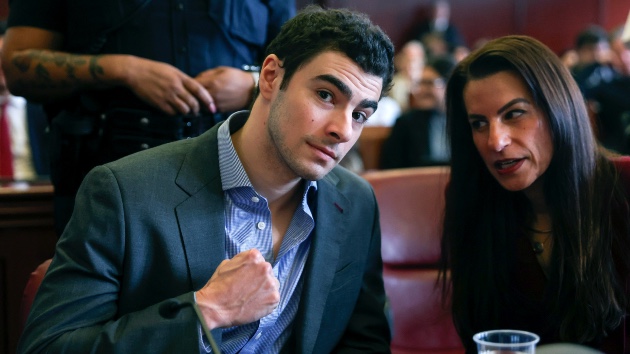
Luigi Mangione (L) appears with his lawyers for a suppression of evidence hearing in the killing of UnitedHealthcare CEO Brian Thompson in Manhattan Criminal Court on December 8, 2025 in New York City. (Photo by Sarah Yenesel – Pool/Getty Images)
(NEW YORK) — Luigi Mangione returns to court in New York City Thursday for a sixth day of a hearing to determine what evidence will, or will not, be used against him when he goes on trial on charges of gunning down UnitedHealthcare CEO Brian Thompson on a Manhattan sidewalk last December.
Prosecutors with the Manhattan district attorney’s office are expected to call supervisory police officers present at the Altoona, Pennsylvania, McDonald’s where Mangione was apprehended after customers thought they recognized the suspect wanted in New York due to his distinctive eyebrows.
The supervisors, a sergeant and two corporals, briefly were overheard on body camera footage debating whether officers needed a warrant to conduct more than a cursory search of Mangione’s backpack, from which police were seen on the footage retrieving the alleged murder weapon, writings, and a note that prosecutors said mentioned “escape routes”
Defense attorneys say the lack of a warrant made the search and seizure illegal, and they are seeking to preclude the contents of the bag.
They also argue officers were too late reading Mangione his Miranda rights and continued to pepper him with questions after he indicated he preferred to remain silent.
The officers have testified that they lawfully searched Mangione’s backpack pursuant to his arrest for showing them a fake ID, and said they were legitimately concerned Mangione may have had a weapon or explosive.
The officers also testified their questions to Mangione’s about his fake ID and whether his bag contained anything harmful were appropriate under the circumstances.
Prosecutors are expected to rest next week. Judge Gregory Carro is expected to issue a written decision about the evidence sometime in January.
David Ellison, chairman and chief executive officer of Paramount Skydance Corp., center, outside the New York Stock Exchange (NYSE) in New York, US, on Monday, Dec. 8, 2025. (Michael Nagle/Bloomberg via Getty Images)
(NEW YORK) — Paramount launched a hostile bid for Warner Bros. Discovery this week, just days after Netflix struck a deal to acquire the legacy media company.
The rival multi-billion dollar efforts to purchase streaming platform HBO Max and movie studio Warner Bros., among other assets, could upend the media industry and shape content viewed by hundreds of millions of people.
For now, the outcome remains highly uncertain. Any acquisition of Warner Bros. Discovery would likely be reviewed by the Trump administration, which could move to block a proposed merger over anti-monopoly concerns, according to antitrust experts from Vanderbilt University, the University of Tennessee and the Cardozo Law School.
The government approval process could take anywhere from several months to more than a year, the experts said.
The Department of Justice did not immediately respond to ABC News’ request for comment.
Here’s what to know about the government hurdles faced by a potential blockbuster deal to acquire Warner Bros:
What government hurdles await a bid from Netflix or Paramount?
Streaming giant Netflix appeared to win the bidding war for Warner Bros. Discovery last week, when the two firms announced a merger. Within days, however, Paramount launched a hostile bid for Warner Bros. Discovery, meaning Paramount plans to appeal to shareholders in an effort to overcome the wishes of management.
The $108 billion bid from Paramount encompasses the HBO Max streaming service, the Warner Bros. film production company and cable channels such as CNN. Netflix established its agreement with Warner Bros. Discovery at a lower price of $83 billion, though the Netflix offer excluded the cable channels.
Ultimately, the prevailing bid for Warner Bros. Discovery — whether from Paramount or Netflix — will likely face scrutiny from the Trump administration that could doom the proposal if agency officials consider the newly created company in violation of anti-monopoly law, experts said.
An antitrust review of the merger would draw on a standard established in the Clayton Antitrust Act of 1914, some experts said. The law prohibits mergers in which “the effect of such acquisition may be substantially to lessen competition, or to tend to create a monopoly.”
As part of its assessment, Trump officials would examine the market share of the newly created company, especially with regard to whether it could result in higher prices for consumers or reduced fees for creators selling content to media companies, Maurice Stucke, a law professor at the University of Tennessee, told ABC News.
An antitrust review could also focus on the potential impact on content distributors, such as movie theaters, Stucke noted.
“It’s not just a question of higher prices,” Stucke said. “It could be less content, less choice, less innovation and a decrease in quality — all of those could be a concern.”
If the Trump administration considers a potential merger illegal, a federal agency could seek a settlement under terms that would assuage government concerns.
Typically, the Federal Trade Commission or the Department of Justice (DOJ) are tasked with settlement negotiations or legal action tied to antitrust concerns.
In June, for instance, the DOJ announced a settlement agreement that permitted Hewlett Packard Enterprise’s (HPE) $14 billion purchase of Juniper Networks, a digital infrastructure firm. The settlement requires HPE to divest a part of its business and license Juniper Network’s critical software to competitors, the DOJ said.
If a settlement between the government and the firm cannot be reached, the Trump administration may move to sue the company in an effort to block the merger. A lawsuit would present a task for the Trump administration, Stucke said: “How do you prove this in court?”
The potential merger could also receive scrutiny from state-level regulators or the European Union.
How may regulators weigh a bid from Netflix or Paramount?
Proposals from Netflix or Paramount could each raise antitrust concerns, but for slightly different reasons, some experts said.
Netflix is the most popular streaming service, boasting 300 million subscribers worldwide as of late 2024, the most recent time for which data is available. The company accounts for 46% of mobile app monthly active users in global streaming, according to a CNBC analysis of data from intelligence firm Sensor Tower. After acquiring HBO Max, that share of app users would rise to 60%, CNBC said.
“Netflix has studios and a big chunk of streaming,” Sam Weinstein, a professor at the Cardozo School of Law who focuses on antitrust, told ABC News. “If you think that’s a market, they might have a big enough chunk that they can raise prices to impact streamers.”
“On the other hand, they’re a big buyer of projects. Creators might think, ‘Well now there’s one less studio to bid on my work,” he added.
Netflix may seek a broad definition of the market that includes consumers of online video, such as YouTube and short-form social media content, rather than merely traditional streaming, according to Weinstein.
“In that larger market, Netflix has a much smaller share,” Weinstein said.
Speaking to reporters on an earrings call on Friday, Netflix co-CEO Ted Sarandos voiced confidence about government approval of the merger.
“This deal is pro-consumer, pro-innovation, pro-worker, it’s pro-creator, it’s pro-growth,” Sarandos said, adding that the firm would “work really closely with all the appropriate governments and regulators.”
Paramount+ counts a smaller streaming audience than Netflix, recording about 79.1 million subscribers in September 2025, or less than a third of the audience of Netflix. The comparatively small market share for streaming could lessen concern among regulators about the potential to push up prices for consumers, some experts said.
Still, Paramount boasts a movie studio of its own, Paramount Pictures, presenting a risk of decreased competition for content production in the event of a potential merger, Rebecca Allensworth, a law professor at Vanderbilt University, told ABC News. In turn, TV shows or movies could command lower prices for creators, while actors or other workers could lose out on pay, she noted.
“At this moment, you can approach either Warner or Paramount as competitive studios,” Allensworth said. “This will take away one of those options.”
Speaking to CNBC on Monday, Paramount Skydance CEO David Ellison addressed antitrust concerns, saying the offer from Paramount compares favorably to the one from Netflix when considered through the lens of preserving a competitive industry.
“What we’re creating by putting these two companies together is a real competitor to Netflix, a real competitor to Amazon, a real competitor to Disney — not something that is so anti-competitive,” Ellison said.
Could the Trump administration take into account issues unrelated to competition?
The Trump administration may retain leeway to consider issues unrelated to competition, including potential agreements surrounding coverage at new outlets such as Warner Bros. Discovery-owned CNN, some experts said, noting the murky nature of antitrust law.
“A speeding violation or murder is fairly clear cut,” Stucke said. “With bringing an antitrust claim, there’s a lot of discretion.”
Trump, a frequent critic of major news outlets including CNN, told reporters on Sunday that he would “be involved” in the decision on a potential Warner Bros. Discovery merger. Trump’s willingness to take a direct role in deal evaluation departs from standard practice in which the president has sought to distance himself from antitrust reviews, Weinstein noted.
“The norm is that the White House wouldn’t get involved — that definitely isn’t happening here,” he said.
Speaking on the red carpet at the Kennedy Center honors on Sunday, Trump raised antitrust concerns about a potential Netflix acquisition, saying the deal “could be a problem” due to the market share of the new firm.
The circumstances afford the Trump administration leverage to extract potential concessions from a buyer like Netflix or Paramount, since in each case the purchase presents legitimate antitrust issues, granting Trump an opportunity to exercise robust oversight of the merger while seeking a favorable settlement, Allensworth said.
“Because antitrust law would likely find at least serious problems with the merger, Trump can make that all go away on terms that he agrees to,” Allensworth added.
Weinstein agreed, suggesting that their may be a court-enforceable agreement.
“It’s entirely possible you might have a consent decree with conditions that are non-competitive,” Weinstein said.
As part of a process seeking Federal Communications Commission approval for its $8 billion acquisition of Paramount earlier this year, Skydance agreed to a series of concessions that appeared to align with the views of the Trump administration, including agreements to forego implementation of diversity, equity or inclusion programs and appoint an ombudsman.
In a statement when the acquisition was approved in July, FCC Chairman Brendan Carr said the changes aimed to improve public trust in mainstream news outlets like CBS.
“Americans no longer trust the legacy national news media to report fully, accurately, and fairly. It is time for a change,” Carr said. “That is why I welcome Skydance’s commitment to make significant changes at the once storied CBS broadcast network.”
Experts underscored the uncertainty surrounding the outcome of a potential review of the Warner Bros. Discovery merger.
“If it’s a straight-up merger under antitrust guidelines, that’s one thing,” Weinstein said. “If you can win favor of the administration by making promises, that makes the deal unpredictable.”
Volodymyr Zelenskiy, Ukraine president, during a meeting at Downing Street in London, UK, on Monday, Dec. 8, 2025. (Tolga Akmen/EPA/Bloomberg via Getty Images)
(LONDON) — Russia’s Defense Ministry said its forces shot down at least 287 Ukrainian drones overnight into Thursday morning, soon after Ukrainian President Volodymyr Zelenskyy previewed more meetings with foreign partners regarding a possible peace deal.
Forty of the drones were shot down over the Moscow region, 32 of which the Defense Ministry said were “flying toward Moscow.”
Moscow Mayor Sergei Sobyanin said in posts to Telegram that emergency services had been dispatched to several sites where falling drone debris was reported.
A spokesperson for Rosaviatsiya, Russia’s federal air transport agency, said in posts to Telegram that temporary flight restrictions were introduced at all four of Moscow’s airports.
The latest exchanges came soon after Zelenskyy said his negotiating team was “finalizing work on the 20 points of a fundamental document that could define the parameters for ending the war.”
Zelenskyy was referring to the 20-point peace settlement proposal that Ukrainian, U.S. and European leaders have been working on for several weeks.
A Ukrainian official close to the peace talks told ABC News on Thursday morning that Ukraine had handed the U.S. a revised 20-point peace plan.
The official noted that the revised plan contains “some new ideas” regarding territories and control over the Zaporizhzhia Nuclear Power Plant.
“This is not a new version, it is the same 20 points, only some of them have been slightly rethought,” the official said.
Ukrainian and American negotiating teams are expected to hold online consultations on Thursday regarding the peace plan, but the main topic will be security guarantees, not the revised points of the plan.
“Right now, there are three documents: the basic 20 points, the security guarantees and the document on the economy and reconstruction,” the Ukrainian official told ABC News. “Yesterday, we discussed the economy, today the guarantees.”
Russia continued its long-range strike campaign on Ukraine overnight.
Ukraine’s air force said Russia launched 151 drones and three missiles into the country on Wednesday night into Thursday morning, of which 83 drones and two missiles were shot down. Impacts of one missile and 63 drones were reported across 34 locations, the air force said.
Zelenskyy said in a Wednesday social media post that a meeting with the “Coalition of the Willing” — a group of mostly European leaders backing Ukraine — was planned for Thursday.
“Ukraine is working swiftly; every visit and every negotiation we conduct always yields practical results for our defense and for our resilience,” Zelenskyy wrote.
Warner Bros. has shared a first look at its upcoming Supergirl film. The teaser, which debuted on Wednesday, announces that a longer trailer will release on Thursday. Milly Alcock stars as the titular cape-wearing superhero in the new movie, which is directed by Craig Gillespie. The upcoming movie flies into theaters on June 26, 2026 …
We now know when The Lincoln Lawyer season 4 will debut on Netflix. The hit drama series returns with 10 new episodes on Feb. 5, 2026. It will bring Mickey his most challenging case yet — his own …
Jeff Garcia, known for providing the voice of Sheen Estevez in the Nickelodeon series Jimmy Neutron, died at age 50 on Wednesday. His son Joseph Garcia confirmed the news to Instagram. “With a very heavy heart, I would like to inform everybody that my father, Jeff Garcia, has passed away. My father was a unique soul. He was unapologetically himself and I will always admire the love, compassion, and drive that he had,” the tribute reads …
Milwaukee County Circuit Judge Hannah Dugan leaves the Milwaukee Federal Courthouse on May 15, 2025 in Milwaukee, Wisconsin. (Scott Olson/Getty Images)
(MILWAUKEE) — Jury selection is set to begin on Thursday in the federal trial of Milwaukee County Circuit Court Judge Hannah Dugan, who is accused of concealing an undocumented man to prevent his arrest by immigration authorities.
The court has scheduled jury selection over two days, with the trial set to begin on Monday in Milwaukee.
Prosecutors have told the court they expect to have 25 to 28 witnesses.
Dugan was arrested in April and charged in a two-count federal indictment alleging obstruction of official Department of Homeland Security removal proceedings and knowingly concealing the man, Eduardo Flores-Ruiz, from immigration authorities.
According to federal prosecutors, Dugan encountered federal agents who were at the Milwaukee County Circuit Court on April 18 to arrest Flores-Ruiz, who was appearing in her courtroom on a battery charge.
Prosecutors say that after speaking to the agents, Dugan directed them to the chief judge’s office down the hall and then sent Flores-Ruiz and his attorney out a non-public door in an alleged attempt, authorities claim, to help him evade arrest on immigration violations.
Dugan has pleaded not guilty to the charges.
Her lawyers have called her arrest “virtually unprecedented” and sought to dismiss the case, arguing she has judicial immunity for official acts and her prosecution is unconstitutional. Judge Lynn Adelman denied the motion, finding that there was “no basis for granting immunity simply because some of the allegations in the indictment describe conduct that could be considered ‘part of a judge’s job.'”
The Wisconsin Supreme Court suspended Dugan in the wake of her arrest, stating in an order that it found it was “in the public interest that she be temporarily relieved of her official duties.”
Flores-Ruiz, a native of Mexico, was later arrested and charged with unlawful reentry into the U.S.
He was sentenced to time served earlier this month after pleading guilty to the charge, federal court records show. DHS said last month he had been deported.
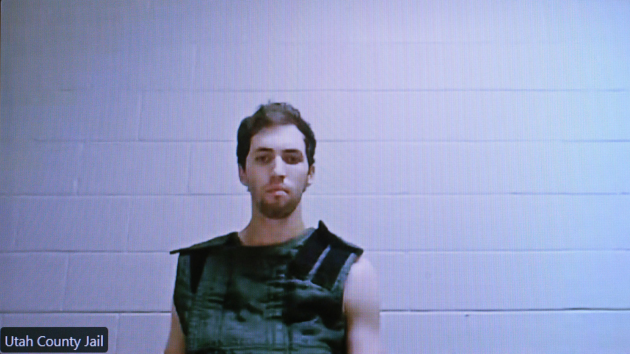
Tyler Robinson, 22, the suspect in the fatal shooting of Charlie Kirk, appears before Judge Tony Graf of the 4th District Court via a video confrerence call during a hearing on September 16, 2025 at the Fouth Judicial District Courthouse in Provo, Utah. (Scott G Winterton – Pool/Getty Images)
(NEW YORK) — Tyler Robinson, the man accused of killing conservative activist Charlie Kirk, is set to make his first in-person court appearance on Thursday.
Kirk was shot and killed in the middle of his outdoor event at Utah Valley University in Orem, Utah, on Sept. 10. The 31-year-old was the founder of the conservative youth activist organization Turning Point USA, and the Utah Valley event marked the first stop of his “The American Comeback Tour,” which invited students on college campuses to debate hot-button issues.
Robinson, 22, allegedly fled the scene of the shooting, prompting a massive manhunt. Robinson surrendered to authorities on the night of Sept. 11.
Robinson has been charged with aggravated murder, felony discharge of a firearm causing serious bodily injury, obstruction of justice, two counts of witness tampering and commission of a violent offense in the presence of a child.
He made two previous court appearances, but the first was virtual and the second was audio-only.
He has not entered a plea. He could face the death penalty if convicted of aggravated murder.
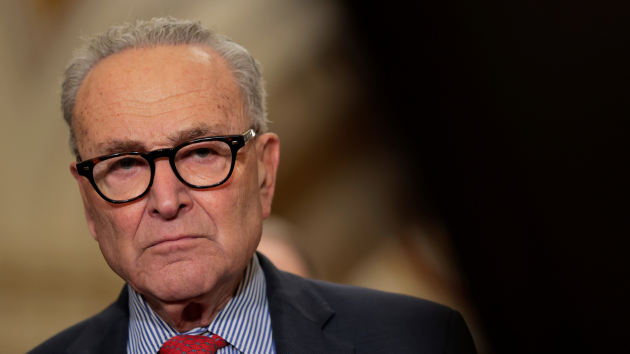
U.S. Senate Minority Leader Chuck Schumer (D-NY) looks on as senators speak to reporters following a Senate Democratic policy luncheon at the U.S. Capitol on December 09, 2025 in Washington, DC. (Photo by Heather Diehl/Getty Images)
(WASHINGTON) — The Senate is poised to vote on Thursday on two separate plans aimed at addressing a spike in health care costs that are expected for tens of millions of Americans who receive enhanced Affordable Care Act tax credits unless Congress acts.
Both plans, one put forward by Democrats and the other championed by Republicans, are almost certain to fail.
After they do, lawmakers will have only a matter of days remaining to address the expiration of the enhanced tax credits, and there’s little indication that any sort of breakthrough is on the horizon.
Democratic plan: 3-year extension of expiring enhanced tax credits
The Democratic plan that will receive a vote on Thursday proposes a three-year extension of the enhanced Affordable Care Act subsidies that are otherwise set to expire on Jan. 1. The enhanced subsidies were originally put in place during the COVID-19 pandemic.
During remarks on the floor Wednesday, Minority Leader Chuck Schumer called the Democratic plan the “only realistic path left” to address the looming premium spike.
“We have 21 days until Jan. 1. After that, people’s health care bills will start going through the roof. Double, triple, even more,” Schumer said. “There is only one way to avoid all of this. The only realistic path left is what Democrats are proposing — a clean direct extension of this urgent tax credit.”
Even though Democrats are in the minority, they are getting a vote on their proposal, as part of a deal struck by a small group of Senate moderates to re-open the federal government after a 43-day shutdown, which centered around Democrats’ efforts to address the expiring tax credits.
“What we need to do is prevent premiums from skyrocketing and only our bill does it is the last train out of the station,” Schumer said.
But any health care proposal in the Senate will require 60 votes to pass, which means members of both parties would need to lend votes to approve a plan.
Majority Leader John Thune made clear Wednesday that Republicans will not support the Democratic plan.
Thune called the Democratic proposal a “partisan messaging exercise” and said that Democrats’ claim that their plan would lower health care costs represented a “tour of fantasy land.”
Republicans have for months been saying that the premium subsidies require reform. Without changes, Republicans say, the enhanced subsidies create opportunities for waste, fraud and abuse and have driven up the overall cost of premiums.
The nonpartisan Congressional Budget Office estimates that the Senate Democrats’ proposal would add nearly $83 billion to the federal deficit over the next decade. CBO also estimates that enacting the Democrats’ legislation would increase the number of people with health insurance by 8.5 million people by 2029.
Pointing to the cost of extending the subsidies, Thune said, Democrats ought to put forward a program that makes modifications to the program.
“That’s not what they did … No changes,” Thune said. “Just continue to run up the cost. Run up the cost in the individual marketplace like that — but have the American taxpayers pay for it and then go tell people that you’re trying to keep their premiums down,” Thune said. “This does nothing, nothing, to lower the cost of health insurance.”
Republican plan: Do away with the enhanced tax credits and create HSAs
Republicans will offer an “alternative” plan on the Senate floor on Thursday.
The Republican proposal, championed by Senate Health Committee Chairman Bill Cassidy and Senate Finance Committee Chairman Mike Crapo, would do away with the enhanced tax credits and instead take the extra money from those tax credits and put it into health savings accounts for those who purchase bronze-level or “catastrophic” plans on the ACA exchanges. Republicans say this will help Americans pay for out-of-pocket costs.
Under the plan, individuals earning less than 700% of the federal poverty level would receive $1,000 in HSA funding for those between age 18 and 49 and $1,500 for those age 50-64. Republicans say these funds could be used to help cover the higher deductibles on lower cost plans.
Republicans say that their plan will reduce premiums through cost-sharing reductions and tout that the plan stops payments to insurance companies. Thune called it a “very different business model” than what Democrats are proposing.
“The question is do you want the government deciding this, ordo you want to put this power and these resources in the hands of the American people?” Thune said on the Senate floor on Wednesday. “American taxpayers. Patients. That’ what we’re about.”
This bill is also unlikely to pass the Senate on Thursday. Schumer called it “dead on arrival”.
“I want to be very clear about what this Republican bill represents, junk insurance,” Schumer said. “Let me tell my Republican colleagues: it is dead on arrival. The proposal does nothing to bring down sky-high premiums; it doesn’t extend the ACA premiums by a single day. Instead, Republicans want to send people $80 dollars and pretend that is going to fix everything.” Schumer said.
Cassidy this morning called Schumer’s categorization of his plan as a “junk plan” “so ironic.”
“These are Obamacare plans. These are the plans they put in place, except that when they did the plans, they’ve got $6,000 deductibles, or $7,500 deductibles. We addressed that deductible. We make these plans better,” Cassidy said. “We Republicans are trying to make it better. We want money in your pocket for your out-of-pocket [costs], and they want you to front the whole thing.”
Democrats also take umbrage with provisions in the GOP bill that prevent funds from being used for abortions. Schumer, on the Senate floor, called it a “poison pill.”
Sen. Patty Murray, the top Democrat on the Senate appropriations committee, was asked if she saw any way that Democrats could support the bill today.
“Not with the choice issues in it, where they have made it that women cannot get access to an abortion through their plan,” Murray said. “I don’t see any way that this helps the people that are being hurt right now by the tax credits going away.”
Powerball lottery ticket forms at Bluebird Liquor on Monday, Dec. 1, 2025 in Hawthorne, CA. (Juliana Yamada / Los Angeles Times via Getty Images)
(NEW YORK) — The Powerball jackpot has climbed to an estimated $1 billion, after no one won the grand prize in Wednesday night’s drawing.
It’s the second billion-dollar Powerball jackpot this year — and the seventh largest prize in the game’s history, according to Powerball.
The next drawing is set for Saturday.
The jackpot has an estimated cash value of $461.3 million, according to Powerball.
The numbers selected in Wednesday’s drawing were: 10, 16, 29, 33 and 69 with Powerball 22.
The Powerball jackpot was last hit on Sept. 6 by two tickets in Missouri and Texas that split a $1.787 billion prize. There have been 40 consecutive drawings with no wins.
The largest Powerball prize ever was $2.04 billion, won on Nov. 7, 2022.
Winning players have the choice between annual payments worth an estimated $1 billion or an immediate $461.3 million lump sum payment.
According to Powerball, the odds of winning the jackpot are 1 in 292.2 million.
Megan Moroney’s ‘Blue Christmas …duh’ (Sony Music Nashville/Columbia Records)
Megan Moroney‘s top yuletide moments involve a classic movie, a sweet treat and a saltwater crustacean.
“I think my favorite Christmas tradition is Christmas Eve, my whole family and I, my dad makes us watch It’s a Wonderful Life, the black-and-white version, every single year,” she says. “And he makes chocolate chip cookies.”
“And then on Christmas Day, we have lobster,” she adds.
For lots of Megan Moroney fans, listening to her Christmas EP, which came out in 2024, is a new tradition. The three-track Blue Christmas …duh features her cover of the Elvis Presley classic, plus two originals, “Christmas Morning” and “All I Want for Christmas Is a Cowboy,” which she performed on this year’s CMA Country Christmas special.
If you missed the ABC special, you can now stream it on Hulu.