The new storm will bring widespread rain and mountain snow starting New Year’s Eve and continuing through the end of the week.
An excessive rainfall risk level of 2 out of 4 is in place in the Los Angeles and Santa Barbara areas on Wednesday and Thursday.
Through Friday, 2 to 4 inches of rain is possible at higher elevations, and 1 to 2 inches at lower elevations like downtown Los Angeles.
In the Northeast, another cold front is moving through on Wednesday and Thursday, which brings the slight chance for a few snow flurries to mix in with confetti as the ball drops in Times Square. But no measurable snow accumulation is expected and the flurries will be gone by sunrise on Thursday.
The only part of the Northeast to get intense snow is the Great Lakes, where lake effect snow will continue through the week. A winter storm warning is in place in Orchard Park, New York, home of the Buffalo Bills, where residents could see up to 3 feet of snow by the end of New Year’s Day.
The rest of the country will be dry, with above average temperatures through the Plains and much of the South on New Year’s Day.
How very! Cobra Kai star Peyton List is set to join the off-Broadway cast of Heathers: The Musical in the role of Heather Chandler. Her stint in the New York production of the musical starts at the end of January. “Can’t wait to take on the role of the mythic b**** herself HEATHER CHANDLER in NYC January 26th,” List wrote on Instagram.
If you missed Gabby’s Dollhouse: The Movie while it was playing in theaters, you’ll get your chance to see it at home very soon. The movie will be available to stream on Peacock on Jan. 23. A sing-along version of the film will also be available to watch the same day. Laila Lockhart Kraner, Gloria Estefan and Kristen Wiig star in the film, which is based on the popular children’s TV series …
The films nominated for the 13th annual Make-Up Artists and Hair Stylists Guild Awards have been announced. One Battle After Another, Sinners, Weapons, Frankenstein and Wicked: For Good all received the most nominations, with three each. The winners will be announced at the Valentine’s Day gala on Feb. 14 in Los Angeles …
Ukrainian President Volodymyr Zelensky speaks during a press conference with U.S. President Donald Trump following their meeting at Trump’s Mar-a-Lago club on December 28, 2025 in Palm Beach, Florida. Trump invited Zelensky to his private club to work on the U.S.-proposed peace plan to end the war in Ukraine, as the conflict approaches four years since the sudden full-scale invasion by Russia on February 24, 2022. (Joe Raedle/Getty Images)
(LONDON) — A top Russian official on Monday issued personal threats against Ukrainian President Volodymyr Zelenskyy after Russia claimed that Ukraine launched a drone attack on one of Russian President Vladimir Putin’s official residences.
Russian Foreign Minister Sergei Lavrov alleged that Ukraine launched a drone attack on Putin’s state residence in Novgorod region on the night of Dec. 29. Lavrov offered no evidence to support the assertion, which Zelenskyy was quick to dismiss as a Russian disinformation effort.
Dmitry Medvedev — the former Russian president and prime minister now serving on the country’s Security Council — posted to X accusing Zelenskyy of “trying to derail the settlement of the conflict,” referring to the ongoing U.S.-sponsored peace talks.
“He wants war. Well, now at least he’ll have to stay in hiding for the rest of his worthless life,” Medvedev wrote.
In separate posts to Telegram, Medvedev — who, during Moscow’s full-scale war on Ukraine, has become known as a particularly hawkish voice within Putin’s security establishment — even appeared to suggest that Zelenskyy should be “exhibited” in St. Petersburg after his “imminent demise.”
Kiril Dmitriev, the Kremlin aide who also serves as the CEO of the Russian Direct Investment Fund and has been closely involved in negotiations with U.S. representatives, also questioned the Ukrainian president’s future.
“Who is after Zelenskyy?” Dmitriev said in a post to X.
The Kremlin said U.S. President Donald Trump was informed of the alleged attack during a Monday phone call with Putin. Russian officials also threatened retaliatory strikes in Ukraine.
Yuri Ushakov, a top aide to Putin, told the state-run Tass news agency that Putin and Trump discussed the issue by phone on Monday, with the U.S. leader expressing his surprise and anger.
Zelenskyy rejected the Russian reports of the supposed Ukrainian drone attack as “yet another lie.”
“Now, with their statement that some residence of theirs was attacked, they are simply preparing — I am sure — preparing the ground, in principle, to launch strikes, probably on the capital and, probably, on state buildings,” Zelenskyy said.
Ukrainian Foreign Minister Andrii Sybiha said in a post to X on Tuesday that “Russia still hasn’t provided any plausible evidence to its accusations of Ukraine’s alleged ‘attack on Putin’s residence.’ And they won’t. Because there’s none. No such attack happened.”
It is unclear what the latest developments might mean for the ongoing peace talks.
Kremlin spokesperson Dmitry Peskov told reporters on Tuesday that the alleged Ukrainian attack would prompt a “hardening of the Russian Federation’s negotiating position,” as quoted by the state-run Tass news agency.
“Russia is not withdrawing from the negotiation process,” Peskov added, describing the alleged attack as an effort aimed “at disrupting President Trump’s efforts to promote a peaceful resolution of the Ukrainian conflict.”
After talks with Zelenskyy — which were preceded and followed by phone calls between Trump and Putin — at his Mar-a-Lago residence on Sunday, Trump told reporters that the negotiating teams are “getting a lot closer, maybe very close” to achieving a peace deal to end Russia’s full-scale invasion, which Moscow launched in February 2022.
Lavrov said that Russia does not intend to withdraw from the negotiation process following the alleged attack. But the foreign minister said that the “targets and timing of Russia’s retaliatory strike” had “been determined.”
Ukraine’s air force said on Tuesday that Russia launched two missiles and 60 drones into the country overnight into Tuesday morning, of which one missile and 52 drones were shot down or suppressed. One missile and eight drones impacted across five locations, the air force said.
Russia’s Defense Ministry said that four Ukrainian drones were shot down on Tuesday morning over the southern Krasnodar region.
The operational headquarters of the Krasnodar region reported on Telegram that two people sustained shrapnel injuries caused by drones. Drone wreckage fell on a railway station in the region, the headquarters said.
Rosaviatsiya — Russia’s federal air transport agency — reported temporary flight restrictions at Krasnodar airport.
(NEW YORK) — From robotic surgery performed 7,000 miles away to the first blood test to help diagnose Alzheimer’s disease, 2025 has been a year full of medical breakthroughs.
Scientists discovered a brain implant to give some patients back their independence, prevented others from needing to take opioids and made a discovery that could help solve the organ shortage crisis.
Here are seven of the biggest innovations in the health and science space this year.
ALS patient is 1st to control iPad by thought with implantable brain sensor
A patient with amyotrophic lateral sclerosis (ALS) became the first person in the world to control an iPad entirely by thought, neurotech company Synchron announced earlier this year.
The patient, Mark Jackson, from western Pennsylvania, controls the tablet without using his hands or voice command but rather with an implantable brain-computer interface (BCI) that translates his thoughts into actions.
At the time, Jackson told ABC News he doesn’t have use of his arms so the BCI helps him watch TV shows, listen to audiobooks, browse social media and send text messages to his children.
BCIs are sensors implanted in the brain and translate brain signals into actions outside of the body. The BCI that Jackson is using was developed by the company Synchron, which involves a device implanted into one of the veins within the brain in a minimally invasive procedure.
“This is really an exciting field, because I think the opportunities are boundless,” Dr. Leah Croll, a neurologist at Maimonides Medical Center in New York City, told ABC News. “I think that we’re going to see, moving forward, not only using BCIs to control other electronic devices, but also using them to give patients back movement, to give patients back language, really bodily functions that they weren’t able to do after whatever neurologic insult happened to them.”
Croll said it’s important, going forward, to consider legal and ethical considerations such as privacy and data storage.
She also encouraged more research and clinical trials to generate data on how patients can be protected in both research and real-world settings.
“There’s so much we haven’t figured out legally and ethically when it comes to storing personal, private data from your brain, and how is that used, and how do we manage that responsibly,” she said. “There’s a lot of bio-ethical minds at work as to how we deal with this issue and how do we make it so that a patient isn’t sort of signing away the rights to their entire brain and inner world and manage something responsibly for them that’s helpful and not harmful.”
First pill for obstructive sleep apnea may be around the corner
The first oral pill for obstructive sleep apnea (OSA) could soon be available after a late-clinical showed positive results, according to pharmaceutical company Apnimed Inc.
The drug, AD109, showed “clinically meaningful and statistically significant reductions” in airway obstruction after 26 weeks, the company said in a press release in July.
OSA is a sleep disorder in which the airways become narrowed or blocked while sleeping, causing breathing to pause.
The investigational once-daily pill is a neuromuscular modulator that stabilizes upper airway muscles and prevents them collapsing, improving oxygenation.
OSA patients treated with the medication saw a nearly 50% reduction in the severity from baseline at week 26, compared to 6.8% of those in the placebo group.
The reduction was “significant” at the end of the study period, which concluded at 51 weeks. At the end of the trial, nearly 23% of participants saw “complete disease control.”
More recent trial data published in October found that a meaningful number of patients achieved complete disease control and experienced significant improvements in oxygenation measures.
First non-opioid medication in more than 20 years approved by FDA
Earlier this year, the FDA approved a new type of non-opioid pain medication to treat moderate to severe acute pain, the first of its kind on more than 20 years.
Suzetrigine, also known by the brand name, Journavx, is manufactured by biotech company Vertex Pharmaceuticals and doesn’t have addictive properties, unlike opioids often used for this type of pain.
“It’s significant in light of all the concerns about the opioid epidemic and addiction substance use disorder,” Dr. Jianguo Cheng, a professor of anesthesiology and medical director of the Cleveland Clinic Consortium for Pain at Cleveland Clinic, told ABC News.
In two clinical trials, tested on adults between ages 18 and 80, Journavx was found to reduce moderate to severe acute pain for adults from baseline by about 50% in 48 hours.
The average time to meaningful pain relief ranged from two to four hours, compared to eight hours in the placebo group, according to the trial.
Cheng, who was not involved in the clinical trials, said the studies demonstrated efficacy of the drug not compared to not only placebo, but also to weak opioids.
“Its efficacy is as good as a weak opioid. So why that is important?” Cheng said. “Because not all patients need opioids, and not all patients need a strong opioid. … If most of them do need a weak opioid, and if this can replace the weak opioid, that can be a big deal.”
Although gene-edited pig kidneys have been seen as a way to help ease the shortage of organs available for those on transplant waiting lists, many of the organs have been rejected not long after transplant surgery.
“Until 2021, we had never put one of these gene-edited pig organs into a human … so it was a bit of a mystery when we started doing the pig-to-human transplants, about what we were going to encounter,” Dr. Robert Montgomery, director of the NYU Langone Transplant Institute, told ABC News.
Last month, a team at NYU Langone Health published a study in which they discovered immune reactions that may explain why these organs get rejected.
The team collected two months of data from a patient who was brain dead and had a genetically engineered pig kidney transplanted into them. The family had donated the patient’s body to science.
The team learned that pig organs were being rejected due to an immune system reaction from specific antibodies — which recognize and attach themselves to foreign substances so they can be removed from the body — and from T cells, which are white blood cells that help the body fight off germs and other unfamiliar invaders.
‘So you have this very coordinated immune response that involves antibodies and white cells, and it seems to happen somewhere between two and four weeks after the transplant,” said Montgomery, lead author of the study. “Now the good news on that front is that we can detect when it’s coming before rejection happens, and we can begin to respond, and we have very good therapeutics that can block the rejection and prevent it from causing damage.”
After rejection, the team used an FDA-approved drug combination to successfully reverse it, with no signs of permanent damage or reduced kidney function.
In a second study, Montgomery and his team looked at the body’s immune response to the pig organ in greater detail. By measuring levels of biomarkers in the blood, they were able to spot an attack up to five days before it would be visible in bodily tissue.
Montgomery said the findings could lead to a future where gene-edited pig organs are a realistic alternative to human organs.
“The pig organ can really replace a human organ and do all the things that a human organ can do, and it’s really just a matter of overcoming the immunosuppression and preventing rejection,” he said. “I think it’s going to happen … and people will be receiving xenotransplants on a regular basis. It’s going to be normalized, and it’s going to be something that will benefit thousands, first, and then millions of people around the world.”
FDA clears 1st blood test to help diagnose Alzheimer’s disease
In May, the FDA cleared the first blood test to help diagnose Alzheimer’s disease.
The test, manufactured by Fujirebio Diagnostics, is for those aged 55 and older who are already exhibiting signs and symptoms of the disease, according to the federal health agency.
The new blood test works by measuring the ratio of two proteins — pTau217 and β-amyloid 1-42 — which are found in human plasma, a component of blood. That ratio is then linked to the presence or absence of amyloid plaques in the brain to determine whether a patient is showing signs of Alzheimer’s disease.
In a clinical study, more than 91% of nearly 500 cognitively impaired patients who tested positive on the blood test had their results confirmed by other diagnostic tools.
“Essentially, it does provide a first quantitative measure of an Alzheimer’s disease diagnosis,” Dr. Jeffrey Savas, an associate professor in the department of neurology at Northwestern University Feinberg School of Medicine, told ABC News. “This is very important to identify patients which could be good candidates for some of the emerging therapeutics.
Savas said the test is rapid, highly accurate and less expensive or invasive compared to previous diagnostic tests.
Because many Alzheimer’s patients need to wait months to see a specialist, the test can allow primary care providers to start the diagnostic process.
“Many neurological research centers have huge backlogs of patients, and there’s not enough physicians or nurses to really see the patients in a timely manner,” Savas said.
“Having this quick diagnostic test, which could be taken in other medical settings, should pave the way for quicker, more effective opportunities and chances for being treated in a timely manner.”
In October, the FDA cleared a second blood-based test called Elecsys pTau181, made by Roche.
Groundbreaking remote robotic surgery
A patient living in Angola with prostate cancer underwent surgery this year to cut the cancer out, but the doctor performing the surgery was 7,000 miles away in Orlando, Florida.
The patient was the first in a groundbreaking human clinical trial approved by the FDA to test transcontinental robotic telesurgery.
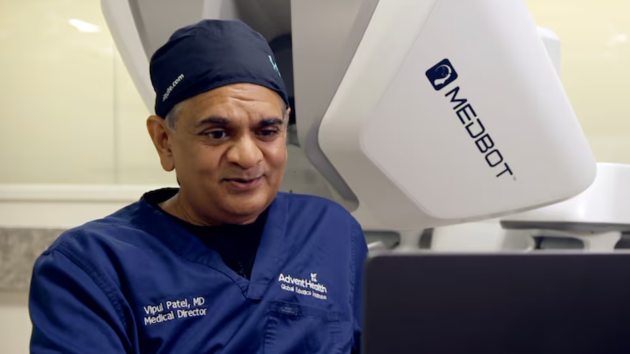
A team at OrlandoHealth operated on the patient via a multimillion-dollar robot with enhanced visuals and nimble controls.
Using a robot allows for the procedure to be less invasive, more precise and typically comes with a faster recovery time.
The team has said underserved areas in the U.S. and around the world could benefit from the technology by having a surgeon perform an operation even if they are not nearby.
1st-ever gene fix for rare deadly disease saves baby’s life
A baby with a rare and life-threatening metabolic disorder underwent a personalized treatment involving a first-of-its-kind type of gene-editing.
KJ Muldoon was diagnosed as a newborn with carbamoyl-phosphate synthetase 1 deficiency as a newborn. The disorder affects a bodily cycle that causes deadly levels of ammonia to build up in the blood, which can lead to severe and permanent brain damage.
If left untreated, it will typically result in the death of the patient, according to the National Organization for Rare Disorders.
The treatment for KJ involved the powerful gene-editing tool CRISPR, which allows scientists to precisely slice and repair faulty genes. Using CRISPR, the team was able to create a treatment tailored to the baby’s specific genetic mutation.
In June, KJ went home after spending the majority of his life at Children’s Hospital of Philadelphia. Earlier this month, he reached a big milestone: taking his first steps ahead of Christmas.
(NEW YORK) — The Federal Bureau of Investigation said fraudsters in 2025 bilked Americans out of more than $333 million with ruses perpetrated using bitcoin ATM machines, a marked uptick over previous years as the popularity of cryptocurrencies continues to grow.
The new FBI statistics, which document fraudulent transactions using cryptocurrency kiosks, reflect a “clear and constant rise” that is “not slowing down,” a bureau spokesperson told ABC News.
In 2024, scammers caused roughly $250 million in losses, more than double the figure from the previous year. From January through November 2025, that figure was $333.5 million, the bureau said.
There are more than 45,000 bitcoin ATMs nationwide that allow users to insert cash and send it to a digital wallet anywhere in the world. It takes only a few minutes, and once the transaction is executed, experts say, the money can be nearly impossible to recover — making it an attractive method for prospective fraudsters.
“Requesting crypto is now the No. 1 preferred method of criminals,” Amy Nofziger, AARP’s director of fraud victim support, told ABC News in October. “It is a huge problem.”
Authorities have taken notice. In September, the Washington, D.C., attorney general’s office sued Athena Bitcoin, one of the largest bitcoin ATM machine purveyors in the country, accusing it of “pocketing hundreds of thousands of dollars in undisclosed fees on the backs of scam victims.”
The lawsuit claims 93% of the transactions on Athena’s devices in the district “are the product of outright fraud,” and that “the median age of victims was 71 years.”
Athena forcefully denied those allegations in a statement to ABC News, asserting in part that it maintains “strong safeguards against fraud including transparent instructions, prominent warnings and consumer education.”
“Just as a bank isn’t held responsible if someone willingly sends funds to someone else, Athena does not control users’ decisions,” the statement said.
AARP has advocated for more stringent regulations to protect Americans from scams on bitcoin ATMs, like capping the amount of money a user can deposit in one day. At least 17 states have passed legislation in recent years regulating the machines, and some municipalities have moved to ban them outright.
Scott Ian of Anthrax band, performs during a Mx Metal Festo 2024 at velodromo on April 13, 2024 in Monterrey, Mexico. (Medios y Media/Getty Images)
Anthrax‘s Scott Ian embodied the spirit of metalheads everywhere upon obtaining Iron Maiden guitarist Dave Murray‘s signature Fender Stratocaster.
As seen in a video posted to his Instagram, Ian broke in his new guitar by shredding the riff from the Maiden classic “The Trooper.”
“Got the new Dave Murray Strat … and of course this is the first riff I played (too fast) on it,” Ian writes in the caption. “The guitar is SWEET!!!”
Ian will have a chance to show off his Maiden playing skills to Murray when Anthrax opens for the English metallers on select dates of their 2026 U.S. tour starting in September.
Anthrax’s other 2026 plans include the release of their long-awaited new album, the follow-up to 2016’s For All Kings.
‘Dick Clark’s New Year’s Rockin’ Eve with Ryan Seacrest 2026′ performers (Courtesy DCP)
Who had a 4 Non Blondes comeback on their 2025 bingo card? Well, frontwoman Linda Perry, for one.
“The top of the year, I had a premonition, and I said, ‘You know what? I’m gonna put the band back together,'” Perry told ABC’s On the Red Carpet during rehearsals for Dick Clark’s New Year’s Rockin’ Eve with Ryan Seacrest 2026, during which 4 Non Blondes will be performing.
“When I got that energy, all this stuff started happening,” she added.
Said stuff included the first extended run of 4 Non Blondes live shows in over 30 years, as well as a viral TikTok trend featuring a mash-up of the 4NB hit “What’s Up?” and the Nicki Minaj track “Beez in the Trap.” Celebrities including Madonna,Jennifer Lopez and Paramore‘s Hayley Williams have taken part in the trend.
“I mean, it’s still going,” Perry said of the trend. “Martin Scorsesedid one, alright?”
For Perry, performing on NYRE is a fitting way to cap such an eventful year.
“It’s just been a really wonderful experience because, you know, it’s been 30 years, and we had a momentum like this 30 years ago,” Perry said. “So it’s really kinda fun to be 30 years later and to have that same feeling, that same momentum, and the drive and the love.”
“The song just doesn’t go away,” she adds of “What’s Up?” “It’s one of those songs, it’s iconic, and I’m so blessed to have written that song.”
4 Non Blondes will look to continue that momentum into 2026 with the release of their first album since their 1992 debut.
Until then, you can watch NRYE 2026 Wednesday at 8 p.m. ET on ABC. Other performers include AJR and The All-American Rejects.
Kendrick Lamar took control of his narrative and remained “Humble” while doing so for another year. His 2025 kept him in the headlines, beginning with a sweep at the 67th annual Grammy Awards, where he won all five categories he was nominated for — including song and record of the year.
Exactly one week later, Kendrick returned to another massive stage, headlining the Super Bowl halftime show alongside Samuel L. Jackson, Serena Williams and special guest SZA. The performance also included a bit of a pointed shade toward Drake, who had filed a lawsuit over their 2024 feud.
The show previewed the chemistry to come on his Grand National Tour with the SOS singer, which ran from April 19 to June 18 and has since become the highest-grossing co-headlining tour in history.
Though Kendrick kept his releases light in 2025, appearing on Playboi Carti’s Music album and on Clipse’s “Chains and Whips,” his prolific 2024 run was more than enough to keep him at the center of the cultural conversation.
He was the top winner at the BET Awards, taking home five trophies. Those included album of the year for GNX, video of the year for “Not Like Us,” best male hip-hop artist and best collaboration for “Luther” featuring SZA. He added VMA and NAACP Image Award wins for “Not Like Us,” while his Super Bowl performance helped him secure a Primetime Emmy Award.
Kendrick closes out 2025 atop several year-end lists, including Billboard’s top rapper, #1 Hot 100 songwriter of the year and top R&B/hip-hop artist of the year.
His hit “Luther,” which became the longest-running #1 in the history of Billboard’s Hot R&B/Hip-Hop Songs chart, also finishes the year leading both the hot rap songs and hot R&B/hip-hop songs year-end rankings.
Backstreet Boys, ‘Into the Millennium’ at Sphere Las Vegas (Live Nation)
Backstreet Boys will be spending New Year’s Eve onstage at Sphere Las Vegas, performing their Into the Millennium residency show for a crowd of 20,000 fans. The songs in the concert are synced to the custom, immersive video projected on the venue’s giant screens, but Backstreet’s AJ McLean says they’re going to try to change things up when the clock strikes midnight.
“We’ve already pushed the start time back to, now, 10:30. So we will be onstage when the ball drops,” he told ABC Audio. “So [we’re] trying to figure out if there’s a way to, like, somehow get a ball to drop on the screen. I don’t know if that’s gonna happen, but hopefully we can figure something out that doesn’t cost a gazillion dollars.”
He laughs, “Worst case, I’ll hold a disco ball in my hand and just slowly drop it with a fishing line.”
But ball or not, AJ said, “It’s gonna be really cool to bring in the new year with 20,000 people at the coolest venue that there is.”
Backstreet Boys’ Sphere residency, which began in August, has been extended through Feb. 15. AJ will release his solo album Hi, My Name Is Alexander James on Jan. 9, which also happens to be his birthday. In September, the group will launch a residency at an arena in Dusseldorf, Germany.