
Texas abortion ban backlash is distraction from other issues: Cassidy

ABC’s This Week

(NEW YORK) — President Joe Biden and Democrats are using the outcry over the new Texas abortion law to distract from other issues including Afghanistan, Sen. Bill Cassidy, R-La., said Sunday.

“(The Supreme Court’s decision) had nothing to do with the constitutionality of Roe v. Wade, it was only on if the plaintiffs had standing, people are using it to gin up their base to distract from disastrous policies in Afghanistan, maybe for fundraising appeals,” Cassidy told ABC “This Week” anchor George Stephanopoulos. “I wish we’d focus on issues as opposed to — as opposed to theater.”

The severe new abortion law in Texas bans nearly all abortions in the state. The law makes most abortions illegal after six weeks of pregnancy and encourages anyone to sue a person they believe is providing an abortion or assisting someone in getting an abortion after six weeks.

In a 5-4 decision released late Wednesday night, the Supreme Court rejected a request by Texas abortion providers to block the new law.

Cassidy, who called himself “pro-life,” said the Supreme Court will “swat it away” once the law reaches them “in an appropriate manner.”

“If it is as terrible as people say it is, it will be destroyed by the Supreme Court,” Cassidy added. “But to act like this is an assault upon Roe v. Wade is, again, something the president is doing I think to distract from his other issues.”

Pressed further by Stephanopoulos on whether he thinks the Supreme Court decision signals they plan to overturn Roe v. Wade, Cassidy deflected, instead bringing up Hurricane Ida, Afghanistan and the bipartisan infrastructure deal.

“We can always talk theoreticals,” Cassidy responded. “But I’m kind of a guy who’s in the middle of a state in which 700,000 people don’t have electricity, in which we’ve got a disastrous withdrawal from Afghanistan, and the administration is pushing a $3.5 trillion bill which will be to inflation what the withdrawal was to Afghanistan.”

Debate continues over the $3.5 trillion reconciliation bill that many Democrats demand pass in conjunction with the bipartisan infrastructure deal that Cassidy helped negotiate. On Thursday, Sen. Joe Manchin, D-W.Va., wrote an op-ed in the Wall Street Journal calling for a “strategic pause” on the budget resolution Democrats took the first step in passing last month.

Stephanopoulos asked Cassidy whether Manchin’s op-ed effectively kills the bill.

“You saw Senator Joe Manchin’s statement this week. As far as you’re concerned, does that kill the bill? And if it does, does it worry you that the bipartisan infrastructure bill, the smaller one that you support, will also die?” Stephanopoulos asked.

“Implicit in what Joe said is that he would accept a smaller (reconciliation) bill,” Cassidy responded. “I think a smaller bill is disastrous, but on the other hand, the two are delinked.”

“There’s going to be a vote on September the 27th on the bipartisan infrastructure bill,” Cassidy added. “The very fact that Joe is saying he has to negotiate means that the vote on the $3.5 trillion inflation-igniting bill that comes later will come later.”

Cassidy said he is concerned that if Manchin’s opposition stands, House Speaker Nancy Pelosi would not pass the smaller bipartisan bill.

“Of course, I’m concerned about that, which is why I want Republicans to vote for it, too,” Cassidy said. “It should not be a party line vote in the House, it wasn’t in the Senate.”

The infrastructure bill includes provisions for disaster mitigation, which Cassidy brought up, encouraging those planning to vote no to tell people with no power due to Hurricane Ida.

“I say go down to Lafourche and Terrebonne Parish, to people who will not have electricity back until September 29th and tell them you’re going to vote against a bill which hardens our grid, which gives coastal restoration dollars, which has flood mitigation, which will build levees and protect Louisiana and other states from natural disasters, go to those parishes and tell them whatever cockamamie reason you have to vote no,” Cassidy said.

Hurricane Ida made landfall on Aug. 26, 16 years to the day after Hurricane Katrina did in 2005. The hurricane has left at least 67 dead in eight states.

On Thursday, Cassidy penned a letter to Biden requesting emergency disaster relief for Louisiana and met with him in his state on Friday.

Asked whether he is satisfied with Biden’s initial response, Cassidy told Stephanopoulos the situation is getting better.

“The federal partners have been there,” Cassidy said. “And so, I compliment the federal partners and thank them for that, but we need gasoline and we need electricity and we need housing. And then we need to pass the bipartisan infrastructure bill for the long term.”

On the other crisis his state is battling — COVID-19 — Cassidy, a physician, said the delta variant case count is falling but vaccine rates remain low. He also encouraged people to get vaccinated.

“Our immunization rates are still way too low and our ICUs still have too many patients related to what is essentially a vaccine-preventable disease,” Cassidy said. “Yes, it’s getting better, but we can imagine future waves.”

Copyright © 2021, ABC Audio. All rights reserved.
Vaccine hesitancy eases in teeth of the delta surge: POLL

ABC News/Washington Post polls

(NEW YORK) — Vaccine hesitancy has subsided in the face of the delta surge, with the share of Americans who are disinclined to get a coronavirus shot now just half what it was last January. Support for mask mandates is broad and President Joe Biden’s approval for handling the pandemic has dropped sharply.

Alongside the steep rise in cases, there’s been a jump in perceived risk of catching the virus, from 29% in late June to 47% now, the latest ABC News/Washington Post poll finds. Yet worries about the consequences of infection are moderate, expressed by 39%, partly reflecting broad awareness of vaccine efficacy.

While 75% of adults have gotten a shot, per data from the Centers for Disease Control and Prevention, some hesitancy persists. Among unvaccinated adults, about 7 in 10 are skeptical of the vaccines’ safety and effectiveness, 9 in 10 see vaccination as a personal choice rather than a broader responsibility and just 16% have been encouraged by someone close to them to get a shot. Each is an impediment to uptake.

Further, few unvaccinated Americans, 16%, say the FDA’s approval of the Pfizer vaccine makes them more likely to get a shot; 82% say it makes no difference. And among those who work, again just 16% say they’d get a shot if their employer required it; many more say they’d quit.

The poll, produced for ABC News by Langer Research Associates, finds approval of Biden’s handling of the pandemic dropping steeply, from 62% in June to 52% now. Forty-one percent disapprove, with the rest undecided. (Biden’s overall approval rating is just 44%, pulled down by criticism of his handling of the Afghanistan pullout, as reported Friday.)

Policies

  • On the policy front, the survey finds broad support for mask mandates, with smaller majorities lining up behind vaccine requirements:
  • Sixty-seven percent support school districts requiring students, faculty and staff to wear masks. As many support state or local orders requiring masks in public places.
  • Fifty-nine percent support school vaccine mandates for teachers and staff; 54% support this for students if a vaccine is approved for their age group. Public school parents, though, are less apt to support student mandates – 47% vs. 56% among others.

Close to half of all adults, 52%, support businesses requiring vaccination for employees who come into work – but that ranges from 45% among people who work for pay to 66% of all others. Many fewer people who work for an employer, 18%, say their employer currently has a vaccine mandate in place.

Marking the strength of vaccine resistance among some Americans, if a workplace mandate were imposed, three-quarters of unvaccinated workers say they’d quit their job (42%) or seek a health or religious exemption (35%). If those who sought an exemption didn’t get one, most say they’d then quit. In all, assuming no exemptions, 72% of unvaccinated workers not currently facing a workplace mandate threaten to walk if faced with one.

On the issue of vaccine information, one-third of unvaccinated Americans say they’ve heard or read things about the vaccines that have swayed them against getting a shot. (Many may have been predisposed to be receptive to that kind of information in the first place.) Just 4% say they’ve been swayed in favor, likely because nearly all such people are vaccinated by now. Sixty-two percent of the unvaccinated report no impact of what they’ve heard or read.

The survey touches on a few items unrelated to the pandemic. In one result, Biden has a 45-49% approval rating for handling the economy, with approval down 7 percentage points since it last was measured in April. Also 53% support $3.5 trillion in federal spending on new or expanded social programs, educational assistance and efforts to address climate change. Forty-one percent are opposed.

Vaccine attitudes

As noted, 47% of Americans think they have a high or moderate risk of getting sick from the coronavirus, up sharply from 29% in June as the delta variant has surged. Still, just 39% are worried about it, with only 7% very worried. (Worry is broader among vaccinated people, at 45% vs. the unvaccinated at 22%.)

In a different question in January, many more expressed concerns about infection: 60% overall were worried that they or a family member might get sick. That peaked at 69% at the start of the pandemic in the United States in March 2020.

About 7 in 10 Americans see the vaccines as safe and as many call them effective. Yet there are compunctions. Many fewer — 43% — call them very safe or very effective. And 27% don’t think they’re safe or effective. Vaccine hesitancy soars among people who hold these doubts; in a statistical analysis called regression, they’re crucial predictors of not getting a shot. As noted, among the unvaccinated, seven in 10 question vaccine safety and efficacy.

Another key predictor of vaccine uptake is the sense that it’s a responsibility to protect others, not just a personal choice. Yet the public only divides on this: 50% call it a personal choice; 48%, a broader responsibility. Among unvaccinated people, the share calling it a personal choice soars to 91%, and 8 in 10 of them feel strongly about this. Among the vaccinated, by contrast, 62% say it’s a responsibility to others.

Two other predictors of getting vaccinated, albeit weaker ones, are a sense that people who care about you want you to get a shot and one’s level of worry about getting infected.

In the first, fewer than half of adults overall, 47%, say someone who cares about them has encouraged them to get vaccinated. About as many, 43%, say those who care about them have stayed out of it; 5% say they’ve been actively discouraged from taking action.

Notably, among unvaccinated adults, only 16% say people who care about them have encouraged them to get a shot, versus 58% among vaccinated adults — evidence of how establishing a social norm of vaccination is another way to encourage uptake.

Groups

Lingering vaccine hesitancy — defined as people who say they definitely or probably will not get the coronavirus vaccine (as noted, 17% overall) — is especially high among rural residents (36%), very conservative people (36%), Republicans (30%), conservatives overall (30%), evangelical white Protestants (28%) and those with no more than a high school diploma (26%).

Attitudinally hesitancy peaks among those who lack confidence in the vaccines’ safety (57%) and effectiveness (52%). It’s 33% among those who think they have no risk of getting sick from the coronavirus and essentially the same (32%) among those who see getting vaccinated as personal choice rather than a broader responsibility.

By contrast, hesitancy is lowest among those with a post-graduate degree (6%), liberals (6%), Democrats (4%), those who’ve been encouraged to get vaccinated by people close to them (4%), those with confidence in the vaccines’ effectiveness (4%) or safety (2%) and those who see getting vaccinated as a broader responsibility (1%).

Methodology

This ABC News/Washington Post poll was conducted by landline and cellular telephone Aug. 29-Sept. 1, 2021, in English and Spanish, among a random national sample of 1,006 adults. Results have a margin of sampling error of 3.5 percentage points, including the design effect. Partisan divisions are 30-24-36%, Democrats-Republicans-independents. In addition to traditional sample weights for age, race/ethnicity, sex and education, results were adjusted to reflect CDC vaccination rates.

The survey was produced for ABC News by Langer Research Associates with sampling and data collection by Abt Associates of Rockville, Maryland. See details on the survey’s methodology here.

Copyright © 2021, ABC Audio. All rights reserved.

Desperation, ‘crisis’ at Planned Parenthood clinic under new Texas abortion law

Good Morning America

(NEW YORK) — A Planned Parenthood clinic in Houston has turned into a “crisis center” in the days after the most restrictive abortion law in the nation went into effect in Texas, with women desperate and begging for care, a distraught staffer told ABC News.

“People don’t know where to go,” Doris Dixon, who oversees patient access at the clinic, said in an emotional interview Friday with Rachel Scott for “Good Morning America.”

As of Wednesday, physicians in Texas are banned from providing abortions once they detect a fetal heartbeat, which can be as early as six weeks into a pregnancy — before many women even know they’re pregnant.

The same day the law went into effect, one woman came in for a regular checkup at the Planned Parenthood clinic, Dixon said. During her checkup, she found out she was five-and-a-half weeks pregnant — still eligible for a legal abortion. But that same day, she also tested positive for COVID-19. By the time her mandated self-isolation will end, she’ll be too far along in her pregnancy to get an abortion under the new Texas law, Dixon said.

“To hear her beg for someone to help her was hard, she was begging,” Dixon said. “For me, I was trying very hard not to cry but the tears were coming down, they were there.”

Out-of-state clinics anticipate a surge in patients due to the law, which has increased the average miles a Texan must drive one-way to seek an abortion from 12 miles to 248, according to the Guttmacher Institute, a reproductive rights organization.

Dixon said some women she’s spoken to don’t have the financial means or the access to child care to travel out of state for an abortion.

“I’m angry. I’m actually angry because this is an attack on people’s constitutional rights to seek these services. And it’s between them and their doctors,” Dixon said with tears in her eyes.

As of Friday, Dixon estimated 70% of the women who called in seeking abortion care this week were turned away.

“They’ve relied on Planned Parenthood for years and we don’t have the answers,” Dixon said, again fighting back tears. “We usually have the answers — we don’t have the answers.”

Dixon has been working at Planned Parenthood in Houston for 13 years. This is the “worst” she has “ever seen it.”

“I feel like I take it personally,” Dixon said, choking back tears. “I have failed in my goal to help people.”

She said she fears this law will lead to high-risk attempts to self-abort pregnancies. The clinic has already seen at least one woman this week who tried to terminate her pregnancy herself after the Texas law went into effect, she said.

Before Wednesday, no law banned abortions earlier than 20 weeks of pregnancy nationwide. Many states had tried to enact early gestational bans, but they had all been blocked by courts.

The Supreme Court refused to block Texas’ law, which allows anyone to sue a person they believe is providing an abortion or assisting someone in getting an abortion after six weeks. The law does not make exceptions for pregnancies resulting from incest or rape.

On Friday, Planned Parenthood affiliates in Texas won a court battle to protect their employees from some lawsuits. A judge granted them a temporary restraining order against Texas Right to Life, stopping the largest anti-abortion rights group in the state from suing Planned Parenthood abortion providers and health care workers under the law.

“This restraining order offers protection to the brave health care providers and staff at Planned Parenthood health centers throughout Texas, who have continued to offer care as best they can within the law while facing surveillance, harassment, and threats from vigilantes eager to stop them,” Helene Krasnoff, vice president for public policy litigation and law, Planned Parenthood Federation of America, said in a statement.

A spokesperson for Texas Right to Life told ABC News the group is “undeterred” by the legal defeat and would not be “intimidated” by Planned Parenthood.

Copyright © 2021, ABC Audio. All rights reserved.

Navy declares 5 missing sailors dead after helicopter crash

Austin Nooe/iStock

(WASHINGTON) — The U.S. Navy has declared five sailors dead after they went missing following the crash of their helicopter off the coast of southern California on Tuesday.

“U.S. 3rd Fleet has shifted from search and rescue efforts to recovery operations, Sept. 4,” according to a statement.

The helicopter, based on the USS Abraham Lincoln, was conducting routine flight operations aboard the carrier when it crashed into the sea approximately 60 nautical miles off the coast of San Diego at 4:30 p.m. PDT on Tuesday.

A sailor aboard the helicopter was rescued shortly after the crash and three others who had been on the carrier’s deck were found injured. But five soldiers remained unaccounted for.

Over the next 72 hours, Navy and Coast Guard ships and helicopters carried out extensive flight and sea operations in search of the five missing sailors.

“We are deeply saddened by the loss of five Sailors and those injured following the MH-60S helicopter tragedy off the coast of Southern California,” Adm. Mike Gilday, the chief of Naval Operations, said in a statement. “We stand alongside their families, loved ones, and shipmates who grieve.”

The Navy said the crash is under investigation and that the names of the five sailors will be made public 24 hours after the last notification was made to families.

Copyright © 2021, ABC Audio. All rights reserved.

Biden to survey Ida storm damage in hard-hit New York, New Jersey

Spencer Platt/Getty Images

(NEW YORK) — After touring storm damage from Hurricane Ida in Louisiana on Friday, President Joe Biden will travel to the Northeast next, the White House said.

Biden will be in Manville, New Jersey, and Queens, New York, on Tuesday — two areas hard-hit by devastating flooding as remnants of Ida wreaked havoc earlier this week.

Overall, there have been at least 64 deaths across eight U.S. states related to Ida, including at least 49 in the Northeast.

New Jersey has seen the greatest loss of life tied to Ida, with at least 25 people dead and at least six people still missing as of Friday. Three tornadoes also were confirmed in New Jersey as the storm swept through Wednesday, mostly in the southern part of the state.

New Jersey Gov. Phil Murphy confirmed on Twitter he will be joining Biden on the tour.

In New York City, at least 13 people died due to the storm. All but two were found in basement apartments.

On Friday, Biden traveled to Louisiana to survey damage caused by Hurricane Ida.

“This storm has been incredible, not only here but all the way up the East Coast,” Biden told local officials in hard-hit LaPlace, Louisiana, just outside New Orleans.

“We came because we want to hear directly from you all, what specific problems you’ve been dealing with,” he said.

Biden told local officials he thought it was important to rebuild damaged infrastructure in a more resilient manner, such as placing power lines underground or making roofs stronger, and he spoke of the need to restore cellphone service so that residents can get in touch with loved ones and also learn about resources available to them.

Nearly a week after the storm, over 727,000 customers in Louisiana still remain without power statewide, according to data from PowerOutage.us.

The president also surveyed storm damage in the Cambridge neighborhood and took part in an aerial briefing by helicopter to Galliano, south of New Orleans, on Friday, according to the White House.

Before Hurricane Ida made landfall as a powerful Category 4 storm Sunday, Biden approved emergency declarations for Louisiana and Mississippi, authorizing FEMA to provide emergency assistance.

ABC News’ Ben Gittleson contributed to this report.

Copyright © 2021, ABC Audio. All rights reserved.

Pete Buttigieg, husband introduce their two new babies in family photo

Pete Buttigieg/Twitter

(WASHINGTON) — Transportation Secretary Pete Buttigieg, who made history as the first openly gay Cabinet member to be confirmed by the Senate, and husband Chasten Buttigieg are officially fathers — twice over.

After announcing last month that the two were expanding their family, the former 2020 Democratic presidential candidate and South Bend, Indiana, mayor, officially introduced the couple’s new babies, sharing a black-and-white photo on social media of him and his husband each cradling a newborn in a hospital bed.

“Chasten and I are beyond thankful for all the kind wishes since first sharing the news that we’re becoming parents,” Pete Buttigieg said on Twitter. “We are delighted to welcome Penelope Rose and Joseph August Buttigieg to our family.”

Pete Buttigieg, 39, said in a Twitter post last month that he and his husband were wanting to grow their family “for some time,” and they would “share more soon” on becoming parents.

The couple married in 2018. In an interview with The Washington Post in July, Chasten Buttigieg, 32, detailed their experience getting on adoption waiting lists for babies that have been abandoned or surrendered on short notice. He told the newspaper they had been trying to adopt for a year and had several close calls.

“It’s a really weird cycle of anger and frustration and hope,” he said in the interview. “You think it’s finally happening and you get so excited, and then it’s gone.”

While answering questions about his views on paid family leave on the campaign trail back in April 2019, Pete Buttigieg also spoke about wanting to have children.

“We’re hoping to have a little one soon, so I have a personal stake in this one, too,” he said at a rally. “We should have paid parental leave and find a way to have paid leave for anyone who needs caring.”

Pete Buttigieg has not yet revealed his plans for paternity leave.

ABC News’ Morgan Gstalter contributed to this report.

Copyright © 2021, ABC Audio. All rights reserved.

Scoreboard roundup — 09/03/21

iStock

(NEW YORK) — Here are the scores from Friday’s sports events:

 MAJOR LEAGUE BASEBALL

 INTERLEAGUE
 Final  Detroit  15  Cincinnati   5
 Final  Seattle   6  Arizona      5
 Final  Houston   6  San Diego    3

 AMERICAN LEAGUE
 Final  Tampa Bay      5  Minnesota           3
 Final  Toronto       11  Oakland            10
 Final  Boston         8  Cleveland           5
 Final  N.Y. Yankees   4  Baltimore           3
 Final  Kansas City    7  Chicago White Sox   2
 Final  L.A. Angels    3  Texas               2

 NATIONAL LEAGUE
 Final  Chicago Cubs    6  Pittsburgh     5
 Final  Miami          10  Philadelphia   3
 Final  N.Y. Mets       6  Washington     2
 Final  Colorado        4  Atlanta        3
 Final  St. Louis      15  Milwaukee      4
 Final  San Francisco   3  L.A. Dodgers   2

 TOP-25 COLLEGE FOOTBALL
 Final  Virginia Tech  17  (10)North Carolina  10

 MAJOR LEAGUE SOCCER
 Final  Nashville        3  New York City FC       1
 Final  New England      1  Philadelphia           0
 Final  Portland         2  Houston                0
 Final  Los Angeles FC   4  Sporting Kansas City   0

Copyright © 2021, ABC Audio. All rights reserved.

Louisiana one week after Ida: Widespread power outages persist, death toll mounts

Sean Rayford/Getty Images

(NEW YORK) — Nearly one week on, Louisiana is struggling to recover from Hurricane Ida’s devastating blow.

Ida, which is tied for the fifth-strongest hurricane to strike the U.S. mainland in history, killed at least 10 in Louisiana, dumped more than 13 inches of rain in some southern regions and left whole neighborhoods underwater.

Over 721,000 customers in the state remain without power statewide, according to data from PowerOutage.us, as the state swelters under a heat advisory.

All power is expected to be restored in Orleans Parish by Sept. 8., energy company Entergy said in a statement. Over 1 million were left powerless in the immediate aftermath of the storm.

Several communities continue to grapple with water outages and boil-water advisories.

Due to the continued power outages, New Orleans is offering daily transportation assistance to residents who want to temporarily relocate to state-run public shelters, Mayor LaToya Cantrell said in a news release Friday.

“RTA will pick up residents from 12 City facilities utilized during our recovery response. We have been coordinating direct outreach to our senior housing facilities and apartment complexes to ensure that we are meeting our folks where they are,” said Mayor LaToya Cantrell.

Gov. John Bel Edwards said Thursday that 3,400 people are being sheltered by the state.

On Friday the Louisiana Department of Health announced a 10th fatality in the state: a 59-year-old man poisoned by carbon monoxide from a generator believed to be running in his home.

Among the dead, were four nursing home residents who were transferred to a warehouse for the hurricane and later died. Louisiana Attorney General Jeff Landry has opened an investigation into the deaths.

The coroner determined three of the deaths to be storm-related, though the residents’ definitive causes of death have not been confirmed.

On Aug. 27, two days before Ida made landfall, the LDH learned of the four deaths at the warehouse in Tangipahoa Parish.

The probe will look into who decided to move the patients to “this apparently unsafe and potentially inappropriate facility,” who later “turned away career staff members of the LDH when they attempted to look into this situation” and “why did the police chief and the sheriff state an investigation was not needed.”

President Joe Biden surveyed the damage of the storm on the ground in several neighborhoods, including LaPlace, Friday. La Place, straddled between the Mississippi River and Lake Pontchartrain suffered severe water damage and flooding.

“I promise we’re going to have your back,” Biden said in a briefing.

He pledged to help with financial assistance and said the government has already distributed $100 million directly to individuals in the state through $500 checks to get them on their feet.

Now, people in communities where streets turned into rivers and roofs were ripped off in Ida’s 150 mph winds are trying to piece their lives back together.

Officials in Jefferson Parish called Grand Isle, a popular vacation site, “uninhabitable”. The Louisiana Department of Transportation and Development posted a warning on its website Thursday urging people to stay away citing multiple washouts along roadways, no electricity, running water or essential supplies.

The Federal Emergency Management Agency’s individual assistance director Chris Smith said there’s been a record number of individual assistance applications coming in from Louisiana, particularly the New Orleans area. To date, 290,000 applications for individual assistance have come in, he said in a conference call with reporters Friday,

“This is a record number of applicants that we have received from the Louisiana Ida declaration. We received more applications in the first two days of this disaster than we received in any other disaster in recent history,” he said.

After hammering Louisiana, Ida went on to pummel the Northeast, triggering record rainfall and devastating flooding. Overall, there have been at least 63 deaths across eight U.S. states related to Ida.

Copyright © 2021, ABC Audio. All rights reserved.

Labor Day could exacerbate COVID surge with millions still unvaccinated, experts warn

ABC News

(NEW YORK) — As Americans get ready to celebrate the end of summer, health officials are once again urging the public, particularly those who are still unvaccinated, to act responsibly during the Labor Day weekend, given the country’s ongoing struggle with the virus.

“First and foremost, if you are unvaccinated, we would recommend not traveling,” Centers for Disease Control and Prevention Director Dr. Rochelle Walensky said during a White House COVID-19 briefing Tuesday.

Holidays, which often entail traveling and large gatherings, have proven to be a catalyst of rapid COVID-19 spread across the country.

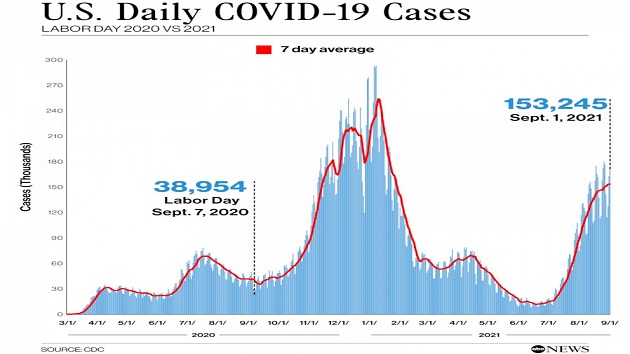
Last year, in the weeks prior to Labor Day, the country was experiencing a steady decline in COVID-19 cases, with the national daily case average falling to approximately 38,000.

However, the late summer holiday weekend set the stage for the country’s most significant viral surge of the pandemic. Between mid-September and Thanksgiving, the nation’s daily case average rose by more than 400%, followed by a record-setting influx of hospitalizations and deaths.

The country’s current average is now more than 100,000 daily cases higher than it was a year ago, with the U.S. reporting more than 153,000 new cases each day, following weeks of increasing metrics. Since the Fourth of July, COVID-19-related infections, hospitalizations and deaths surged to levels not seen since last winter.

“As we head into Labor Day, we should all be concerned about history repeating itself. High or intense transmission around most of the country combined with population mobility with limited masking and social distancing has been a consistent predictor of major surges,” said Dr. John Brownstein, an epidemiologist at Boston Children’s Hospital and an ABC News contributor.

Experts are warning that although vaccination rates may help partially blunt the impact of a potential Labor Day holiday surge this year, and protect those who are inoculated against severe disease, the country could still be at-risk for the unwanted impacts of unmitigated spread.

“While we now have widespread vaccine uptake, we still have large segments of the population that remain fertile ground for the virus to spread, including our children,” Brownstein said.

With more than 47% of Americans still not fully vaccinated, there is concern that an increase in infections could push already struggling health systems in states with low vaccination rates to the brink, Brownstein added.

Seven states — Alabama, Arkansas, Florida, Georgia, Kentucky, Mississippi and Texas — have intensive care units about 90% or more filled, and nationally, nearly 8 in 10 staffed adult ICU beds are occupied by COVID or non-COVID patients.

A recent report published by the CDC found unvaccinated people were five times more likely to get COVID-19 than vaccinated people — and 29 times more likely to be hospitalized for their infections, and ICU bed capacity remains tight in several states with low vaccination rates.

“We need more individuals to step up, as people across the country prepare for Labor Day weekend,” White House COVID-19 response coordinator Jeff Zients said during Tuesday’s briefing. “It’s critical that being vaccinated is part of their pre-holiday checklist.”

Walensky added that while fully vaccinated people can feel comfortable traveling, with the added protection of masks, it is important that they take into consideration the risks of COVID-19 infection, given the high transmissibility of the delta variant, prior to deciding whether to or not to travel.

It is also essential, said Walensky, that those who choose to celebrate the weekend holiday take precautions in order to keep themselves safe, such as gathering outside and with others who are vaccinated.

“Throughout the pandemic, we have seen that the vast majority of transmission takes place among unvaccinated people in closed, indoor settings,” she warned.

Further, Walensky said, while inside, wear masks to mitigate the spread of the disease.

The warnings come at yet another critical turning point in the pandemic, with infection rates still on the rise driven by the highly contagious delta variant.

Every state in the country is now experiencing high community transmission and nearly 103,000 Americans are currently hospitalized with the virus — one of the highest numbers of patients receiving care in seven months. An average of 1,000 Americans are also currently losing their lives each day from the virus.

Also, pediatric COVID-19 infections and hospitalizations are reaching their highest point of the pandemic, as many unvaccinated children fall victim to the virus.

“With children returning to in-person school after Labor Day, health officials stress it is critical to act cautiously and responsibly in order to reduce transmission,” Brownstein said.

In the last week alone, nearly 204,000 children have tested positive for COVID-19, marking the second highest week on record, according to the American Academy of Pediatrics and the Children’s Hospital Association.

Since the Fourth of July, the rate of child hospital admissions per capita has grown sevenfold, coinciding with the rapid spread of the highly infectious delta variant. Further, hospitalization rates among unvaccinated adolescents were 10 times the rate of those fully vaccinated, according to a newly released CDC study.

“It will be critical for eligible Americans who are still unvaccinated to get the shot, and protect those who are still vulnerable,” Brownstein said.

Copyright © 2021, ABC Audio. All rights reserved.

Democrats plan vote on abortion rights bill after Supreme Court doesn’t block Texas law

Kevin Dietsch/Getty Images

(WASHINGTON) — The House will vote in late September to protect abortion rights, House Speaker Nancy Pelosi, D-Calif., said this week, after the Supreme Court rejected a request to block the new Texas law outlawing most abortions in the state after six weeks.

The court’s late-night ruling left Democrats in Washington and across the country scrambling to respond, sparking vows for action on Capitol Hill and renewed calls from activists for the expansion of the Supreme Court currently controlled by conservatives.

“It’s so stunning,” Pelosi said Thursday at an event in Texas, pledging a House vote when the chamber returns at the end of the month to “make sure that women everywhere have access to reproductive health that they need.”

Democrats have coalesced around the Women’s Health Protection Act, which would “enshrine the protections of Roe v. Wade into law,” Rep. Judy Chu, D-Calif., the lead author of the bill, told ABC News.

“If it were to pass, then abortion access would be protected everywhere, in every state,” Chu said, adding that the House is expected to vote on the measure the week of Sept. 20.

But the path forward is unclear in the Senate, where Democrats hold a majority with just 50 seats. Forty-eight Democrats back the bill; Sens. Bob Casey of Pennsylvania and Joe Manchin of West Virginia are not co-sponsors.

Even with the support of pro-choice GOP Sens. Susan Collins of Maine and Lisa Murkowski of Alaska, the proposal would still lack the votes to clear the chamber’s 60-vote threshold to reach the president’s desk.

While a Senate Democratic aide claimed “all options are on the table” in response to the Supreme Court’s decision, Chu was skeptical that the party could use the budget reconciliation process, which Democrats are using to pass President Joe Biden’s policy agenda with just 50 votes in the Senate around GOP opposition, to enact abortion protections.

“Whatever we pass with reconciliation has to have a direct impact on the budget, and I have to think that this would not qualify,” she said.

Even if Democrats did pass a bill to enshrine the protections of the landmark 1973 Supreme Court decision, it wouldn’t be a “silver bullet,” said Kate Shaw, a constitutional law professor at Cardozo School of Law and ABC News legal contributor.

“As a constitutional matter, I do think Congress is on solid footing, but I also think it’s possible that this conservative Supreme Court, particularly if it was hostile to the effort to enshrine in federal law abortion protections, could be inclined to read Congress’s [authority] narrowly, which could result in this law being invalidated,” Shaw said.

With the court’s 6-3 conservative majority, and plans to take up a major abortion case later this fall brought by the state of Mississippi, some Democrats are pressuring party leaders to consider altering the number of justices on the highest court for the first time since 1869 — or change Senate rules to empower Democrats to pass abortion legislation with just 50 votes.

“We need to restore balance to the court after Donald Trump and Senator Mitch McConnell blatantly stole the seats of Justice Scalise and Justice Ginsburg,” Sen. Ed Markey, D-Mass., said in a statement, referring to Senate Republicans’ refusal to fill the seat left vacant by the death of the late Justice Antonin Scalia until after the 2016 presidential election, and decision to confirm a replacement for the late liberal Justice Ruth Bader Ginsburg in the fall of 2020, before the election.

Rep. Ayanna Pressley, D-Mass., a member of the progressive “squad” and co-sponsor of the Women’s Health Protection Act, has been among those calling to expand the court.

“We need to abolish the filibuster and we need to expand the court,” Pressley told ABC News Friday night. “I’m not at all surprised by the extreme response of this court. The courts have not been on our side, and that’s why Congress must act.”

But Biden, a former chair of the Senate Judiciary Committee, has been wary of changing Senate rules or altering the composition of the Supreme Court, and instead set up a commission to study the issue.

“He’s waiting for the conclusion of [the commission’s] report, looks forward to reviewing it, seeing where they come out,” White House press secretary Jen Psaki said Thursday.

Democratic candidates and operatives also expect the Supreme Court’s actions to reverberate into the upcoming election cycles, likely turning abortion into a major issue for the party looking to defend gubernatorial seats in 2021 and the House and Senate majorities in 2022.

ABC News’ Trish Turner contributed to this report.

Copyright © 2021, ABC Audio. All rights reserved.