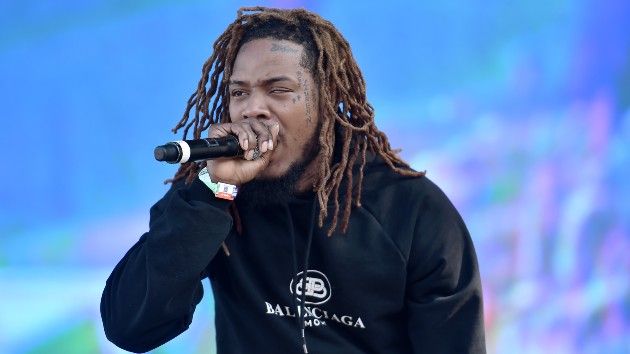
Fetty Wap pleaded not guilty to federal drug charges during an arraignment Friday in Central Islip federal court in Long Island, New York, ABC News confirms.
Federal prosecutors asked that the rapper be detained pre-trial, which the defense did not contest.
“This defendant is part of an organization that systematically distributed 100 kilograms of fentanyl and heroin across Long Island,” assistant U.S. Attorney Andrew Wenzel said.
Prosecutors noted Fetty Wap, birth name William Junior Maxwell II, faces a minimum of 10 years in prison and a maximum sentence of life in prison if convicted.
The rapper was arrested Thursday during the Rolling Loud music festival at Citi Field in Queens, New York. He was charged with five others, including a New Jersey corrections officer, with conspiring to distribute and possess controlled substances across Long Island and New Jersey.
2021 just keeps on getting better for Elton John. After scoring his first number-one single in his native U.K. in nearly 20 years with “Cold Heart” two weeks ago, his latest album, The Lockdown Sessions, has debuted at number one on the Official U.K. Albums Chart.
The Lockdown Sessions, which features Sir Elton singing with everyone from Stevie Wonder, Stevie Nicks and Charlie Puth to Miley Cyrus, Eddie Vedder and Lil Nas X, is Elton’s first chart-topper in Great Britain since 2012.
On Instagram, a delighted Elton writes, “This album is all about the capacity for music to bring people together to form new friendships and connections. And right now I couldn’t feel more connected to my amazing fans in the U.K. who made this happen.”
He continues, “When I started collaborating with some of my favorite artists at the start of the pandemic, I couldn’t have dreamt in my wildest dreams it would lead to a number one album. I am so proud of what we have created and thrilled that it has connected with our fans to such a degree. It shows the spirit of collaboration and togetherness that can still happen in the most trying circumstances.”
Elton’s songwriting partner Bernie Taupin didn’t co-write any of the tunes on The Lockdown Sessions — with the exception of “Cold Heart” — but he still jumped into Elton’s comments section to write, “Yea buddy congratulations.”
Elton’s last #1 U.K. album was 2012’s Good Morning to the Night, which featured dozens of his old hits remixed and spliced together by Australian dance duo Pnau, the same team who similarly put together “Cold Heart.”
(NEW YORK) — Another 28 million Americans are one step closer to getting vaccinated against COVID-19 after the Food and Drug Administration on Friday authorized the Pfizer shot for 5-11-year-olds.
Children will be one of the last groups in the U.S. to become eligible for the vaccine. Protecting them against COVID-19 is a major step in getting the country back on the path to normalcy after an unexpected late-summer surge that disproportionately impacted unvaccinated Americans and filled hospitals to the brim.
“As a mother and a physician, I know that parents, caregivers, school staff, and children have been waiting for today’s authorization. Vaccinating younger children against COVID-19 will bring us closer to returning to a sense of normalcy,” Acting FDA Commissioner Janet Woodcock said in a statement Friday afternoon.
The process now heads to the Centers for Disease Control and Prevention. An advisory committee for the CDC will meet on Tuesday to discuss the pediatric vaccine safety and efficacy data, as an advisory FDA panel did this past week, and then CDC Director Rochelle Walensky is expected to give the final signoff soon afterward.
That means kids could begin getting shots at some point next week and become fully vaccinated by December.
In anticipation, the White House planned to unleash millions of vaccine shipments across the nation as soon as FDA authorization was announced. Vaccine sites will have to wait for the CDC’s word to begin administering the vaccine, but stock will be on hand.
“The bottom line is that we will be ready immediately following FDA and CDC decisions so that parents can get their kids vaccinated quickly, easily and conveniently,” White House COVID-19 coordinator Jeff Zients said at a briefing with reporters on Thursday.
The White House purchased enough shots for all 28 million 5-11-year-olds and on Thursday announced plans to purchase another 50 million shots by April 30, 2022, which could also be used for children under 5, if and when there is authorization for that age group.
Though there was some debate at the FDA advisory meeting about the potential side effects for children 5-11 — particularly because myocarditis, a condition involving inflammation of the heart, has been linked to the vaccine in teenage boys and young men — the panel nearly unanimously voted in favor of the vaccine, deciding that the risk was worth the benefit.
None of the 2,200 kids who received the Pfizer-BioNTech pediatric vaccine last June in the clinical trials have experienced serious side effects, including myocarditis.
Meanwhile, nearly 2 million kids ages 5-11 have gotten COVID, and 8,300 have been hospitalized with COVID-19. A third of those children ended up in the ICU and over 100 have died.
“To me the question is pretty clear. We don’t want children to be dying of COVID, even if it is far fewer children than adults, and we don’t want them in the ICU,” Dr. Amanda Cohn, an epidemiologist with the CDC, said at the FDA meeting on Tuesday.
Dr. William Gruber, the senior vice president of Pfizer Vaccine Clinical Research and Development, told ABC News in an interview Friday that he also saw the vaccine as a way to protect children from the emotional instability the virus has wrought. Widespread vaccination could keep children out of quarantine after being exposed at school and ensure the safety of indoor activities ahead of the winter.
He pointed to the benefits of “allowing children to be children.”
“This allows that to open up again, we’ve been seeing step-by-step progress and opening up society. It’s time for that to happen with children as well,” Gruber said.
Whether parents will embrace the vaccines for their kids is still a question. In an October poll, the Kaiser Family Foundation found that about a third of parents with kids ages 5-11 were willing to vaccinate their kids right away, while another third wanted to “wait and see.” The figures represented a slight uptick in vaccine acceptance among parents of elementary-school-aged kids since July, but they have stayed steady since September.
The CDC director on Thursday emphasized the urgency of getting kids vaccinated, even as the country recovers from an alarming uptick of cases and begins to relax again.
“There’s urgency because we’re seeing disease in children, we’ve seen deaths in children and we’ve seen long COVID,” Walensky said at a White House briefing.
And as America saw during the delta surge, unvaccinated areas will be the most vulnerable if there are future spikes in cases.
“Certainly we have seen cases come down before and a way to prevent surges again is to get more and more people vaccinated and make sure that we have protection,” Walensky said.
Are Dan + Shay planning to release holiday music this year? Some fans certainly think so, as the duo have been on social media this week dropping hints about something Christmas-y to come.
“60 days ’til Christmas. Just sayin’,” Dan + Shay wrote on their socials. While they didn’t share many more details than that, fans poured into the comments section, clamoring for Christmas music from the group, or possibly even a full holiday album.
It wouldn’t be out of the realm of possibility: Last year, Dan + Shay dropped a pair of original holiday tracks, “Take Me Home for Christmas” and “Christmas Isn’t Christmas.” On the heels of their success with those two songs, the pair posted an end-of-year reflection letter to fans just a couple of days after Christmas 2020, which said they were thinking about putting out more holiday music in 2021.
“It’s been really encouraging, and has inspired lots of conversations about doing more next year (if you think we should, let us know),” they wrote at the time, adding, “It’s always been a dream of ours to release Christmas music.”
In non-holiday related news, Dan + Shay are still riding the high of their latest album, Good Things. They’re also on the road for their The (Arena) Tour, which makes up some dates that were canceled amid the 2020 COVID-19 pandemic and also includes brand-new stops.
(WASHINGTON) — The Biden administration is launching a new effort with The Rockefeller Foundation to encourage schools to set up surveillance COVID testing for students and staff, ABC News has learned.
The effort, which will be led by the Education Department and Centers for Disease Control and Prevention, comes seven months after President Joe Biden pledged $10 billion for testing by schools.
The idea is that school districts around the country, particularly elementary schools with large populations of unvaccinated children, would routinely test kids, teachers and other staff for COVID-19 to prevent the spread of the virus.
But some states have rejected their share of the $10 billion in federal funds for COVID-19 testing in schools while others have been painfully slow in actually implementing virus mitigation plans.
A survey of the nation’s 100 largest school districts from the Center on Reinventing Public Education found that less than 15% of those schools are utilizing federal funding dollars to establish COVID-19 in-school screening programs.
Meanwhile, pediatric COVID cases increased this summer with many school districts reporting mass quarantines at the beginning of the school year.
Will Smith dropped the trailer for his Best Shape of My Life docuseries Friday, and in the clip, he reveals that he had thoughts of taking his own life.
The Fresh Prince of Bel Air star is publishing his autobiography, simply titled Will, on November 9. In discussing revelations in the book with family members in the clip, including son Jaden and daughter Willow, he shocks them when he says, “That was the only time in my life that I considered suicide.”
The 53-year-old entertainer also admits that he’s not the hero he portrays in films such as Men in Black.
“This began as a journey to get into the best shape of my life,” he says to start the trailer. His goal was to lose 20 pounds in 20 weeks; however, he says he discovered he was not mentally ready.
At one point Will declares,”I don’t want to do any of this. I’m finished with the Best Shape of My Life.”
The trailer also shows him reading a confessional statement, admitting, “What you’ve come to understand as Will Smith, the alien-annihilating MC, the bigger-than-life movie star, is largely a construction, a carefully crafted and honed character designed to protect myself, to hide myself from the world, to hide the coward.”
The six-part unscripted docuseries Best Shape of My Life debuts Monday, November 8, on Will’s YouTube channel.
Smith also stars as Richard Williams, the father of Serena and Venus Williams, in the film King Richard, premiering November 19.
(NEW YORK) — Michael and Jennifer Spaetti of Salisbury, North Carolina, were both vaccinated last spring as soon as shots became available. But when it comes to their 6-year-old grandson who lives with them, they aren’t so sure.
As his primary caregiver, they wonder about long-term side effects. He also hates getting shots, guaranteeing that an extra trip to the pediatrician would be tough emotionally.
“I’m not sure. It just seems like it came out so fast,” said Jennifer Spaetti. “And we’re talking about a child. I feel like it’s different for me, but I just I’m not sure. I don’t think I know enough about it.”
Denise, a mother of two from Columbia, South Carolina, expressed similar concerns. Asked to withhold her last name for privacy reasons, Denise jokes she would feel more comfortable seeing the neighborhood kids get their shots fist, just in case there is some rare side effect that researchers missed.
And as a Black mother, Denise said she worries not enough African American children were represented in the clinical trials.
“My husband is gung-ho,” she said. “And I’m definitely not opposed to it. But I do just want to wait and see … I want to make the best decision as a parent.”
With the first pediatric vaccine for COVID-19 expected to roll out as early as Nov. 3, only 27% of parents with kids ages 5-11 say they will vaccinate them “right away,” according to the latest poll by the Kaiser Family Foundation.
Another 33% of parents with the elementary-aged kids say they want to “wait and see” how it works in others before getting their child vaccinated. And at least two thirds of those parents say they are concerned about potential long-term and serious side effects.
This hesitancy is worrying many health officials, who contend widespread vaccinations in schools will be critical to vaccinate kids ahead of the cold weather to prevent another surge in cases.
They also counter that parents should be much more worried about the virus than the vaccine. Of the 1.9 million kids ages 5-11 who contracted the virus, 8,300 wound up hospitalized. One third of those children hospitalized had no underlying health conditions.
Another concern pediatricians have is that children exposed to the virus are at risk of developing “long-haul” symptoms. While very rare for children, the symptoms such as brain fog, chest pain and debilitating fatigue persist for weeks after exposure.
None of the 2,200 kids who received the Pfizer-BioNTech pediatric vaccine last June in the clinical trials has experienced serious side effects, including the myocarditis that’s been seen in a small group of older teen and adult males. Experts say any side effects to a vaccine typically occur within two months of getting a shot.
The Centers for Disease Control and Prevention, along with independent vaccine and health experts, also have found no evidence that the vaccine could impact a person’s fertility and is safe for pregnant and breastfeeding moms.
The CDC also warns that people shouldn’t count on prior exposure to the virus. In a study released Friday, the CDC found adults with “natural” immunity through infection were more than five times more likely to develop COVID-19 compared to people who were fully vaccinated.
Still, even vaccine experts say it can be nerve-wracking to make a decision for millions of children based on a study involving only a few thousand kids.
The trial also wasn’t as diverse as some experts would like. Of the children participating in the clinical trials, the vast majority of participants – 78% — were white. Six percent were Black, while 21% were Hispanic and 6% were Asian.
Dr. Paul Offit, an adviser to the U.S. Food and Drug Administration, who voted in favor of authorizing the vaccine at a meeting this week, said he still supports the rollout because he believed the benefits outweigh the risks.
The FDA was expected to authorize the pediatric vaccine as early as Friday, with the Centers for Disease Control and Prevention expected to sign off next week.
“The question is when do you know enough? And I think we certainly know that there are many children between five and 11 years of age who are susceptible to this disease who could very well be sick and are hospitalized or die from it,” said Offit, director of the Vaccine Education Center and an attending physician in the Division of Infectious Diseases at Children’s Hospital of Philadelphia.
For its part, the White House is planning to launch a social media campaign to urge parents to vaccinate their kids. To increase trust, federal officials also have pushed to make the vaccine for kids – which is a third of the dosage used in adults and comes in a special orange-capped vial — widely available in pediatrician offices and pharmacies, rather than relying on mass vaccination sites.
Still, many parents don’t want to be rushed.
Paul Ekeoha, a father of four kids in Odessa, Texas, says he’s not convinced yet that his kids need it because they seem healthy now and strong. At the same time, he’s not opposed to vaccines for other people and said he is open to changing his mind.
“If my hands are tied, and I don’t have options, I wouldn’t have any objection,” Ekeoha said.
Other parents said they would be keeping a close eye on how the rollout goes for pediatric vaccines.
“Probably what I’ll do is just wait and see how it goes,” said Jennifer Spaetti.
(NEW YORK) — Letitia James, the attorney general of New York whose sexual harassment investigation led to the resignation of former Gov. Andrew Cuomo, announced a run for governor Friday, mounting a formidable primary challenge to Kathy Hochul, the state’s first female governor.
James could become the state’s first Black governor and the nation’s first Black female governor.
James announced her candidacy in a video and through a campaign website highlighting her election promises and past work as attorney general.
“New Yorkers need a governor who isn’t afraid to stand up to powerful interests on behalf of the vulnerable,” James said.
Two other Brooklyn Democrats, New York City Public Advocate Jumaane Williams and New York City Mayor Bill de Blasio, are also interested in the job, along with Long Island Democratic Congressman Tom Suozzi.
In August, James released a report that found Cuomo sexually harassed multiple women, including a state trooper on his security detail. Cuomo attacked the report as politically motivated.
New York State Republican Committee Chairman Nick Langworthy called James a “radical left ideologue” who “turned a blind eye to Cuomo’s unethical behavior and corruption … when it suited her needs” in a statement Friday.
As attorney general, James has bolstered her profile with a lawsuit against the National Rifle Association. Her office is also investigating whether former President Donald Trump manipulated the value of some of his real estate holdings for tax and insurance purposes.
“I’ve sued the Trump administration 76 times,” James mentioned in her announcement video. “But who’s counting?”
She previously served in the New York City council and as the city’s public advocate.
(NEW YORK) — As the clock counts down, nearly 80% of New York City municipal employees have complied with a COVID-19 vaccine mandate, city officials said.
Nearly all city workers, including police officers, firefighters and emergency medical technicians, have until 5 p.m. Friday to get at least one dose of the vaccine or be placed on unpaid leave, starting Monday.
Mayor Bill de Blasio has said the city anticipates that many outstanding employees will get vaccinated close to the deadline, and city agencies have been making final pushes to drive up their numbers.
On Thursday, more than 1,000 NYPD members got their first shot, Commissioner Dermot Shea said. As of Friday morning, 80% of the department was vaccinated, Shea said on 1010 WINS radio. He said he believes that the department will be in “good shape for Monday morning,” but will move resources to ensure appropriate coverage.
Prior contingency plans are “being actually scaled-down” as NYPD officials watch vaccination rates rise, with Shea telling Channel 5 on Friday they’re now more concerned about filling “individual shifts” than staffing precincts on Monday.
“We will move resources around. We have had significant increase in people getting vaccinated in the past three days, and that’s the good news,” Shea told Channel 5. “The contingencies are there. New Yorkers should not, should not, be worried about this.”
Paul McCartney apparently is now claiming that he wrote the opening lines to the classic 1967 Beatles song “A Day in the Life,” which previously had been attributed to the late John Lennon.
The Daily Mail reports that in McCartney’s upcoming book The Lyrics: 1956 to the Present, he claims that when he wrote the lyrics “He blew his mind out in a car/ He didn’t notice that the lights had changed,” he was thinking about Guinness heir Tara Browne, who was killed in a 1966 car crash.
The newspaper points out that Lennon had once said that Browne “was in my mind when I was writing that verse,” while McCartney was quoted as saying in a 1997 biography that when the song was being written, he envisioned the lines being about “a politician bombed out on drugs who’d stopped at some traffic lights and didn’t notice that the lights had changed.”
Paul then added that the lyrics had been attributed to being about “Tara Browne, which I don’t believe is the case.”
The Lyrics: 1956 to the Present will be published this Tuesday, November 2. A new video trailer promoting the book has been posted on McCarntey’s official YouTube channel that shows clips of Paul chatting with British comedian and podcast presenter Bob Mortimer about different aspects of the book and his career.
Topics Sir Paul touches on in the trailer include writing songs with Lennon, and forgetting the lyrics to “Blackbird” while he was performing at New York’s Grand Central Station in 2018. The video also captures McCartney checking out the new exhibit focusing on his book that will be opening at the British Library in London on November 5.