FINNEAS has premiered the video for “Only a Lifetime,” a track off his new album, Optimist.
The clip stars the older O’Connell sibling as he wanders throughout an empty aquarium until the end, when he’s joined by his sister, Billie Eilish, and what appears to be their parents.
“A lot of people were pacing around their houses, praying for lockdown to be lifted, and waiting for the vaccine,” FINNEAS says. “I had a sudden realization — I might really miss this calm time I had with my family and my girlfriend.”
“Only a Lifetime,” FINNEAS shares, reflects him “trying to remind myself to stay present and stay engaged no matter what is going on.”
You can watch the “Only a Lifetime” video streaming now on YouTube.
Optimist, FINNEAS’ first full-length solo effort, was released this past October. He’s nominated for Best New Artist at the 2022 Grammys.
(MAYFIELD, Ky.) — President Joe Biden on Wednesday surveyed storm damage and met with families in neighborhoods ravaged by the deadly tornadoes .
Biden viewed damage in Mayfield before heading to Dawson Springs and also make remarks on the federal response and “extreme weather,” according to the White House.
Shortly before noon, Marine One landed in Mayfield, and Biden was greeted on the tarmac in Fort Campbell by Kentucky Gov. Andy Beshear, stopping for a five-minute conversation.
Deputy principal press secretary Karine Jean-Pierre said Biden’s message on Wednesday “is that he and the federal government intend to do whatever it takes, for as long as it takes, by providing any support that is needed to aid recovery efforts and support the people of Kentucky — and of other impacted states as they rebuild.”
“It is going to be a very long, long road ahead. And so that’s the president’s focus right now is to talk, specifically to hear from the elected officials on the ground,” she told reporters earlier on Air Force One.
Before receiving a briefing from state and local officials in Kentucky, Biden vowed all the federal support he can provide to the area, both now and in the months to come.
“Immediately after a disaster is a time when people are really, really moving, and trying to help each other and trying to get things done. But after a month, after six weeks, after two months, people can get themselves to a point where they get fairly depressed about what’s going on, particularly young kids, particularly people who’ve lost somebody. And so I just want you to know, the help that we’re able to offer at the federal level, is not just now,” Biden said.
“I’ve instructed my team to make you all aware of everything that is available from a federal level,” Biden added later on. “And some of it has to do outside of FEMA, outside of Homeland Security, there’s other programs, including education, there’s a whole range of things, but I’m here to listen.”
The president seemed struck by the scale of the damage he saw on his aerial tour.
“As you fly over here, as I’ve done in the past, I’ve not seen this tornado, this much damage from a tornado. You know, you think, but for the grace of God, why was I not 100 yards outside that line? Which makes it so different,” he noted.
After a briefing in Mayfield by local leaders “on the impacts of the tornadoes and extreme weather,” according to the White House, Biden will then continue on to Dawson Springs and that tour will culminate in remarks at 4 p.m. EST.
White House press secretary Jen Psaki earlier this week said Biden will not be delivering a “major speech” there but rather will be “trying to be a source of comfort to people who have gone through a devastating couple of days in their communities.”
“I would expect while he’s there, he will receive an update from local authorities on what their needs are, see local elected officials and discuss in person with them and make sure they’re getting what they need from the federal government,” Psaki said.
“He also wants to hear directly from people, and he wants to offer his support directly to them,” Psaki added. “People who have gone through over the last couple of days, really incredible challenges losing their homes, losing loved ones, losing parts of their community that they’ve grown up with and I think he wants to offer his support directly to them as well.”
Biden was joined for the visit by Department of Homeland Security Secretary Alejandro Mayorkas and FEMA Administrator Deanne Criswell, who were on the ground there on Sunday.
A Whitney Houston NFT was auctioned this week for $999,999, setting a record for the highest-selling NFT on the Tezos blockchain.
From The Whitney Houston Collection, the NFT is an early, never-before heard, full length song demo that the six-time Grammy winner recorded at just 17 years old, along with a digital video created by 17-year-old artist Diana Sinclair.
“This initial NFT drop is one of many Whitney Houston collections as we continue to tell her story, going behind the scenes and using never-before-seen content from the estate’s archives to celebrate her career, music, and talent in new and creative ways,” Rob Dippold, partner & president of Digital Strategy for Primary Wave Music, said in a statement.
Whitney E. Houston Estate President and CEO Pat Houston loved having Sinclair involved in the project.
“Being able to work with someone as young as Diana, she’s 17 years old. Whitney was 17 years old when she recorded the song. Both come from Newark, both have the same middle name. Whitney had the desire to always help others help themselves, especially young people,” Pat Houston said
“She established the Whitney E. Houston Foundation in 1989 and she had events each year centered around young people, so it was a no brainer when we were introduced to Diana,” Pat continued. “We want to continue Whitney’s legacy, and this is a new art form for her music to be displayed. What better way than to do it with Diana and through the NFT.”
A portion of the proceeds of the auction will go directly to the Whitney E. Houston Foundation, a non-profit that continues the work of the late star of The Bodyguard to empower, support, and inspire young people.
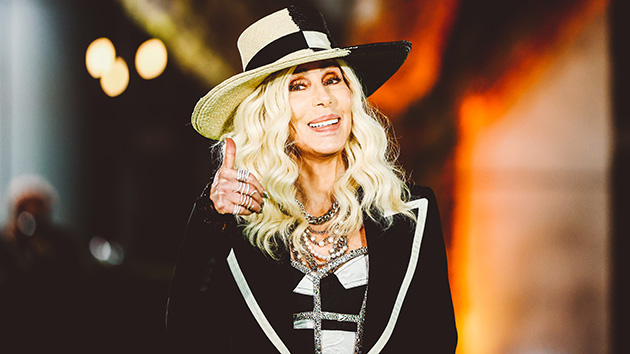
It can be a fan’s worst nightmare to come across their idol in public and fail to recognize him or her — but in the COVID-19 era where people are masking up, it is a likely reality. Case in point, one couple didn’t recognize the one and only Cher when she offered to take their photo.
The “Believe” singer posted the photo she took of them on Twitter on Tuesday and joked about the situation. Cher explained that she was “coming out of [a] movie” when she saw a “beautiful couple” posing for photos with a gorgeous bouquet of flowers.
“I said…can I take your Pic…Had my mask on so they didn’t Know Who I was,” the legend noted, and laughed about coming across as “just a crazy woman.”
Of course, it turns out the couple realized their mistake after the tweet went viral and reached out to Cher.
The woman, identified as Syndie, tweeted back, “Omg! That’s me, and it was my birthday! Wow! I can’t believe it!” She also responded to some incredulous fans who had a hard time believing Cher was that unrecognizable.
When asked why she was unable to recognize Cher’s voice, Syndie explained, “She had a mask on, and when she asked to take our photo, she was far away from us.” The birthday girl also said the room was dark, but admitted that the way Cher carried herself clued her and her boyfriend in that they weren’t interacting with “an average person.”
Either way, the lovebirds are thrilled that they were able to share a special moment with Cher. The boyfriend, who goes by the name Tehran Stokes on Twitter, marveled, “This night will certainly be remembered forever.”
Syndie joked back, “If only we could ‘turn back time.'”
When we were coming out of movie I saw beautiful
Couple.He Was taking
Her pic….She had flowers
I said … can I take your
Pic….Had my mask on so they didn’t Know Who I was. MAYBE Just a crazy woman..
THAT ME pic.twitter.com/M02p8I3tCk
(WASHINGTON) — Federal Reserve officials announced Wednesday that they intend to more rapidly end pandemic-era monetary policies meant to support the economy as surging inflation casts a new shadow over the recovery.
The U.S. central bank announced it would accelerate the tapering of its bond-buying program that flushed financial markets with liquidity during the coronavirus-induced downturn. Fed officials voted to keep interest rates near-zero currently, but indicated that they anticipated as many as three interest rate hikes starting in 2022.
“The path of the economy continues to depend on the course of the virus,” the Fed officials said in a policy statement Wednesday. “Progress on vaccinations and an easing of supply constraints are expected to support continued gains in economic activity and employment as well as a reduction in inflation. Risks to the economic outlook remain, including from new variants of the virus.”
The policy shift comes on the heels of the Federal Reserve’s final meeting of the year, which ended Wednesday afternoon.
The committee decided during the meeting to “double the pace of reductions in its asset purchases,” Federal Reserve Chair Jerome Powell said in a post-meeting news conference, signaling the pandemic-era program could be halted completely by March.
“Beginning in mid-January, we will reduce the monthly pace of our net asset purchases by $20 billion for Treasury securities and $10 billion for agency mortgage-backed securities,” Powell said. “If the economy evolves broadly as expected, similar reductions in the pace of that asset purchases will likely be appropriate each month, implying that increases in our securities holdings would cease by mid-March, a few months sooner than we anticipated in early November.”
He added that they are phasing out purchases more rapidly because, “with elevated inflation pressures and a rapidly strengthening labor market, the economy no longer needs increasing amounts of policy support.”
Powell also said supply constraints and bottlenecks have limited how quickly production can respond to recent rises in demand, resulting in elevated levels of inflation.
“These problems have been larger and longer lasting than anticipated, exacerbated by waves of the virus,” Powell said. “While the drivers of higher inflation have been predominantly connected to the dislocations caused by the pandemic, price increases have now spread to a broader range of goods and services.”
While Powell didn’t use the words “temporary” or “transitory” to describe inflation levels — as he and the Fed have previously — he did say inflation is expected to continue falling, to levels closer to the longer-run goal of 2%, by “the end of next year.”
“I think the Fed is showing that they’re taking this threat of higher inflation seriously, more seriously than they seemed to be before, but they still think that inflation should abate next year,” said Megan Greene, global chief economist at the advisory firm Kroll Institute and a senior fellow at the Harvard Kennedy School.
Greene said open-ended questions about changing labor force participation patterns and evolving consumer habits in the wake of the pandemic ultimately will have a big impact on how policymakers can react to inflation.
“There are fewer people in the labor force now than there were before the pandemic, and there’s a big question about whether that’s just the big structural change, or whether people might still jump in off the sidelines and get jobs,” Greene told ABC News. “And we’ve never been through this before, so we just don’t know, but if the labor force participation rate is just lower now, then the labor market is pretty tight and that makes sustained inflation a bigger threat.”
Americans also are changing their spending habits, she said.
“It’s not just that as the economy reopened and there’s a surge in demand, there’s also been a change in what we have a demand for,” she said. “In the 1960s, two-thirds of what we bought were goods. Right before the pandemic, two-thirds of what we bought were services.”
The pandemic reversed that decades-long shift, but it’s unclear whether it’s structural or related to lingering worries over the virus, according to Greene.
“All the inflation pretty much is in goods, so there’s a question, Is this just a change in our consumption habits now? Or is it that people are worried that going to the gym will land them in the hospital, so they’re not paying for those kinds of services anymore?” Greene told ABC News.
She said while the “jury’s out” on how this trend will play out as the pandemic ebbs, it’s something the Fed will have to figure out to better address inflation.
While the Fed’s projections indicate the possibility of up to three rate hikes in 2022, Greene suggests Americans take this with a “grain of salt” for now, saying that the data released Wednesday only indicates what each member of the Federal Open Market Committee thinks will happen “based on their own assumptions about inflation and growth and unemployment.”
The Fed’s policy shifts comes, meanwhile, as data indicates inflation hit a 39-year high last month. The government’s consumer price index, which measures the prices consumers pay for a basket of everyday goods and services, soared 6.8% in the last 12 months — the largest such increase since 1982.
The latest indicators inflation is tightening its grip on the U.S. economy have thrown a wrench in the Fed’s original plans to boost the economy throughout the pandemic.
Economists have attributed the rapidly climbing consumer prices largely to supply-demand imbalances lingering from the pandemic shock to the economy. Global supply chain issues, and an apparent shortage of workers accepting low-wage jobs in the service industry, have been linked to supply not being able to keep up with the surging consumer demand for goods and services as the pandemic wanes in the U.S. As a result, prices have been rising at a rapid clip.
The risk of inflation snowballing out of control, such as what was seen in the U.S. in the 1970s, makes it more difficult for the Fed to continue its easy monetary policy that was initiated during the pandemic — such as keeping interest rates low and injecting liquidity into financial markets. While these policies can help stimulate consumer demand, economists have linked the rising prices to issues clobbering the supply-side of the equation, not the demand side.
“We understand that high inflation imposes significant hardship, especially on those least able to meet the higher costs of essentials like food, housing and transportation,” Powell said. “We are committed to our price stability goal. We will use our tools both to support the economy and a strong labor market and to prevent higher inflation from becoming entrenched.”
Actually, as the Oscar winner confessed to Collider last year, the movie centers on a, “neurotic, high-strung, anxiety-ridden” spoof of himself, who, despite his Hollywood stardom, is in need of a quick paycheck.
To that end, Cage’s agent, played by Neil Patrick Harris, has an offer: come to the destination birthday party of an equally eccentric billionaire, Javi Gutierrez, played by The Mandalorian‘s Pedro Pascal, and collect a million bucks.
Javi even has a shrine dedicated to the actor, complete with a less-than-Madam Tussaud’s-quality life-sized replica of the Face-Off star.
“It’s grotesque,” Cage bristles. “I’ll give you $20 thousand dollars for it.”
Again, not totally off-base, seeing as the real Cage once allegedly outbid Leonardo DiCaprio for a 67-million-year-old, $300,000 dinosaur skull.
In the trailer, Cage pokes fun at himself as his big-screen alter-ego chews scenery, dons disguises, and goes on the run with his equally weird new friend. It’s not exactly clear what happens once he does, but anything’s possible from a movie its producers are calling “The Most Nicolas Cage Movie Ever.”
Also starring Tiffany Haddish, The Unbearable Weight of Massive Talent opens April 22.
While Nicole “Snooki” Polizzi is a massive Real Housewives fan, don’t expect her to represent Jersey on a future installment.
Snooki, who came to fame on MTV’s reality show Jersey Shore, is just happy watching the Bravo show with other fans. And while her wild nights were cataloged on Jersey Shore and its spin-offs, Snooki is sure she can’t “hang” with the Housewives gang.
“I’m, like, terrified because some of those girls. They get into it.” the 34-year-old tells Page Six. “I don’t really go out. I like to stay home. I like to be in bed by eight.”
The mom, TV star and entrepreneur confesses, “Even though I’m on a reality show, I hate drama. I like positivity and I like just having a good time and going home. I just feel like that would be [too] wild.”
The publication notes the mom to 9-year-old Lorenzo, 7-year-old Giovanna and 2-year-old Angelo was quick to shoot down a rumor in 2020 that she was being scouted for a future installment of The Real Housewives of New Jersey.
Snooki is currently filming a new season of Jersey Shore Family Vacation.
Tool drummer Danny Carey has a court date after being arrested in Kansas City over the weekend, Billboard reports.
According to a citation obtained by the publication, Carey is due to appear in municipal court on January 12, 2022. The date falls between two shows on Tool’s scheduled 2022 tour: January 11 in Tacoma, Washington, and January 13 in Boise, Idaho.
Carey was arrested at the Kansas City International Airport this past Sunday after getting into an alleged altercation with another individual, according to TMZ. He was booked on misdemeanor assault and subsequently released on bond. A rep for Tool offered no comment when contacted by ABC Audio.
The citation obtained by Billboard also says Carey allegedly used a homophobic slur in accosting the other individual.
If you’re looking forward to seeing Tom Hanks‘ cameo in the forthcoming Yellowstone prequel, 1883, you can thank Tim McGraw.
Tim, who stars in the series alongside his wife and fellow country star Faith Hill, says he personally asked Tom to make an appearance in the show. Minor spoiler alert: Tom plays a Union general who shows compassion to Tim’s character — who was a Confederate officer in the Civil War — during a flashback scene, according to Deadline.
“Tom and [his wife] Rita [Wilson] and Faith and I have been friends for a long time,” Tim tells ET Online, explaining how he convinced the film star to join 1883‘s cast. “So I gave Tom a call and just asked. He goes, ‘Tell me when to be there.’ And he showed up and did it and he killed it. Of course, he’s Tom Hanks, so he’s gonna.”
The pair’s megawatt friendship isn’t quite as surprising as it sounds. Tim and Tom’s gigs have overlapped on occasion, such as during the January 2021 Celebrating America primetime television special. Tim performed on that event, and Tom hosted it.
Also, in addition to being an actor, Rita Wilson is a singer-songwriter whose musical inclinations fall inside the country genre. Faith even contributed vocals to her 2012 solo debut, AM/FM.
Ringo Starr, Joe Walsh and Jeff Lynne are among the more than 40 celebrities featured in the first-ever official video for the late George Harrison‘s chart-topping 1970 hit “My Sweet Lord,” which premiered Wednesday on Harrison’s YouTube channel.
The clip begins with Star Wars great Mark Hamill portraying the head of a clandestine bureau sending one of his agents, played Saturday Night Live alum Fred Armisen, on a quest to find “something out there” that the bureau wants him to see.
Armisen soon teams up with another agent, portrayed ex-SNL cast member Vanessa Bayer, to look for the mysterious “something.”
Along the way, they cross paths or interact with a variety of musicians, actors, comedians and other celebs. In addition to Starr, Walsh and Lynne, the video features appearances by “Weird Al” Yankovic, Jon Hamm, Rosanna Arquette, Patton Oswalt, Reggie Watts, Darren Criss, Taika Waititi, the comedy duos of Tim & Eric and Garfunkel and Oates, and many others. The clip also includes cameos from Harrison’s widow, Olivia, and son, Dhani, who served as an executive producer for the clip.
The “My Sweet Lord” video was written and directed by veteran filmmaker and music video director Lance Bangs, and uses the 2020 mix of the song that’s featured on the deluxe 50th anniversary reissues of George’s classic 1970 solo album All Things Must Pass, which were released this past August.
“Making this was one of the most fulfilling experiences of my life,” says Bangs. “The approach was to represent the song visually while these agents and inspectors kept missing the metaphysical wonder around them…George threaded a sense of humor through all of his videos, so we kept that spirit and filled the cast with friends and admirers of his music, many coming from the current comedy landscape.”