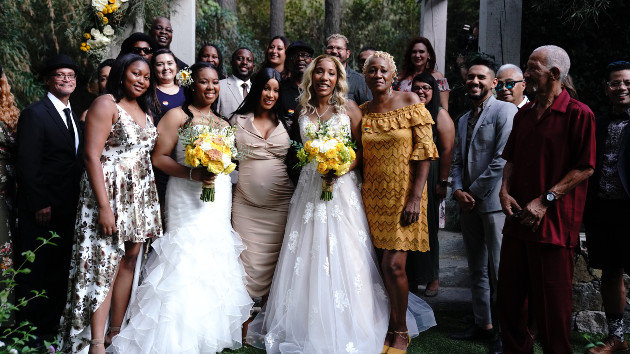
Dierks Bentley and Jason Aldean will try their hands at coaching on The Voice.
The country superstars are both serving as advisors during the Battle Rounds, Dierks coaching Blake Shelton‘s team while Jason lends his talents to Kelly Clarkson‘s contestants.
In a preview of the upcoming episodes, Blake and Dierks can’t get over each other’s hair upon reuniting.
“What happened to your hair?” Blake exclaims. “It’s the longest I’ve ever seen it.”
“What happened to yours?” Dierks jokes, referring to the mullet Blake used to have at the start of his career. “Yours is as gray as I’ve ever seen it.”
Between jabs, the “What Was I Thinkin'” singer meets the four contestants of Team Blake, in addition to coming up with a new team name, like that of celebrity couples.
“Team D-lake. The two of us,” Dierks calls them.
“D-lake, I like it,” Blake approves with a smile.
Meanwhile, Kelly and Jason reminisce on their hit duet, “Don’t You Wanna Stay” that earned them a Grammy nomination and led them to previously appearing on The Voice together.
“It was a huge song that introduced me to a whole different fan base,” Jason remarks, citing it as “the biggest duet of my career,” while Kelly calls it “one of my favorite songs ever. …I feel very fortunate to have the career I’ve had and to be able to come and share that.”
“I’m so excited to get a chance to go in there and offer any advice that I can that’s going to help them not only here at The Voice but down the road with whatever they do with their career,” Dierks reflects.
The Voice Battle Rounds begin airing tonight at 8 p.m. ET on NBC.
Following their performance on SNL over the weekend, Halsey took to social media to address comments about their post-baby body.
The singer shared photos of what their body really looked like post-pregnancy — stretch marks and all — and acknowledged it’s still changing.
“I did SNL two nights ago and a lot of people were quick to say how good I looked,” they write. “That was a weird feeling. My body has felt like a stranger’s for a long time.”
Halsey, who welcomed baby Ender in July, admitted, “I have no interest in working out right now. I’m too tired and too busy playing with my darling son.”
“With that being said, the body behind all those compliments the other night was wearing a custom tailored outfit and lighted perfectly after much testing, so I could feel good and do my job,” they wrote. “I do not want to feed the Illusion that you’re meant to feel and look ‘great’ immediately postpartum. That is not my narrative currently.”
Halsey concluded by explaining that they’ll never have their “pre baby body back” and that’s OK, but they acknowledged that the journey is still “really hard” and they are “not a superhuman.”
“Doing my best to serve my art and my family whilst keeping it all so very real. Love,” they ended their message.
(NEW YORK) — The 2021 U.S. Chess Championships are underway and Irina Krush is back to defend her title.
Krush is an eight-time U.S. women’s champion and the only female American grandmaster. She told ABC Audio’s Perspective podcast that becoming a grandmaster is not easy.
“People will become grandmasters by making things called norms, which is a certain performance, a certain high performance,” Krush said. [It’s] three sets of three tournaments where they’re playing against other grandmasters as well,” Krush said. “When you make those norms and you get your rating to a certain point, which is a threshold of 2500, then you earn your Grandmaster title for life.”
Krush said she knew from an early age that she was better than most girls and boys in her age group.
“I became a master at age 12, and I won the U.S. Women’s Championship for the first time when I was 14,” Krush said. “I was very serious about chess from a young age. I spent my weekends playing chess and sometimes my weekends and my weekdays representing the U.S. in world youth competitions around the world since the age of seven.”
Since then, Krush has been in training.
“In my eyes, chess is definitely a sport,” Krush said. “It really does require a decent level of physical fitness because it is not as easy as it looks to concentrate at your full capacity [for] four or five or sometimes six hours.”
According to Krush, becoming a grandmaster requires mastering perfecting all parts of the game, from the opening moves to the middle tactics and the strategy at the end of the game.
“It requires being exposed to better and better competition, so playing people that are better than you,” Krush said. “From the time I was a young girl, I was playing adults, and that certainly helped me improve. Going to tournaments, traveling domestically [then] later on internationally. And you know, when you make that your life, you will see results.”
And playing chess isn’t the only part of her training. Krush said it also requires a physical commitment, too.
“Certainly, from the time I was an adolescent, I started training physically, jogging regularly, playing table tennis, swimming,” Krush said. “You’re not a basketball player or a tennis player, but you have to be in good physical condition.”
Bryan Adams has released the title track and video for his brand-new album, So Happy It Hurts, due out next year.
Bryan says in a statement, “The title song…is about freedom, autonomy, spontaneity, and the thrill of the open road. The album of the same name, touches on many of the ephemeral things in life that are really the secret to happiness — most importantly, human connection.”
Bryan says those themes were inspired by the COVID-19 pandemic. “The pandemic and lockdown really brought home the truth that spontaneity can be taken away,” he explains. “Suddenly all touring stopped, no one could jump in the car and go.”
In the video for “So Happy It Hurts,” an upbeat rocker about the joys of hitting the road, Bryan does just that, driving a convertible with, variously, his real-life mother, a dog, a group of young girls dressed for a dance recital, a couple of women twerking, headbanging guitarists and a drummer, drag queens, a bodybuilder, and a dancing woman wearing a sari.
Bryan will no doubt perform some songs from the new album at a new residency he’s kicking off at the Encore Theater at the Wynn Las Vegas starting on November 10. Those dates run through November 20.
So Happy It Hurts will be available digitally, as well as a deluxe CD, and a limited edition box set that includes a hardbound book, the album on vinyl and an autographed photo. You can pre-order the album now.
So Happy It Hurts is scheduled for release March 11, 2022.
(NEW YORK) — Children can safely celebrate Halloween this year even as the coronavirus pandemic upends the holiday for the second straight year, according to the nation’s top infectious disease expert.
White House chief medical adviser Dr. Anthony Fauci told CNN Sunday that kids can “go out there and enjoy Halloween,” an approach he attributed to the fact that more and more people are now vaccinated against COVID-19 and that most Halloween activities, including trick-or-treating, are held outdoors.
“It’s a good time to reflect on why it’s important to get vaccinated,” he said, urging unvaccinated adults and teens to get shots before Halloween. “But go out there and enjoy Halloween.”
“This is a time that children love,” Fauci added. “It’s a very important part of the year for children.”
Fauci’s go-ahead on Halloween comes as COVID-19 hospitalizations, cases and deaths are declining nationwide.
But experts caution the virus could rebound if enough people remain unvaccinated.
Last week, Pfizer and BioNTech submitted a request to the Food and Drug Administration (FDA) for emergency use authorization for their vaccine for kids ages 5 to 11. But the timing means the vaccine will not be available for kids in that age group before Halloween.
The Pfizer vaccine is currently authorized for emergency use in children ages 12 to 15 and is approved by the FDA for people ages 16 and older.
Dr. John Brownstein, an epidemiologist and chief innovation officer at Boston Children’s Hospital, is the father of two young children. He said he plans to have a more “normal” Halloween with his kids this year, complete with outdoor trick-or-treating.
“It’s safe to say that trick-or-treating is an activity that all kids can partake in,” said Brownstein, who is also an ABC News contributor. “Kids can feel quite excited by the fact that I think they will have a generally normal Halloween compared to last year.”
Here are four questions answered by Brownstein about how to have a safe Halloween this year.
1. Does my child need to wear a mask while trick-or-treating this year?
In most cases, no, according to Brownstein.
“Every parent has to make their own sort of risk calculation, but given where we are in this pandemic, I think, generally, mask wearing outside is probably unnecessary,” he said, noting that data from nearly two years of the pandemic show that outdoor activities are “generally safe,” even for children who are not yet vaccinated.
“Of course, every family should make decisions that are right for them and the underlying risks of their kids and household members,” Brownstein added. “And luckily, Halloween costumes can make mask-wearing less stigmatizing.”
2. Are indoor Halloween events safe for my kids to attend?
While Brownstein is planning to trick-or-treat outdoors with his kids, he said they are planning to wait another year before attending big, indoor Halloween events.
“The bigger questions that come into play around indoor activities may involve unvaccinated people,” he said. “That’s where masking and good ventilation may be more appropriate.”
Brownstein added that people who do choose to attend indoor Halloween events this year should make sure that people at the event are vaccinated if they are eligible. He also suggests relying on additional layers of protection like social distancing and COVID-19 testing, in addition to masking and good ventilation.
3. Should my family use rapid tests? Are they reliable?
Brownstein said that in addition to vaccination, another major difference between this Halloween and last is that rapid tests are now widely available for use and are particularly smart for indoor events.
“Because rapid tests are becoming more and more pervasive, we should all be using them as a tool to limit the risk to unvaccinated people or the risk of breakthrough infections,” said Brownstein. “Within a short time frame of an event, taking a rapid test, while not 100% foolproof, will give some good reassurance that you’re not putting other people at risk by joining an indoor event.”
“I have a bunch on hand at home, ready to use as needed, so I think those are incredibly effective,” he said.
4. Does a ‘normal’ Halloween mean we’ll also have a ‘normal’ Thanksgiving and Christmas?
Brownstein said he is hopeful that more and more families and friends will be able to spend the holidays safely together this year, but stressed the importance of maintaining good public health practices to keep everyone safe, especially since the upcoming holidays typically involve more travel and time spent indoors.
“While this holiday means that we can gather more seamlessly and in a slightly more normal way, there are small things that we can all do to try to limit transmission,” he said, citing masking as a critical tool. “Transmission takes place through droplets and aerosols so whatever we can do to limit transmission will ultimately have a direct impact on whether we see a surge post-holiday.”
He added, “As we know, those surges can lead to even more significant public health measures that we’re all trying to avoid, so the small things we do during the holiday can mean even a more enjoyable life post-holiday.”
Reba McEntire is expanding her 2022 tour, and she’s taking a team of up-and-coming female artists with her.
On Monday, the country legend added 11 new dates to the Reba: Live in Concert Tour that kicks off on January 13 in Evansville, Indiana and concludes on March 19 in Rosemont, Illinois.Along the way, Reba and crew will make stops at arenas across the country in cities including Atlantic City, Pittsburgh, Birmingham, Biloxi, Omaha and more.
Sevenfemale country artistsjoin the “Fancy” singeras supporting acts: Tenille Townes, Brandy Clark,Brittney Spencer, Caylee Hammack, Caitlyn Smith, Reyna Roberts and Hannah Dasher.
Reba: Live in Concert was originally scheduled for 2020, but was postponed to 2021 and now 2022 due to the ongoing COVID-19 pandemic. Tickets go on sale October 15 at 10 a.m. local time.
The news comes fresh off the release of the three-part box set, Revived Remixed Revisited, that features reimagined versions of several of Reba’s biggest hits.
(NEW YORK) — The United States has been facing a COVID-19 surge as the more contagious delta variant continues to spread.
More than 713,000 Americans have died from COVID-19 while over 4.8 million people have died from the disease worldwide, according to real-time data compiled by the Center for Systems Science and Engineering at Johns Hopkins University.
Just 66% of Americans ages 12 and up are fully vaccinated against COVID-19, according to data from the CDC.
Here’s how the news is developing. All times Eastern:
Oct 11, 12:13 pm
Boston Marathon returns with COVID protocols in place
The Boston Marathon returned with 18,000 runners on Monday following a two-year hiatus.
The field size was reduced by 36% this year while another 28,000 runners participated in the race virtually.
Runners were required to provide proof of vaccination or a negative COVID-19 test. Although masks were not mandated for the 26.2-mile course, face coverings were enforced on participant transportation, as well as for volunteers who interacted with participants.
According to the Boston Marathon Association, 95% of all Boston Marathon volunteers were vaccinated and 100% of Boston Marathon medical volunteers were vaccinated.
Cardi B is letting fans knows she can now officiate their wedding.
“By the way WORLD I’m licensed to marry people,” the “WAP” rapper tweeted over the weekend, following the latest episode of Cardi Tries _, where Cardi took on the role of an officiant.
During the episode, which was released ahead of National Coming Out Day, Cardi, along with “ring bearer” Raven-Symoné, helped to marry same-sex couple Brandi and Shannon during their pop-up wedding.
“I do it all and this was such a fulfilling thing to do and Raven was soo fun,” Cardi continued. “I was sooo starstruck.”
The wedding surprise was initiated by bride Brandi, who enlisted both Cardi and Raven to help her marry her bride-to-be, Shannon, with an impromptu ceremony that was originally disguised as an engagement party.
“You guys are probably wondering why I’m here,” Cardi said during the event. “I’m gonna get these two beautiful ladies married.”
She continued, “It’s not only a special day for you guys. It’s a special day for me. I want to thank you guys for making me a part of your beautiful journey.”
Willy Wonka & the Chocolate Factory fans will soon learn the untold origin story of Mr. Willy Wonka himself.
While Roald Dahl‘s 1964 novel didn’t explore Wonka’s background — nor did its 1971 movie adaption — a 2005 retelling of the book starring Johnny Depp took a crack at it. The reboot framed the eccentric chocolatier’s ambitions around his joyless upbringing, where he was raised by his candy-hating father, who was a dentist.
Timothée Chalamet stars as the titular candy confectioner in the upcoming 2023 movie and on Sunday, he shared a first look of the anticipated film to his Instagram.
“The suspense is terrible, I hope it will last,” he captioned the post, a direct quote spoken by the late Gene Wilder in the 1971 movie.
One still shows Chalamet glancing devilishly to the side while standing in the snow. His costume seems to blend the styles worn by Wilder and Depp’s respective Wonka interpretations, with the Dune star wearing a brown top hat similar to the one seen in the 1971 film and a maroon jacket that more closely resembles the one Depp wore in the reboot. In addition, Chalamet’s brown and curly hair reflects the way Wilder styled his in the 50-year-old classic — unlike the sleek brunet bob Depp rocked over 15 years ago.
A second photo is a closeup of what appears to be a cane, with its intricate top opened up like a flower, revealing a little purple box tied in a red ribbon at the center.
Wonka — also starring Olivia Colman, Sally Hawkins, Rowan Atkinson and Keegan-Michael Key — is currently filming and will tell the story of how the titular character came to open a world-famous chocolate factory, including how he met his future employees, the Oompa-Loompas.
Pink may be American, but it appears that the U.K. can’t get enough of her and her music.
The British licensing company PPL has compiled data from British radio stations and TV channels, and has determined that Pink is the most-played female artist of the 21st Century in the U.K. She’s scored 13 platinum awards in that country, and received a special Outstanding Contribution to Music trophy at the 2019 BRIT Awards, the U.K. equivalent of the Grammys.
According to Britian’s Official Charts Company, Pink has also scored three U.K. number-one singles and three number-one albums, with her best-selling song in that territory being 2013’s “Just Give Me a Reason.”
Madonna is second on the PPL’s most-played list, followed by Katy Perry, Rihanna, Lady Gaga, Adele, Beyoncé, Kylie Minogue, British girl group Little Mix, and Whitney Houston. The rest of the top 20 includes acts like Taylor Swift, Dua Lipa, Kelly Clarkson, Christina Aguilera and Ariana Grande.