Home Alone, the perennial holiday movie about a mischievous boy defending his home from opportunistic burglars, will have its story continued in the new Disney+ original, Home Sweet Home Alone.
Star Aisling Bea [ASH-ling bee], who plays the protagonist’s mother, told ABC Audio the film is “not a remake” of the original 1990 movie — it’s a sequel. That’s a small relief for the Irish comedian, who admits a reboot would mean she’d be compared to Catherine O’Hara — who played Macaulay Culkin‘s on-screen mom.
“The character is so different of the mother,” said Bea, “which I think gives it a new energy and why it makes it a different film. And takes the pressure off ‘Oh, you’re reprising Catherine O’Hara’s role.'”
She further teased, “All of the characters sort of spin on their head in terms of who’s good and who’s bad.”
The This Way Up star, who was about 6 when the first Home Alone movie came out, explains why the original movie was formative for her.
“I remember when I first saw it,” Bea recalled, “I sort of felt like, ‘Oh, this is a film for me like that. It’s from my point of view,’ which was a rarity to see something that felt like a sort of adult movie in a way or comedy that that was told from the child’s eyes.”
So, what would happen if the Wet Bandits broke into her home during the holidays?
“They’d be really disappointed,” she laughed, because her valuables consist of a collection of fridge magnets and modestly-priced jewelry. “Maybe they’d take my one of my 94 pillows and cushions that I have adorning every of every surface and a lot of Irish paraphernalia!”
Home Sweet Home Alone is streaming now on Disney+.
(NEW YORK) — Starbucks workers in upstate New York are seeking to form the coffee chain’s first union in the U.S., as the labor movement gains steam in the wake of COVID-19-related shocks to the economy.
The efforts to unionize at Starbucks come as unique conditions have given many employees an upper-hand in the labor market. Workers are quitting their jobs at some of the highest rates on record, according to Bureau of Labor statistics data, and job openings also have been hitting record highs in recent months. Meanwhile, an apparent shortage of workers accepting low-wage jobs in the service industry has given employees new leverage as major companies struggle to find staff.
“We’ve been called essential workers, yet a lot of my co-workers are barely able to afford rent and putting groceries in the fridge in same week,” Casey Moore, 25, a Starbucks worker in the Buffalo area and member of the union organizing committee, told ABC News on Thursday. “I think the pandemic definitely highlighted the need for change, because it’s not sustainable.”
The unionization bid also comes after Starbucks reported earning record fourth-quarter consolidated net revenues of $8.1 billion. Shares of Starbucks, which closed at $111.44 on Thursday, are up more than 19% over the last year and have nearly doubled over the last five years.
Ballots for a union election were mailed out to Starbucks employees at three locations in the Buffalo area on Wednesday evening despite a last-minute effort on behalf of Starbucks to delay sending out the ballots as the company sought to included all Buffalo-area stores in the vote.
Kayla Blado, the press secretary for the National Labor Relations Board, confirmed to ABC News on Thursday that the union election ballots had been mailed out on Wednesday at 5 p.m. local time after the board did not respond to the Starbucks’ motion for a stay of election by that time. The ballots are going to be impounded, Blado said, meaning they won’t be counted until the board decides whether or not they’re going to review Starbucks’ request.
If the board denies the request for a review, the ballots will be counted Dec. 9, according to Blado. If the board grants the request, then a new date will be chosen to count the ballots.
“I love my job and I love what I do, and that just made it even more incredibly frustrating to see their response,” Moore told ABC News of Starbucks’ apparent reaction to the unionization bid. “One of the reasons I first started working at Starbucks was because of the progressive values that they profess to have as a company, and it’s honestly been shocking living through the this whole thing.”
The workers are seeking to be represented by Workers United, an affiliate of the Service Employees International Union.
The Starbucks Workers United group confirmed on Twitter Wednesday evening that ballots are in the mail and heading to Starbucks partners voting to organize the first unionized stores out of the over 8,000 corporate locations in the U.S.
“Despite Starbucks’ repeated attempt to stop partners from voting, the NLRB has once again upheld our legal right to vote to join a union here in Buffalo,” the Starbucks Workers United said in a statement. “Starbucks’ PR teams say they want partners to vote, yet they continue to use every delay tactic in the book to try and stop an actual vote.”
“Hopefully, the whole country can look at what partners are doing in Buffalo against the odds and realize how outdated our labor laws are when companies are allowed to interfere in the process so dramatically,” the statement added. “When partners filed for a union, we should have been allowed to vote. A company as large as Starbucks shouldn’t be able to use its wealth to intimidate us.”
Moore said working along the service industry’s front lines during the pandemic has been incredibly stressful, and just today a customer she served via the drive-thru openly told her that he’d tested positive for COVID-19.
Union membership has dwindled in recent decades, falling to 10.8% in 2020 among salaried and wage-earning workers in the U.S., according to the Bureau of Labor Statistics. In 1983, the first year the BLS collected this data, that figure was 20.1%.
Despite the slumping figures, approval for labor unions in the U.S. is at its highest levels since 1965, according to Gallup data. Some 68% of Americans approve of labor unions in 2021, the highest recorded by Gallup since a 71% mark in 1965.
Many labor economists have attributed this gap between support for unions and union membership rates to increased employer resistance to unionization and outdated labor laws that make it difficult to form unions. Advocates are seeking to reform this through proposed legislation known as the PRO Act, which seeks to expand workplace protections for union-seeking employees.
Moore told ABC News that she joined the union organizing committee a few months after she began working at Starbucks this past summer.
“I always had positive thoughts about unions — my dad is in a teacher’s union and stuff — so I knew that they were good things, but at first I was like, ‘I don’t know — I’ve never heard of unions in the service industry,'” Moore said.
She said she was inspired to get involved, however, after “meeting with people from Workers United and, like, hearing my co-workers talk about why they wanted to form a union, which is really like to have a seat at the table and to actually have a say in our workplaces.”
“I’ve learned so much about labor law, but I never anticipated just … the sheer craziness of like this whole process,” Moore added.
Starbucks’ leaders have said that unionizing would change employees’ direct relationship with the company, and they want to preserve that relationship.
“We have also asked the National Labor Relations Board to allow all partners in Buffalo stores to vote, instead of just three stores,” Rossann Williams, executive vice president of Starbucks North America, said in a letter to employees last month that was shared with ABC News. “As you know, Starbucks stores in a city or market are deeply interconnected — partners like to routinely work shifts in other stores, we transfer and promote partners between stores, we share inventory across the market, we operate under the same policies, and we share the same set of leaders.”
“We believe rather than restricting the vote to three stores, all Buffalo store partners should vote because every partner’s voice matters, especially in an important decision that may affect them all,” Williams added. She said they are hosting meetings with employees in Buffalo so they can “know the facts and have a space to hear from us directly so they can make their own informed decision.”
“I want to be clear that our actions in Buffalo are not about whether we are pro-union or anti-union,” Williams added. “It’s quite simply that we are pro-Starbucks partners. As you know, our heritage and culture are built on the belief that by working directly together as partners, we can build a different kind of company.”
In the same letter, Williams also made clear that “we are asking partners to vote ‘no’ to a union — not because we’re opposed to unions but because we believe we will best enhance our partnership and advance the operational changes together in a direct relationship.”
In late October, as unionization efforts were in full swing, Starbucks announced it was raising employees’ wages and making other changes to improve working conditions. By summer 2022, according to the company’s fourth-quarter earnings statement, all hourly employees will make an average of $17, ranging from $15 to $23 across the U.S.
Moore said there is “no doubt” in her mind that Starbucks’ instituting a new seniority pay system this was in response to their efforts.
“They had 15 years to implement that policy, and they just did that before, like, I think it was a week before we, the first three stores, started voting,” she said. “So, it’s things like that, where you can see what power we have standing together with just the threat of unionizing.”
(WASHINGTON) — The long-running special investigation into how the government probed candidate Donald Trump’s ties to Russia brought a new indictment last week and in the process cast fresh doubt on earlier claims that a little-known Belarussian-born businessman named Sergei Millian had been an unwitting source for the “dossier” prepared by former British spy Christopher Steele.
The indictment from special counsel John Durham alleged that Igor Danchenko, the key “collector” hired by Steele to gather information for the dossier, had lied to the FBI when he suggested that he had spoken with Millian, who at the time served as president of the Russian-American Chamber of Commerce, and had obtained information from Millian that then made its way into the dossier.
Danchenko, a Russian national living in the U.S., was arrested last week on charges that he “willfully and knowingly” made a number of false statements during interviews with the FBI, including the alleged lies about Millian, in describing how he obtained information that he later provided to Steele for inclusion in the dossier.
“Danchenko stated falsely [to the FBI] that, in or about late July 2016, he received an anonymous phone call from an individual who Danchenko believed to be … then president of the Russian-American Chamber of Commerce” and obtained information about Trump from that man, the indictment says, referring to Millian but not naming him. “Danchenko never received such a phone call or such information from any person he believed to be [Millian] … rather, Danchenko fabricated these facts regarding [Millian].” The indictment alleges that Danchenko “never spoke to” Millian at all.
An indictment in the investigation into how officials probed Donald Trump’s ties to Russia has raised new questions about sourcing of the Steele dossier.
It is illegal to lie to a federal agent. Danchenko’s attorney said in court his client intends to plead not guilty, releasing a statement accusing the special counsel of presenting “a false narrative designed to humiliate and slander a renowned expert in business intelligence for political gain.”
The arrest of Danchenko appeared to be an escalation of the wide-ranging probe by Durham, who was appointed by Trump Attorney General William Barr in October 2020 to investigate the origins of the FBI’s Russia investigation.
The new allegations made public last week have reignited questions about the now-infamous Steele dossier and about earlier claims that Millian had been one of many sources for the content.
In March 2017, shortly after the dossier surfaced publicly, people familiar with the dossier told the FBI, and later told media outlets including ABC News, that Millian had been an unwitting source of some of the most salacious but unverified information laid out in the document, including claims that the Russian government had a video of Trump watching prostitutes urinating on a bed at a Moscow hotel, which if true could be used to blackmail the then-candidate and future American president. Trump denied that claim and called the Steele dossier “junk” and “fake.”
Millian strenuously denied being a source of any material in the dossier, including any information about a supposed tape. He went on social media to call the assertions false, and appeared on a Russian television news outlet to call the claims “a blatant lie.”
Millian said on the Russian broadcast that the people who had named him as a source were lying in an attempt “to show our president [Trump] in a bad light, using my name.” And when asked directly if he had any salacious material about Trump that is described in the dossier, Millian said he did not. “I don’t have any information and I doubt it exists,” he said.
Early in the campaign, Millian sought contact with members of Trump’s campaign, citing past work with the candidate’s real estate business marketing Trump-branded properties in Russia, according to texts and messages that later appeared in the Mueller report. He was never accused of any improper conduct.
Millian could not be reached for comment on the new allegations from the Durham investigation that support his 2017 denials.
The development comes as a series of follow-on investigations have cast doubts on several aspects of the Steele dossier.
In 2019, the inspector general for the Department of Justice released a detailed report on the FBI’s investigation into Russian interference in the 2016 campaign. In it, the agency watchdog describes an interview with a man later identified as Danchenko, which suggested Steele’s dossier had overstated Danchenko’s reports to him.
Danchenko told the inspector general he “felt that the tenor of Steele’s reports was far more ‘conclusive’ than was justified,” and that much of the information he had provided came from “word of mouth and hearsay,” according to the inspector general report.
Last week’s indictment alleges that Steele — whom the indictment refers to as “U.K. Person -1” — told the FBI that he understood from Danchenko that Millian was one of Danchenko’s sources.
According to the indictment, Steele told the FBI that Danchenko had “met in-person with” Millian “on two or three separate occasions” and that Danchenko had cited Millian as one of the sources of information for portions of dossier — specifically including the allegation regarding the purported salacious tape. The indictment asserts that Steele “believed Danchenko had direct contact” with Millian, and that Danchenko never corrected Steele “about that erroneous belief.”
Just weeks before Danchenko was indicted, Steele was interviewed by ABC News’ George Stephanopoulos for the Hulu documentary, “Out of the Shadows: The Man Behind the Steele Dossier.” In the ABC News interview, Steele said he believed his collector may have “taken fright” at having his cover blown and tried to “downplay and underestimate” his own reporting when he spoke to investigators as part of the inspector general’s probe.
Pressed by Stephanopoulos about why, if it exists, the purported salacious tape has yet to be released, Steele replied that “it hasn’t needed to be released.”
“Why not?” Stephanopoulos asked.
“Because,” Steele said, “I think the Russians felt they’d got pretty good value out of Donald Trump when he was president of the U.S.”
Steele added: “I stand by the work we did, the sources that we had, and the professionalism which we applied to it.”
Reached by ABC News in the hours after Danchenko’s arrest, Steele declined to comment.
Last week’s indictment by Durham says Danchenko’s alleged lies were not a trivial matter. The indictment called them “material” because the FBI investigation of the Trump campaign “relied in large part” on the Steele dossier to obtain FISA warrants against former Trump adviser Carter Page, and said that “the FBI ultimately devoted substantial resources attempting to investigate and corroborate the allegations contained” in the dossier.
In his interview for the Hulu documentary, Steele said he had not cooperated with Durham’s probe and did not expect to be charged in connection with his work on the dossier, but said he will be “interested to see what [Durham] publishes and what he says about us and others.”
(WASHINGTON) — Former White House chief of staff Mark Meadows wants a court to resolve former President Donald Trump’s claims of executive privilege before he cooperates with the House committee investigating the Jan. 6 Capitol riot.
This comes after the White House notified Meadows’ attorney in a letter obtained by ABC News that President Joe Biden has no plans to assert executive privilege over testimony or documents.
“President Biden recognizes the importance of candid advice in the discharge of the President’s constitutional responsibilities and believes that, in appropriate cases, executive privilege should be asserted to protect former senior White House staff from having to testify about conversations concerning the President’s exercise of the duties of his office,” said the letter from deputy White House counsel Jonathan Su to lawyer George Terwilliger. “But in recognition of these unique and extraordinary circumstances, where Congress is investigating an effort to obstruct the lawful transfer of power under our Constitution, President Biden has already determined that an assertion of executive privilege is not in the public interest, and is therefore not justified, with respect to particular subjects within the purview of the Select Committee.”
Su also writes that Biden has determined he will not assert immunity to “preclude your client from testifying before the Select Committee.”
Terwilliger said in a statement to ABC News that “it now appears the courts will have to resolve this conflict.”
“Contrary to decades of consistent bipartisan opinions from the Justice Department that senior aides cannot be compelled by Congress to give testimony, this is the first President to make no effort whatsoever to protect presidential communications from being the subject of compelled testimony,” Terwilliger said. “Mr. Meadows remains under the instructions of former President Trump to respect longstanding principles of executive privilege. It now appears the courts will have to resolve this conflict.”
Meadows was first subpoenaed on Sept. 23 and has since been in talks with the committee through his lawyer on the extent to which he will cooperate with its probe. But sources familiar with the committee’s dealings say there has been growing frustration over the lack of progress regarding Meadows’ potential cooperation.
In a letter Thursday night, the committee threatened to hold Meadows in contempt of Congress if he doesn’t appear for a deposition before the committee on Friday.
“Simply put, there is no valid legal basis for Mr. Meadows’s continued resistance to the Select Committee’s subpoena. As such, the Select Committee expects Mr. Meadows to produce all responsive documents and appear for deposition testimony tomorrow, November 12, 2021, at 10:00 a.m. If there are specific questions during that deposition that you believe raise legitimate privilege issues, Mr. Meadows should state them at that time on the record for the Select Committee’s consideration and possible judicial review,” the letter reads.
“The Select Committee will view Mr. Meadows’s failure to appear at the deposition, and to produce responsive documents or a privilege log indicating the specific basis for withholding any documents you believe are protected by privilege, as willful non-compliance,” it continues. “Such willful non- compliance with the subpoena would force the Select Committee to consider invoking the contempt of Congress procedures in 2 U.S.C. §§ 192, 194—which could result in a referral from the House of Representatives to the Department of Justice for criminal charges—as well as the possibility of having a civil action to enforce the subpoena brought against Mr. Meadows in his personal capacity.”
(WASHINGTON) — The U.S. Department of Agriculture’s Food Safety and Inspection Service announced Wednesday that Innovative Solutions, Inc., is recalling approximately 97,887 pounds of raw ground chicken patty products sold at Trader Joe’s locations.
The chicken patty products, which were produced on various dates from Aug. 16 to Sept. 29, may be contaminated with extraneous materials, specifically pieces of bone, according to the press release.
The products subject to recall include Trader Joe’s Chile Lime Chicken Burgers and Spinach Feta Chicken Sliders, which were shipped nationwide.
There have been no confirmed reports of injury or illness, but the FSIS urges consumers to throw away or return the products.
(WASHINGTON) — A group of House Democrats have announced that on Friday they will formally introduce a measure to censure Rep. Paul Gosar, R-Ariz., for tweeting an edited Japanese cartoon showing him stabbing President Joe Biden and killing Rep. Alexandria Ocasio-Cortez, D-N.Y.
Gosar on Monday tweeted the message, “any anime fans out there?” with what appeared to be an edited clip of the Japanese cartoon series “Attack on Titan,” in which the main characters fight off giants trying to exterminate humanity.
The edited clip of the show’s opening credits depict Gosar and other GOP lawmakers flying through the air and stabbing giants with the faces of Biden and Ocasio-Cortez, in between images of Border Patrol officers with migrants at the U.S.-Mexico border.
Gosar was immediately condemned by House Speaker Nancy Pelosi, Ocasio-Cortez and other Democrats, some of whom called for his expulsion from Congress and charged him with glorifying violence against the prominent Democrats.
Pelosi tweeted on Tuesday, “Threats of violence against Members of Congress and the President of the United States must not be tolerated. @GOPLeader should join in condemning this horrific video and call on the Ethics Committee and law enforcement to investigate.”
“For a Member of Congress to post a manipulated video on his social media accounts depicting himself killing Representative Alexandria Ocasio-Cortez and attacking President Biden is a clear cut case for censure,” Rep. Jackie Speier, D-Calif., and other Democrats co-sponsoring her resolution wrote in a statement on Wednesday.
“For that Member to post such a video on his official Instagram account and use his official congressional resources in the House of Representatives to further violence against elected officials goes beyond the pale.”
Ocasio-Cortez also denounced House Minority Leader Kevin McCarthy for not publicly criticizing Gosar’s actions. Aides to the California Republican did not respond to a message from ABC News seeking comment on the video.
Gosar eventually took down the tweet and video Tuesday night, after Twitter placed a public interest notice on the post. He said the video produced by his office was meant to “symbolize the battle for the soul of America” and was “in no way intended to be a targeted attack against” the Democrats.
“The cartoon depicts the symbolic nature of a battle between lawful and unlawful policies and in no way intended to be a targeted attack against Representative Cortez or Mr. Biden,” Gosar said in a statement.
“It is a symbolic cartoon. It is not real life. Congressman Gosar cannot fly. The hero of the cartoon goes after the monster, the policy monster of open borders. I will always fight to defend the rule of law, securing our borders, and the America First agenda,” the statement said.
If the censure resolution is taken up by the full House and approved by a majority of lawmakers present and voting, Gosar could be forced to stand in the center of the House chamber as the resolution condemning his actions are read aloud.
It’s not yet clear if the House will take action against Gosar, who has courted controversy for spreading conspiracy theories about the Jan. 6 attack on the Capitol and appearing at a white nationalist event last winter — though he distanced himself from the main organizer and his comments.
Twenty-three members of Congress have been censured for misconduct, according to a 2016 Congressional Research Service Report.
Former Rep. Charlie Rangel, D-N.Y., was the last member of Congress to be censured — in December 2010 — accused of nearly a dozen ethics violations.
(ALBUQUERQUE, N.M.) — The two largest hospital systems in Albuquerque, New Mexico, have activated crisis standards of care due to an “unprecedented level” of activity during the pandemic, hospital officials announced Thursday.
University of New Mexico Health System and Presbyterian Healthcare Services leaders said in a joint press briefing that they have transitioned to crisis standards of care at their Albuquerque metro hospitals. The move comes as the hospitals are being stretched to the limit in terms of space and staffing due to increasing COVID-19 hospitalizations and a high volume of patients with acute conditions, officials said.
“Currently at UNM today, we’re operating at about 140% of our normal operating capacity, and I’ve had moments where we’ve approached 150%. This really is an unsustainable and unprecedented level of activity that we’ve been able to create,” Dr. Michael Richards, senior vice president for clinical affairs at UNM Health System, told reporters.
The decision means that nonessential medical procedures could be delayed by up to 90 days, and that patients may need to get treated at a different regional hospital, or possibly out of state, hospital officials said.
“We are not triaging and denying care,” said Dr. Jason Mitchell, the chief medical and clinical transformation officer for Presbyterian Healthcare Services. “The decision may be, we don’t have beds in our hospitals — who else can take this patient?”
The announcement comes less than a month after the state’s Department of Health announced a new public health order allowing health care facilities to transition to crisis standards of care amid a delta surge and a shortage of hospital staff. The state is averaging more than 1,450 daily cases and nearly 530 hospitalizations, up from fewer than 700 daily cases and 400 hospitalizations in early October, according to data from Johns Hopkins University.
The order creates a “more standardized and equitable procedure” for determining patient priority when resources are limited. Crisis standards of care were last implemented in the state nearly a year ago, in December 2020.
Last week, San Juan Regional Medical Center in Farmington, New Mexico, became the first hospital under the latest order to declare crisis standards of care. State health officials said Wednesday they were in touch with “multiple” hospital systems in New Mexico that were also considering the same.
“Our hospital teams are really stretched thin, and we are seeing way more patients than they thought possible,” Dr. David Scrase, acting cabinet secretary of the state’s Department of Health, said during a press briefing Wednesday. “What it means is if one of the people watching this press conference has a heart attack right now, there’s a good chance that we won’t have an intensive care unit bed for that person here in New Mexico.”
Intensive care unit capacity has dipped into the single digits for the first time during the pandemic, Scrase said, as nearly every county in the state is experiencing high levels of transmission.
“Not very good news with hospitalizations,” he said, urging people to get vaccinated and booster shots and to follow safe COVID-19 practices. “This is a really serious time.”
The Doors‘ Robby Krieger, The Cars‘ Elliot Easton, Randy Bachman and Guns N’ Roses‘ Slash are among the many artists featured on an upcoming compilation paying homage to late Mountain frontman Leslie West.
Krieger teams up with current Rainbow singer Ronnie Romero for a version of “The Doctor.” Easton and Romero contribute a rendition of “Sittin’ on a Rainbow.” Bachman joins forces with his son Tal for a medley of “Money (Whatcha Gonna Do)” and “By the River.” Slash plays guitar on a version of Mountain’s signature song, “Mississippi Queen,” with vocals from Marc LaBelle of the up-and-coming band Dirty Honey.
Other artists contributing to the album include Twisted Sister‘s Dee Snider and Eddie Ojeda, Quiet Riot bassist Rudy Sarzo, ex-Jethro Tull guitarist Martin Barre, Deep Purple guitarist Steve Morse, former Rainbow singer Joe Lynn Turner and many more.
Legacy initially had been planned as West’s next album project, which was to feature him playing new versions of standout songs from throughout his career with some guest artists. Unfortunately, Leslie died at age 75 in December 2020, two weeks before the sessions were scheduled to start. Instead, it was decided to make the record a tribute album.
“We really didn’t have to reach out to many people,” says West’s widow, Jenni. “They came to us. What’s really amazing is, if Leslie himself had whispered into my ear and told me who he would want on this record, these would be the people he would have requested.”
Here’s Legacy: A Tribute to Leslie West‘s full track list:
“Blood of the Sun” — featuring Zakk Wylde
“Nantucket Sleighride (To Owen Coffin)” — featuring Joe Lynn Turner & Marty Friedman
“Theme for an Imaginary Western” — featuring Dee Snider, Eddie Ojeda, Rudy Sarzo, Mike Portnoy, Francesco Saglietti
“For Yasgur’s Farm” — featuring Joe Lynn Turner & Martin Barre
“Why Dontcha” — featuring Steve Morse & Ronnie Romero
“Sittin’ on a Rainbow” — featuring Elliot Easton & Ronnie Romero
“Never in My Life” — featuring Dee Snider & George Lynch
“The Doctor” — featuring Robby Krieger & Ronnie Romero
“Silver Paper” — featuring Charlie Starr
“Money (Whatcha Gonna Do)/By the River” — featuring Bachman & Bachman
“Long Red” — featuring Yngwie Malmsteen & Teddy Rondinelli
“Mississippi Queen” — featuring Slash & Marc LaBelle
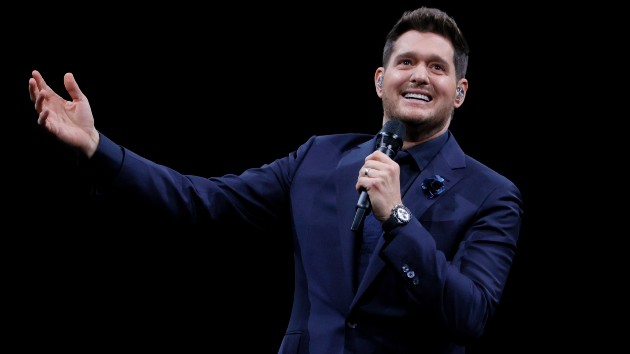
A new Christmas song by Michael Bublé will be featured in a movie called Silent Night, due out next month.
The movie is being produced by Matthew Vaughn, who brought you hit films like Rocketman, Kingsman: The Secret Service, Kick-Ass and more. As Deadline reports, Vaughn has started a music arm of his production company, Marv Music, to create original music for movies, and this holiday song by Michael is one of the first releases.
The song, called “The Christmas Sweater,” will be included on the Super Deluxe 10th Anniversary Box Set version of Michael’s album Christmas. As for the movie, it concerns a family that gets together for Christmas “on the eve of an environmental apocalypse.” It stars Keira Knightley, Matthew Goode and Kirby Howell-Baptiste and will be out December 3.
Marv Music will also be releasing the original music that Dua Lipa is creating for Vaughn’s upcoming film Argylle, in which she’ll also star.
(WASHINGTON) — An appeals court has put a temporary pause on the handover of records from the Trump White House to the House committee investigating the Jan. 6 insurrection.
A three-judge panel in the D.C. Circuit Court of Appeals on Thursday granted a request from former President Donald Trump’s legal team for a temporary injunction to block the exchange of records from the National Archives to the committee, which was set to take place Friday, and scheduled a Nov. 30 hearing to hear arguments from all parties in the case.
Trump sued the committee and the National Archives last month, asserting executive privilege over a broad swath of documents the national archivist had identified as relevant to the Jan. 6 committee’s investigation into Trump’s efforts to overturn the 2020 election and the subsequent attack on the U.S. Capitol.
A district court judge this week twice denied Trump’s request to block or delay the release of the documents, ruling that President Joe Biden’s decision to not assert privilege over the materials outweighed Trump’s efforts to do so as a private citizen.
“[Trump’s] position that he may override the express will of the executive branch appears to be premised on the notion that his executive power ‘exists in perpetuity,'” district judge Tanya Chutkan said in her ruling. “But Presidents are not kings, and Plaintiff is not President.”
It’s unclear how the temporary delay might affect the work of the Jan. 6 committee. The committee’s chairman, Rep. Bennie Thompson, has previously said he hopes the committee’s investigation could conclude by early next year.
According to the national archivist, the first tranche of documents that were set to be handed over on Friday included daily presidential diaries, call logs, White House appointments that occurred around Jan. 6, and three handwritten notes from the files of former White House chief of staff Mark Meadows, among other documents.