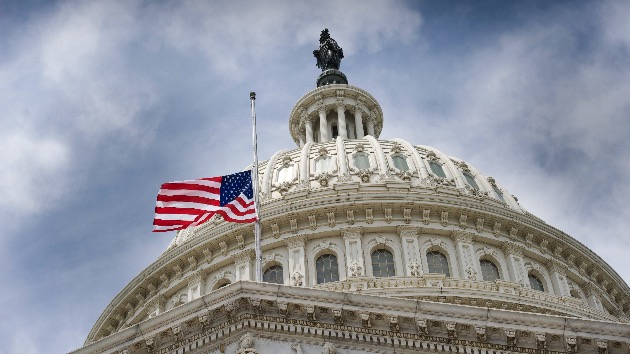
(WASHINGTON) — Former Sen. Bob Dole — a decorated World War II veteran and presidential candidate who served in Congress for 36 years — will lie in state at the U.S. Capitol on Thursday as the nation honors the late American statesman.
Dole died Sunday in his sleep at the age of 98.
A formal arrival ceremony will begin at 9:45 a.m. on Thursday followed by a congressional tribute ceremony at 10 a.m. including remarks from President Joe Biden, who worked alongside Dole in the Senate for more than 20 years and called him “a man of extraordinary courage, both physical and moral courage.”
“Our nation owes Bob Dole a debt of gratitude for the remarkable service and a life well-lived,” Biden said on Wednesday in his first public comments about Dole since the senator’s death.
“Like all true friendships, regardless of how much time has passed, we picked up right where we left off, as though it were only yesterday that we were sharing a laugh in the Senate dining room or debating the great issues of the day, often against each other, on the Senate floor,” Biden, who last saw Dole at the White House in February, wrote on Sunday in a statement.
The president will also deliver a eulogy at Dole’s memorial service on Friday at Washington National Cathedral, which will air on ABC News and ABC News Live.
Thursday’s ceremony at the Capitol will be open only to invited guests, lawmakers said, due to the COVID-19 pandemic, but the public can watch online as he lies in state in the Capitol Rotunda until 8 p.m. — an honor reserved for the most revered American officials.
Dole was severely wounded in action while serving as an Army officer in World War II and left with limited mobility in his right arm — but he persevered. From humble beginnings, Dole went on to graduate law school, serve in the Kansas state legislature and then four terms in the House of Representatives and five terms in the Senate. He also led the Senate Republican Conference for more than a decade and was the longest-serving Republican leader until recently surpassed by Sen. Mitch McConnell of Kentucky.
In Congress, Dole helped shape tax, social security and foreign policy, as well as government farm and nutrition programs. He was an advocate for the rights of veterans and Americans with disabilities, instrumental in the passage of the Americans with Disabilities Act in 1990.
He was known was known as one of the “last lions of the Senate.”
Dole ran for president three times, losing primaries in 1980 to Ronald Reagan and in 1988 to George H.W. Bush. After winning the Republican party nomination in 1996, he lost the general election to Bill Clinton, who later presented him with the Presidential Medal of Freedom.
In a USA Today op-ed Dole finished on pen and paper less than two weeks before his death, he said Congress needs teamwork now more than ever, and wrote, “Those who suggest compromise is a sign of weakness the fundamental strength of our American democracy.”
A formal departure ceremony from the Capitol will be held at 9:30 a.m. on Friday ahead of a funeral at Washington National Cathedral and ceremony at the World War II Memorial with remarks from Chairman of the Joint Chiefs of Staff Gen. Mark Milley.
Dole’s body will then be flown to Kansas for services in his home state.
(NEW YORK) — As the COVID-19 pandemic has swept the globe, more than 5.2 million people have died from the disease worldwide, including over 793,000 Americans, according to real-time data compiled by Johns Hopkins University’s Center for Systems Science and Engineering.
Just 60.4% of the population in the United States is fully vaccinated against COVID-19, according to data from the Centers for Disease Control and Prevention.
Here’s how the news is developing. All times Eastern:
Dec 09, 9:30 am
US processing 1 million PCR tests per day
The U.S. is processing 1 million PCR tests each day, CDC director Dr. Rochelle Walensky told ABC News chief medical correspondent Dr. Jennifer Ashton during an interview Wednesday at the CDC’s Emergency Operation Center.
“That gives us a really good window as to test positivity,” Walensky said. “It also gives us the samples we need in order to sequence, because we can’t sequence from a rapid test.”
“The rapid tests, I think, have another important role, and that is to empower people to help make smart decisions,” Walensky said. “Don’t do a test that you’re not going to do anything with the information. Most people now who do a rapid test are doing so either to protect themselves or somebody who they’re about to go see or some family member. And so they are generally motivated, I would say, to do the right thing with the result.”
-ABC News’ Eric M. Strauss, Sony Salzman
Dec 09, 5:57 am
Omicron spreads but severe cases remain low in South Africa, WHO says
The World Health Organization said Thursday that preliminary data indicates hospitalizations in South Africa remain low, offering “signs of hope,” despite the fact that the omicron variant is spreading rapidly and weekly COVID-19 cases on the African continent have surged by 93%.
In the week ending on Dec. 5, southern Africa recorded a 140% hike in COVID-19 cases, the highest of any region on the continent for that period, mainly driven by an uptick in South Africa, according to the WHO. While researchers are still working to determine whether omicron is fueling the surge, the WHO said that emerging data from South Africa indicates the new variant may cause less severe illness. Data on COVID-19 hospitalizations across South Africa between Nov. 14 and Dec. 4 show that intensive care unit occupancy was only 6.3%, which the WHO said is very low compared with the same period when the country was facing the peak linked to the delta variant in July.
Furthermore, data from the same two-week period from one of the South African health districts most impacted by omicron show that out of more than 1,200 hospital admissions related to COVID-19, there were 98 patients receiving supplemental oxygen and only four on ventilators. The WHO cautioned that the data is “very preliminary with a small sample size and most of the people admitted to the health facilities were under the age of 40.”
Since omicron was first identified in southern Africa in November, confirmed cases of the variant have been reported in 57 countries around the world. In an effort to prevent the spread of the new variant, more than 70 countries have imposed travel bans that are mainly targeting southern African nations, some of which have yet to report any omicron cases, according to the WHO.
“With Omicron now present in nearly 60 countries globally, travel bans that mainly target African countries are hard to justify,” Dr. Matshidiso Moeti, the WHO’s regional director for Africa, said in a statement Thursday. “Through the diligent surveillance efforts of African scientists, the new variant of concern was first detected on this continent, but it’s unclear if transmission was taking place silently in other regions. We call for science-based public health measures to counter the spread of COVID-19. The travel restrictions come at the height of the end-of-year tourist season, ravaging Africa’s economies, with a knock-on impact that is potentially devastating to the health of Africans.”
Dec 08, 9:44 pm
FDA authorizes antibody cocktail for use before COVID-19 exposure
The Food and Drug Administration has authorized the first monoclonal antibody therapy for use before COVID-19 exposure.
AstraZeneca’s Evusheld antibody cocktail can now be given to certain people for preventative use against the virus, including those who are moderately to severely immunocomromised due to a medical condition or medication, and those who have a history of severe adverse reactions to a COVID-19 vaccine. People also must not be currently infected with COVID-19 or have been recently exposed to the virus.
In a recent Phase III clinical trial, AstraZeneca found that the therapy reduced the risk of developing symptomatic COVID-19 infections by 83% in people who did not have the virus, had not been exposed to it and were unvaccinated, when compared to the placebo group.
AstraZeneca told ABC News it is testing the product against the new omicron variant and is “hopeful” that it will hold up against it. Results are expected to become available “within weeks,” the company said. So far, Evusheld has been found to neutralize all previous COVID-19 variants of concern, it said.
AstraZeneca said it has agreed to supply the U.S. government with 700,000 doses of Evusheld, which will be distributed to states and territories at no cost and on a pro-rata basis.
-ABC News’ Sasha Pezenik
Dec 08, 9:40 pm
New Hampshire deploying National Guard to hospitals amid surge
New Hampshire will be deploying National Guard members to hospitals statewide to provide support as the state sees a record number of COVID-19 hospitalizations, Gov. Chris Sununu announced Wednesday.
Seventy members will be deployed in the coming week and assist with food service and clerical work, officials said.
The Federal Emergency Management Agency will also be sending a team of 30 paramedics to help the hospitals with the highest COVID-19 burdens, the governor said.
There are 462 current COVID-19 hospitalizations in the state, the highest since the pandemic began.
Dec 08, 8:48 pm
Senate votes to repeal Biden mandate; won’t affect rule due to objection in House
The Senate passed a repeal of President Joe Biden’s vaccine mandate on private businesses with over 100 employees by a vote of 52-48 Wednesday night, but the mandate is not threatened due to opposition in the Democrat-controlled House.
Two Democrats crossed party lines and voted with Republicans to repeal the mandate. The votes cast by Sens. Joe Manchin, . and Jon Tester, D-Mont., were expected.
While the legislation has now passed the Senate, it will almost certainly not impact the mandate.
It’s unclear if the Senate-passed repeal will even be brought up in the House. Speaker Nancy Pelosi is not required to bring it up for a floor vote, and at least 218 signatures would be needed to force consideration. Even then, if the House were to pass it, White House press secretary Jen Psaki said on Tuesday that Biden would veto it should it land on his desk.
The mandate faces stiffer opposition in ongoing legal challenges from several Republican-led states.
(NEW YORK) — As the COVID-19 pandemic has swept the globe, more than 5.2 million people have died from the disease worldwide, including over 793,000 Americans, according to real-time data compiled by Johns Hopkins University’s Center for Systems Science and Engineering.
Just 60.4% of the population in the United States is fully vaccinated against COVID-19, according to data from the Centers for Disease Control and Prevention.
Here’s how the news is developing. All times Eastern:
Dec 09, 5:57 am
Omicron spreads but severe cases remain low in South Africa, WHO says
The World Health Organization said Thursday that preliminary data indicates hospitalizations in South Africa remain low, offering “signs of hope,” despite the fact that the omicron variant is spreading rapidly and weekly COVID-19 cases on the African continent have surged by 93%.
In the week ending on Dec. 5, southern Africa recorded a 140% hike in COVID-19 cases, the highest of any region on the continent for that period, mainly driven by an uptick in South Africa, according to the WHO. While researchers are still working to determine whether omicron is fueling the surge, the WHO said that emerging data from South Africa indicates the new variant may cause less severe illness. Data on COVID-19 hospitalizations across South Africa between Nov. 14 and Dec. 4 show that intensive care unit occupancy was only 6.3%, which the WHO said is very low compared with the same period when the country was facing the peak linked to the delta variant in July.
Furthermore, data from the same two-week period from one of the South African health districts most impacted by omicron show that out of more than 1,200 hospital admissions related to COVID-19, there were 98 patients receiving supplemental oxygen and only four on ventilators. The WHO cautioned that the data is “very preliminary with a small sample size and most of the people admitted to the health facilities were under the age of 40.”
Since omicron was first identified in southern Africa in November, confirmed cases of the variant have been reported in 57 countries around the world. In an effort to prevent the spread of the new variant, more than 70 countries have imposed travel bans that are mainly targeting southern African nations, some of which have yet to report any omicron cases, according to the WHO.
“With Omicron now present in nearly 60 countries globally, travel bans that mainly target African countries are hard to justify,” Dr. Matshidiso Moeti, the WHO’s regional director for Africa, said in a statement Thursday. “Through the diligent surveillance efforts of African scientists, the new variant of concern was first detected on this continent, but it’s unclear if transmission was taking place silently in other regions. We call for science-based public health measures to counter the spread of COVID-19. The travel restrictions come at the height of the end-of-year tourist season, ravaging Africa’s economies, with a knock-on impact that is potentially devastating to the health of Africans.”
Dec 08, 9:44 pm
FDA authorizes antibody cocktail for use before COVID-19 exposure
The Food and Drug Administration has authorized the first monoclonal antibody therapy for use before COVID-19 exposure.
AstraZeneca’s Evusheld antibody cocktail can now be given to certain people for preventative use against the virus, including those who are moderately to severely immunocomromised due to a medical condition or medication, and those who have a history of severe adverse reactions to a COVID-19 vaccine. People also must not be currently infected with COVID-19 or have been recently exposed to the virus.
In a recent Phase III clinical trial, AstraZeneca found that the therapy reduced the risk of developing symptomatic COVID-19 infections by 83% in people who did not have the virus, had not been exposed to it and were unvaccinated, when compared to the placebo group.
AstraZeneca told ABC News it is testing the product against the new omicron variant and is “hopeful” that it will hold up against it. Results are expected to become available “within weeks,” the company said. So far, Evusheld has been found to neutralize all previous COVID-19 variants of concern, it said.
AstraZeneca said it has agreed to supply the U.S. government with 700,000 doses of Evusheld, which will be distributed to states and territories at no cost and on a pro-rata basis.
-ABC News’ Sasha Pezenik
Dec 08, 9:40 pm
New Hampshire deploying National Guard to hospitals amid surge
New Hampshire will be deploying National Guard members to hospitals statewide to provide support as the state sees a record number of COVID-19 hospitalizations, Gov. Chris Sununu announced Wednesday.
Seventy members will be deployed in the coming week and assist with food service and clerical work, officials said.
The Federal Emergency Management Agency will also be sending a team of 30 paramedics to help the hospitals with the highest COVID-19 burdens, the governor said.
There are 462 current COVID-19 hospitalizations in the state, the highest since the pandemic began.
Dec 08, 8:48 pm
Senate votes to repeal Biden mandate; won’t affect rule due to objection in House
The Senate passed a repeal of President Joe Biden’s vaccine mandate on private businesses with over 100 employees by a vote of 52-48 Wednesday night, but the mandate is not threatened due to opposition in the Democrat-controlled House.
Two Democrats crossed party lines and voted with Republicans to repeal the mandate. The votes cast by Sens. Joe Manchin, . and Jon Tester, D-Mont., were expected.
While the legislation has now passed the Senate, it will almost certainly not impact the mandate.
It’s unclear if the Senate-passed repeal will even be brought up in the House. Speaker Nancy Pelosi is not required to bring it up for a floor vote, and at least 218 signatures would be needed to force consideration. Even then, if the House were to pass it, White House press secretary Jen Psaki said on Tuesday that Biden would veto it should it land on his desk.
The mandate faces stiffer opposition in ongoing legal challenges from several Republican-led states.
(WASHINGTON) — Ali Alexander, a prominent conservative activist who organized “Stop the Steal” rallies after the 2020 election, is cooperating with the House Jan. 6 select committee and is scheduled to appear behind closed doors on Thursday morning.
Alexander, who was banned from Twitter over his posts about the presidential election, is expected to tell investigators that he had “nothing to do” with any violence that occurred on Jan. 6 at the Capitol, according to a prepared opening statement obtained by ABC News.
“I had nothing to do with the planning. I had nothing to do with the preparation. And I had nothing to do with the execution,” he said in the prepared statement.
Alexander’s cooperation with the committee was first reported by The New York Times.
“As a Black and Arab man, an American, it is common for people who look like me to be blamed for things we did not do,” he said.
Alexander said he attended President Donald Trump’s address to supporters on the National Mall as a guest. Hinting at disagreements with activists in his circle, he is expected to tell the committee that other organizers removed information from the program that would have instructed rallygoers where to go after the event — which could have prevented Trump supporters from marching to the Capitol.
Lawmakers issued subpoenas to Alexander and other conservative activists and organizers who were involved in setting up the post-election rallies in support of Trump’s challenges to the election results.
Investigators are interested in any communications between organizers, Trump White House officials and congressional Republicans — and whether the potential for violence was raised before the assault on the Capitol.
In a statement announcing its subpoena to Alexander in November, the committee said Alexander repeatedly referenced the potental for violence at “Stop the Steal” events following the election.
Ahead of the attack on the Capitol, Alexander was in communication with some Republican lawmakers and aides as he organized rallies around the country on Trump’s behalf. He spoke at a Jan. 5 rally in Washington with far-right and pro-Trump extremist groups, leading chants of “Victory or death!”
In his opening remarks, Alexander said he had spent more than 100 hours working to gather records to comply with the committee’s requests, and called the ordeal “extremely difficult and burdensome.”
“But I am voluntarily here to do the patriotic thing,” he is expected to tell the panel in his opening remarks.
Ahead of Alexander’s appearance, former Trump White House chief of staff Mark Meadows sued the committee and House Speaker Nancy Pelosi over the subpoenas issued for his documents and phone records, after he declined to appear for a deposition and Democrats vowed to hold him in contempt of Congress.
The committee has interviewed more than 275 witnesses, issued dozens of subpoenas and collected thousands of pages of records, along with social media, cell phone and communications data. The panel is expected to start a new round of public hearings as soon as next month.
Chairman Bennie Thompson, D-Mississippi, said the committee has also questioned state election officials in key battleground states about efforts to challenge their work and any potential contacts from the Trump administration.
(WASHINGTON) — By gathering leaders Thursday from 112 of the world’s democracies — some healthy, some challenged — President Joe Biden has done the easy part of a campaign promise: He’s held a summit for democracy within his first year in office.
But to actually make meaningful progress pushing back on the global “democratic recession,” as his administration has warned of, will require far more than speeches, video meetings, and even a joint statement, which it’s unclear his summit will yield.
“Here in the United States, we know as well as anyone that renewing our democracy and strengthening our democratic institutions requires constant effort,” Biden said in opening remarks at the first “Summit for Democracy” Thursday morning.
In front of two video panels with 80 world leaders participating virtually, Biden declared democracy as “the defining challenge of our time,” citing “outside pressure” from autocrats.
“They seek to advance their own power, explore and expand their influence around the world and justify their repressive policies and practices as a more efficient way to address today’s challenges. That’s how it’s sold. By voices that seek to fanned the flames of social division and political polarization,” he said.
The president has cast the fight between democracies and authoritarian governments like China and Russia’s as pivotal to the 21st century — and said his administration will prove that democratic governments can still deliver for their publics.
Activists around the world are pressing the administration, along with their own governments, to demonstrate that this week — taking or announcing concrete steps like strengthening free and fair elections, countering corruption, bolstering a free press and combating disinformation, among other things.
While the guest list has drawn lots of attention, especially for some illiberal heads of government, it’s what the attendees agree on that will really matter, according to many experts — with some skeptical that there will be impactful commitments.
“The Biden administration is conceptually approaching it from the right lens in terms of looking inward and outward and being humble about the challenges that we’re facing” in the U.S., according to Marti Flacks, director of the Human Rights Initiative at the think tank CSIS. But “in practice, translating that into concrete commitments and actions that resonate domestically is very challenging.”
Those commitments will be tested over the next “year of action,” according to the administration, with a second summit the White House plans to hold in-person next year to take stock.
“The interval period between these two events — the virtual and hopefully the in-person — really gives us, I think, a rare opportunity to translate into action commitments that are going to be put on the table,” said Uzra Zeya, the top U.S. diplomat for democracy and human rights. “This is not a one-off event, but it’s really an ongoing engagement process that we hope will culminate in an in-person summit with new platforms and coalitions working together meaningfully.”
Democracy has been deteriorating consistently for the last 15 years, according to Freedom House, a Washington think tank that analyzes and rates governments. Its annual survey found this year that less than 20% of the global population lives in a country considered “free” in their analysis — the lowest percentage since 1995.
That includes the U.S., but there are worrying signs that American democracy is slipping, including partisan attacks on elections, dark money in politics and racial disparities, according to Freedom House — which ranks Belize, Mongolia and Romania’s democracies as stronger.
The International Institute for Democracy and Electoral Assistance, a Swedish think tank, has gone even further, issuing a report last month that said the U.S. has fallen “victim to authoritarian tendencies itself, and was knocked down a significant number of steps on the democratic scale.”
Biden has leaned into that reality, urging the passage of voting rights legislation or historic investments in social programs. But more politically, he’s also gone after supporters of former President Donald Trump, who continued to spread unfounded conspiracies about election fraud, with a senior administration official blaming “Republican legislators” in particular for a “systematic assault.”
“The president has been forthright and clear about the challenges facing democracy here at home throughout his presidency, and I think you can expect him to do so as well at the summit,” the official said Tuesday.
The administration has also announced a series of steps in advance of the meetings — an indication of what kind of action it wants other countries to take. For example, the administration is collecting a group of countries that will commit to stop exporting and sharing technology that could be used to violate human rights, like artificial intelligence.
The Treasury Department is also moving to implement a policy that requires the disclosure of who controls shell companies and has proposed increased oversight of all-cash real estate deals — both of which corrupt foreign officials and other bad actors often use to hide money in the U.S. made illicitly overseas.
The White House also unveiled the first-ever strategy to counter corruption, laying out steps to do so that if “matched with appropriate resources… has the power to fundamentally change the calculus for kleptocrats,” according to Gary Kalman, director of the U.S. office of Transparency International, a German-based nonprofit advocacy group.
“In a world where corruption fuels authoritarianism, today’s strategy provides a forward-looking blueprint for bolstering government integrity and advancing democracy,” he added in a statement Monday.
But the strength of these public commitments will be heavily scrutinized. Already, there’s been criticism that some countries crafted theirs without any input from civil society.
“Having worked with parties and NGOs around the world, I was inundated with emails and calls pleading for advice as to how they could influence their own country’s democracy plan,” Laura Thornton, director of the Alliance for Securing Democracy, a bipartisan U.S. advocacy group, wrote.
Biden will address the summit twice, with opening remarks Thursday and closing remarks Friday. The heads of the other 111 invited governments will make their own speeches, which are expected to include some announcements of how they’re strengthening democracy in their country.
But some of those leaders have checkered records when it comes to doing so.
Filipino President Rodrigo Duterte, for example, has weaponized a war on drugs and terrorism to crack down on dissent and journalists and to rule with violent impunity.
Brazilian President Jair Bolsonaro has sowed doubts about the country’s presidential election next year and threatened to not accept the results, along with attacking the judiciary, political opponents and the free press.
Pakistani Prime Minister Imran Khan will speak, but it’s the military that rules as “political arbiter — more powerful than either the judiciary or the elected government — and sets the constraints within which civilian politics play out,” according to Freedom House.
The Biden administration has defended its invitation list by saying it included a “regionally diverse set” of “established and emerging” democracies, according to Zeya, who added, “The invitation to join us at the summit — it’s not a mark of approval, nor is non-invitation from the summit a sign of disapproval from the United States.”
But if the administration invited them anyway because new “progress and commitments” from these countries “would advance a more just and peaceful world,” as Zeya said, it’s notable then that allies like Turkey and Hungary or neighbors in Central America’s “Northern Triangle” were left off the list.
Certain countries with authoritarian leaders will instead have their opposition leaders participate, including Belarus’s Svetlana Tikhanovskaya and Venezuela’s Juan Guaido, who the U.S. still recognizes as the country’s interim leader.
The administration also invited civic leaders, lawmakers and parliamentarians, journalists, and activists outside of government to address the summit outside of the leader speeches with dozens of side events. So while Duterte will get to pontificate, Filipino journalist Maria Ressa, who shared this year’s Nobel Peace Prize and has been jailed and harassed by Duterte’s government, also spoke Wednesday.
ABC News’ Justin Gomez contributed to this report.
(BROOKLYN CENTER, Minn.) — As the trial of former police officer Kim Potter begins in Minnesota, the Brooklyn Center City Council has officially backed the formation of a new public safety department that will reimagine how traffic stops in the city are handled.
Daunte Wright, a 20-year-old Black man, was fatally shot by Potter during a traffic stop in April. He was initially stopped for an expired registration tag, and when officers discovered he had an outstanding warrant for a gross misdemeanor weapons charge, they tried to detain him.
That’s when things turned deadly: During a struggle, Potter shot Wright, and he drove off and crashed the car a few blocks away, according to officials. Wright has said she accidentally grabbed her firearm instead of her stun gun when she shot him.
Potter is charged with first-degree and second-degree manslaughter. She has pleaded not guilty to both charges.
The city council has now designated $1.3 million to fund the promises made in a police reform resolution that was passed back in May 2021 following Wright’s death.
“This is a real landmark moment,” Brooklyn Center Mayor Mike Elliott, who is also a council member, said in an interview with ABC News. “This is a start, and it is still a big step forward in doing this work.”
Wright’s death spurred a movement
Elliott created and presented the Daunte Wright and Kobe Dimock-Heisler Community Safety and Violence Prevention Act less than a month following Wright’s death. Dimock-Heisler was a 21-year-old man on the autism spectrum who was fatally shot by Brooklyn Center officers during a domestic disturbance call last year. Charges were not filed against the officers.
The city council quickly voted unanimously to pass the resolution in honor of the two men.
“We’re taking a bold step here, this city,” Elliott said at a May 15 city council session discussing the vote. “But we can do it. We’re gonna do it.”
On Monday, the Brooklyn Center city council voted in favor of reducing police funding by about 1.6% in the upcoming year and shifting funds to create the new Department of Community Safety and Violence Prevention. Brooklyn Center police will still be funded more than they were in 2020, according to budget documents shown at the meeting.
Along with the Department of Community Safety and Violence Prevention, which will be responsible for “overseeing all city agencies and city efforts regarding community health and public safety,” according to the resolution, there will be a new Community Response Department composed of unarmed, trained medical and mental health professionals and social workers to assist with medical, mental health and disability-related calls.
An unarmed, civilian Traffic Enforcement Department will also be created to response to “non-moving” traffic violations.
“[Police departments] are coming around and seeing how valuable this type of transformation is, and how much it frees them up from having to respond to mental health calls and calls related to social work,” Elliott said.
A New York Times investigation found that in the last five years, police killed more than 400 people during traffic stops, all of whom were not displaying a gun or a knife, or were under pursuit for a violent crime when they were killed. LINK?
The city will also implement a “citation and summons” policy requiring officers to only issue citations and ban “custodial arrests or searches of persons or vehicles for any non-moving traffic infraction, non-felony offense or non-felony warrant,” the resolution reads.
“This is what could happen in many small cities across this country,” said Jaylani Hussein, the executive director of the local Islamic civil liberties and advocacy group CAIR-Minnesota. “The merits of this resolution is to do less harm and evaluate the amount of workload that police officers have to engage in that can create very volatile and dangerous situations for the public.”
The resolution also seeks to create new use of force policies and establish a new Community Safety and Violence Prevention Committee, composed of mostly city residents with direct or close experience with arrests, detention or contact with Brooklyn Center police.
The Brooklyn Center Police Department deferred to City of Brooklyn Center representatives for comment, who did not respond to ABC News’ requests. Elliott said BCPD officials are supportive of the compromises made on the resolution.
Still more to do, activists say
The ambitions of the initial proposal for the new department have been somewhat muted in the final revision of the budget.
Funds for 14 open police department positions were initially supposed to support the department’s creation, but the council approved freezing only three currently vacant police positions and instead will use lodging taxes and grants to assist in paying for the public safety changes for now.
Although the goal is to have 24/7 service to completely replace officers in traffic enforcement, according to Elliott, it’s not set in stone.
“I am fully committed to continuing to work with the community to make sure that the rest resolution is Public Safety Act and the programs and are fully funded in the year 2022,” Elliott said.
Katie Wright, Wright’s mother, was among many during the Dec. 6 city council budget meeting who expressed concern that this proposal would fall short of the original vision passed in April — a proposal named for her son.
“I don’t want my son’s name on a resolution that is not going to be effective, that is going to cause so much adversity in the community and that people are not in support of,” she said.
Local activists, who have been involved in the police reform efforts, say this is the first step toward fixing what they say is a broken criminal justice system. However, the over $9 million budget given to police — the most funding given to any government initiative in Brooklyn Center by a wide margin — is a point of contention for some.
“We know that anytime something is funded, that’s what gives it its power,” said Toshira Garraway, founder of support group Families Supporting Families Against Police Violence, which is working with Wright’s family.
Citing the four fatal civilian shootings by law enforcement in Brooklyn Center since Wright’s death, she said that treading lightly on reform initiatives is not the way to go.
“We have to start doing what makes sense and we have to try a different avenue,” Garraway said. “We can’t go about things the same way and think that we’re gonna get a different outcome.”
ABC News’ Adia Robinson contributed to this report.
(NEW YORK) — Here are the scores from Wednesday’s sports events:
NATIONAL BASKETBALL ASSOCIATION
Indiana 122, New York 102
Cleveland 115, Chicago 92
Philadelphia 110, Charlotte 106
Oklahoma City 110, Toronto 109
Washington 119, Detroit 116 (OT)
Miami 113, Milwaukee 104
Utah 136, Minnesota 104
Final Dallas 104 Memphis 96
Houston 114, Brooklyn 104
Denver 120, New Orleans 114 (OT)
Sacramento 142, Orlando 130
Golden State 104, Portland 94
LA Clippers 114, Boston 111
NATIONAL HOCKEY LEAGUE
Colorado 7, NY Rangers 3
New Jersey 3, Philadelphia 0
Vancouver 2, Boston 1 (SO)
Vegas 5, Dallas 4
TOP-25 COLLEGE BASKETBALL
Arizona 94, Wyoming 65
West Virginia 56, UConn 53
Michigan St. 75, Minnesota 67
Florida 85, North Florida 55
Ohio St. 85, Towson 74
Wisconsin 64, Indiana 59
BYU 82, Utah St. 71
(WORCESTER, Mass.) — Despite having one of the nation’s highest vaccination rates, Massachusetts is in the midst of a full coronavirus resurgence. The state’s daily case average is now at its highest point in nearly a year, and in the last month alone, new hospital admissions have more than doubled.
In central Massachusetts, the UMass Memorial Health System is, once again, completely overwhelmed with COVID-19 patients.
“We, right now, have more patients in the hospital, overall, than we have had at either of the two peaks previously. You come in one day and you say this is the worst we’ve ever seen it and you come back the next day and it’s even worse. This is very concerning, what’s going on right now,” UMass Memorial Health Care President and CEO Dr. Eric Dickson told during an interview ABC News Wednesday.
According to Dickson, many of the hospitals in the UMass Memorial health care system are currently at-capacity.
At UMass Memorial Medical Center, all 450 beds, which are typically available, are full. There are 75 patients waiting in the ER for a bed, including seven ICU patients.
“We’re running at more than 120% of capacity right now,” Dickson said. “There’s really no end in sight, which is the scary part for all of us.”
The health system’s latest surge is the result of the delta variant, said Dickson, who added that although the health system is actively sequencing patients, the omicron variant has yet to be detected in the patient population.
On top of the “intense pressure” and significant increase in COVID-19 patients overwhelming health care workers, hospitals are also seeing an increase in winter trauma-related incidents, such as slips, heart attacks and strokes.
“It’s really the perfect storm for a bed crisis,” Dickson added.
A strike among workers, in one of the hospitals in Worcester, has forced 100 beds offline, thus further reducing hospital capacity, while staffing shortages have greatly exacerbated the health care system’s struggle.
“You can’t imagine how exhausted caregivers are right now,” Dickson said. “The biggest challenge for us right now is that our people are extremely, extremely fatigued. This is their third surge over the course of about 20 months, and that’s really taking a toll on them.”
In addition, compounding its woes, UMass Memorial Health was forced to fire 200 employees last week after they refused to get vaccinated.
“We’ve got a problem getting patients out of the hospital, because there’s no staff in the nursing homes and they’re dealing with shortages,” Dickson said.
Dickson explained that he is greatly concerned by the fact that a state like Massachusetts, with more than 72% of its total population fully vaccinated, could be experiencing such a significant surge.
“This pandemic is clearly not over,” Dickson said. “This is really the toughest period of this whole pandemic right now for some of us,” adding that he was “extremely concerned” about the health system capacity to handle potential increases in people needing care, over the next several weeks and months.
The rest of the upcoming winter holidays also continue to be a major source of concern for Dickson and his teams, who saw a “big bump” in test positive cases and hospitalizations following Thanksgiving.
“Now you have a higher starting point, and you’re going to add Christmas and New Year’s on top of that. It really could get bad into mid January, and that’s what we’re most concerned about. We’re holding on right now, today. But if this keeps on going up for the next five, six weeks, I’m not quite sure where we’re going to get everyone in,” he said.
Although the majority — between 60 and 75% — of patients currently under care are unvaccinated, hospital officials have seen the impact of waning immunity over time.
“We even have some breakthrough cases of people that have received the booster, so there’s definitely a waning of the immunity over time, but it’s still your best protection is getting your COVID vaccine and then getting a booster,” Dickson said.
Ultimately, it is critical for all residents to do their best to slow the rise in infections by getting vaccinated and boosted, and by following important mitigation strategies to control the spread, Dickson said.
Neil Young‘s latest studio album with his frequent backing band Crazy Horse, Barn, gets released this Friday, and Young sat down recently with Apple Music’s Zane Lowe to chat about the project, which was recorded quickly this past June in a restored barn that Young owns in the Colorado Rockies.
During the interview, which was conducted at producer Rick Rubin‘s Shangri-La Studio in Malibu, California, Young explains why he feels Barn is one of his best albums.
“I’m very thankful for having made it,” he declares. “And I think it was a gift and everything in it works [for me], and it’s not often that happens…Everything felt right. So I feel great about it.”
Young says he contacted Crazy Horse’s members 10 months in advance and timed the Barn sessions to happen during the full moon.
“[W]hen we got set up, we started to play and then [the moon] got bigger and bigger and bigger until we recorded everything,” Neil recalls. “So that was cool. It was really cool.”
Regarding the actual barn, Young notes that it dates back to the 1870s, “and it was falling down and going back into the ground…So we took it and got a real master barn builder…and we rebuilt. Made it just like it was in the old drawings of it and old photographs.”
As previously reported, a film capturing the making of Barn, directed by Young’s wife, actress Daryl Hannah, will be included on a Blu-ray packaged with the deluxe version of the album, and also released as a standalone Blu-ray.
The documentary will get its theatrical premiere tonight at theaters in New York City, Chicago and Santa Monica, California. Visit NeilYoungArchives.com for more details.
Watch Young’s full interview with Lowe at Apple Music’s YouTube channel.
HBO Max on Wednesday treated fans to the first image from its upcoming special Harry Potter 20th Anniversary: Return to Hogwarts, premiering January 1.
The photo shows Potter stars Daniel Radcliffe, Rupert Grint and Emma Watson chatting with each other in the Gryffindor common room.
“Like they never left,” the streaming service tweeted, along with the picture.
The project, which commemorates the 20th anniversary of the eight-movie series that began in 2001 with Harry Potter and the Sorcerer’s Stone, “will tell an enchanting making-of story through all-new in-depth interviews and cast conversations, inviting fans on a magical first-person journey through one of the most beloved film franchises of all time.”
Among the cast interviews will be Ralph Fiennes, who played Voldemort, as well as Helena Bonham Carter, Robbie Coltrane, Gary Oldman, Imelda Staunton and Tom Felton — who played Bellatrix Lestrange, Hagrid, Sirius Black, Dolores Umbridge and Draco Malfoy, respectively — along with director Chris Columbus “and many more.”
All eight Harry Potter movies are currently streaming on HBO Max.