
Ten Americans to watch at the Beijing Winter Olympics

Ten Americans to watch at the Beijing Winter Olympics
Matthias Hangst/Getty Images

(BEIJING) — It’s only been six months since the festivities wrapped up at Tokyo’s Summer Olympics, but it’s time to learn who will be stealing nightly headlines at the Beijing Winter Games.

If you’re a sports fan who’s been more focused on Patrick Mahomes and Ja Morant than monobob or moguls in the past few months, let this be a guide to the big names from the 223 athletes the U.S. is sending to China.

Two of these athletes (Jamie Anderson and David Wise) are going for three-peats, which would tie them for the most consecutive Winter Olympic golds in the same event. Speedskater Bonnie Blair is the only American to accomplish the feat, winning the 500 meters, albeit in a shortened timeframe from 1988 to 1994. (Six Summer Olympians, including Michael Phelps in the 200-meter individual medley, have won four in a row in the same event.)

Shaun White meanwhile is going for four total golds, which would be a first for a Winter Olympian in the same individual event. He’ll also be one of four Americans attending their fifth Olympics (White, Lindsey Jacobellis, John Shuster and Katie Uhlaender).

Here’s a look at who will be hunting hardware in Beijing:

Jamie Anderson, 31, Snowboarding

Anytime you get to watch the best of all time in their sport, it’s worth tuning in. No woman has had more success in snowboarding than Jamie Anderson, a seven-time X Games gold medalist and the two-time defending Olympic champion in slopestyle. Anderson won the sport’s debut in 2014 and followed that up with gold in Pyeongchang. She’s been remarkably consistent in a sport that often comes down to who can stay upright for a “full pull.”

The California native will bring her megawatt smile and trademark blond locks to a third Olympics in Beijing, hoping to fend off a new generation she inspired. One of those women, 20-year-old Zoi Sadowski Synnott of New Zealand, edged out Anderson at last month’s X Games and the 2021 world championships (and already has a bronze as a 16-year-old competing in big air at the Pyeongchang Games). Australia’s Tess Coady, 21, and Japan’s Kokomo Murase, 17, will also be tough competition for Anderson.

Brittany Bowe, 33, Long-track speedskating

Brittany Bowe is among the recent spate of U.S. speedskating stars to make the transition from inline skates to blades. She had a disappointing 2014 Games and won just a bronze in team pursuit in 2018, but expects more individual success in 2022. Since Pyeongchang, Bowe set a world record in the 1,000 meters that’s stood for three years. Bowe currently leads the world cup standings in the 1,000 with two individual wins and is second in the 1,500 with one event win. She’ll be a medal favorite at both distances with a host of Japanese rivals in each distance.

Nao Kodaira and Miho Takagi have both bested Bowe in individual world stops at 1,000 meters, while Takagi has won three of four stops at 1,500.

Not only is Bowe a tremendous athlete, she is also a tremendous person. When Erin Jackson, the current world No. 1 in the 500 meters this year, caught her edge and finished third at the U.S. trials — meaning she would not qualify — Bowe, who won the distance in the trials, graciously passed her spot to her friend and countrywoman Jackson.

Nathan Chen, 22, Figure skating

Chen’s trip to Pyeongchang was supposed to end with a medal. Instead, the teenage prodigy fell apart in the short program and stood in 17th after night one. He showed just how brilliant he could be in the free skate, finishing first and landing six quads — four rotations in midair — including the first quadruple flip in Olympic history. The astonishing night two skate propelled him to fifth overall — off the medal stand but a portent of things to come.

He’s failed to win only one competition in the last four years, including gold medals at the last three world championships. (The championships were canceled due to COVID in 2020.) That includes a dominating win at the 2018 world championships a month after failing in Pyeongchang.

Chen will be a big favorite in Beijing, with familiar rivals from Japan as his main challengers: Yuma Kagiyama, just 18, who won silver at last year’s world championships, and two-time defending Olympic gold medalist Yuzuru Hanyu, who led after the short program at the 2021 world championships before literally stumbling in the free skate. But Chen’s biggest competition may be the demons of what happened in Pyeongchang.

Jessie Diggins, 30, Cross-country skiing

Jessie Diggins immortalized herself in U.S. Olympics history in Pyeongchang when she out-sprinted the competition down the stretch in dramatic fashion in the women’s team sprint to win America’s first cross-country skiing gold alongside Kikkan Randall. Diggins is back in Beijing after four successful years between games proved 2018 was no fluke. She had a tremendous 2020-2021 season, becoming the first American man or woman to win the Tour de Ski, a cross-country skiing event modeled after cycling’s Tour de France, and finished atop the world cup rankings as well — the first American woman ever. She currently stands in third place in this year’s world cup standings and has two individual wins so far.

Diggins’ compatriot in 2018 — Randall — will not be competing in Beijing. She’ll be a strong contender in the individual events though, especially the sprints. It’s cross-country skiing, so you know Scandinavia will be her top competition. Sweden’s Maja Dahlqvist currently stands atop the world cup sprint standings while fellow Swede Frida Karlsson leads in the distance standings. Russian Natalia Nepryaeva, who is talented at both distance and sprint races — like Diggins — is on top of the overall standings.

Chloe Kim, 21, Snowboarding

Were there no age requirements in snowboarding, Chloe Kim would likely be going for a three-peat in Beijing. Kim was already beating the best in the halfpipe snowboarding world in 2014, but the minimum age to compete in the Olympics is 15. So, instead, the Princeton student will be going for a repeat of her gold medal win when she was just 17.

Her win in Pyeongchang launched her, well, higher than a Chloe Kim frontside air, into the ranks of most marketable athletes. She’s been made into a Barbie doll, appeared alongside Serena Williams and Simone Biles in a Nike ad, competed on “The Masked Singer” and been named one of Time’s 100 Most Influential People. And when she wasn’t attending college classes, taking time off in 2019 and 2020, she’s continued to dominate in the halfpipe. She won gold at the X Games and world championships in 2021 and was last year’s Dew Tour champ.

In Kim’s last tuneup for the Olympics, she won the world cup tour stop in Switzerland on Jan. 15 needing just her first run. She’ll certainly be the favorite at the 2022 Games, but the home country’s Xuetong Cai and veteran Queralt Castellet of Spain will be medal contenders. Fellow American Maddie Mastro will also threaten the podium.

Elana Meyers Taylor, 37, Bobsled

Elana Meyers Taylor is no newcomer to the Olympics. In fact, this will be her fourth games. But her sport will be making its debut. Meyers Taylor made the transition from two-person bobsled — long in the Winter Games — to the monobob as it is contested at the Olympics for the first time in Beijing. In the two-person sport, the person in front is the driver and the one in the back — largely there for their pushing ability at the start — controls the brake. All of that is left to the sole athlete in monobob. It’s a discipline that has been dominated by the American leading up to the 2022 Games. She wrapped up the world cup title in the monobob Jan. 15 and will be the favorite in Beijing. In fact, her top competition is likely fellow American Kaillie Humphries, who won the world cup title last year.

Meyers Taylor is looking to get the monkey off her back when it comes to winning Olympic gold. In the two-women competition, she holds two silvers — in 2014 and 2018 — and a bronze from Vancouver in 2010. But an added hurdle was thrown into Meyers Taylor’s quest when she tested positive for COVID-19 after arriving in Beijing. She said she’s asymptomatic and is “optimistic” she’ll recover in time for her event, which doesn’t come until the second week.

Kai Owens, 17, Freestyle skiing

Kai Owens’ journey has come full circle with a trip to Beijing and the 2022 Olympics. Owens was abandoned in a town square as an infant in China and sent to an orphanage in Anhui province, west of Shanghai, where she was adopted by an American couple at 1 year old. She grew up in Vail, Colorado, and took to moguls skiing, where she’s a rising star on the international circuit.

Owens competed in her first world cup event at just 15 and was named rookie of the year on the FIS Freestyle Skiing World Cup tour in 2021. While she’s not a medal favorite, just the journey may be impressive enough.

Mikaela Shiffrin, 26, Alpine skiing

If there’s a face of the Olympic Games, at least for Americans, it’s Mikaela Shiffrin. Shiffrin is one medal away from tying Julia Mancuso for most medals by a female American Alpine skier (four). A particularly successful games — two golds — would tie Shiffrin for most golds ever by a female Alpine skier (four) and three medals of any color would tie her for the overall lead (six). Both of those records are held by Croatian legend Janica Kostelic. Not only would six medals make her the winningest female Alpine skier of all time, it would tie her with Bode Miller for most medals by an American man or woman.

One thing is for sure: Shiffrin will have plenty of chances to move up the all-time leaderboards. She said she hopes to ski in all five individual Alpine events in the Olympics: downhill, super G, giant slalom, slalom and Alpine combined. Shiffrin was atop the world cup standings through 21 of 35 events and though she’s not No. 1 in any of the individual disciplines, she’s second in both giant slalom and slalom and fifth in both downhill and super G. And that combination of skills both in slalom and downhill makes her a big favorite in the Alpine combined.

Shaun White, 35, Snowboarding

Snowboarding, like its sibling skateboarding, is notoriously a young person’s game. But don’t tell that to Shaun White, who is about old enough to be the father of some of his competitors in Beijing. The 35-year-old is going to his fifth Olympics in 2022, a far cry from the “Flying Tomato” who won gold as a 19-year-old in Torino. (Danny Kass, the American who won silver in 2006, hasn’t competed in over a decade despite being only a few years older than White.)

A three-time gold medalist (2006, 2010, 2018), White is a long shot to win a fourth in Beijing. He’s become a part-time competitor on the international level, saving himself for Olympic years. For someone who was the face of the Winter X Games for a decade, winning 15 total gold medals, he hasn’t won gold since 2013 and has only competed twice in the last nine years. In his bid to qualify for Beijing, he just snuck onto the U.S. team with a third place finish Jan. 15 in Laax, Switzerland.

The favorite to win in Beijing will be Japan’s Ayumu Hirano, who earned silver in 2018 and has won the last two world cup stops, including in Laax. He’s also the only snowboarder to ever land a triple cork (that’s three off-axis rotations) in competition. Australia’s Scotty James, the reigning bronze medalist, and Japan’s 19-year-old Ruka Hirano, no relation to Ayumu, are other top competitors. James managed to edge Ayumu Hirano and Ayumu’s brother, Kaishu, at this year’s X Games. Win or lose, the greatest halfpipe snowboarder of all time — and probably the most famous winter athlete period — is worth a watch one last time in the Olympics.

David Wise, 31, Freestyle skiing

He doesn’t have the profile of Shaun White, but David Wise is a two-time defending gold medalist in the halfpipe. He just does it on skis. Like White, he’ll be fending off a slew of younger challengers after a few shaky years of world competition. His last win in world competition came in February 2019 and he hasn’t won X Games gold since 2018. But he took bronze at the X Games this year and stands fourth in the current world cup standings, so he’s still capable of winning a third straight Olympic gold.

While many of the top U.S. competitors in other sports — like White and Chloe Kim — sat out the X Games two weeks ago, the men’s ski halfpipe competition featured most of the top contenders in Beijing. New Zealand’s Nico Porteous, who earned bronze in 2018 at just 16 years old, won gold at last month’s X Games and will be tough to beat in Beijing. Gus Kenworthy, though he couldn’t put together a clean run in Aspen, will be a sentimental favorite since he will retire following the Olympics. Kenworthy earned silver in slopestyle in Sochi, won hearts by saving several stray dogs at those games and publicly came out as gay a year later. The five-time X Games medalist will be competing for Great Britain to honor his mother after competing for the U.S. at the last two games. Canadian Brendan MacKay and Wise’s fellow American Alex Ferreira did not compete at the X Games but are also contenders.

Copyright © 2022, ABC Audio. All rights reserved.

Biden says US raid in Syria killed ISIS leader

Biden says US raid in Syria killed ISIS leader
Izzeddin Kasim/Anadolu Agency via Getty Images

(WASHINGTON) — President Joe Biden said Thursday that a U.S. raid in Syria killed the leader of ISIS.

“Last night at my direction, U.S. military forces in northwest Syria successfully undertook a counterterrorism operation to protect the American people and our Allies, and make the world a safer place,” he said in a statement. “Thanks to the skill and bravery of our Armed Forces, we have taken off the battlefield Abu Ibrahim al-Hashimi al-Qurayshi—the leader of ISIS. All Americans have returned safely from the operation. I will deliver remarks to the American people later this morning. May God protect our troops.”

The White House tweeted a photo it said showed Biden and Vice President Kamala Harris in the Situation Room watching as the raid took place.

Earlier, the Pentagon has confirmed U.S. special operations forces carried out a what it called a “successful” counterterrorism mission in northwest Syria Wednesday, but provided few other details.

“U.S. Special Operations forces under the control of U.S. Central Command conducted a counterterrorism mission this evening in northwest Syria. The mission was successful. There were no U.S. casualties,” said John Kirby, the Pentagon press secretary, in a statement. “More information will be provided as it becomes available.”

One of the helicopters used in the mission experienced a mechanical problem and then had to be blown up on the ground by U.S. forces, according to a U.S. official.

No details were provided on whether it involved ground troops and helicopters as was claimed in a flurry of social media reports emerging from Syria on Wednesday night.

ABC Senior White House Correspondent Mary Bruce reported that a source familiar with the situation said any reported civilian casualties resulted from the target or a family member detonating an explosive device at the beginning of the operation, not from U.S. forces.

The social media posts reported possible U.S. military activity in Idlib province, a town in far western Syria, close to the border with Turkey. Some posts included videos that seemed to show night scenes where the sounds of gunfire and low-flying helicopters could be heard near the towns of Atimah and Dar Ballout.

The approximately 1,000 U.S. military troops in Syria operate in eastern Syria supporting the mission against ISIS.

American troops do not operate in government-controlled areas in northwestern Syria, especially in Idlib province, which was an extremist safe haven for much of the last decade. But they have sporadically carried out counterterrorism missions in Idlib, targeting various Islamic extremist groups with drone strikes.

The highest profile mission was a ground raid that killed ISIS’ top leader, Abu Bakr al Baghdadi, who was hiding out in a house close to the border with Turkey, on Oct. 27, 2019.

Copyright © 2022, ABC Audio. All rights reserved.
Afghanistan’s women’s rights activists tested Taliban in Oslo, but expect few advancements

Afghanistan’s women’s rights activists tested Taliban in Oslo, but expect few advancements
STIAN LYSBERG SOLUM/NTB/AFP via Getty Images

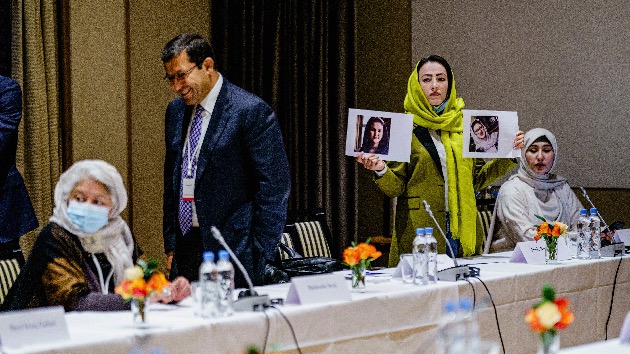
(LONDON) — “Pick up the phone right now, call Kabul and ask the girls to be released immediately,” Hoda Khamosh, an Afghanistan woman’s rights activist shouted at the Taliban’s acting foreign minister, Amir Khan Muttaqi, in Oslo, Norway, last week.

Khamosh demanded the release of Tamana Zaryabi Paryani and Parawana Ibrahimkhel, two female activists who disappeared after their houses were raided on Jan. 20. They had attended a series of protests against the Taliban over the past few months.

Khamosh was one of six Afghan women who were invited to sit with Taliban officials as they made their first invited visit to a Western country since taking control of Afghanistan in August. The talks were to discuss the humanitarian and economic situation in Afghanistan.

The invitation led to different reactions from Afghanistan’s various women’s rights activists, with some welcoming it as a chance for Afghan-to-Afghan negotiations. Others felt that Taliban rule should not be normalized by holding such meetings and casted doubts on the trustworthiness of their promises.

“It was important to us that Norway stressed the invitation did not mean recognition of the Taliban,” Khamosh told ABC News, explaining how the “horrible humanitarian situation” in Afghanistan compelled her to sit face-to-face with the Taliban, pushing for a way to get as many concessions from them as possible.

According to the United Nations Children’s Fund, around 10 million children across Afghanistan are in “urgent” need to humanitarian assistance to survive.

“Without urgent action, almost one million children could be severely malnourished in the coming weeks. That is half of all children under the age of 5,” UNICEF says.

“We were discussing how the money can come to Afghanistan and help with opening schools, opening offices, creating jobs and making the economy wheels turn,” Khamosh said.

However, the Taliban’s track record of female suppression has left many women’s rights activists with almost no reason to trust their promises.

“It is why my first request in the beginning of the meeting with the Taliban was to release our fellow activists they had arrested,” Khamosh said.

In the statement released by the governments of the U.S. and Norway about the Oslo meeting, the Taliban was “urged” to do more to stop the alarming increase of human rights violations, “including arbitrary detentions (to include recent detentions of women’s rights activists), forced disappearances, media crackdowns, extra-judicial killings, torture and prohibitions on women and girls’ education, employment and freedom to travel without a male escort.”

However, the acting foreign minister Muttaqi denied the arrests of the activists for whom Khamosh demanded freedom, saying that the Taliban had not arrested or tortured those women.

“I do not trust him,” Khamosh said, reacting to Mottaqi’s denial. She said she’d been handed documents by one of the women’s mothers that showed the women had been taken by the Taliban.

“This is why the west should not give all the money the Taliban wants in one go and not to give it directly to them,” she said. “We have to wait and see the Taliban’s next move and real intention to fulfil their promises first.”

Former Afghan parliamentarian Shinkai Karokhail, who shared the same concerns as Khamosh, said the Taliban must end its hostilities against women and take a moderate approach towards human rights, as many things have changed since the last time they had the control of the country.

Karokhail advocated for women’s rights during her term, but had to flee Afghanistan when the country fell into the Taliban’s hands.

“Two decades has passed and lots of changes happened in the life of Afghans,” she said, adding that the Taliban has no way but to end isolating women from their social an economic life of Afghanistan.

The Taliban did not respond to ABC News’ inquiry about the Oslo talks and the topics discussed.

Karokhail said she feels the West must ask the Taliban to prove themselves before entering into talks, telling ABC News: “We have to use this Oslo event like a ticket. A ticket that must not be used so much.”

ABC News’ Aleem Agha contributed to this report.

Copyright © 2022, ABC Audio. All rights reserved.

Michigan’s ‘fairer’ election maps challenged for ‘diluting’ Black vote

Michigan’s ‘fairer’ election maps challenged for ‘diluting’ Black vote
ABC News

(NEW YORK) — Michigan, one of the nation’s hottest political battlegrounds, is being hailed for a citizen-led effort to transform its famously gerrymandered election maps into some of the fairest and most competitive ahead of the fall midterm elections.

“This is just one small step to start taking power back and even the playing field for voters to be able to actually control our elections and get the results we want,” said Katie Fahey, the 32-year-old independent from Grand Rapids who sparked the grassroots redistricting reform movement with a 2016 Facebook post.

The state’s closely watched experiment in redistricting by independent commission — rather than by partisan state legislators — could provide a model for other communities gripped by political polarization, experts say. Only eight other states limit direct participation of elected officials in the drawing of state and federal districts.

“People, when they go to the polls, they want to think that their vote matters. Whereas a lot of the time, when seats are gerrymandered to favor one party or the other, basically no matter what, those elections won’t be competitive,” said Nathaniel Rakich, a FiveThirtyEight senior elections analyst.

“The [new Michigan] map just does a really good job of making sure that neither Democrats’, nor Republicans’ votes are wasted,” Rakich said.

But six months before Michigan’s voters can put the new maps to the test, a barrage of partisan legal challenges threatens to blunt an achievement praised by the likes of former Republican Gov. Arnold Schwarzenegger and former Democratic President Barack Obama.

“Are these maps better for partisan fairness? Yes. Could they be better? Absolutely,” said state Sen. Adam Hollier, a Democrat who represents historically majority Black neighborhoods in metro Detroit.

Hollier is among a group of Detroit Democrats who allege in a state lawsuit that the maps “dilute” the power of Black voters in violation of the Voting Rights Act. African American voters are “almost completely politically silenced,” the complaint claims.

Republicans, who have controlled both chambers of the state legislature for years, allege in a separate federal lawsuit that the newly drawn political districts aren’t of equal population size as legally required and unlawfully split up several cities and counties.

“I think we did a very good job of sort of putting our individual feelings on the shelf and making sure we were doing what was best for the people of Michigan,” said Rebecca Szetela, a lawyer, mother of four and political independent who chairs the state’s first 13-member Independent Citizens Redistricting Commission.

“I think that the maps should be fair and balanced moving forward, and I think that people will feel once again that their vote is their voice and that they have the ability to elect someone that represents them,” Szetela said.

Michigan’s old state and federal political districts — in place for the past decade — have been considered some of the most unfair and unbalanced in the country — drawn by Republicans, to favor Republicans. Just two of the state’s 14 congressional districts are rated as competitive by FiveThirtyEight.

“Michigan’s a super purple state. About 50% of us vote for Democrats; about 50% of us vote for Republicans,” said Fahey. “But depending on what party had gerrymandered, that party would have like a supermajority and be able to pass whatever kind of legislation they want, even though theoretically, we should have compromise on almost every single bill.”

The new maps are cleaner, fairer and more competitive for both parties, according to FiveThirtyEight’s nonpartisan Redistricting Tracker. It achieves this by unpacking the gerrymandered majority Black and heavily Democratic districts around Detroit, spreading those voters across new districts creating a blend of urban and suburban voters.

Yvette McElroy Anderson, a longtime community advocate and field director of the Fannie Lou Hamer Political Action Committee, said the disappearance of majority Black districts will make it harder for minority candidates to get on the ballot.

“It’s hurting the ability of Black candidates as well as hurting African Americans to have people that will represent the interests that needs to be represented on their behalf,” Anderson said. “Fifty-one percent or better is what the Voting Rights Act says. So if we don’t do that, then we are doing a disservice to the African American population.”

Hollier, who is challenging the commission to go back to the drawing board before the state’s August primary election, argued that it’s possible to achieve districts that are both majority Black and more competitive.

“Black candidates, particularly from urban communities, and from across our state, have typically raised less money because there’s less money in their districts,” Hollier said, “and we talk about how much money has impacted politics. It changes who can run for things, and where the elected officials come out of.”

Szetela argued that the new maps will enhance the power and influence of Black voters in more races and create more opportunities for representation. The two new congressional districts in metro Detroit would have roughly 44% African American voter representation.

“The data that we were looking at showed that even with lower percentages, that Black voters will be able to elect their candidates of choice,” she said. “And because we divided up some of those districts that were historically 80 to 90% African American into more districts, there should be better representation.”

Rakich said the debate doesn’t have an easy answer.

“On one hand, [the critics] do have a point because certainly a district that is 44% Black is less likely to elect a Black representative,” he said. “But at the same time, because of our system of elections, it’s also very likely that even a 44% Black district would elect a candidate preferred by Black voters.”

State and federal courts will likely decide the fate of Michigan’s new maps, and it’s the voters in November’s midterm elections who will put them to their first big test.

“As a lawyer, I’m never confident on what’s going to happen in a court because courts can rule any way that they want to,” said Szetela. “At the end of the day, we did our good faith effort to come up with very good maps for the people in the state of Michigan.”

Fahey, who is now counseling at least 13 other states on redistricting reform, said she’s confident that no matter where the lines are drawn, the commission’s impact will be a positive change over the old maps.

“It means that we’ll have more competitive elections; it means that we’ll probably have some more moderate candidates who are actually listening to both Democrats and Republicans,” she said.

Copyright © 2022, ABC Audio. All rights reserved.

How Olympic figure skating scores work and other facts to know

How Olympic figure skating scores work and other facts to know
Valery SharifulinTASS via Getty Images

(NEW YORK) — Social media phenom is figure skating for change and representation

Figure skating at the Olympics is set to kick off on Friday, starting with the team event’s men’s singles short program.

There will be five types of figure skating events at the 2022 Beijing Winter Olympics: men’s individual, women’s individual, pairs, ice dancing and the team event. The events will run through Feb. 19, ending with the pairs free skate event.

Here, we break down what you need to know about figure skating, from how it’s scored to the jumps and spins required.

Scoring

The Olympics competition follows the International Judging System, which was established by the International Skating Union (ISU), the governing body for competitive ice skating sports, including figure skating, synchronized skating and speed skating.

Skaters earn technical scores and program components scores, which are added together to determine the score they got for the segment. Scores from the short program and free skating segments are then added to give the total score.

Skaters accumulate points based on the degree of difficulty of each element and how well each element is executed, according to US Figure Skating.

A technical panel — made up of a technical controller, technical specialist, assistant technical specialist, data operator and video replay operator — is tasked with identifying each element performed by skaters and its level of difficulty.

The judging panel is made up of a maximum of nine judges all tasked with scoring the quality of each technical element made and the five program components for each skater. The five components are: skating skills, transitions, performance, composition and interpretation of music.

Judges give a score for each component on a scale of 0.25 to 10, in increments of 0.25, with 10 being the best. The highest and lowest scores are thrown out and the remaining scores are averaged, and then multiplied by a set factor.

Different kinds of jumps and spins have different requirements, such as the number of rotations and edges used, in order to be performed correctly.

Points are deducted from skaters for any infractions they make. Deductions can be made for time violations, costume violations, illegal elements, falls during the program, interruptions of the program, late starts and not performing elements, according to the requirements of the programs.

The number of penalty points vary based on the kind of penalty made, according to ISU rules.

Skaters can also earn bonus points for jump elements performed during the second half of their program.

Spins

In order for it to qualify, a spin needs a minimum of two revolutions without interruption. There are three basic spin positions — a camel, sit or upright spin — and each can be performed a number of ways.

In a camel spin, one leg is on the ice while the other is lifted behind the skater with the knee higher than hip level. In a sit spin, the upper part of the leg not on the ice needs to be at least parallel to the ice. Upright spins are performed in any position with one leg extended or slightly bent, but not in a camel position.

There are also non-basic positions, such as a layback spin, where the skater is upright while their head and shoulders are leaning backwards with the back arched, and the sideways-leaning spin, where the skater is upright and their head and shoulders are leaning sideways with their upper body arched.

Spin combinations need at least two different basic positions with two revolutions each. Changing to a non-basic position is not considered a change of position.

Short programs need to include a flying spin, a spin in one position and a spin combination with only one change of foot. In the free skate, skaters need to have a maximum of three spins, with one of each: a spin combination, a flying spin or a spin with a flying entrance, and a spin with only one position.

Jumps

Jumps in competitive-level figure skating generally fall into two categories: edge jumps and toe jumps. To perform edge jumps, skaters rely on the blades of their skates to get off the ice, while toe jumps require skaters to use their toe pick to get in the air.

The edge jumps are the loop, the salchow and the axel, while the toe jumps are the toe loop, the flip and the lutz.

Each jump is assigned a different number of points depending on difficulty level.

Part of the difficulty level involves the number of rotations skaters make in the air. Triple-jumps require three or three and a half rotations in the air, and quadruples require four revolutions.

Jumping elements can be solo jumps, jump combinations and jump sequences. In a jump combination, the landing foot has to be the takeoff foot of the next jump, while jump sequences are made up of two jumps beginning with any jump and followed by an axle jump with a direct step from the landing curve of the first jump.

In the short program, skaters need to perform two solo jumps and a jump combination. Skaters need to include seven jumping elements in the free skate.

Copyright © 2022, ABC Audio. All rights reserved.
Eddie Vedder encourages COVID-19 testing ahead of US solo tour: “The goal is to be conscientious of others”

Eddie Vedder encourages COVID-19 testing ahead of US solo tour: “The goal is to be conscientious of others”
Scott Dudelson/Getty Images

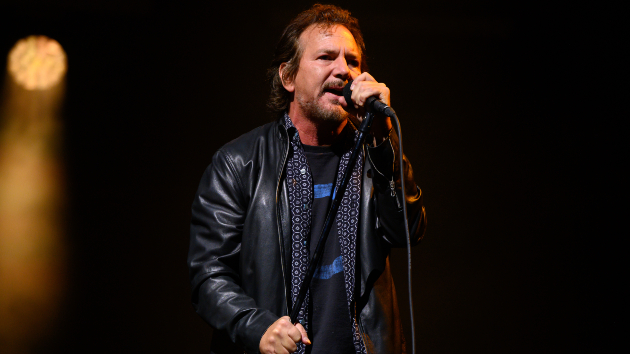
Pearl Jam frontman Eddie Vedder has shared a statement regarding the COVID-19 safety protocols for his U.S. solo tour, which launches Thursday in New York City.

“We have done our absolute best and are doing everything we can to be able to play these shows as safely as possible,” Vedder writes.

Vedder asks attendees for tonight’s show to “remember to bring your proof of vaccination and wear your mask.” He adds, “If you have access to testing and can double-check you’re negative before you come, even better.”

“The goal is to be conscientious of others,” Vedder concludes. “And in doing so, get 2 or 3 hours where we can not think of any of this crap and tap into the live music we’ve been missing.”

Vedder will be touring in support of his forthcoming solo album, Earthling, due out February 11. His live band for the outing features Red Hot Chili Peppers drummer Chad Smith, ex-RHCP guitarist and current Pearl Jam touring member Josh Klinghoffer, Jane’s Addiction bassist Chris Chaney, singer-songwriter Glen Hansard, and producer and guitarist Andrew Watt.

Copyright © 2022, ABC Audio. All rights reserved.

Who’s Helen Reddy? Emmy Meli’s “ashamed” that at first, she didn’t know about the other “I Am Woman”

Who’s Helen Reddy? Emmy Meli’s “ashamed” that at first, she didn’t know about the other “I Am Woman”
Claire Schmitt

After breaking out on TikTok, Emmy Meli’s song “I Am Woman” is climbing the radio chart. Back in 1972, there was a number one hit called “I Am Woman” by the late Australian singer Helen Reddy. It became an anthem for the women’s movement and has earned a permanent place in pop culture — it even inspired Katy Perry‘s hit “Roar.” So, was Emmy equally inspired by Reddy’s song? Well, no.

“I’m actually ashamed to say that at first, I didn’t know what people were talking about,” Emmy admits to ABC Audio. “I had no idea that that was a song, and then once I went back and listened to it, I was like, ‘Oh yeah, I feel like I might have heard this song before, like, maybe in a movie.’ Or it sounded familiar, for sure.”

The point is that when Emmy wrote “I Am Woman,” which has a similar message of female empowerment, she really wasn’t aware that there was another song with that title and theme…until people started pointing it out.

“At first, people were like ‘Nice cover of the song by Helen Reddy,’ and I was like, ‘Wait, who’s Helen Reddy?'” she laughs. “And I felt kind of dumb, because I love oldies and I love older music, and I grew up listening to lots of ’50s and ’60s music and funk and Motown and a lot of older artists.”

“I kind of was like, ‘How did I not know who Helen Reddy is?”’ she laughs. “I was embarrassed that I didn’t know!”

A few days ago, Emmy released a video for “I Am Woman” billed as Emmy Meli & Friends. It features women of all races, from all walks of life, illustrating the song’s message.

(Video contains uncensored profanity.)

Copyright © 2022, ABC Audio. All rights reserved.

K. Michelle reveals one reason why she had plastic surgery: “I felt like the bigger the butt, the bigger the career”

K. Michelle reveals one reason why she had plastic surgery: “I felt like the bigger the butt, the bigger the career”
Paras Griffin/Getty Images

K. Michelle is starring on Lifetime twice this week…in a dramatic film and in a docuseries that she hopes will save lives.

The docuseries, My Killer Body with K. Michelle, premieres on Thursday, February 3, at 9 p.m. ET/8 p.m. CT. The Love & Hip Hop star is also featured in the movie Single Black Female, which airs Saturday, February 5, at 8 p.m. ET/7 p.m. CT.

My Killer Body tells her painful story of several years of enduring near-fatal plastic surgeries, and she hopes the series will help prevent others from similar suffering. The NAACP Image Award winner says she decided to get silicone-filled injections into her buttocks more than six years ago, because she believed it would enhance her music career.

“I had just got a new record deal and I felt like the bigger the butt, the bigger the career,” Michelle tells Essence. “I already had a big butt. It was just ridiculous.”

The “V.S.O.P.” singer recalls that the injections almost killed her. After undergoing multiple reconstructive surgeries, she now says she’s “probably the healthiest I’ve been in a while.”

“There are several people who’ve gone through this who are just starting to feel the effects of it,” Michelle says about the individuals who are also featured on the series. “You even have women who recently had this procedure and are feeling the effects right away.”

The 39-year-old entertainer warns people to be aware of the consequences when considering cosmetic surgery.

“Just like you research when you want to buy a car, you should definitely research what you’re going to do with your life and your body because you only get one,” Michelle says.

Copyright © 2022, ABC Audio. All rights reserved.
Céline Dion is “an amazing actress,” says her ‘Text for You’ co-star Priyanka Chopra Jonas

Céline Dion is “an amazing actress,” says her ‘Text for You’ co-star Priyanka Chopra Jonas
Gotham/GC Images

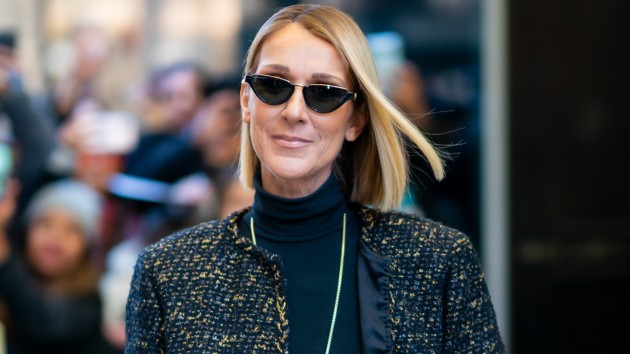
Since Celine Dion delayed her new Las Vegas residency due to a medical problem, we’re not sure when the singer will launch the engagement, but she is expected to grace our movie screens sometime this year in her first film role.  And according to one of her co-stars, the Canadian superstar knocked it out of the park.

The movie, a romantic comedy called Text for You, stars Priyanka Chopra Jonas as a woman who copes with the death of her fiancé by sending text messages to his old cellphone number. It’s now been assigned to another guy, played by Outlander‘s Sam Heughan, who is also bereaved. It’s reportedly Céline’s music that gives both characters the courage to find love again.

Speaking to Harper’s Bazaar Arabia, Priyanka says, excitedly, “It’s Céline Dion’s acting debut and it will be in my movie! She’s so funny. And she’s an amazing actress.” Priyanka knows a thing or two about singers who act, since her husband is Nick Jonas.

“She definitely needs to do more of this,” adds Priyanka of Céline.

Meanwhile, the movie Aline, which was loosely inspired by Céline’s life and features her music — though not her original recordings — opens in the U.S. on April 8.  The movie has faced criticism from Céline’s family over its supposed inaccuracies, and its portrayal of their family as a bunch of scam artists.

Copyright © 2022, ABC Audio. All rights reserved.

“The shackles are off”: TJ Osborne explains how coming out changed his life and music, one year later

“The shackles are off”: TJ Osborne explains how coming out changed his life and music, one year later
ABC

One of Brothers Osborne‘s first big hits was their 2016 single “21 Summer.” It was based on a real-life breakup that singer TJ Osborne experienced, but he couldn’t talk about the personal story behind the song: He hadn’t yet come out as gay.

“No one knew that I was in a relationship and no one knew that I just got broke up with,” he reflects. “And I had a lot of inner turmoil and I was bitter that I couldn’t talk to anyone.”

But one year ago, in February 2021, TJ finally shared his story: He came out in an expansive TIME feature, becoming the first openly gay country artist signed to a major label.

TJ and his brother and band mate, John Osborne, worried about what the response would be, but TJ says the reaction to his song was overwhelmingly positive: Not just within the industry, but also from fans they met at their shows when they went back out on tour.

“Seeing that people were there to love and support me, it was incredibly inspiring,” he notes. “It was very refreshing and encouraging to see, [not just] from a personal place, but just to see humanity be that way. It was one of the highlights of going back out on tour.”

And playing “21 Summer” live feels more meaningful now, too.

“To finally be able to play it and talk about that — there’s probably more depth to that song than people even realize,” TJ notes. “To be able to talk about that now, it feels like the shackles are off.”

Brothers Osborne released the deluxe version of their 2020 album Skeletons this year. The duo opened up about that album, and the personal battles they’ve faced together and individually, in a recent episode of ABC’s Nightline.

Copyright © 2022, ABC Audio. All rights reserved.