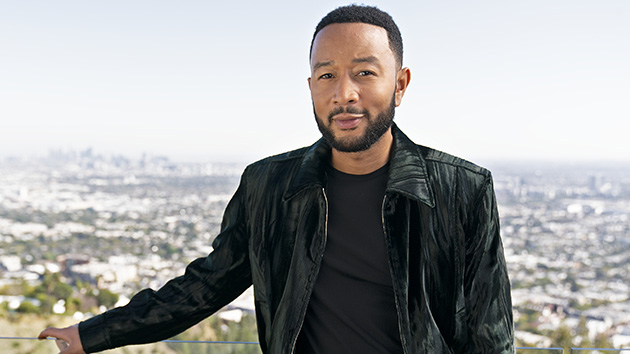
We have all seen the meme comparing John Legend to Arthur the aardvark, and now, the creators of the Arthur series hope to cash in on it.
Speaking to The Hollywood Reporter, author Marc Brown and executive producer Carol Greenwald discussed the long-running animated children’s show coming to an end after 25 seasons, but hinted they aren’t fully ready to say goodbye. Instead, they floated the idea of creating a feature-length film, and say they have the perfect person in mind to star in it.
“I mean, if I could pick one person I would love to be a part of this project, it might be John Legend,” said Brown.
While a feature-length film does sound “intriguing” to the showrunner, he admits that he can’t “wrap my head around it completely.” He also teased that a movie could be “in the works soon,” noting, “[W]e’ve got a great idea…The subject matter is very timely, and maybe there is even a really interesting person involved.”
While Brown has yet to confirm that Legend is definitely part of the plan, it wouldn’t be all that surprising. Aside from being the father of two young children, five-year-old Luna and three-year-old Miles, the Grammy winner previously parodied his resemblance to Arthur in 2018. He appeared in a Google Duo commercial, where he dressed up in the character’s trademark yellow sweater and blue jeans, and even referenced the infamous Arthur hand-clenching meme.
Arthur just wrapped its 25-year run on PBS, but will continue on in other mediums, including, maybe, a movie.
(NEW YORK) — Russia’s military launched a long-feared invasion of Ukraine early Thursday, attacking its ex-Soviet neighbor from multiple directions despite warnings of dire consequences from the United States and the international community.
Thursday’s attacks followed weeks of escalating tensions in the region. In a fiery, hourlong speech on Monday, Russian President Vladimir Putin announced he was recognizing the independence of two Russia-backed separatist areas in eastern Ukraine’s Donbas region: the self-proclaimed People’s Republics of Donetsk and Luhansk.
Russia has blamed Ukraine for stoking the crisis and reiterated its demands to NATO that Ukraine pledges to never join the transatlantic defense alliance.
Here’s how the news is developing. All times Eastern:
Feb 24, 4:02 pm
US believes Russia has launched more than 160 missiles
The U.S. believes Russia has launched more than 160 missiles, mostly short-range ballistic missiles, but some medium-range and cruise missiles, as well, a senior defense official told reporters.
The official said the U.S. believes Russian troops have gotten closer to Kyiv.
“We also have seen indications since we last talked of additional airborne troops into Kharkiv” in northeast Ukraine, the official said in a briefing. “And our assessment is still that there’s active fighting going on there.”
-ABC News’ Matt Seyler
Feb 24, 3:53 pm
Putin spoke with France’s president by phone: Kremlin
France set up a phone call between Russian President Vladimir Putin and French President Emmanuel Macron during which they had a serious discussion on Ukraine, the Kremlin press service reported.
“Vladimir Putin gave an exhaustive explanation of the reasons and circumstances for the decision to conduct a special military operation,” the report said.
Feb 24, 3:50 pm
Biden to participate in virtual NATO conference Friday
President Joe Biden will participate in a NATO conference virtually from the Situation Room beginning at 9 a.m. ET Friday, a White House official confirmed.
NATO Secretary General Jens Stoltenberg will offer public opening remarks and a press conference after the meeting.
Feb 24, 2:58 pm
US sanctions Belarus for role in Russia’s invasion of Ukraine
The U.S. is not only sanctioning Russia, but sanctioning 24 Belarusian officials, business people, defense agencies and firms, state-owned companies, and banks and financial institutions for “Belarus’s support for, and facilitation of” Russia’s invasion of Ukraine, the Treasury Department said in a statement.
“The Lukashenka regime has continued to erode democracy in Belarus and has become increasingly subservient to Russia in the process,” the Treasury Department claimed.
The targets include two state-owned banks which the department says are “among the most important banks in Belarus.” Along with sanctioning Russia’s banks, which are very involved in Belarus’s economy, “a significant portion of the Belarusian financial sector is now subject to U.S. sanctions,” the department said.
The other major target is Belarus’ defense industry, with defense firms, defense business leaders, the defense secretary and the State Secretary of the Security Council of Belarus all hit.
-ABC News’ Conor Finnegan
Feb 24, 2:44 pm
FAA banning US airlines from operating over Ukraine, Belarus, parts of western Russia
The Federal Aviation Administration said it’s now prohibiting U.S. airlines from operating over Ukraine, Belarus and parts of western Russia.
Previously the FAA was only prohibiting U.S. airlines from operating over eastern Ukraine.
This ban does not apply to the military.
-ABC News’ Mina Kaji, Amanda Maile
Feb 24, 2:58 pm
US sanctions Belarus for role in Russia’s invasion of Ukraine
The U.S. is not only sanctioning Russia, but sanctioning 24 Belarusian officials, business people, defense agencies and firms, state-owned companies, and banks and financial institutions for “Belarus’s support for, and facilitation of” Russia’s invasion of Ukraine, the Treasury Department said in a statement.
“The Lukashenka regime has continued to erode democracy in Belarus and has become increasingly subservient to Russia in the process,” the Treasury Department claimed.
The targets include two state-owned banks which the department says are “among the most important banks in Belarus.” Along with sanctioning Russia’s banks, which are very involved in Belarus’s economy, “a significant portion of the Belarusian financial sector is now subject to U.S. sanctions,” the department said.
The other major target is Belarus’ defense industry, with defense firms, defense business leaders, the defense secretary and the State Secretary of the Security Council of Belarus all hit.
-ABC News’ Conor Finnegan
Feb 24, 2:44 pm
FAA banning US airlines from operating over Ukraine, Belarus, parts of western Russia
The Federal Aviation Administration said it’s now prohibiting U.S. airlines from operating over Ukraine, Belarus and parts of western Russia.
Previously the FAA was only prohibiting U.S. airlines from operating over eastern Ukraine.
This ban does not apply to the military.
-ABC News’ Mina Kaji, Amanda Maile
Feb 24, 2:18 pm
7,000 more US troops deploying to Europe to reassure NATO allies
Secretary of Defense Lloyd Austin, at the direction of the president, has ordered 7,000 more U.S. troops to Germany “to reassure NATO Allies, deter Russian aggression and be prepared to support a range of requirements,” a senior defense official said.
The troops are expected to deploy in the coming days, the official said.
-ABC News’ Matt Seyler
Feb 24, 2:16 pm
Biden authorizes ‘additional strong sanctions’ against Russia
President Joe Biden on Thursday authorized “additional strong sanctions” against Russia.
“This is going to impose severe cost on the Russian economy both immediately and overtime,” Biden said in an address. “We have purposefully designed these sanctions to maximize the long-term impact on Russia and to minimize the impact on the United States and our allies.”
Biden said he and the other G-7 leaders are in agreement and vowed to “limit Russia’s ability to do business in dollars, euros, pounds and yen to be part of the global economy.”
BREAKING: Pres. Biden authorizes “additional strong sanctions” against Russia.
“We have purposefully designed these sanctions to maximize the long-term impact on Russia and to minimize the impact on the United States and our allies.” https://t.co/1c4zPiKUgapic.twitter.com/cmyi5dGEIg
Biden said the administration was imposing sanctions on four more major banks, meaning “every asset they have in America will be frozen,” he said.
“This includes VTB, the second largest bank in Russia, which has $250 billion in assets,” he said.
Biden said they’re adding names to the list of Russian elites and family members the U.S. is sanctioning, as well.
“Between our actions and those of our allies and partners, we estimate that we’ll cut off more than half of Russia’s high-tech imports,” Biden said. “We’ll strike a blow to their ability to continue to modernize their military. It will degrade their aerospace industry, including their space program. It will hurt their ability to build ships, reducing their ability to compete economically. And it will be a major hit to Putin’s long-term strategic ambitions.”.
Biden said Russian President Vladimir Putin’s attack on Ukraine was premeditated and had been planned for months.
“For weeks we have been warning that this would happen, and now, it’s unfolding largely as we predicted,” he said.
“Putin is the aggressor. Putin chose this war. And now he and his country will bear the consequences,” Biden said.
Feb 24, 2:08 pm
US official says this is ‘initial phases of a large-scale invasion’
There are movements of Russian military and special forces coming into Ukraine from many directions, according to the officials: from the northeast via Russia; from the south via Moscow-annexed Crimea; and from the north via both Belarus and Russia.
U.S. intelligence believe these three axes were “designed to take key population centers” and that the early moves from the north toward Kyiv indicate an intention to remove the Ukrainian government, a senior U.S. defense official told reporters at the Pentagon.
“What we’re seeing are initial phases of a large-scale invasion,” the official said.
The initial attack included an estimate of more than 100 Russian-launched missiles — mostly short-range ballistic missiles but also some medium-range ones — and about 75 fixed-wing heavy and medium bombers. So far, the targets are mostly Ukrainian military infrastructure and air defense systems, the official said, adding that U.S. intelligence does not yet have a good sense of total damages or casualties.
The official could not give an exact estimate of how many Russian troops have crossed into Ukraine thus far but said that, at this early stage, it is certainly a minority of the 150,000 troops that were massed near the borders.
U.S. intelligence have seen indications that Ukrainian troops “are resisting and fighting back,” the official said. Some fighting has been seen around the airport in Kyiv. But the heaviest fighting is currently occurring in the northeastern city of Kharkiv, some 300 miles east of Kyiv, according to the official.
“We have not seen the Russians thus far move into the western part of Ukraine,” the official said. “We don’t know exactly where things are going to unfold.”
The U.S. official said Russia has conducted “ground incursion from Belarus to the northwest of Kyiv, and we have seen at least some indications of air assault incursions into Kharkiv.”
“So missile, long range fires, and then there has been some insertion of troops both from the air and on the ground in the north,” the official summarized.
“We haven’t seen a conventional move like this, nation state to nation state [in Europe], since World War II,” the official said, “It has every potential to be very bloody, very costly and very impactful on European security writ large.”
The official said he did not have a number on casualties.
-ABC News’ Matt Seyler
Feb 24, 1:45 pm
Chernobyl taken by Russian forces, Ukraine says
Russian troops have reportedly taken full control of the area around the Chernobyl nuclear power station, including the plant itself, according to Ukraine’s prime minister.
“Unfortunately, we are obliged to inform that as things stand the Chernobyl Zone, the so-called ‘Exclusion Zone’ and all the Chernobyl nuclear power station have been taken under the control of the Russian armed groups,” prime minister Denis Schmygal told UNIAN, Ukraine’s main news wire.
The Chernobyl power plant, the site of the world’s worst nuclear accident, is located about 60 miles north of the Ukrainian capital, Kyiv. The Chernobyl exclusion zone begins almost immediately below Ukraine’s border with Belarus.
-ABC News’ Patrick Reevell
Feb 24, 1:36 pm
US intelligence says this is ‘initial phases of a large-scale invasion’
There are movements of Russian military and special forces coming into Ukraine from every direction, according to the officials: from the northeast via Russia; from the south via Moscow-annexed Crimea and the pro-Russian separatist areas in Ukraine’s Donbas region Crimea; and from the north via both Belarus and Russia.
U.S. intelligence believe these three axes were “designed to take key population centers” and that the early moves from the north toward Kyiv indicate an intention to remove the Ukrainian government, a senior U.S. defense official told reporters at the Pentagon.
“What we’re seeing are initial phases of a large-scale invasion,” the official said.
The initial attack included an estimate of more than 100 Russian-launched missiles — mostly short-range ballistic missiles but also some medium-range ones — and about 75 fixed-wing heavy and medium bombers. So far, the targets are mostly Ukrainian military infrastructure and air defense systems, the official said, adding that U.S. intelligence does not yet have a good sense of total damages or casualties.
The official could not give an exact estimate of how many Russian troops have crossed into Ukraine thus far but said that, at this early stage, it is certainly a minority of the 150,000 troops that were massed near the borders.
U.S. intelligence have seen indications that Ukrainian troops “are resisting and fighting back,” the official said. Some fighting has been seen around the airport in Kyiv. But the heaviest fighting is currently occurring in the northeastern city of Kharkiv, some 300 miles east of Kyiv, according to the official.
“We have not seen the Russians thus far move into the western part of Ukraine,” the official said. “We don’t know exactly where things are going to unfold.”
The U.S. official said Russia has conducted “ground incursion from Belarus to the northwest of Kyiv, and we have seen at least some indications of air assault incursions into Kharkiv.”
“So missile, long range fires, and then there has been some insertion of troops both from the air and on the ground in the north,” the official summarized.
“We haven’t seen a conventional move like this, nation state to nation state [in Europe], since World War II,” the official said, “It has every potential to be very bloody, very costly and very impactful on European security writ large.”
The official said he did not have a number on casualties.
-ABC News’ Matt Seyler
Feb 24, 1:13 pm
Ukraine loses control of key airport on edge of Kyiv: Ukraine official
Ukraine has lost control of a key military airport that is located less than 20 miles from the center of the capital Kyiv, according to Ukraine’s deputy interior minister.
Russian special forces landed at the Hostomel airport just on the edge of Kyiv earlier Thursday and after fierce fighting the base remains in Russian hands, deputy minister Anton Gerashchenko said.
-ABC News’ Patrick Reevell
Feb 24, 12:47 pm
UK announces new package of sanctions
The United Kingdom’s Prime Minister, Boris Johnson, has announced a new package of sanctions in the House of Commons targeting over 100 Russian entities and individuals.
Johnson said this would totally exclude Russian banks from the U.K. financial system, adding, “oligarchs in London will have nowhere to hide.”
He vowed, “We will continue on a relentless mission to squeeze Russia from the global economy” as Putin seeks to “redraw the map of Europe in blood.”
-ABC News’ Guy Davies
Feb 24, 12:34 pm
All US diplomats in Poland
All U.S. diplomats from the mission to Ukraine are in Poland and will remain there, with no plans to travel to Ukraine for now, the State Department confirmed.
“We will continually assess the security situation to determine when it may be safe for U.S. government personnel to return to Ukraine to conduct diplomacy on the ground and provide in-person consular services,” a State Department spokesperson told ABC News.
-ABC News’ Conor Finnegan
Feb 24, 12:26 pm
UN Security Council to vote Friday on resolution condemning Russia, calling for withdrawal
The U.S. and its allies and partners on the United Nations Security Council are circulating a draft resolution that would condemn Russia’s invasion of Ukraine and impose “legally binding” obligations for Moscow to “immediately, unconditionally, and completely” withdraw its forces, a senior U.S. administration official said.
The U.S. fully expects Russia to veto the resolution during a vote Friday, but the official said the world must act to hold Russia accountable.
The U.S. mission, led by Ambassador Linda Thomas-Greenfield, is beginning “urgent diplomacy” now with every Security Council member to lobby support for this resolution, the official said, declining to comment on whether they think they can win support from veto-wielding China or partners like India and the United Arab Emirates who Thursday night did not condemn Russia.
While Russia may successfully block this resolution, the senior administration official said they would take action at the U.N. General Assembly, too, where Russia doesn’t have a veto and all 193 members get a vote.
The official provided a brief preview of the resolution itself, saying it “would impose legally binding Chapter 7 obligations on Russia in response to its aggression against Ukraine” and “condemns in the strongest terms possible Russia’s aggression, invasion, and violation of Ukraine’s sovereignty. It reaffirms the sovereignty, independence, unity, and territorial integrity of Ukraine, and it requires the Russian Federation immediately, completely, and unconditionally to withdraw its forces.”
It also calls for unhindered humanitarian assistance to those in need in Ukraine.
-ABC News’ Conor Finnegan
Feb 24, 12:17 pm
Ukraine’s president address nation on latest with Russian invasion
On Thursday Ukrainians heard “not just rocket explosions, battles, the roar of aircraft,” but the “sound of a new Iron Curtain lowering and closing Russia away from the civilized world,” Ukrainian President Volodymyr Zelenskyy said in an address to the nation.
He said Ukraine has had “losses” and has captured Russian soldiers.
In eastern Ukraine’s Donbas region, where Russian President Vladimir Putin announced he was recognizing the independence of two Russia-backed separatist areas, Ukraine’s military is “doing great,” Zelenskyy said.
Kharkiv in northeast Ukraine “is very difficult,” he said, adding, “The most problematic situation today is in the south — our troops are fighting fierce battles in the suburbs of [the southern city of] Kherson. The enemy is pushing out of the occupied Crimea, trying to advance towards Melitopol [a city in southeast Ukraine].”
“In the north of the country, the enemy is slowly advancing in the Chernihiv region, but there are forces to hold it,” he said.
Zelenskyy said, “Ukraine did not choose the path of war — but Ukraine offers to return to peace.”
He said Ukrainians can help by joining the armed forces, saying, “Any citizen with combat experience will now be useful. It is up to you and all of us whether the enemy will be able to advance further into the territory of our independent state.”
Others can contributed by donating blood, he said, while politicians and community leaders should help “ensure normal life on the ground as much as possible.”
-ABC News’ Christine Theodorou
Feb 24, 12:05 pm
G-7 leaders bringing ‘severe’ coordinated sanctions
The leaders of the G-7 countries — the U.S., the United Kingdom, Canada, France, Germany, Italy and Japan — condemned Russia’s attack in a joint statement, vowing to bring “severe and coordinated economic and financial sanctions.”
The statement followed the leaders’ Thursday morning meeting.
The group called on the Russians “to immediately de-escalate and to withdraw its forces from Ukraine,” adding, “We also condemn the involvement of Belarus in this aggression against Ukraine and call on Belarus to abide by its international obligations.”
The G-7 leaders asked the leaders of other nations to also come forwarding condemning the violence.
The leaders said they condemn Russian President Vladimir Putin recognizing the independence of two Russia-backed separatist areas in eastern Ukraine’s Donbas region — the self-proclaimed People’s Republics of Donetsk and Luhansk — and urged “other states not to follow Russia’s illegal decision to recognise the proclaimed independence of these entities.”
“We reaffirm our unwavering commitment to Ukraine’s sovereignty and territorial integrity within its internationally recognised borders and territorial waters as well as the right of any sovereign state to determine its own future and security arrangements,” the G-7 leaders said.
They continued: “We condemn President Putin for his consistent refusal to engage in a diplomatic process to address questions pertaining to European security, despite our repeated offers. We stand united with partners, including NATO, the EU and their member states as well as Ukraine and remain determined to do what is necessary to preserve the integrity of the rules-based international order. In this regard, we are also closely monitoring global oil and gas market conditions, including in the context of Russia’s further military aggression against Ukraine. We support consistent and constructive engagement and coordination among major energy producers and consumers toward our collective interest in the stability of global energy supplies, and stand ready to act as needed to address potential disruptions.”
Feb 24, 11:09 am
Overnight curfew issued in Kyiv
An overnight curfew will be imposed in Kyiv, Mayor Vitali Klitschko said. Residents must stay home between 10 p.m. and 7 a.m., with only workers involved in critical infrastructure and services allowed out.
Kyiv’s metro is also now being used as a bomb shelter.
-ABC News’ Patrick Reevell
Feb 24, 10:19 am
Biden expected to announce new sanctions at 12:30
President Joe Biden is scheduled to speak at 12:30 p.m. ET, when he’s expected to announce new sanctions against Russia, the White House said.
-ABC News’ Mary Bruce
Feb 24, 10:09 am
Russian forces enter Chernobyl Exclusion Zone, Ukrainian official says
Ukraine’s deputy interior minister, Anton Gerashchenko, warned on Thursday afternoon that Russian and Belarusian troops have entered the deserted exclusion zone around the Chernobyl power plant, the site of the world’s worst nuclear accident, located about 60 miles north of the Ukrainian capital, Kyiv
In a statement posted on his official Facebook page, Gerashchenko said Ukrainian forces are putting up an intense resistance. The Chernobyl Exclusion Zone begins almost immediately below Ukraine’s border with Belarus.
Gerashchenko expressed concerns that artillery could hit the reactor if fighting were to approach it, causing radioactive nuclear dust to spread over the region.
Ukrainian President Volodymyr Zelenskyy said Russian forces “are trying to seize” the Chernobyl Exclusion Zone.
“Our defenders are giving their lives so that the tragedy of 1986 will not be repeated,” Zelenskyy said in a post on his official Twitter account Thursday. “This is a declaration of war against the whole of Europe.”
-ABC News’ Patrick Reevell
Feb 24, 10:04 am
Russia claims it’s destroyed 74 Ukrainian military facilities
Russian airstrikes have destroyed 74 ground targets belonging to the Ukrainian military thus far, including 11 airfields, three command centers and a naval base, Russian Ministry of Defense spokesperson Igor Konashenkov said Thursday.
Some 18 radio-locating stations for anti-aircraft missile systems were also destroyed, according to Konashenkov.
However, Konashenkov noted that the strikes are not being carried out against social facilities at Ukrainian military garrisons, such as homes, residential buildings and barracks, in order to avoid casualties among servicemen and their families.
Meanwhile, he said a Russian assault aircraft crashed due to a “pilot error” in eastern Ukraine’s Donbas region.
“The pilot safely ejected and is at his military garrison now,” Konashenkov added.
Pro-Russian separatist militias in Donbas continue a counteroffensive on the Ukrainian Armed Forces with fire support from the Russian army, according to Konashenkov.
-ABC News’ Tanya Stukalova
Feb 24, 9:15 am
Biden convenes National Security Council
U.S. President Joe Biden met with the National Security Council on Thursday morning in the Situation Room to discuss the latest developments in Ukraine, according to a White House official.
Biden was already scheduled this week to participate in a virtual meeting of the G7 leaders to discuss the ongoing situation as well as priorities of the German G7 presidency year.
In the early afternoon Thursday, Biden will address the nation directly on the Russian invasion of Ukraine and announce “further consequences” that the United States and its allies will impose on Russia “for its unprovoked and unjustified attack on Ukraine,” according to the White House.
Feb 24, 8:33 am
US troops in Poland will be deployed to border checkpoints with Ukraine, source says
U.S. Army soldiers in the 82nd Airborne Division in Poland will be deployed to the checkpoints at the border with Ukraine to help with a possible surge in the flow of traffic, a military source with direct knowledge told ABC News on Thursday.
Their new mission is a change from their previous one of solely to “deter and assure,” as a full-scale Russian invasion is now underway in neighboring Ukraine.
With Ukraine’s airspace shut down, the source said they expect traffic at border checkpoints to increase significantly, including citizens of NATO member states. However, estimates on the number of potential refugees was unclear.
There are currently 5,200 U.S. troops currently in Poland, with another 300 en route from Germany. Although they are on slightly higher alert, there was no expectation of any engagement with the Russian forces attacking Ukraine.
Feb 24, 8:05 am
At least five killed in Ukrainian military aircraft crash, officials say
A Ukrainian military aircraft carrying 14 people crashed in the Kyiv region on Thursday, killing at least five of them, according to Ukraine’s Ministry of Internal Affairs.
The crash sparked a fire that has since been extinguished. It was not immediately clear what caused the crash, the ministry said in a statement posted to its official Facebook page.
Feb 24, 7:52 am
US oil tops $100 a barrel
U.S. crude oil prices topped $100 a barrel on Thursday morning, sending gasoline prices to an average of $3.54 a gallon, according to the American Automobile Association.
Meanwhile, U.S. stock futures plunged. Dow futures were down more than 700 points ahead of the opening bell.
The developments came amid ongoing attacks on Ukraine by Russia, the world’s third-largest oil producer.
Feb 24, 7:31 am
Ukraine temporarily disconnects from Russian, Belarusian energy systems
Ukraine’s energy system has temporarily cut itself off from the power grids of neighboring Russia and Belarus, according to Ukrainian transmission system operator Ukrenergo.
Ukrenergo said in a statement Thursday that the country’s system is now functioning independently and will continue to do so for the coming days as it tests for a future connection to the European network of transmission system operators.
The European Union’s ambassador to Ukraine, Matti Maasikas, took to Twitter to say the “controlled disconnection” was “perfect timing” and that the system is “operating autonomously under normal conditions.”
“The assets of the main network are currently functioning without interruptions,” Maasikas tweeted.
Feb 24, 6:52 am
At least 40 killed, several dozen injured in Ukraine, official says
At least 40 people have been killed Thursday in Russia’s attack on Ukraine, according to Oleksiy Arestovich, an adviser to Ukrainian President Volodymyr Zelenskyy.
Arestovich told ABC News that several dozen others have been injured so far.
Feb 24, 6:37 am
Russia says it’s establishing military censorship of media
Russia appears to be establishing military censorship of media coverage of its invasion of neighboring Ukraine.
The Russian Federal Service for Supervision of Communications, Information Technology and Mass Media, or Roskomnadzor, warned Thursday that all Russian media outlets are required to use information exclusively from official Russian sources while covering the military operations in eastern Ukraine.
“Roskomnadzor informs media outlets and information resources that they are required to use information received exclusively from official Russian sources in their materials and reports covering the special operation in the Luhansk and Donetsk people’s republics,” the agency said in a statement.
Roskomnadzor warned that publishing knowingly false information will result in an administrative fine of up to 5 million rubles (about $60,000).
“The number of unverified and untrue reports published by media outlets and other online information resources has considerably grown in recent hours,” the agency added.
Feb 24, 6:04 am
Russia tells Ukraine it’s ‘never been an enemy’
Russia’s parliament speaker claimed Thursday that the “sole purpose” of the country’s invasion of Ukraine “is to secure peace,” saying “Russia has never been an enemy.”
“I am calling on Ukrainian citizens: We have always deemed you to be a fraternal people. The sole purpose of what our country is doing is to secure peace,” State Duma Speaker Vyacheslav Volodin said in a statement. “We are asking you to step aside and do not take part in any mobilization campaigns proposed by the Kyiv authorities. They are not independent, all orders come from Washington and Brussels.”
Volodin also urged Ukrainian Armed Forces to lay down their weapons, saying the orders given from Kyiv are criminal and serve the interests of NATO and the United States. He noted that Russia and Ukraine share history, culture and religion.
Feb 24, 5:41 am
Russia attacking Ukraine from north, east, south, Zelenskyy says
Russian forces are attacking Ukraine “from the north, east and south,” according to Ukrainian President Volodymyr Zelenskyy.
“Our soldiers are heavily fighting, the aggressor suffered heavy losses,” Zelenskyy said in an address to the Ukrainian public from Kyiv on Thursday morning. “We have wounded soldiers.”
He added that the Ukrainian military “is giving and will give weapons to everyone who is able to defend out country.”
The Ukrainian president also announced that his country has “cut diplomatic ties with Russia.”
“Ukraine is defending its freedom,” he said. “Citizens of Russia will choose today their own way. Time for you to come out and protest this war with Ukraine.”
Just hours before Russia launched the early morning invasion of its ex-Soviet neighbor, a senior Pentagon official told ABC News: “You are likely in the last few hours of peace on the European continent for a long time to come. Be careful.”
Feb 24, 4:49 am
Three Ukrainian border guards are first reported deaths from Russian attack
At least three Ukrainian border guards were killed near the southern port city of Skadovsk on Thursday morning after a commandant’s headquarters was shelled by a Russian helicopter, according to Ukraine’s State Border Guard Service.
They are the first reported deaths after Russia launched military operations in Ukraine early Thursday.
An unknown number of personnel were also wounded, Ukraine’s State Border Guard Service said in a statement on its official Facebook page, noting that the border guards in the area were still fighting.
Feb 24, 3:26 am
EU urges Russia to ‘immediately cease’ attack on Ukraine
Leaders of the European Union are urging Russia to “immediately cease” its attack on Ukraine, saying “such use of force and coercion has no place in the 21st century.”
“We condemn in the strongest possible terms Russia’s unprecedented military aggression against Ukraine,” European Council President Charles Michel and European Commission President Ursula von der Leyen said in a joint statement Thursday. “By its unprovoked and unjustified military actions, Russia is grossly violating international law and undermining European and global security and stability. We call on Russia to immediately cease the hostilities, withdraw its military from Ukraine and fully respect Ukraine’s territorial integrity, sovereignty and independence.”
They noted that EU leaders will meet later Thursday “to discuss the crisis and further restrictive measures that will impose massive and severe consequences on Russia for its action.” They said von der Leyen “will outline a further sanctions package being finalized by the European Commission and which the Council will swiftly adopt.”
In on-camera statements Thursday, the EU’s top diplomat, Josep Borrell, pledged to “adopt a stronger package, the harshest package of sanctions we have ever implemented.”
Von der Leyen added that the EU “will not let President Putin tear down the security architecture that has given Europe peace and stability over the past decades.”
“Ukraine will prevail,” she said.
Feb 24, 2:41 am
Pro-Russian separatists claim to be taking territories in eastern Ukraine
Russia-backed separatists in eastern Ukraine’s Donbas region claimed Thursday that their forces are taking over Ukrainian government-controlled territories amid a Russian invasion.
Ivan Filiponenko, a representative of the military department of the self-proclaimed Luhansk People’s Republic, said in a statement that militia units have begun “artillery preparation and an operation to liberate the temporarily occupied territories.”
Meanwhile, Eduard Basurin, a spokesman for the militia of the self-proclaimed Donetsk People’s Republic, told Russia’s Interfax news agency that “forces are delivering strikes on positions of the Ukrainian Armed Forces along the entire line of contact, using all weapons that are available to them.”
Separatist leaders want to control all of the Luhansk and Donetsk regions in Donbas. But they currently only have about a third, with the rest controlled by Ukraine.
Feb 24, 2:03 am
Russia claims to have neutralized some of Ukraine’s military infrastructure
Russia claimed Thursday to have neutralized some of Ukraine’s military infrastructure amid an attack on the country.
“The military infrastructure of air bases of Ukraine’s Armed Forces has been rendered inoperable,” the Russian Ministry of Defense said in a statement. “Air defense systems of the Ukrainian Armed Forces have been suppressed.”
The Russian defense ministry further alleged that Ukrainian forces on the border “are offering no resistance to Russian units.”
Meanwhile, a statement from the Ukrainian Ministry of Defense claimed that five Russian planes and a helicopter had been shot down.
“Reports of foreign media on a Russian aircraft allegedly downed on the Ukrainian territory have nothing to do with the reality,” the Russian defense ministry said Thursday.
ABC News could not independently verify the claims on either side.
Feb 24, 1:28 am
State Department suspends consular operations in Lviv
In a new security alert, the State Department said it has suspended its consular operations in Lviv in western Ukraine amid “reports of Russian attacks on targets in a number of major Ukrainian cities, including Kyiv, Kharkiv, Odesa, Mariupol and others.”
The U.S. Embassy in Kyiv previously suspended operations on Feb. 12.
“The U.S. government will not be able to evacuate U.S. citizens from Ukraine,” the warning stated.
The State Department advised U.S. citizens to shelter in place and issued instructions on actions to take if a loud explosion is heard or if sirens are activated.
“Further Russian military action can occur at any time without warning. U.S. citizens throughout Ukraine are strongly encouraged to remain vigilant and take appropriate steps to increase their security awareness,” the warning read. “Know the location of your closest shelter or protected space. In the event of mortar and/or rocket fire, follow the instructions from local authorities and seek shelter immediately. If you feel that your current location is no longer safe, you should carefully assess the potential risks involved in moving to a different location.”
Feb 24, 1:11 am
Russian, Belarusian troops attacking Ukraine from Belarus
Ukraine’s border service said Russian and Belarusian troops are now attacking from Belarus.
Ukraine’s border came under attack from artillery, tanks and small arms around 5 a.m. local time from Russian troops “with the support of Belarus,” the border service said in a statement.
The attack is happening along much of Ukraine’s northeast border, including the Chernigiv and Zhitomirsky regions that are directly north of Kyiv.
There are reports of casualties.
Feb 24, 1:00 am
Ukrainian president declares martial law
Ukrainian President Volodymyr Zelenskyy declared martial law in the country Thursday, saying Russia has launched an “unjustified, false and cynical invasion.”
“There are strikes on military and other important defense facilities, attacked border units, the situation in the Donbas has degraded,” Zelenskyy said in a statement Thursday morning. “The Armed Forces, all special and law enforcement agencies of the state are on alert. The National Security and Defense Council is working in an emergency mode.”
“Civilian citizens of Ukraine should stay at home,” he added. “Warn your loved ones about what is happening. Take care of those who need help. All thoughts and prayers with our soldiers.”
Martial law allows military authorities to temporarily take over government functions, generally during a time of emergency.
The announcement came as reports of explosions and air raid sirens in cities across Ukraine rolled in and as Russian-controlled separatists, in a breakaway region of eastern Ukraine known as Donbas, say they have launched a full-scale offensive to retake what they claim is their territory there.
Feb 24, 12:44 am
Zelenskyy asks for global response, talks to Biden
In a new video statement denouncing the Russian attacks on his country, Ukrainian President Volodymyr Zelenskyy said it’s not only the fate of Ukraine that’s being decided.
“Ukrainians will never give their freedom and independence to anyone. Only we, all citizens of Ukraine, have been determining our future since 1991,” Zelenskyy said. “But now the fate of not only our state is being decided, but also what life in Europe will be like.”
The Ukrainian president stressed the need for a global response, stating that what remains of international law “depends on the world’s honest and just response to this aggression.”
President Joe Biden and Zelenskyy spoke over the phone around midnight ET, when Zelenskyy asked Biden to “call on the leaders of the world to speak out clearly against President Putin’s flagrant aggression and to stand with the people of Ukraine,” Biden said in a statement.
Biden said he told Zelenskyy that the U.S. condemned the attack, and he also briefed him on the steps the U.S. is taking “to rally international condemnation.”
Biden also reiterated in the statement that he will meet with G-7 leaders Thursday and plans to impose “severe” sanctions on Russia.
“We will continue to provide support and assistance to Ukraine and the Ukrainian people,” he said.
In the video, Zelenskyy implored citizens to stay home.
“Warn your loved ones about what is happening,” he said. “Take care of those who need help.”
Feb 24, 12:11 am
US senators call for harsher sanctions following Russian attack
Senators on both sides of the aisle are calling on the administration to turn up the pressure on Russia following its attack on Ukraine.
“President Biden has already imposed an initial tranche of sanctions, and it is now time for us to up the pain level for the Russian government,” Senate Intelligence Committee Chairman Mark Warner, D-Va., said in a statement.
“I urge the Biden administration to respond swiftly and in concert with our allies to impose crushing economic sanctions on Kremlin officials, Russian entities and other actors involved int his attack on Ukraine,” Sen. Jeanne Shaheen, D-N.H., said.
“America and our allies must answer the call to protect freedom by subjecting Putin and Russia to the harshest economic penalties, by expelling them from global institutions, and by committing ourselves to the expansion and modernization of our national defense,” Sen. Mitt Romney, R-Utah, said.
While a handful of Republicans knocked the administration for not imposing pre-invasion sanctions, those jabs are largely being overwhelmed by calls for unity among NATO allies.
“There is no justification for this assault and I call for the administration to lead the world in a unified response,” Ohio Republican Sen. Rob Portman said.
Feb 24, 12:00 am
Reports of Russian troops crossing border into Ukraine, ballistic missiles
There are reports that Russian troops have now crossed the border in eastern Ukraine, close to the city of Kharkiv, as explosions in the area continue.
Ukraine’s deputy interior minister, Anton Gerashchenko, told media the troops crossed near Kharkiv. A former senior adviser to Ukraine’s government also confirmed the reports, saying he was informed by the president’s office, while Ukraine’s main newswire agency, UNIAN, has also reported the news.
Kharkiv is Ukraine’s second largest city and is only about 20 miles from the border with Russia. However, it is not next to the separatist-controlled areas.
Ukrainian authorities also said that Kyiv and multiple cities east of it have been stuck by ballistic missiles. Gerashchenko said at least seven cruise missiles or ballistic missiles hit a military aerodrome near Kyiv that is home to fighter jets. It appears that the missiles have largely struck targets on the outskirts of the city so far.
Russia’s defense ministry said it is striking Ukrainian air bases, military infrastructure and air defenses across the country but said it will not target Ukrainian cities themselves.
The ministry said “high-precision” missiles are being used.
Reports of explosions also continue to come in from Odessa, Dnipro and Mariupol.
Country trio Runaway June is seeing another lineup shift.
Singer Naomi Cooke, a founding member and the group’s lead singer for the past seven years, announced on social media this week that she plans to leave Runaway June in order to go solo. When she shared her big news, Naomi thanked her former band mates for all their work together over the years.
“I am so grateful for the memories and the time well spent with my bandmates, Hannah, Jen and Natalie,” she wrote. Hannah Mulholland and Jennifer Wayne formed the group with Naomi in 2015; in 2020, Hannah departed and was replaced with Natalie Stovall.
“It’s been extremely hard to keep quiet about what I’ve been up to, Naomi continued. “I cannot wait to share everything with you all very soon!! I miss you guys so much, and can’t wait to see y’all out on the road.”
Runaway June’s last album with Naomi was their 2020 holiday project, When I Think About Christmas.
If you’re one of the many people who took on a new DIY project during the COVID-19 shutdowns, you’re in good company: Several country stars took advantage of their time off the road to make their living quarters extra cozy.
Kane Brown showed off his newly assembled man cave on an episode of CMT’s Off the Road series, paying special attention to his new video gaming setup, a coffee bar and candy station.
Another artist with a man cave built to host low-key friend gatherings is Brantley Gilbert, who says he renovated his garage in order to have a place where he was “out of his wife’s hair.” In a People spread, he gave a tour of the spot he dubbed the “Dawg House” — after the Georgia Bulldogs, of course.
Brantley’s setup features a stocked bar, car and motorcycle collections, a spot to write and record music and more.
“It’s a man cave slash showroom slash anything you can think of,” Brantley explained.
Ana Ceballos/Miami Herald/Tribune News Service via Getty Images
(TALLAHASSEE, Fla.) — The Parental Rights in Education bill, dubbed the “Don’t Say Gay” bill by LGBTQ activists, has been passed by the Florida House of Representatives. The bill would limit what classrooms can teach about sexual orientation and gender identity.
Under this legislation, these lessons “may not occur in kindergarten through grade 3 or in a manner that is not age-appropriate or developmentally appropriate for students in accordance with state standards.”
The bill would also allow parents to sue schools or teachers that engage in these topics.
The bill is now on the Senate agenda for Feb. 28. If the bill is ultimately signed into law, it would go into effect on July 1. Gov. Ron DeSantis has said he supports the bill though he hasn’t explicitly said he will sign it if it crosses his desk.
LGBTQ activists and advocates slammed the decision to move the legislation forward, saying it will harm queer youth by shunning representation and inclusion from classrooms.
“Lawmakers should be supporting LGBTQ students and their families and encouraging schools to be inclusive, not pitting parents against teachers and erasing the LGBTQ community from public education,” Amit Paley, CEO and executive director of The Trevor Project, said in a statement.
He added, “When lawmakers treat LGBTQ topics as taboo and brand our community as unfit for the classroom, it only adds to the existing stigma and discrimination, which puts LGBTQ young people at greater risk for bullying, depression, and suicide.”
Activists say erasing LGBTQ presence from lessons implies students should be ashamed or suppress their gender identity or sexual orientation.
The Biden administration has denounced the bill as anti-LGBTQI+.
“I want every member of the LGBTQI+ community — especially the kids who will be impacted by this hateful bill — to know that you are loved and accepted just as you are,” President Joe Biden said in a Feb. 8 Twitter post.
In a recent interview on ABC News’ podcast “Start Here,” Rep. Joe Harding defended the bill, saying the bill would not prohibit people from talking about gender identity and sexual orientation, it would ban curriculum and lessons.
“What we’re preventing is a school district deciding they’re going to create a curriculum to insert themselves,” Harding said.
He said the decision to talk about these topics should be left to the parents.
“Families are families,” Harding said. “Let the families be families. The school district doesn’t need to insert themselves at that point when children are still learning how to read and do basic math.”
L-R — Bure, Barber, Coulier — Ray Tamarra/GC Images
Dave Coulier, Candace Cameron Bure, Andrea Barber and Scott Weinger from Full House will be back under the same roof in March, which will be two months after the January death of Tanner family patriarch Bob Saget.
The stars will be on hand at Connecticut’s Hartford Convention Center for the first-ever 90s Con, which runs March 11, 12 & 13.
For those looking for even more of a throwback, Neve Campbell from the Scream movies and Party of Five will also be there, as well as Danielle Fishel and Will Friedle from Boy Meets World; Joey Lawrence from Gimme A Break and Blossom; Jo Marie Payton from Family Matters and The Proud Family;AJ McLean from The Backstreet Boys ; and Melissa Joan Hart from Sabrina the Teenage Witch, among many others.
Tapping into people’s appetite for ’90s nostalgia,90s Con 2022 is taking place next month in Hartford, Connecticut, and some of your favorite boy band members will be on hand for the occasion.
Backstreet Boys AJ McLean and Nick Carter and *NSYNC‘sJoey Fatone will appear during all three days of the con, which runs from March 11 through March 13. All three guys will be part of a panel, and will be posing for photos and signing autographs separately and together. If you want a selfie with all three together, it’ll cost you $175. Selfies with each guy individually cost between $40 and $50.
Less than a month after the con, AJ and Nick will join the rest of the Backstreet Boys as they kick off their rescheduled DNA World Tour in Las Vegas on April 8.
In addition, Chilli and T-Boz from TLC will be attending the con, but only on the 12th and 13th. They’ll also be available for autographs and selfies.
If you want even more ’90s nostalgia, 90s Con 2022 also will feature appearances by the cast of Full House, plus Joey Lawrence, Holly Marie Combs, Christopher Lloyd and the stars of Sabrina the Teenage Witch, Boy Meets World, Party of Five and Family Matters.
“I Hope” singer Gabby Barrett is hoping to someday walk in the footsteps of the legendary Shania Twain.
Speaking to Billboard, the 21-year-old spoke about the possibility of launching an international career similar to the “Man! I Feel Like a Woman” singer. “I would love to eventually sell out Madison Square Garden one day. That’s definitely a bucket list goal,” Gabby raved. However, that dream of hers will have to wait because, she says, “my role first and foremost is being a good mother to my daughter and raising her correctly.”
Gabby welcomed Baylah May in January 2021 with spouse Cade Foehner. While being a mom is her number one priority, she added, “I think everything just follows the way that it’s supposed to be.”
An example of that is her breakout anthem “I Hope,” which she believes came out at the right time. “I don’t think I could write that now,” she admitted, “I am in a very happy marriage, so I think I would write that a little bit differently.”
Gabby, who finished third on American Idol, reflected on her music journey and credits an unlikely person for her success. Apparently, the former coach of the Pittsburgh Steelers, Bill Cowher, is the reason her dad even allowed her to sign to her label, Warner Music Nashville. Gabby said CEO John Esposito wanted to sign her so badly, he exploited her father’s love of the Steelers and reached out to Cowher to personally change his mind.
“My dad was a big part of the journey coming up for me. When Coach Cowher gave him a call, he called me freaking out. He was like, ‘Do you know who just called my phone? Coach Cowher! He’s iconic,'” Gabby recalled, laughing. “He was all for my signing with the label after that.”
(WASHINGTON) — After weeks of warning of “severe” sanctions if Russia invaded Ukraine, President Joe Biden addressed the nation and the world from the White House Thursday in what’s unfolding as a defining moment in his presidency as President Vladimir Putin pressed a large-scale attack.
Biden announced escalated sanctions to correspond with the escalated Russian aggression, but not the full economic punishment Ukraine and others have called for and none yet on Putin himself, although he did say that option was “not a bluff. It’s on the table.”
“The Russian military has begun a brutal assault on Ukraine without provocation, without justification, without necessity,” Biden said firmly. “This is a premeditated attack.”
Biden announced new sanctions on four large Russian banks including VTB and SberBank, additional Russian elites and family members, and applying the restriction of Russia’s sovereign debt to state-owned enterprises, companies whose assets exceed $1.4 trillion.
“Putin is the aggressor. Putin chose this war. And now he and his country will bear the consequences,” Biden said. “Today, I am authorizing additional strong sanctions and new limitations on what can be exported to Russia. This is going to impose severe costs on the Russian economy, both immediately and over time.”
However, Biden stopped short not only of sanctioning Putin himself also of cutting Russia off from the SWIFT international banking system.
Pressed by reporters why not sanction Putin directly now, Biden deflected.
“Sir, sanctions clearly have not been enough to deter Vladimir Putin to this point,” said ABC News Chief White House Correspondent Cecilia Vega. “What is going to stop him? How and when does this end? And do you see him trying to go beyond Ukraine?”
“No one expected the sanctions to prevent anything from happening,” Biden replied. “It has to — it’s going to take time, and we have to show resolve. So, he knows what is coming. And so the people of Russia know what he’s brought on them.”
“Between our actions and those of our allies and partners, we estimate that we’ll cut off more than half of Russia’s high-tech imports,” Biden said in his prepared remarks. “We’ll strike a blow to their ability to continue to modernize their military. It will degrade their aerospace industry, including their space program. It will hurt their ability to build ships, reducing their ability to compete economically. And it will be a major hit to Putin’s long-term strategic ambitions.”
But it’s still unclear whether the sanctions will make any difference in what Putin claimed overnight would be a “special military operation” in eastern Ukraine, which is proving to be much more widespread.
“To anyone who would consider interfering from the outside, if you do, you will face consequences greater than any you have faced in history,” Putin warned the world.
While it was also still unclear just how far Putin would go beyond eastern Ukraine, Russian forces attacked near the capital city Kyiv — raising new fears he would try to topple Ukraine’s government.
Biden has maintained that U.S. forces will not fight Russians on the ground but announced he was authorizing additional U.S. force capabilities to deploy to Germany as part of NATO’s response force — including the 8,500 troops put on “heightened alert” last month.
“Our forces are not going to Europe to fight in Ukraine but to defend our NATO allies and reassure those allies in the East. As I made crystal clear, the United States will defend every inch of NATO territory with the full force of American power,” Biden said.
“I’ve also spoken with Defense Secretary Austin and Chairman of Joint Chiefs General Milly about preparations for additional moves, should they become necessary, to protect our NATO allies and support the greatest military alliance in the history of the world — NATO,” he added later on.
Biden also said that NATO would convene a summit Friday.
“This aggression cannot go unanswered,” Biden added. “If it did, the consequences would be much worse.”
Will Biden sanction Putin personally?
The Biden administration had threatened further sanctions on major Russian financial institutions and banks and to take steps to restrict Russian access to technology — as it did Thursday — but it had also weighed cutting Russia off from SWIFT (Society for Worldwide Interbank Financial Telecommunication) — which would hinder Russia’s participation in global markets, and to directly sanction Putin’s inner circle — or the Russian president himself.
Biden told reporters late last month that he would consider personally sanctioning Putin if Russia invaded Ukraine — a day after 8,500 American forces were put on “heightened alert” in the region — but those efforts did not appear to deter the Russian leader, nor did economic sanctions imposed this week by the U.S. and European allies, including halting the certification of Nord Stream 2, a major natural gas pipeline running from Russia to Germany.
But Biden has not gone that far.
The administration has begun to roll out a “first tranche” of sanctions, related to Russian banks, oligarchs and the natural gas pipeline Nord Stream 2, as some lawmakers have criticized Biden of not going far enough on sanctions, which haven’t resulted in Russia reversing course.
Senate Republican Leader Mitch McConnell at a press event in Kentucky ahead of Biden’s remarks called on the administration to “ratchet the sanctions all the way up” on Russia.
“Don’t hold any back. Every single available tough sanction should be employed and should be employed now,” McConnell said.
He said “we honestly don’t know” if sanctions would be enough to deter Putin but argued harsher ones were still necessary.
As of Thursday morning, Russian forces had advanced from three directions — from the south heading north, from Belarus heading south to Kyiv and from northeast of Ukraine heading to the south — as Ukrainian woke up to a nation at war.
US military assessment, diplomatic moves
U.S. intelligence believes these three axes were “designed to take key population centers,” a senior defense official said Thursday.
The White House has said the sanctions will be “united and decisive,” but it remains to be seen how the West can punish Putin, who seems intent on moving ahead with his plans, despite weeks of attempted diplomacy from the international community and a set of sanctions already imposed.
With the U.S. condemning what’s it calling an “unprovoked and unjustified” attack on Ukraine, Biden met with his National Security Council in the Situation Room early Thursday ahead of a virtual video call with G-7 leaders to discuss a united response to the Russian attack.
Notably, Russia was a part of the G-7 until its illegal annexation of Crimea in 2014 — where it is now closing in further on Ukrainian borders.
Biden was at the White House overnight as the attack unfolded.
Within minutes, Biden was on the phone with the Ukrainian President Volodymyr Zelenskyy, who had reached out to him after receiving “silence,” he said, on a phone call to Putin. Russia has two tactical goals in Ukraine, according to Zelenskyy’s office: seizing territory and toppling Ukrainian leadership.
Consequences — for Americans
After their call, Biden released a statement saying that Putin “has chosen a premeditated war that will bring a catastrophic loss of life and human suffering.”
“The prayers of the world are with the people of Ukraine tonight as they suffer an unprovoked and unjustified attack by Russian military forces,” Biden said.
The American president has acknowledged that there will be “consequences at home” — particularly at the gas pump and in energy prices — as a result of the Russian invasion and subsequent sanctions but has vowed to mitigate those costs.
However, ahead of his Thursday remarks, U.S. crude oil prices topped $100 a barrel, sending gasoline prices to an average of $3.54 a gallon, according to the American Automobile Association. At least three states had average gas prices of $4 or higher. Meanwhile, U.S. stock and dow futures also plunged.
“We’re taking active steps to bring down the cost, and American oil and gas companies should not — should not — exploit this moment to hike their respect prices to raise profits,” Biden said Thursday. “In our sanctions package, we specifically designed to allow energy payments to continue.”
Throughout the crisis, Biden has reminded Americans that the U.S. has a responsibility to defend its NATO allies — and democracy around the world.
“America stands up to bullies,” Biden said Thursday. “We stand up for freedom. This is who we are.”
ABC News’ Luis Martinez, Patrick Reevell, Allison Pecorin, Zunaira Zaki, Sarah Kolinovsky and Molly Nagle contributed to this report.
Walker Hayes has signed on to help kick off a partnership between the NHL and TikTok. The singer will take the stage ahead of the 2022 NHL Stadium Series game later this month.
He’s performing on the TikTok Tailgate Stage at the NHL Pregame, and his set will be available to watch on TikTok beginning at 5:30 p.m. ET on Saturday, February 26.
Of course, it’ll include his breakout hit, “Fancy Like,” which went viral on TikTok after the singer posted a clip of himself dancing to it with his teenage daughter, Lela. Since then, the video has amassed over 34.9 million views on the app, and “Fancy Like” skyrocketed to the top of the country charts.
Ahead of his performance, Walker told NHL.com that he’s still not used to his newfound stardom.
“Just being involved in something of this caliber is still very new to me,” he pointed out. “‘Fancy Like’ — the song that exploded my career — is not even a year old. For [me], my wife and kids, especially playing a show like this involved with the NHL, these are dreams coming true for us.”
“Fancy Like” is on Walker’s new Country Stuff: The Album.