Before this year’s ACM Awards, the Academy of Country Music’s Lifting Lives arm will once again host its Tee-Off & Rock On event at TopGolf Las Vegas. Luke Bryan, Jordan Davis and Lainey Wilson are among the acts who will perform during the golf tournament.
Country music and golf have always made a great pairing. In fact, there are lots of country singers who love to wind down by hitting the links, and even a few who almost went pro.
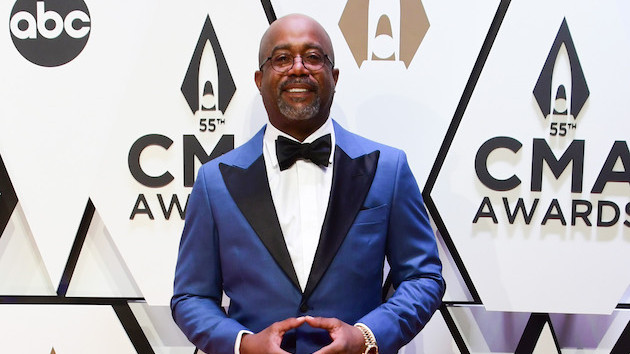
Darius Rucker is a noted golf enthusiast, who has hosted many golf-focused charity events and can often be spotted enjoying the sport himself. One of his superstar golf buddies is Lady A band mate Charles Kelley, who actually played pretty seriously as a kid: He won the North & South championship at Pinehurst when he was 11 years old, according to Golf Digest.
Then there’s Jake Owen, who not only plays as a hobby, but also hosts an annual tournament for charity in his home state of Florida. Jake dreamt of playing professionally, but a wakeboarding accident and subsequent reconstructive shoulder surgery steered him in another direction. Fortunately for country fans, he found music.
“I always believe that when one door closes, another one opens up,” the singer told PGATour.com back in 2011, of his switch from golf to music.
If you’re looking to mix some golf into your country listening, tickets for the pre-ACMs Tee-Off & Rock On show are available now
(WASHINGTON) — Amid an international crisis demanding his attention, President Joe Biden still took time out Friday to introduce to the nation his first high court nominee — Judge Ketanji Brown Jackson — at the White House, officially following through on his campaign promise made two years ago to the day to nominate the first Black woman to the Supreme Court of the United States.
“Today as we watch freedom and liberty under attack abroad, I’m here to fulfill my responsibilities under the Constitution to preserve freedom and liberty here in the United States of America,” Biden began. “And it is my honor to introduce to the country a daughter of former public school teachers, a proven consensus builder, an accomplished lawyer, a distinguished jurist.”
Jackson, 51, currently sits on the U.S. Court of Appeals for the D.C. Circuit to which she was named by Biden and confirmed by the Senate last year with the support of three Republican senators — the third instance in which was confirmed by the Senate on a bipartisan basis.
Biden was flanked by Jackson and Vice President Kamala Harris — the highest-ranking Black woman in government — for the historic announcement.
“I’m pleased to nominate Judge Jackson, who will bring extraordinary qualifications, deep experience and intellect, and a rigorous traditional record to the court. Judge Jackson deserves to be confirmed,” he said.
“For too long our government, our courts haven’t looked like America. And I believe it is time that we have a court that reflects the full talents and greatness of our nation with a nominee of extraordinary qualifications. And that we inspire all young people to believe that they can one day serve their country at the highest level,” Biden continued.
A former clerk to retiring Justice Stephen Breyer, Jackson has more than eight years experience on the federal bench, following a path through the judiciary traveled by many nominees before her. If confirmed, she would be the first federal public defender to serve on the Supreme Court and the first justice since Thurgood Marshall to have criminal defense experience.
“During this process, I looked for someone who, like Justice Breyer, has a pragmatic understanding that the law must work for the American people,” Biden said. “I’ve admired these traits of pragmatism, historical perspective, wisdom, character in the jurists nominated by Republican presidents as well as Democratic presidents. And today, I’m pleased to introduce to the American people a candidate who continues in this great tradition.”
As the president pitched his nominee to the public for the first time, he also spoke to her personal side, saying Jackson’s parents grew up under segregation, “but never gave up hope that their children would enjoy the true promise of America.”
He said Jackson was a “star student” who fell in love with a law career while watching her own father going to law school at the University of Miami, often drawing on coloring books at the dining room table next to her father’s homework. Jackson went on to attend Harvard Law School herself, despite some cautioning her against setting her sights too high.
Biden said she doesn’t put “her thumb on the scale of justice one way or the another — but she understands the broader impact of the decisions, whether there’s cases addressing the rights of workers or government service, she cares about making sure that our democracy works for the American people.”
“She listens. She looks people in the eye, lawyers, defendants, victims and families. And she strives to ensure that everyone understands why she made a decision, what the law is and what it means to them,” he continued. “She strives to be fair, to get it right, to do justice.”
Jackson appeared at the White House with her husband, Patrick, a surgeon, and one of her daughters, Leila, for the formal announcement and her debut under the presidential spotlight.
“I am truly humbled by the extraordinary honor of this nomination,” Jackson said. “And I am especially grateful for the care that you have taken in discharging your constitutional duty in service of our democracy, with all that is going on in the world today.”
“My life has been blessed beyond measure and I do know that one can only come this far by faith. Among my many blessings, the very first is the fact that I was born in this great country. The United States of America is the greatest beacon of hope and democracy the world has ever known,” she continued.
Jackson also took the opportunity to give a special thanks to Breyer in her remarks, saying that he “not only gave me the greatest job that any young lawyer could ever hope to have, he exemplified every day in every way that Supreme Court Justice can perform at the highest level of skill and integrity, by also being guided by civility and pragmatism and generosity of spirit.”
“Justice Breyer, the members of the Senate will decide if I fill your seat. But please know that I could never fill your shoes,” she added.
She finished by turning to the glass ceiling she is shattering, giving thanks to those who paved the way for her, including Constance Baker Motley, the first Black woman ever to be appointed as a federal judge.
“Today, I proudly stand on Judge Motley’s shoulders, sharing not only her birthday, but also her steadfast and courageous commitment to equal justice under law,” she said. “And if I’m fortunate enough to be confirmed as the next associate justice of the Supreme Court of the United States, I could only hope that my life and career, my love of this country and the Constitution and my commitment to upholding the rule of law and the sacred principles upon which this great nation was founded, will inspire future generations of Americans.”
ABC News’ Devin Dwyer, Sarah Kolinovsky and Molly Nagle contributed to this report.
(WASHINGTON) — President Joe Biden called a desperate but defiant President Volodymyr Zelenskyy on Friday as Russian forces closed in on Ukraine’s capital Kyiv and after he publicly pleaded with U.S. and European nations to do more to help.
Zelenskyy also called on Russian President Vladimir Putin to negotiate, but Putin showed no interest in a diplomatic solution.
He appeared, instead, to call for a coup in Ukraine in a statement Friday, calling on Ukraine’s military to turn on Zelenskyy, who was elected democratically, and terming his government a “gang of drug addicts and neo-Nazis that has settled in Kyiv and taken hostage the entire Ukrainian people.”
In an address to his people Friday morning, Zelenskyy called on Putin “to sit at the table for negotiations to stop people dying,” but did not order Ukrainian troops to stop fighting, telling them to “stand tough. You’re everything we have, you’re everything that is defending us.”
Russia’s Foreign Minister Sergey Lavrov said Friday that Russia will begin negotiations again once the “democratic order is restored” in Ukraine, suggesting that only once it has forced Ukraine’s government to surrender and conceded to demands, will it negotiate, with the Kremlin claiming Zelenskyy wants to discuss Ukraine’s “neutrality.”
Russia had demanded Ukraine agree to never join NATO before Putin invaded, which Zelenskyy would not agree to, though Zelenskyy wasn’t seemingly close called to NATO membership, at one point calling it a “dream” for Ukraine.
On Russia’s demand that Ukraine be barred from joining NATO, White House press secretary Jen Psaki has said repeatedly that “that is a decision for NATO to make.”
As Russian troops got ever closer to the capital, the Ukrainian president reportedly told European leaders in a call Thursday night, “This may be the last time you see me alive.”
“We have information the enemy as defined me as number one target and my family as a number two target,” he said in a video address to the nation Friday. “They want to destroy Ukraine politically by destroying the head of state.”
“I will stay in the capital,” Zelenskyy added. “My family is also in Ukraine.”
Even as Zelenskyy pleaded with Western allies to do more to help Ukraine defend itself against Russia’s attack, now in its second day, Biden has emphasized that sanctions on Russia will take time to have an impact, but he faced continuing questions as to why not sanction the Russian leader now.
Thousands of Ukrainians forced to flee their homes appear to be running out of time as Russian forces advance on the capital city Kyiv, and U.S. officials express concerns that Kyiv could fall to Russia within days.
Zelenskyy had urged allies including the U.S. to enact sanctions before Russia invaded, lamenting last week that the “system is slow and failing us time and again, because of arrogance and irresponsibility of countries on a global level” — but that, largely, did not happen.
The Biden administration, at first, said that its sanctions were meant to deter war, and once triggered, the deterrent effect would be lost — but under questioning from ABC News Chief White House Correspondent Cecilia Vega Thursday, who noted that “sanctions clearly have not been enough to deter Vladimir Putin to this point,” Biden replied, “No one expected the sanctions to prevent anything from happening.”
However, Vice President Kamala Harris said on CBS Sunday that “the purpose of the sanctions has always been and continues to be deterrence,” echoing language from Secretary of State Antony Blinken, national security adviser Jake Sullivan and several other administration officials over several weeks — in sharp contrast to Biden’s claim.
The White House official in charge of crafting the sanctions against Russia, Daleep Singh, playing a kind of clean-up Thursday evening, said that the sanctions were never meant to deter war and laid out multiple reasons why the administration didn’t move preemptively.
“Had we unleashed our entire package of financial sanctions preemptively,” he said, “President Putin might have said, ‘Look, these people are not serious about diplomacy, they’re not engaging in a good faith effort to promote peace. Instead, they’re escalating.’ And that could provide a justification for him to escalate and invade.”
“Secondly, he could look at it as a sum cost. In other words, President Putin could think I’ve already paid the price, why don’t I take what I paid for, which is Ukraine’s freedom. So that’s what we wanted to avoid,” Singh added.
But even Democratic lawmakers are calling on Biden to do more to sanction Russia.
“There is more that we can and should do,” said Sen. Bob Menendez, the top Democrat on the Senate Foreign Relations Committee. “Congress and the Biden administration must not shy away from any options—including sanctioning the Russian Central Bank, removing Russian banks from the SWIFT [international banking] system, crippling Russia’s key industries, sanctioning Putin personally, and taking all steps to deprive Putin and his inner circle of their assets.”
Even if Biden did sanction Putin as he’s said is “on the table,” there are still major questions about what more the U.S. and Europe can do to not only punish Russia and Putin, but whether any of the sanctions can change his calculus — or make him retreat from the ongoing invasion of Ukraine.
ABC News’ Luis Martinez, Patrick Reevell and Molly Nagle contributed to this report.
Brad Paisley returns to Wynn Las Vegas’ Encore Theater next month for a pair of acoustic shows, a continuation of the Acoustic Storyteller concert series that he debuted in 2021.
The engagement is more of a mini-residency, Brad explains to People, noting that he might get tired out by the end of the kind of dazzling, multi-date series of performances that country stars like Luke Bryan and Carrie Underwood are currently mounting in Vegas.
Brad says the first two acoustic concerts he played in Vegas last year they were “the most special shows that I’ve done in at least a decade,” because the intimate, stripped-down atmosphere allowed him to truly interact with the audience.
“This isn’t something that I phone in,” the star adds. “These shows are sort of rare.”
The experience of Brad playing in concert solo with just him and an acoustic guitar, he explains, is “something that you can’t see otherwise.”
“Usually, we’re touring everywhere, and people go see me play with my band,” he points out. “This is something that’s kind of a real special thing because I really interact with the audience.”
Brad returns to Vegas on March 11 and 12. Tickets are available now.
(NOTE LANGUAGE) While waiting for Robert Pattinson‘s first turn as the Dark Knight in The Batman, Bat-fans are freaking out about an Instagram post from the guy who first wore the suit in 1989.
Michael Keaton dropped a post last night that didn’t need any caption: A photo of his unmistakable silhouette as the Caped Crusader, first seen in Tim Burton‘s groundbreaking Batman film.
As previously reported, Keaton agreed to return as the iconic hero in both Warner Bros.’ Ezra Miller-led film The Flash and HBO Max’s forthcoming Batgirl movie.
Both of these projects are separate from the Gotham City created by Matt Reeves for Pattinson with The Batman, which premieres March 4.
In an interview with The Hollywood Reporter last summer, Keaton said of returning to the character, “Frankly, in the back of my head, I always thought, ‘I bet I could go back and nail that motherf***er.'”
However, the Oscar winner admitted that The Flash‘s time-shifting plot that will allow Keaton to occupy the Batsuit, reportedly along with Ben Affleck‘s Caped Crusader, went over his head. “They had to explain that to me several times,” he confessed.
That film hits theaters on November 4, 2022. There’s no release date yet for the Batgirl movie starring Leslie Grace as the heroine, and which Keaton is now shooting overseas.
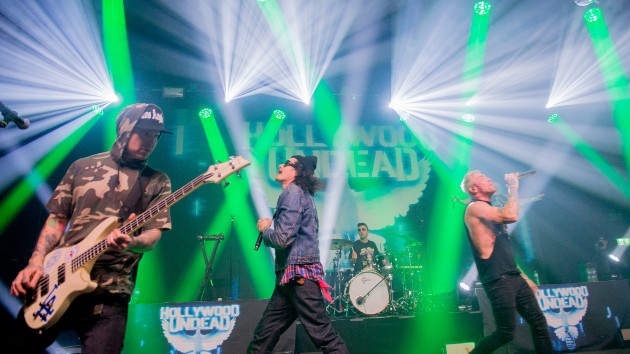
Hollywood Undead has released a new song called “Chaos.”
The track is the first offering from the rap-rock outfit of 2022, and follows their two 2020 albums, New Empire, Vol. 1 and Vol. 2. You can listen to “Chaos” now via digital outlets.
Last year, Hollywood Undead released a pair of songs with electronic artists Imanbek and Blasterjaxx called “Runaway” and “Shadows,” respectively.
Hollywood Undead will hit the road next week on Papa Roach‘s U.S. Kill the Noise tour, which begins March 1 in Anaheim, California. Bad Wolves is also on the bill.
Paul McCartney‘s recently announced Got Back tour just got an additional show. The new date, which was added “due to overwhelming demand,” is scheduled for June 8 at Boston’s Fenway Park, and joins a previously announced June 7 concert at the historic stadium.
Tickets for McCartney’s June 8 performance will go on sale to the general public on Friday, March 4, at 10 a.m. ET.
American Express card members can get pre-sale tickets starting Monday, February 28, at 10 a.m. ET, while PaulMcCartney.com also is offering pre-sale tickets beginning at 12 p.m. ET that same day. For all the details, visit PaulMcCartneyGotBack.com.
As previously reported, McCartney’s Got Back tour, his first since his Freshen Up trek wrapped in 2019, launches April 28 in Spokane, Washington, and is scheduled to wrap up on June 16 in East Rutherford, New Jersey. The U.S. outing currently features 15 shows.
The fourth and final season of Killing Eve debuts this Sunday on BBC America and AMC+, and it kicks off with Jodie Comer‘s assassin character, Villanelle, attempting to become “good” by, of all things, joining a church. Laura Neal, the show’s lead writer and executive producer, tells ABC Audio that the big theme this season is whether or not people are actually capable of change.
“Can Villanelle really change? Can she become a good person after all this time of being, you know, a murderous psychopath?” says Neal. “And likewise for [Sandra Oh‘s ex-intelligence agent] Eve — she hasn’t been a murderous psychopath, but can she become somebody who can do very dark things and be very self-serving?”
But this season’s big challenge, Neal notes, was creating an exciting plot that would also lead to a satisfying series finale.
“We did have a sense of where we wanted these characters to end and how we wanted their stories to kind of collide,” she says. “And then, of course, you have to make each episode thrilling and include all of those things that the audience of Killing Eve has come to expect — like fun murders and amazing costumes and amazing locations.”
Neal adds, “We definitely had to balance the overarching intention for the series with the individual episodes, and making those feel fun and light and not too weighed down by the expectation of the ending.”
So what about that ending? After all Villanelle and Eve have been through, will they end up together? Neal shares what she says when people ask her.
“I stay very tight-lipped,” she laughs. “I normally say, ‘What do you think happens?’ and then I mine them for ideas!”
The eight-part final season of Killing Eve debuts at 9 p.m. ET/PT, and encores Monday on AMC at 9 p.m. ET/PT.
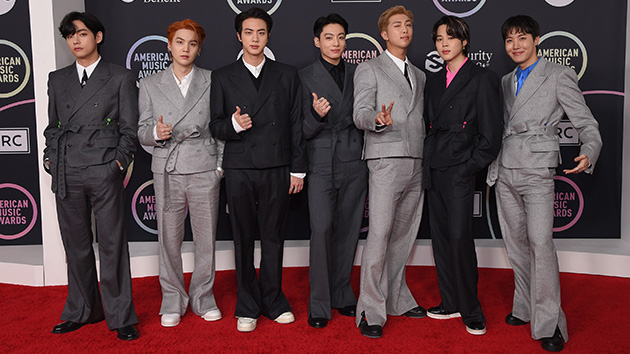
If you’re hoping to grow your collection of BTS merchandise, you’re in luck. The “Butter” hitmakers have teamed with Nordstrom for an exclusive line.
The collection, dubbed BTS Themed Merch, went live on Friday both online and in stores and features unisex clothing, buttons, stickers and a whole bunch of other goodies. Items range in price from about $10 to $110 USD.
The line even includs photo flags that fans hoping to catch their next live performance can wave around in the crowds, but the $9 offerings that had group and individual photos are mostly gone.
Other offerings include a “Boy with Love” pink robe for $110 that comes with matching slippers for an extra $25, a gender inclusive “Black Swan” sweatshirt for $80, a “Mic Drop” black fleece pouch for about $40, and a “Dynamite” reversible knit scarf. Fans can also snatch up exclusive sweatpants, mugs, beanies, stamps, tee shirts, jackets, and even throw blankets.
Items are selling out already, so if you are dying to grab a little something, better act fast.
As one of country music’s fastest-rising newcomers, Breland has gotten his fair share of attention from listeners on the Internet — including some negative comments.
“There are people on the Internet who like to troll and I definitely have gotten some pretty hateful messages from people that don’t feel like my brand in country music is authentic,” the singer tells E! Online.
Hailing from New Jersey and pulling influence from gospel standards to Justin Bieber-era pop and more, Breland does indeed have his own distinct sound, which he’s dubbed “cross country.”
But he’s far from the only country artist to make the genre their own. His duet partner on his remixed version of “My Truck,” Sam Hunt, is just one example of someone who’s pushed the boundaries of country music and been hugely successful in the process.
Breland’s message to his haters? “Okay, well, you don’t have to love it. Music is interpretative,” he reflects. “Just because you don’t think that this is country enough doesn’t mean that it isn’t.”
Most recently, Breland joined forces with Dierks Bentley and Hardy for Dierks’ hit single, “Beers on Me.”