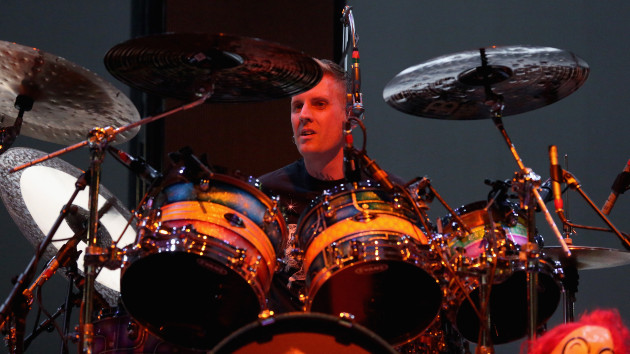
Brann Dailor is getting more use out of his Rob HalfordHalloween costume.
The Mastodon drummer and vocalist leads a cover of the Judas Priest song “Screaming for Vengeance,” recorded for the popular metal-themed YouTube channel Two Minutes to Late Night.
Dailor explored the upper register of his voice to sing the 1982 tune while surrounded by shredders including Anthrax‘s Jon Donais and Two Minutes to Late Night host Jordan Olds, aka Gwarsenio Hall.
Two Minutes to Late Night previously featured Dailor’s Mastodon band mate Bill Kellihertaking onRush‘s “Anthem” alongside an all-star prog lineup of Tool‘s Danny Carey, Primus‘ Les Claypool and Coheed and Cambria‘s Claudio Sanchez.
Kane Brown has returned to the top of the country music charts with “One Mississippi.”
This week, the superstar reached the summit on country radio with his new #1 hit, and Kane took to his Instagram Stories on Sunday to share a simple, but sweet message in reaction to the news. “Thank you country radio,” he wrote alongside a series of heart emojis.
This marks Kane’s seventh #1 hit following, “What Ifs” featuring Lauren Alaina, “Heaven,” “Lose It,” “Good as You,” “Homesick” and the most recent, “Famous Friends,” a collaboration with Chris Young.
“Famous Friends” is up for multiple awards at the 2022 ACM Awards, including Single of the Year, Music Event of the Year and Video of the Year. The show airs on Amazon Prime Video live from Las Vegas on March 7 at 8 p.m. ET.
Robert Plant and Alison Krauss have debuted a music video for their new cover of the 1965 soul tune “Searching for My Love,” which appears on the duo’s 2021 collaborative album, Raise the Roof.
The clip, which is the first official music video that Plant and Krauss have released in 14 years, depicts a series of lonely male travelers on various quests to find seemingly unattainable objects of desire.
The video includes scenes of a man climbing to a mountaintop, a pirate standing in front of a treasure chest, an adventurer soaring through gray clouds on man-made wings, and a man swimming in the ocean toward a mermaid who disappears just as he reaches her.
“Searching for My Love,” which originally was recorded by American soul group Bobby Moore & The Rhythm Aces, is a tune that Plant first sang when he was a teenager. The Led Zeppelin frontman says the song was “another nugget of beautiful lost soul music which has been ricocheting between me and Alison for a long time.”
As previously reported, Raise the Roof, which was released in November, is a 14-track collection that features 13 covers of songs by “legends and unsung heroes of folk, blues, country and soul music,” as well as one original tune co-written by Plant and producer T Bone Burnett, titled “High and Lonesome.”
In support of Raise the Roof, Plant and Krauss will launch a U.S. tour leg that runs from a June 1 show in Canandaigua, New York, trough a June 17 appearance at the Bonnaroo festival in Manchester, Tennessee. The duo also has a series of European concert in late June and July.
Twisted Metal, Anthony Mackie‘s action-comedy show based on the hit Sony PlayStation game series of the same name, will unspool on the streaming service Peacock.
As previously reported, the project is being executive-produced by Deadpool and Zombieland screenwriters Rhett Reese and Paul Wernick, and written by co-executive producer and Cobra Kai writer Michael Jonathan Smith.
The games center on tricked-out vehicles and burned-out drivers going at each other in a post-apocalyptic world, though the half-hour, live-action series will be more fleshed out than that.
The series will have Marvel movie star Mackie playing John Doe, a motor-mouthed, amnesiac milkman who must travel across the wasteland in his souped-up milk truck to deliver an important package.
“With no memory of his past, John gets a once-in-a-lifetime opportunity to make his wish of finding community come true, but only if he can survive an onslaught of savage vehicular combat,” Peacock teases.
The network adds, “With the help of a trigger-happy car thief, he’ll face savage marauders driving vehicles of destruction and other dangers of the open road, including a deranged clown who drives an all too familiar ice cream truck,” referring to the character that gamers know as the maniacal marauder Sweet Tooth.
In a new statement, Jeff Frost, president of Sony Pictures Television Studios, and Jason Clodfelter, co-president of Sony Pictures Television Studios, enthused, “Michael…and Rhett and Paul have ingeniously brought this high-action comedy to life, and we are so fortunate to have Anthony at the center of the show.”
They add, “We look forward to this incredible team blowing audiences away with this twisted and inventive concept.”
It’s lucky number seven for Carrie Underwood‘s oldest son!
On Sunday, Carrie and her husband, Mike Fisher, celebrated the seventh birthday of their son Isaiah. The superstar singer commemorated the occasion with a celebratory post on Instagram showing that Isaiah had a Star Wars-themed birthday party at a skating rink, complete with a disco ball, a Darth Vader cake with galactic frosting and his name written in bold red lettering, and storm trooper balloons. She also shared a photo of her son and his friends playing the claw crane arcade game.
But alongside the fun, Carrie took a moment to reflect on her son’s character.
“It has been so much fun to see this little dude grow! He has the biggest heart and the brightest smile,” she describes in the caption, praising her firstborn son’s “strong and pure” faith. “He is an old soul with a vintage style…wise beyond his years. He’s the kind of kid that would rather raise money for the kids at @danitaschildren than get gifts for himself! What 7 year old does that?!?! I am so blessed to be his mom and I can’t wait to see where God leads him in the years to come. Happy birthday, monkey! We love you!”
Carrie’s former tour mates Maddie Font of Maddie & Tae and Runaway June‘s Jennifer Wayne are among those who wished Isaiah a happy birthday in the comment section. “He’s getting too big. Happy happy birthday Isaiah!” Maddie writes alongside a crying face emoji. “Happy birthday Isaiah!!! Cannot believe you are 7!!!” adds Jennifer.
Carrie and Mike are also parents to three-year-old son Jacob.
The critically acclaimed FX comedy Better Things debuts its fifth and final season today. Star and creator Pamela Adlon based the show — in which she plays Sam, a single mom with three daughters — on the trials and tribulations of her own life.
“I feel like in a way, FX paid for my therapy and you guys all watched it like The Truman Show,” she jokes to ABC Audio.
“You know, Sam is like me in a cape. It’s like the worst of me and the best of me,” Adlon says, explaining her personal pride in the show’s success. “And if something happens to me in life, I could be in my car driving home, reflecting on it, saying, ‘Ah would have been so bad if this happened.’ Put in the show. ‘It would have been so good if I just said this one thing,’ put it in the show.”
She adds, “I have this saying — bad for my life, good for my show.”
Adlon admits that she had mixed feelings when she learned this season would be the last for Better Things.
“When it was presented to me…at first it was a stomach ache, like, ‘Oh, I can’t believe this is going to be the last,'” she admits. “And by the end of the conversation, I got really excited because I thought, oh, it reinvigorated me.”
Rise Against has announced a U.S. summer headlining tour.
The outing launches July 16 in Las Vegas, and will wrap up August 18 in Detroit. The Used and Senses Fail will open on select dates.
Tickets go on sale this Friday, March 4, at 10 a.m. local time. For the full list of dates and all ticket info, visit RiseAgainst.com.
Rise Against will be touring in continued support of their 2021 album, Nowhere Generation. Ahead of the summer dates, they’ll launch a spring U.S. trek beginning in April.
(NEW YORK) —Russian forces are continuing their attempted push through Ukraine from multiple directions, while Ukrainians, led by President Volodymr Zelenskyy, are putting up “stiff resistance,” according to U.S. officials.
The attack began Feb. 24 as Russian President Vladimir Putin announced a “special military operation.”
Russians moving from Belarus towards Ukraine’s capital, Kyiv, don’t appear to have advanced closer towards the city since coming within about 20 miles, although smaller advanced groups have been fighting gun battles with Ukrainian forces inside the capital since at least Friday.
Russia has been met by sanctions from the U.S., Canada and countries throughout Europe, targeting Russia’s economy and Putin himself.
Here’s how the news is developing. All times Eastern:
Feb 28, 2:22 pm
Ukraine, Russia envoys kick off contentious debate in rare UNGA special session
In an extraordinary emergency meeting of the U.N. General Assembly — only the 11th in the body’s history — representatives from Ukraine and Russia delivered fiery back-to-back remarks.
Ukrainian Ambassador to the U.N. Sergiy Kyslytsya compared Russian President Vladimir Putin to Adolf Hilter.
“This war was not provoked. It was chosen by someone who is right now sitting in the bunker. We know what happened with the person who sat in the bunker in Berlin in May 1945,” he said.
Kyslytsya accused Russia of carrying out war crimes, saying Russians “keep attacking kindergartens and orphanages, thus committing war crimes and violating the Rome Statute. Hospitals and mobile medical aid brigades are also targeted by the Russian shelling and sabotage groups working in Ukraine cities and towns.”
He concluded with an appeal for support, stressing that it was not just Ukraine at stake.
“If Ukraine does not survive, international peace will not survive,” he said.
Russian Ambassador Vasily Nebenzya denied the veracity of many of Kyslytsya’s claims, saying instead of discussing the roots of the “disinformation,” he wished to focus on the “real reasons for the crisis,” saying the fault lies with Ukraine itself. He cited baseless Kremlin-peddled claims that the country was carrying out a brutal attack on the people of the Donbas region and accused Western powers of turning “a blind eye.”
Nebenzya also attempted to shift blame to the West.
“Our Western colleagues have shamelessly inundated the country with weapons, have sent to the country instructors, and effectively incited Ukrainians who are facing a 120,000-strong military contingent, and prompted them to engage in armed provocation again the Donbas,” he said.
This phase of debate on a resolution condemning Russia’s actions in Ukraine has now concluded and the General Assembly is expected to vote on the resolution later on Monday.
-ABC News’ Shannon Crawford
Feb 28, 1:55 pm
French embassy moving from Kyiv to Lviv
France’s embassy in Ukraine will be moved from the capital, Kyiv, to Lviv, near the Polish border, France’s Foreign Minister Jean-Yves Le Drian said in a live interview on BFMTV.
Le Drian said, “I’m not sure President Putin imagined his operation was going to be so difficult.”
He added, “Vladimir Putin has lost the communication battle” and that while “Putin wanted to divide us,” “he has achieved the opposite.”
Feb 28, 1:17 pm
US shutters embassy in Belarus, draws down embassy in Russia
The U.S. is suspending operations at the embassy in Belarus, where just half a dozen U.S. diplomats had been based, Secretary of State Antony Blinken announced.
The U.S. is also drawing down its embassy in Moscow, authorizing the departure of non-emergency staff and diplomats’ families, Blinken said in a statement.
He didn’t cite any specific threat but said the department took these steps “due to security and safety issues stemming from the unprovoked and unjustified attack by Russian military forces in Ukraine.”
The U.S. special envoy for Belarus tweeted a photo showing two American diplomats taking down the flag at the embassy in Minsk, the capital of Belarus.
“Belarus’ complicity in Russia’s war against Ukraine has shown the regime’s loss of sovereign decision-making,” Ambassador Julie Fisher tweeted.
Fisher said all staff have already departed the country, with some moving to Vilnius, the capital of Lithuania, where she has been based.
While U.S. officials have been concerned that Belarusian forces will join Russia’s invasion, a senior Defense Department official told reporters Monday they’ve seen no indication that Belarus is preparing to join. But Belarus leader Alexander Lukashenko “seems to be establishing a pretext for more active involvement” in the war, according to an internal State Department situation report Sunday obtained by ABC News, including by accusing Ukraine of “beating” and “poisoning” Belarusians in Ukraine.
Feb 28, 12:51 pm
FIFA, UEFA suspend Russian teams
FIFA and UEFA said they are suspending all Russian national and club soccer teams from competition until further notice.
The UEFA soccer league also said it’s ending its partnership with Russian gas company Gazprom.
“The decision is effective immediately and covers all existing agreements including the UEFA Champions League, UEFA national team competitions and UEFA EURO 2024,” UEFA said.
Feb 28, 12:40 pm
Russia bans flights from 36 countries from their airspace
Russia is restricting the flights of airlines from 36 countries “as a retaliatory measure” for the European Union’s ban on Russian planes, Russian news agency Interfax reported, citing the Russian Federal Air Transport Agency.
The countries on Russia’s ban are: Austria, Albania, Anguilla (a British overseas territory), Belgium, Bulgaria, the British Virgin Islands, the United Kingdom, Hungary, Germany, Gibraltar, Greece, Denmark (including Greenland, the Faroe Islands and the territorial sea), Jersey, Ireland, Iceland, Spain, Italy, Canada, Cyprus, Latvia, Lithuania, Luxembourg, Malta, the Netherlands, Norway, Poland, Portugal, Romania, Slovakia, Slovenia, Finland, France, Croatia, the Czech Republic, Sweden and Estonia.
The U.S., which isn’t included on Russia’s list, hasn’t banned Russia from its airspace. However, Delta suspended its codeshare partnership with Russian airline Aeroflot on Friday.
Feb 28, 12:13 pm
State Department: Reports of human rights abuses ‘widespread’
The State Department said in a statement Monday that “reports of human rights abuses have been widespread” since Russia’s invasion of Ukraine, pointing to attacks that killed civilians, including children, and destroyed schools, hospitals and homes.
The allegation of human rights abuses has also gone further to accusations of war crimes by Russia’s military. Amnesty International reported Sunday that Russia used cluster munitions in an attack against a kindergarten that killed three civilians, including one child, which “could constitute a war crime,” the human rights group said. The use of cluster munitions against civilians is a violation of international law.
Ukrainian Foreign Minister Dmytro Kuleba has repeatedly accused Russian forces of committing war crimes, tweeting on Friday that Ukraine’s general prosecutor’s office is collecting reports and will send them to The Hague, adding, “responsibility is inevitable.”
Secretary of State Antony Blinken will address the United Nations Human Rights Council on Tuesday. Russian Foreign Minister Sergey Lavrov was set to address the same chamber but his trip was canceled “due to an unprecedented ban on his flight in the airspace of a number of EU countries,” Russia’s mission to the U.N. offices in Geneva said.
Feb 28, 11:59 am
Talks between Ukraine, Russia end after six hours
Talks between a Ukrainian delegation and Russian officials at the Belarus-Ukraine border have ended after six hours. Both sides will return to their capital cities for consultation ahead of a second round of talks.
Ukraine said it wanted a ceasefire and Russian withdrawal, while the Kremlin said it would not announce its position. Russia’s negotiators have talked of striking a deal that’s in the interests of both sides.
Feb 28, 11:47 am
Russian advance frustrated by resistance: US official
Russian forces are frustrated by their slow advance, but that could lead them “to be more aggressive and more overt in both the size and scale of their targeting of Kyiv,” a senior U.S. defense official said Monday, implying less discriminate attacks with more danger to civilian populations.
The Russians heading south to Kyiv continue to be slowed by fuel shortages and stiff Ukrainian resistance and have only moved about three miles since Sunday, leaving them about 16 miles away from the capital city, the official said.
“We believe they want to encircle Kyiv and it’s possible that they could adopt siege tactics there,” the official warned.
On Sunday the same official said there were indications Russian forces were adopting siege tactics around the city of Chernihiv in northern Ukraine.
So far, the Russians have fired more than 380 missiles, the official said.
Putin has committed about 75% of the more than 150,000 forces he had arrayed at the border to the invasion inside Ukraine, according to the official.
There’s no indication Belarusian forces are involved or are preparing to join Russia in the invasion, and Russia has not placed nuclear weapons in Belarus, according to the official.
Feb 28, 10:53 am
Putin tells Macron he’ll stop strikes against civilian targets
According to the Elysée, Russian President Vladimir Putin told French President Emmanuel Macron on Monday that he’ll stop strikes against civilian targets.
Putin also told Macron he’ll preserve civilian infrastructure to secure main roads, including the road south of Kyiv, according to the French government.
Macron and Putin will speak again this week, the Elysée said.
Feb 28, 10:18 am
IOC recommends no participation of athletes from Russia, Belarus
The International Olympic Committee said its executive board is recommending prohibiting athletes and officials from Russia and Belarus in international competitions.
The recommendation is “to protect the integrity of global sports competitions and for the safety of all the participants,” the IOC said.
Feb 28, 9:57 am
Neutral Switzerland adopts EU sanctions targeting Russia
Switzerland is breaking from its longstanding policy of neutrality by adopting the packages of sanctions imposed by the European Union citing Russia’s continuing military invasion of Ukraine.
Switzerland, which has long been a safe haven for Russian assets, announced on Monday that it’s imposing financial sanctions targeting Russian President Vladimir Putin, Russian Prime Minister Mikhail Mishustin and Russian Foreign Ministry Sergey Lavrov, and is targeting the assets of certain people and companies.
Switzerland also is imposing entry bans against individuals who have a connection to Switzerland and are linked to Putin and will be closing Swiss airspace to flights from Russia, with the exception of flights for humanitarian, medical or diplomatic purposes, officials said.
Switzerland will also extend a ban on imports, exports and investments concerning Crimea and Sevastopol, which has been in place since 2014, to the Ukrainian regions of Donetsk and Luhansk.
Swiss officials said they are partially suspending the 2009 agreement on visa facilitation for Russian nationals, and those with diplomatic passports will continue to be allowed entry without a visa in an effort to continue diplomatic talks.
-ABC News’ Christine Theodorou
Feb 28, 9:01 am
US banning Russia’s central bank from accessing reserves in US
Senior administration officials on Monday provided more specifics on the sanctions against Russia announced over the weekend and emphasized the drastic nature of these steps, saying the “actions represent the most significant actions the U.S. Treasury has taken against an economy of this size, and assets of this size,” noting the Russian central bank is multiple times larger than Iran’s or Venezuela’s.
The U.S. has put into effect sanctions on Russia’s central bank that keep Moscow from accessing any of their more than $600 billion in reserves in the U.S., or in U.S. dollars in foreign countries. The sanctions also target Russia’s National Wealth Fund and the Ministry of Finance.
Officials said it was clear from the beginning of the invasion that Russian President Vladimir Putin was planning to use central bank assets to mitigate any sanctions.
“Today’s announcement that prohibit transactions with the Central Bank of Russia in the national wealth fund will significantly hinder their ability to do that, and inhibit their access to hundreds of billions of dollars in assets from our actions alone, they will not be able to access assets that are either in United States or in US dollars,” officials said.
“What we’ve done today is not only preventing them from using those dollars in the United States, but preventing them from being able to use those dollars in other places like Europe or Japan to defend their currency and prop up their institutions. And our goal was to make sure that not only would they not have access to dollars, but also not have access to other currencies,” officials said.
“Our strategy — to put it simply — is to make sure that the Russian economy goes backwards, as long as President Putin decides to go forward with his invasion of Ukraine,” a senior administration official said.
-ABC News’ Sarah Kolinovsky, Justin Gomez
Feb 28, 8:39 am
White House: ‘No reason to change’ US alert levels
After Russian President Vladimir Putin put Russia’s nuclear deterrent forces on a state of heightened alert this weekend, a White House official confirms the U.S. has not changed its own alert level.
“We are assessing President Putin’s directive and at this time see no reason to change our own alert levels,” a White House official confirmed to ABC News.
“We think provocative rhetoric regarding nuclear weapons is dangerous, adds to the risk of miscalculation, should be avoided, and we will not indulge in it,” the official added.
The official also noted that, as recently as June, when President Joe Biden met Putin face-to-face in Geneva, the two leaders affirmed nuclear war is tantamount to mutually assured destruction.
The leaders said in a joint statement in June, “Today, we reaffirm the principle that a nuclear war cannot be won and must never be fought.”
-ABC News’ Sarah Kolinovsky
Feb 28, 8:21 am
US shutters embassy in Belarus, draws down embassy in Russia
The U.S. is suspending operations at the embassy in Belarus, where just half a dozen U.S. diplomats had been based, Secretary of State Antony Blinken announced.
The U.S. is also drawing down its embassy in Moscow, authorizing the departure of non-emergency staff and diplomats’ families, Blinken said in a statement.
He didn’t cite any specific threat but said the department took these steps “due to security and safety issues stemming from the unprovoked and unjustified attack by Russian military forces in Ukraine.”
-ABC News’ Conor Finnegan
Feb 28, 6:47 am
Russia hikes key rate to 20% as ruble tumbles
Russia’s central bank on Monday raised its key interest rate to 20% from 9.5% in an apparent effort to slow the fallout from severe international sanctions.
The rate hike came as the Russian ruble tumbled, trading down as much as 30% against the U.S. dollar on Monday, according to Bloomberg. The currency traded about 17% lower midday in Moscow.
The Russian stock market reportedly closed for the day.
-ABC News’ Zunaira Zaki
Feb 28, 6:23 am
500,000 refugees have fled Ukraine, UN says
More than 500,000 people have fled Ukraine since the Russian invasion began on Thursday, the U.N. Refugee Agency said on Monday.
More than half have crossed the border into Poland, the agency said. Filippo Grandi, the U.N. high commissioner for refugees, had said on Sunday that 368,000 people had fled to neighboring countries.
-ABC News’ Zoe Magee
Feb 28, 5:00 am
Ukraine delegation arrives for talks with Russia
The Ukrainian delegation sent for talks with Russia arrived Monday morning at the Belarus-Ukraine border, where the meeting will be held.
Ukraine has said the key issue for the talks is an immediate ceasefire and the withdrawal of Russian troops.
Russia has signalled it wants to discuss Ukraine adopting “neutral status.”
The head of Russia’s delegation has said the two sides will meet within about an hour. They are meeting on the Pripyat River, north of Chernobyl.
The Ukrainian delegation includes the Minister of Defense Oleksiy Reznikov, the head of Zelenskyy’s parliamentary party, as well as advisors to the president and MPs.
Russia’s delegation includes officials from the Foreign and Defense ministries, and the presidential administration.
The talks were agreed to on Sunday in a call between Ukraine’s President Volodymyr Zelenskyy and Belarus’ leader Alexander Lukashenko.
Fighting continued throughout the night, as Russia attempted to advance and bombarded Ukrainian forces.
-ABC News’ Patrick Reevell and Julia Drozd
Feb 28, 3:29 am
Russian advance slows north of Kyiv, UK military says
The U.K. Ministry of Defence said on Monday that the advance of Russian ground forces had been slowed by Ukraine’s defense of an airport in Hostomel, about 19 miles north of Kyiv.
“Logistical failures and staunch Ukrainian resistance continue to frustrate the Russian advance,” the ministry said on Twitter.
(NEW YORK) — A pair of social media misinformation campaigns exploiting tensions in Russia and Ukraine were identified and disabled on Facebook over the weekend, according to two senior leaders at the social network’s parent company Meta.
One operation thwarted by Meta’s security team involved about 40 accounts described as “inauthentic” with some profile pictures suspected to have been generated artificially, Threat Disruption Director David Agranovich said Sunday night. The fictitious personas operated across the internet, the Meta employees said, including on Twitter, YouTube, Telegram and two Russian social media networks.
The campaign also included fake websites resembling news outlets that claimed to be based in Kyiv with the people behind the sites posing as news editors and expert sources.
The operation was connected to a campaign previously detected and taken down by Facebook in April 2020. At the time, the activity was found to have come from Russia, the Donbas region and two media organizations in Crimea.
“The campaign had a very limited following across its presence online,” Agranovich said.
When Meta took action against the accounts, they had fewer than 4,000 followers on Facebook and fewer than 500 on Instagram, Agranovich said. The security team did not say how many total impressions or views the inauthentic posts received.
Another operation involved the specific targeting of Facebook accounts belonging to members of the Ukrainian military, as well as politicians and a journalist. The profiles were used to share YouTube videos portraying Ukrainians as weak and surrendering to Russia, which Facebook said was done by compromising the accounts likely through personal email. One video appeared to show Ukrainian soldiers coming out of a forest waving a white flag.
The Meta employees did not disclose the total number of compromised accounts, only referring to them as “a handful.” They also did not reveal the names behind the accounts, citing privacy concerns.
While Facebook described the number of accounts affected as minimal, the phishing operation that led to the compromise was reportedly widespread and attributed by cybersecurity researchers to a previously known misinformation campaign called “Ghostwriter.”
“Ghostwriter has previously targeted the NATO alliance, seeking to erode support for the organization,” said Ben Read, director of Cyber Espionage Analysis at the cybersecurity firm Mandiant. “I wouldn’t be surprised if similar operations were seen in the near future.”
Mandiant has linked the “Ghostwriter” campaign to the Belarusian military, and concerns remain over the exploitation of Ukrainians’ personal data.
“Leaking misleading, or fabricated documents taken from Ukrainian entities could be leveraged to promote Russia- and Belarus-friendly narratives,” Read said.
ABC News has tracked the spread of disinformation related to Ukraine and Russia across online forums and social media networks.
In one example, a video that appeared to show a man with his leg blown off was shared by a Russian separatist militia on Telegram last week. The stump of the man’s leg was blurred.
“Ukrainian punishers continue the genocide of the civilian population of Donbass,” the video’s caption read.
But other, unblurred videos of the scene show the man was, in fact, an amputee. There is no blood and the attachment for a prosthetic leg is clearly visible.
At Meta, Facebook has increased its fact-checking capacity in Russia and Ukraine and added new features to protect Ukrainians and help them lock down their accounts and check privacy settings. Meta will now also extend some of those features to Russia in an effort to protect the increased targeting of Russian protesters, the company announced.
Earlier this week, Russian state media was barred from running ads or monetizing the platform.
In response to calls for Meta to shut down Facebook and Instagram in Russia, Vice President of Global Affairs Nick Clegg said the company does not want to restrict services for Russians who are protesting and organizing against the war.
“The Russian Government is already throttling our platform to prevent these activities,” Clegg said in Tweet Sunday. “We believe turning off our services would silence important expression at a crucial time.”
Benedict Cumberbatch shared a very unique memory he has of Madonna, which involves her asking a pretty personal question.
Appearing recently on TheGraham Norton Show, the Oscar nominee was asked if he ever auditioned for the “Like a Prayer” hitmaker. “Oh, god, yes I did,” Benedict revealed with a laugh, though he didn’t reveal for what project. “She just sort of came in breezily, very late and had a clipboard in her hand.”
Mimicking a gesture of her holding up the clipboard to her face, the Power of the Dog Oscar nominee continued, “[She] said, ‘Yeah. Benedict Cumberbatch… is that really your name?’ And I went, ‘Yes it is, Madonna.'”
As the rest of the guests laughed, Benedict deadpanned, “I didn’t get the part.”
Madonna’s birth name is Madonna Louise Ciccone, while Cumberbatch’s full name is Benedict Timothy Carlton Cumberbatch.