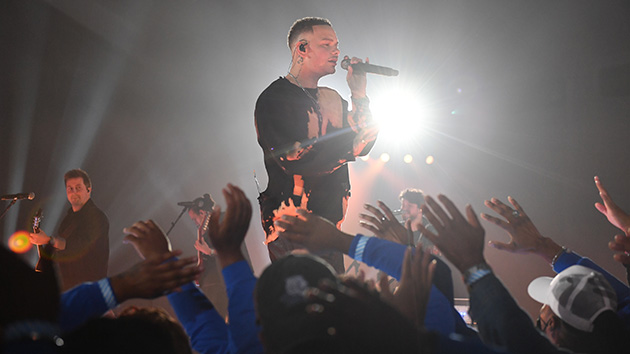
Two-time Grammy winner KidCudi launched his recording career in 2009 on Kanye West‘s GOOD Music label. His debut album, Man on the Moon: The End of Day, was certified double platinum, igniting a very successful career. However, the 37-year-old rapper admits that he could not handle stardom and, eventually, became depressed and suicidal for five years.
Cudi, born Scott Mescudi, remembers that when West called him “the most important artist of the past 10 years” during a concert in Houston, it helped him escape his depression.
“My mom was visiting me,” Cudi tells the Los Angeles Times. “And [she] came up to me and was like, ‘Look at this.’ And it was Kanye in concert. I started bawling my eyes out. Like I just started weeping like a big baby. Because we had fallen out and there was beef. But that’s my brother. I just kind of realized in that moment … I realized that he really loved me.”
Cudi’s emotional story is told in the new Amazon Prime Video documentary, A Man Called Scott, which premiered Friday
It includes testimonials from West, PharrellWilliams, A$AP Rocky, Jaden and WillowSmith, and Lil Yachty.
Cudi also appears in the film, Don’t Look Up, opening December 10, starring LeonardoDiCaprio, Jennifer Lawrence, Meryl Streep, Jonah Hill, Tyler Perry, Cate Blanchett and Chris Evans.
Last week, he received a nomination from the Hollywood Music in Media Awards for On Screen Performance for the song “Just Look Up” that he recorded with Ariana Grande for the film. Cudi is also nominated in the Feature Film Category for his song, “Guns Go Bang” with Jay-Z, from The Harder They Fall.
Fifty years ago today, November 8, Led Zeppelin released its classic fourth studio album, an untitled collection commonly known as Led Zeppelin IV.
The massively successful album is packed with some of the band’s best-known songs, including one of the great all-time rock anthems, “Stairway to Heaven,” and cemented Led Zeppelin’s reputation as the world’s biggest hard rock band.
Led Zeppelin IV missed topping the Billboard 200 chart, peaking at #2, but the album has gone on to sell over 23 million copies in the U.S., making it among the five best-selling studio albums ever in the States.
Besides “Stairway to Heaven,” Led Zeppelin IV features “Black Dog,” “Rock and Roll,” “Misty Mountain Hop,” “Going to California” and more.
“Black Dog” reached #15 on the Billboard Hot 100, Led Zeppelin’s second highest-charting single in the U.S. after “Whole Lotta Love,” which peaked at #4 in 1970.
Two guest artists are featured on Led Zeppelin IV. Former Fairport Convention singer Sandy Denny duets with Robert Plant on “The Battle of Evermore,” and original Rolling Stones keyboardist Ian Stewart plays piano on “Rock and Roll.” Denny was the only guest vocalist ever to appear on a Led Zeppelin song.
Heart sisters Ann and Nancy Wilson, who famously saluted Led Zeppelin at the 2012 Kennedy Center Honors by performing “Stairway to Heaven” with late Zeppelin drummer John Bonham‘s son, Jason, tell ABC Audio that Led Zeppelin IV made a major impact on them.
Ann credits the album with being “probably one of the biggest turning points of my musical life,” while Nancy says that Led Zeppelin “painted…culture-altering landscapes” on the record.
Meanwhile, a video series profiling the making of Led Zeppelin IV has been posted on the band’s YouTube channel.
Here’s the album’s full track list:
“Black Dog”
“Rock and Roll”
“The Battle of Evermore”
“Stairway to Heaven”
“Misty Mountain Hop”
“Four Sticks”
“Going to California”
“When the Levee Breaks”
Kieran Culkin, star of HBO’s Succession, made his Saturday Night Live hosting debut over the weekend in an episode that featured surprise guest appearances from music legend Dionne Warwick and SNL alum Tracy Morgan.
While it was Culkin’s first hosting gig, the 39-year-old actor explained in his opening monologue that he actually made his SNL debut 30 years ago, when his older brother, Macaulay Culkin, hosted the show.
Kieran showed a clip of his younger self being hoisted into the air by then-cast member Kevin Nealon during the goodnights, and recreated that moment when current cast members Chris Redd and Kenan Thompson lifted him onto their shoulders at the end of Saturday’s show.
In the show’s cold open, Aaron Rodgers, played by Pete Davidson, was interviewed by Fox News’ Judge Jeanine Pirro — played by Cecily Strong — about his COVID-19 diagnosis.
The sketch also saw the return of former President Donald Trump, played by new cast member James Austin Johnson, whose impression drew praise on social media.
Later, Ego Nwodim reprised her “Dionne Warwick Talk Show,” sketch, in which she portrays the legendary singer-turned-social media personality — who is confused by today’s music. The bit ended with an appearance from the Grammy-winning singer herself, who joined Nwodim for a snippet of her 1966 hit, “What the World Needs Now.”
Another popular sketch was about the awkward conversations guys have in the men’s room. Alex Moffat‘s character admitted that he “killed a man in 2012” and the bit ended with Tracy Morgan popping out of one of the stalls and warning them “not to go in there,” because “I dropped a bomb… and that man [pointing to Moffat] killed my brother.”
Musical guest Ed Sheeran performed “Shivers” and “Overpass Graffiti” from his new album = (Equals).
As names of some of the victims emerged in the deadly stage-surge horror at the Astroworld Festival concert in Houston, the medical examiner is asking for the public’s help in identifying one young man who died in the chaos that erupted during rapper Travis Scott‘s performance.
The Harris County Institute of Forensic Sciences released a post-mortem photo of the 6-foot-2, nearly 500-pound man, who perished at Memorial Hermann Hospital in the Texas Medical Center, where he was brought after Friday night’s mayhem.
He was among eight concert-goers killed when throngs in the estimated crowd of 50,000 packed into NRG Stadium in Texas, and suddenly surged toward the stage, authorities said.
Three of the people killed were identified by either their families or the schools they attended.
The youngest victim who died was 14-year-old John Hilgert, a freshman at Memorial High School in Houston, according to a letter the school’s principal sent to parents.
Also killed was 16-year-old Brianna Rodriguez, a junior at Heights High School in Houston, and Franco Patino, 21, a senior at the University of Dayton in Ohio.
As previously reported, the concert bedlam unfolded around 9:30 p.m. local time Friday when the “the crowd began to compress toward the front of the stage,” Houston Fire Chief Sam Pena told reporters during a news conference Friday night.
At least 13 people injured remain hospitalized, including five under the age of 18, Houston Mayor Sylvester Turner told reporters during a briefing.
What triggered the surge is under investigation by the Houston Police Department. Texas Gov. Greg Abbott said he has ordered the Texas Department of Public Safety to make state resources available to support the investigation.
Scott has since addressed the incident. He first posted a statement on social media saying he is “absolutely devastated” by what happened. He later shared updates on his Instagram Stories, saying he was “working closely with everybody to get to the bottom of this.”
His girlfriend, Kylie Jenner, also posted a statement via her IG Stories, which reads in part that she is “broken and devastated” by the incident, and that her “thoughts and prayers” are with those who lost their lives and were affected.
(HOUSTON) — At least eight people are dead, including two teenagers, after a crowd surged toward the stage at a massive Houston concert, causing panic and chaos, authorities said.
Over 50,000 people were at the first night of this weekend’s sold-out Astroworld music festival at NRG Stadium when, around 9:30 p.m. local time, “the crowd began to compress toward the front of the stage,” Houston Fire Chief Sam Pena told reporters Friday night.
“That caused some panic, and it started causing some injuries,” Pena said.
Twenty-five people, including one as young as 10, were transported to the hospital, authorities said. Eleven people were transported in cardiac arrest, Pena added.
As of Saturday afternoon,13 people were still hospitalized, including five under the age of 18, Houston Mayor Sylvester Turner told reporters during a briefing.
Those who died ranged in age from 14 to 27. One was 14, another 16, two were 21, two were 23 and one was 27, the mayor said. One has yet to be identified.
“Nothing of this magnitude that any of us can recall, and certainly that I can recall, has taken place in this city,” Turner said.
The cause of death of the eight individuals won’t be known until the medical examiner completes the investigation, Pena said.
Some of the deceased individuals didn’t have identification on them, Houston Police Chief Troy Finner told reporters Friday.
A command post for information on missing persons was set up at a nearby hotel. As of Saturday afternoon, no one has been reported missing, officials said.
The festival ended early Friday night and has been canceled for Saturday.
Pena described the chaotic scene in an interview with ABC News’ Gio Benitez on “Good Morning America” Saturday.
“As soon as the crowd began to surge … those people began to be trapped, essentially up at the front, and they began to be trampled and they actually had people falling down and passing out,” Pena said.
One concertgoer said she was pushed “very aggressively.”
“It was intense, it was intense,” the concertgoer told “Good Morning America.” “We were seeing people getting pulled out of the crowd, and we would see some of these people unconscious.”
Madeline Eskins, who attended the concert with her boyfriend, told ABC News they tried to leave when they started getting pushed from all sides toward the front of the stage but couldn’t move.
“I remember I was about to tell him to tell my son that I love him because at that point I was like, ‘I’m going to die,'” Eskins said. “I really didn’t think I was going to see him again. And then I fainted.”
Amid the chaotic scene and mass of people it was difficult to disperse the crowd and reach those who needed medical attention, Pena said. The festival organizer, Live Nation, had set up a field hospital of sorts to treat minor injuries during the festival, but that was “quickly overwhelmed.”
Eskins, an ICU nurse, said once she recovered she started helping the on-site medical staff treat unconscious concertgoers and delegate tasks, though medical supplies, including defibrillators, were limited.
“I was trying to control the chaos as much as I can,” she said. “Nothing could have prepared them for this.”
The cause of the incident is currently unknown, according to Finner, who said Live Nation is cooperating with police in reviewing video footage of the concert.
“Nobody has all the answers tonight,” he said Friday. “There’s a lot of rumors going around. We don’t have facts, we don’t have evidence.
“We’ve got to do an investigation and find out because it’s not fair to the producers, to anybody else involved, until we determine what happened, what caused the surge. We don’t know. We will find out.”
Concertgoers knew something was amiss during a set by headliner Travis Scott. During the middle of his performance, the rapper stopped and told the crowd, “Somebody passed out right here,” as captured by an Apple Music livestream of the event.
“I’m absolutely devastated by what took place last night,” Scott, a Houston native, said in a statement on Twitter Saturday. “My prayers go out to the families and all those impacted by what happened at Astroworld Festival.”
Scott said the Houston Police Department has his “total support” during the investigation, and that he is “committed to working together with the Houston community to heal and support the families in need.”
Festival organizers also said they are “focused on supporting local officials,” and urged anyone with information to contact the police.
Live Nation also released a statement Friday saying it was “heartbroken for those lost and impacted at Astroworld last night,” and is “working to provide as much information and assistance as possible” to local authorities.
Investigations will be speaking with concert promoters and witnesses and reviewing videos from the event and venue on Saturday, according to Turner.
“I have called for a detailed briefing from all stakeholders, including Live Nation, Harris County, NRG Park, Police, Fire, Office of Emergency Management, and other agencies, explaining how the event got out of control leading to the deaths and injuries of several attendees,” he said in an earlier statement.
Gov. Greg Abbott said he has ordered the Texas Department of Public Safety to make state resources available to support the investigation.
“What happened at Astroworld Festival last night was tragic, and our hearts are with those who lost their lives and those who were injured in the terrifying crowd surge,” Abbott said in a statement. “Thank you to the first responders and good Samaritans who were on site and immediately tended to those who were injured in the crowd.”
This isn’t the first time there have been crowd control issues at Astroworld. There was a “similar incident” at the 2019 festival, where there was a “breaching of barricades,” according to Harris County Judge Lina Hidalgo.
“Actions were taken after that experience. There were stronger fencing more and more robust barricades, more personnel and more security personnel,” Hidalgo told reporters Saturday.
The number of Houston Police Department officers on hand increased from 47 in 2019 to 76 at this year’s festival, she said. There was also additional space for crowd control, she said.
“But I want to know, the community deserves to know, if more needed to have been done,” she said, calling for an independent investigation into the tragedy. “The public has a role here, too. If you have any information as to what took place, let us know.”
ABC News’ Frank Elaridi contributed to this report.
(WASHINGTON) — Pete and Chasten Buttigieg tweeted about their son’s return home after a three-week hospitalization Saturday, including a week on a ventilator.
“Thankful, relieved, and reflecting a great deal on the mixture of joy, terror, and love that is parenting,” Pete Buttigieg, U.S. Secretary of Transportation, said in a tweet responding to his husband.
Chasten Buttigieg first tweeted about his son’s hospitalization on Halloween saying, “Gus has been having a rough go of it but we’re headed in the right direction.” The transportation secretary retweeted the message.
The baby also traveled 125 miles in an ambulance, but the family is grateful for the medical professionals’ care, according to Chasten Buttigieg’s Twitter post.
“We’re so relieved, thankful, and excited for him and Penelope to take DC by storm! Thank you so much for all of the love and prayers,” tweeted Chasten Buttigieg.
The infant, Joseph “Gus” August Buttigieg, and his twin, Penelope Rose, were adopted by the political couple earlier this year, and Pete Buttigieg previously said they were born prematurely.
“The work that we are doing is joyful, fulfilling, wonderful work. It’s important work. And it’s work that every American ought to be able to do when they welcome a new child into their family,” said Pete Buttigieg to Jake Tapper on CNN, responding to criticism that he was taking too much time off for paid family leave.
“The Secretary feels fortunate and grateful to be able to take time to focus on his responsibilities as a father, and believes all American parents deserve the same,” the spokesperson said via a statement in late October.
Chasten Buttigieg also tweeted his thanks for everyone who shared their stories of Gus in the neo-natal intensive care unit.
“Those were so comforting during such a scary time. Thank you for helping us feel less-alone amidst all of the anxiety and uncertainty,” tweeted Chasten Buttigieg.
One out of every ten infants were born prematurely in 2020, according to the Centers for Disease Control and Prevention. Complications related to preterm birth complications are the leading cause of death among children and were responsible for around 1 million deaths in 2015, according to the World Health Organization.
(HOUSTON) — At least eight people are dead after a crowd surged toward the stage at a massive Houston concert, causing panic and chaos, authorities said.
Over 50,000 people were at the first night of this weekend’s sold-out Astroworld music festival at NRG Stadium when, around 9:30 p.m. local time, “the crowd began to compress toward the front of the stage,” Houston Fire Chief Sam Pena told reporters Friday night.
“That caused some panic, and it started causing some injuries,” Pena said.
Pena described the chaotic scene in an interview with ABC News’ Gio Benitez on “Good Morning America” Saturday.
“As soon as the crowd began to surge … those people began to be trapped, essentially up at the front, and they began to be trampled and they actually had people falling down and passing out,” Pena said.
One concertgoer said she was pushed “very aggressively.”
“It was intense, it was intense,” the concertgoer told “Good Morning America.” “We were seeing people getting pulled out of the crowd, and we would see some of these people unconscious.”
Amid the chaotic scene and mass of people it was difficult to disperse the crowd and reach those who needed medical attention, Pena said. The festival organizer, Live Nation, had set up a field hospital of sorts to treat minor injuries during the festival, but that was “quickly overwhelmed.”
Twenty-three people, including one as young as 10, were transported to the hospital, authorities said. Eleven people were transported in cardiac arrest, Pena added.
The cause of death of the eight individuals won’t be known until the medical examiner completes the investigation, Pena said.
No further details have been released on the deceased victims. Some didn’t have identification on them, Houston Police Chief Troy Finner told reporters Friday.
A command post for information on missing persons was set up at a nearby hotel. The festival ended early Friday night and has been canceled for Saturday.
The cause of the incident is currently unknown, according to Finner, who said Live Nation is cooperating with police in reviewing video footage of the concert.
“Nobody has all the answers tonight,” he said Friday. “There’s a lot of rumors going around. We don’t have facts, we don’t have evidence.
“We’ve got to do an investigation and find out because it’s not fair to the producers, to anybody else involved, until we determine what happened, what caused the surge. We don’t know. We will find out.”
The Houston Fire Department has scheduled an update on the investigation for 3 p.m. local time Saturday.
Concertgoers knew something was amiss during a set by headliner Travis Scott. During the middle of his performance, the rapper stopped and told the crowd, “Somebody passed out right here,” as captured by an Apple Music livestream of the event.
“I’m absolutely devastated by what took palace last night,” Scott, a Houston native, said in a statement on Twitter Saturday. “My prayers go out to the families and all those impacted by what happened at Astroworld Festival.”
Scott said the Houston Police Department has his “total support” during the investigation, and that he is “committed to working together with the Houston community to heal and support the families in need.”
Festival organizers also said they are “focused on supporting local officials,” and urged anyone with information to contact the police.
Investigations will be speaking with concert promoters and witnesses and reviewing videos from the event and venue on Saturday, according to Houston Mayor Sylvester Turner.
“I have called for a detailed briefing from all stakeholders, including Live Nation, Harris County, NRG Park, Police, Fire, Office of Emergency Management, and other agencies, explaining how the event got out of control leading to the deaths and injuries of several attendees,” he said in a statement.
Gov. Greg Abbott said he has ordered the Texas Department of Public Safety to make state resources available to support the investigation.
“What happened at Astroworld Festival last night was tragic, and our hearts are with those who lost their lives and those who were injured in the terrifying crowd surge,” Abbott said in a statement. “Thank you to the first responders and good Samaritans who were on site and immediately tended to those who were injured in the crowd.”
(ATLANTA) — With a COVID vaccine for younger children given the final go-ahead, millions more Americans as young as 5 years old can now roll up their sleeves for the protection the shot affords: dramatically reducing the risk of developing COVID-19.
For many, that will also mean protection from long COVID — sometimes-debilitating symptoms that can last for months after a COVID-19 diagnosis.
Kate Porter’s daughter Adria was 11 when they both came down with an awful fever, fatigue and malaise in March 2020, before there was a vaccine for anyone. They both have grappled with ongoing symptoms since.
“If she could have been prevented from going through what we went through, I think it would have saved us a lot of hardship and pain and emotional, just anguish and worrying. I would have gotten her vaccinated immediately,” Porter said.
The U.S. Centers for Disease Control and Prevention’s final signoff late Tuesday paved the way for pediatric doses of the Pfizer vaccine to begin rolling out to thousands of hospitals, family doctors’ offices and major retail pharmacies across the country. It comes as the academic year kicks into higher gear and just in time to punctuate the holiday season.
“So many of my friends are just breathing a sigh of relief. They have been waiting for this,” Ann Wallace said. Her daughter Molly was 16 when she came down with COVID. Molly has grappled with recurring bouts of chronic fatigue ever since.
“Whether they are 8 or 18, long-hauler symptoms is a real struggle, especially for those in school,” Wallace said. “It takes an enormous toll.”
In discussing whether to recommend Pfizer for younger age groups, federal health officials have emphatically pointed not only to the overwhelming benefits of the vaccine, but also to the sobering risks of not making the shot available to vulnerable kids.
“There’s a lot of attention to the vaccine and not as much to the danger of COVID and what it can do,” said Claire Hannan, executive director of the Association of Immunization Managers. “And that’s a really important piece.”
“As a parent, if I had young children this age group, I would get them vaccinated now,” acting Food and Drug Administration Commissioner Janet Woodcock said Friday. “I would not want to take the risk that they would be one of the ones who would develop long COVID.”
“We can include not only the known benefit of the prevention of COVID cases … but many broader benefits — prevention of hospitalizations, MIS-C and deaths — as well as the prevention of additional post-COVID conditions,” CDC’s Sara Oliver said at Tuesday’s meeting recommending the shot.
More than 1 million children were diagnosed with COVID in the past six weeks, adding to the total of more than 6 million children who have tested positive since the start of the pandemic, according to the American Academy of Pediatrics. Of the 1.9 million kids aged 5 to 11 who have gotten COVID, 8,300 wound up hospitalized.
Estimates vary, but studies in adults suggest that 10% to as many as a third of COVID-19 patients go on to develop long-term symptoms.
While vaccinations will help prevent many cases of COVID-19 — and therefore save many children from developing long-haul symptoms — scientists still aren’t sure if getting vaccinated will heal children already living with long COVID.
Molly, now 18, never expected to have symptoms this long. But more than a year after being infected she still struggles with chronic fatigue, and uses an inhaler.
“People are like, ‘Oh, I’ll get better, it’ll be fine.’ But there’s a wide range of ways that COVID can affect you,” she said.
Porter, meanwhile, was concerned how her daughter’s long-hauler symptoms might be impacted by taking the vaccine. But she now plans to get Adria vaccinated in the coming weeks.
“I feel like the last two years were stolen from us,” Porter said. “I feel like she should still be 11. And I should still be 34.”
Terri King’s daughter, Haley, was 9 in November 2020 when her fever began to spike, along with a sore throat, cough, headache and loss of taste and smell. She felt like her mouth was constantly numb and burning, King said. A year later, Haley has a persistent hypersensitivity to noise that interferes with her daily life. King has been hesitant to get Haley vaccinated, though.
Before data was available on Pfizer’s pediatric vaccine, a Kaiser Family Foundation poll suggested that roughly a third of parents of children ages 5 to 11 wanted to “wait and see.” Public health officials are hoping the FDA and CDC’s public review of all available data and strong endorsement will encourage more parents to seek vaccination for their younger children.
“I waiver back and forth, and you tend to get pulled in both directions,” King said. She’s now leaning toward getting Haley vaccinated by the end of the year.
“I know this is what needs to happen for my kids,” King said. “It’s just getting to that point where I’m completely comfortable with having it done. But we’re ready to get back to — and obviously, we know, it’s not going to be the same normal that it used to be — but, you know, back to some kind of normality. We’re ready to start out a new year, new and protected.”
ABC News’ Sony Salzman and Eric M. Strauss contributed to this report.
(WASHINGTON) — President Joe Biden said the country took a “monumental step forward” after his $1 trillion bipartisan infrastructure plan passed the House late Friday.
“We did something that’s long overdue, that long has been talked about in Washington, but never actually been done,” Biden said Saturday from the White House of the bipartisan infrastructure bill. “A once-in-a-generation investment that’s going to create millions of jobs, modernize our infrastructure, our roads, our bridges, our broadband, a whole range of things. To turn the climate crisis into an opportunity. And it puts us on a path to win the economic competition of the 21st century that we faced with China and other large countries, and the rest of the world.”
The bipartisan infrastructure deal will invest $110 billion in the nation’s highways, bridges and roads; $66 billion in passenger rail; $39 billion in public transit; $65 billion in broadband access; $65 billion in the nation’s power grid; and $55 billion in water and wastewater infrastructure, among other areas. The White House said the plan will create on average 1.5 million jobs per year over the next decade.
Biden had taken to the phones for last-minute calls to key House members as Speaker Nancy Pelosi pushed through two critical votes late Friday on the Democratic agenda: the infrastructure plan, and the $1.75 trillion “Build Back Better” social spending and climate policy package.
The final vote on the infrastructure plan, already passed by the Senate, passed 228-206, with 13 Republicans joining Democrats and six Democrats voting against. The bill will now be sent to Biden’s desk for his signature.
During a briefing with reporters, Biden told ABC News’ Ben Gittleson that Americans can expect to see the impacts of the bill within two to three months.
In the end, it took 87 days following the passage of the bill in the Senate to get the spending approved in the House, as well as two visits to the Capitol by the president and dozens of meetings between the White House and representatives.
The six Democrats who voted against the infrastructure bill were all members of the so-called “squad”: Reps. Alexandria Ocasio-Cortez, Ilhan Omar, Ayanna Pressley, Cori Bush, Rashida Tlaib and Jamaal Bowman.
Democratic infighting had continued throughout Friday as moderates demanded Pelosi wait for a cost estimate on the larger bill from the nonpartisan Congressional Budget Office before moving forward.
That group, including Reps. Kathleen Rice, D-N.Y., Ed Case, D-Hawaii, Josh Gottheimer, D-N.J., Stephanie Murphy, D-Fla., and Kurt Schrader, D-Ore., released a statement late Friday saying they would support the “Build Back Better” vote if it’s considered by Nov. 15 and the CBO scores remains consistent.
Progressives, who had their own issues with the bills, such as guaranteeing the inclusion of paid family leave, also came to an agreement late Friday to support the vote.
“Tonight, members of the Progressive Caucus and our colleagues in the Democratic Caucus reached an agreement to advance both pieces of President Biden’s legislative agenda,” Congressional Progressive Caucus Chair Rep. Pramila Jayapal said in a statement just prior to the vote.
Just after midnight in Washington, the House approved a procedural measure that advances the $1.75 trillion plan, 221 to 213, directly down party lines.
Late Friday afternoon, Pelosi announced the House would vote Friday on the already Senate-passed bipartisan infrastructure plan and then take a procedural vote on moving forward with the “Build Back Better” legislation — but not a final vote — a significant concession.
“We had hoped to be able to bring both bills to the floor today. Some members want more clarification or validation of numbers that have been put forth — it’s top line, that it is fully paid for. And we honor that request,” Pelosi said. “So today, we hope to pass the BIF and also the rule on Build Back Better with the idea that before Thanksgiving — it should take them another week or so — to get the numbers they are requesting.”
So, Democratic leaders imposed yet another deadline after missing many others — to pass the “Build Back Better” legislation by the middle of the month, with Pelosi calling its hoped-for passage a “Thanksgiving gift for the American people.”
The speaker, renowned for her vote-counting prowess and who has famously said she doesn’t call a vote unless she know she has enough to win, was asked by a reporter, “Do you … have 218 votes to pass it?” Pelosi answered, “We’ll see, won’t we?”
“I have a speaker’s secret whip count. I don’t tell anybody. Not even you, my dear good friends, but I have a pretty good feeling,” she said.
Even so, it wasn’t clear whether progressive Democrats would go along with Pelosi’s plan to vote Friday on the bipartisan infrastructure bill.
For months, they’ve threatened to vote against it — unless at the same time they got a vote on final passage of the larger social spending package.
Pelosi had addressed some of their concerns by adding back in four weeks of paid family and medical leave over the objections of West Virginia Democrat Joe Manchin, whose vote is key to getting the measure passed in the Senate.
In a sign of the fast-changing developments and disarray, minutes after Pelosi announced there would be a vote on the bipartisan infrastructure package Friday, progressives gathered behind closed doors.
In the middle of their meeting, Biden called Jayapal, according to two sources familiar with the matter.
She left in a hurry, racing to nearby elevators to take the call from the president.
ABC News Congressional Correspondent Rachel Scott said she was told roughly 20 progressives were ready to vote against the bipartisan infrastructure bill unless there was a vote on the larger social spending bill, too.
The roadblocks thrown up by House Democrats continued despite Biden urging them to act — with the party facing new pressure to deliver after disappointing election results on Tuesday.
“I’m asking every House Member, Member of the House of Representatives to vote yes on both these bills right now. Send the infrastructure bill to my desk. Send the Build Back Better bill to the Senate,” Biden send in his Friday morning message to lawmakers. “Let’s, let’s build on incredible economic progress. Build on what we’ve already done, because this will be such a boost when it occurs. Let’s show the world that American democracy can deliver and propel our economy forward. Let’s get this done.”
(NEW YORK) — Across the small town of Gloster, Mississippi, passersby can still see remnants of the damage caused by Tropical Storm Claudette and Hurricane Ida: tarps on roofs, fallen trees, damaged cars and homes hit hard by rain, debris and strong winds.
Both of the storms tore through the area in quick succession over the summer — Claudette in June and Ida in August, leaving a trail of damage and power outages.
Jimmy Brown, an activist who works with the local NAACP, says that when the power goes out in Gloster as it did for half of Amite County during Ida, it can stay out for days or weeks — and help can be hard to come by.
In the last five years, Gloster has had at least 774 outages and extreme weather events are the main culprits, according to Entergy Mississippi representatives.
Brown, who has lived in this impoverished small town all of his life, says his community members are finding it more difficult to manage as the effects of climate change continue to intensify.
“I call us the forgotten communities,” Brown said in an interview with ABC News. “This is heartbreaking when you really sit down and think about it. But you have to, in order to make some changes, you’ve got to go out and do something to try to help try to make it better.”
Experts say climate change causes hurricanes and other storms to intensify, and with that, those most frequently in their path, particularly the Gulf states, such as Mississippi, are faced with an uncertain future.
For the poor, the effects are particularly acute.
Research suggests that the impoverished are impacted in several ways: they are less prepared for the effects of extreme weather events and then don’t have the resources to either recover or move.
On top of that, as in the case of Gloster and other impoverished places, the effects of climate change on vulnerable populations are compounded — in this case by poor air quality from local industry.
Only getting worse
Gloster, a small majority-Black town of only 869 people, has a poverty rate of more than 50%, with a median household income of about $17,000, according to the U.S. Census Bureau.
Data from the National Hurricane Center shows that at least 14 storms have affected Mississippians in the last four years, resulting in floods, strong winds and heavy downpours.
After Hurricane Ida in August, Gloster was one of several places in Mississippi to qualify for public and individual assistance to recover from the disasters. FEMA often provides temporary housing, funds for disaster-caused expenses and more for natural disaster victims.
“I’ve met quite a few individuals who had been affected by Hurricane Harvey and they were displaced from their homes, and I heard stories about mobile homes being wrapped around trees,” Erniko Brown, an activist with the environmental advocacy group Dogwood Alliance said about residents she’s helped in Gloster. She is unrelated to Jimmy Brown.
For those living in vulnerable populations in vulnerable areas, climate change is another expense that many can’t bear. And it’s only going to get worse for the people of Gloster and towns all across the country just like it, according to the Fourth National Climate Assessment, which is a congressionally mandated report from the U.S. Global Change Research Program.
Existing inequalities in poor communities will only be exacerbated due to climate change, the Fourth National Climate Assessment shows.
According to a 2018 study published in Cambridge University Press, natural disasters reduce household income, destroy homes, and force families to give up a larger fraction of their wealth.
The study reports that natural disasters are a “key factor for pushing vulnerable households into poverty and keeping households poor.”
Poor property owners can’t afford to modify their homes to withstand strong winds, erosion, or flooding, the Fourth National Climate Assessment shows. Instead, the repairs only make them financially tied to houses that are at greater risk of damage.
“People were just trying to live in what they had left of a home,” Erniko Brown said. “One woman told me about her mother and father living in their mobile home although it had mold in it, and they felt like calling FEMA, but there’s so much red tape.”
Impoverished communities are often composed of renters and people who do not own their property, the report says, which makes it harder to advocate and invest in better climate-prepared housing. Poverty also makes it harder for people to evacuate or relocate during or following a major natural disaster.
This research found that impoverished communities are more likely to be exposed to the negative environmental impacts of climate change, like intensified storms, and will often take longer to recover from natural disasters.
Hits keep on coming
When one storm hits Gloster, the blue tarps, fallen trees and home damage are often still in sight when the next storm creeps up on the small rural town, according to Jimmy Brown.
He says that the community has taken a lot of hits in recent years — businesses have slowly closed, there is no longer a school in the town, and they rely on many outside emergency services to get assistance.
Representatives from the Red Cross say that in the last five years alone, it has helped more than 28,000 people affected by tornadoes, floods, hurricanes and home fires in Mississippi. Overall, they say it’s helped 767,100 people across the U.S
“This increasing rate of climate-driven disasters has become an unsustainable burden on those most vulnerable, notably low-income populations and low-income communities of color, the elderly and people with disabilities,” Jennifer Pipa, vice president of American Red Cross Disaster Programs, told ABC News.
Of the U.S. households the Red Cross provided assistance to following disasters in 2020, the Red Cross reported that 63% had incomes at or below federal poverty levels.
“Until recently, what was an episodic series of acute events has now become a chronic condition of devastating climate impact, leaving families and neighborhoods without the opportunity or time to prepare or recover effectively on their own,” Pipa added.
Storms often leave lasting destruction and damage in their wake: the total cost for the 2020 hurricane season almost reached $47 billion, the Center for Disaster Philanthropy reports. The research shows 2020 was the seventh most expensive hurricane season in history.
Nine of the 10 costliest hurricane seasons in the Atlantic have occurred since 2004, according to the Center for Disaster Philanthropy.
Hurricanes and flood-related events cause more economic damage than other types of natural disasters, according to NOAA.
Between 2010 and 2018, flood damage has cost the U.S. $17 billion annually, according to Federal Emergency Management Agency representative Michael Grimm in House testimony.
Since 1980, the total amount of damage has surpassed $1 trillion, according to research from the flood research organization First Street Foundation.
It was estimated that flood damage would cause $20 billion of damage in 2021 to homes with a substantial risk of flooding. First Street Foundation also found that this amount is expected to rise to $32 billion annually by 2051.
Compounded by other injustices
Like many injustices, environmental tragedies are affecting Gloster from many different angles.
In February, following action taken by the Mississippi Department of Environment Quality the wood pellet manufacturer Drax Biomass agreed to pay $2.5 million to settle allegations that its facilities emitted three times more air pollution than permitted over Gloster. The company did not admit to wrongdoing and a Drax spokesperson at the time said that the company had monitored the emissions and notified MDEQ of its breach.
Local environmental advocacy organizations say they have heard reports of asthma, rashes, throat irritation and more impacting the people of Gloster since the factory arrived in 2016.
“My first time experiencing it — the air was so thick,” Erniko Brown said. “My eyes and my nose were burning and I couldn’t be out there. I think I was out there for maybe five minutes.”
“We take our environmental responsibilities seriously, are committed to complying with all local and federal regulations and have worked with the local authorities in Mississippi to install equipment at our plant, which ensures we are operating within the permitted emissions limits,” a Drax spokesperson said in a statement to ABC News.
“We monitor our emissions regularly and report them to the state environment agency – the Mississippi Department for Environmental Quality,” the statement read.
In rural, impoverished areas like Gloster, the Fourth National Climate Assessment reports that there is an increased risk of exposure to extreme heat and poor air quality, lack of access to basic necessities and fewer job opportunities.
With environmental injustices compounding, activists in the South have pleaded with legislators to come and survey the damage and the impact on the livelihoods of those who feel they’ve been forgotten in the conversations about climate change and environmentalism.
“Please come to a rural community and see what kind of effect it is having on us,” Jimmy Brown said.
Erniko Brown called on legislators to remember the smaller communities, who she says are suffering while lawmakers wait patiently for solutions as climate injustices worsen.
“If we are the richest nation in the world, then we need to be able to provide some of the resources to the people in the communities that are being left behind,” she said.
ABC News’ Julia Jacobo and Ayushi Agarwal contributed to this report.