(NEW YORK) — Michelle Obama is honoring her mom in a special way.
Ahead of Mother’s Day, the former first lady announced that an exhibit in the highly anticipated Obama Presidential Center in Chicago will pay tribute to her mother, Marian Robinson.
In a video Friday shared first with ABC News’ Good Morning America, Obama reflected on the close relationship she has with her mother and the values that Robinson instilled in her at a young age.
“Growing up with my mom was always an adventure,” Obama said. “It was trips to the library as a toddler to learn about ABCs; it was the entire family piling into our car to go to the local drive-in; and my mom inviting family over for New Year’s Eve, passing around her special hors d’oeuvres and toasting in the new year.”
“But above all else,” she added, “my mother gave me that nonstop, unconditional love that was so important for me to grow up. In so many ways, she fostered in me a deep sense of confidence in who I was and who I could be by teaching me how to think for myself, how to use my own voice and how to understand my own worth. I simply wouldn’t be who I am today without my mom.”
The exhibit, called “Opening the White House,” will focus on community and family while also making sure everyone who visits the presidential center “feels at home,” Obama said.
The upcoming exhibit will also feature scale replicas of the White House’s East Room, where the Obamas once held dinners, as well as the Blue Room and the South Lawn, where the family hosted garden tours and the Easter Egg Roll.
“This is just one part of the story we’re telling at the Obama Presidential Center,” Obama said. “I am so excited to announce that we will be dedicating a space at the Obama Presidential Center in her honor.”
In her memoir, Becoming, Obama opened up about her mother, whom she called the “first grandmother” because she lived with them in the White House. During their eight years there, Robinson would help Obama balance the demands of raising a private family in a very public house.
Obama ended her Mother’s Day tribute to her mom by saying that she hopes everyone will be able to see the exhibit when the presidential center opens to the public in 2025.
“In the years ahead, we want to welcome you to Chicago to see it — maybe even with your mom,” she said. “So Happy Mother’s Day everyone. And especially to you, mommy. Love you.”
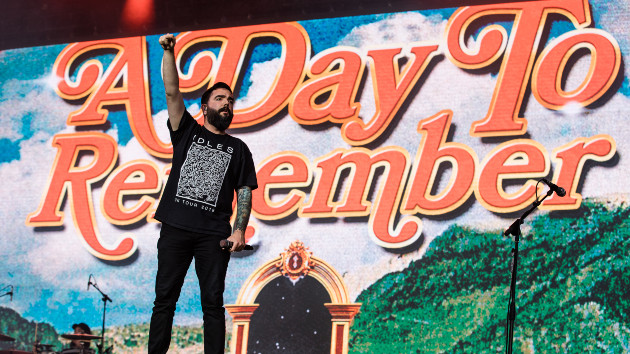
A Day to Remember has announced a U.S. headlining tour.
The outing will be divided into two sections, dubbed Just Some Shows and Just Some More Shows. Just Some Shows will run from July 27 in Baltimore to August 27 in Portsmouth, Virginia, while Just Some More Shows picks up October 1 in Pensacola, Florida, and wraps up October 28 in Irvine, California.
Beartooth, The Ghost Inside and Bad Omens will support on Just Some Shows, while the Just Some More Shows bill includes The Used, Movements and Magnolia Park.
Tickets to all dates go on sale next Thursday, May 12, at 10 a.m. local time. For the full list of dates and all ticket info, visit ADtR.com.
A Day to Remember will be touring behind their new album You’re Welcome, which was released March 2021. Earlier this year, they released a new version of the You’re Welcome track “Re-Entry” featuring Blink-182‘s Mark Hoppus.
Xavi Torrent/Redferns; Kevin Mazur/Getty Images for Bud Light
Yungblud and WILLOW‘s long-awaited collaboration has finally arrived.
The joint track, which the pair first began teasing last December, is titled “Memories,” and is available now via digital outlets. You can watch its accompanying video, which stars both artists, streaming now on YouTube.
“I think with ‘Memories’ I wanted to create a song that would allow people to let go of past trauma in any regard whether that be a relationship, whether that be abuse, whether that be a misconception in terms of race, in terms of gender, in terms of anything,” Yungblud tells ALT CTRL Radio on Apple Music 1. “I wanted to create a song that would allow people to scream in one room and take each other’s burdens on together because if we carry it together, the load is easier.”
“Memories” follows Yungblud’s single “The Funeral,” and WILLOW’s Paramore-sampling PinkPantheress collaboration “Where You Are.”
(NEW ORLEANS) — The New Orleans Jazz & Heritage Festival kicked off in New Orleans last weekend after two years and three cancellations due to the COVID-19 pandemic.
“The energy is just out of this world. I feel like there’s just such an overwhelming feeling of like, love and camaraderie — from the musicians to the participants,” Robin Barnes, who is known as the Songbird of New Orleans, told ABC News.
Barnes is set to perform at the festival on Sunday, its closing day.
For New Orleans — considered by many as the birthplace of jazz — the festival is the city’s musical heartbeat.
The 10-day cultural festival attracts over 400,000 visitors to New Orleans each year and draws musicians from around the world and pumps an estimated $400 million into the local economy.
“The economical side of it is extremely significant,” Barnes said, adding that while tourism in the city ebbs and flows throughout the year, Jazz Fest is a “musical mecca” and its return is a “game changer” for musicians around the city.
“It’s almost just a breath of relief,” Barnes, who is part of the jazz duo Da Lovebirds with her husband Casey Pat, said.
“For musicians, with the gig economy, every gig is a paycheck … so coming from a pandemic, we’ve all had to learn to basically survive with no money,” she added.
And the sorrows for the jazz community amid the pandemic have been immense in other ways. The human toll of the virus touched every corner of the jazz world as dozens of jazz musicians and producers died of COVID-19, including New Orleans jazz legend Ellis Marsalis.
“I feel like the amount of loss or lack of having music during the pandemic was able to really just force us to have such a renewed appreciation and love for the music,” Barnes said.
Hurricane Ida, which also wreaked havoc in New Orleans in September, swept away the Karnofsky Tailor Shop and Residence, a historic jazz landmark that Louis Armstrong once considered a second home and many musicians affected by the destruction.
As Jazz Fest returned to the city, the New Orleans Public School Board reversed a 100-year-old rule banning jazz in New Orleans schools.
Kenneth Ducote, NOLA public schools historian, found the obscure rule and brought it to the board’s attention.
“There was no prior discussion. There was no analysis, there was no theory, theoretical analysis of jazz,” he told ABC News’ Good Morning America of the rule.
Although it was mostly unenforced, Ducote brought it to the school board’s attention which reversed the rule.
“It was really important for us to pass it because, to be honest, this is a policy that was rooted in racism,” Olin Parker, president of the New Orleans Parrish school board, told GMA.
Barnes, who is the mother of a 2-year-old daughter named Riley, said reversing the rule is a “symbolic” move that shows the community’s appreciation for jazz and its impact on New Orleans history.
As for Riley, who was born during the pandemic, Barnes said she is excited to have her daughter experience Jazz Fest for the first time.
Although jazz is the cornerstone of the event, the festival celebrates all the indigenous music and culture of New Orleans and Louisiana and includes music from various genres, including blues, R&B, gospel, Cajun, zydeco, Afro-Caribbean, folk, Latin, rock, rap, country and bluegrass, according to the festival’s website.
This year’s headlining acts include The Who, Stevie Nicks, Willie Nelson, Foo Fighters, Jimmy Buffett and The Coral Reefer Band, Luke Combs, Lionel Richie, The Black Crowes, The Avett Brothers, Erykah Badu and Norah Jones.
Barnes said that the festival “encompasses the diversity” of New Orleans and so many people come because “there is something for everyone.”
(WASHINGTON) — U.S. employers added 428,000 jobs to their payrolls in April, the latest figures released Friday by the Labor Department show.
The increase marks the 12th straight month of job growth above 400,000.
The biggest gains in employment last month occurred in leisure and hospitality (78,000), manufacturing (55,000) and transportation and warehousing (52,000), according to the Labor Department.
The unemployment rate, meanwhile, remained unchanged at 3.6%.
Despite quick-spreading rumors circulating the internet Thursday night that Georgia YouTuber and self-proclaimed “relationship guru” Kevin Samuels died, as of early Friday morning, the Fulton County Medical Examiner has yet to confirm the news.
As detailed in an incident report provided by the Atlanta Police Department to ABC News, at approximately 6:04 p.m. on Thursday, May 5, authorities responded to a call regarding a person injured at an apartment on E Paces Ferry Road in Atlanta. Upon arriving at the home, an officer observed the fire department administering CPR to a Black male, who was unresponsive on the floor of his apartment.
The officer then met with a woman who identified the male as Kevin Samuels.
According to the incident report, currently categorized as “Miscellaneous Non-crime,” the woman stated that she met Samuels the evening prior and spent the night with him. Upon Samuels’ complaint of chest pain, the woman attempted to help him but he fell on top of her, after which she called 911. The woman also said she requested the 911 operator to contact the front desk for a defibrillator to help keep Samuels responsive until hospital staff arrived.
Samuels was later transported to Piedmont Hospital for care.
A Monday evening press release from Chief Medical Examiner Karen E. Sullivan states in full, “The Fulton County Medical Examiner’s Office can neither confirm nor deny the reported death of Kevin Samuels. If further information becomes available, an updated press release will be issued.”
Samuels is known as a popular social influencer who often went viral due to his controversial relationship advice and remarks. Many people strongly disagreed with his dating opinions — often times aimed at Black women — including his most recent proclamation that, “If you have made it to 35 years old and you’re unmarried, you are a leftover woman.”
ABC News has reached out for confirmation of Samuels’ condition and will update this story as more information becomes available.
The clip for the Fergie-sampling track stars “Girl from Rio” singer Anitta as a mysterious woman who spies on Jack with a telescope as he exits a building, and then gets on a motorcycle and rides into the night down a road painted with letters spelling out “Glamorous” — the name of the Fergie song in question.
In the clip, which switches from black-and-white to color, we see Jack in the studio, in the club, on a runway with a helicopter, and on what looks like the same nighttime road Anitta is driving on. It ends with him opening the trunk of a car, only to see a beam of light pour out and shoot up to the sky, which could be a nod to the 1984 cult classic Repo Man.
As previously reported, Come Home the Kids Miss You features Justin Timberlake, Pharrell, Drake and Lil Wayne. There’s also a song called “Dua Lipa,” in which Jack raps, “I catch a groove like Dua Lipa/I’m tryna do more with her than do a feature.”
Speaking to Zane Lowe on Apple Music 1 about the album, Jack explains its theme is all about bringing a piece of his glamorous life back to his home in Louisville, Kentucky.
“I take these experiences where I’m flying through the Hollywood Hills or I’m on a private jet to Miami…I experience stuff no one from my city is getting to experience,” he explains. “And I take that home and go, ‘Let me tell you about it.’”
The full interview drops Saturday at 11 a.m. ET on Jack’s YouTube channel.
(NEW YORK) — Former NASCAR driver Danica Patrick revealed she had her breast implants removed after suffering medical complications she believes were caused by the implants.
Patrick, who turned 40 in March, shared in an Instagram post that she had her implants removed this month, nearly eight years after undergoing breast augmentation surgery.
“I thought to myself, I want to share this if it makes a difference,” Patrick told ABC News’ Kayna Whitworth in an interview that aired Friday on Good Morning America. “Because I’ve tried so many different things to feel better to look better, all the things, and nothing worked.”
Patrick said she got her silicone implants in 2014, when she was 32-years-old.
“I did it because I wanted to be more perfect,” she said. “I wanted the whole package … I felt like I was very fit and I thought, well, but I just don’t have boobs.”
Four years later, in 2018, Patrick said she started experiencing health concerns, and spent the next four years seeking answers for symptoms including weight gain, inflammation, leaky gut, menstrual changes, heavy metal toxicity and thinning hair.
Patrick said she went to multiple doctors, took thyroid medications, tried a 90-day protocol to heal her gut and at one point was taking “up to 30 pills a day” to improve her health, all to no avail.
Ultimately, Patrick said she came to the conclusion that she had breast implant illness, a term coined by clinicians and patients to describe symptoms reported by women after breast reconstruction or augmentation using implants, according to the Food and Drug Administration.
Dr. Shaun Parson, the Arizona-based plastic surgeon who performed Patrick’s removal surgery, said breast implants can sometimes prompt a “chronic inflammatory response” in the body.
“It’s usually that their bodies have this kind of chronic inflammatory response to this thing, this implant, so your body’s fighting something just like if it had an infection,” said Parson, a board-certified plastic surgeon. “I have seen too many times people get better after you remove their implants, and I think we have work to do to try to figure out why.”
One week after having her implants removed, Patrick said she feels “amazing.”
She said she plans to continue to share her journey with the hope of helping other people.
“My journey is not even over. This is week one,” said Patrick. “There’s going to be tons of testing that still happens. There are going to be physical changes on the inside and outside that I’m happy to share.”
What to know about breast implant illness
Breast implant illness is not yet a recognized medical term but is described by experts as a “diagnosis by exclusion,” according to Diana Zuckerman, Ph.D., president of the National Center for Health Research, who has studied the health impact of breast implants for over 30 years.
“Diagnosis by exclusion means that there is no test for it, but there are tests for other things that have the same symptoms or similar symptoms,” Zuckerman said. “And if there is no other reason for this array of symptoms, then there are doctors who will call it breast implant illness.”
There are as many as 40 symptoms of breast implant illness, but the most common symptoms include joint and muscle pain, fatigue, memory problems or brain fog, hair loss and difficulty breathing, according to Zuckerman.
She said Patrick’s story of taking years to get to a diagnosis is not uncommon for women who suffer health complications due to breast implants.
It can take years for breast implants to start causing complications, which makes it more difficult to link complications back to breast implants, according to Zuckerman, who was not involved in Patrick’s care. She also noted that many of the symptoms of breast implant illness can, and are, attributed to other things.
“When [women] go to the doctor and say, ‘I have joint pain. I’m really tired,’ the doctor will say things like, ‘No wonder you’re tired, you have a young child,’ or, ‘No wonder you’re tired, you’re 45 years old. You’re not 25 years old anymore,” said Zuckerman.
“So there’s been this, some might call it gaslighting, but this sense that these are common symptoms and they could be anything,” she said. “But, what is distinct about them is there are so many women who are experiencing them, and there are very good studies showing when women have these symptoms and they have their breast implants taken out, almost all of them get better.”
Breast implant surgery is considered an elective procedure that is done not only for cosmetic reasons but also for women undergoing breast reconstruction after a medical procedure such as a mastectomy.
Saline-filled and silicone gel-filled are the two types of breast implants approved for use in the United States, according to the FDA.
Breast implants may cause damage if they leak in the body, or because they can cause scar tissue to build in the body, according to Zuckerman.
“When women have a breast implant, their body almost always forms a scar tissue capsule around the implant,” she said. “The body is basically protecting itself by surrounding this foreign body, this breast implant, with scar tissue, and that scar tissue can get very thick and can get very hard and be a bad symptom in that it can be painful.”
Zuckerman said that the popularization of social media has helped women with similar symptoms connect and share their experiences, leading to greater awareness and more diagnoses of breast implant illness.
Patrick wrote on Instagram that she watched “over 100 stories on YouTube” of women with breast implant complications.
“Social media has really made the big difference here,” Zuckerman said. “It wasn’t until Facebook and other social media options became available that women could really share their stories.”
“We’ve certainly known women who’ve spent tens of thousands of dollars on tests and specialists, and nothing helped and then they went online and found a Facebook page or some other social media, and they started reading these stories of other women that sounded just like them,” she said.
In October, the FDA released new guidelines on breast implants, adding a black box warning and a checklist for doctors and patients about potential side effects.
“The patient must be given the opportunity to initial and sign the patient decision checklist and it must be signed by the physician implanting the device,” the FDA noted in its guidelines.
Zuckerman, a member of the working group that advised the FDA on implant safety, said she advises women who are thinking of getting implants to make sure they also have the resources to get them removed later on if needed.
“Don’t get them unless you can afford to have them taken out,” she said. “A lot of women spend all this money getting them put in, and then when they get sick, they don’t have the money to get them taken out. It costs just as much, sometimes more, to have them taken out.”
(CINCINNATI) — Crossing the finish line at a marathon is often a time to celebrate, but one running family is facing criticism after their 6-year-old was allowed to enter and complete the Flying Pig Marathon in Cincinnati last weekend.
Rainier Crawford, 6, ran the 26.2-mile course with his five siblings and parents, finishing in 8 hours and 35 minutes.
“Some of the training was like, hard, but I falled sometimes but sometimes, when I did one, it was like, normal,” Rainier told Good Morning America.
Crawford’s father, Ben Crawford, wrote on Instagram that his youngest son did struggle physically during the marathon.
“He was struggling physically and wanted to take a break and sit every three minutes,” Crawford wrote in an Instagram post Tuesday. “After 7 hours, we finally got to mile 20 and only to find an abandoned table and empty boxes. He was crying and we were moving slow so I told him I’d buy him two sleeves [of potato chips] if he kept moving.”
Crawford added that he was impressed by his son’s abilities.
“I didn’t know if he was going to be able to do it so to be able to run alongside of him and to watch his little body, it’s pretty mind-blowing,” he told GMA.
The social media post has since sparked an outcry, with some saying the family did it for likes on Instagram and some going so far as to accuse the Crawfords of child abuse.
Kara Goucher, a two-time Olympian and long-distance runner, was among those speaking out, writing on Twitter Wednesday, “I don’t know who needs to hear this but a six year old cannot fathom what a marathon will do to them physically. A six year old does not understand what embracing misery is. A six year who is ‘struggling physically’ does not realize they have the right to stop and should.”
Organizers of the Flying Pig Marathon defended their decision to let every member of the Crawford family participate in the 2022 marathon.
“The intent was to try to offer protection and support if they were on our course (Medical, Fluid and Replenishment),” Iris Simpson Bush, the president and CEO of the marathon’s parent organization Pig Works, wrote in an open letter posted to the organization’s website.
The nonprofit also told GMA they knew the Crawfords would run the Flying Pig race despite the marathon’s age limitation, which usually only lets runners 18 and older participate, a factor that played into the decision to let the Crawfords run.
“Our requirement of 18+ for participation in the marathon will be strictly observed moving forward,” Bush added in the open letter.
Experts say a child’s growth plates, the tissue near long bones, isn’t fully developed at age 6 and an extreme activity like running a marathon could be dangerous for children.
Dr. Alok Patel told GMA that he would be concerned with letting a young child run a marathon.
“If a young child were to run a marathon, I’m worried about electrolyte abnormalities, nausea, vomiting, heatstroke, all these signs and symptoms that may not be that clear in a young child,” Patel said.
The Crawfords said they don’t pressure their children to do intense activities like run a marathon but follow their kids’ lead if they say they want to try it out.
“We really care about our kids’ emotional and physical health. But we also care about their agency and if they want to do something, and we, you know, assess the risks and figure out if it’s OK,” Kami Crawford, Rainier’s mom, said.
(WASHINGTON) — Inclined sleepers for babies and crib bumper pads will be banned from being sold under legislation passed Wednesday by Congress.
The bill, known as the Safe Sleep for Babies Act, will now go to the White House for President Joe Biden to sign.
Among the advocates calling on Biden to sign the legislation quickly into law is Erika Richter, whose 2-week-old daughter, Emma, died while using a Fisher-Price Rock ‘n Play sleeper, a type of incline sleeper that would be banned under the new legislation.
“For this bill to be passed, it’s a huge win, and for it to have bipartisan support just highlights that this change was long overdue and undeniably necessary,” Richter, of Portland, Oregon, told Good Morning America. “There are 4.7 million of these products sold.”
Richter has been a vocal advocate for change since the death of Emma, her only child, in August 2018.
In 2020, Richter filed a lawsuit against Fisher-Price for wrongful death and gross negligence. The case is ongoing in Los Angeles County Superior Court and Richter declined to provide details on her daughter’s cause of death due to the litigation.
In its answer to the lawsuit, Fisher-Price has denied all of the allegations and specifically denied “that because of an act or omission by them, their agents, or independent contractors, Plaintiffs were injured or damaged in any sum, or at all.”
It was only after Emma’s death that Richter said she learned about reports of other infant deaths associated with Rock ‘n Play sleepers, which were recalled in 2019 by the Consumer Product and Safety Commission (SCPC) after being linked to over 30 deaths.
“I thought to myself, ‘If I had just known sooner,'” said Richter. “I wish that somebody had done what I’m doing and what some of the other mothers are doing more publicly around the time that I had Emma.”
Last June, Richter shared her story publicly for the first time at a congressional hearing that followed up on a report from the House Committee on Oversight and Reform. The report found Fisher-Price ignored repeated warnings that its Rock ‘n Play sleeper was dangerous before the device was recalled.
The report found more than 50 infant deaths were linked to the sleeper, which puts infants at a 30-degree incline.
The cause of death for some of the babies was asphyxia, or the inability to breathe, due to the child’s position, the report said.
“We trusted a name brand, and we were wrong,” Richter said in her testimony, holding up baby clothes as a reminder of what she has left to remember her daughter.
When Richter first shared her story publicly last June, a spokesperson for Mattel, the parent company of Fisher-Price, told ABC News in a statement there “is nothing more important” to the company than the safety of its products and that its “hearts go out to every family who has suffered a loss.”
“The Rock ‘n Play sleeper was designed and developed following extensive research, medical advice, safety analysis and more than a year of testing and review,” a spokesperson said, adding that independent medical and other expert analyses verified that the sleeper was safe when used in accordance with its instructions and warning. “It met or exceeded all applicable regulatory standards. As recently as 2017, the U.S. Consumer Product Safety Commission (CPSC) proposed to adopt the ASTM voluntary standard for a 30-degree angled inclined sleeper as federal law.”
A Mattel spokesperson confirmed to ABC News Thursday the Rock ’n Play Sleeper is no longer on the market, noting it, “was sold from its introduction in 2009 up until its voluntary recall in April 2019.”
Guidelines from both the CPSC and the American Academy of Pediatrics (AAP) say caregivers should always place infants to sleep on their backs on a firm, flat surface and should never add “blankets, pillows, padded crib bumpers, or other items to an infant’s sleeping environment.”
In addition, caregivers should not use infant sleep products with inclined seat backs of more than 10 degrees, and should not use infant car seats, bouncers and other inclined products for sleep, according to the guidelines.
Around 3,400 babies in the U.S. die each year while sleeping, in sudden and unexpected deaths, according to the AAP, which issued a statement Wednesday applauding the passage of the Safe Sleep for Babies Act.
“The message from pediatricians has long been clear: the safest sleep environment for babies is a firm, flat, bare surface,” AAP’s president, Dr. Moira Szilagyi, said in a statement. “Despite what the science shows, crib bumpers and inclined sleepers have remained on the market and store shelves, misleading parents into thinking they are safe and leading to dozens of preventable infant deaths.”
Experts say that padded crib bumpers, which are also banned under the new legislation, pose a particular potential danger because babies may turn their faces into the bumper’s padding, raising the risk of suffocation, may become entrapped underneath or around the bumper, or may become entangled in the bumper’s ties, increasing the risk of strangulation.
Even when federal crib standards changed in 2011, mandating a smaller distance between crib slats so babies would not get their heads stuck between them, crib bumpers — which arguably had lessened that risk — became unnecessary, but they remained on the market, despite the safety risk, according to Dr. Ben Hoffman, a professor of pediatrics at Oregon Health & Science University and chairman of the AAP’s Council on Injury, Violence, and Poison Prevention.
“There is an assumption that [products] are safe until they are proven dangerous, as opposed to what I think the public believes, which is if something is sold, it is safe,” Hoffman told ABC News last year.
Richter said she too has learned from her advocacy work since Emma’s death that parents need to be cautious consumers when it comes to the products they use with their kids.
“I have learned that we have a long way to go when it comes to consumer protections, and that legacy brands do not equal trust,” she said. “People die because they make assumptions that the brands themselves are doing their due diligence, and you cannot put that type of control in the hands of profit maker or profit owner.”
Richter said she plans to continue to push for more consumer controls, including calling on Congress to repeal a provision, 6B, in the Consumer Product Safety Act that she claims allows companies to “self-regulate” when it comes to product safety.
Richter said she also plans to keep speaking out to raise awareness and make sure banned infant sleep products don’t end up in the hands of other mothers.
“I’m still a mom. I’m still Emma’s mom. I still have that responsibility, and I still think like a mom and I still want to protect other moms and other children,” she said. “That is so important to me.”