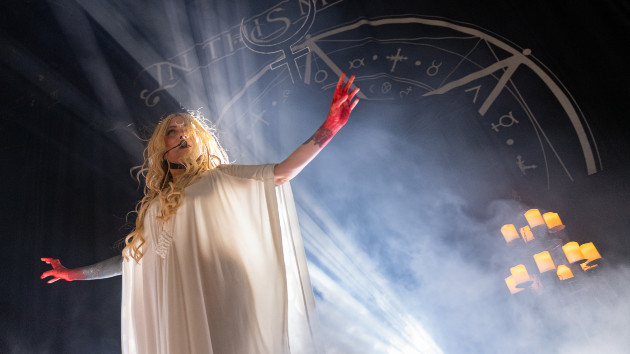
On his new double album, Macon, Georgia, Jason Aldean does some things he’s never tried before. First of all, the project was released across two discs, the first of which came out last November as Macon and the second of which, Georgia, will arrive in April.
It’s also the tenth album of Jason’s career, so he wanted to do something special. He’s never done a greatest hits package or a live album, and while Macon, Georgia doesn’t qualify as either, it does include some elements of both. Each disc ends with five live tracks of Aldean classics like “Amarillo Sky,” “Big Green Tractor” and “Any Ol’ Barstool.”
“The idea was to at least pull one live song from each of the previous nine albums,” the singer says. “Obviously, one album will have two off it. But after this long [of a career], you know, you’re trying to just get creative and find new ways to give your fans something different that you haven’t given them yet.”
But don’t expect a full greatest hits album from Jason anytime soon. “We’ve never done a greatest hitsrecord. That’s been by choice for me,” he points out.
“I hope I got a lot more hits in the tank, so I don’t want to put out a Greatest Hits yet, because I don’t feel like I’m finished,” he reflects, but adds that his creative approach to structuring his new album was his way of giving listeners a little bit of that ‘greatest hits’ feel.
“I felt like that was sort of a way to do that, a little bit,” Jason explains.
Georgia, the second half of the country star’s double album, is due out on April 22.
The Whowill play a special acoustic show on March 25 at London’s famed Royal Albert Hall as part of the 2022 edition of the annual series of benefit concert for the Teenage Cancer Trust that singer Roger Daltrey helps organize.
The event will mark the band’s first concert since February 2020, and will take place a month before the recently announced The Who Hits Back! tour of North America kicks off.
The acoustic show will feature Daltrey and Who guitarist Pete Townshendaccompanied by two members of The Who’s touring band — guitarist/backup singer Simon Townshend and backing vocalist Billy Nicholls — as well as by bassist Phil Spalding, percussionist Jodie Linscott, keyboardist Geraint Watkins, violinist Charlie Hart and accordion player Andy Cutting.
The concert will feature a mix of Who classics, rarities and fan favorites. The show’s opening act will be The Wild Things, a British rock group whose upcoming album is being produced by Pete Townshend.
The 2022 Teenage Cancer Trust Concerts will run from March 21 through March 27. This year’s other headlining acts include Yungblud on March 23, Madness on March 24, Liam Gallagher on March 26 and Ed Sheeran on March 27. The event was canceled in 2020 and 2021 because of the COVID-19 pandemic.
“My wonderful team and I have pulled out all the stops to make this 20th series of shows for Teenage Cancer Trust the best ever,” Daltrey says. “The Who will be back on stage this year at the Hall alongside some wonderful talent. After the last two unbelievably difficult years, young people with cancer deserve everything we can do for them.”
Tickets for the shows go on sale to the general public on Friday, February 25, at 9 a.m. local time at RoyalAlbertHall.com.
With nine women remaining and hometowns right around the corner, Monday’s episode of The Bachelor saw Clayton deciding on the three women whose families he’d meet, leading to one of the most heartbreaking eliminations of the season.
First, two of the ladies had a score to settle after Mara, angry over losing a one-on-one date to Sarah — who already had one — warned Clayton that the 23-year-old wasn’t ready for marriage. Clayton, without revealing his source, confronted Sarah with the accusation and, after an emotional conversation, gave her the date rose.
Back at the hotel, Mara told Sarah that she was the one who approached Clayton, leading to an argument between the two. The drama ended at the rose ceremony where Mara — along with Eliza — was sent home.
The action then moved to Vienna, Austria, where a Sarah, Teddi, Genevieve, Rachel and Gabby took turns opening up with an intimate couples’ therapy session. The task proved to be too daunting for Genevieve, forcing Clayton to send her home.
At the conclusion, Clayton was rocked by the therapist’s observation that one of the remaining ladies wasn’t being honest with her answers.
After speaking with each of them at the afterparty, Clayton determined that Sarah was the guilty party and sent her packing as well. He rejoined the others with the announcement that he couldn’t give any of them the date rose.
Elsewhere, a pair of one-on-one dates ended with Susie and Serene taking home date roses.
That led to the most heartbreaking rose ceremony yet, as Teddi was sent packing.
Here are the four women whose families Clayton will meet:
Gabby, 30, an ICU nurse from Denver, Colo.
Rachel, 25, a flight instructor from Clermont, Fla.
Serene, 26, an elementary school teacher from Oklahoma City, Okla.
Susie, 28, a wedding videographer from Virginia Beach, Va.
(NEW YORK) — The United States continues to warn that Russia could invade Ukraine “any day” amid escalating tensions in the region, with President Joe Biden telling reporters Friday he’s “convinced” Russian President Vladimir Putin has decided to invade.
More diplomacy seemed possible, though, with Biden agreeing “in principle” Sunday to meet with Putin, as long as Russia didn’t invade, but the Kremlin on Monday said talk of a summit was “premature.”
In an address to the Russian public on Monday, Putin announced that he’s recognizing two Russian-controlled separatist regions in eastern Ukraine’s Donbas region as independent: the self-proclaimed People’s Republics of Donetsk and Lugansk.
Biden swiftly responded to Putin with sanctions. The White House said Biden will issue an executive order banning “new investment, trade, and financing by U.S. persons to, from, or in the so-called DNR and LNR regions of Ukraine.” The order “will also provide authority to impose sanctions on any person determined to operate in those areas of Ukraine,” White House press secretary Jen Psaki said, adding that the U.S. “will also soon announce additional measures related to today’s blatant violation of Russia’s international commitments.”
While the U.S. says some 190,000 Russian troops and separatist forces are estimated to be massed near Ukraine’s borders, Russia has denied any plans to invade and reiterated its demands that the U.S. and NATO bar Ukraine from joining the military alliance.
Here’s how the news is developing Tuesday. All times Eastern:
Feb 22, 5:49 am
Top Russian officials dismiss the West’s sanctions
Top Russian officials on Tuesday morning dismissed new sanctions being imposed by Western countries for Moscow’s recognition of the separatist areas in eastern Ukraine.
In an interview with state-owned television channel Russia-24, Russian Foreign Minister Sergey Lavrov said the country was already “used to” sanctions and that more would be imposed regardless of what Moscow does.
“That our [Western] colleagues are trying to push the blame on Russia for the failure of the Minsk agreements, we also understand,” Lavrov said. “Our European, American, British colleagues won’t stop and won’t calm down as long as they haven’t exhausted their possibilities for the so-called punishment of Russia.”
“They already threaten all possible sanctions. Hellish, or as they say there, ‘the mother of all sanctions,'” he added. “Well, we’re used to this. The president already noted our position, we know that sanctions will be introduced all the same, in any case. With a basis, without a basis.”
Meanwhile, the speaker of Russia’s parliament, Vyacheslav Volodin, echoed Lavrov’s sentiments during an ongoing session of the lower house, known as the State Duma.
“Yes, sanctions hinder our development. But they would happen anyway. They would happen anyway even if that decision hadn’t been taken,” Volodin told lawmakers, adding that there are “more important problems.”
“Yesterday, our president stopped a war,” he said. “It’s not a question of territory — it’s a question of the lives of millions of citizens.”
Feb 22, 5:10 am
US embassy staff return to Ukraine after spending night in Poland
U.S. embassy staff who remained in Ukraine will return to the country on Tuesday after spending the night in Poland amid fears of a Russian invasion, a senior U.S. official told ABC News.
Personnel will return to the city of Lviv in western Ukraine, where they had relocated operations from the Ukrainian capital, Kyiv. But they are poised to move back to Poland at any point, the official said.
Feb 22, 4:58 am
Russia-backed separatists claim Ukraine is still staging attacks
Russia-backed separatists in eastern Ukraine have continued to accuse Ukrainian government forces of attacks.
The separatists in a breakaway region known as Donbas made another unverified claim Tuesday morning that three civilians were killed by a roadside bomb.
Separatist leaders posted photographs of a burned-out minivan on a road in their territory that they alleged was the vehicle blown up by a Ukrainian “diversionary group.” The claim is unverified and resembles other allegations that have been rapidly debunked.
Meanwhile, a top separatist military commander accused Ukrainian government forces of continuing to shell the area.
The latest claims raise the possibility that Russia is still building a pretext to launch an attack on Ukrainian government troops, even after recognizing the self-proclaimed People’s Republics of Donetsk and Luhansk as independent.
Feb 22, 4:33 am
‘World cannot be silent,’ Ukrainian defense minister warns
Ukrainian Defense Minister Oleksii Reznikov took to Twitter early Tuesday to dismiss Moscow’s recognition of the Russian-controlled breakaway areas in eastern Ukraine, saying the move amounts only to a recognition of the Kremlin’s “own aggression.”
“We remain confident and calm,” Reznikov tweeted. “We are ready and able to defend ourselves and our sovereignty.”
But he also issued a warning: “World cannot be silent.”
“Sanctions?” he tweeted. “Another brick in the wall? New Berlin Wall?”
Feb 22, 2:54 am
Putin’s recognition of separatists’ independence is ‘shameful act,’ Blinken says
U.S. Secretary of State Antony Blinken early Tuesday called Russia’s move to recognize separatist regions in Ukraine as independent a “predictable” act.
“Russia’s move to recognize the ‘independence’ of so-called republics controlled by its own proxies is a predictable, shameful act,” he said on Twitter.
Blinken is scheduled to meet Ukrainian Foreign Minister Dmytro Kuleba in Washington on Tuesday.
Feb 22, 2:03 am
Blinken speaks with Ukraine’s Kuleba ahead of Tuesday meeting
U.S. Secretary of State Antony Blinken spoke by phone on Monday with Ukrainian Foreign Minister Dmytro Kuleba, noting the Biden administration’s “swift response” to Russia’s decision to recognize Ukraine’s separatists’ regions as independent.
“They discussed the strong measures we announced today in response and reiterated that additional steps would be forthcoming,” State Department spokesperson Ned Price said in a statement late Monday.
Blinken and Kuleba are scheduled to meet on Tuesday in Washington.
Kuleba earlier said he spoke with Blinken about sanctions.
“I underscored the need to impose tough sanctions on Russia in response to its illegal actions,” Kuleba said on Twitter.
Feb 21, 11:58 pm
Ukrainian envoy says UN is infected with ‘virus’ spread by Kremlin
After the Russian envoy spoke at the U.N. Security Council’s emergency meeting Tuesday night, Ukraine’s envoy began his remarks by saying he was afraid to take off his mask not because of COVID-19 but “because of the virus that has so far no vaccine — the virus that hates the United Nations and the virus that is spread by the Kremlin.”
That “virus” has infected the U.N. and threatens to kill it, Ambassador Sergiy Kyslytsya said in a stark warning.
“The United Nations is sick, that’s a matter of fact,” he said. “It’s been hit by the virus spread by the Kremlin. Will it succumb to this virus? It is in the hands of the membership.”
Kyslytsya warned it’s not just the U.N. that he believes is under threat. During his remarks, he held up a paper that had a copy of the Kremlin’s decree recognizing Russian-backed “breakaway” provinces from Georgia in 2008 and the decree issued Monday recognizing the separatist Donetsk and Luhansk, showing how they’re almost the exact same.
“Copy, paste. Copy, paste. No creativity whatsoever. The copying machine in the Kremlin works very well. Who is next among the members of the United Nations? The question is open,” he said.
Kyslytsya demanded that Russia “cancel” and remove “additional Russian occupation troops” in Ukrainian territory, and he insisted, “The internationally recognized borders of Ukraine have been and will remain unchangeable regardless of any statements and actions by the Russian Federation.”
“We are committed to a peaceful and diplomatic path, and we will stay firmly on it. We are on our land. We are not afraid of anything or anyone. We owe nothing to anyone, and we will not give away anything to anyone,” he said.
Feb 21, 11:48 pm
Ukraine highlights importance of global response to Russia
Ukraine called for “painful sanctions” against Russia in a statement released by its foreign ministry, noting that how the world responds may greatly influence Russia’s next move.
“Further decisions and steps of the Russian Federation largely depend on the world’s reaction to today’s events,” the statement read. “Therefore, we insist on imposing painful sanctions against Russia in order to send a clear signal of the inadmissibility of further escalation. It is time to act to end Russia’s aggression and restore peace and stability in Europe.”
The country reiterated that it is ready to defend itself, stating that it “understands Russia’s intentions and its desire to provoke Ukraine. We take into account all risks and do not succumb to provocations.”
Ukrainian Foreign Minister Dmytro Kuleba is currently in Washington and meets with U.S. Secretary of State Antony Blinken on Tuesday.
Feb 21, 11:21 pm
Russian envoy dismisses criticisms, blames Ukraine in Security Council meeting
In remarks during an emergency U.N. Security Council meeting Tuesday, Russian Ambassador Vasily Nebenzia dismissed “highly emotional” criticisms of Russia and said nothing has changed on the ground, while also blaming Ukraine for the decisions President Vladimir Putin’s decisions made earlier in the day.
Nebenzia dismissed “unfounded panic about an impending Russian invasion of Ukraine” — as Russian troops prepare to come across the border — and painted Russia as a pacifist hero that welcomed refugees who were forced onto buses by Russian-led separatists.
“We’ve just heard a number of highly emotional statements, categorical assessments, and far-reaching conclusions,” he said during the emergency meeting. “I’ll leave the direct verbal assaults against us unanswered. Now it’s important to focus on how to avoid war and how to force Ukraine to stop the shelling and provocations against Donetsk and Luhansk.”
Russian-controlled separatists are responsible for the shelling and for staging the provocations, but Nebenzia worked to portray Ukraine as the aggressor and Russia as the force preventing war, despite it essentially seizing Ukrainian territory.
Traditionally, it’s been thought that it takes about 21 days to break a bad habit – or for a new behavior to become automatic.
But where did that statistic come from? Well, it originated in a popular book from 1960 called “Psycho-Cybernetics.” It was written by a plastic surgeon who noticed his patients seemed to take about21 days to get used to their new faces.
Well, a new study looked at that long-held belief and found that it takes a lot longer than that! Researchers at the University College London studied hundreds of people and found that the average time it takes for a new habit to stick is actually 66 days! Some people were able to do it as fast as 18 days – others took nearly9 MONTHS for a new habit to form! But 66 days was the average.
Neuroscientist Dr. Elliot Berkman led the research… and he says, if you want to speed up the process, it’s easier if you’ve got another behavior lined up to take its place. That’s why nicotine gum tends to be more effective than the nicotine patch. Because you’re replacing the act of putting a cigarette in your mouth with the behavior of popping a piece of gum!
So, don’t give up if you haven’t changed a habit after 21 days. Because the average person needs 2 MONTHS for new behaviors to stick.
Here are some tips for maximum bonding from Dr. David Niven, a family therapist who wrote the book “The 100 Simple Secrets of Happy Families”
Start by sitting in a circle at mealtime. Studies show that whether you sit in a circle at the table or on a picnic blanket in the backyard, the circle automatically strengthens family ties – or even just friendships. Clinical psychologist Dr. Alexa Foster says it makes everybody feel included and important – rather than the important person sitting at the head of the table.
Another bonding tip: Get some yellow in your life – yellow throw pillows, a yellow blanket, yellow walls. Scientists say the color yellow encourages people to open up and be more talkative. Then, once the conversation is going, talk about your day. Did something embarrassing happen, something funny, something frustrating? One of the best ways to bond is to talk candidly about your life. When parents open up, children feel more comfortable to talk truthfully about their own lives.
If you want to go further, the name of the book again is “The 100 Simple Secrets of Happy Families” by Dr. David Niven.
According to the Institute For Evolutionary Anthropology in Germany, some dogs can recognize up to 200 words, and even figure out what new words mean, making them mentally equivalent to a 3 year old child.
Just like people, animals have two kinds of intelligence: Fluid intelligence, which is their natural smarts like they know instinctively how to hunt or to stay away from the street. Then there’s crystallized intelligence, which is how they process everything they’ve learned like when they put two and two together that when the alarm goes off in the morning, they get fed.
But according to the book “How Dogs Think”, you can actually help your pet improve their brain power by teaching them new things that’ll increase their crystallized intelligence. Here’s how:
You can teach your dog new words. Start by speaking to your dog daily, but not just about the weather. Give your dog consistent verbal signals. If you’re going upstairs say “upstairs”. Pretty soon when you say the word, they’ll scamper up the steps automatically.
And your cat can be taught using the same training method you use with your dog.
Animals also need a rich environment to learn. They need the same stimulation that they’d get if they were running free. So when you get home spend at least half an hour playing with your dog. Here’s a good one: hide some treats while the dog is watching then take him out of the room. After a minute, let him back in and see how many of the hiding places he can remember. Also, change the toys they play with often and vary the route you go on when you take walks.
A sharp mind also translates into a healthier pet. With nothing to do but sleep and eat, animals get bored and destructive and are more likely to be obese. Keeping their brain busy means your shoes won’t be chewed, your cat won’t obsessively groom, and your bird won’t pluck their feathers out. If you’d like to know more, check out the book “How Dogs Think” by Stanley Coren.
(NEW YORK) — In emotional testimony on Monday, former Minneapolis police officer Thomas Lane told a jury that he tried to help George Floyd several times but in each instance was blocked by his senior officer, Derek Chauvin.
Lane is the third former police officer to take the witness stand in his own defense regarding charges of violating Floyd’s civil rights.
The 38-year-old Lane told the U.S. District Court jury in St. Paul, Minnesota, that when paramedics came to take Floyd to a hospital, he volunteered to assist them, testifying that he thought Floyd “didn’t look good.”
He welled up with emotion and his voice cracked when asked by his attorney, Earl Gray, why he decided to go into an ambulance and help try to revive Floyd.
“I felt with the situation, they might need a hand,” Lane testified.
Lane and his former police colleagues, Tou Thao, 35, and J. Alexander Kueng, 28, are charged with using the “color of the law,” or their positions as police officers, to deprive Floyd of his civil rights by allegedly showing deliberate indifference to his medical needs as Chauvin kneeled on the back of the handcuffed man’s neck for nine minutes and 29 seconds, ultimately killing him.
They have all pleaded not guilty. If convicted, the men face a maximum sentence of life in prison.
Closing arguments in the high-profile case are scheduled for Tuesday.
Both Lane and Kueng were rookie police officers at the time of Floyd’s death, and their field training officer was Chauvin, who was convicted of murdering Floyd and sentenced to over 22 years in prison. Chauvin also pleaded guilty to federal civil rights violations.
Lane said he and Kueng were partnered up for the first time when they responded to a call on Memorial Day 2020 of a person possibly under the influence who had allegedly used a fake $20 bill to purchase cigarettes at a Cup Foods store.
He testified that when he confronted Floyd, who was seated in the driver’s seat of a Mercedes-Benz SUV parked outside the store with two passengers, “it looked like he (Floyd) was trying to put something away” and that he couldn’t see the man’s right hand.
Lane told the jury that he initially drew his gun and yelled at Floyd “to let him know how serious I thought it was.”
He said he then lowered his voice to de-escalate the situation and told Floyd, “I’m not going to shoot you.”
A struggle broke out, he testified, when he and Kueng tried to get the handcuffed man into a police cruiser.
Lane testified that he and Kueng were still struggling with Floyd when Chauvin and Thao arrived at the scene.
“Chauvin cut in front of me,” he said, adding that he backed off and deferred to Chauvin, who decided to place Floyd prone on the pavement.
Lane said he was holding and monitoring Floyd’s legs “because of the kicking.” But, he testified, Floyd’s resistance lessened after a few minutes.
Gray asked Lane if he could see where Chauvin’s knee was on Floyd’s body.
“It appeared to be kind of holding at the base of the neck and shoulder,” Lane testified.
Lane said he couldn’t see Floyd’s face until the paramedics arrived and placed him on a stretcher.
He testified that while he, Kueng and Chauvin held Floyd down, he suggested rolling Floyd on his side to help his breathing, but Chauvin told him, “Nope, we’re good like this.” He said that when he asked a second time, Chauvin “deflected” his question.
Lane testified that he also asked Kueng to check Floyd’s pulse and that he also tried to check Floyd’s ankle for a pulse.
He claimed that when paramedics arrived and checked Floyd’s pulse, he was assured he had a pulse. Later, under cross-examination, Lane said paramedics told him Floyd was unresponsive.
Under cross-examination from Assistant U.S. District Attorney Samantha Trepel, Lane agreed that fear of repercussions or angering his field training officer was not an exception to his duty as a police officer to render aid to Floyd.
“Despite your training, you deferred to your colleagues?” Trepel asked.
Lane replied, “It seemed reasonable at the time with an ambulance coming.”
Led Zeppelin bassist John Paul Jones is one of more than 20 musicians from seven different countries featured in a video performing a new version of the blues song “When the Levee Breaks.” It premiered this weekend at PlayingforChange.com and on the Playing for Change YouTube channel.
“When the Levee Breaks,” a song written about about the Great Mississippi Flood of 1927, was originally recorded by Kansas Joe McCoy and Memphis Minnie in 1929. Led Zeppelin’s reworked version of the tune appears on the band’s 1971 album, Led Zeppelin IV.
The video, which features various musicians and singers performing their parts in different locations around the world, also includes Jane’s Addiction drummer Stephen Perkins and ex-Allman Brothers Band guitarist Derek Trucks, as well as Trucks’ wife and current band mate Susan Tedeschi on vocals, Robbie Robertson‘s son Sebastian on guitar, singer/songwriter Ben Lee on harmonica, and many others.
The clip also includes footage such natural disasters as flooding and drought.
“It seems that little has changed since 1927, or even 2005 with [Hurricane] Katrina,” Jones says in a statement regarding “When the Levee Breaks.” “It’s still a really powerful track, both musically and lyrically.”
Those who view the video are encouraged to donate money to the Playing for Change Foundation to aid its efforts raise awareness about and support organizations focused on various environmental issues.
The new recording and video of “When the Levee Breaks” is the latest in a series of covers of famous songs by international musicians that have been put together by Playing for Change organization, which connects people around the world through music.
(ATLANTA) — A jury began deliberations Monday in the federal hate-crime trial of three white Georgia men in the murder of Ahmaud Arbery, with a prosecutor calling them “vigilantes” fueled by pent-up anger for Black people and defense attorneys portraying them as vigilant citizens concerned about protecting their neighborhood from crime.
The U.S. District Court jury in Brunswick, Georgia, started weighing the evidence against 64-year-old retired police officer Gregory McMichael, his 36-year-old son, Travis McMichael, and their neighbor William “Roddie” Bryan, 52, who were all convicted in state court last year of murdering the 25-year-old Black jogger.
The jury received the case at about 3 p.m. ET after hearing hours of closing arguments.
The McMichaels and Bryan are each charged with one count of interference of Arbery’s civil rights and attempted kidnapping. The McMichaels are also charged with using, carrying and brandishing a firearm in relation to a crime of violence, and Travis McMichael faces an additional count of using a firearm in relation to a violent crime.
They have all pleaded not guilty.
If convicted, the men could be sentenced to life in prison. All three are already serving life sentences, the McMichaels without the possibility of parole, after a state jury convicted them last year of murder.
‘Vigilantes’ motivated by hate
Assistant U.S. Attorney Christopher Perras told the jury the defendants were “vigilantes.”
“When Greg McMichael saw Ahmaud Arbery jogging by his house and Greg suspected that Ahmaud was up to no good, he didn’t grab his phone and call the police. He grabbed his son and his gun and chased after him,” he said.
He said that when the pursuit went by Bryan’s home, Bryan assumed “that the Black guy must be the bad guy and the white guys are the good guys.”
Perras scoffed at defense claims that the McMichaels pursued Arbery because they had previously seen him on surveillance video repeatedly trespassing inside a home under construction in their neighborhood.
“When you peel away the defendants’ excuses and you follow the evidence, it wasn’t about trespassing and it wasn’t about neighborhood crime. It was about race,” Perras said. “Racial assumptions, racial resentment and racial anger.”
Perras added that “all three defendants saw a young Black man in their neighborhood and they thought the worst of him.”
‘This is not a murder trial’
Travis McMichael’s attorney, Amy Lee Copeland, countered that prosecutors failed to prove that racial animus motivated the lethal actions her client took against Arbery on Feb. 23, 2020.
“The government argued about the murder of Ahmaud Arbery in its closing argument,” Copeland told the jury. “This is not a murder case, it’s not an aggravated assault case. You are here today only to determine only the crimes charged in the indictment.”
She said the government must prove four elements of the hate crime statute: that there was a threatened use of force, that the defendants tried to willfully injure Arbery, that the crime happened because of race, and that it happened because Arbery was enjoying the use of a public street.
Copeland told the jury that the government’s prosecutors made a big deal about her client’s history of posting on social media and texting racial slurs to describe Black people.
Copeland noted that the 17 racially charged text messages and Facebook posts she conceded Travis McMichael made between 2013 and 2020 had nothing to do with the Arbery killing. She said the evidence shows that Travis McMichael never made racial statements to Arbery or the police on the day of the fatal shooting.
She said Travis McMichael’s digital footprint only proves he made derogatory statements in mostly private exchanges with “like-minded” people.” In his online posts, Travis McMichael was “playing to his audience,” Copeland said.
“This case is not about the rightness of the beliefs or whether these beliefs should be punished. You can’t use it to judge his character, the case isn’t to punish for beliefs even if you think they’re wrong,” she said.
Copeland told the jury that the government failed to present any evidence of prior circumstances of racial violence on the part of Travis McMichael or any evidence that he was a member of a white supremacist group.
Copeland said prosecutors also did not prove the grounds for the kidnapping charge, arguing Travis McMichael gave Arbery the opportunity to run away only to have Arbery charge toward him and engage in a struggle over McMichael’s pump-action shotgun.
“Mr. Arbery got shot because he tried to take Travis’ shotgun away from him,” Copeland said.
She asked the jury to find Travis McMichael not guilty of all the charges.
Gregory McMichael’s attorney, A.J. Balbo, told the jury that federal prosecutors didn’t present a shred of evidence showing that his client’s text messages or social media posts contained any evidence of racial animus, although he conceded the government’s investigators couldn’t get into his encrypted cellphone.
“Ladies and gentlemen, this case is hard, hard first of all because it involves the death of a young man,” Balbo told the jury. “It was horrific because it shouldn’t have happened.”
Balbo said Gregory McMichael had no hesitation renting properties to Black people while at the same time acknowledging the elder McMichael used rude language to describe a Black tenant. He said that during his long career in law enforcement, Gregory McMichael never received a complaint against him of being racist.
Balbo, too, asked the jury to acquit Gregory McMichael on all charges.
Bryan’s lawyer, J. Pete Theodocion, told the jury that Bryan would have reacted the same way had he seen the McMichaels chasing a white man, an Asian person or a person of any other race.
Theodocion said Bryan was not trying to be “Johnny Law Enforcement” when he joined the chase of Arbery. He said Bryan’s suspicions of Arbery were “entirely reasonable” considering that he heard the McMichaels yelling at Arbery to stop and that they wanted to talk to him.
“His instincts told him people do not get chased like that unless they’ve done something wrong,” Theodocion said of Bryan.
Theodocian accepted that Bryan did not approve of a relationship his daughter had with a Black man, saying that the racial slurs he used to vent his anger were “ignorant and stupid” but not criminal.
“He did not see the world through the prism of race,” Theodocian said of Bryan.
They “never saw Ahmaud as a fellow human being”
In her rebuttal argument, U.S. Assistant Attorney Tara Lyons asked the jury to carefully review the video Bryan took of Travis McMichael shooting Arbery and the defendants’ statements to police in the aftermath of the shooting that were captured on police body-camera video.
“If you have any doubt, watch the way they react to him (Arbery) on the scene even after there’s no doubt in the world that the young man lying dead or dying in the street is unarmed and has nothing on him but his clothes and a well-worn pair of running shoes,” Lyons said.
Lyons said the defendants walked around Arbery’s body as if he were a “speed bump” or a “pothole.”
“Look for any sign of recognition by these defendants that in the middle of that pool of blood was an actual human being twitching and gasping as he bled out in the street,” Lyons said. “Go watch those videos. You won’t see one sign of sadness or regret or remorse from any of these defendants. And by now, you know why: because the three defendants — Travis, Greg and Roddie — never saw Ahmaud as a fellow human being.”
ABC News’ Janice McDonald contributed to this report.