If you’re a Grateful Dead fan who also happens to like the New York Yankees, here’s some cool news for you: The first 1,000 fans who purchase a special-event ticket to the Yankees’ August 1 home game will receive a collectible Jerry Garcia Bobblehead doll.
The promotion takes place on what would’ve been the late Garcia’s 80th birthday. The doll depicts Garcia with gray hair and a gray beard holding a guitar and wearing a Yankees home jersey, complete with pinstripes, the team’s interlocking NY logo on the front and the number 80 on the back.
Tickets to the game, which will feature the Yankees facing off against the Seattle Mariners, are available now at MLB.com. A portion of every ticket sold will be donated to The Grateful Dead’s Rex Foundation charity, which supports people involved with creative endeavors in the arts, sciences and education.
Fans can pick up their doll at Yankee Stadium by heading to the Bobblehead redemption table located on the Field Level next to Gate 2 up to one hour after the game’s first pitch is scheduled to be thrown.
It’s worth noting that a number of Grateful Dead fans have taken exception to the Yankees-themed Garcia Bobblehead, with some pointing out in the comments of a post on Jerry’s Facebook page that, as a native of the Bay Area, the legendary musician was a big San Francisco Giants fan.
(WASHINGTON) — As reactions to the Dobbs decision roll in, Congressional Democrats are outraged. But don’t expect that outrage to translate to passable legislation anytime soon.
Any effort to codify a woman’s right to choose would need to clear the Senate filibuster. That means 60 votes. And those votes are nowhere to be seen in the Senate.
Undoubtedly, today’s Supreme Court decision will reignite discussion among some progressives about overturning the filibuster to try to codify the rights previously enshrined in Roe v. Wade. They’ll have to wait to see if those discussions gain any traction, but 50 votes are needed to change the Senate rules.
That will need the support of Democratic Sen. Joe Manchin of West Virginia, who has been exceptionally clear that he doesn’t support a filibuster carve out. Without his support, the Senate rules can’t be changed.
In a statement today following the ruling, Manchin said he’s hopeful for a bipartisan solution (which, if some are reading the Joe Manchin tea leaves, likely means a path forward that does NOT involve a change to the Senate rules).
“Let me be clear, I support legislation that would codify the rights Roe v. Wade previously protected,” Manchin said in a statement. “I am hopeful Democrats and Republicans will come together to put forward a piece of legislation that would do just that.”
When the draft Dobbs decision leaked in May, reporters chased after Manchin to ask him if he’d support a filibuster carve out to codify Roe. He held the line then on defending the Senate rules. He was asked if he’d be willing to get rid of the filibuster in light of the ruling if it meant Democrats could be successful in their efforts to codify Roe.
“The filibuster is the only protection of democracy,” he said.
When reporters pushed him on women who are going to be affected by the ruling, he said, “We’ve protected women’s rights with the filibuster, so we have to look at it. But the bottom line is it is the only check and balance we have.”
It’s deeply unlikely Manchin will have a change of tone. Which means any legislative efforts are going to be largely for show. That’s a road that Democrats have already gone down. Democrats forced a vote on the Senate floor on the Women’s Health Protection Act in May. It failed 49-51 (Sen. Joe Manchin opposed it because he felt it was more sweeping than simply codifying a right to an abortion).
Republican Sens. Susan Collins of Maine and Lisa Murkowski of Alaska said they support codifying a woman’s right to choose, but their support isn’t enough to get to 60.
Collins said in a statement Friday she’s working with Sen. Tim Kaine, D-Va., on bipartisan legislation to codify Roe.
“Our goal with this legislation is to do what the Court should have done — provide the consistency in our abortion laws that Americans have relied upon for 50 years,” she said.
If that effort fails to gain traction, where does that leave abortion rights supporters? Looking toward the 2022 election. That’s why Senate Majority Leader Chuck Schumer and others today have been calling on Americans to take to the polls in November.
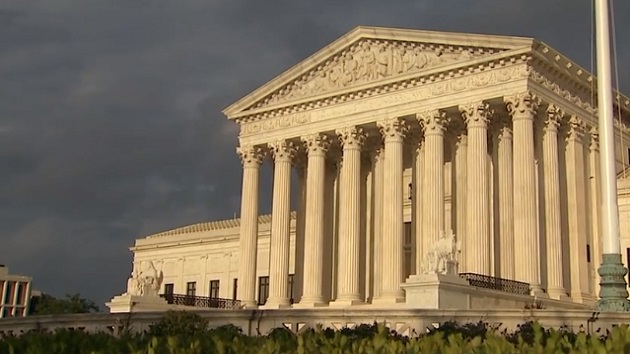
(WASHINGTON) — After the U.S. Supreme Court ruling striking down Roe v. Wade, the 1973 landmark decision that guaranteed a woman’s right to an abortion, states are taking action.
The court’s ruling rolled back constitutional protection for abortion rights, giving each state the power to decide.
Several states had trigger laws in place that immediately banned abortion if Roe was overturned. Others guarantee the right to an abortion under state laws or their constitutions.
Some states are now introducing new laws, emboldened by the Supreme Court’s decision.
Latest updates:
Jun 24, 2:11 pm
Indiana legislators to address abortion in special session
Indiana Gov. Eric Holcomb said a special session of the General Assembly next month will address abortion in the wake of the Supreme Court’s ruling.
“The Supreme Court’s decision is clear, and it is now up to the states to address this important issue. We’ll do that in short order in Indiana,” Holcomb said in a statement. “I’ve already called the General Assembly back on July 6, and I expect members to take up this matter as well.”
The Supreme Court’s decision is clear, and it is now up to the states to address this important issue. We’ll do that in short order in Indiana. I’ve already called the General Assembly back on July 6, and I expect members to take up this matter as well.
Jun 24, 2:10 pm
South Carolina governor vows to push for passage of ‘fetal heartbeat bill’
South Carolina Gov. Henry McMaster, a Republican, vowed to push for more abortion restrictions on the heels of the Supreme Court overturning Roe v. Wade.
“Today’s Supreme Court ruling is a resounding victory for the Constitution and for those who have worked for so many years to protect the lives of the most vulnerable among us,” McMaster tweeted.
He added, “By the end of the day, we will file motions so that the Fetal Heartbeat Act will go into effect in South Carolina and immediately begin working with members of the General Assembly to determine the best solution for protecting the lives of unborn South Carolinians.”
By the end of the day, we will file motions so that the Fetal Heartbeat Act will go into effect in South Carolina and immediately begin working with members of the General Assembly to determine the best solution for protecting the lives of unborn South Carolinians.
— Gov. Henry McMaster (@henrymcmaster) June 24, 2022
The law requires doctors to perform ultrasounds on pregnant women seeking an abortion to determine if cardiac activity can be detected, which typically occurs around six weeks — before many women know they’re pregnant.
The law had been blocked, pending the outcome of Mississippi’s 15-week abortion ban, which was upheld by the Supreme Court in a 6-3 vote along party lines.
Additionally, the state’s attorney general, Alan Wilson, announced he has filed a motion in federal court to lift the injunction of the law.
Jun 24, 1:11 pm
Alabama governor seeks to enforce abortion ban
Alabama Gov. Kay Ivey said Friday the state will work to enforce a 2019 law that makes performing an abortion at any stage a felony unless the mother’s health is in danger.
“Currently, there is a halt by a federal judge on the enforcement of that law, but now that Roe is overturned, the state will immediately ask the court to strike down any legal barriers to enforcing this law,” Ivey said in a statement.
Currently, there is a halt by a federal judge on the enforcement of that law, but now that Roe is overturned, the state will immediately ask the court to strike down any legal barriers to enforcing this law. (4/6)
— Governor Kay Ivey (@GovernorKayIvey) June 24, 2022
Alabama Attorney General Steve Marshall also issued a statement calling on all abortion clinics in the state to close.
“Any abortionist or abortion clinic operating in the State of Alabama in violation of Alabama law should immediately cease and desist operations,” Marshall said.
The right to an abortion is not protected under Alabama’s state constitution.
Jun 24, 1:10 pm
Virginia governor seeks to ban abortion after 15 weeks
Virginia Gov. Glenn Youngkin will seek to ban abortion after 15 weeks of pregnancy following the Supreme Court decision to overrule Roe v. Wade, his office confirmed to ABC News.
Virginians elected a pro-life governor and he supports finding consensus on legislation,” spokesperson Macaulay Porter said.
She added, “He has tapped Senator Siobhan Dunnavant, Senator Steve Newman, Delegate Kathy Byron and Delegate Margaret Ransone to do so and prioritize protecting life when babies begin to feel pain in the womb, including a 15-week threshold.”
Youngkin released a statement Friday morning praising the court’s decision, saying it “rightfully returned power to the people and their elected representatives in the states.”
Jun 24, 12:56 pm
Missouri announces abortion ban after Supreme Court ruling
Missouri Gov. Mike Parson said in a tweet Friday that Missouri has banned abortions following the Supreme Court’s ruling overturning Roe v. Wade.
“In response to today’s SCOTUS ruling overturning Roe v. Wade, I have signed a proclamation activating the ‘Right to Life of the Unborn Child Act,’ ending elective abortions in the State,” Parson wrote.
BREAKING: Missouri has become the first state in the nation to effectively end abortions.
In response to today’s SCOTUS ruling overturning Roe v. Wade, I have signed a proclamation activating the “Right to Life of the Unborn Child Act,” ending elective abortions in the State. pic.twitter.com/Spfi5k1grX
With the overturning of Roe, nearly half of the nation’s 50 states are prepared to ban all or nearly all abortions, according to the Guttmacher Institute, a reproductive rights policy organization.
Stephen Stills has joined the growing ranks of famous rock artists who have sold the rights to their musical recordings for a big payday.
Stills’ recorded music assets have been acquired by longtime Eagles manager Irving Azoff‘s Iconic Artists Group company, whose roster also includes David Crosby, Linda Ronstadt and The Beach Boys.
The 77-year-old singer, songwriter and guitarist’s recorded assets include his solo work as well as music he created as a member of Buffalo Springfield, Crosby, Stills & Nash, Crosby, Stills, Nash & Young, Manassas, The Stills-Young Band and other projects. Stills has been inducted into the Rock & Roll Hall of Fame twice — with Buffalo Springfield and CSN.
The agreement also includes an interest in Stephen’s band trademarks and the use of his name and likeness.
In the wake of the acquisition, plans are in the works to release an archival live solo album that Stills recorded in 1971 in Berkeley, California, in support of his second solo album, Stephen Stills 2, and an expanded, 50th anniversary reissue of Manassas’ 1972 self-titled debut album.
“Music is one of the greatest driving forces in my life, a means to communicate a universal language, and it’s comforting to know my life’s work is in the very best hands with Irving and the Iconic team,” Stills says in a statement. “With the unreleased recordings I’m uncovering from my vault, and the 50th anniversary of Manassas, it couldn’t have been a more opportune time.”
Adds Azoff, “I have had the pleasure of knowing Stephen for more than 50 years and he is certainly one of rock’s most enduring American treasures. I’m pleased that we will be working together to preserve, expand, and share his musical legacy for his next generation of fans.”
The new comedy series Loot kicks off Friday on Apple TV+ and opens with Maya Rudolph‘s socialite Molly enjoying all the trappings of having a dashing billionaire husband — until she finds out he’s been cheating on her with a much younger woman.
With an $87 billion divorce settlement in hand, but no direction in her life, Molly gets an unexpected call from Sofia, played by Pose Emmy winner Michaela Jaé Rodriguez, the no-nonsense head of a charitable foundation that Molly doesn’t even know she technically runs.
Sofia needs to make sure the money keeps flowing to various charities — and that Molly’s globe-trotting rebound tour stops embarrassing the nonprofit.
“It’s a little bit of a … fish out of water for Molly, for sure,” SNL vet Rudolph tells ABC Audio.
“And I think that … pairing people together who would never spend any time together just immediately allows you to have endless possibilities of things going wrong, which is always a great place to start for comedy, obviously.”
Rodriguez, agrees, contrasting the “free-spirited” Molly to her dedicated character, Sofia, who doesn’t have time for Molly’s shenanigans — like giving women at a domestic abuse shelter designer-curated SWAG bags.
“I just like that they’re just totally polar opposites,” Rodriguez says. “You would never expect for these two to be in the same place together. And yet they are. They’re an odd couple, for sure.”
Rudolph jokes, “It’s The Odd Couple 2.0.”
Rodriguez revealed it was hard to constantly act peeved opposite Rudolph “because she is actually a sweetheart.”
“It’s a challenge in general to be in front of a legendary icon,” she adds, “and you have to play this character that is no B.S. So, yeah, it’s hard, but I like the … challenging.”
(WASHINGTON) — As Pride Month nears its end, the House has passed the LGBTQI+ Data Inclusion Act, which will require over 100 federal agencies to improve data collection and surveying of LGBTQ communities.
Data collection is vital to understanding the needs of a community, sponsors of the bill say.
The legislation states that complete and accurate information about LGBTQ identities is needed to “inform public policy and federal programs,” allowing legislators to direct resources where they are needed and better serve the community.
Right now, few federal agencies regularly collect complete, nuanced data on these populations, according to the bill.
“The availability of data also has a critical role in ensuring that any disparities in areas like health outcomes, housing, and employment can be addressed,” the bill states.
The act would also implement privacy requirements for data collection that would prevent the personal identification of individuals for their protection.
Today, the House is considering the LGBTQI+ Data Inclusion Act. By ensuring the LGBTQI+ community is represented in federal studies and surveys, the LGBTQI+ Data Inclusion Act will help us craft better policies to meet the needs of the LGBTQI+ community #BetterData#BetterPolicypic.twitter.com/3CwpjIgB5t
— LGBTQ+ Equality Caucus (@LGBTEqCaucus) June 23, 2022
LGBTQ people are more likely to experience poor health conditions, financial and housing insecurity, and higher unemployment rates than the general population, according to research by Rutgers University, the Centers for Disease Control and Prevention, and more.
Activists applauded the move to expand data collection, including the nation’s largest LGBTQ civil rights group, the Human Rights Campaign.
They say it’ll help formally acknowledge and attempt to address issues facing the community.
“Turning the knowledge of those disparities into action that will close the gap requires a much more systematic and consistent effort,” said David Stacy, HRC’s Government Affairs director. “We call on the U.S. Senate to take up this important legislation, pass it, and send it to President Biden for his signature.”
(WASHINGTON) — The House voted Friday afternoon to pass a bipartisan gun safety package.
The bill, crafted in the wake of devastating mass shootings and on the one-month anniversary of the Robb Elementary School massacre in Texas that left 19 young children dead, is the first major piece of gun reform to clear Congress in decades.
The final vote was 234-193, with 14 Republicans joining all Democrats in supporting the bill. Applause could be heard in the chamber when House Speaker Nancy Pelosi called the vote.
The legislation now goes to President Joe Biden’s desk.
The president has praised the bill, despite having called on lawmakers to pass stronger restrictions like a ban on assault weapons and high-capacity magazines.
“This bipartisan legislation will help protect Americans,” Biden said in a statement after the Senate passed the legislation on Thursday. “Kids in schools and communities will be safer because of it.”
Fifteen Republicans in the Senate, including Republican leader Mitch McConnell, voted in favor of the bill.
The measure makes enhancements to background checks for potential gun buyers under the age of 21, requiring an “investigative period” to review juvenile and mental health records.
It also closes the so-called “boyfriend loophole.” Under current law, those convicted of domestic violence are prohibited from purchasing a gun if they are married to their partners or live with their partners. But under this bill, individuals in “serious” “dating relationships” will also be unable to buy guns for at least five years if they are convicted of abuse.
Millions of dollars would also be allocated to incentive states to pass “red flag” laws to remove guns from people deemed to be a danger to themselves or others, as well as other intervention programs or mental health services.
The House previously passed numerous gun reform packages; however, the Senate never took up the legislation due to Republican opposition.
The most recent package passed in the House earlier this month went much further than the Senate package. The legislation raised the minimum age to purchase firearms and banned ghost guns and large-capacity ammunition magazines, among other gun safety protections.
“This is a compromise. Surely not everything I want, and it’s not everything Republicans won. But it’s the first opportunity we’ve had in decades to do something worthwhile to prevent gun violence,” said Rep. Jim McGovern, D-Mass.
But other Democrats said the package didn’t go far enough.
“While I know that some are celebrating progress today, I am certainly not,” Rep. Norma Torres, D-Calif., emotionally said during Friday’s Rules Committee meeting. “This bill before us today is the bare minimum and we should be embarrassed. The bare minimum to protect children that are being murdered while learning their ABCs.”
Pelosi and other Democrats gathered on the steps of the United States Capitol before the vote to celebrate the legislation.
“I say to my colleagues: while it isn’t everything we would have liked to see in legislation, it takes us down the road, the path to more safety, saving lives,” Pelosi said. “Let us not judge the legislation for what it does not do, but respect it for what it does.”
“Our colleagues are gathered here with pictures of those who have been lost in all of this, accompanied by family members of those who have been lost,” Pelosi added. “It is our constant resolve that we will not stop until the job is done.”
The passage of the gun safety bill comes just one day after a major Supreme Court decision expanding gun rights.
The court’s conservative majority struck down a 100-year-old New York law that restricted the concealed carry of handguns in public to only those with a “proper cause.” Justice Clarence Thomas wrote in the opinion that the Second and Fourteenth Amendments protect an individual’s right to carry a handgun for self-defense outside the home.
ABC News’ Benjamin Siegel contributed to this report.
(WASHINGTON) — In thousands of rulings over its storied history, the U.S. Supreme Court has broken with stare decisis, the doctrine of respecting prior decisions, just 145 times in cases requiring interpretation of the Constitution.
The overturning of Roe v. Wade, the landmark 1973 ruling that extended constitutional protection for abortion, marks one of the few times it has clawed back a right enjoyed by millions of Americans for decades.
“The court has never ever overturned a prior case extending a constitutional right,” said Cardozo Law professor Kate Shaw, an ABC News legal analyst. At the same time, other scholars say, it would be restoring the right of people to govern themselves through elected policymakers.
The decision in Dobbs v. Jackson Women’s Health — allowing states to ban abortion — has put renewed focus on when and how the high court decides to reverse itself, and what some scholars say is a distinct shift in approach over the last 50 years.
“In most matters, it is more important that the applicable rule of law be settled than that it be settled right,” wrote Justice Louis Brandeis in 1932, famously summarizing the court’s approach to precedent at the time.
Justice Samuel Alito made clear the current majority has a different view: “When it comes to the interpretation of the Constitution,” Alito wrote in Dobbs, “we place a high value on having the matter ‘settled right.'”
The perceived “rightness” of a settled case has taken on new salience with the current Supreme Court, where five conservative justices — three appointed in the last five years — have signaled growing openness to revisit old “wrongs.”
“There is evidence that a weaker version of stare decisis — the presumption that the Supreme Court generally should not overrule its prior decisions — is in vogue on the court,” wrote University of Akron Law School professor Michael Gentithes in a 2020 law review analysis.
Gentithes says the high-water mark for the power of stare decisis was in the 1992 decision in Planned Parenthood v. Casey, when a conservative majority of justices reaffirmed the core holding of Roe even though a plurality considered it flawed.
“Then, as now, there were a bunch of new justices on the court who seemed quite skeptical of the soundness of Roe,” said Shaw. “And many people were very surprised to see the final outcome from a three justice majority of Republican appointees.”
Since then, as the court’s membership has changed, “poor reasoning” in a prior decision has become “ever-present justification” to attempt to overturn it, Gentithes’ analysis found.
Notably, it was Justice Alito who enshrined the court’s current approach to precedent in his 2018 opinion Janus v. AFSCME.
Laying out five factors he says justices should weigh in reversing a precedent, Alito put the quality of its reasoning as the paramount consideration — a standard that several of his justice peers have publicly embraced.
“I think a lot of people lack courage. They know what is right, and they’re scared to death of doing it. And then they come up with all these excuses for not doing it,” Justice Clarence Thomas, who joined Alito’s opinion in Janus, said last month about overturning cases he believes to be fundamentally wrong.
Two years later, Justice Brett Kavanaugh in a concurring opinion in Ramos v. Louisiana, put his spin on the approach, saying the precedent must be “grievously or egregiously” wrong to warrant overturning. But even then, he noted, justices should keep an eye on the reliance interests in a prior decision and a need to “maintain stability in the law.”
Justices Kavanaugh, Thomas, Alito, Neil Gorsuch, and Amy Coney Barrett all voted to overturn Roe and Casey.
“When one of our constitutional decisions goes astray, the country is usually stuck with the bad decision unless we correct our own mistake,” Alito explained.
Error correction has always been a factor in the Supreme Court’s rationale for overturning precedent, especially in matters of constitutional interpretation, which cannot easily be addressed by Congress.
While lawmakers could have attempted to amend the constitution to obliterate the Supreme Court’s racist “separate but equal” doctrine legitimized in the 1896 Plessy v. Ferguson decision, it was the justices’ unanimous 1954 ruling to overturn Plessy in Brown v. Board of Education that set it right.
“I think the Plessy example is very persuasive, not that Roe should be overturned but that we don’t want a stare decisis doctrine written in stone — or even setting cement,” said Sarah Isgur, a former Justice Department lawyer and ABC News legal analyst.
Justice Brandeis, a revered liberal icon of the court, acknowledged as much in his 1932 writing on stare decisis, noting that “lessons of experience and the force of better reasoning” may necessitate corrections.
But critics say contemporary emphasis on a prior decision’s reasoning — and its rightness or wrongness — may be undermining stare decisis and the credibility of the court.
“A court that changes its mind every time there is a new justice or different set of facts undermines the very concept of the rule of law and creates uncertainty for citizens, businesses and elected officials trying to go about their lives while following the laws of the land,” said Isgur.
Many legal scholars say overturning Roe also threatens precedents involving rights other than abortion not explicitly enumerated in the Constitution, such as marriage.
“If the court is willing to overrule Roe v. Wade, after we just had confirmation hearings of justices come in and say it’s precedent upon precedent, it’s a ‘super precedent,’ it’s foundational,” said Rachel Barkow, vice-dean of New York University Law School, “what the public sees is that no precedent is safe, that stare decisis is meaningless to them and that anything is up for grabs.”
Alito attempts to head off the criticism in his decision, writing “nothing in this opinion should be understood to cast doubt on precedents that do not concern abortion.”
“Everybody thinks that stare decisis is the idea that precedent counts for something, but it’s not absolute,” said University of Notre Dame law professor Sherif Girgis, a former clerk to Justice Alito. “It gets respect because it’s a precedent, but there’s always the possibility that it can be overturned if a bunch of other criteria are satisfied.”
(WASHINGTON) — President Joe Biden on Friday harshly criticized the Supreme Court’s decision upending abortion rights and called on Congress to enshrine access in federal law.
“It’s a sad day for the court and the country,” Biden said as he delivered remarks from the Cross Hall of the White House.
“Today the Supreme Court of the United States expressly took away a constitutional right from the American people that it had already recognized,” he said. ‘They didn’t limit it, they simply took it away. That’s never been done to a right so important to so many Americans but they did it.”
The court’s conservative majority voted Friday to overturn Roe v. Wade as it upheld a Mississippi law that bans nearly all abortions past 15 weeks of pregnancy.
Justice Samuel Alito, who also authored the bombshell draft opinion leaked to the public earlier this year indicating this outcome, wrote in the opinion that Roe was “egregiously wrong from the start.”
“Abortion presents a profound moral question,” Alito wrote. “The Constitution does not prohibit the citizens of each State from regulating or prohibiting abortion. Roe and Casey arrogated that authority. The Court overrules those decisions and returns that authority to the people and their elected representatives.”
The Supreme Court’s three liberal justices slammed the majority’s opinion, writing that the decision essentially “says that from the very moment of fertilization, a woman has no rights to speak of.”
Biden said he believed Roe was correctly decided, calling Friday’s ruling a “tragic error” by the high court.
Biden called on Congress to take action to enshrine abortion rights at the federal level.
“No executive action from the president can do that,” Biden said.
“This fall, Roe is on the ballot,” he added.
“This decision must not be the final word,” he said. “With your vote, you can act. You can have the final word.”
He called out President Donald Trump’s influence by name.
“It was three justices, named by one president, Donald Trump, who are the core of today’s decision to upend the scales of justice and eliminate a fundamental right for women in this country,” he said.
“Make no mistake: this decision is a culmination of a deliberate effort over decades to upset the balance of our law,” he said. “It is a realization of an extreme ideology, and a tragic error by the Supreme Court, in my view.”
Abortion rights activists previously told ABC News they believed Biden could employ the Food and Drug Administration and Medicaid to fill gaps in care.
Biden took such action on Friday, stating he was instructing the Department of Health and Human Services — which oversees the FDA — to take steps to protect access to medication abortion in the wake of Roe being overturned.
Biden also expressed concern Friday that the ruling would impact other Supreme Court decisions relating to the notion of privacy — such as contraception and same-sex marriage rights.
Supreme Court Justice Clarence Thomas, in his concurring opinion on Friday, stated such unenumerated rights should be reconsidered.
Thomas specifically called for the reconsideration of Griswold v. Connecticut, which established the right of married couples to use contraception; Lawrence v. Texas, which protects the right to same-sex romantic relationships; and Obergefell v. Hodges, which establishes the right to same-sex marriage.
“Because any substantive due process decision is ‘demonstrably erroneous,’ we have a duty to ‘correct the error’ established in those precedents,” he wrote.
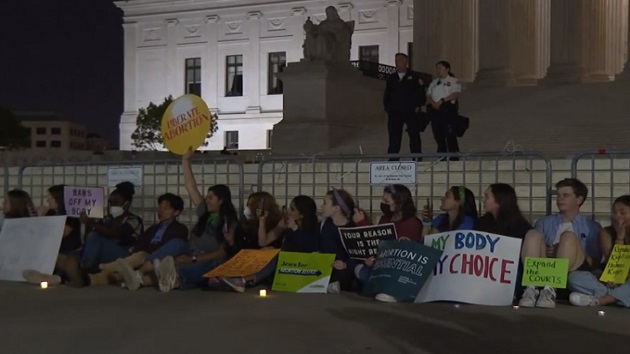
The Supreme Court’s ruling was met with immediate protest from individuals on both sides of the abortion debate. Biden called on Americans to keep all protests peaceful.
ABC News’ Ben Gittleson contributed to this report.
(WASHINGTON) — When activists learned the Supreme Court was considering overturning abortion rights, they feared other rights, such as same-sex marriage, same-sex relationships and contraceptives, might be next.
On Friday, Supreme Court Justice Clarence Thomas’s concurring opinion on Dobbs v. Jackson Women’s Health Organization that overturned Roe v. Wade validated those concerns by stating that other precedents from the high court should be reconsidered.
Thomas called for the reconsideration of Griswold v. Connecticut, which established the right of married couples to use contraception; Lawrence v. Texas, which protects the right to same-sex romantic relationships; and Obergefell v. Hodges, which establishes the right to same-sex marriage.
“In future cases, we should reconsider all of this Court’s substantive due process precedents, including Griswold, Lawrence, and Obergefell. Because any substantive due process decision is “demonstrably erroneous,” we have a duty to “correct the error” established in those precedents,” he wrote.
“After overruling these demonstrably erroneous decisions, the question would remain whether other constitutional provisions guarantee the myriad rights that our substantive due process cases have generated,” Thomas wrote.
Activist groups across the country are sounding the alarm about a potential fight for previously protected LGBTQ and reproductive rights.
“The anti-abortion playbook and the anti-LGBTQ playbook are one and the same,” said Sarah Kate Ellis, the president and CEO of LGBTQ advocacy organization GLAAD, in a statement. “Our bodies, healthcare and our future belong to us, not to a meddling politician or extremist Supreme Court justices, and we will fight back.”
The lack of reference to “abortion” in the Constitution and the fact that “no such right is implicitly protected by any constitutional provision,” was used in the opinion that led to the overturning of Roe v. Wade.
Still, Justice Samuel Alito stated in the opinion that other unenumerated rights that aren’t explicitly mentioned in the Constitution are not immediately in doubt.
“To ensure that our decision is not misunderstood or mischaracterized, we emphasize that our decision concerns the constitutional right to abortion and no other right,” the document states. “Nothing in this opinion should be understood to cast doubt on precedents that do not concern abortion.”
Thomas’ note to “correct the error” established in other precedents, however, has put LGBTQ groups like GLAAD, the National LGBTQ Task Force and reproductive rights organizations like Planned Parenthood, on edge.
“We must push back now – on all state and federal lawmakers and courts – to fight for abortion access and reproductive choice, the right for transgender people to access life-saving healthcare, the right to bodily autonomy, and the right to sexual freedom,” said Kierra Johnson, the executive director of the National LGBTQ Task Force, in a statement.
She continued, “These are our most basic liberties — to live a life of dignity, private from government interference. The Court has no place interfering with our constitutional right to make decisions about our own bodies.”