(NEW YORK) — Here are the scores from Monday’s sports events:
MAJOR LEAGUE BASEBALL
AMERICAN LEAGUE
Toronto 3, NY Yankees 2
Baltimore 14, Boston 8
NATIONAL LEAGUE
Pittsburgh 8, Cincinatti 3
Atlanta 8, Washington 0
NATIONAL HOCKEY LEAGUE PRESEASON
Florida 4, Nashville 3 (OT)
Nashville 4, Florida 0
NY Rangers 4, NY Islanders 1
New Jersey 2, Montreal 1
St. Louis 4, Dallas 0
Seattle 3, Edmonton 0
Los Angeles 2, Vegas 1 (OT)
(NEW YORK) — Katya Echazarreta made history in June when she became the first Mexican-born woman to travel into outer space.
The 27-year-old electrical engineer was aboard the June 4 flight of the Blue Origin as a Space for Humanity Ambassador. For her, this moment marked an emotional high point in her lifelong ambition to go into space.
Echazarreta spoke with GMA3 Monday for its Latina Leaders Week about her journey and message for others who are looking to reach for the stars.
ECHAZARRETA:I was 7 years old when I first told my mom, “What do you think is the hardest thing somebody can do?” And she said, “For you, I think maybe being an astronaut.” And that is the day I decided that I wanted to go to space.
My parents were obsessed with Carl Sagan’s “Cosmos.” I was never met with, “Oh no, you wouldn’t understand this. This is for grown-ups.” If I had any questions about it, then I was welcomed in and I was shown more things.
I was 18 years old when I had to essentially become a parent to my siblings. My parents were going through a divorce. All of us had decided to stick with my mom. We had nothing. We no longer had a house. We no longer had a car. I had my job at McDonald’s and she started being a nanny, cleaning houses, walking dogs, and that is how we were able to make it through.
It was 2019 when I applied for this mission through Space for Humanity, and I was already a NASA engineer. By this time, I came in expecting to do a second interview. They said, “You’re going to be going to space.” One of the most beautiful moments out of this whole experience was getting to tell my mom. She never let me believe that there was anything on Earth that I couldn’t do or even anything in space that I couldn’t do.
It was a very interesting experience. You’re the highest you’ve ever been in your life. And then suddenly it’s all black and you are now in space. And I looked out the window, I just couldn’t believe it. And I felt just a single tear down on my cheek when I was first told that I would be going to space. I also understood that a woman born in Mexico had never gone to space before. Being told that that person would be me, it’s a huge responsibility for women of color who are pursuing big dreams. It’s harder for us, I know that, but it’s also possible for us. I also know that I’ve seen it. I’ve done it. I’ve lived it. Si se puede. [Yes, we can!]
Paul Hennessy/SOPA Images/LightRocket via Getty Images
(WASHINGTON) — Ahead of Hurricane Ian’s expected landfall in Florida, White House press secretary Karine Jean-Pierre said Monday that President Joe Biden has yet to speak directly with GOP Gov. Ron Desantis.
“We don’t have any calls to preview or that’s locked into there, at this time,” Jean-Pierre said when asked by ABC Chief White House Correspondent Cecilia Vega.
Jean-Pierre insisted that the politically tense relationship between the two men is not at issue.
“It’s about the people of Florida. It’s not about public officials, especially in this time. And so again, the president, as president of the United States, as president for — for folks in red states and blue states, he’s going to keep that commitment. And you have seen him do that over the course of the 19 months when there has been extreme — extreme events, extreme weather that has happened again in blue states and red states,” she said.
When another reporter pointed out that President Biden never spoke with Mississippi GOP Gov. Tate Reeves during the height of Jackson’s water crisis, Jean-Pierre said the administration showed up for Mississippians, even without a Biden call to Reeves.
“When you mentioned the governor of Mississippi, they, you’re right, they didn’t speak and we still were able to deliver for the folks in Jackson and for the folks of Mississippi. You had our EPA administrator on the ground, you had FEMA administrator on the ground and not just them, but also folks who work for those — for those two agencies. And you have the Army Corps of Engineers. And so we put the full — the full power of the administration. We surged resources on the ground, to make sure that we did everything that we can to help the people of Mississippi. This is the same, there’s no difference here,” she insisted.
She did say that FEMA Administrator Deanne Criswell, who was in Miami Monday, will appear in the White House briefing room Tuesday to provide an update.
“FEMA has prepositioned supplies at strategic locations in Florida and also Alabama. That includes generators, millions of meals and millions of liters of water. FEMA also has staff on the ground supporting planning and preparation efforts. Tomorrow, Administrator Criswell will provide an update on the efforts underway in Florida — Florida to prepare for Hurricane Ian as well as ongoing recovery efforts in Puerto Rico and also Alaska,” Jean-Pierre said.
Biden has declared a state of emergency exists in Florida and has ordered federal aid to supplement state efforts.
An unrelated Biden trip to Florida scheduled for Tuesday has been postponed because of the storm.
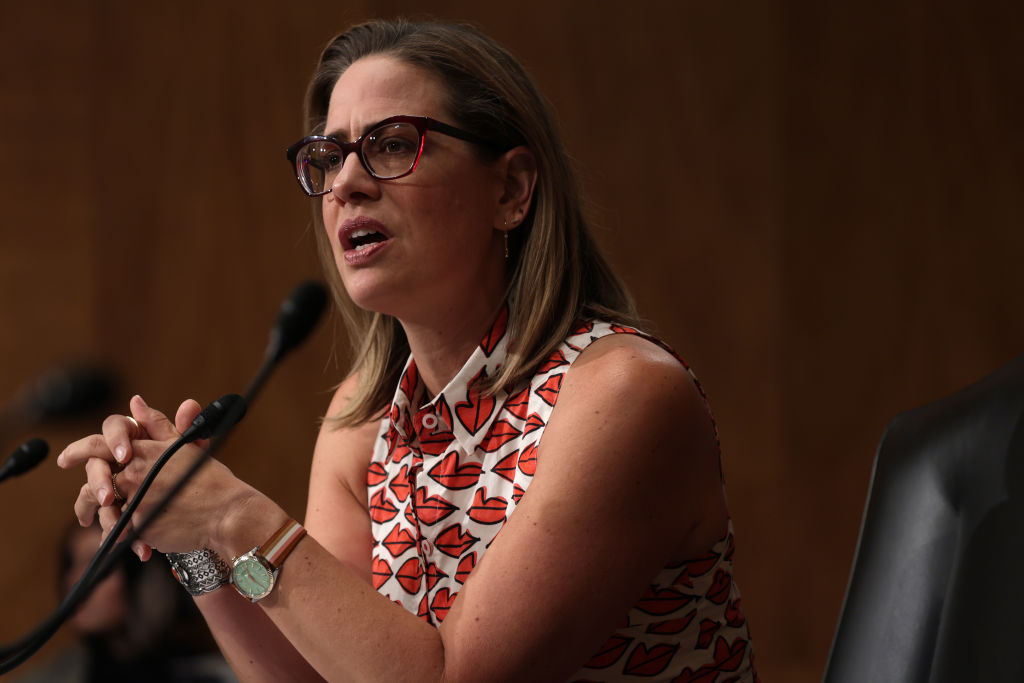
(WASHINGTON) — Arizona Democratic Sen. Kyrsten Sinema on Monday doubled down on her controversial support for the filibuster and displayed her unconventional friendship with Senate Minority leader Mitch McConnell during a speech hosted by the Republican in his home state of Kentucky.
Speaking at the McConnell Center at the University of Louisville, Sinema reiterated her stance that the Senate should continue passing legislation under a 60-vote threshold, clarifying that she hopes to resurrect the filibuster for “everything,” including all judicial and executive branch nominees. That move would almost guarantee that the 50-50 Senate would block nearly all of President Joe Biden’s appointments.
“I committed to the 60-vote threshold, it’s been an incredibly unpopular view. I actually think we should restore the 60 vote threshold for the areas in which it has been eliminated already,” the moderate Democrat said during her speech on “The Future of Political Discourse and the Importance of Bipartisanship.”
“It would make it harder for us to confirm judges. It would make it harder for us to confirm executive appointments in each administration. But I believe by restoring, we’d actually see more of that middle ground in all parts of our governance which is what I believe our forefathers intended.”
Sinema has over the past two years been the outlier among fellow Democratic senators who have attempted to pass legislation in a tied Senate, remaining steadfast in her allegiance to the filibuster rule despite mounting criticism. Her main argument against eliminating the filibuster was that doing so might turn the Senate into the House — a lower chamber without the longstanding Senate rule.
“The trouble with that is …the House with elections every two years, representing a smaller group of voters by each House, they really represent the passions of the moment in the political spectrum,” she said, noting the impending midterm elections just over a month and a half away. Sinema is not yet up for reelection for another term.
“Control changes between the House and the Senate every couple of years, it’s likely to change again, in just a few weeks … The Senate was designed to be a place that moves slowly to cool down those passions, to think more strategically and long term about the legislation before us.”
Ahead of her remarks, Sinema was called “the most effective first term senator I’ve seen in my time in the Senate,” by McConnell, who has served 37 years in the chamber and is poised to break records for leadership longevity.
His selection of Sinema for the bipartisan speaking series means the Arizonan is now part of a longstanding list of political heavyweights, including Supreme Court Justice Amy Coney Barrett, Sen. Amy Klobuchar, D-Minn., Biden while he was vice president and Hillary Clinton while she was secretary of state.
“She is today what we have too few of in the Democratic Party, a genuine, moderate, and a dealmaker,” McConnell said, noting with particular reverence her dedication to the Senate’s 60-vote threshold rule.
“It took one hell of a lot of guts for Kyrsten Sinema to stand up and say, ‘I’m not going to break the institution in order to achieve a short-term goal,'” he said, noting her departure from the Democrats’ desire to lower the threshold.
McConnell also said that former President Donald Trump “would harangue me on virtually a weekly basis,” about the same idea.
He also applauded Sinema’s involvement in moving forward bipartisan legislation — a role she has enjoyed as one of the few swing votes in the 50-50 Senate.
“Kyrsten has been right in the middle of, if not the principal leader, in getting us to an outcome in a highly partisan time, on infrastructure on school safety, mental health, postal reform, that ships bill you name it, every single thing that we’ve been able to work together on,” McConnell said.
Sinema, too, touted her friendship with the top Republican during her speech.
“At first glance, Sen. McConnell and I have relatively little — or some could even say nothing — in common,” she said. “For starters, he drinks bourbon, I drink wine. He’s from the Southeast and I’m from the great Southwest. He wears suits and ties, and I wear dresses and these fierce sneakers. Perhaps most obviously, we come from opposing political parties.”
“But despite our apparent differences, Sen. McConnell and I have forged a friendship — one that is rooted in our commonalities, including our pragmatic approach to legislating, our respect for the Senate as an institution, our love for our home states and a dogged determination on behalf of our constituents.”
(WASHINGTON) — Congress has just three legislative days remaining to avert a fast-approaching government shutdown at the end of the week, and much of its ability to keep the government running will depend upon whether lawmakers can navigate an impasse over energy policy.
In the few days that remain, Senate Majority Leader Chuck Schumer will try to lead the Senate in passage of a short-term funding bill that is expected to include Sen. Joe Manchin’s energy permitting reform legislation. Schumer struck a deal with Manchin to include energy permitting reform, a top priority for the West Virginia moderate Democrat, on a must-pass piece of legislation before the end of the fiscal year on Sept. 30 in order to secure Manchin’s crucial support for Democrats’ keystone Inflation Reduction Act.
But with the passage of the health care and environmental bill now in the rearview mirror, Schumer’s behind-the-scenes deal making has come home to roost. The fiscal year ends on Friday, leaving the Democratic caucus in both chambers deeply divided with just days to a shutdown.
On Tuesday, the Senate will take a key test vote to determine the fate of Manchin’s legislation as it considers a bill to fund the government through mid-December.
Schumer, with the backing of the White House, is sticking to his promise to include the Manchin legislation, introduced Wednesday, in the short-term funding bill. The Manchin bill would accelerate energy projects mandating that federal environmental reviews essentially be completed in two and a half years, a substantial increase from today’s process.
In a Wall Street Journal op-ed published Sunday, Manchin argued that his proposed legislation would bring the country in line with allied countries like Canada and Australia by reducing timelines on energy products from the current five to 10 years.
He called his bill, which speeds up permitting process for both renewable projects like wind and solar as well as non-renewable energies like oil and gas, “the kind of balanced and all-of-the-above energy approach America needs if we are to defend this nation’s energy security from those who seem hell-bent on weakening it.”
But it’s proven a tough pill to swallow for some progressives, many of whom knew of the outlines of the Schumer-Manchin deal before the IRA vote but not the specifics, which were just unveiled at the end of last week. They’re pushing back against what they see as a deal that goes counter to the very progress the IRA is expected to make against climate change.
Sen. Jeff Merkley, D-Ore., is organizing a letter to Schumer — signed by a number of liberal senators, including Sen. Bernie Sanders — asking that a vote on legislation speeding up permits occur separately from one on funding the government, according to an aide to the Oregon Democrat.
But the Senate group, like the more than 80 House progressives who oppose the deal in the House, stopped short of threatening to vote against the government funding bill if permitting reform is attached.
Sanders, however, has said unequivocally he intends to vote against funding the government if it includes Manchin’s bill.
In a scathing dear colleague letter on Friday, Sanders urged his fellow lawmakers to block the “disastrous side deal recently introduced by Senator Manchin to make it easier for the fossil fuel industry to destroy the planet and pollute the environment.”
“Next week, Congress has a fundamental choice to make. We can listen to the fossil fuel industry and climate deniers who are spending huge amounts of money on lobbying and campaign contributions to pass this side deal. Or we can listen to the scientists and the environmental community who are telling us loudly and clearly to reject it,” Sanders wrote.
It is that Sanders’ opposition in the narrowly divided Senate that has put Schumer in something of a bind. He needs GOP votes on government funding, but Republicans — feeling they have leverage — are anxious to pay Manchin back for what they see as his betrayal when he pivoted from opposing the Democrats’ sweeping climate and health bill to casting the deciding “yes” vote.
Manchin, in his Sunday op-ed, accused GOP leadership of playing politics in standing in the way of his legislation while promoting a competing, though slightly more expensive, bill by his home state GOP colleague, Sen. Shelley Moore Capito. The bills are remarkably similar, especially in that both guarantee the approval of a top project for West Virginia — the as-yet-unbuilt Mountain Valley Pipeline which is intended to carry natural gas some 300 miles from northern West Virginia into southern Virginia. The project is tied up in litigation.
It’s in part because of the greenlighted Mountain Valley Pipeline project that Capito said she intends to support Manchin’s legislation when it comes to the floor. She’ll back the short term funding bill with Manchin’s legislation attached during Tuesday’s test vote.
But it’s not clear if other Republicans will be ready to give Manchin another win.
According to an aide, Manchin spent the weekend working the phones and shored up the support of several other Republicans. He’s still confident there’s a path to the 60 votes necessary to clear Tuesday’s procedural vote on the short term funding bill that will include his legislation.
Despite Manchin’s optimism, that vote faces major headwinds. That’s why there’s a backup plan to keep the government funded.
If the bill fails to get the necessary 60 votes to proceed, Schumer is largely expected to strip Manchin’s permitting reform legislation and barrel forward. That’s essential not only to keep the lights on in Washington but also to secure funds for a few other bipartisan priorities.
There is support from both parties for additional funding to assist Ukraine in the ongoing war against Russia. The short term funding bill is expected to include at least $12 billion in economic and humanitarian aid for Ukraine.
The bill is also expected to include disaster aid for Jackson, Mississippi’s ongoing water crisis. A flood in Jackson last month brought to a head years of water system failures in the area, leaving residents without access to clean drinking water.
A potential funding crisis at the Food and Drug Administration will also be averted. After months of behind-the-scenes squabbling, negotiators reached an agreement late last week to include language reauthorizing FDA user fees in this short term package. Authorization for those fees on companies which seek authorization from the FDA for new drugs must be renewed every five years. Current authorization expires Friday.
The FDA uses the user fees to fund an expedited approval process for new and innovative drugs and medical technologies. By including this language in the short term bill, the FDA won’t be sending pink slips to workers who helped authorize COVID-19 vaccines during the pandemic.
But other COVID-19 priorities are expected to fall by the wayside, yet again.
The administration wanted Congress to approve an additional $22 billion in funds to combat COVID-19 to fund vaccine research and additional testing. Republicans have blocked multiple efforts to secure these funds, arguing that there is still remaining funding that’s yet to be utilized, and questioning the necessity of additional spending.
The administration’s efforts to secure COVID money were not helped, however, by Biden’s comments on “60 Minutes” earlier this month that “the pandemic is over.”
Republican Whip John Thune told reporters last week that Biden’s comments make it “eminently harder for sure” to persuade the GOP to support additional funds.
The fate of a separate $4 billion request from the White House to combat monkeypox remains uncertain.
The Senate is expected to act sometime this week to avert a shutdown, at which point the House will have to swiftly take up and pass the legislation. House Majority Leader Steny Hoyer said the chamber may work through the weekend to secure funding if necessary.
(IZHEVSK, Russia) — At least 17 people, including 11 children, were killed after a man opened fire at a school in central Russia on Monday, officials said.
Local authorities said at least 24 more people were injured, some severely, in the attack in the school in the city of Izhevsk about 600 miles from Moscow, making it one of the deadliest school shootings Russia has suffered. Twenty-two children were among the two dozen injured in the shooting.
Two teachers and two security guards were among the dead, according to the region’s governor.
Police said the alleged shooter killed himself at the school following the attack. They identified him as a 34-year-old former student at the school. Russia’s Investigative Committee, which handles serious crimes, identified him as Artyem Kazantsev, and posted a video it said showed his body lying in a pool of blood in a classroom.
The motive for the attack was still unclear but the committee said it was investigating possible “neofascist views” held by the shooter, who in the video it released appeared to be wearing a T-shirt with a red swastika.
President Vladimir Putin’s spokesman called the shooting a “terrorist act.”
“President Putin grieves in connection with the deaths of people and children in the school, where the terrorist act occurred. It was carried out by an individual who, judging by everything, belongs to a neofascist organisation or group,” Dmitry Peskov, Putin’s press secretary told reporters.
The shooting began mid-morning, while children were in class. Video circulating in Russian media showed pupils cowering under desks and with blood stains visible on the floor. Police sealed off the school and emergency services could be seen carrying stretchers with the wounded from the building.
The shooter was armed with two pistols, according to Alexander Khinstein, the chairman of Russia’s parliamentary committee for information policy, technology and communications.
School shootings have been relatively rare in Russia, but in recent years they have become increasingly frequent.
In May 2021, a teenager killed seven children and two adults after attacking a school in Kazan, and in April this year a man shot two children and a teacher dead at a kindergarten in the Ulyanovsk region. An 18-year-old student killed 21 people and wounded dozens more after setting off a bomb in a polytechnic college in Kerch in occupied Crimea in 2018.
(WASHINGTON) — President Joe Biden’s federal student loan forgiveness plan will cost $400 billion over 10 years, according to a revised estimate this week from the Congressional Budget Office.
That’s a lower number than from one leading outside estimate, but the nonpartisan federal agency’s projection drew quick pushback from the White House, which is sensitive to criticism it is growing rather than reducing the government deficit.
In a letter sent Monday to North Carolina Republicans Sen. Richard Burr and Rep. Virginia Foxx following their inquiries into Biden’s announcement last month to forgive up to $20,000 in federal student loans, the CBO noted that the cost of pausing repayments through the end of 2022 will add an additional $20 million onto that $400 billion price tag.
That CBO estimate does not include the cost of another feature of Biden’s plan: lowering the maximum amount a borrower can pay back to 5% of their income, down from 10%. The nonpartisan Committee for Responsible Federal Budget estimates that would tack on $120 million.
The CBO score, which the agency estimates is “highly uncertain” due to components that include projections dependent on future economic conditions and on how future terms of loans might be modified, is slightly less than the University of Pennsylvania’s Wharton Business School assessment that all three components of the forgiveness plan would cost about $605 billion.
Opponents of Biden’s student loan program — including some members of his own party — have insisted that the plan is impractical during a time of historic inflation rates and high gas prices, though the many Democratic supporters of the plan say it helps addresses education’s affordability issues.
The White House maintains that the cost of the student loan forgiveness plan pales in comparison to the president’s ability to foster debt reduction elsewhere.
The estimated loan cancellation price comes in higher than the $300 million amount that the Biden-backed Inflation Reduction Act is expected to reduce the federal deficit by, however. (An administration official noted to ABC News that, overall, the cash flow impact of debt cancellation will be very small in 2023 — about $21 billion.)
MORE: Biden’s student loan forgiveness policy: How to apply, who qualifies, more
In a statement, a White House spokesman emphasized that the president is still likely to reduce the federal deficit this year, despite the outlay for debt forgiveness, and the spokesman compared that with a major tax cut under Biden’s predecessor Donald Trump.
“The Biden-Harris Administration’s student debt relief plan provides breathing room to tens of millions of working families. It gives people who have been struggling with student debt that shot they want at starting a business, buying that first home, or just having a slightly easier time paying the monthly bills,” Abdullah Hasan said. “It’s a stark contrast to the Trump tax bill, which ballooned the deficit by nearly $2 trillion and provided the vast majority of benefits to big corporations and the wealthiest individuals.”
The White House also circulated a memo pushing back on the CBO estimate, noting that it assumed a 90% participation rate in the forgiveness program — though similar, smaller-scale programs had much lower participation.
The White House memo challenged how the CBO arrived at $400 billion, suggesting that the agency’s own logic pegged the number at around $250 billion.
The debt cancellation program is expected to open for applications in October.
(NEW YORK) — NASA has successfully tested its Double Asteroid Redirection Test spacecraft, or DART, which collided with an asteroid Monday night.
Asteroid Dimorphos, which NASA said is the size of a football stadium, does not pose a threat to the planet, in this case. But the mission will help scientists test technologies that could prevent a potentially catastrophic asteroid impact.
Here’s what you need to know about the mission:
How did the DART mission work?
The refrigerator-sized aircraft, launched atop a SpaceX Falcon 9 rocket last November, traveled roughly 7 million miles to reach its point of impact. On the receiving end of that collision was Dimorphos, a small asteroid that is the moon of a bigger space rock, Didymos.
Dimorphos, which means “having two forms” in Greek, spans 525 feet or 160 meters in diameter.
DART will record images with the Didymos Reconnaissance and Asteroid Camera for Optical navigation. The instruments will give viewers a first glimpse of Didymos and allow the spacecraft to autonomously steer itself into a direct collision with the small asteroid, Dimorphos.
At the moment of impact, DART was traveling at 14,000 mph, a speed fast enough to cover the last 4 miles in a single second.
The aircraft will not destroy Dimorphos but was expected to redirect the space rock onto a different flight path.
“The idea is that asteroid impacts occur when an asteroid’s orbit and the Earth’s orbit intersect,” Andy Rivkin of the Johns Hopkins Applied Physics Laboratory (Johns Hopkins APL), which is building the spacecraft and managing the mission for NASA, told ABC News last November. “So the idea of kinetic impactor is to give the asteroid a bit of a push so it doesn’t show up at the same time, at the same place as Earth.”
“This is the only natural disaster that humankind can do something about,” Rivkin said of asteroid impacts. “And this is our first attempt to kind of take that into our hands, to take our future into our hands that way.”
Scott Ian has shared an update on the status of the next Anthrax album, telling Metal Hammer that the thrash icons are “getting there.”
“We had started writing before COVID, but then eventually we jumped back in, so we do have eight arrangements and half of them with lyrics,” Ian says. “We’ve got at least another six really, really great things that we just need to start bashing out as a band.”
The guitarist adds, “We’re not that far off!”
Anthrax’s most recent studio effort is 2016’s For All Kings. Over the summer, they released a live album titled XL, which captured their 2021 40th anniversary streaming concert.
The 40th anniversary celebration continued this year with a U.S. Anthrax tour also featuring Black Label Society and Hatebreed.
This year marks the 10th anniversary of Rob Thomas‘ annual charity concert at the Borgata Hotel in Atlantic City, New Jersey, and he’ll mark the milestone with a special one-night-only event taking place in January.
For the show, the Matchbox Twenty singer has invited some “very special guests” to perform along with him — but he is remaining tight lipped on who they are at the moment. The event is set for Sunday, January 15.
The concert benefits Thomas’ Sidewalk Angels Foundation, which he co-founded in 2003 with wife Marisol Maldonado. He explained on Twitter that his charity supports “over 20 no-kill animal shelters and animal rescues across the country” by providing them critical resources and funds.
The Grammy winner noted that COVID-19 impacted these rescues and shelters, so his charity is helping them “continue their work as well as make sure that families can continue to get the care they need for their pets.”
Tickets for the event go on sale on Tuesday, September 27, for VIP and fan club members on The Borgata‘s website. General public ticket sales start Friday, September 30.