(NEW YORK) — Here are the scores from Tuesday’s sports events:
MAJOR LEAGUE BASEBALL
INTERLEAGUE
Arizona 3, Chicago White Sox 2
Minnesota 8, San Francisco 3
Kansas City 15, San Diego 7
AMERICAN LEAGUE
Tampa Bay 12, Boston 4
LA Angels 8, Toronto 3
Houston 3, Baltimore 1
Detroit 9, Texas 8
Seattle 4, Cleveland 0
Oakland 4, NY Yankees 1
NATIONAL LEAGUE
LA Dodgers 8, Miami 1
Washington 3, Cincinnati 2
Pittsburgh 5, Philadelphia 0
Colorado 1, NY Mets 0
Milwaukee 9, Chicago Cubs 7
St. Louis 6, Atlanta 3
NATIONAL FOOTBALL LEAGUE PRESEASON
NY Jets 31, NY Giants 27
Pittsburgh 19, Detroit 9
WOMEN’S NATIONAL BASKETBALL ASSOCIATION PLAYOFFS
Seattle 76, Las Vegas 73
Connecticut 68, Chicago 63
MAJOR LEAGUE SOCCER
Atlanta 3, DC United 2
Orlando City 2, New York City FC 1
LA Galaxy 2, New England 1
(WASHINGTON) — Republican Sen. Lindsey Graham of South Carolina is facing backlash after claiming political violence will break out if former President Donald Trump is indicted for mishandling presidential records.
President Joe Biden on Tuesday, while not mentioning Graham by name, appeared to call him out at a political rally in Pennsylvania, saying, “the idea you turn on a television and see senior senators and congressmen saying if such and such happens, there’ll be blood in the street. Where the hell are we?”
Graham’s comments came at a time when Trump supporters’ threats against law enforcement have escalated following the Mar-a-Lago search and at least one man citing it attacked an FBI field office in Cincinnati, Ohio, and was later killed by police.
Law enforcement officials told ABC News they were investigating social media posts apparently linked to the suspect that called for violence in the days after the FBI search.
During an appearance on Fox News on Sunday, the former chairman of the Senate Judiciary Committee said there “will be riots in the street” if Trump faces legal ramifications for taking at least 184 classified documents to his Mar-a-Lago estate after leaving office.
After months of the Justice Department and National Archives negotiating with Trump’s legal teams to get him to return the documents, the FBI executed a search warrant on Aug. 8 at Mar-a-Lago. But since then, Graham and many other Republicans have argued that Trump is facing a double standard from how the DOJ treated Hillary Clinton.
Specifically, Clinton, Trump’s 2016 Democratic rival for president, was not charged after probes into her use of a private email server containing classified information while she was secretary of state.
The two cases are not the same, however. In both cases, the FBI launched criminal investigations, obtaining search warrants to obtain or access relevant documents. But in Clinton’s case, the FBI said in findings released in July 2016, the classified information had been improperly transmitted via carelessness, not in an attempt to circumvent the law.
The caliber of “classified information” found on Hillary Clinton’s private servers was not the same as what was found at Mar-a-Lago, particularly as it relates to highly-sensitive Special Access Programs. According to the Department of Justice’s report on the Clinton case, investigators found seven email chains on Clinton’s servers that were “relevant to” and “associated with a Special Access Program, while it appears Trump was keeping SAP materials themselves at Mar-a-Lago.
Trump’s case is ongoing, but an unsealed search warrant and property receipt from the FBI raid confirmed that the former president took properly marked classified documents from the White House.
Experts have said it’s highly unlikely that the Justice Department would have pursued such a search warrant without significant evidence. “The department does not take such a decision lightly,” Garland said during the press conference following the FBI search.
“If they try to prosecute President Trump for mishandling classified information after Hilary Clinton set up a server in her basement, there literally will be riots in the street. I worry about our country,” Graham said to Fox News host and former South Carolina GOP Rep. Trey Gowdy. Later in the program, Graham repeated the threat of violence again.
Graham again doubled down on his earlier remarks in Charleston on Monday, again likening Trump’s FBI search to the probe into Clinton, saying: “America cannot live with this kind of double standard. I thought what she did was bad, but she got a pass at the end of the day.”
Using less inflammatory language, he said that that there would be many “upset people” if Trump was prosecuted. “I reject violence. I’m not calling for violence. Violence is not the answer, but I’m just telling you,” he said.
Despite growing evidence against the former president, Trump and allies like Graham have repeatedly accused the Justice Department of being biased against him.
The Justice Department on Friday made public the redacted affidavit that supported the search of Trump’s Mar-a-Lago estate. The affidavit outlines months of interactions between the National Archives and Records Administration and Trump’s team to secure the return of records that were improperly taken from the White House.
“Most Republicans, including me, believes when it comes to Trump, there is no law. It’s all about getting him. There’s a double standard when it comes to Trump,” Graham said.
Trump posted a video clip of Graham’s comments on his Truth Social media platform but without comment.
Asked for a response to Graham’s comments Monday, White House press secretary Karine Jean-Pierre said, “we have seen MAGA Republicans attack our democracy. We have seen MAGA Republicans take away our rights, make threats of violence, including this weekend …”
Rep. Eric Swalwell, D-Calif., tweeted on Monday about Graham’s remarks in contrast to the legislative victories that Democrats have seen throughout the summer.
“We are fighting for relief from prescription drug costs for Seniors, relief from inflation for working-class families, relief from mass shootings for parents, relief from the climate crisis for farmers. Republicans like @LindseyGrahamSC are promising riots,” he tweeted.
The Washington Post editorialized, “There is no excuse for this irresponsible rhetoric, which not only invites violence but also defies democratic norms.”
A new joint intelligence bulletin obtained by ABC News confirms that the FBI has seen an uptick in threats and acts of violence, including armed encounters, to its agents and law enforcement since their search of Trump’s Florida home.
Since the search, the FBI and DHS have identified multiple articulated threats and calls for the targeted killing of judicial, law enforcement, and government officials associated with the Palm Beach search, including the federal judge who approved the Palm Beach search warrant, according to the bulletin.
Graham has been a staunch defender of the former president, despite briefly breaking with Trump right after the Jan. 6 attack on the Capitol.
He’s currently resisting a grand jury probe into potential election interference in Georgia, fighting a subpoena to testify in connection with the investigation into Trump’s alleged effort to intimidate Georgia Secretary of State Brad Raffensperger and other state officials into overturning his 2020 loss to President Joe Biden, asking Raffensperger to “find” enough votes to ensure his victory.
Graham had recently hired former president Trump’s first White House counsel, Donald McGahn, to be part of his legal team.
The probe is led by Fulton County District Attorney Fani Willis, who subpoenaed Graham in July. In fighting the order, Graham has argued, among other things, that he was acting “within [his] official legislative responsibilities” as a senator and chairman of the Judiciary Committee when he allegedly made calls to Georgia officials in the wake of the 2020 election.
On Monday, new court filings from the Fulton County District Attorney’s office blasted the temporary subpoena block granted to Graham by a federal appeals court. The motion mentions that the strength of Trump and Graham’s relationship weakens the senator’s push against testifying.
“Senator Graham’s repetition of his previous arguments does not entitle him to partial quashal, and the District Attorney respectfully requests that his motion be denied,” Donald Wakeford, Fulton’s chief senior assistant district attorney, wrote in a motion filed on Monday.
The Fulton County DA’s response comes after Graham told Gowdy on Sunday that he’s got a “good legal case” against testifying before a grand jury.
“If we let county prosecutors start calling senators and members of Congress as witnesses when they’re doing their job, then you’ve got out of kilter our constitutional balance here,” Graham said about the probe on Sunday to Gowdy.
“I’ve got a good legal case, I’m going to pursue it …. You love the law, I love the law. I’ve never been more worried about the law and politics as I am right now. How can you tell a conservative Republican that the system works when it comes to Trump?”
ABC News’ Aaron Katersky, Olivia Rubin and Will Steakin contributed to this report.
(NEW YORK) — Officials have released a remarkable new image of the Phantom Galaxy — about 32 million light-years away from Earth — taken by the James Webb Space Telescope.
Published first by the European Space Agency, which has been collaborating with NASA on the Webb telescope, the image shows the galaxy — located in the Pisces constellation — in great detail.
Also known as Messier 74, the Phantom Galaxy, with its two well-defined spiral arms, falls under a class known as a “grand design spiral.”
The galaxy has low surface brightness, making it hard to see and requiring clear, dark skies to do so. However, Webb’s sharp lens have captured the clearest image of the galaxy’s features.
“These spiral arms are traced by blue and bursts of pink, which are star-forming regions,” NASA wrote in a social media post. “A speckled cluster of young stars glow blue at the very heart of the galaxy.”
It also provides an unobstructed view of the star cluster at the center of the galaxy, without it being obscured by gas. The Webb telescope can past through gas and dust, which can appear opaque to the human eye.
“The addition of crystal-clear Webb observations at longer wavelengths will allow astronomers to pinpoint star-forming regions in the galaxies, accurately measure the masses and ages of star clusters, and gain insights into the nature of the small grains of dust drifting in interstellar space,” the ESA said.
In the NASA post, there are also differences seen in the way the Webb telescope captured the Phantom Galaxy compared to the Hubble telescope.
The Webb telescope is an infrared telescope, meaning it uses infrared radiation to detect objects in space.
It can observe celestial bodies, such as stars, nebulae and planets, that are too cool or too faint to be observed in visible light — that is, what’s visible to humans.
By comparison, the Hubble telescope sees visible light, ultraviolet radiation and near-infrared radiation.
While Hubble did manage to capture many of the same star-forming regions and young stars, the images are not as clear as the one captured by Webb.
The Webb telescope was launched last December and NASA and ESA began releasing images from the new technology in July.
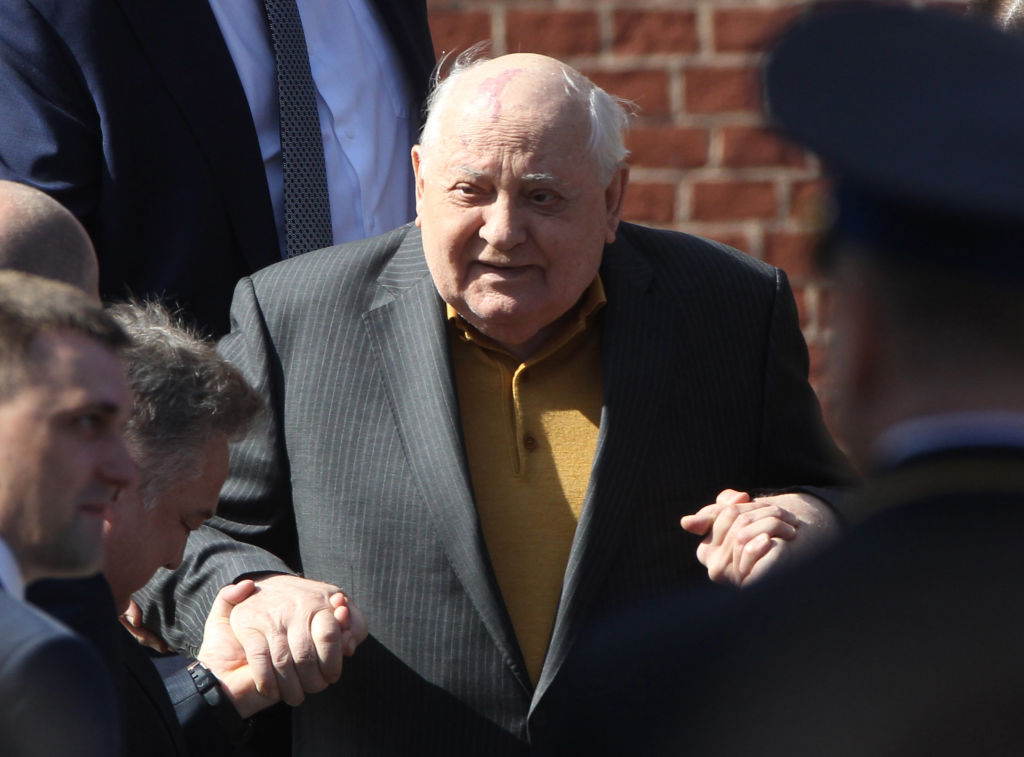
(MOSCOW) — Former Soviet President Mikhail Gorbachev has died “after a serious and long illness,” the Central Clinical Hospital reported on Tuesday.
He was 91 years old. A more specific cause of death was not immediately clear.
Gorbachev will be buried at Moscow’s Novo-Dyevitchiye cemetery, next to his wife, Raisa, Russia’s state-run news agency Tass reported.
Gorbachev was the last leader of the Soviet Union before it dissolved. He ruled as general secretary of the Communist Party of the Soviet Union from 1985 until 1991 and was the country’s only president, a title he took in the waning months of his time in office.
Young and energetic, his rise in the ’80s signaled a new spring for what was then one of the world’s two superpowers. A political insider with a view to the outside, Gorbachev set into motion radical reforms — that led to a series of unintended events.
He tore through the Iron Curtain between the USSR and the West by opening relations with the U.S., agreeing to a series of crucial summits soon after taking power.
“We have become closer, and we have come to know each other better,” Gorbachev said in 1989, his — and U.S. President Ronald Reagan — New Years’ address decorated with hopes of international cooperation and understanding. “Americans seem to be rediscovering the Soviet Union, and we are rediscovering America.”
Gorbachev signed treaties to reduce the size of his country’s nuclear arsenal and, in a well-received reversal in military policy, he withdrew troops from a nine-year war in Afghanistan.
In a meeting with Regan in 1988, Gorbachev signed the Intermediate-Range Nuclear Forces Treaty eliminating both countries’ stock of intermediate and short-range land-based missiles that could carry nuclear warheads. It was the first treaty that abolished an entire class of weapons systems and established unprecedented protocols for observers from both nations to verify the destruction of its missiles.
Underscoring the invention of nuclear weapons as a “material symbol and expression of absolute military power,” Gorbachev also underscored that mankind’s survival and self-preservation came to the floor.
Domestically, Gorbachev had two trademarks: more transparency and freedom — a policy known as glasnost — and bold economic reform, or perestroika.
It was not, ultimately, a winning combination.
Glasnost brought a feeling of liberation and empowerment to the Soviet people and when his economic policies didn’t work, they weren’t afraid to express their disillusionment.
Gorbachev’s vision was to legitimize communism by putting a democratic face on it. What he didn’t seem to realize was that his people would start demanding the real thing.
Discontent spread like wildfire to the countries of the East bloc. And Gorbachev allowed the peaceful revolutions to happen. In 1989, the Berlin Wall came down.
Gorbachev was revered in the West for ending the Cold War. He was ridiculed and ultimately reviled by many at home for the collapse of the country and the bleak years that followed, in the ’90s.
As the Soviet flag was lowered for the last time at the Kremlin in Moscow, Gorbachev had no choice but to resign.
“We live in a new world,” he said in his farewell address. “The Cold War has ended, the arms race has stopped, as has the insane militarization which mutilated our economy, public psyche and morals. The threat of a world war has been removed. Once again, I want to stress that on my part everything was done during the transition period to preserve reliable control of the nuclear weapons.”
“[Russia] has been freed politically and spiritually, and this is the most important decision that we yet to fully come to grips with,” Gorbachev said as he resigned, “and we haven’t because we haven’t learned to use freedom yet.”
Others benefitted far more from his changes than he did.
His political rival, Boris Yeltsin, rose out of the post-Soviet chaos. When Gorbachev ran against Yeltsin, he received less than 1% of the vote, a humiliating end to his political career.
But the Nobel Peace Prize winner — so honored, the Nobel organization said, “for the leading role he played in the radical changes in East-West relations” — remained a man of influence.
After his closest ally, wife Raisa, died in 1999, Gorbachev devoted himself to campaigning for environmental causes. And he continually called for a nuclear disarmament, warning in 2019 that renewed tension between Russia and the West was putting the world at “colossal” risk.
“As long as weapons of mass destruction exist, primarily nuclear weapons, the danger is colossal, irrespective of any political decisions that may be made,” he told the BBC.
Five years after his resignation, Gorbachev published the book “Memoirs” — which recounted his childhood, political rise and his fall as the Soviet Union’s last leader.
“I am the principle witness and the principal person who bears responsibility for what happened,” Gorbachev said of his decision to write, “and I believed it was important for me to explain my position about why I started reforms, why I came around to the view that reforms were necessary … and how difficult the process was.”
For his 85th birthday, in 2016, Gorbachev released a 700-page collection of memoirs, interviews and other documents about his life.
“The more I think about my life, the more I see that the biggest and most important events took place unexpectedly. Absolutely,” he said at the time.
Tributes poured in Tuesday from world leaders after news of Gorbachev’s death.
“I’m saddened to hear of the death of Gorbachev,” British Prime Minister Boris Johnson tweeted. “I always admired the courage & integrity he showed in bringing the Cold War to a peaceful conclusion. In a time of Putin’s aggression in Ukraine, his tireless commitment to opening up Soviet society remains an example to us all.”
Former U.S. Secretary of State Condoleezza Rice called Gorbachev a “man who tried to deliver a better life for his people.”
ABC News’ Christine Theodorou contributed to this report.
(WASHINGTON) — Mehmet Oz, the Republican candidate for Senate in Pennsylvania, on Tuesday tried to distance himself from an aide’s comment last week that appeared to mock the stroke suffered by Oz’s opponent, Democratic Lt. Gov. John Fetterman.
“The campaign has been saying lots of things,” Oz told KDKA, a Pittsburgh radio station. “My position — and I can only speak to what I’m saying — is that John Fetterman should be allowed to recover fully and I will support his ability, as someone who’s gone through a difficult time, to get ready.”
Oz was responding to a question about a comment attributed to Rachel Tripp, his communications adviser, who was quoted saying that if Fetterman “had ever eaten a vegetable in his life, then maybe he wouldn’t have had a major stroke and wouldn’t be in the position of having to lie about it constantly.”
Tripp’s comment was first reported by Insider on Aug. 23.
Amid near-instant condemnation, including from pro-Fetterman doctors and Fetterman himself, Oz’s campaigni nitially doubled down, calling the comment “good health advice” from a former cardiothoracic surgeon.
Until Tuesday morning, Oz had yet to personally speak about the campaign’s comment.
A spokesperson did not respond to repeated requests from ABC News to speak to the candidate after a town hall Monday night outside Pittsburgh — even as Oz criticized Fetterman for dodging the press at campaign stops of his own.
The spokesperson, Brittany Yanick, and Tripp did not immediately respond to requests for comment on Tuesday.
The backstory
The Pennsylvania Senate race took a heated — and personal — turn when Oz’s adviser was quoted derisively blaming Fetterman for his own stroke.
Tripp, the aide, had given a statement for the campaign, to Insider in response to Fetterman’s attacks on Oz as elitist and out of touch.
The Oz campaign comment drew immediate reaction on social media, including from Fetterman, who tweeted, “I know politics can be nasty, but even then, I could *never* imagine ridiculing someone for their health challenges.”
“I had a stroke. I survived it. I’m truly so grateful to still be here today,” he added.
Fetterman — who told a local outlet in 2018, when he was mayor of a small Pittsburgh suburb, that he had lost nearly 150 pounds by adopting a diet that included more vegetables — acknowledged in the days after the stroke in May that he “should have taken my health more seriously.”
But the tone of Tripp’s statement was deemed inappropriate by a group of pro-Fetterman physicians who earlier spoke out against Oz at an event organized by Fetterman’s campaign.
“No real doctor, or any decent human being, to be honest, would ever mock a stroke victim who is recovering from that stroke in the way that Dr. Oz is mocking John Fetterman,” Dr. Valerie Arkoosh, the Democratic chair of the board of commissioners in Montgomery County, said in a statement provided on Tuesday by a Fetterman spokeswoman.
The Oz campaign went on to tell ABC News in a statement late on Aug. 23: “Nice try. Dr. Oz has been urging people to eat more veggies for years. That’s not ridicule. It’s good health advice. We’re only trying to help.”
The salvo — in a race in a battleground state that could tip control of Congress — represented a departure from Oz’s other lines of attack since Fetterman’s stroke, which had involved largely dancing around it by jeering at Fetterman for his absence from the trail without referencing what sidelined him.
Oz struck an even more sympathetic tone immediately after Fetterman announced his stroke. He tweeted then: “I am thankful that you received care so quickly. My whole family is praying for your speedy recovery.”
“I think he just had it,” Stacy Garrity, the state treasurer and a co-chair of Oz’s campaign, told ABC News on Aug. 23. “I think he just got tired. He’s probably tired of hearing about veggies,” she said, referring to the Fetterman team’s repeated swipes over a video showing Oz shopping for vegetables to make crudités and criticizing Democrats for grocery prices.
The volley of statements threatened to overshadow Fetterman’s separate appearance on Aug. 23 afternoon in Pittsburgh to tout a key labor endorsement — only his second public campaign stop since his stroke. With many eyes still on his health, he spoke for roughly four and half minutes and exhibited patterns similar to those he showed at a rally in Erie earlier this month, speaking often in choppy sentences. (He told a newspaper last month that he was working with a speech therapist as he recovered.)
Amid now-routine jokes about the “crudités” video and Oz’s residential history outside of Pennsylvania, Fetterman also pledged to “stand with the union way of life” before exiting the venue without answering a group of reporters who flanked him as he walked.
Among those ignored questions was whether Fetterman would agree to debate Oz this fall, an issue Oz has hammered as Fetterman has remained largely mum about his plans to share a stage with his opponent.
“We’ve said we’re open to debating Oz,” Joe Calvello, a spokesman, said in response to a question that a reporter posed to Fetterman.
Oz’s campaign says he has agreed to five debates, including one on Sep. 6. Fetterman’s campaign says it refuses to set a schedule on Oz’s terms.
But according to a Pittsburgh Post-Gazette report, the campaign did not initially respond to an invitation emailed nearly a month ago to both campaigns by a politics editor at KDKA, a TV station in Pittsburgh planning the Sep. 6 debate.
Oz has accepted the invitation, the station’s news director told the Post-Gazette.
Asked by ABC News to respond to that report, a Fetterman spokesperson sent a statement from Rebecca Katz, a senior adviser to the campaign, who called Oz’s focus on debates “an obvious attempt to change the subject during yet another bad week for Dr. Oz.”
On Tuesday, Fetterman declined in a statement to take part in the debate, prompting a spokeswoman for Oz to call him a “liar” and a “coward.”
Fetterman did not commit to debating Oz this fall but did not rule it out, either.
(DURHAM, N.C.) — A Duke University women’s volleyball player targeted by a fan using hateful, racial slurs while playing a game against Brigham Young University calls the incident an “opportunity” to curate a healthy environment for Black people in collegiate athletics.
Rachel Richardson, a sophomore at Duke, said she’s not angered by the situation that occurred at last Friday’s game, but would rather show compassion and educate people using her platform to spread awareness for similar incidents in the future.
“I’m not the first person, I’m not the last person,” Richardson told ABC News Tuesday. “This isn’t an isolated incident, but it’s an opportunity for not just me, but for anyone who has an opinion, anyone who has a voice to decide that it should be the last time.”
Richardson heard the slur “every time she served,” according to former Texas county prosecutor Lesa Pamplin, who is running for county judge and said Richardson is her goddaughter in a tweet posted on Saturday.
“She was threatened by a white male that told her to watch her back going to the team bus. A police officer had to be put by their bench,” Pamplin tweeted. “Not one freaking adult did anything to protect her.”
Richardson didn’t condemn BYU for this incident, but singled out the alleged perpetrator.
“I know a lot of times when things like this happen, the perpetrators are met with anger. And that’s not what I want to happen in this moment,” Richardson said. “I don’t think that all of BYU should be condemned because grouping all of BYU together with the few students or non-students that were doing it would be the same thing that those people did to me, like viewing all Black people as less than. And I don’t want to sit down to a level.”
The fan, who was not a student, was sitting in the BYU student section, and was identified by Duke during the game, according to BYU. The fan has since been banned from all BYU athletic venues.
“To say we are extremely disheartened in the actions of a small number of fans in last night’s volleyball game in the Smith Fieldhouse between BYU and Duke is not strong enough language,” BYU said in a statement. “We will not tolerate behavior of this kind. Specifically, the use of a racial slur at any of our athletic events is absolutely unacceptable and BYU Athletics holds a zero-tolerance approach to this behavior. We wholeheartedly apologize to Duke University and especially its student-athletes competing last night for what they experienced.”
BYU Athletic Director Tom Holmoe, spoke out following the incident involving Richardson, telling their supporters to “not cross the line where you would hurt or harm anyone in any way,” and is taking the necessary steps to better educate his staff and student-athletes on ways to handle inappropriate behavior from fans in the future.
Although Holmoe spoke out against the racism, Richardson posted a statement on Twitter Sunday, claiming officials and BYU coaching staff were aware of what was happening during the game but failed to stop the fan and end the behavior.
“This is an opportunity to dig deep into closed cultures which tolerate amoral racist acts, such as those exhibited Friday night, and change them for the better,” Richardson said Sunday. “It is not enough to indicate that you are not racist, instead you must demonstrate that you are anti-racist.”
Nina King, Duke University Vice President & Director of Athletics, said Friday’s alleged incident is unacceptable and all players should be able to compete in a safe environment.
“Duke student-athletes should always have the opportunity to compete in an inclusive, anti-racist environment which promotes equality and fair play,” King said in a statement on Saturday.
As for Richardson, she plans to continue making strides and serving nets on the volleyball court and to continue spreading light and compassion on and off the court.
“It’s not that you’re just a terrible person because you made that mistake the one time, it’s that you’re ignorant and that you need to be educated,” Richardson said. “Hopefully, that person can also meet you with compassion, open their heart, and be willing to learn and be willing to share what they’ve learned, because that’s how it happens. You know, it starts with one place and then it spreads.”
(CHICAGO) — COVID-19 cases during the first week of the 2022-23 school year in Chicago Public Schools are much higher compared to the same time last year.
According to CPS data, 449 students have tested positive for the virus during the first week of the new school year — 3.3 times higher than the 135 students who tested positive during the first week of the 2021-22 school year.
Additionally, 315 adults — including people such as faculty and administrators — have contracted COVID-19, CPS data shows. That’s 4.8 times higher than the 65 adults who had COVID during the same period last year.
Doctors told ABC News it’s not surprising more cases of the virus are cropping up compared to last school year for a couple of reasons.
One reason is because the BA.5 variant, an offshoot of the original omicron variant, is continuing to spread — making up 90% of cases in the Midwest, according to the Centers for Disease Control and Prevention.
“Obviously COVID is still circulating in the community and the variant of COVID that is circulating, BA.5, is extremely transmissible, so that one person that’s infected can infect a lot more individuals,” Dr. Tina Tam, a professor of pediatrics at Feinberg School of Medicine of Northwestern University and a pediatric infectious diseases physician at Ann & Robert Lurie Children’s Hospital of Chicago, told ABC News.
The second reason is because mitigation measures have been loosened.
During a media briefing earlier this month, the CDC said it was no longer recommending unvaccinated people quarantine after exposure, instead suggesting they mask up for 10 days and get tested five days after they were being exposed.
Following the news, CPS announced there would no longer be a requirement for students exposed to the virus to quarantine unless they test positive.
Additionally, masks continue to be optional for students and staff in school buildings and on school buses after CPS dropped its mask mandate in March.
Tan said some of these mitigation measures may need to be reinstated if COVID-19 cases continue to rise.
“If someone’s exposed and they’re not symptomatic, they can still go to school, but they should be wearing a mask,” she said. “How many kids are actually doing that? I don’t know. But I think that if the numbers continue to rise the way they’re rising, one of the probably best things to consider is to put back into place a mask mandate.”
The Chicago Teacher’s Union said the increase in cases is concerning and, if infections continue to climb, it will demand that a mask mandate be reestablished.
“There is nothing stopping the district and we have advocated for this to immediately reimpose a mask mandate, if they are seeing spread,” CTU vice president Jackson Potter told local affiliate ABC 7 Chicago.
The CTU did not immediately reply to ABC News’ request for comment.
Tan said she also wants to encourage parents to vaccinate their kids, especially considering the low vaccination rate among students.
CPS data shows only about 51% of eligible students at district-runs schools are fully vaccinated against COVID-19.
The percentages vary widely depending on age. More than 63% of students aged 12 to 17 are fully vaccinated compared to a little more than 14% of children ages 4 and under.
“People just need to remember that COVID is still circulating in the community,” Tan said. “Yes, this particular variant tends to cause mild disease. However, there are normal healthy children that will develop more severe disease with BA.5 and may be hospitalized from it.”
She continued. “So, the best way to protect their children is to vaccinate them.”
(NEW YORK) — Movie lovers pained by the price of popcorn, slushies and tickets will have something to celebrate on “National Cinema Day.”
On Sept. 3, tickets at theaters across the country will only be $3 for every movie, showtime and format — a fraction of the national average price of $9.17.
The Cinema Foundation, a donor-supported nonprofit, announced a markdown and holiday to celebrate a summer of “record-breaking moviegoing.”
“The one-day event, held at more than 3,000 participating locations with more than 30,000 screens, will bring together audiences of all ages to enjoy a day at the movies,” The Cinema foundation said in a release.
The Cinema Foundation also said moviegoers will be able to see sneak peeks of upcoming films from A24, Amazon Studios, Disney, Focus Features, Lionsgate, Neon, Paramount, Sony Pictures Classics, Sony, United Artists Releasing, Universal and Warner Bros.
“After this summer’s record-breaking return to cinemas, we wanted to do something to celebrate moviegoing,” Cinema Foundation President Jackie Brenneman said in a statement. “We’re doing it by offering a ‘thank you’ to the moviegoers that made this summer happen, and by offering an extra enticement for those who haven’t made it back yet.”
Labor Day weekend is historically one of the slowest weekends in theaters, The Associated Press reported. If organizers of the deal find this trial to be successful, National Cinema Day could become an annual fixture.
(HARRIS COUNTY, Texas) — An adult resident of Harris County, Texas, who had been diagnosed with monkeypox, has died, state health officials announced on Tuesday.
The patient was severely immunocompromised, according to the Texas Department of State Health Services, and died at a Harris County hospital.
The official cause of death is still unknown. Although this person was a presumptive positive for monkeypox, it is still unknown whether the person’s death was due to or related to monkeypox, officials said.
“What we’re looking to be able to determine is the specific cause of death. We know that this patient had monkeypox as a diagnosis, what we do not know for sure is that the patient passed away from monkeypox,” county officials said during a press conference on Tuesday.
The case is currently under investigation to “determine what role monkeypox may [have] played in the death,” according to state officials. An autopsy is in progress, and the final report will be available in the next few weeks, according to the Harris County Department of Health.
“Monkeypox is a serious disease, particularly for those with weakened immune systems,” Dr. John Hellerstedt, DSHS commissioner, said in a statement. “We continue to urge people to seek treatment if they have been exposed to monkeypox or have symptoms consistent with the disease.”
Local officials in Harris County reported that they have been collaborating with state and federal health officials from the Centers for Disease Control and Prevention (CDC), to investigate the case.
“We are sharing this information to err on the side of transparency and to avoid potential misinformation about this case,” Harris County Judge Lina Hidalgo wrote in a statement. “The best way for us to fight this virus is through vaccines. Our goal is still to get as many people who qualify vaccinated as quickly as possible — I have always felt that vaccines are the key to reducing spread.”
Officials urged anyone who is immunocompromised to consider getting vaccinated, as they are at higher risk of severe disease.
“Monkeypox can affect those who are immunocompromised, and because of that, we would certainly encourage anyone who fits the criteria, including being immunocompromised, to seek vaccination,” officials added.
In a statement to ABC News, a representative from the CDC wrote that the agency is aware of the reported death and working with Texas officials to investigate.
“Our thoughts are with the family during this heartbreaking time,” the representative said.
Officials from the CDC cautioned that the strain of monkeypox responsible for the current outbreak is “rarely fatal,” and most people who become infected with this form of the disease will likely survive.
However, officials wrote that people with weakened immune systems are at a higher risk of becoming seriously ill or dying.
During a press briefing on Tuesday, officials from the White House’s Monkeypox Response Team further emphasized that “only a handful” of monkeypox deaths have been reported globally throughout the current outbreak.
“It’s serious and our hearts certainly go out to this family who’ve lost a loved one, and while we are doing further investigation to find out what role monkeypox may have played, it’s important to focus that we have mitigation measures in place to prevent monkeypox,” said Dr. Jennifer McQuiston, CDC monkeypox response incident manager.
So far, the majority of cases in the current monkeypox outbreak have been detected in gay, bisexual or other men who have sex with men. However, officials stress that anyone exposed to the virus can become infected with monkeypox.
Across the globe, nearly 49,000 cases of monkeypox have now been reported, including 18,100 cases in the U.S. — the most of any country, according to the CDC.
Monkeypox primarily spreads through prolonged skin-to-skin contact with infected people’s lesions or bodily fluids, according to the CDC. The virus can also spread through bedding and towels contaminated by infected lesions.
In addition to lesions, which can appear like pimples or blisters, the most common symptoms associated with monkeypox are swollen lymph nodes, fever, headache, fatigue and muscle aches.
ABC News’ Sony Salzman and Justin Gomez contributed to this report.
Shinedown‘s tour made a stop Sunday in frontman Brent Smith‘s hometown of Knoxville, Tennessee, where he received a surprise honor.
During the show, Knox County Mayor Glenn Jacobs — also known to WWE fans as the wrestler Kane — got up onstage and presented Smith with a key to the city. The key was created by students of South-Doyle High School, which Smith graduated from in the ’90s.
Shinedown posted video of the key presentation on Facebook alongside a caption from a “speechless, humbled and beyond grateful” Smith.
“Never in my wildest dreams would I have ever imagined a moment like this, as I watched Kane take the stage, and proceed to address the crowd, and present me with the Key to the city of my hometown of Knoxville, Tennessee,” Smith writes. “Thank you to the Mayor. I am honored beyond belief. Thank you also to South-Doyle High School for creating the key. I appreciate you so much. I LOVE YOU KNOXVILLE.”
Shinedown is currently on tour in support of the band’s new album, Planet Zero, which dropped in July.