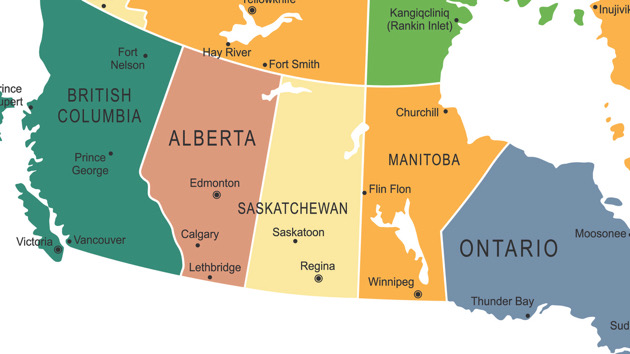
(SASKATCHEWAN, Canada) — Two suspects in a Canada stabbing rampage that left 10 people dead and 15 injured in an Indigenous community in Saskatchewan remained on the run Monday morning as a massive search for them continued into its second day, authorities said.
Royal Canadian Mounted Police Saskatchewan identified Damien Sanderson and Myles Sanderson as the two suspects in the massacre. They are believed to be driving a black Nissan Rogue with SK license plate 119 MPI, according to police.
“Let me be clear, we are still looking for the two suspects. We are asking residents across Saskatchewan and our neighboring provinces to be vigilant. At this stage in our investigation, we believe some of the victims have been targeted by the suspects and others have been attacked randomly,” Assistant Commissioner Rhonda Blackmore, the commanding officer of Saskatchewan RCMP, said in a statement issued late Sunday night.
The Sandersons, whose relationship to each other was not immediately disclosed, are considered armed and dangerous, and Blackmore advised anyone who spots them to call police immediately and refrain from approaching them.
The stabbings occurred between James Smith Cree Nation and in the village of Weldon, located northeast of Saskatoon, police said.
Blackmore said the massacre started around 5:40 a.m. Sunday when the Saskatchewan RCMP Divisional Operational Communications Center received the first call reporting a stabbing on the James Smith Cree Nation. Blackmore said numerous calls began coming into the center from multiple locations.
“At this point in our investigation, we have located 10 deceased individuals and are investigating 13 locations in the communities of the James Smith Cree Nation and Weldon in Saskatchewan,” Blackmore said.
A motive for the attacks remains under investigation.
Canadian Prime Minister Justin Trudeau issued a statement Sunday, saying, “I am shocked and devastated by the horrific attacks today in James Smith Cree Nation and Weldon, Saskatchewan, that claimed the lives of 10 people and injured many more.”
“As Canadians, we mourn with everyone affected by this tragic violence, and with the people of Saskatchewan. We also wish a full and quick recovery to those injured,” he said.
(WASHINGTON) — President Joe Biden, a pro-union president, on Labor Day kicks off the the unofficial start of the fall campaign season ahead of the midterm elections with two cross-country stops in battleground states.
Biden, the White House says, will deliver remarks “celebrating Labor Day and the dignity of American workers,” in Wisconsin and Pennsylvania, after a string of legislative victories and a slight bump in approval ratings.
In both swing states, Democrats are facing high-stakes, heavily-funded midterm races.
Biden travels first to Milwaukee to speak about 1:00 p.m. at the city’s Laborfest, with Democratic Gov. Tony Evers — up for reelection in November against Republican Tim Michels — expected to make an appearance.
It was unclear whether Lt. Gov. Mandela Barnes — a Democratic Senate hopeful embattled in a tight race against incumbent GOP Sen. Ron Johnson — would also accompany Biden.
Ahead of his visit, Republican National Committee and the Wisconsin Republican Party hosted a Zoom call, slamming the president’s Thursday primetime speech in Philadelphia and his recent moves to cancel up to $20,000 in student loan debt.
Johnson was on the Zoom, calling the president “no moderate” and that he has become a “divider-in-chief.” Johnson noted that his Democratic opponent has been “in hiding” and that Barnes has not been doing any recent press conferences. One of Barnes’ most recent events was a meet and greet with seniors on Aug. 29 on the subject of Social Security and Medicare, in response to recent Johnson comments on potentially cutting those programs.
From Milwaukee, Biden travels to Pittsburgh where he is scheduled to make more Labor Day remarks at 5:30 p.m at United Steelworkers of America Local Union 2227 — the third time the president has visited the commonwealth in one week.
Pennsylvania’s Democratic Lt. Gov. John Fetterman is in a contentious battle for retiring Republican Sen. Pat Toomey’s Senate seat against Trump-endorsed Dr. Mehmet Oz.
In a tweet, Fetterman’s director of communications said that the candidate will also be marching with Biden — the first time the candidate has joined the president during his weeklong span of the state — with plans to discuss marijuana decriminalization.
“John will be marching in the Labor Day parade in Pittsburgh next week, and he looks forward to talking to the President there about the need to finally decriminalize marijuana,” wrote Joe Calvello.
Democratic Attorney General Josh Shapiro is also facing a tight race against Trump-endorsed Republican Doug Mastriano for governor. Shapiro will also march with Biden on Monday, following his appearance with the president at Wilkes University on Tuesday.
In Pittsburgh, Shapiro will be “marching with the hardworking men and women of labor on Monday,” Manual Bonder, a spokesperson for Shapiro, said in a statement. “As always, we welcome President Biden back to his home state of Pennsylvania.”
On Thursday in Philadelphia, Biden, in a fiery speech, warned about what he called threats to American democracy, presenting himself and Democrats ahead of the midterms as a clear contrast to Trump and MAGA Republicans.
He pummeled Republicans who participated in the Jan. 6 insurrection, and those who refuse to accept the 2020 election results and want to strip away abortion rights.
“Too much of what’s happening in our country today is not normal,” he said. “Donald Trump and the MAGA Republicans represent an extremism that threatens the very foundations of our republic.”
Vice President Kamala Harris, speaking at the Greater Boston Labor Council Annual Breakfast on Monday, echoed Biden’s remarks Thursday in Philadelphia, criticizing “extremist, so-called leaders” for their attempts to “turn back the clock …To a time before workers had the freedom to organize. To a time before women had the freedom to make decisions about their own bodies. To a time before all Americans had the freedom to vote.”
(NEW YORK) — Here are the scores from Sunday’s sports events:
MAJOR LEAGUE BASEBALL
INTERLEAGUE
Toronto 4, Pittsburgh 3
AMERICAN LEAGUE
Oakland 5, Baltimore 0
Boston 5, Texas 2
N.Y. Yankees 2, Tampa Bay 1
Kansas City 3, Detroit 2
Minnesota 5, Chicago White Sox 1
Seattle 6, Cleveland 3
Houston 9, L.A. Angels 1
NATIONAL LEAGUE
Colorado 8, Cincinnati 4
Atlanta 7, Miami 1
Washington 7, N.Y. Mets 1
St. Louis 2, Chicago Cubs 0
Cincinnati 10, Colorado 0
Arizona 5, Milwaukee 1
San Francisco 5, Philadelphia 3
L.A. Dodgers 9, San Diego 4
WOMEN’S NATIONAL BASKETBALL ASSOCIATION PLAYOFFS
Chicago 76, Connecticut 72
Las Vegas 110, Seattle 98 (OT)
MAJOR LEAGUE SOCCER
Portland 2, Atlanta 1
Colorado 0, D.C. United 0
CF Montreal 4, Toronto FC 3
Sporting Kansas City 2, LA Galaxy 2
Orlando City 0, Miami 0
New England 3, New York City FC 0
Seattle 2, Houston 1
San Jose 2, Vancouver 0
Los Angeles FC 2, Real Salt Lake 0
Waldo was an avid skier and taught skiing on the weekends. – Courtesy Victoria Waldo
(WASHINGTON) — Less than a month after Victoria Waldo recovered from COVID, she woke up feeling drunk.
Dizzy and slurring her speech, she went to the emergency room only to be sent home after routine blood work turned up negative.
The newly engaged 26-year-old, who worked long days in finance at a start-up and taught skiing on the weekends, would spend the next several months in a haze on her couch in her Washington, D.C., apartment.
Unable to focus, she lost her job. At one point, she stumbled upon a pair of slippers she liked and asked her fiancé who they belonged to. They were hers, he said, a Christmas gift from his sister.
Another time, she forgot what her wedding planner looked like and introduced herself to the woman as if the two had never met.
“I had no idea what was going on. Nobody diagnosed me with anything. Everyone said I was fine based on my labs. Someone asked me if I was on my period,” she said.
Now, at an age when many young professionals consider financing a home, traveling or starting a family, Waldo is weighing her options. Her employer didn’t offer disability insurance with her job — a benefit she didn’t think she’d need as a healthy twenty-something. So she’s waiting to see if her condition improves with time — and burning through her cash savings in the meantime.
“I think in a parallel universe where none of this happened, we would be doing that now,” she said of house hunting. But “instead, I’m kind of like, ‘Oh, I want to see if we can get away with this cheap rent again.”
‘A mass disabling event’
More than two years after COVID began, millions of survivors say they still don’t feel right. Brain fog, difficulty breathing, and intense fatigue are among the symptoms they say are still lingering in their bodies — upending their ability to work and derailing their financial independence.
The government estimates as many as 7 million to 23 million people are impacted by long COVID, and a Census Bureau survey suggests that among people who have been infected, one in five still experience lingering symptoms.
Vaccination is expected to significantly reduce a person’s chance of developing long COVID. That immunity though wanes with time and doctors say some people — like Waldo who was fully vaccinated but days away from a booster shot when she caught the virus — can still be young and healthy when they get sick.
Advocates have called this phenomenon a kind of “mass disabling event” that both insurers and the federal government have yet to reckon with. Data on disability claims with private insurers tied to long COVID aren’t publicly available. And while disability claims with the federal government’s Social Security program currently remain flat for now, at least one economist says that might not last for long.
“This is a $3.5 trillion problem,” said David Cutler, a professor of economics at Harvard University, whose calculations factor in lost earnings, medical care and lower quality of life.
“And there are very few 3.5 trillion problems that we know as little as we know about this,” he said.
‘This is not in their heads’
Doctors and scientists have long suspected that viral infections might be to blame for other chronic or debilitating diseases and conditions with mysterious origins, including multiple sclerosis, rheumatoid arthritis and chronic fatigue syndrome.
Then came COVID, triggering a wave of 93 million viral infections in the U.S. in just two years. Hospitals quickly began to see patients like Waldo show up at emergency rooms and doctors’ offices with symptoms they couldn’t explain.
Dr. Alba Azola, who helps run the post-acute COVID team at The Johns Hopkins Hospital in Baltimore, Maryland, said she might consult with a half a dozen other specialists or more to rule out other causes before diagnosing someone with long COVID. After that, she said, her team will have to go back-and-forth several times with insurers and employers to help their patients secure job accommodations.
“This is not in their heads,” Azola said of her patients. “This is not something that is just to get out work or a disability scam. These patients just want to be themselves again.”
One of Azola’s patients, Jazmin Holcombe, is among the luckier ones when it comes to her work life. After four months in the hospital with COVID, the 29-year-old was able to return to her job working from her home office in marketing. She hadn’t been vaccinated when she contracted the virus last year because, she said, she had been nervous about a new vaccine and she mostly stayed at home.
But she’s still far from her old self. Now, rather than planning trips or going to concerts like she used to, Jazmin spends much of her time doing physical therapy at the hospital, carrying with her an oxygen tank wherever she goes. She said her doctors hope to have a better idea by the end of the year what her prognosis will be.
“No one knows yet,” she said.
‘No man’s land’
That uncertainty in the lives of young long haulers and its impact on the economy has caught the attention of senior government officials and scientists.
The National Institutes of Health has launched a $1.5 billion study to identify the causes and find treatments for long COVID. And, the Biden administration has added long COVID as a condition that qualifies as a disability under the American Disability Act — a move that requires employers to grant work accommodations.
Also, the Labor Department has teamed up with the Centers for Disease Control and Prevention and Surgeon General’s office to crowdsource ideas from the public on “workplace challenges” tied to long COVID.
Taryn Williams, assistant secretary of labor for disability employment policy, said she hopes to have an analysis of that effort in coming months. In the meantime, she said, people can go to www.covid.gov/longcovid to see what benefits they might be eligible for. They also can get free counseling through the Job Accommodation Network at askjan.org, she said.
“We do not know yet the full extent of the impact of long COVID on the economy or the workforce. But we do know that public health and safety are critical to a healthy economy, which is why we are so focused on this,” Williams said.
For now though, employer accommodations can still be scarce, especially without legal help.
Mark DeBofsky, a disability attorney and law professor at the University of Illinois-Chicago John Marshall Law School, said people should know that many lawyers — including himself — won’t bill their clients until they win a case. He said he advises his clients to save any medical documentation they have and collect statements from family members about how they might have changed.
Keeping detailed journals of their symptoms can be a good idea too, he said.
“I think it’s still a mixed bag,” DeBofsky said about insurance companies and employers responding to long COVID patients.
“Every disability claim is very complex, and I don’t begrudge the insurance companies for really doing their due diligence,” he added.
But even people who keep detailed records can get rejected, like Frantz Dickerson, a 55-year-old sales executive who worked during the pandemic for a company that sold and fixed elevators. Dickerson’s job was to drive into Philadelphia where he would stand on rooftops or climb into the elevator shafts of high-rise buildings and hospitals to ensure safety and order fixes.
After being diagnosed with long COVID — a mental state he describes as feeling as though his brain went from a 10-lane highway down to two lanes — his doctors suggested he take time off to rebuild his cognitive and physical abilities.
But according to his employer’s disability insurer, Dickerson could still work in sales. That’s because the insurer defined a sales job as mostly sitting at a desk, even if that wasn’t an accurate description of what he did. His former employer did not respond to requests for comment, and his insurer said it won’t discuss individual cases due to privacy concerns.
“I was kind of in this no man’s land,” Dickerson said of his rejection. “Insurance says that I’m not disabled, but my work says, ‘no, you can’t come back until your doctor fully releases you.’ And my doctors were not fully releasing me because they understood long COVID.”
Dr. Benjamin Abramoff, who treated Dickerson as head of PennMedicine’s post-COVID care clinic and confirmed the details in his case, said he oftentimes will spend hours filling out paperwork for patients. Abramoff said he knows of other doctors and clinics that have pulled back from the specialty because they don’t have the staff or resources to do it.
Abramoff said he wants more data on effective treatments and is watching ongoing studies closely. But he also would like to see insurers agree to use the same standardized forms.
“It is a big administrative burden,” he said. Insurers “send in the forms and the forms get rejected for technicalities (such as) a box that wasn’t filled out quite right. And then it has to come back to be filled out again or edited.”
Dickerson eventually switched sales jobs to one that’s fully remote. After several months of therapy, he says he’s doing better now that he’s learned how to pace himself and take breaks if he needs it, including playing his guitar — something he was encouraged to do by his doctor.
As for Waldo, she eventually landed an official diagnosis of long COVID: “Post COVID-19 Condition ICD10 code U09.9” — a medical code that didn’t exist until about a year ago.
But she’s close to draining her once-impressive cash savings of $70,000 to pay for medical treatments and living expenses – money she had hoped to use to buy a house someday and maybe travel.
In the meantime, she’s still planning to get married next year. But everything else, including starting a family, is on hold for now.
“I just don’t know what my body can handle,” she said.
ABC News producers Vika Aronson, Kelly Terez, Iru Ekpunobi and Cate Barbera contributed to this report.
(LONDON) — The United Kingdom’s Conservative Party announced Monday that it has selected Liz Truss as its new leader, putting her in line to be confirmed as the country’s prime minister.
Truss beat rival Rishi Sunak in a leadership election, in which only the 180,000 dues-paying members of the ruling party were allowed to vote. Britain’s Queen Elizabeth II is scheduled to formally name Truss as prime minister on Tuesday.
In a speech following her victory, Truss said it was an “honor” to be elected and paid tribute to her “friend” Boris Johnson, whom she will be succeeding. She will become the U.K.’s fourth prime minister since 2016 and the country’s third female premier ever.
Truss previously served as the foreign secretary under Johnson’s Rishi Sunak, the former chancellor of the exchequer whose resignation helped bring about Johnson’s downfall in July.
Members of the Conservative Party cast their votes after eight weeks of campaigning, with Truss — a supporter of Johnson’s who said she did not back his resignation — emerging as the overwhelming favorite.
The leadership campaign was dominated by questions about what both candidates would do to tackle a looming economic crisis, with household energy bills set to skyrocket this winter and inflation, already at a four-decade high at 10.1%, is expected to rise further according to the Bank of England. The leadership hopefuls clashed most fiercely on the issue of tax, with Truss saying she would not raise taxes, while Sunak has supported a windfall tax on energy companies’ profits to help ease the burden on households.
Truss has promised action on the energy crisis within a week of taking office, though she has not spelled out her plans in any detail and refused to elaborate when questioned by the BBC on Sunday.
Truss will also have the task of uniting a divided Conservative Party. Johnson’s tenure in office was dogged by scandal – most notably with the issue of ‘Partygate’ – the illegal gatherings held in government residences while the country was under lockdown. While his supporters will remember him for securing a huge election victory, Brexit and support for Ukraine, his detractors say Johnson’s conduct and flexible relationship with the truth damaged the Conservative Party brand.
Writing in the Sunday Telegraph, the leader of the opposition Labour Party, Sir Keir Starmer, said that the appointment of a fourth Conservative prime minister in recent years did not mark a “new dawn” for Britain.
“As summer turns to autumn, the shadows of crisis are lengthening, looming over the whole country,” he wrote. “There is no sign that either Rishi Sunak or Liz Truss have grasped the scale of what is facing us, let alone possesses the answers to it.”
Truss will not be formally installed as the new prime minister until Tuesday after Johnson formally submits his resignation to the Queen at Balmoral and his successor is then invited to form a government.
“It is clearly now the will of the parliamentary Conservative Party that there should be a new leader of that party and therefore a new prime minister,” Johnson said on the steps of Downing Street when he announced his resignation. “I want you to know how sad I am to be giving up the best job in the world… But them’s the breaks.”
(WEED, Calif.) — A wildfire raging in Northern California took a tragic turn as two bodies were recovered after the blaze swept into a small town, damaging or destroying more than 100 structures, authorities said.
Siskiyou County Sheriff Jeremiah LaRue broke the grim news at a community meeting Sunday night, telling residents that the Mill Fire, which has burned more than 4,200 acres near the town of Weed, had claimed two lives.
“It’s one thing to come up here and tell you things, but to look at your faces … it almost brings me to tears,” LaRue said before reporting that two people had been killed and asking for a moment of silence.
The sheriff’s office released a statement early Monday reporting that the two deceased individuals were women, ages 66 and 73. The sheriff’s office said the remains were located on Friday by first responders within the city limits of Weed.
The sheriff office did not provide any further details on the deaths.
The news came as firefighters appeared to be getting a handle Sunday on the Mill Fire while dealing with new challenges being caused by the Mountain Fire, which is also burning in Siskiyou County near the Oregon border.
The Mill Fire was 40% contained Sunday night after burning 4,254 acres since igniting on Friday, according to Cal Fire officials.
The Mountain Fire has grew from 6,451 acres Sunday morning to nearly 9,000 by Sunday night , according to Cal Fire. The Mountain Fire, which was only 10% contained Sunday night, forced the evacuations of more than 300 people living in the remote rural area of Siskiyou County, officials said.
Winds on the ridges of the Mountain Fire were of particular concern for firefighters, who feared they could spread burning embers and ignite spot fires, according to Cal Fire’s update Sunday on the blaze.
Firefighters are battling the dueling fires amid triple-digit heat.
“Weather continues to be hot and dry with poor overnight relative humidity recoveries,” Cal Fire said Sunday.
The agency said firefighters will remain focused on defending structures and expanding containment lines around the two blazes.
California Gov. Gavin Newsom has declared a state of emergency in Siskiyou County to support the response to the fires.
The mayor of Weed, meanwhile, reported new details on the Mill Fire, which ravaged her town of more than 2,600 people, injuring several people as they fled the flames and damaging or destroying at least 132 structures, including many homes.
Mayor Kim Greene told ABC News the Mill Fire started Friday in an old warehouse at the town’s lumber mill, the Roseburg Forest Products, which sits near a park and a cluster of homes she said were nearly all destroyed.
“My co-worker’s husband ran in and said, ‘There’s a fire,'” Greene recalled. “By the time we go out the front door to see, [there] was just a big puff of black smoke. You could hear the small explosions.”
Fanned by 30 mph winds, Greene said the blaze spread quickly, jumped a set of train tracks and swept into a neighborhood.
Green said many people had only minutes to escape. An ABC News crew observed several walkers and wheelchairs abandoned along streets as people fled for their lives. Numerous vehicles sat charred in roadways and driveways of homes completely destroyed.
The Mill Fire, according to Cal Fire, caused more than 1,000 people to be evacuated.
Firefighters got a break from the high winds on Saturday, but high temperatures continue to be a challenge, Cal Fire officials said. The temperature in Redding, in Northern California, was expected to be 111 degrees on Monday.
Capt. Robert Foxworthy of Cal Fire said the high temperatures are forcing firefighters to take precautions to protect themselves physically.
“It makes it a little bit tougher physically on those firefighters that are working on the ground,” Foxworthy told ABC News. “You have them making sure they are hydrating and making sure they are getting good rest cycles, making sure those folks are getting good meals and nutrition so when they do go and work on these fires in those conditions, they are the best they can be to deal with those conditions.”
ABC News’ Alex Presha and Alyssa Pone contributed to this report.
(KYIV, Ukraine) — In an exclusive interview with ABC’s World News Tonight anchor David Muir, Ukrainian President Volodymyr Zelenskyy hinted of more counteroffensives as his country tries to turn the tide of war against Russia.
“It’s a very difficult war,” Zelenskyy told Muir from the presidential office in Kyiv. “We will regain our territory.”
You can watch more of David Muir’s full interview with Ukrainian President Volodymyr Zelenskyy on ABC’s Good Morning America and World News Tonight.
Last week, the Ukrainian military launched a long-awaited counteroffensive near the southern port city of Kherson, which Russian forces seized in early March. Kherson was the first major Ukrainian city to fall to the Russians amid the early days of the full-scale invasion, which began on Feb. 24. The counteroffensive there is one of the first for Ukrainian troops that have been largely on the defensive.
In his nightly video address on Sunday, the Ukrainian president said he had received “good reports” from his military commanders and head of intelligence. He thanks his troops for liberating a settlement in the eastern Donetsk region as well as two settlements in the south, and for advancing and regaining “certain heights” in an eastern area in the Lysychansk-Siversk direction.
Zelenskyy told Muir that Ukrainians “need to, step-by-step, de-occupy our territory.”
“This task is difficult and it doesn’t only depend on us, but I’m sure that is what will happen,” he added. “It’s only matter of time.”
When asked why the Ukrainian military decided to launch the counteroffensive in the Kherson region at this time, Zelenskyy told Muir: “I won’t say that it’s only counteroffensive in Kherson … There is a direction or directions — plural — and we have to move forward.”
Asked to clarify that the Kherson counteroffensive is not the only one underway in Ukraine, Zelenskyy said he “can’t discuss details of any military actions.”
“I want that the enemy gets some surprises from us,” he added.
Muir pressed: “So what you are telling me, more than six months into this war, is that you will cede no Ukrainian territory — that is not on the table?”
Flores Elementary School is pictured in Uvalde, Texas, on Aug. 21, 2022. – Kat Caulderwood/ABC News
(UVALDE, Texas) — When gunfire broke out at Robb Elementary School in Uvalde, teacher Elsa Avila said her fourth graders followed lockdown protocols.
“I slammed my door. I turned off the lights, and I told the kids, ‘Let’s move, let’s move. Let’s go, let’s go.’ They knew what to do,” she told ABC News.
As soon as they hid in a corner of the classroom, they heard gunfire in the hallway, Avila said, and the kids started crying.
When Avila stood up to check on her students, she said she felt a gunshot pierce her abdomen and she fell to the floor.
“The kids are terrified,” she said. “I was in so much pain. I couldn’t move, I couldn’t talk.”
She said her fourth graders comforted her and told her, “It’s going to be okay…We love you.”
The gunman never entered Avila’s classroom. She spent weeks in the hospital recuperating.
As the summer drew to a close, Avila, an educator for more than 30 years, knew she wasn’t ready to return to school.
Tuesday marks the first day of classes for the Uvalde school district, over three months after the May 24 massacre that killed 19 students and two teachers. The school year, which usually starts in August, was pushed back to give everyone more time to prepare for the new year.
With Robb’s doors shuttered, students from that school will be moved to one of three other district elementary schools.
The students who were wounded at Robb left the district and are now attending Uvalde’s Sacred Heart Catholic School, where classes started in August, according to the diocese. In the wake of the massacre, Sacred Heart said its enrollment more than doubled to over 100 students.
Some Uvalde families, critical of the school district’s safety protocols, aren’t ready to send their kids back to classrooms and are opting for homeschooling or virtual learning. Uvalde’s school district said it created a new virtual schooling framework so children can learn from home and access counselors and other resources remotely.
Eight-year-old Zayon Martinez, who was at Robb the day of the massacre, is one of those choosing virtual learning as he starts third grade.
Zayon didn’t act like himself for weeks after the shooting, his dad, Adam Martinez, told ABC News. Zayon is starting to get back to normal, he said, but still has nightmares and is extra cautious.
Early in the summer, Adam Martinez said he knew his 12-year-old daughter and Zayon wouldn’t be ready to return to their classrooms.
“We started putting pressure on the school board and the police, city council,” he said. “We were demanding actions like more school safety, firing the cops, fencing, bulletproof windows.”
The district soon “started moving a little faster” with the new protocols, like fencing and a larger police presence, he said.
“But as I told my children that, they didn’t care,” Adam Martinez said. “They said, ‘Who cares if there’s cops or not? They’re not gonna go in, they’re not gonna protect us.'”
A state investigation found the police response to the school shooting was delayed 77 minutes and plagued with failures. A special committee in the Texas legislature issued a report that found school district police chief Pete Arredondo “failed to perform or to transfer to another person the role of incident commander.”
Arredondo was fired on Aug. 24.
His lawyers said in a statement that day that he couldn’t have served as incident commander because he was on the front line and that officers were unaware there were others in the room with the shooter.
The legislature’s report also found failures in facilities maintenance and advance preparation, including insufficient security at points of entry and a “culture of noncompliance by school personnel who frequently propped doors open and deliberately circumvented locks.”
District superintendent Dr. Hal Harrell announced new security measures this summer, including assigning 33 state public safety officers to the district; installing 500 cameras; creating one single point of entry at each school; and hiring a “campus monitor” responsible for walking the grounds and checking the gates, locks and doors.
Avila, who isn’t returning to teach as she recovers, said she’s not sure what will make students and parents feel comfortable to transition back to classrooms, because she sees a lot of holes in the district’s protocols.
Avila said Uvalde’s schools need better training, nothing that teachers had been trained for a “lockdown,” but not an active shooter.
“I know if the shooter’s in the building we should be trying to get out. But we were never trained on, how are you going to get out if there’s somebody in the building?” she said, noting that the classroom windows didn’t open.
She said some of the protocols — locking doors and turning off lights — were a hindrance to police who had no idea they were in the classrooms.
The district said it’ll conduct “extensive professional development and training on campus security, campus and district protocols.”
Avila’s also concerned about staff communication. She said she texted her principal saying she’d been shot, but said that wasn’t shared with police.
The district has promised to “evaluate and audit communication and WiFi” at its campuses.
While the district is now providing mental health resources, Avila said she’s worried about the students whose parents aren’t comfortable letting their children meet with counselors.
And although Uvalde is offering virtual learning, Avila said she didn’t find online school during the pandemic especially effective.
“A lot of them don’t have adult supervision during that time…so it’s up to the child to be disciplined and follow along. And we just didn’t see that happening,” she said.
Adam Martinez said his wife will be at home to monitor their 8-year-old and 12-year-old’s virtual learning. The family plans to reevaluate online schooling at the end of the semester.
Venessa Rendon is sending her three children back to in-person school, including her son who attended Robb.
“In my home, virtual is not an option. I feel that their interaction with their peers, and then being in a classroom setting, is more beneficial to them,” she said.
Junior Andrea Perez said her mom wanted her to try virtual learning, but she felt it’d be too difficult to learn that way. Her cousin who attended Robb isn’t going back to in-person learning yet, she added.
Senior Jazmin Cazares, whose 9-year-old sister, Jackie, died at Robb, is also returning to the classroom.
“I’m mentally preparing myself,” she said. “I’m ready to be back, to try to find a little normalcy in my life, but it’s really rough.”
Cazares found it hard to stay focused during COVID-19 virtual learning, so she chose in-person to get more interaction with her teachers.
“Everyone’s a little divided” on back to school, she said. The teen said she thinks the district hasn’t “done much” to upgrade security.
“If you don’t feel safe at school, if your parents don’t feel like you’re safe at school, don’t go. There’re so many other options,” the teen said.
Veronica Mata, whose bubbly 10-year-old daughter, Tess Mata, was killed at Robb, is returning to her job as a kindergarten teacher at another elementary school in Uvalde.
“Teaching was always something that I wanted to do. And I know that Tess would have wanted me to go back,” she told ABC News. “I think if I would have stayed home, it wouldn’t have been good for me.”
“She always loved teaching,” her husband, Jerry Mata, added.
Veronica Mata said she feels safe going back to the classroom.
She added, “We want the accountability. But we can’t let that anger take over our lives. Tess wasn’t an angry person and I think I cannot live being angry all the time.”
ABC News’ Josh Margolin, Olivia Osteen, Jim Scholz, Lucien Bruggeman, Joe Diaz, Kiara Alfonseca, Kat Caulderwood, Brian Mezerski, Mireya Villareal and Patrick Linehan contributed to this report.
(WHIDBEY ISLAND, Wash.) — At least one person is dead and several others are unaccounted for after a float plane crash in Puget Sound on Sunday, officials said.
“A de Havilland DHC-3 Otter crashed in Mutiny Bay off Whidbey Island, Wash., around 3:10 p.m. local time Sunday,” the Federal Aviation Administration said in a statement.
There were 10 people onboard, nine adults and one child, the U.S. Coast Guard said. The FAA said initial reports “indicate 10 people were aboard.”
The Coast Guard recovered the body of one person, the branch’s Pacific Northwest division wrote on Twitter Sunday evening.
“The FAA and the National Transportation Safety Board will investigate,” the FAA said. “The NTSB will be in charge of the investigation and will provide additional updates.”
The plane was traveling from Friday Harbor to Renton Municipal Airport when it crashed, the USCG said, and the cause of the crash is unknown at this time. The Coast Guard had initially said the plane was traveling from Friday Harbor to Seattle Tacoma International Airport, which it later corrected.
The Coast Guard responded to a report of the crash that was initially said to have eight adults and one child onboard, the USCG Pacific Northwest had said earlier Sunday. The USCG later corrected its statement, saying there were 10 people unaccounted for.
South Whidbey Fire/EMS said that its crew was at the scene near the west side of Whidbey Island.
ABC News’ Marilyn Heck, Teddy Grant and Michelle Stoddart contributed to this report.
(CHARLESTON, S.C.) — A shooting in downtown Charleston, South Carolina, on Sunday has left five people injured, according to the Charleston Police Department.
Five people were wounded and treated at area hospitals for non-life-threatening injuries, Sgt. Elisabeth Wolfsen told ABC News.
Teenager killed, 3 people wounded in 7-Eleven shooting in Maryland: Police
The shooting incident occurred around 12:55 a.m. near King and Morris streets, Charleston police said.
Law enforcement officials arrested 20-year-old Trayvon Davis and an unidentified 16-year-old male suspect in connection to the shooting. Both have been charged with firearm violations, police said in a press release.
According to the Charleston Police Department, a sixth person was believed to be wounded by gunfire, but police determined that the person was injured after falling to the ground.