
Ex-Trump adviser Tom Barrack’s emails to Paul Manafort, Jared Kushner, Ivanka Trump read aloud during trial

Ex-Trump adviser Tom Barrack’s emails to Paul Manafort, Jared Kushner, Ivanka Trump read aloud during trial
Michael M. Santiago/Getty Images

(NEW YORK) — Government prosecutors in the case of Tom Barrack on Thursday read aloud hundreds of emails and texts sent by the former Trump fundraiser, who is on trial at a federal courthouse in Brooklyn, New York, for allegedly illegally lobbying on behalf of the United Arab Emirates.

The hours-long recitation included messages to Donald Trump’s daughter Ivanka Trump, her husband Jared Kushner, and Trump’s 2016 campaign manager, Paul Manafort.

Barrack, a billionaire California-based businessman and longtime Trump associate, has pleaded not guilty to charges that he acted as a foreign agent for the UAE from 2016 to 2018 and failed to register with Justice Department, which prosecutors say constitutes a crime. The government alleges that Barrack illegally lobbied on behalf of the UAE while seeking investments from two UAE sovereign wealth funds — a charge his defense attorneys have dismissed as ridiculous.

“[The government’s] accusations are nothing short of ridiculous. Tom Barrack was never under anybody’s direction. Tom Barrack was never under anybody’s control,” said Michael Schachter, Barrack’s attorney. “Tom Barrack was his own man [and] said things because he wanted to.”

After several days of testimony, prosecutors on Thursday laid out communications from Barrack in an effort to prove their case. The messages largely focused on discussions surrounding an energy speech that Trump, who was then a presidential candidate, was set to deliver in early 2016.

Prosecutors have alleged that Barrack shared an early draft of the speech with UAE government officials for feedback, and then inserted language favorable to the UAE.

“Wow, I’m just stunned by how bad this is,” Barrack wrote in an email to Manafort in May, 2016, upon receiving a new draft of the proposed energy speech that did not include his earlier additions praising the UAE. “We better figure out a way to get one paragraph to balance foreign policy concerns for energy dependent allies in the gulf.”

“Send me an insert that will work for our friends. I will push to get it included,” replied Manafort, who was later pardoned by Trump after being sentenced in 2019 to seven years in prison for charges related to special counsel Robert Mueller’s investigation. “This is easier than fighting to get the speech back to where it was.”

According to emails presented by prosecutors, Barrack, seeking feedback, had first sent a draft of the speech to Rashid Al Malik, whom the government describes as a UAE national who is also charged alongside Barrack. Al Malik then forwarded the speech to a member of the UAE government, and after much back-and-forth, language praising the UAE was inserted.

“Here is my latest draft, I will give it to him tomorrow,” Barrack wrote days later to Al Malik, in an email with the subject line “totally confidential.” Amidst more back-and-forth that followed, Barrack pushed back on some suggestions, writing to his aide, Matthew Grimes — who is also charged and has pleaded not guilty — “do not include any of their other comments please.”

On May 26, 2016, Trump delivered the speech — which included a pledge to “work with our Gulf allies.”

“Amazing speech!” Al Malik wrote to Barrack shortly thereafter.

“MBZ and MBS were watching,” added Al Malik, referring to UAE President Mohamed bin Zayed Al Nahyan and then-Deputy Crown Prince of Saudi Arabia Mohammed bin Salman Al Saud.

Prosecutors also displayed emails from months before the speech, in which Barrack pushed to get Manafort hired by the Trump campaign.

“I think it’s really, really important and Manafort is a genius killer [sic] but the opposite of [Trump adviser Roger] Stone,” Barrack wrote in a Feb. 29, 2016, email to Ivanka Trump and Kushner.

Barrack also forwarded an email he had previously sent to Trump saying that Manafort was “the most serious and lethal of managers.”

“Thank you for being such a great friend,” Manafort emailed to Barrack after Manafort was hired as the campaign’s GOP convention manager. No responses from Ivanka Trump or Kushner were included.

Other emails also appeared to show an effort by Barrack to prevent others from meeting with UAE officials. In early May, Barrack emailed Al Malik that a sheikh had “reached out to the Trump Organization to Jared … to try and set up a meeting.”

“I intercepted,” Barrack wrote in the May 5, 2016, email, which prosecutors read as a picture of Kushner was displayed for the jury.

“I told him to cancel that is bulls—,” Barrack wrote days later regarding a separate potential meeting.

Later, Barrack emailed Jared that the man he was supposed to meet with was a “mid level bureaucrat.”

“You are the only direct channel to the candidate and no one else,” Al Malik told Barrack in a later email.

Copyright © 2022, ABC Audio. All rights reserved.

What the new FDA ‘healthy’ definition means for food labeling, consumers

What the new FDA ‘healthy’ definition means for food labeling, consumers
d3sign/Getty Images

(SILVER SPRING, Md.) — Foods that claim to be “healthy” on their packaging will soon be subject to a new set of labeling guidelines, part of an effort by the U.S. Food and Drug Administration to help educate consumers on nutrition literacy and align packaging language with current nutritional guidance.

The FDA announced the new rules on Wednesday.

The proposed update will ensure that food labels with “healthy” content claims are better aligned with current nutrition science, the updated Nutrition Facts label and the current Dietary Guidelines for Americans.

For example, foods like salmon, despite having higher fat content, can now be labeled as “healthy,” as it is a nutrient-dense food.

According to the FDA, “The proposed rule would update the ‘healthy’ claim definition to better account for how all the nutrients in various food groups contribute and may work synergistically to create healthy dietary patterns and improve health.”

“Diet-related chronic diseases, such as cardiovascular disease and Type 2 diabetes, are the leading causes of death and disability in the U.S. and disproportionately impact racial and ethnic minority groups,” FDA Commissioner Robert M. Califf, M.D., said in a statement on Wednesday. “Today’s action is an important step toward accomplishing a number of nutrition-related priorities, which include empowering consumers with information to choose healthier diets and establishing healthy eating habits early. It can also result in a healthier food supply.”

The moves by the FDA are part of a broader anti-hunger push from President Biden. The changes were announced ahead of the White House Conference on Hunger, Nutrition, and Health.

The FDA also plans move nutrition labels from the back to the front of a food package to help consumers “with lower nutrition literacy.”

The newly proposed rule on healthy labels is part of the agency’s ongoing commitment to help improve nutrition and dietary patterns for consumers to ultimately help reduce the burden of chronic disease and advance health equity.

According to the FDA, 80% of Americans don’t eat enough vegetables, fruit and dairy, and most consume too much added sugars, saturated fat and sodium.

“Nutrition is key to improving our nation’s health,” HHS Secretary Xavier Becerra said in a statement. “Healthy food can lower our risk for chronic disease. But too many people may not know what constitutes healthy food. FDA’s move will help educate more Americans to improve health outcomes, tackle health disparities and save lives.”

Copyright © 2022, ABC Audio. All rights reserved.

Charleston is vulnerable to storm surge, and Hurricane Ian is taking aim

Charleston is vulnerable to storm surge, and Hurricane Ian is taking aim
Manuel Augusto Moreno/Getty Images

(CHARLESTON, S.C.) — Another coastline known for its sensitivity to storm surge will feel Ian’s wrath as the storm system strengthens back into a hurricane and makes another landfall in a vulnerable region.

While Ian made a slow crawl through central and northern Florida on Thursday as a tropical storm, its sights will soon be set on the coast of South Carolina — specifically Charleston, which historically does not do well with storm surge.

After exiting into the Atlantic Ocean, the warms waters, combined with the Gulf Stream, could allow Ian to regain strength as it heads toward the South Carolina coast as a Category 1 or even Category 2 storm.

Charleston is extremely susceptible to storm surge due to its geography and proximity to the coast.

Nearly 90% of Charleston homes and businesses are vulnerable to storm surge, a 2020 report conducted by the City of Charleston found.

During a major flooding event, emergency responders would not be able to reach about 86% of properties citywide due to roadway flooding, the report found.

Many areas surrounding Charleston Bay could be flooded with even just over 3 feet of surge.

Meteorologists are forecasting a storm surge in Charleston topping 7 feet, putting those who live near the coast in peril. The all-time record for storm surge in the region is 9 feet after Hurricane Irma struck in 2017.

A hurricane warning has been issued for the entire coast of South Carolina, while parts of Georgia are now under hurricane watch advisories, and parts of North Carolina are under tropical storm warnings.

The system is expected to form back into a hurricane Thursday night and could make landfall in South Carolina Friday morning.

Ian had already threatened other regions particularly vulnerable to storm surge.

South Carolina will be Ian’s fourth landfall. The hurricane first made landfall as a Category 3 storm near La Coloma, Cuba, on the southwest side of the island, early Tuesday morning.

The system then traveled up the Gulf of Mexico and made landfall twice in Florida on Wednesday afternoon — first near Cayo Costa, near Fort Myers Beach, as a Category 4 storm with 150 mph winds and again 90 minutes later in Punta Gorda, near Pirate Harbor, with winds at 145 mph.

Ian’s path of destruction is far from over.

ABC News’ Max Golembo contributed to this report.

Copyright © 2022, ABC Audio. All rights reserved.

Multiple deaths reported after Hurricane Ian slams into Florida

Multiple deaths reported after Hurricane Ian slams into Florida
Lokman Vural Elibol/Anadolu Agency via Getty Images

(NEW YORK) — At least nine people in Florida died due to Hurricane Ian, according to preliminary reports from local officials.

The Category 4 storm slammed into Florida’s west coast Wednesday afternoon, causing catastrophic  damage and dangerous, record-breaking storm surge.

At least six storm-related deaths have been reported in Charlotte County, on Florida’s west coast, county commissioner Chris Constance said on CNN.

Door-to-door search and rescue efforts are still ongoing and it’s unclear how many people may be unaccounted for, he said on Thursday.

The Sarasota County Sheriff’s Office confirmed Thursday the county had at least two storm-related deaths.

One death was also reported overnight in Volusia County, in central Florida. A 72-year-old man in Deltona died after attempting to drain his pool during the storm, the Volusia Sheriff’s Office said Thursday.

The man, who was not publicly identified, “disappeared” after heading outside, the sheriff’s office said. Deputies found him unresponsive in a canal behind the home and he was pronounced dead at a local hospital, the sheriff’s office said.

The Florida Department of Law Enforcement will ultimately release figures on the estimated death toll due to the storm.

Emergency response was largely halted Wednesday as the storm slammed Florida with high winds and heavy rain. Search and rescue efforts were underway throughout the state Thursday.

Florida Rep. Kathy Castor, who represents the Tampa Bay area, called the situation a “major catastrophe.”

“I’m afraid we’re going to be dealing with a larger loss of life than we anticipated,” she said on “ABC News Live” Thursday.

Florida Sen. Rick Scott told “Good Morning America” Thursday morning there were “thousands of rescue efforts going on right now.”

“We’ve got great sheriff’s departments, police departments, fire departments, state rescue teams. They’re working hard. But there’s a lot of people that need help right now,” he said.

He expressed concern for the state’s many low-lying areas.

“The water kills and I’m just — I’m scared to death of, you know, what’s happened here and I hope everybody stays safe,” he said.

Lee County Sheriff Carmine Marceno, whose county is home to hard-hit Fort Myers and the barrier island Sanibel, told “Good Morning America” Thursday that they had thousands of 911 calls that they were currently answering.

“We still cannot access many of the people that are in need,” Marceno said. “It’s a real, real rough road ahead.”

Marceno said there are fatalities, including drownings, but that he does not know the exact number of people dead.

ABC News’ Benjamin Stein and Will Gretsky contributed to this report.

Copyright © 2022, ABC Audio. All rights reserved.

Many people evacuating Hurricane Ian face dire financial choices

Many people evacuating Hurricane Ian face dire financial choices
Franz Marc Frei/Getty Images

(NEW YORK) — Fleeing Hurricane Ian, Kallie Collins, her fiance and four of her children flew out of Tampa Bay on Tuesday hours before the airport halted flights. However, her fifth child, a 14-year-old boy, wasn’t on the plane with them.

Months earlier, the family had purchased plane tickets for an October visit to her parents in Minnesota. As the storm headed straight toward their Tampa Bay-area home, the airline allowed them to move up their departure date and evacuate.

But her eldest son hadn’t wanted to come along back when they scheduled the trip, and they couldn’t afford to add a ticket for him.

“Leaving your child behind in a situation like this is just horrible,” she said. “I felt so guilty.”

The family had spent all of its savings, a total $1,100, on hurricane preparations like storage for their valuables and medical supplies for her two children with special needs, Collins said. Ultimately, she found a brother-in-law who could shelter her son at his home in Jacksonville.

“With our savings depleted, plus inflation, we’re in a really, really tough financial spot,” Collins said. “I have no idea how we’re going to get through this.”

Collins is hardly the only person fleeing Hurricane Ian who faced dire financial choices in recent days.

More than 2.5 million Floridians fell under an evacuation order on Wednesday as the hurricane barreled toward the state, where 13% of people live in poverty and the median annual household income is about $58,000.

For low- and middle-income households, the costs of evacuation can force individuals to put themselves in harm’s way, go into credit card debt or rely on support from family members and charity, advocates and experts said.

“The insecurity that so many people in this country are facing — you see it play out during a hurricane,” Mechele Dickerson, a professor at the University of Texas Law School who has studied the costs of living through a hurricane, told ABC News.

“The evacuations show the same thing we saw during COVID,” she added. “As soon as everything was shut down, the disparities were on display.”

Evacuating Hurricane Ian is unaffordable for many

During Hurricane Harvey, which struck Texas and Louisiana in 2017, hurricane evacuation cost households an average of $1,200, David Bierling, a researcher at A&M’s Texas Transportation Institute and Hazard Reduction and Recovery Center, told the Texas Observer. Costs add up from transportation, lodging, food and lost wages, his research showed.

That sudden financial burden would prove out of reach for most Americans. More than half of people across the U.S. cannot afford to cover a $1,000 emergency, according to a Bankrate survey in January.

Many people cannot afford to evacuate because they lack a car and the savings to pay for alternate transportation, Dickerson said, noting the costs of staying at a hotel also exceed many household budgets.

Further, people who work for hourly wages often cannot afford to miss days or weeks of work as they shelter elsewhere, Dickerson added. “If somebody could be making money if they stay, there’s also the income component,” she said.

‘For low-income people, this is a disaster’

Still, many people have chosen to evacuate from the path of Hurricane Ian, even as they struggle to afford basic needs, said Vanessa Tinsley, the executive director of a Miami-area food bank called Bridge to Hope.

A local influx of evacuees has dramatically increased the number of people seeking food, she said.

“My phone has been ringing off the hook,” Tinsley told ABC News. “The increased need is enormous.”

Bridge to Hope, which typically provides food to 100 clients by appointment each day, saw the number of appointments shoot up to 156 on Thursday, she added. Tinsley hired two additional staff members to work the food pantry, nearly doubling a staff that usually stands at three. The heightened need will continue for at least a month, she said.

“For low-income people, this is a disaster,” she said. “The food budget is the last flexible piece they have.”

“You can’t call the bank and say, ‘I need a lower car payment,'” she added. “You can’t lower your car insurance, the cost of your housing, your utility bill.”

Jasmine King, a customer service representative for Enterprise Rent-A-Car who makes $16 per hour, evacuated from the Western coastal city of Bradenton on Tuesday night with her five children.

Staying with her kids at a hotel near the Miami airport, King faces $178 per night for lodging as she suffers lost wages from missing her job. In all, King’s savings have dwindled to $240, she said on Thursday, adding that she hopes to go home as soon as possible when the roads are navigable.

“This experience has been an eye-opener,” she told ABC News. “It’s not just the glitz and glam of living in a state like Florida, but do you have a financial backup plan if something goes wrong?”

Copyright © 2022, ABC Audio. All rights reserved.

Marvel Studios’ ‘Armor Wars’ shifts from Disney+ to the big screen

Marvel Studios’ ‘Armor Wars’ shifts from Disney+ to the big screen
Marvel Studios

Marvel’s Armor Wars, originally planned as a Disney+ TV series, is being redeveloped as a feature film, according to The Hollywood Reporter.

The project stars Don Cheadle, reprising his MCU role of James “Rhodey” Rhodes, a.k.a. War Machine. Armor Wars is based on Marvel Comics’ seven-issue Iron Man story arc that follows Rhodes dealing with the consequences Tony Stark’s tech falling into the wrong hands.

Production on the film is set to start in 2023.

Cheadle has played the character since 2010’s Iron Man 2, replacing Terrence Howard in the role. His next Marvel appearance will be in the MCU series Secret Invasion, also starring Samuel L. Jackson and Ben Mendelsohn.

Marvel Studios is owned by Disney, the parent company of ABC News

Copyright © 2022, ABC Audio. All rights reserved.

In Brief: New ‘Yellowstone’ trailer, ‘American Pie’ reboot, and more

In Brief: New ‘Yellowstone’ trailer, ‘American Pie’ reboot, and more

“Power has a price,” reads a graphic at the end of Yellowstone‘s official season five trailer, released on Thursday, signaling the tough job Montana’s newly appointed governor John Dutton — played by Kevin Costner — has ahead of him. Yellowstone follows the Dutton family, led by patriarch John, who “control the largest contiguous ranch in the U.S. and must contend with constant attacks by land developers, clashes with an Indian reservation and conflict with America’s first national park,” according to the show’s official logline. Season five premieres November 13… (Trailer contains uncensored profanity.)

Lovecraft Country alum Jonathan Majors is in early talks to play basketball star Dennis Rodman in the upcoming Lionsgate movie 48 Hours in Vegas, according to Variety. The film is inspired by the Chicago Bulls’ star player and his infamous trip to Sin City in the middle of the the team’s 1998 NBA Finals series with the Utah Jazz. Majors will next be seen the trailblazing Navy pilot Jesse Brown in the Korean War-set drama Devotion, coming out in November…

Deadline reports Emma Stone, Willem Dafoe, Jesse Plemons and Margaret Qualley are set to star in And, the next movie from Yorgos Lanthimos, the filmmaker behind dark comedies like The Favourite and The Lobster. In addition to directing, Lanthimos is writing the screenplay with his The Lobster and The Killing of a Sacred Deer collaborator, Efthimis Filippou. Plot details are being kept under wraps. The film will also reunite Lanthimos with Stone, who earned an Oscar nod for her role in The Favourite

Insecure actor Sujata Day is developing what is being described a fresh take on the popular American Pie franchise, according to The Hollywood Reporter. The original 1999 film grossed more than $235 million worldwide and spawned three sequels with the core cast — Jason Biggs, Chris Klein, Alyson Hannigan, Natasha Lyonne, Thomas Ian Nicholas, Tara Reid, Mena Suvari, Eddie Kaye Thomas, Seann William Scott, Eugene Levy, Shannon Elizabeth and Jennifer Coolidge, as well as spinoff franchise American Pie Presents

Copyright © 2022, ABC Audio. All rights reserved.

Trevor Noah exiting ‘The Daily Show’ after seven years

Trevor Noah exiting ‘The Daily Show’ after seven years
Comedy Central

Trevor Noah announced to his audience on Thursday that after seven years as host, he will soon be leaving Comedy Central’s The Daily Show.

“It has been seven years since we started The Daily Show with Trevor Noah. This week is our anniversary, “ Noah told the audience. “And one of the overriding feelings I found myself experiencing…is a feeling of gratitude…There’s so many people who make this thing come together. I want to say thank you for an amazing seven years. It’s been truly wild.”

“It’s been absolutely amazing. It’s something I’ve never expected,” he continued. “Everything we’ve gone through — the [Donald] Trump presidency, the pandemic. I realized after seven years that my time is up, but in the most beautiful way. I’ve loved hosting this show. It’s been one of my greatest challenges. It’s been one of my greatest joys. I’ve loved trying to figure out how to make people laugh when the stories are particularly s***** even on the worst days…But after seven years, I feel like it’s time.”

Noah concluded by promising he wasn’t “disappearing,” explaining he misses “learning other languages” and “going to other countries and putting on shows.”

The 38-year-old South African comedian joined The Daily Show as an on-air correspondent in 2014, before being named as Jon Stewart‘s successor a year later.

Noah didn’t offer a timetable for his departure, but Comedy Central, in a statement obtained by Variety, noted they were “working together on next steps.”

“As we look ahead, we’re excited for the next chapter in the 25+ year history of The Daily Show as it continues to redefine culture through sharp and hilarious social commentary, helping audiences make sense of the world around them,” the statement concluded.

Copyright © 2022, ABC Audio. All rights reserved.
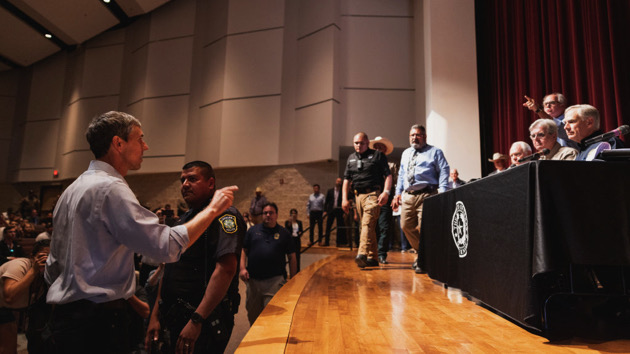
Greg Abbott and Beto O’Rourke set to debate: What to expect

Greg Abbott and Beto O’Rourke set to debate: What to expect
Jordan Vonderhaar/Getty Images

(NEW YORK) — On Friday — for the first and only time — Texas Republican Gov. Greg Abbott and his Democratic challenger, former Texas Rep. Beto O’Rourke, will meet face-to-face for a debate less than six weeks before Election Day.

Both candidates come to the stage with long political careers, well-known records and established public personas.

Abbott has been governor since 2015 — the position has no term limits — and was the state attorney general and a member of the Texas Supreme Court before that.

He has defined his tenure based in part on Texas’ economic performance and also on his hardline stances on abortion access and on immigration across the southern border, saying he is focused on reducing the flow of drugs and human trafficking.

His Operation Lone Star, where state troopers and National Guard members patrol the Texas border with Mexico, was one such major initiative to address that. But it has drawn scrutiny both for its success — given its price tag and given that migrant arrests remain at all-time highs — and what the federal government suspects may be civil rights violations.

Abbott’s office has said President Joe Biden’s border policies are to blame and that criticism of Abbott’s immigration policies amounted to “attacking the only state taking unprecedented actions to do the federal government’s job.”

More recently, Abbott has also been sending migrants from Texas via bus to Democratic-led cities such as Chicago, New York and Washington, drawing outcry there that he is using people as part of a political stunt. He said it is a necessary protest of the White House’s border strategy.

O’Rourke, who is running to unseat him, is a former representative for El Paso and announced last fall that he would run for governor. He previously ran against Republican Sen. Ted Cruz but narrowly lost in 2018; he then went on to unsuccessfully seek the Democratic nomination for president in 2020.

The last Democratic governor to represent the Lone Star State was the late Ann Richards, from 1991 to 1995, leaving office after being defeated by George W. Bush.

Friday’s debate may well focus on a handful of topics that that either been priorities or pitfalls for both candidates. Immigration, a perennial focus for voters in Texas, is likely to come up with each candidate pressing different points — on how best to handle people who seek to cross the border. O’Rourke may also cite the state’s power grid failure during deadly winter weather last year while Abbott could cite O’Rourke’s embrace of gun law changes in a state where gun ownership is popular — but which was also the site of the Uvalde school massacre in May.

Abortion, too, splits Abbott and O’Rourke, given that Abbott signed a ban on abortions without exceptions for rape or incest. (Abbott’s website states that he wants to “defend the culture of life in Texas.”)

Recent polls indicate that O’Rourke has more work to do with voters and may be on the defensive on some issues. FiveThirtyEight’s analysis of the best polling shows Abbott with an approximately 7-point lead over O’Rourke.

According to a recent Quinnipiac University poll, the Texas-Mexico border ranks as the No. 1 issue among likely voters along with that group narrowly backing Abbott’s migrant busing (51-47% approval). However, O’Rourke has a slight advantage over Abbott with Hispanic voters (49-48%).

O’Rourke has called his fluency in Spanish is a “competitive advantage.”

Abbott, for his part, has downplayed the certainty of a close race: “This game ain’t over yet, and we’ll see how close it is when all is said and done,” he said earlier this month.

Some O’Rourke supporters are optimistic.

“Beto has done the work on the ground,” said Jen Ramos, a political specialist for Jolt Action. ” He not only focused on South Texas communities and Latino communities before he even decided to run for the governorship but has made a key point on talking to voters that have not been spoken to historically, in any gubernatorial election.”

The debate will begin Friday at 8 p.m. ET and will be telecast throughout the state and on Nexstar’s national cable news network.

Copyright © 2022, ABC Audio. All rights reserved.

Surge of respiratory illnesses in children straining some hospitals’ capacity

Surge of respiratory illnesses in children straining some hospitals’ capacity
Morsa Images/Getty Images

(NEW YORK) — The surge in children’s respiratory illnesses, including rhinovirus and enterovirus, is pushing pediatric emergency departments and health systems toward capacity in some parts of the country.

Infectious disease experts say they are seeing a higher-than-expected rate of certain pediatric infections other than COVID-19. There is no one reason for this uptick, but factors include time of the year and relaxed pandemic restrictions.

Hospitals across at least four states — Washington, Louisiana, New Jersey and Massachusetts — have told ABC News they are feeling this crush and expect things to worsen as the school year proceeds and winter approaches.

Seattle Children’s Hospital is “experiencing unprecedented Emergency Department (ED) volumes and inpatient census,” Dr. Tony Woodward, medical director of emergency medicine and Emergency Medicine Division chief at Seattle Children’s, told ABC News in a statement.

There has been a particular upward trend in respiratory viruses, along with the background of COVID-19 and other standard viruses, Woodward said, adding that he expects the coming RSV and flu season to further amplify the trend.

“While we’re still seeing some patients requiring hospitalization specifically with COVID-19, other respiratory and gastrointestinal illnesses are making our patients sick,” Woodward said. “We are already seeing significant viral activity, which we expect to increase as kids are now back in school and the winter viral and flu season is approaching.”

Enteroviruses can cause respiratory illness ranging from mild — like a common cold — to severe, according to the Centers for Disease Control and Prevention. In rare instances, severe cases can cause illnesses like viral meningitis (infection of the covering of spinal cord and brain) or acute flaccid myelitis, a neurologic condition that can cause muscle weakness and paralysis.

RSV — or respiratory syncytial virus — can also cause mild, cold-like symptoms, and in severe cases, can cause bronchiolitis or pneumonia, according to the CDC. “Most people recover in a week or two, but RSV can be serious, especially for infants and older adults,” the CDC says.

Seattle Children’s is seeing more than double the number of respiratory visits associated with the rise in rhinovirus than they have at any time in the past year — statistically significant, Dr. Russell Migita, attending physician and a clinical leader of emergency services at Seattle Children’s Hospital, told ABC.

They’ve also seen an early rise in RSV, Migita said. “In typical years, RSV starts to rise in November and peaks in February. Last year, it started in August. This year, September/October.”

Woodward added that “wildfire smoke has also exacerbated respiratory and other health concerns for many children in the region.”

In response to the recent emergency department surges, Woodward said the hospital has increased physician staffing and opened additional beds.

In an advisory to pediatricians and hospitals shared with ABC News, the New Jersey Department of Health warned of increasing levels of enterovirus and rhinovirus activity earlier this month, and noted the state is seeing a similar “surge” like other parts of the country.

A spokesperson for the department said they are “monitoring and watching hospitalizations and Pediatric Intensive Care Unit census daily throughout the state,” adding that officials have planned a call with hospitals “to assess pediatric capacity” amid the surge.

Doctors at RWJ Barnabas Health System in New Jersey are seeing that upward trend in cases firsthand, where a wave of children’s enterovirus cases in recent weeks has pushed their pediatric ICUs to capacity, Dr. Uzma Hasan, division director of pediatric infectious disease at Cooperman Barnabas Medical Center, told ABC News.

“Approximately two weeks ago we started to see the numbers steadily rising, and the ICUs were starting to hit capacity with these kids coming in with respiratory symptoms,” Hasan said.

It has impacted asthmatic children and those with chronic lung disease particularly hard, but there have also been kids without any major underlying conditions who “seemed to have a pretty significant illness progress in a short period of time,” Hasan added.

Children with chronic lung disease, premature babies and kids with asthma are considered especially high risk. Families of kids with asthma should have an action plan with how to deal with an asthma exacerbation if they become ill, Hasan said.

With regards to capacity, Hasan noted that staff had been in communication with state officials “to figure out which sites have ICU beds available to make sure these kids coming into the ER setting are getting accommodated.”

One bittersweet silver lining of the pandemic, Hasan said, was how it had drilled hospitals and doctors on how to implement surge protocols and react to emergencies quickly, through COVID’s many intense waves — something has helped them handle the influx in respiratory cases of late. While hospitals are still understaffed and many doctors are grappling with burnout, they’ve been able to figure out ways to shuffle limited resources around where they’re needed most, and how to stay nimble with shifting beds, patients and staff around fast.

“I think one good thing that came out of COVID — if I can say that — is we’ve learned to plan ahead of the game,” Hasan said. “When we started seeing the numbers of patients showing up in the pediatric ERs rise and ICUs starting to fill up with kids, we got together pretty quickly to come up with a plan.”

Still, that plan could be threatened as the country heads deeper into fall, flu season, and RSV season — not to mention additional surges of COVID-19.

“The biggest worry is that we may see a concomitant rise in all these respiratory viruses — and whether we will be able to accommodate the kids who are coming in with severe respiratory symptoms,” Hasan told ABC. “We’re bracing ourselves for what’s next to come.”

Ochsner Health in Louisiana is also seeing an “influx” of children’s respiratory infections.

“Like other hospitals across the region and the country, Ochsner Health is currently experiencing an influx of viral pediatric respiratory illnesses,” Dr. William Lennarz, pediatrics system chair of Ochsner Health, told ABC News in a statement.

“Our Emergency Department volumes have seen an increase due to the flu virus and other normal seasonal respiratory viruses like RSV,” Lennarz said. “We are closely monitoring cases of respiratory illness and have a model in place to accommodate increased patient numbers and resources needed to care for these patients.”

The Boston area, meanwhile, has seen a similar spike in pediatric respiratory illnesses.

“Reduced population-wide immunity, the dropping of COVID mitigation efforts and increased mixing in schools and daycares is likely responsible for driving the surge in pediatric cases of acute respiratory illness both in our region and nationally,” Boston Children’s Hospital chief innovation officer and ABC News contributor Dr. John Brownstein said, adding the challenges of emergency department and inpatient capacity, alongside staff shortage, are “only adding more fuel to this fire.”

Copyright © 2022, ABC Audio. All rights reserved.