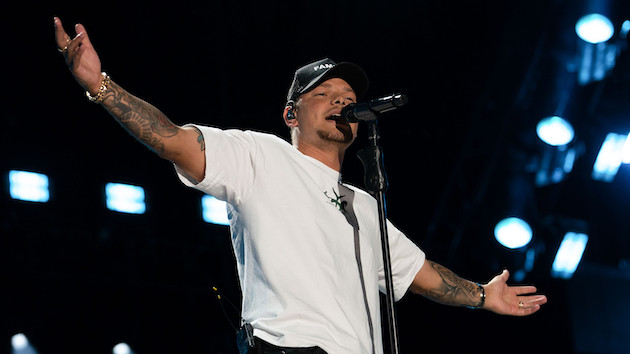
Kane Brown and his wife, Katelyn,escape the world with a lush, tropical beachside vacation in the music video for “Thank God,” their new duet, which appears on Kane’s Different Man album.
Some shots show the couple cruising down a greenery-covered backroad with the top down, while others see them at a beachside bonfire, dancing around and watching the sun go down.
It’s an idyllic visual addition to the couple’s duet, a romantic declaration of love and dedication to a partner who makes life complete. For Kane’s listeners, the collaboration is a long time coming: fans have been asking for the singer to release a duet with his wife, a talented singer who pursued a career as an R&B/pop artist before she and Kane met and got married.
“My fans have been waiting for five years for us to sing together,” Kane tells People, revealing that the couple went through four other duet ideas before settling on “Thank God.”
“…And then ‘Thank God’ came in and I was like, ‘This is the one.’ And she said the same thing, and I’m so glad I waited for this particular one to come out,” he continues.
Kane’s Different Man album arrived on Friday. It also features another duet: the title track is a collaboration with Blake Shelton.
Pearl Jam performed a cover of The Beatles deep cut “Her Majesty” during their show in Toronto on Thursday.
A hidden track off Abbey Road, the original “Her Majesty” lasts just 23 seconds and features tongue-in-cheek lyrics, such as “Her Majesty is a pretty nice girl/But she doesn’t have a lot to say.”
Pearl Jam’s rendition of “Her Majesty” came just hours after news broke that Queen Elizabeth II, the longest-reigning monarch in British history, had died at age 96. Vedder made no specific mention of the queen when introducing the song, telling the crowd only, “This is just a little one I’m gonna borrow from Paul McCartney.”
You can watch fan-shot footage of the performance posted to YouTube by user mfc172.
Both McCartney and fellow living Beatle Ringo Starrsharedtributes to Queen Elizabeth II following the news of her passing.
A Louisiana grand jury indicted rapper Mystikal on first-degree rape charges this week.
The New Orleans Advocate reports that if he is found guilty, he could face a life sentence.
Sheriff’s deputies accuse Mystikal, born Michael Tyler, of attacking a woman at his Louisiana home on July 30 following a financial dispute. He’s also been charged with criminal damage to property, false imprisonment, domestic abuse battery by strangulation, simple robbery and numerous drug possession accusations.
Mystikal previously pleaded guilty to sexual battery and extortion in 2003 and was sentenced to six years in state prison.
In 2017, the 51-year-old MC was charged with first-degree rape and second-degree kidnapping. Unable to post bond, he spent 18 months in jail. The charges were eventually dropped due to lack of evidence.
Mystikal, a two-time Grammy nominee, hit number one on the Billboard Hot R&B/Hip-Hop chart in 2001 with “Danger (Been So Long)” featuring Nivea.
The Beach Boys in 1964; Gems/Redferns/Getty Images
A new series of videos set to four classic Beach Boys songs from the mid-1960s launched Friday with the premiere of 1965’s “Barbara Ann.”
Watched together, the four videos tell the story of a high school romance between surfing-obsessed Helena and her classmate Lucas, an aspiring photographer who just moved into town. All of the clips include clever references and nods to The Beach Boys.
The “Barbara Ann” clip specifically follows Helena as she daydreams about surfing while sitting in class and then making her way home from school. We’re also briefly introduced to Lucas, whom Helena passes on her bicycle.
The other three videos, which will be set to “Don’t Worry Baby,” “Wouldn’t It Be Nice” and “God Only Knows,” will debut on the band’s official YouTube channel at noon ET, respectively, on Saturday, September 10; Friday, September 16; and Saturday, September 17.
The “Don’t Worry Baby” visual will share Lucas’ back story, “Wouldn’t It Be Nice” will focus on his and Helena’s romance, and “God Only Knows” will look at where their relationship is at as the school year ends.
The videos were directed by Andrew Litten, who’s worked with Earth, Wind & Fire, Anderson .Paak and Pusha T, and were filmed in South Africa with local actors.
“A recurring theme throughout The Beach Boys’ music is the feeling of being young and in love,” explains Litten. “Their most iconic songs were written when they were between the ages of 15 to 21, so there’s this exciting view on life that’s immortalized in their lyrics. I wanted to do the same with the music videos by capturing the spontaneity and playfulness of being a teenager, fantasizing about the future, pursuing new passions, and falling in love.”
(COBB COUNTY, Ga.) — Two Cobb County sheriff’s deputies in Georgia have been killed while serving a warrant, officials said Thursday night.
Cobb County Sheriff Craig D. Owens said at a press conference late Thursday that the two were “ambushed” when they went to deliver the warrant.
“What I can tell you in this moment is this — in plain terms, it is simple, my two deputies were ambushed this evening and killed,” Owens said. “The two suspects we believe are the perpetrators of this crime are currently in custody and are being held at the Cobb County Police Department for questioning.”
The deputies were shot after exiting their vehicles, Owens said, with one person opening fire from inside the house and another from a nearby car.
The warrant was being served for failure to appear by theft of deception, the sheriff said.
Earlier in the evening, authorities had said a suspect was barricaded in the home where the warrant was being served. The suspects were taken into custody just after midnight, according to Atlanta ABC affiliate WSB-TV.
“Two @CobbSheriff deputies died tonight in the line of duty while serving a warrant,” the sheriff’s office tweeted. “SWAT and FAST teams are at the scene. The suspect is barricaded.”
“We will release additional information, including the names of the fallen deputies, as it becomes available,” the office added.
Pink had a memorable way to ring in her 43rd birthday: she climbed into the shower and belted out several heartfelt hits to show off the acoustics.
“They say it’s my birthday so it’s time to get weird,” the Grammy winner captioned the humorous video, which begins with her being followed around the house by her puppy.
“Do you ever feel like you’re being followed?” she asks before panning the camera down toward her rescue dog, Habañero. “Everywhere I go. All the time!”
Pink then switches gears, announcing she “woke up with a song in my heart” and that she’s “blessed beyond belief” to be celebrating another birthday.
“I am so lucky to be alive,” she says with vigor before noting that, because she has a “song in [her] heart,” she needs to go “in the shower” to perform “I Dreamed a Dream” from the musical Les Misérables. She also belts out Whitney Houston‘s “Greatest Love of All.”
“I’m now deaf and so are you,” Pink quips. “Happy birthday to me! Happy birthday to you!… That’s all I got, really.”
The “Irrelevant” singer ends the lighthearted video by singing an ultra-stylized version of “Happy Birthday” to herself and everyone else born on September 8.
Pink captioned the post, “Thanks for the birthday love always!!!!!!!!!!!! Here’s to another turn around the sun! How lucky are we?!?!”
The hitmaker has since shared all the birthday love she’s received from fans and friends on her Instagram Stories.
(LONDON) — British rail and postal workers on Thursday canceled scheduled strikes after Queen Elizabeth II died earlier that day.
The moves pause worker protests that in recent months have involved hundreds of thousands of workers and at times disrupted train and mail services across England.
The Communication Workers Union, or CWU, which represents 115,000 workers at the Royal Mail, called off a 48-hour strike that began on Thursday and was scheduled to continue on Friday.
“Following the very sad news of the passing of the Queen and out of respect for her service to the country and her family, the union has decided to call off tomorrow’s planned strike action,” the Communication Workers Union said in a tweet on Thursday.
A strike by the postal workers late last month across 1,500 locations, the first of several strikes planned for the ensuing weeks, marked the biggest work stoppage in England since 2009.
Postal workers are seeking a wage increase amid the country’s near-historic inflation, which reached a 40-year high of 10.1% in July.
CWU said its members would not accept an “imposed” 2% pay raise, the BBC reported. Royal Mail said that the workers rejected an offer with raises of up to 5.5%.
Meanwhile, roughly 40,000 rail workers with the National Union of Rail, Maritime and Transport Workers, or RMT, canceled a two-day strike set for Sept. 15 and 17.
“RMT joins the whole nation in paying its respects to Queen Elizabeth,” the union said in a statement. “We express our deepest condolences to her family, friends and the country.”
The rail workers, who work at Network Rail and 14 train operators, have carried out intermittent strikes since June, when it appeared that their employers would reject a demand for a 7% pay raise.
Network Rail made an offer in July with raises worth more than 5%, but it depended on workers accepting “modernising reforms,” the BBC reported. RMT rejected the offer, saying it amounted to a pay cut in inflation-adjusted terms and would require cutting a third of front-line maintenance roles.
In a statement, Network Rail confirmed that RMT had called off the strike, saying it would alert riders “when we receive more information on any confirmed or proposed industrial action.”
(COLUMBIA, S.C.) — The South Carolina State Senate rejected a bill that would ban nearly all abortions just days after House lawmakers approved the ban.
The Senate went on to pass a separate bill that has an exception for fetuses born with a fatal anomaly. Both the House and Senate versions included exceptions for pregnancies that are a result of rape or incest; however, the Senate bill only allowed this exception if the abortion is performed within the first trimester of pregnancy.
When a physician performs an abortion under the rape or incest exceptions, the Senate bill requires the physician to report the allegations to his or her respective county sheriff’s department within 24 hours of performing or inducing the abortion. This includes reporting the name and contact information for the woman making the allegation. The physician would also be required to preserve a DNA sample from the fetal remains and submit the evidence to the country sheriff.
The physician would also be required to add a note to the woman’s medical records that the abortion was performed under the exception.
The Senate bill criminalizes providers who perform abortion services in the state. The bill makes it illegal to perform an abortion or administer, provide or distribute medication or drugs that induce an abortion. A person found guilty of providing an abortion could face a fine of up to $10,000 and jail time of up to two years.
The Senate bill also prevents Planned Parenthood from utilizing state funds for any purposes related to abortions.
South Carolina’s Supreme Court temporarily blocked a six-week abortion ban from going into effect in August. The temporary block was part of a lawsuit brought by Planned Parenthood in July. The organization alleged that the abortion ban is an invasion of privacy and a violation of equal protection under the state constitution.
The ban was signed into law in February 2021 by South Carolina Gov. Henry McMaster and took effect June 27 when the U.S. Supreme Court overturned Roe v. Wade.
The new version of Dolly Parton’s number one hit “9 to 5,” reimagined by Kelly Clarkson and Dolly, herself, is finally here.
While the original 1980 version of the song was peppy and upbeat, the new version has more of a melancholy feel, with slight changes in the melody reflecting the frustration of trying to get ahead in one’s career and being held back by your boss.
“It’s a rich man’s game, no matter what they call it/And you spend your life putting money in his wallet,” sings Kelly.
The new duet version of the song appears in the new documentary, Still Working 9 to 5, which is set to premiere September 16. It’s about the 1980 feminist comedy 9 to 5, in which Dolly starred alongside Jane Fonda, Lily Tomlin and Dabney Coleman. The doc examines the landmark film and the impact it had on the women’s movement at that time, as well as how its message still resonates as women continue to fight for equality in the workplace.
“I am so honored that Dolly asked me to reimagine this iconic song, ‘9 to 5,’ with her!” Kelly says in a statement. “She is so talented, an inspiration to all women, and one of the sweetest people you will ever meet! I hope y’all like what we did, but even if you don’t, remember I got to sing a duet with the magical Dolly Parton and now have bragging rights til the end of time!”
Dolly adds, “Nobody sings like Kelly Clarkson. She makes any song come alive. I love her voice on ‘9 to 5’ and I am so proud I got to sing with her on it.”
(NEW YORK) — As cultural debates over access to books rage on in school districts across the country, a Republican lawmaker in Virginia is hoping to make it easier for parents to control what their children read in public school libraries.
“In school libraries across the Commonwealth, there are books that are in the libraries that are extremely sexual in nature,” Virginia delegate Tim Anderson told ABC News.
“We have to give parents more authority over the schools and what their children have access to while they’re in the schools,” he added.
Anderson, a Republican who represents parts of the cities of Norfolk and Virginia Beach, said that he plans to introduce a bill that would identify titles that contain “sexual content” and implement a rating system for library books that would essentially be based on the Motion Picture Association film rating system. Books would be marked with “Parental Advisory Warning” labels and parents would be able to opt their children out of reading books with a particular rating.
He said titles would be rated from G, appropriate for all audiences, to R, which restricts content to children under 17 years of age. If a child is 17, they can access the content with the supervision of a parent or guardian.
“This puts parents back in the driver’s seat,” Anderson said of his proposed legislation.
Anderson, an attorney, filed a lawsuit in May that attempted to stop Barnes & Noble bookstores from selling books that contain sexual content to children. The lawsuit, which was dismissed last month by a Virginia Beach Circuit Court judge, named graphic novel Gender Queer and A Court of Mist and Fury — two books that have been challenged or banned in various school districts across the country.
According to ABC affiliate in Hampton, Virginia, WVEC-TV, Judge Pamela Baskervill dismissed the case because Virginia law doesn’t grant circuit courts authority to determine if a book is obscene to minors.
Anderson said that since the lawsuit failed, he is now “looking for a legislative fix.”
Virginia state Senator Ghazala Hashmi, a Democrat, told WJLA-TV, an ABC affiliate in Washington, D.C., that the potential bill is “deeply concerning.”
“I’m concerned about this subset of parents who think that they can legislate what children are reading, and whose children get to read these materials,” Hashmi said. “Overwhelmingly, the books that we see targeted are by authors of minority communities or by LGBTQ authors. And it is unfortunate that they continue to push their particular perspective onto other families.”
Yael Levin-Sheldon, a parent in Virginia and chief communications officer of No Left Turn in Education, told ABC News that the nonprofit organization is part of a nationwide coalition advocating for a rating system and “fully supports” Anderson’s proposal.
“We are staunch believers in the First Amendment and the right of parents to direct the upbringing of their children,” Levin-Sheldon said. “Appropriately labeling books based on content, just as is done with movies, is a commonsense way to allow parents to decide what books are acceptable for their own children, without imposing their standards and values on other parents and their children.”
Books have been banned in at least 26 states and 86 school districts, with at least seven in Virginia, according to PEN America, a nonprofit organization working to advance freedom of expression through literature.
A PEN America report documenting book bans in school libraries and classrooms between July 1, 2021 to March 31, 2022, shows that the spike in bans reflects a “disproportionate targeting of books by or about people whose identities and stories have traditionally been underrepresented in children’s and young adult literature, such as people of color, LGBTQ+ individuals, or persons with disabilities.”
Virginia Gov. Glenn Youngkin signed into law in April a bill that would give parents the authority to opt their children out of instructional content in classrooms that is deemed “sexually explicit.”
The Republican governor hailed the signing of Senate Bill 656 as delivering on “my Day One promises to give parents a greater say in their children’s education.”
But critics who opposed the legislation argued that what qualifies as “sexually explicit” is too vague and the law would make it easier for conservative advocates and organized groups to target and censor LGBTQ+ content.
“While SB 656 may not explicitly censor what books are taught, it puts teachers and librarians in the unenviable position of having to determine if a book qualifies under the policies,” the American Civil Liberties Union said in a statement on April 8. “This will most likely result in censorship due to teacher and librarian’s fear or confusion over what qualifies as ‘sexually explicit content.'”
Anderson, a father of three, argued that the law gave “parents back their rights” by giving them more authority over the material their children are taught in the classroom. Now he hopes that his bill, which he plans to introduce in the coming weeks, would do the same when it comes to books available in public school libraries.
“This isn’t about gay, trans or straight literature,” he said, pushing back on the argument that the bill could lead to censorship. “This is about literature and books that have sexual content in it.”
Anderson’s proposed legislation is one of several initiatives in the state seeking to give parents more control over the material their children have access to in schools.
As children returned to the classroom this fall, Bedford County school libraries in Virginia launched a new notification system that enables parents to receive alerts about the books their children check out of the library.
“In response to some concerns brought up by a community member about the content in the libraries and curriculum, we’ve really had a year-long conversation about how we can be more transparent and inform parents,” said Shawn Trosper, director of curriculum and instruction for the school system, according to ABC affiliate in Lynchburg, WSET-TV.
Levin-Sheldon, who leads the Virginia chapter of No Left Turn in Education, told ABC News that she supports the alert system and hopes it would be implemented in additional counties across the state.
“At the end of the day, we just want the parents to have a choice in what their children are exposed to,” she said. “Because that choice is ours…that right is ours.”