(LONDON) — Princes George and Louis and Princess Charlotte, three of Queen Elizabeth II’s 12 great-grandchildren, have taken on a new last name in the wake of the late monarch’s death.
George, 9, Charlotte, 7, and Louis, 4, are now using the last name Wales, a change from the name they’ve each used since birth, Cambridge.
The siblings, whose parents are Prince William and Kate, now go by the titles Prince George of Wales, Princess Charlotte of Wales and Prince Louis of Wales.
The children’s new titles were used in the Order of Service released by Buckingham Palace for the queen’s funeral Monday, which George and Charlotte attended alongside William and Kate.
The change comes after their parents received the titles of the Prince and Princess of Wales from William’s father King Charles III.
Charles made the announcement in his first address as king on Sept. 9. With the title change, Kate becomes the first person to use the “Princess of Wales” title since Williams’ late mother Princess Diana. Charles’ wife Camilla, now the Queen Consort, was referred to previously as the Duchess of Cornwall.
With the queen’s death, William is now the heir to the throne and George, Charlotte and Louis are second, third and fourth in the line of succession, respectively.
Additionally, as heir to the throne, William inherited Charles’ prior title of the Duke of Cornwall and now oversees the duchy of Cornwall, the private estate that was established in 1337 to provide financial independence for the heir and their family.
William, Kate and their children were formerly known as the Cambridges, as the couple previously held the titles of the Duke and Duchess of Cambridge.
The new last name for the family of five comes just as George, Charlotte and Louis begin classes at a new school.
The siblings had their first day at Lambrook School in Berkshire the week of Sept. 5, the same week their great-grandmother died.
George, Charlotte and Louis moved to the preparatory school in Southeast England after their family moved this summer from Kensington Palace in London to Adelaide Cottage, a four-bedroom cottage on the grounds of Windsor Castle.
In school, the siblings will be known as George Wales, Charlotte Wales and Louis Wales.
(NEW YORK) — Russian President Vladimir Putin’s “special military operation” into neighboring Ukraine began on Feb. 24, with Russian forces invading from Belarus, to the north, and Russia, to the east. Ukrainian troops have offered “stiff resistance,” according to U.S. officials.
The Russian military has since launched a full-scale ground offensive in eastern Ukraine’s disputed Donbas region, capturing the strategic port city of Mariupol and securing a coastal corridor to the Moscow-annexed Crimean Peninsula.
Here’s how the news is developing. All times Eastern:
Sep 21, 9:32 AM EDT
White House reacts to Putin’s partial military mobilization
Russian President Vladimir Putin’s partial military mobilization for his ongoing war in neighboring Ukraine is “definitely a sign that he’s struggling,” according to the White House’s National Security Council spokesman John Kirby.
“And we know that,” Kirby told ABC News’ George Stephanopoulos during an interview Wednesday on Good Morning America.
“[Putin] has suffered tens of thousands of casualties. He has terrible morale, unit cohesion on the battlefield, command and control has still not been solved. He’s got desertion problems and he’s forcing the wounded back into the fight,” Kirby added. “So clearly manpower’s a problem for him, he feels like he’s on his back foot, particularly in that northeast area of the Donbas.”
Some 300,000 Russian reservists are expected to be conscripted, which Kirby noted is “a lot.”
“That’s almost twice as much as [Putin] committed to the war back in February,” he said.
Kirby said Putin’s latest nuclear threats are “typical” but something the United States and its allies still take “seriously.”
“We always have to take this kind of rhetoric seriously,” he added. “It’s irresponsible rhetoric for a nuclear power to talk that way, but it’s not atypical for how he’s been talking the last seven months and we take it seriously. We are monitoring as best we can their strategic posture so that if we have to, we can alter ours. We’ve seen no indication that that’s required right now.”
And if Russia does use nuclear weapons, “there will be severe consequences,” according to Kirby.
While Moscow appears poised to annex Russian-held regions in Ukraine and attempt to politically legitimize it with sham referendums in the coming days and weeks, Kirby said the United States will still consider those areas Ukrainian territory.
“We’re going to continue to support Ukraine with security systems and other financial aid, as the president said, for as long as it takes,” he added. “That is Ukrainian territory. It doesn’t matter what sham referendum they put in place or what vote they hold, it is still Ukrainian territory.”
Sep 21, 7:47 AM EDT
Putin orders partial mobilization, says he won’t ‘bluff’ on nukes
Russian President Vladimir Putin has ordered a partial mobilization of reservists in Russia, in an apparent admission that his war in neighboring Ukraine isn’t going according to plan.
In a seven-minute televised address to the nation that aired on Wednesday morning, Putin announced the start of the mobilization — the first in Russia since World War II. The measure is expected to draft more than 300,000 Russian citizens with military experience, according to Russian Defense Minister Sergey Shoigu.
The move comes as Moscow is poised to annex all the regions it occupies in Ukraine in the coming weeks, with plans to hold sham referendums this weekend to legitimize its actions. By declaring those areas officially Russian territory, Putin is also threatening that any continued efforts by Ukraine to retake them will be seen as a direct attack on Russia. In his speech Wednesday, the Russian leader raised the specter of using nuclear weapons if Ukraine continues to try to liberate the occupied regions.
“In the event of a threat to the territorial integrity to our country, for the protection of Russia and our people, we of course will use all means in our possession,” Putin said. “This is not a bluff.”
“Those who are trying to blackmail us with nuclear weapons should know that the wind can turn in their direction,” he added.
It’s an attempt to regain the initiative after disastrous setbacks in Russia’s war against Ukraine.
Russia has been suffering severe manpower shortages in Ukraine after months of heavy losses, mainly because the Kremlin has pretended it is fighting not a war but a “special military operation.” That, in part, allowed Ukraine’s spectacular counteroffensive in the country’s northeast two weeks ago, which led to the collapse of Russia’s frontline there.
Military experts and Russian commentators themselves had acknowledged that without a mobilization, Moscow is not capable of anymore offensive operations in Ukraine and in the longterm might well be unable to even hold the territory it has already taken.
Putin has balked at ordering a mobilization, until now, because of the huge political risks it carries for him at home. Russians have proved relatively supportive of the war while they have not been ordered to fight it, but this carries much bigger risks now of domestic unrest. It will bring up dangerous memories of the Soviet disaster in Afghanistan and Chechnya.
Yet Putin has clearly decided he must take the risk, with losing the war in Ukraine seen as an existential danger to his regime.
The mobilization order has profound implications for not just Russia and Ukraine, but also for Europe and the United States. It means Putin is expanding the war in Ukraine even further, ready to throw hundreds of thousands more people into it — making the fight harder again for Ukraine, while also raising the threat of nuclear strikes on it. And at home, Putin is going to enter uncharted waters.
Sep 20, 3:50 PM EDT
US and Ukraine bolster efforts to prosecute Russia for war crimes
U.S. Attorney General Merrick Garland met Tuesday with Ukrainian Prosecutor General Andriy Kostin and signed a memorandum of understanding to strengthen their investigative partnership in pursuing prosecutions against Russians accused of committing war crimes in Ukraine.
“America and the world have seen the horrific images and the heart-wrenching reports of the brutality and death caused by the unjust Russian invasion of Ukraine,” Garland said following the meeting at the Department of Justice in Washington.
Garland said the DOJ’s War Crimes Accountability Team has provided Ukraine with a “wide variety” of technical assistance on criminal cases, including collecting evidence and forensic analysis.
The memorandum of understanding, Garland said, will allow the two countries to “work more expeditiously and efficiently” in their investigations of Russian war crimes.
Kostin also delivered somber remarks on war crimes uncovered by Ukrainian investigators since the start of the Russia’s invasion. He said that two hours before his meeting with Garland, a prosecutor in the Kharkiv region of Ukraine informed him of a village “where about 100 graves” were just discovered.
“This place is not safe at the moment since it needs de-mining,” Kostin said. “But this is a new example of mass atrocities by the aggressor. This is a sign that Russia uses not only prohibited means and methods of warfare, but this is a clear and intentional policy of Russia.”
-ABC News’ Alexander Mallin
Sep 20, 2:49 PM EDT
Ukraine conflict could increase food prices, food insecurity: Study
The impact on crop production due to Russia’s invasion of Ukraine will likely continue to increase global food prices and food insecurity, though not as much as initially feared, according to a new study.
The price of corn and wheat are expected to increase by 4.6% and 7.2%, respectively, and crops such as barley, rice, soybeans and sunflower are also anticipated to rise, according to a study from Indiana University published this week in Nature Food.
Nations with current existing food insecurity will be most impacted by the conflict, according to the study.
Other countries, including Brazil, have stepped up their production to fill the gap left by the lack of exports coming out of the region, offsetting some of the impacts on world food prices and food insecurity, the study found. Clearing more land and vegetation to grow crops could increase deforestation and carbon emissions, the study said.
-ABC News’ Tracy Wholf
Sep 20, 2:35 PM EDT
White House slams referendums in Russia-backed regions of Ukraine
U.S. national security adviser Jake Sullivan said referendums planned for this week in Russia-backed areas of eastern and southern Ukraine are a “sham.”
“Russia is throwing together sham referendums on three days notice as they continue to lose ground on the battlefield and as more world leaders have distanced themselves from Russia on the public stage,” Sullivan said in a briefing Tuesday at the White House.
He also slammed legislation being pushed through the Russian parliament to lay the ground for a general mobilization of men aged 17-27 as “scraping for personnel to throw into the fight.”
“These are not the actions of a confident country. These are not acts of strength, quite the opposite,” Sullivan said. “We reject Russia’s actions unequivocally.”
-ABC News’ Ben Gittleson
Sep 20, 12:24 PM EDT
Kremlin says referendums to be held in separatist regions of Ukraine
The Kremlin made a series of dramatic announcements Tuesday, signaling its response to its failing military campaign in Ukraine.
The Kremlin said referendums will be held later this week in Russian-backed regions of eastern and southern Ukraine for people to vote on whether to join Russia.
Dmytro Kuleba, the Ukrainian minister of foreign affairs, called the proposed vote “sham referendums” in a post on Twitter.
“Russia has been and remains an aggressor illegally occupying parts of Ukrainian land,” Kuleba said. “Ukraine has every right to liberate its territories and will keep liberating them whatever Russia has to say.”
Depending on the results of the referendums, which critics say is a foregone conclusion, Russia will suddenly consider territory it has occupied in Ukraine as its own.
Meanwhile, legislation is being rushed through the Russian parliament, laying the ground for a general mobilization of men aged 17-27, an age range that could be expanded.
Russian state media reported that Russian President Vladimir Putin and his minister of defense will address the nation Tuesday night.
According to a Moscow-based military analyst, even parts of Ukraine’s eastern Donbas, which are not currently controlled by Russian forces, will be considered Russian territory.
After its apparently successful offensive in northeastern Ukraine, the Ukranian military now appears to be pushing further east and is contesting areas of the eastern Donbas region.
In a highly symbolic moment, Ukrainian forces claim they have retaken a village in Luhansk, in the northern part of the Donbas, an area the Kremlin took control of in July.
Sep 18, 4:01 PM EDT
Zelenskyy says preparation underway to liberate all of Ukraine
Ukrainian President Volodymyr Zelenskyy said in his nightly address Sunday that he interpreted a lull in fighting after a series of victories by his country’s military forces as preparation for the liberation of all of Ukraine.
“Maybe now it seems to some of you that after a series of victories, we have a certain lull,” Zelenskyy said.
He went on to say, “this is not a lull. This is preparation for the next series. To the next series of words that are very important to us and must sound. Because Ukraine must be free … all of it.”
Ukrainian troops made good on Zelenskyy’s call to take back lands claimed by Russian forces with an aggressive counteroffensive over the past week in the country’s northeast region.
Ukrainian officials said their forces drove out the Russian in two key areas in the Kharkiv region and are not going to let up.
Sep 18, 1:59 PM EDT
Biden says China not supplying Russia weapons to use in Ukraine
President Joe Biden said in an interview with CBS’ 60 Minutes that it does not appear China is sending weapons to Russia to use in Ukraine.
“Thus far there’s no indication that they’ve put forward weapons or other things that Russia has wanted,” Biden said in the clip from the interview released Sunday.
That’s consistent with the message his administration has repeatedly shared for months. But it doesn’t mean China has stopped helping Russia in other ways, including purchasing Russian oil.
Biden recounted how he had previously told China’s President Xi Jinping that if he thought “Americans and others are gonna continue to invest in China based on your violating the sanctions that have been imposed on Russia, I think you’re making a gigantic mistake. But that’s your decision to make.”
Biden also said he does not think there’s currently a “new, more complicated cold war” with China, as the interviewer, Scott Pelley, put it.
-ABC News’ Ben Gittleson
Sep 18, 12:06 PM EDT
‘True face of aggression’: Ukrainian ambassador condemns Russia over mass grave
Ukraine’s ambassador to the U.S., Oksana Markarova, accused Russia on Sunday of committing “war crimes of massive proportions” after a mass grave was discovered in Ukraine.
“It’s tortures, rapes, killings. War crimes of a massive proportions,” Markarova claimed in an interview with ABC “This Week” co-anchor Jonathan Karl. “That’s why we need to liberate the whole territory of Ukraine as soon as possible because clearly Russians are targeting all Ukrainians. Whole families. Children. So, there is no war logic in all of this. It’s simply terrorizing and committing genocide against Ukrainians.”
Ukrainian President Volodymyr Zelenskyy said in an address on Thursday that a mass grave was found in the recently recaptured territory of Izyum. Over 400 bodies could be buried in the site, according to Ukrainian officials.
Markarova said the majority of the bodies recovered from the site are Ukrainian, including entire families. She also said most of the remains showed “clear signs of torture.”
She said an investigation of the mass grave is underway and that with the assistance of the United States her country is continuing to prepare national and international criminal cases against Russia.
Russia has repeatedly denied targeting civilians, despite evidence otherwise.
“It’s so important for everyone to see the true face of this aggression and terrorist attack Russia is waging,” Markarova said.
Accepting the Nashville Songwriters Association International award for Songwriter/Artist of the Decade Tuesday night in Nashville, Taylor Swift took the opportunity to reveal a songwriting secrets: It’s apparently all about the pen.
After thanking the NSAI and the city of Nashville for inspiring her earliest songwriting endeavors, Taylor talked about how her favorite part of the process is writing lyrics. She then revealed the “dorky” way she thinks about her lyrics: She puts them into three categories, based on the kind of pen she imagines herself using to write them.
According to Taylor, “quill lyrics” are things that sound antiquated or, as she put it, “If my lyrics sound like a letter written by Emily Dickinson’s great grandmother while sewing a lace curtain, that’s me writing in the quill genre.” She gave an example by reciting lyrics from “Ivy,” from her album evermore.
Next, she said, are “fountain pen” lyrics, which have “modern references, but with a poetic twist,” and sound like “confessions scribbled and sealed in an envelope, but too brutally honest to ever send.” She quoted “All Too Well” — which she performed at the ceremony — as an example of that genre.
The third category, Taylor said, is “glitter gel pen,” which she described as “frivolous, carefree, bouncy.” To illustrate that genre, she quoted “Shake It Off.”
Taylor added, “Why did I make these categories, you ask? Because I love doing this thing we are fortunate enough to call a job. Writing songs is my life’s work and my hobby and my never-ending thrill.”
She concluded, “I am moved beyond words that you, my peers, decided to honor me in this way for work I’d still be doing if I had never been recognized for it.”
There’s fan-recorded video of the whole speech on YouTube.
(WASHINGTON) — A new bill from a pair of Republican lawmakers would prevent the Biden administration from lifting key sanctions on Iran over the country’s alleged support of efforts to assassinate high-profile Americans and critics on U.S. soil.
The bill, set to be introduced Wednesday by Iowa Sen. Joni Ernst and Florida Rep. Mike Waltz, would codify Trump-era sanctions imposed on Iran — specifically, on major industries and financial institutions — according to legislative text shared first with ABC News.
Should the U.S. and its allies reach an agreement with Iran in ongoing negotiations to return to the 2015 nuclear agreement reached under President Barack Obama, the PUNISH Act would prevent the Biden administration from lifting the Trump sanctions — and unfreezing billions of dollars in Iranian assets — until the State Department can certify that Iran has not supported efforts to kill prominent American citizens or Iranian dissidents on American soil for five years.
While the Democratic majority isn’t expected to consider the proposal, it signals Republicans’ intent to pressure and constrain Biden’s foreign policy agenda and negotiations with Iran should they retake control of either chamber of Congress in the November elections.
“President Biden should not provide a dime of sanctions relief to the largest state sponsor of terrorism, which is actively trying to kill U.S. officials and citizens, at home and abroad,” Ernst will say Wednesday, according to prepared remarks shared with ABC News.
In August, an alleged Iranian operative with links to the country’s Revolutionary Guard Corps was charged by the Justice Department in what prosecutors called a plot to murder Trump’s former national security adviser John Bolton. The Justice Department accused the Iranian government of supporting the assassination attempt in response to the 2020 U.S. missile killing of military leader Qasem Soleimani. (Iran has claimed the case is “baseless” and politically motivated.)
Bolton and several top Trump administration officials, including former Secretary of State Mike Pompeo, Defense Secretary Mark Esper and Iran envoy Brian Hook, reportedly receive government protection due to ongoing threats from Iran.
The U.S. government has said Iran encouraged attacks on author Salman Rushdie, who was stabbed in August at a public event in upstate New York. (Iran denied involvement.) And in July, a federal court unsealed an indictment charging four Iranian nationals with conspiring to kidnap an outspoken Iranian American activist and journalist in Brooklyn.
It’s against this backdrop that Republicans say they must try to limit the White House’s ability to change sanctions without assurances of nonviolence.
“Whether you want to argue whether it’s a return to the [2015 nuclear agreement] or a new deal, it astounds me that we are continuing to negotiate with a regime with active plots against American officials … that is instigating attacks on Americans citizens,” Waltz told ABC News.
Republicans and some Democrats have questioned the Biden administration’s efforts to reenter the Obama-era deal to curb Iran’s nuclear program after the Trump administration withdrew from the agreement in 2018 and slapped on sanctions as part of a “maximum pressure campaign.” Iran responded by enriching more uranium at higher levels beyond the limits of the deal.
Biden’s critics have expressed concerns that Iran can still develop its nuclear program in secret while using newly unfrozen assets and oil revenue to support terrorist proxies and other groups across the Middle East that threaten U.S. interests and allies.
Last year, a bipartisan group of 140 U.S. lawmakers urged Biden to reach a “comprehensive” deal with Iran to limit its nuclear program and address other national security issues.
In an interview with CBS News that aired Sunday, Iranian President Ebrahim Raisi denied his country’s involvement in the alleged attempt against Bolton and said American pledges to abide by a new nuclear deal would be “meaningless” without a “guarantee” that the U.S. would not withdraw from a future deal and reimpose economic sanctions on Iran.
Raisi, who is now in New York for the U.N. General Assembly and is scheduled to address the gathering on Wednesday, met with French President Emmanuel Macron on Tuesday amid a stalemate in indirect negotiations over the return to a nuclear agreement.
Both sides have exchanged proposals in recent weeks, but they publicly remain at odds over a U.N nuclear watchdog investigation and Iran’s insistence on a guarantee that the U.S. would not pull out of any deal.
Republican efforts to codify sanctions on Iran are “designed to tie this president or future presidents’ hands so he or she cannot waive these sanctions to encourage better Iranian behavior and bring Iran’s nuclear behavior under a modicum of control,” Daryl G. Kimball, the executive director of the Arms Control Association, who has called for a return to the nuclear agreement, told ABC News.
Waltz, the lead author of the bill in the House, told ABC News that he thinks Iran “is constantly holding out because they believe they can get a better deal.” Waltz argued that if the country’s leaders “see these things codified by Congress, and they see clear action by the Congress, then that puts them in a weaker negotiation position.”
ABC announced Tuesday that Jimmy Kimmel has signed a three-year contract extension to continue to host his late-night talk show, Jimmy Kimmel Live! The news ends speculation that Kimmel would end his show sometime in the near future. “After two decades at ABC, I am now looking forward to three years of what they call ‘quiet quitting,’” joked Kimmel. Kimmel has the longest-running late-night talk show in ABC history and now becomes the longest-tenured host currently in late night, after Conan O’Brien ended his show last year…
(NOTE LANGUAGE) After a six-year hiatus, Amy Schumer‘s sketch comedy series, Inside Amy Schumer, is returning for a fifth season. “I wanted to bring back Inside Amy Schumer to burn any remaining bridges,” the comedienne joked in a Wednesday tweet, adding it will move from Comedy Central to Paramount+ — which Schumer called, “the hottest piece of a**.” She added, “So, sit down and open your pants (so you’re comfortable, not in a sexual way) because we’re not holding anything back.” She concluded, “You won’t want to miss the show that will finally get me forever cancelled.” Season five will consist of five episodes, with two debuting on the premiere date and the remaining three set to drop weekly on Thursdays…
Beetlejuice will end its Broadway run in January, according to Variety. Its final show at the Marquis Theater will be on January 8, 2023. However, it won’t be curtains for the stage version of Tim Burton‘s 1988 film, which will launch a 26-city national tour kicking off December 6 in San Francisco. Beetlejuice opened in 2019 to mixed reviews and weak ticket sales, before turning into a viral hit among younger audiences on social media…
(NEW YORK) — The wage gap that sees Black women earning less than white, non-Hispanic men can cost them as much as $2,000 per month, $23,000 per year and more than $900,000 over the course of a 40-year career, according to the National Women’s Law Center, a policy-focused organization that fights for gender justice.
Sept. 21 marks Black Women’s Equal Pay Day, the date that Black women have to work to in 2022 to earn what their male, white, non-Hispanic counterparts earned in 2021.
Last year, the day fell on Aug. 3, meaning that Black women this year have had to work over six weeks longer into the year to try to make up for their lost wages.
In the United States, Black women are on average paid 58 cents for every dollar earned by men, according to Census Bureau data shared by the American Association of University Women, a non-profit organization dedicated to empowering women and girls.
Women of all races working full-time in the U.S. are paid 83 cents to every dollar earned by men, according to the AAUW. Equal Pay Day fell on March 15, the day that women have to work into 2022 to earn the same as their male counterparts did last year.
“Because women earn less, on average, than men, they must work longer for the same amount of pay,” the National Committee on Pay Equity said in a statement on Equal Pay Day. “The wage gap is even greater for most women of color.”
According to National Women’s Law Center data, a Black woman who starts working at age 20 would have to work until she is almost 80 years old to earn what a white, non-Hispanic man is paid by age 60.
Black Women’s Equal Pay Day comes this year as Black women are still trying to recover from the economic fallout of the coronavirus pandemic, a time during which they lost jobs at a higher rate than other groups in the country.
Unemployment rates dropped or remained the same for almost every race or ethnicity except Black women, with an unemployment rate almost double that of white Americans, according to the National Women’s Law Center. In August, while many groups joined the labor force, 45,000 Black women left.
Black women also continue to be hit hardest by the student debt crisis in the U.S., with around 1 in 4 Black women holding student debt, according to data from the Census Bureau and the American Association of University Women.
Just over a decade after starting college, Black women, on average, owe 13% more than they borrowed, while white men, on average, have paid off 44% of their debt, according to The Education Trust.
One of the reasons Black women owe so much more in the years after graduating college is the gender pay gap, experts say.
Gloria Blackwell, CEO of the American Association of University Woman, said because Black women earn less, many are burdened by student debt for the larger part of their career. She described what Black women face in the workplace as the “perfect storm” of both a racial wealth gap and gender pay gap.
“When you are a Black woman and you have this burden of student loans, it impacts every aspect of your life,” Blackwell told ABC News last month. “It impacts whether you can pay for basic living expenses, whether you can afford transportation or even the rent in order to have a decent place to live, let alone save for a house or be able to start a family or take care of your family. It’s a burden on Black women on whether they can save for retirement or afford rent or be able to move to a better neighborhood.”
Black women enroll in college at higher rates than other groups. However, a 2020 report from the Lean In organization found that the gender pay gap is largest for Black women who have bachelor’s degrees.
“Black women are ambitious — they’re more likely than white men (35%) and white women (26%) to say they want to become top executives,” the report stated. “But even in the same job, Black women are paid less than white men.”
Experts including Blackwell and Nicole Mason, president and CEO of the Institute for Women’s Policy Research, say the solution for closing the gender pay gap for Black women needs to come from both the government and private sectors.
On the federal level, Mason said the passage of legislation like the Paycheck Fairness Act can help promote pay equity and transparency, while enforcement of existing civil rights and equal employment laws can help lower workplace discrimination.
“Employers have a role to play in terms of making sure there is pay equity and making sure that women across the board earn what they’re worth and the skills and talents they bring to the table,” Mason previously told ABC News. “And as a culture and a society, we have a lot of work to do in terms of breaking gender stereotypes around women in the workplace, their value and how much women should be paid for their work.”
Andor, the latest Star Wars small-screen project, launches on Disney+ Wednesday with a three episode premiere.
The 12-episode prequel series follows Diego Luna‘s Rogue One: A Star Wars Story character Cassian Andor, and his early days with the Rebellion against the evil Galactic Empire.
The series was written and produced by Rogue One‘s Tony Gilroy, and the show matches that beloved movie’s “boots on the ground” feel of that galaxy far, far away as the Empire tightens its grip.
Kyle Soller plays Syril Karn, a tightly-wound Imperial agent trying to be promoted off of the backwater planet he’s stationed. He and Denise Gough, who plays icy Imperial Security Bureau agent Dedra Meero, explained they were spared from revealing any Andor secrets because the day after they got their jobs, COVID-19 hit.
“We went into lockdown,” Soller says.
Gough laughs, “Yeah, the world sort of became more interested in other things, you know, life and death.”
She adds, “And now we’re becoming really aware, ‘Oh, Jesus, we’re in Star Wars. This is really actually quite full on.'”
Genevieve O’Reilly again plays Senator-turned Rebel leader Mon Mothma. O’Reilly first played her in 2005’s Episode III – Revenge of the Sith, but her scenes were cut.
She called it “a unique experience” to play the character in again in Andor, set five years before the events of Rogue One.
She adds, “…I think it’s also important for me to acknowledge just what George Lucas did back then of creating the leader of the rebel alliance who was a woman! I am ever grateful for him.”
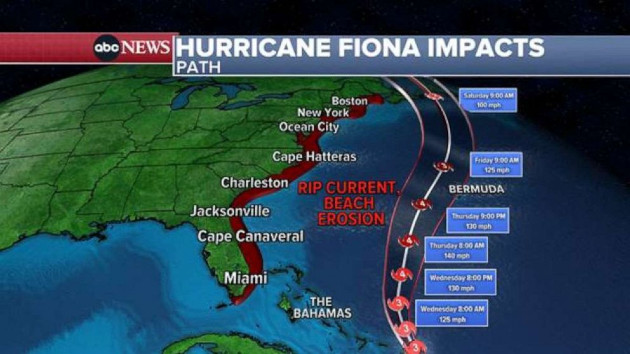
(NEW YORK) — Hurricane Fiona strengthened to a Category 4 storm on Wednesday, after killing at least four people in Puerto Rico and leaving the entire island without power.
The storm dropped 6 to 20 inches of rain in Puerto Rico and the U.S. Virgin Islands, with up to 30 inches of rain falling in southern and southeastern Puerto Rico. The rain caused rivers to rise over their banks and triggered rock and mudslides, according to officials with the Federal Emergency Management Agency.
As of early Wednesday morning, the storm system was carrying maximum sustained winds of 130 miles per hour as it moved away from Turks and Caicos after dropping heavy rains over parts of the islands. Winds could possibly increase to 140 mph, according to the National Weather Service.
Fiona is expected to move parallel to the eastern United States, passing between the East Coast and Bermuda late Thursday into early Friday, the National Weather Service said.
The East Coast could see high surf, rip currents and even coastal flooding over the coming days. Meanwhile, a tropical storm watch remains in effect for Bermuda, which could see heavy rain, gusty winds and coastal flooding on Thursday night and Friday morning, according to the National Weather Service.
FEMA officials said during a press conference Tuesday that at least four people have died in Puerto Rico due to Fiona. A public health emergency was declared in the U.S. territory.
On Monday, officials reported that one person was killed as the then-Category 1 storm slammed the island. The Arecibo resident was attempting to fill his generator with gasoline while it was on, causing an ignition, officials said.
No one has been reported missing as of Tuesday afternoon, according to Steve Goldstein, the National Weather Service’s liaison to FEMA.
FEMA officials were still assessing the extent of the damage in Puerto Rico, saying it is too early to estimate the financial impact of the storm.
Fiona made a second landfall Monday in the Dominican Republic near Boca de Yuma on the eastern side of the island with sustained winds of 90 mph and even higher gusts.
Puerto Rico Gov. Pedro Pierluisi warned residents that more rain was expected on the island through Tuesday evening.
“We are going through a difficult moment but our people are strong and very generous,” he said during a press conference.
Four helicopters are in the air surveying damage from Fiona. The governor said it would take at least a week to determine the extent of the damage left by the storm.
In addition to the four deaths cited by FEMA, at least two other people died in a shelter due to natural causes, but those have not been labeled as storm-related, Pierluisi said.
Restoring power in Puerto Rico
LUMA Energy said that only 300,000 out of 1.5 million clients have had power restored on the island as of Tuesday morning, with more expected in the coming days.
“We assure you that a large part of Puerto Rico will have electricity today and tomorrow,” Abner Gomez, spokesperson for LUMA Energy, said at a press conference Tuesday.
In an update Tuesday afternoon, FEMA said that 80% of customers still remain without power.
The governor said Monday the goal is for “a large number of LUMA customers” to have power “in a matter of days.” However, LUMA said in a statement Sunday that “full power restoration could take several days.”
Hospitals on the island are currently operating on generators, according to the governor.
Only 34% of households on the island have potable water after rivers grew and heavy rainfall impacted the system — meaning more than 834,000 people are without drinking water, the governor said Monday.
More than 1,000 people have been rescued by authorities, including a woman rescued Sunday who was stuck in a tree for seven hours after trying to look at the damage, officials said.
Heavy rainfall causes flooding across the island
Fiona strengthened to a hurricane from a tropical storm Sunday morning. The National Hurricane Center said Fiona made landfall in southwestern Puerto Rico on Sunday at 3:20 p.m. ET, dumping torrential rain on much of the island.
Some regions measured up to 25 inches of rain by 8 a.m. Monday.
A flash flood emergency was issued due to many rivers rising very quickly out of their banks. The Rio Grande de Arecido river rose 13 feet in one hour.
A bridge near Utuado, a town in the central mountainous region of the island, has collapsed, cutting off the communities of Salto Arriba and Guaonico, local newspaper El Vocero de Puerto Rico reported.
The portion of the bridge that collapsed is on Highway 123, a branch of Highway 10, which serves as a link between both roads and is one of the accesses to the University of Puerto Rico at Utuado campus, according to El Vocero.
The bridge, installed by the National Guard following Hurricane Maria, cost about $3 million to construct, the newspaper reported.
The rain saturated areas in the southeastern part of Puerto Rico, along with the mountainous areas, where potential mudslides could cause the most damage.
Prior to landfall, Pierluisi said Puerto Rico was prepared as it could be, with enough resources and manpower in place to respond — adding that the island learned its lessons from the devastating effects of Hurricane Maria in September 2017.
“We’re much in a much better position than we were five years ago,” he said.
Where Fiona heads next
After passing through the Caribbean, the storm system will head northward, passing just east of Turks and Caicos before tracking near Bermuda, forecasts show. The storm system will continue to gradually strengthen in the coming days as it moves north and then northeast this week.
The Dominican Republic is expected to receive up to 10 inches and some regions in Turks and Caicos are expected to see 8 inches of rain.
On Tuesday, Puerto Rico and the Dominican Republic will continue to see gradually improving conditions, however, lingering showers and thunderstorms will still be likely, potentially impacting initial cleanup and recovery efforts.
Winds could be as high as 125 mph as the storm passes near Bermuda, bringing strong winds, heavy rain and storm surge. The latest model shows Bermuda will not see a direct hit, with the worst of the storm passing just west of the island.
While it won’t make landfall in the U.S., the hurricane will affect the entire East Coast with huge waves, rip currents and coastal flooding from Florida to Maine as it moves northward.
President Joe Biden approved an emergency declaration for Puerto Rico on Sunday, which allows federal agencies to coordinate all relief efforts.
Biden’s decision has the “purpose of alleviating the hardship and suffering caused by the emergency on the local population, and to provide appropriate assistance for required emergency measures, authorized under Title V of the Stafford Act, to save lives and to protect property and public health and safety, and to lessen or avert the threat of a catastrophe in all 78 municipalities in the Commonwealth of Puerto Rico,” the White House said in a statement.
FEMA Administrator Deanna Criswell arrived in Puerto Rico on Tuesday to coordinate the emergency response, the White House said. “Hundreds” of federal responders are already on the island, including members of the U.S. Army Corps of Engineers.
(NEW YORK) — When terrible things happen, like the kidnapping and murder of Memphis, Tennessee teacher Eliza Fletcher, many wonder what could have been done to prevent it.
A young woman who said she was sexually assaulted by the same suspect in the murder of Fletcher said police did not do enough for her case — and failed Fletcher.
“I’m angry. Not a day goes by that I didn’t think about this,” said Alicia Franklin.
Franklin, 22, spoke to ABC News’ Good Morning America in her first television interview.
Franklin was allegedly assaulted by suspect Cleotha Abston Henderson a year before Fletcher went missing, but the DNA results from her rape kit were not reported until after Fletcher disappeared.
“They had more than enough evidence that night when they interviewed me to get him off the streets. But they didn’t,” Franklin told ABC’s Erielle Reshef.
Henderson only appeared in court last week for charges related to Franklin’s incident, including especially aggravated kidnapping, aggravated rape and illegal possession of a firearm after results from the submitted 2021 rape kit linked him to Franklin’s case. He pleaded not guilty.
Franklin and her lawyers contend that if Franklin’s rape kit had been processed sooner, authorities would’ve been able to identify Henderson and get him off the streets.
“I didn’t want to believe it because I just never thought that my case would have [been] tied to [Fletcher’s] case. I was shocked,” she said. “I’m still kind of trying to process everything.”
In Sept. 2021, Franklin said she met a man who went by “Cleo” on an online dating site and the two texted and talked on the phone for weeks before finally planning to meet in-person for a dinner date.
She said she agreed to pick him up from what he claimed was his apartment, which she says turned out to be abandoned.
“When we walked in the house, he put a gun to my neck,” said Franklin, who said he brought her to a White Dodge Charger behind the apartment. “He forced me in the car, he raped me.”
At the time, Franklin says she was four months pregnant.
“I told him I was pregnant. He didn’t care,” she said.
Afterwards, Franklin said he brought her back into the vacant apartment at gunpoint before he left in a car and Franklin escaped.
She said the next thing she did was drive herself to the hospital, then to a Rape Crisis Center, where she was given a rape kit and interviewed by sex crimes detective. She said, on the night of her attack, she gave authorities the man’s phone number, walked them through the crime scene, described his car, his dating profile and all the details of the assault.
Franklin said she was told at the time that there was “not enough evidence” to charge the man for rape. Over the next year, she said she kept pressing authorities for answers, but felt she was given the “runaround.”
GMA reached out to the Memphis Police Department for comment, but did not receive a response. The Tennessee Bureau of Investigation (TBI) said they were unable to answer specific questions about Franklin’s case, but offered a statement.
“TBI’s role in forensic processing of evidence and providing the results of that analysis is to support law enforcement investigations,” the TBI said in part of a statement. “We do not make decisions on how the information we provide is utilized. That decision is solely made by the investigative agency, usually in consultation with the prosecuting attorney.”
Franklin is now suing the city of Memphis and the apartment complex where she says the attack happened.
Earlier this month, Henderson was charged with especially aggravated kidnapping and tampering with evidence in connection to Fletcher’s disappearance. Henderson has yet to enter a plea to the charges stemming from Fletcher’s homicide.
After Fletcher’s body was found near a vacant duplex, Henderson was also charged with first-degree murder, premeditated murder and first-degree perpetration of kidnapping.
Fletcher, a married mother of two, was last seen jogging near the University of Memphis campus early in the morning, when she was approached by a man and forced into a dark-colored GMC Terrain, which was caught on surveillance video.
If her case had been processed sooner, Franklin claims that Fletcher’s death could have been prevented.
“I definitely believe she would have still been alive today,” she said.
(JACKSON, Miss.) — When Jackson, Mississippi, residents lost access to clean water late last month, federal, state and local officials scrambled to fix an infrastructure problem deeper than just money could solve.
In August, historic flooding in Mississippi damaged a major pump at the O.B. Curtis Water Plant, the main water treatment facility in Jackson, which left around 150,000 of the city’s mostly Black residents without drinkable water.
Residents were forced to line up on streets and highways throughout the city to pick up water at distribution sites because of the shortage.
The most recent water crisis highlighted residents’ yearslong plight with the city’s ongoing water issues, and raised questions about how the city came to be in this situation and what the long-term plans are to fix the issue.
How did Jackson get here
While water pressure did return to Jackson about a week after the shortage, the city’s mayor, Chokwe Antar Lumumba, at a press conference earlier this month, attributed the crisis to staffing shortages, system issues and multiple equipment failures.
“This is due to decades, decades and decades, of possibly 30 years or more of deferred maintenance, a lack of capital improvements made to the system, a lack of a human capital, a workforce plan that accounted for the challenges that our water treatment facility suffers from,” Lumumba told “ABC News Prime” last month.
Over the last 40 years, Jackson’s population has shrunk as more of the city’s white residents left and moved to the suburbs, a practice known as “white flight,” resulting in not as many taxes coming into the city, policy experts told ABC News.
“Infrastructure is crumbling in a lot of different places, not just Black places,” Andre M. Perry, Ph.D., a senior fellow at Brookings Metro, a policy arm of the Brookings Institution, told ABC News. “However, in Jackson, there was a direct link to a loss of revenue to white and middle-class flight, which were facilitated by investments in the ’60s and ’70s that led to the building up of the suburbs.”
Black people make up 82.5% of Jackson’s population, while white people make up 16.2%, according to the U.S. Census Bureau. The most recent census data also showed that Jackson’s population went from slightly more than 173,000 people in 2010 to around 149,000 people as of July 2021.
That “white flight” cost the city of Jackson the opportunity to build its infrastructure, according to Perry.
“In its highest form, infrastructure lays the foundation for economic and community development across regions,” he said.
Here are the issues experts and officials say Jackson needs to address to move forward and tackle its water crisis:
Show me the money
Mississippi is one of the most dependent states on the federal government, currently ranking third in federal funding, behind West Virginia and New Mexico, according to a 2022 study from financial tech company SmartAsset.
For every $1 it pays in income tax, the state receives $2.53 in federal funding, according to SmartAsset.
Government officials have discussed how much it will cost to fix Jackson’s water issue, and the figures have varied.
Environmental Protection Agency Administrator Michael Eagan met with Lumumba and Mississippi Gov. Tate Reeves earlier this month to discuss the water crisis and said the state has already received millions of dollars to solve the water issue.
Mississippi is set to receive more than $26 million in State Revolving Funds (SRF) this year, which is on top of the $30 million it received in 2021 for Jackson, Eagan said during a Sept. 7 press conference. Around $13 million is currently being spent, he said.
The state funds help public water systems bankroll the costs of infrastructure projects needed to reach or maintain compliance set under the Safe Drinking Water Act.
In December, the EPA announced that Mississippi would get nearly $75 million for water infrastructure projects, as part of the Bipartisan Infrastructure Law, which was signed by President Joe Biden in November 2021; in the next five years, Mississippi is expected to receive $400 million through the law, Eagan said.
Lumumba estimated it would cost at least $1 billion to fix the water distribution system and billions more to resolve the issue altogether.
During a Sept. 7 press conference, Reeves said that one of the solutions is to fix the water billing system so that people who get water are being billed for it.
City residents have long complained about a malfunctioning water meter system, preventing them from receiving their bills, according to Jackson ABC affiliate WAPT-TV.
“Within that funding structure and the rate structure, we have to make sure we have adequate dollars in there so as to fund routine maintenance on a regular basis. Those are areas that have been a challenge in the immediate past,” Reeves said.
How Jackson’s water system works
The city of Jackson runs its own water, making it harder to fix the system because not enough taxes are being collected due to shifting demographics, according to Perry, who believes there is a shared responsibility to fix the issue.
“We need a regional approach to managing water, in which taxes for infrastructures are collected on a regional level and dispersed equitably based on need,” he said.
Jackson’s water system only serves the city’s residents, which is detrimental to Jacksonians, according to experts.
“If [we] drink from the same water source, even if [we] don’t like one another, we’re sort of handcuffed, whether we like each other or not, we’re drinking from the same water, so we both have an interest in making sure that it’s good,” Manny Teodoro, an associate professor at the LaFollette School of Public Affairs at the University of Wisconsin-Madison, told ABC News.
No easy solution
Jackson City Councilman Aaron Banks told ABC News that there needs to be an in-depth analysis of all the conditions and system components impacting Jackson’s water system, as well as policy in addressing how much it would cost.
“I think all options are on the table when it comes to oversight,” Banks said. “We as the council need to know what it costs so we can begin working with our partners to invest money, whether federally or state, and begin prioritizing our budget.”
However, throwing money at the problem isn’t going to immediately solve Jackson’s long-stemming water issues, which are more systemic and structural, Teodoro said.
”The disaster is a legacy of racial hatred, but also the work of leaders who found it politically expedient to ignore the city’s water problems for decades instead of solving them,” Teodoro wrote in a blog post on his website.
This week, Jackson residents filed a federal class-action lawsuit against the city; past and current city officials, including Lumumba and former mayor Tony Yarber, and infrastructure engineering companies for their purported roles in the water crisis. Spokespersons for Lumumba, Powell, Miller, and Siemens declined to comment when reached by ABC News. Yarber, Smash, and Trilogy Engineering did not immediately respond to ABC News’ requests for comment.
Some suggestions in handling Jackson’s water issues include the state creating a regional water authority to operate the system, creation of a state commission to take control of the system and privatizing the city’s system, according to Teodoro.
“Even if somebody could wave a magic wand and Congress, by some miracle, were to pass a bill that would give Jackson $1 billion to completely overhaul its infrastructure for water and sewer, we’d be right back in this situation five, 10, 20 years down the road because we haven’t fixed those underlying structural problems,” Teodoro said.